KDLL - Kenai

KDLL is our partner station in Kenai. KTOO collaborates with partners across the state to cover important news and to share stories with our audiences.
Skating the winter blues away

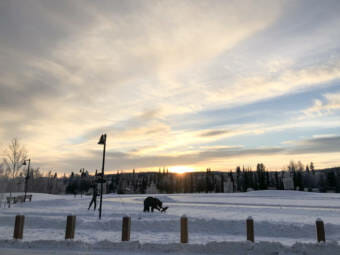
Soldotna creates a skating track at Soldotna Creek Park every winter. Outdoor skating is especially popular on the peninsula this year as the pandemic brings more people outside. (Sabine Poux/KDLL)

Heidi Hanson has seen a lot of rookie ice skaters this winter at the AK Sk8 Shop in Soldotna. It’s not hard to tell who’s new.

“A lot of them, I’ve tried to teach them how to put the skates on and how to lace them,” she said. “They have never skated in their lives.”

Skating has become a popular answer to the winter blues in Soldotna. With the Soldotna Regional Sports Complex closed to public skate, new and experienced skaters alike are turning to the city’s natural rinks to get their fix.

Like Arc Lake, near the landfill on the Sterling Highway. Soldotna Parks and Recreation is holding Saturday afternoon skates there this January.

“We had 300 people on Arc Lake, which seems like a lot, but if you spread 300 people across Arc Lake, it seems like everybody’s 50 feet away, or 100 feet away,” said Soldotna Parks and Recreation Director Andrew Carmichael.

It’s a more high-tech operation than it’s been in the past. The department used CARES Act funding to buy two overhead lights for night skating, and staff are throwing water on the ice every day instead of once a week.

On Saturdays, they’re playing music and lighting campfires. They’ve also brought in a porta potty and cleared more space for parking.

Other Alaska cities are making similar efforts during this COVID winter. The city and school district in Anchorage partnered to maintain eight rinks in that area.

In Kenai, the parks and recreation department also bought lights for the ice at Daubenspeck Pond, said director Bob Frates.

“Not so much to provide lighting. It was more of an ambiance, I guess, to create a nice ambiance to the skating rink,” he said.

The Kenai Multi-Purpose Facility is open to free skate for an hour and a half each day. But Frates said those slots are usually reserved by hockey players.

The department measures the ice at Daubenspeck Pond weekly and posts updates on its Facebook page and at the pond, which is near the Kenai Walmart.

Hanson said she’s sold skates to about 50 families this winter.

As for her her advice for first-timers, “It would be to definitely wear elbow pads and a helmet,” she said. “And obviously, if your skates aren’t sharp, you’re not going anywhere. That’s another thing I have to teach people. If your edge is not grasping and you’re just sliding, it means it’s time to resharpen.”

As a backup, Carmichael said there’s help available at Arc Lake.

“In addition to the skates, we also take our skating aids, which are called ‘Bobby the Seals,’” he said. “They look like seals with a tail, that kids or people who are marginal skaters or just figuring out can lean on and skate with in a safe manner.”

Soldotna also maintains a skating path at Soldotna Creek Park.

Protesters follow local Alaska lawmakers in backing Trump’s attacks on election integrity

Dianna and Loren Hollers at a pro-Trump protest in Soldotna Wednesday afternoon. (Sabine Poux/KDLL)

A mob of extremists supporting President Trump stormed the U.S. Capitol on Wednesday, violently interrupting lawmakers who were gathered to certify Joe Biden’s Electoral College victory.

No violent demonstrations were reported in Juneau or elsewhere in Alaska, but there was a small group of protesters gathered on the corner of the Kenai Spur and Sterling highways in Soldotna to show support for the outgoing president.

Krista Schooley, of Kasilof, said she doesn’t think the election is over. She said her representatives, including District 31 Republican Sarah Vance, of Homer, have her back and support Trump.

“I have talked to them,” Schooley said. “A lot of them, actually. Mainly local. And yes, they do.”

Loren Hollers, of Soldotna, was waving a “Don’t Tread on Me” flag. He said he thinks the election has been a coverup.

“We believe that our vote was stolen,” he said.

Claims of voter fraud have been debunked. Over 60 legal challenges to the election outcome from the Trump campaign have failed.

Dianna Hollers said she worries about her freedoms under a Biden administration.

“Our freedom to even travel without a dang COVID test. Our freedom to speak the truth as we see it,” she said. “The political correctness that has come upon this world. It seems like everybody’s a snow baby now. You can’t even have an open discussion with people.”

Schooley said she has friends from the peninsula who went to D.C. to protest but she was unable to get in touch with them Wednesday afternoon.

Both Loren and Dianna Hollers said they don’t agree with the violence today at the Capitol, but they support those who protested peacefully on the lawn outside.

Wasilla Republican Rep. David Eastman told Alaska Public Media he was one of those protesters. And central peninsula House representatives have made the same claims that drove the mob in D.C. — that the 2020 election was fraudulent. In December, they asked Gov. Mike Dunleavy to join a Texas suit to overturn election results in four states. That suit was later thrown out by the U.S. Supreme Court.

As local professors and teachers prepare lesson plans for the upcoming semester, which starts Monday at Kenai Peninsula College, they’re going to have to figure out how to work current events into their curricula.

Jeffrey Meyers, an assistant professor of history and political science for KPC, is teaching U.S. history and American government.

“Even teaching U.S. history last semester, when we talk about the U.S. founding fathers, the most important thing to them was a peaceful transfer of power and that the elections are fair and equal,” he said. “And it will be a semester long process, but in all of these classes, it’s going to be quite simple for us as professors and students to understand why we are where we are today.”

He said it’s important for lawmakers to realize the impact their remarks have on their constituents. In Alaska, all three members of Congress have acknowledged Joe Biden as the president-elect. But Sen. Dan Sullivan was one of eight senators who was mum on whether he would vote to certify the election ahead of Wednesday.

“Anyone who’s played sports or been in a band or the chess club or any type of group understands that culture and leadership is top down,” Meyers said. “It has a huge impact what your local officials have said about this election.”

On the peninsula, District 29 Rep. Ben Carpenter, of Nikiski, has consistently cast doubts on whether the election is legitimate. Before the violence this morning, he posted on his personal, public Facebook page that the election was corrupt.

Meyers said those remarks matter.

“If they don’t condemn people going after this election, then they are part of the problem,” he said.

Reps. Carpenter, Vance and Ron Gillham, of Soldotna, as well as Soldotna Sen. Peter Micciche, did not respond to requests for comment by deadline.

Congress certified Biden’s victory early this morning after resuming the process Wednesday afternoon, once the Capitol was secured.

First COVID-19 vaccine clinics for Alaskans 65 and older set for next week

Soldotna Professional Pharmacy held a coronavirus vaccine clinic Monday for healthcare workers who work directly with patients. (Sabine Poux/KDLL)

The state announced it will allow Alaskans who are 65 and older to get the coronavirus vaccine starting Jan. 11.

Originally, the state told providers they could start vaccinating seniors later this month. Chief Medical Officer Dr. Anne Zink attributed the change to confusion over eligibility and scheduling.
It’s a relief to Soldotna Professional Pharmacy co-owner Justin Ruffridge. His pharmacy has been vaccinating many of those included in the first phases of vaccine allocation, mainly long-term care residents and employees and some healthcare workers.

Before getting the green light, Ruffridge worried smaller communities would finish vaccinating those priority groups earlier than more urban areas and there would be a lag in the state’s plan.

“I think there was some concern about that just because the Tier 3 group, which is direct healthcare folks, seemed to maybe already be registered for their vaccines this week,” Roffridge said. “And then potentially we had other clinics scheduled already for the following weeks and were really uncertain as to who were going to fill those up. And we hadn’t heard from the state yet about whether or not they were going to open it up to that 65-and-older crew.”

The Kenai Peninsula’s population skews older, which means it could have more people to vaccinate in the next tier. The pharmacy’s first clinics for Alaskans who are 65 years or older are scheduled for Jan. 14 and 15.

On Monday, the pharmacy was doing its first in-house vaccine clinic, for healthcare workers who work directly with patients. Before, the pharmacy was traveling to long-term care facilities to do clinics there.

Ruffridge thinks they’ll be done vaccinating those healthcare workers mid-week. His staff will also start administering the second dose of the vaccine to long-term care residents and staff Wednesday.

The state is using an app called Prepmod that Ruffridge says made the process run more smoothly.

“The state had us enroll in an online registration site that also runs the clinic, so people can wait outside and then come in only when it’s their time,” he said. “So we were uncertain of how that would run, but so far it’s run really well. And we’ve been able to do two shots at a time, every 10 minutes. We’ll finish with about 80 vaccines today.”

They’re administering the Moderna vaccine to the healthcare workers. The pharmacy got 300 doses of the Moderna vaccine on top of the 400 Pfizer-BioNTech doses it received in mid-December.

It’s a lot of moving parts. At first, health officials say a lot of people signed up for appointments who should not have.

The state opened an online appointment portal last week for medical providers to finish lining up to get vaccinated. The next day, the state’s vaccine allocation committee announced the following group would include seniors over 65.

The website wasn’t supposed to allow that group to use the portal yet, but it did not screen them out either. Over the weekend, health officials say friends were sending each other the link to covidvax.alaska.gov, encouraging each other to sign up.

Now the state is asking those who have cut in line to cancel their appointments — though seniors can keep theirs.

Despite that earlier confusion about scheduling appointments, Ruffridge says state website helps.

“That website that we’re using today, that PrepMod, makes things quite a bit easier because we were doing everything relatively manually, creating calendars, spreadsheets and we were putting in a lot of manpower,” he said. “This allows you to sort of say, ‘You came here, you got a shot, you must enroll in the second one,’ and they send email reminders and everything. It works out really nice.”

According to the state website, Peninsula Community Health Services and Fred Meyer will also begin vaccinating eligible recipients this week.

Registration for Alaskans in the 65-plus age bracket opens Wednesday. You can schedule an appointment at covidvax.alaska.gov.

Closures send clamdiggers across Cook Inlet

A charter boat in front of Chisik Island on the west side of Cook Inlet. (courtesy Bottom Line Charters)

Scientists are still digging for answers about the low abundance of adult razor clams on the east side of Cook Inlet. Meantime, charter companies are taking passengers over to the west side, where razors abound.

“The west side is like Deep Creek and Clam Gulch were 20, 24 years ago,” asid Ernie Kerby. He’s owned Bottom Line Charters, in Ninilchik, for almost three decades.

In response to the crash of clam populations, the Alaska Department of Fish and Game closed east side beaches to personal and sport-use clamming in 2014. It announced last week it will close those beaches again in 2021.

At one time, the 80 miles of shoreline from the mouth of the Kenai River to the Homer Spit was home to the most popular clam fishery in Cook Inlet. That includes the beaches of Clam Gulch, a town named for its abundance of razor clams.

Scientists aren’t sure why the crash initially happened, about a decade ago. What they do know is that stocks aren’t rebounding, said Mike Booz, the Lower Cook Inlet sportfish area manager for Fish and Game.

He said the department has successfully incorporated new juvenile clams into the area, a process known as “recruitment.” But as they reach adulthood — between three and five years old — they’re dying off.

“Unfortunately, it’s not a perfect recovery,” he said. “During that time, or transitioning through that time, growth has been really poor for razor clams, particularly in 2017 and 2018. The adult survival of razor clams through that time hasn’t been very good. So, yes, you’re getting new clams, but they’re not growing and they’re not surviving for the population to rebuild to what it was, historically.”

This high rate of mortality among adult clams is likely due to a confluence of factors, including environmental stressors and changes in habitat. The instability of ocean water temperatures could be part of the equation.

“Overall, climate change, that’s only one component of it,” Booz said. “Climate change doesn’t cause clams to leave the beach. It definitely influences their growth rate or the primary productivity of plankton in Cook Inlet and how that likely affects razor clam abundances on these beaches.”

The closures have driven more people to the beaches on the west side. Off the road system, those shores are only accessible via boat or plane.

Kirby does the 30-mile ride to the Crescent River drainage, south of Polly Creek, with his passengers. It takes about an hour and fifteen minutes from Ninilchik.

He’s always taken his passengers to the west side. But since the closure on the east side, many others are, too.

“A lot more of the guys in Ninilchik are starting to go over there,” he said.

That’s also where the commercial clammers, like Nikiski’s Pacific Alaska Shellfish, get their stock.

There are no harvest limits on the west side. Kirby said he’s not worried about the area getting overfished because there are enough clams to go around.

Again, it’s not completely clear to Fish and Game why the west side seems to be doing much better than its neighbor. And more generally, it’s hard to know how the dwindling numbers on the shore of the peninsula stack up with their counterparts on other Pacific shores. Razor clams in the east part of Cook Inlet are more studied than others, due partly to the robustness of the fishery.

“Further south, in Oregon and Washington would probably be the next place where razor clams are really studied well enough to make a comparison between east Cook Inlet,” Booz said. “And razor clams in Oregon and Washington right now are doing great.”

The department continues to monitor clam stocks on both shores and submitted a proposal this year to develop a management plan for east Cook Inlet razor clams. Currently, there’s no management plan that would regulate harvests in the case of a reopening.

Kirby says he trusts the department to protect the east side fishery.

“I would want them to show at least two years, two consecutive years of growth,” he said. “Good, sustained growth. I’m losing business if they keep it closed but in the long run, it’s going to be better for everybody.”

That department’s proposal will be discussed at the board’s scheduled meeting in March.

Alaska fishermen cheer passage of the Young Fishermen’s Development Act through Congress

Crew members shovel pollock off the deck of a Bering Sea fishing boat earlier this year.
Crew members shovel pollock off the deck of a Bering Sea fishing boat earlier this year. (Photo by Nathaniel Herz / Alaska’s Energy Desk)

A new federal act will set aside funds annually to support fledgling fishermen, pending approval from President Donald Trump.

The Young Fishermen’s Development Act passed through both houses of Congress this month with strong support from all three Alaska legislators. If enacted, the act would fund training and mentorship opportunities for commercial fishermen who are just entering the industry.

It would be the first program of its kind for fishermen. The U.S. government already sponsors comparable professional development programs for young ranchers and farmers.

Grants and program funding would come from Congress. But it would be up to local communities to decide how to use funding.

“So local nonprofits or Native organizations can apply and propose projects that make sense for that year,” said Marissa Wilson, executive director of the Alaska Marine Conservation Council. The council is one of the nonprofits that brought the idea for the act to Rep. Don Young’s desk five years ago.

“Things are changing so much year to year that having this sort of bottom-up program focus, I think, is going to be a lot more effective than having some kind of program legislated at the federal level and then trickling down across the nation,” Wilson said.

Wilson is a fisherman herself, based out of Homer. She started fishing with her dad when she was 14. But she said those who aren’t born into fishing families can have a hard time getting started in the field.

As a result, Alaska’s fishermen are trending older. In 2016, the average age for a commercial fisherman in Alaska was over 50 — a decade older than it was the previous generation. That’s known as the “graying of the fleet.”

Researchers from the University of Alaska studying the fishing industries in Bristol Bay and Kodiak found that young people were deterred by high economic and social barriers to entry, not lack of interest.

Fisheries demand a complex skill set, said Linda Behnken, executive director of the Alaska Longline Fishermen’s Association. They have to be able to run a boat and a business and keep up with technology.

And the industry has become more competitive over the years. This year, Cook Inlet fishermen, in particular, had to grapple with low returns on harvests and the prospect of closed fishing areas.

All together, it can be daunting for those without experience or family ties.

Over the last several years, young Alaska fishermen took trips to Washington, D.C. to talk to legislators about the act. They joined forces with peers across the country under the umbrella of the Fishing Communities Coalition, a national association of commercial fishing groups.

Abby Turner-Franke, of Soldotna, fished with her family from the time she was eight years old. She’s now a project coordinator for the North Pacific Fisheries Association in Homer.

She went to D.C. to lobby twice. She said it was exciting that young fishermen were involved in pushing the act through.

“For them to participate in that process, to meet with delegations and with staffers and to see this progress, from being written and going through different iterations, and also having to explain themselves and why it is beneficial — I think is an incredible learning opportunity in itself for young fishermen,” she said.

The act does not exactly specify what age is considered “young,” but does say that term encompasses those who are either starting out or have worked on a commercial fishing vessel for no more than 10 cumulative years.

Wilson said fishermen had originally proposed the act be funded by the Asset Forfeiture Fund, the fines collected from fishermen who violate regulations.

The bills that passed in the House and Senate, however, show money coming from the regular Congressional appropriations process each fiscal year.

“It’s great that we now have this mechanism that will be in place as soon as it’s signed by the president. But it’s going to be something that we’ll need to continue advocating funding for moving forward,” Wilson said.

Funding will be allocated through Sea Grants, a partnership of the federal government and universities across the country. Eligible tribal groups, organizations and institutions will be able to propose projects for funding.

The Young Fishermen’s Development Act is awaiting approval by the president.

Kenai plant gets federal approval to reopen to import natural gas

The Kenai liquefied natural gas facility (Photo by Sabine Poux/KDLL)

The Kenai liquefied natural gas plant, which exported natural gas overseas from Nikiski for nearly four decades, got federal approval to start importing natural gas. That could give parent company Marathon Petroleum a more cost-effective way to power its crude oil refinery down the street.

Marathon subsidiary Trans-Foreland Pipeline applied last year to reactivate the historic plant as an import facility.

Marathon got the green light last week from the Federal Energy Regulatory Commission that’s tasked with reviewing natural gas project proposals, though it wasn’t a unanimous decision. One commissioner said he’s concerned the agency didn’t consider the project’s potential effects on climate change.

With approval in hand, the company has two years to act on its proposal. In an emailed statement, a Marathon representative said the company has not yet determined its plans for the facilities going forward, but that the project provides an opportunity for the company to get low-cost fuel to the refinery.

In its heyday, the Kenai plant was the only liquefied natural gas exporter in the U.S. It was also Japan’s sole supplier.

But the natural gas market became more competitive. As other exporters crowded the market and Japan sought to diversify its sources, Kenai’s exports shrunk to under 5% of Japan’s imports.

It was owned by ConocoPhillips then. The company cited that competition when it mothballed the facility in 2017. Marathon bought it in 2018.

Natural gas is about twice as expensive in Alaska than it is in the Lower 48, where there’s generally more available.

But there’s a big need for natural gas in the state, including just down the street where the Kenai Refinery needs natural gas to power its crude oil heaters.

That could be a good way for Marathon to save some money.

“Marathon is a multi-faceted, mega-company, and they have lots of subsidiaries and probably have a lot of natural gas in their own supply chain,” said former Kenai Mayor John Williams. “So chances are, they’re even using some of their own natural gas, which would even reduce the costs that much more.”

If they do reopen, Williams said they’ll probably look outside of Cook Inlet for gas.

“There’s no doubt in my mind that they can buy gas cheap enough, either through their own conglomerate or through other suppliers, import it to Alaska, run it in through the refinery and burn it cheaper than they can buy gas here in Cook Inlet,” he said.

Currently, Hilcorp owns most of the natural gas production in Cook Inlet.

Separately, the plant is eligible for a spot on the National Register of Historic Places. The facility is still allowed to operate if it receives this designation.

Site notifications
Update notification options
Subscribe to notifications