KDLL - Kenai

KDLL is our partner station in Kenai. KTOO collaborates with partners across the state to cover important news and to share stories with our audiences.
James Fisher, elected to Alaska’s first Legislature in 1959, dies of COVID-19

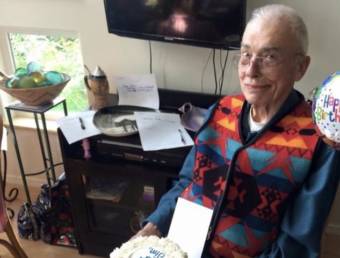
Jim Fisher on his 88th birthday, in 2015. (Courtesy of Michele Vasquez)

Alaska’s first steps into statehood were shaped by its inaugural legislative class, a group of senators and House representatives who set the young government on its course six decades ago.

One of those first legislators, James Fisher, played an equally prominent role in shaping the Kenai Peninsula. Jim died of COVID-19 last month at his home at Heritage Place in Soldotna. He was 93.

Those who knew Jim remember him for his deep-rooted political involvement and unflinching advocacy for local people and causes — and his love for his kids, grandkids and great-grandkids.

“If my dad ran the world, everybody would have a place to sleep and food to eat,” said Sally Tachick, Jim’s daughter.

Jim was born in Ohio and grew up in Texas. He spent several years in Asia with the Army and Marines and came to Anchorage in 1955, following the spirit of adventure and the legacy of his great-grandfather, who had sought gold in the Klondike.

He became involved in “Operation Statehood” and was elected to the first Alaska Legislature in 1959, one of eight representatives from Anchorage. The Legislature was majority Democrat at the time.

Jim Fisher represented Anchorage in Alaska’s inaugural legislature. (Courtesy of Sally Tachick)

Jim was a loyal Democrat his entire life. Michele Vasquez remembered meeting him at a District 30 Democratic Party meeting years later.

“And he said he was Jim Fisher, and he was the oldest living Roosevelt Democrat on the Kenai Peninsula,” she said. “I was like, enamored from that moment. I said, ‘I’ve got to get to know this guy.’”

Jim married his wife, Helen, in 1960. Shortly after, he lost reelection to the state House and the family moved down to the peninsula, where they raised Tachick and their son Bruce in Soldotna and then Kenai.

That’s where Jim opened his law practice. He recruited Jim Hornaday to be his partner.

“Once he set a goal, he generally accomplished it,” Hornaday said. “I was clerking for the court up in Anchorage, and he literally dug me out of the courthouse and offered me a partnership in his firm down on the Kenai Peninsula.”

Hornaday didn’t know him then. The two ended up practicing together for over a decade.

“We basically made legal services available in areas where they hadn’t been available,” Hornaday said. “He was the first practitioner in Kenai and then I think we opened the first office in Homer.”

Jim and Helen also spent several years in Juneau. There, they adopted Cory Mann, then a teenager, who they helped guide through school.

The theme for Jim was always service. He founded the Kenai Bar Society and was a representative to the USDA during the Carter Administration. He was deeply involved with local causes and was famously committed to the Kenai Peninsula Food Bank, where he was inducted into the first hall of fame.

Jim at a protest in front of Lisa Murkowski’s Soldotna office. (Courtesy of Michele Vasquez)

Jim always kept up to date with politics. Tachick says when she was going through his things, she found receipts from campaigns he had donated to out East. He supported candidates he believed in all over the country.

Vasquez said he especially wanted to support women who ran for office. He championed the League of Women Voters and worked hard to overturn SB21.

Hornaday, who identified as a moderate Republican, said they would have friendly debates from the other side of the aisle.

“Oh, yeah, we’d go round and round on the politics,” he said.

Jim’s patronage extended into the realm of music. Once Helen died, he dove into the peninsula’s live music scene, attending open mic nights and shows — usually multiple times in one night.

Some of his favorites were Soldotna musicians Sue Biggs and Jack Will.

“Jim, being the lawyer that he was, in his pocket he had a little notepad and a pen,” said Biggs. “He’d pull it out and he’d write down songs that he liked. And then if we came back another Friday or Saturday, he would be there, having his soup — he always liked to have a bowl of soup — and he would pull out his little notepad and he’d say, ‘How about, ‘Put Out the Cat!’ Or something like that. And so he started having a list of songs that he liked of ours.”

He kept it up when he moved into Heritage Place, Central Peninsula Hospital’s long-term living facility. Even in his old age, he was determined to get to know the people around him.

“He’s quizzed all of his CNAs and nurses about, ‘How many kids do you have?’ and, ‘So, what is your daughter studying in college?’ Tachick said.

COVID-19 swept through Heritage Place in November. Fisher tested positive for the virus and died four days later, Nov. 21.

The facility was buttoned up to prevent the spread of coronavirus. Bruce says the last time they visited face-to-face was in September.

“That’s the saddest thing I’ve ever had to do, is when we Zoomed, and he was in the emergency room, and you could tell he’s just gasping for air,” he said. “And his eyes were bugged out a little. And the doctor said, ‘Is there anything you want to say to your son?’ ‘Come get me, come get me.’ Ah, it just tore me up.”

Before Jim died, Biggs and Will played him some of his favorite songs over FaceTime.

Like always, he did his best to sing along.

“You could tell, his lips were kind of moving, even though he wasn’t really all there. I could hear him. I could tell he was singing along,” Biggs said. “We were singing all his favorite songs that he loved to sing along with us.”

They even changed the words to an old folk tune he liked for his 80th birthday. You can listen to that song in the audio version of this story.

On this day in 1989, Redoubt eruption triggered seismic shift in Alaska volcano research

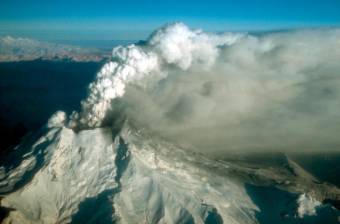
Redoubt on Dec. 18, 1989. (W.M. White/Alaska Volcano Observatory)

When an ominous mushroom cloud of ash erupted from Mount Redoubt 31 years ago on Dec. 14, 1989, it was anyone’s guess how long the eruption would last.

“The rule of thumb for looking at volcanoes like Redoubt is you typically look at how it’s erupted in the past and that often gives you good guidelines in the future,” said John Power, a research geophysicist at the Alaska Volcano Observatory.

Today, AVO uses an assemblage of sensors, receivers and satellites to monitor dozens of Alaska volcanoes, including Redoubt.
But in 1989, AVO was just one year old. When Redoubt’s first ashy belches began on Dec. 14, AVO had been watching Redoubt for about three months.

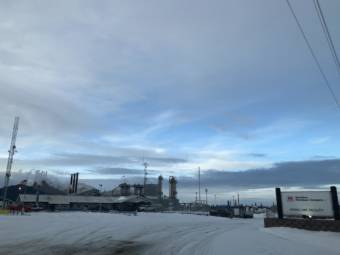
Power remembered catching wind of a set of foreboding, low-frequency volcanic earthquakes under Redoubt 23 hours before the eruption. That was AVO’s first hint of the six-month eruption that followed, sending layers of snow-like ash across Southcentral Alaska, grounding flights and temporarily halting a Cook Inlet oil operation.

One of the most dramatic effects of the eruption was when a cloud of ash cut off all four engines of a Boeing passenger airplane traveling from Amsterdam to Tokyo with 250 passengers. It dropped over two miles before the crew could restart the engines and land in Anchorage.

Henry Knackstedt, of Kenai, wasn’t in the air that day. But he did avoid flying his private plane for a while after that to avoid the disruptive effects of ash on his own engine.

“When it came here, we had a fair bit of snow on the ground,” he said. “And then we ended up with three-eighths of an inch, half-inch of ash, depending perhaps where you were. It looked like what I would imagine the moon to look like.”

Game McGimsey of the Alaska Volcano Observatory and Willie Scott of the Cascades Volcano Observatory collect samples on ash-covered snow near Redoubt in April 1990, more than four months after the first eruption. (Steve Brantley/Alaska Volcano Observatory)

Come April, the snow melted faster because of the ash buried beneath it. Occasionally, there were muddy rains that had a corrosive effect on car paint.

“We were concerned about it because, periodically, you’d see plumes arise from the cone and you’d think, ‘Well, is this going to be a big one?’ And that went on for several months after the main eruption,” said John Williams, who was mayor of Kenai at the time.

Williams said he was preoccupied by concurrent efforts to clean up after the Exxon Valdez oil spill, which had happened several months prior. No shutdown orders or emergency proclamations in Kenai were necessary after the eruption.

No one had a better view of Redoubt than Mindee Morning. She looks at the volcano across the inlet from her home on the bluff along Kalifornsky Beach Road and remembered seeing beautiful pink shocks of light as the sun rose.

Her husband is an electrician and ran to the KSRM station to help when the power went out. But Morning wasn’t too worried.

“We were so casual about it,” she said. “My son and I just, because the lights went out, we just went back to bed.”

Spectators were awestruck by the eruption’s beauty. But the fallout over the next few months was more serious.

Eruptions prompted flight cancellations and delays at airports in Anchorage and Kenai. Experts worried ash would interfere with engines, as it had with the passenger jet, or cause damage to wings and windshields.

The ash was also bad for air quality, as Morning remembered.

“At that time I was a very active runner, running two times a day,” she said. “That came to a screeching halt. I was running in my basement.”

A recent shot of the west side of Mount Redoubt from Henry Knackstedt’s plane.
(Courtesy of Henry Knackstedt)

Mudflows reached the Drift River Oil Terminal, a tank farm for crude oil across Cook Inlet from Kenai, at the base of Redoubt. Williams, president of the Cook Inlet Regional Citizens Advisory Council, said he advocated closing that facility completely after the explosion, for fear mudslides could take down tanks full of oil.

All the while AVO, which had been created in response to earlier eruptions, was coming into its new role.

Redoubt erupts fairly often. Before 1989, it erupted in 1902 and 1966. Most recently, it went off in 2009.

But Power thinks the 1989 eruption brought home for many people how scary eruptions could be, in part because it nearly took down a passenger jet.

“I think, prior to that, the really invasive incidences of problems between jet aircraft and volcanic ash had occurred in Indonesia and very distanced areas,” he said. “And it hadn’t really been brought home that, ‘OK, this is an issue here for us, as well.’”

In response, AVO expanded. That included the creation of a worldwide network of volcanic ash advisory centers, which provide information on where and how ash travels after eruptions through weather services and aviation agencies. It also ramped up an effort to monitor eruptions along the Aleutian chain.

Technology has helped the observatory up its game. In 1989, it relayed information by fax machine and floppy disk. Now, notifications come in via cellphone. People who are interested in learning more about the observatory’s work can follow along on its Facebook page.

“I think we’re much better positioned at this point to anticipate eruptions with volcanos like Redoubt any many more throughout the state,” Power said.

Power said there’s currently nothing unusual happening at Redoubt. But in case of an eruption, he recommends a set of precautions that is very familiar in the age of COVID-19: avoid travel and stay inside, especially if you have respiratory problems.

New Ocean Alert app lets Alaskans share whale sightings with scientists

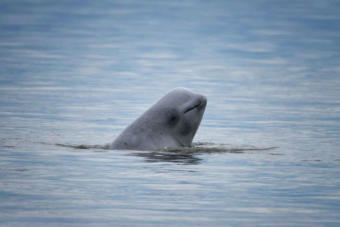
Cook Inlet beluga whale. (Public domain photo by Paul Wade/NOAA Fisheries)

You don’t have to know much about what you’re seeing to make the Ocean Alert app work.

Say you’re driving past Turnagain Arm and you see a beluga.

“You can say, ‘I saw a whale.’ Not have to know what species it is or anything like that,” said Jacob Levenson, a biologist with the Bureau of Ocean Energy Management. “Or you can say, ‘I saw this whale, here’s a picture of its tail,’ and then there’s an artificial intelligence backend, Flukebook, that tells you if we’ve seen that whale before.”

Levenson and other BOEM scientists are using the new Ocean Alert app to crowdsource sightings of marine megafauna that will inform the agency’s work in federal waters. That means large animals you can see swimming from your car or boat or front porch, Levenson said.
“When it comes to megafauna, we’re looking for stuff that you can just see with your regular eyes. No need for microscopes or anything like that,” he said.

BOEM oversees offshore energy and mineral development on both U.S. coasts and in Alaska’s federal waters, including potential oil and gas lease sales in Cook Inlet.

Part of its work is identifying how projects could impact animals that live in a given area. To do that, it needs a better snapshot of what local ecosystems look like and how animals are moving in and out of those areas.

“The oceans are a changing place. It’s pretty cool, things are always changing, there’s always something showing up and going away,” Levenson said. “And scientists really can’t be everywhere at once. And so we made this app for a way for anyone to better work with scientists.”

The data collected through the app will never provide a full picture of the ocean’s wildlife in any given spot. But alongside other information, it gives BOEM a better sense of where endangered species are throughout the year, which helps it plan projects.

Levenson called this method of data collection “citizen science.” It’s a strategy already in use with apps like eBird and iNaturalist.

Flukebook is one piece of technology scientists are using to interpret sightings. Much like facial recognition software, it can detect markings on specific whales and determine whether that specific whale has already been identified.

Even without a photo, users can still enter comments and pinpoint where the sighting was. For non-whales, there’s a list of potential species.

Scientists and computers verify submitted sightings before they appear on other users’ screens. Additional data that BOEM and other scientific agencies collect shows up in real-time on the app.

Download Ocean Alert through the App Store or Google Play.

Worry for commercial fishermen and Kenai Peninsula communities after Cook Inlet fishery closure

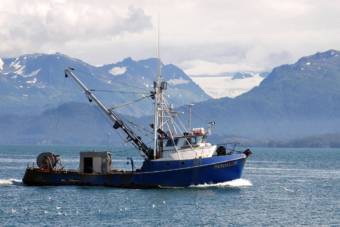
The 10-0 vote shuts down drift gillnet fishing in waters farther than three miles offshore, from the southern tip of Kalgin Island to Anchor Point. (courtesy Redoubt Reporter)

Federal managers voted Monday to close a huge swath of Upper Cook Inlet to commercial salmon fishing, capping a two-year fight over the fate of the fishery and its 500 permit-holders.
Those fishermen and representatives from the Kenai Peninsula turned out in droves to the North Pacific Fisheries Management Council meeting to oppose the closure and advocate for lighter conservation measures.

But when representatives from Alaska Gov. Mike Dunleavy’s administration said the state was unwilling to manage the area alongside the federal government, the council voted unanimously for the closure.

The 10-0 vote shuts down drift gillnet fishing in waters farther than three miles offshore, from the southern tip of Kalgin Island to Anchor Point. Fishermen like Georgie Heaverly, of Anchorage, said the area is a crucial fishing ground and that the closure will reverberate across industries.

“Fishermen have been leaving the fishery already for the last several years,” she said. “It’s hardly economically viable, and this really is the nail in the coffin.”

For years, fisheries management of Upper Cook Inlet’s federal waters was under state jurisdiction. But in 2013, United Cook Inlet Drift Association, advocating for the commercial industry, filed a lawsuit in an effort to revert management to the federal government.

The courts sided with UCIDA in 2017, and the council was tasked with drafting a new salmon management plan. This fall, two years into a process that involved collaboration from groups of stakeholders, Dunleavy’s administration introduced the option of closing the federal waters to commercial salmon fishing completely — a proposal known as “Alternative 4.”

It was a controversial idea. In the weeks leading up to the meeting, hundreds submitted comments in opposition, including the Kenai Peninsula Borough Assembly, the cities of Kenai and Homer, Rep. Ben Carpenter, R-Nikiski, and Sen. Peter Micciche R-Soldotna.

Micciche now says he thinks the council’s decision will be challenged in court.

Rather than an outright closure of the federal waters of Upper Cook Inlet, opponents of Alternative 4 asked the council to turn management over to the state, with federal oversight.

Council members rejected fishermen’s plea for state management after hearing from the Dunleavy administration. Rachel Baker, the deputy Fish and Game commissioner who represents Dunleavy’s administration on the council, said the state does not want to take on the burden of managing fishing in Upper Cook Inlet’s federal waters.

Andy Mezirow, who runs a charter fishing business in Seward, is the one council member who lives on the Kenai Peninsula.

He said he was worried about the impacts of the decision on his neighbors. But he added that if the state would not agree to joint management, he would reluctantly support the closure.

“I’m not an expert on states’ rights, but it seems like almost everyone agrees that the state should be the one that’s ultimately managing this fishery,” he said.

A big concern among opponents is that the closure will make matters worse for seafood processors, who are already strained by poor fishing seasons the last couple of years. And it’s hard for drift and set-net fisheries to stay open if processors are closing, says Robert Ruffner, a former member of the Alaska Board of Fisheries and a resident of Soldotna.

“Our communities are going to suffer pretty heavily, probably more than the numbers reflect in terms of the harvest that occurs out there, because our processors are rapidly becoming the limiting factor in what they can continue to stay open and operate under those environments,” he said.

Homer, in particular, would be hard hit by the decision, according to the council’s report.

The area in red is Cook Inlet’s exclusive economic zone. The pending fishery management plan will apply to that stretch of water.
(NOAA)

At least one group of fishermen supported the action. The Kenai River Sportfishing Association, which has close ties to Dunleavy’s administration, submitted the lone comment in support of closing the federal waters to fishing.

Executive Director Ben Mohr said he would prefer state management of the fishery than total closure. But after the court’s decision in the UCIDA lawsuit, he saw the closure as the best path forward.

“We weren’t seeking to shut down the commercial fishery or anything like that, that’s not what we’re about,” he said. “It was solely about who manages those fish and defending the state’s primacy to manage our fish and wildlife resources for the benefit of all Alaskans.”

Most other waters in Alaska under federal jurisdiction are closed to commercial salmon fishing.

Baker said at the meeting that benefits to other groups might balance out its negative effects. Smaller harvests in the federal waters could lead to better harvests in other parts of the inlet, like for sportfishing groups, commercial set-netters and northern inlet drift fishermen.

The closure will not go into effect before the upcoming 2021 season, since it still needs to be approved by the secretary of the Department of Commerce and the National Marine Fisheries Service.

Jim Balsiger, the service’s regional administrator, was the one member of the council to abstain from voting Monday.

Federal COVID-19 funding for Alaska farmers largely lies fallow

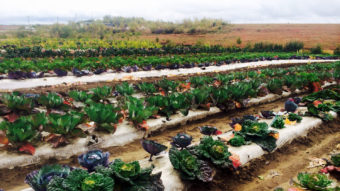
A field near harvest time at Meyers Farm in Bethel, Alaska, can now grow crops like cabbage outside in the ground, due to rising temperatures. Daysha Eaton/KYUK
A field near harvest time at Meyers Farm in Bethel, Alaska. (Daysha Eaton/KYUK)

All Alaska agricultural producers are eligible for federal assistance under a new USDA program. But days before the deadline, not many have applied.

This is the second round of Coronavirus Food Assistance Program, or CFAP, administered by the USDA’s Farm Service Agency. Round one was reserved for producers who worked with certain commodities and could prove they were impacted by the pandemic.

This round is open to many more producers working with a large swath of commodities, said Alaska FSA Program Manager Jeff Curry. That includes peonies, a popular crop on the Kenai Peninsula.

“Any farmer in Alaska that sells their commodity commercially would probably have a commodity out there that is on the eligible list,” he said.

But as of Sunday, only 46 Alaska applications had been approved — a small fraction of the 760,000 applications approved nationwide. The USDA’s most recent Census of Agriculture identifies nearly 1,000 farms in Alaska, with a total market value of over $70 million.

Curry said he’s not concerned about the numbers because his office has done a lot of outreach to local organizations and to commodity groups like the Alaska Peony Growers Association. He says at this point, it’s up to producers.

Abby Ala, of Ridgeway Farms in Soldotna, plans on applying for the program. She said she’s heard producers say they’re hesitant to apply for federal funds because they worry about government control.

“I’ve been in a situation for about 40 years of being on boards that have watched and there has been no government intrusion on farmers,” she said.

Ala has benefited from other federal programs during the pandemic, including a grant that helped the Alaska Food Bank buy produce from her and other farmers.

Generally, Ridgeway Farms had an okay season.

“Oh, kind of average to a little below average,” Ala said.

Heidi Chay, district manager of the Kenai Soil and Water Conservation District, said she’s heard similar reports from other local farmers.

“A lot of Alaska producers did well this year. There was strong demand for local food,” she said. “If they weren’t prevented from being face-to-face at the market because of their own health concerns, they might have done quite well.”

Farmers markets and a surge of local shopping this summer helped some surpass their 2019 sales. The Kenai Peninsula Food Hub, an online marketplace for local farmers, saw sales triple this year.

Data from the USDA breaks down how funds have been distributed to Alaska farmers since the program opened earlier this fall.

Because of this, Chay said she thinks some farmers will think they are not eligible for funding. But CFAP2 funds are available to any producer, regardless of how they were impacted by COVID-19.

“We really looked at it and USDA determined that everybody’s been impacted by COVID-19, whether it’s getting supplies in or selling their product, and this is just one way to give them some relief from that,” Curry said.

Beyond misconceptions about funding, some producers may just not want to apply. Alaska FSA Executive Director Bryan Scoresby said that could be a factor for some of Alaska’s many small producers.

“We have a lot of very small farmers in Alaska and with the size of it, by the time they go through and figure how much money it’s worth to them, they say it isn’t worth the effort of applying,” he said.

Payments are limited to $250,000 per producer. Recipients are eligible for a portion of their 2019 earnings on a sliding scale.

Lou Heite, of Eagle Glade Farm in Nikiski, said she’s not sure if she’ll apply for funding. She said her farm did pretty well with some crops and poorly in others this year.

“My experience with most USDA programs is that if you can’t afford a bookkeeper, at least, and preferably an accountant, the amount of work involved in doing the applications doesn’t pay back,” she said. “And, yes, it’s wintertime, yes, we’re sitting around looking out the window at the snow. But, you know, there’s still other things that have to be done.”

The FSA gave out under $300,000 to 18 Alaska producers in the first round of the program and almost $10.5 billion nationwide.

So far in the second round, it’s given out about $415,000 in state and over $11.5 billion nationwide.

The deadline to apply for CFAP2 is Dec. 11.

With little government action, Kenai Peninsula businesses forced to enforce mask rules

Masks hang on a display in the Kenai Walmart in this June 2020 photo. (Elizabeth Earl/ KDLL)

Just as Gov. Mike Dunleavy has left decisions on mask mandates up to Alaska cities, all but one Kenai Peninsula city has left those decisions up to businesses.

Local officials say they’d rather give owners the option to enforce — or not enforce — mask wearing. But that hands-off approach has put some in a bind.

Craig Wortham is the general manager of Alyeska Tire, an Alaska auto repair and tire chain with four stores on the peninsula and several others around the state. He’s required masks at all locations since the pandemic started.

“We’ve been called names at the front door. We’ve been called ‘libtards,’ ‘communists,’ ‘socialists’ and more recently ‘Nazis.’ It’s been a remarkably difficult journey for us,” he said.

Wortham has been following recommendations from the Centers for Disease Control and Prevention and World Health Organization since day one. Recently, he experienced the toll of the virus firsthand when an Alyeska employee died from the virus.

The measures at Alyeska have helped ensure that no outbreak has originated from any of the stores. But the blowback from customers has been difficult. On top of the taunting, Wortham estimates nearly half of his potential customers turn around when they see they have to wear masks inside his business.

“It feels like all the responsibility has fallen on the doorsteps of the businesses to educate the consumer, educate the community, educate employees,” he said. “We get virtually no support from city officials, we’ve gotten virtually no support from the leadership on the state level and we haven’t got much leadership on the federal level, either.”

On Monday, Wortham asked the Kenai City Council to implement a mask mandate to take some of the pressure off his business. He said he plans on making a similar appeal to the Soldotna City Council.

Kenai Mayor Brian Gabriel said it’s unfortunate that mask-wearing has become politicized, but that he’d rather see decisions about masks left to individuals. He pointed to a video he put out last week and a joint resolution from the cities and borough asking residents to take precautions.

He also said he thinks a mask mandate would be difficult for cities to enforce. Last month, Kenai City Councilman Henry Knackstedt said he worries mandates might lead to fights between those who are enforcing the rules and those who refuse to wear masks.

But that’s something Wortham’s already had to deal with on his own.

“I had a gentleman jump in a truck coming down to beat me up one day from our Palmer location for mask-wearing,” he said. “And the police had to intervene. The troopers did. And it was all over asking someone to wear a mask.

Pamela Parker is the only member of the Soldotna City Council who has openly advocated a mask mandate for the city at meetings. She also owns Everything Bagels in Soldotna and requires masks there.

“It’s so challenging to come out and take a stance on some of these more politicized issues because you’re not removed from the community at all,” she said. “You’re not the governor of the state whose sole job it is to make these tough decisions. You’re the neighbor to people who are disagreeing with you. You’re a business owner in the community, you have kids in the community. You see everyone when you’re out grocery shopping.”

She said she wishes the state would do something to alleviate the pressure on city governments and business owners.

“I do think it would carry a lot more weight if it did come from the top down,” she said.

Still, there are plenty of customers who applaud the measures these businesses have taken. Wortham said he’s gotten some encouraging feedback at his Soldotna store, which is down the street from Central Peninsula Hospital.

“I received phone calls from doctors in the community, lending their support and giving me high fives and telling me how much they appreciated what we were doing, how positive it was and how it was helping them in their fight and their battle,” he said. “The medical community seemed to rally behind us.”

Seward once again became the only city on the Kenai Peninsula to instate a mask mandate at its Monday night meeting. The city had a similar mandate in place this summer.

Site notifications
Update notification options
Subscribe to notifications