
KDLL - Kenai

KDLL is our partner station in Kenai. KTOO collaborates with partners across the state to cover important news and to share stories with our audiences.
Environmental regulators to give Alaska LNG pipeline another look

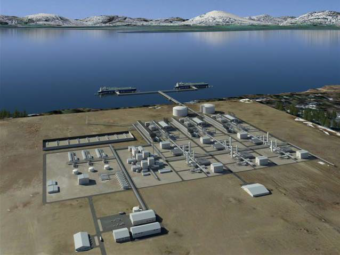
This illustration shows a rendition of what the liquefaction plant in Nikiski could look like if the Alaska LNG project is completed as planned. (Image courtesyAlaska LNG project.)
A 2015 rendering of what the plant in Nikiski might look like. (Image from Alaska LNG Project)

The Alaska LNG project would take natural gas from the North Slope of Alaska down to a proposed plant on the Kenai Peninsula, in Nikiski, where it would be liquified, sold and shipped out.

The gas is already pumped out of the ground on the North Slope. But it isn’t currently sent to market.

To get it there, the state wants to construct an 800-mile pipeline. And last year, it got the go-ahead from environmental regulators, under then-President Donald Trump, to build the massive project.

But now the Biden administration wants to take another look.

The federal Department of Energy announced last week that it’s ordering a supplemental environmental review of the Alaska LNG project. It’s part of the Biden administration’s focus on fighting climate change and it’s also in response to a legal challenge from the Sierra Club, a national environmental organization.
Under the review, regulators will take a new look at the environmental impacts of natural gas production on Alaska’s North Slope. Plus, they’ll analyze the project’s greenhouse gas emission potential — from the extraction of natural gas to its export, to its use overseas.

The federal government could then decide whether to keep, change or overturn it’s approvals for the project.

The Alaska Gasline Development Corporation, a public corporation under the state, doesn’t see the order as an obstacle, said to Tim Fitzpatrick, AGDC spokesman.

“The project has been thoroughly scrutinized over a period of about six years or so, taking a look at over 150,000 pages of data,” Fitzpatrick said. “So we’re confident that the project is going to continue to stand up to any environmental scrutiny.”

AGDC still needs funders for the project. It’s requested money from the federal government and is looking for private investors.

The project is estimated to cost $38.7 billion dollars.

“The new environmental review is not really going to slow down or impact the project’s time table,” Fitzpatrick said. “At this point, we do have the authorization that we need to construct the project, and we’re continuing to talk to investors to secure the funding so that work can begin.”

Fitzpatrick declined to name those investors, saying negotiations are ongoing.

Supplemental environmental review or not, Larry Persily just doesn’t see the gas line project happening. He was a coordinator for gas transportation projects under President Barack Obama.

“I looked at it and thought, ‘Well, OK, that’s good. You can do a supplemental EIS on a project that’s probably never ever going to go ahead. But hey, if you got the time, go for it,’” he said.

Three large oil and gas companies were once signed onto the project and filed a permit to ship the resulting natural gas overseas. But they later pulled their support due to high project costs and Alaska’s declining market for liquified natural gas.

A completed environmental impact statement does not necessarily mean a project will happen. But it’s a necessary step before something can be built.

Regulators said they plan to take a full-scope approach to their new environmental analysis.

Persily said that’s easier said than done.

“One flaw in this is the assumption that you know who will burn the gas over the next 20 or 30 years,” Persily said. “How efficient their equipment will be. What kind of emissions they’ll give off. So it’s a bit of a flying leap to try to really project that in 2021.”

A spokesperson from the Department of Energy said the department will foot the bill for the supplemental environmental assessment.

The department also said it will issue a notice when the draft supplemental statement is released. It will take comments and hold hearings on the draft.

Once the assessment is finalized, the agency could decide to reaffirm, modify or retract the federal authorization for the project, according to an April re-hearing on the project.

Alaska fishermen join sleep deprivation study

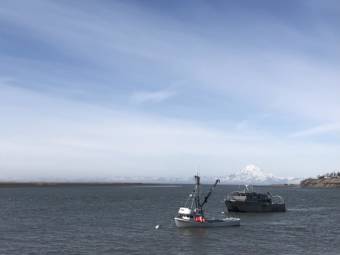
At least one fisherman from Cook Inlet is participating in the sleep deprivation study. Outside of Alaska, researchers are also following fishermen in the Northeast and Pacific Northwest. (Sabine Poux/KDLL)

For commercial fishermen, the difference between getting a few more hours of sleep or not can sometimes be a question of livelihood.

That’s what Jerry Dzugan explains in his classes. He’s the executive director of the Alaska Marine Safety Education Association, or AMSEA, based in Sitka.

“The less you sleep, the more money you make in some sense,” he said. “And that’s a really hard thing to overcome. Because everybody wants to make more money.”

It’s one of the factors he said is driving the issue of sleep deprivation among fishermen. AMSEA and several other organizations are studying 200 commercial fishermen over the next two years to quantify the problem and gauge fishermen’s concerns when it comes to how their sleep patterns affect their overall health.

Studies show that sleep deprivation leads to more accidents and worsens physical performance, both on land and at sea. Safety boards have cited fatigue as a factor in many fishing boat crashes, like the grounding of the Savannah Ray off Kodiak in 2015 and a deadly collision near La Push, Wash. in 2012.

And long term, sleep deprivation can stir up a host of health issues. Dzugan said it’s something he talks about with the fishermen in his community.

“I don’t think I’ve had one person tell me it’s not a problem,” he said.

But there’s little research on how sleep deprivation impacts commercial fishermen or what can be done to improve outcomes.

“There is a lot of data, both qualitative and quantitative data, on sleep deprivation,” he said. “I mean, the military alone has done volumes and volumes on this because of performance of personnel in the military. But not much has been done in the commercial fishing industry. And I think that’s the big thing.”

The Northeast Center for Occupational Health and Safety and is leading the study, called “Assessments of Sleep Deprivation and Associated Health and Cognitive Impacts in Commercial Fishermen.” Funding comes from a grant from the U.S. Coast Guard and the National Institute for Occupational Health.

AMSEA is collecting data in Alaska while research teams in Oregon and the Northeast collect data there.

Dzugan said he’s hoping to study 57 Alaska fishermen. Already, he said AMSEA has conducted six qualitative interviews, including one with a fisherman from Kenai.

Researchers will also follow fishermen’s sleep patterns through a tracking app and do health exams this summer and fall. And they plan on releasing a podcast with information about sleeping at sea.

Dzugan knows firsthand that sleep deprivation is a problem for fishermen. He remembers dealing with it when he was longlining in the 1980s.

“I was fishing halibut openers with an hour and a half of sleep a night, for days on end,” he said. “And I personally felt the effects of that.”

He said fishery management decisions can indirectly contribute to the problem, when it comes to limiting crews to certain numbers or opening fisheries for short, unrelenting periods of time, for example.

As for a fix, he said there’s no silver bullet. He hopes the study will raise more awareness about what he says poses a real threat to fishermen in Alaska and beyond.

Soldotna lawmaker shares post likening health workers, journalists to Nazi war criminals

Rep. Ron Gillham at an April town hall in Soldotna. (Sabine Poux/KDLL)

Soldotna Republican Rep. Ron Gillham shared a post on his personal Facebook last week that likened those who provide information about COVID-19 vaccines to Nazis who were executed for war crimes after World War II.

The post, originally reported by the Peninsula Clarion Tuesday, showed a photo of a public hanging. Under the photo, it said “Members of the Media who lied and misled the German People were executed, right along with Medical Doctors and Nurses who participated in medical experiments using living people as guinea pigs. Those who forget the past are condemned to relive it.”

Above the photo, the text reads “Still so sure you want to try to force me to get the experimental vaccination?”

Facebook flagged and hid the post for containing factual inaccuracies. The fact checking site Agence-France Presse said the claims made under the photo are untrue. It said the public hanging in the photo was not from the Nuremberg Trials and that only one member of the media was executed during that time.
Gillham removed the post after the Clarion published its story.

He told the Anchorage Daily News that he “forwarded a post that I believed was a historical incident. That was it.” He also told the Daily News he thinks people in the media should be held accountable for what they post but that he’s not an advocate for violence.

He told Alaska Public Media earlier this year he wouldn’t get the COVID-19 vaccine.

Alaska Medicaid must cover gender-affirming care following Homer woman’s lawsuit

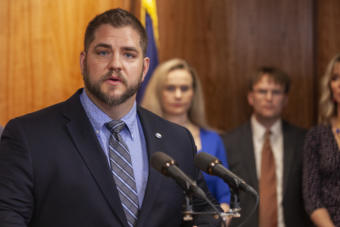
Adam Crum, Commissioner of Alaska’s Department of Health and Social Services, answers a question during a 2019 press conference. Crum was named in a class action lawsuit after Alaska Medicaid refused to cover costs related to hormone treatment in 2019. (Rashah McChesney/KTOO)

Starting this month, Alaska Medicaid can no longer deny coverage to transgender Alaskans undergoing gender-affirming treatment.

That’s following the January settlement of a class action lawsuit filed by Swan Being, a transgender woman from Homer who said Alaska Medicaid refused to cover costs related to hormone treatment in 2019.

Being sued the Alaska Department of Health and Social Services, which oversees Alaska’s Medicaid program, and department commissioner Adam Crum. She alleged the state’s policies discriminated against transgender Alaskans and violated the 14th Amendment, which grants all Americans equal treatment under the law.

Being was the first to file the case. Robin Black and Austin Reed, both of Anchorage, joined as plaintiffs in 2020.

Up until now, Alaska was one of 10 states that still explicitly denied Medicaid coverage for gender-affirming treatment, including surgery, hormone treatment and therapy. Similar lawsuits are currently in motion in West Virginia and Georgia, said Carl Charles, an attorney with Lambda Legal. He co-counseled the case alongside the Anchorage-based Northern Justice Project.

Charles said that kind of gender-affirming health care is life-saving for transgender people. And he said it’s particularly important to protect access to that health care when it’s contingent upon employment.

“When you consider the transgender people as a group, when you take into consideration that we are chronically underemployed as a result of anti-trans discrimination, that makes health care that much more difficult,” Charles said.

Being relied on Medicaid for her health care and was diagnosed by her doctor with gender dysphoria — a conflict between a person’s assigned gender and the gender with which they identify.

The American Medical Association identifies gender dysphoria as a “serious medical condition,” the lawsuit said, with dire health implications if left untreated. The association said gender-affirming care is linked to a lower rate of suicide attempts among transgender people and overall higher quality of mental health.

Being received hormone replacement therapy and, in 2019, planned to travel from Homer to Anchorage for further treatment.

Alaska Medicaid typically covers travel for medical expenses. But because it didn’t cover the hormone injections and lab work Being sought, it denied her doctor’s request to cover the trip.

The other plaintiffs both reported a lack of coverage for gender-affirming surgery and hormones, according to the lawsuit.

A spokesperson from the Department of Health and Social Services said the changes go into effect July 25. The spokesperson also said the settlement is a result of both the Affordable Care Act and a 2020 Supreme Court Case, Bostock v. Clayton County, that upheld gay and transgender workers are protected under existing civil rights legislation.

The state estimated the regulation change will cost the department an additional $28,000 each year, Charles said.

“Which, if I may say, is a real drop in the bucket,” he said.

He said that’s partly because there are not as many transgender people living in Alaska as in other states. Even fewer are Alaska Medicaid recipients.

“But it is going to be lifesaving,” Charles said. “It will cost the state very little to make these people’s lives really measurably improved.”

2015 survey of transgender Americans, including 84 Alaskans, found a third of transgender Alaskans had had issues in that past year with insurance coverage related to being transgender.

Nationwide, the American Medical Association found in 2019 about a quarter of transgender patients seeking coverage for hormones were denied in the year prior. That was true for over half of those who sought coverage for gender-affirming surgery.

Health care costs are compounded for people living in remote communities in Alaska. Goriune Dudukgian, an attorney with the Northern Justice Project, said that was just one manifestation of the discrimination challenged in the suit.

“For folks who are living in the off-the-road-system communities, or where they can’t get care within their own communities, the travel component is a really big deal,” he said.

When it comes to private insurance, however, there is no law barring insurers in Alaska and about half of all other states from excluding transgender-related health care coverage.

All the plaintiffs in the case will also receive $60,000 for damages, according to the settlement agreement.

Hiker bitten by brown bear after his dog chased sow on Kenai Peninsula trail, troopers say

Trail near Skilak Lake in Soldotna, Alaska (sf-dvs/Creative Commons)

A man says he was bitten by a brown bear sow this weekend while hiking near Cooper Landing, according to Alaska Wildlife Troopers.

The man told troopers that he was hiking with his dog Sunday evening, on the upper part of the Kenai River Trail, which starts off Skilak Lake Loop Road, when they encountered the bear and two cubs.

“The adult male’s dog chased the bear which caused the sow to charge the hiker,” said troopers in a written report. “The hiker reported that he was bitten on the arm by the bear and he then entered the Kenai River. The bear followed him into the river and bit him once more on the shoulder.”

The bear retreated. The man — who troopers have not identified — then went to his car and called for help. Troopers got called about the bear attack around 7:40 p.m.

Troopers said the man’s injuries were not life-threatening, and he was taken to the hospital for treatment.

He did have bear spray on him but was unable to deploy it, according to troopers.

The Kenai National Wildlife Refuge has closed the Kenai River Trail for now.

Park Ranger Leah Eskelin said it’s common for female brown bears to charge when defending her cubs.

“A bear doing her job to protect her cubs sees a threat, neutralizes it, typically in the smallest amount of energy, without any intent to cause serious harm,” she said.

The refuge has seen a significant uptick in usage in the last two years, with the COVID-19 pandemic pushing more and more people outdoors. That includes the Skilak Wildlife Recreation Area, where there are a lot of bears and a lot of people, Eskelin said.

Many bears have cubs with them right now, and they may come into conflict with humans over a shared resource: fish. The best ways to prevent surprise bear incidents are to walk rather than run, stay in groups, make lots of noise and keep pets under control, Eskelin said.

This is the second reported bear incident in the Skilak Lake area in June. Two campers were reportedly mauled by a bear on June 12 near the mouth of Hidden Creek.

Law enforcement has not yet located the bear, and the investigation is ongoing. The hiker’s dog, a 13-month-old border collie, is still missing in the area. Anyone who encounters a loose border collie in the area should call the Soldotna Alaska Wildlife Troopers at 907-262-4573.

Federal eviction moratorium extended through July

The federal moratorium on evictions has been extended through the end of July. That means tenants will have until July 31, instead of June 30, to get their rent payments in order without getting ousted from their housing.

The Centers for Disease Control and Prevention introduced the eviction moratorium last September, to prevent the spread of COVID-19 through homeless shelters and other congregate living. The agency has extended the order several times and said this extension will be the last.

Tyson Cox, who manages properties in Kenai and Soldotna under AK Rentals, said the moratorium hasn’t changed much for him, since he doesn’t do a lot of evictions anyway. But he has been directing his tenants who’ve struggled during COVID-19 toward the millions in federal dollars available to renters.

“Ten to 12 percent of my current tenants — we have received a check for three months of rent toward the AHFC rent relief program that is using federal funds,” he said.

Landlords say federal rent relief dollars have been a big help. The Alaska Housing Finance Corporation has distributed several rounds of rent relief, most recently a program to cover a year’s worth of rent and utility assistance.

AHFC received more than 30,000 applications for that rent relief program — nearly a third of all rental households in the state, according to the organization. AHFC said more than 25,000 of those applications met eligibility criteria for its rent relief program.

Cox said the program helped some tenants stay on top of payments.

“Our tenants are either keeping up with them or they’re communicating with me and we’ve made arrangements,” he said.

But the federal aid has been somewhat slow to reach landlords’ accounts. That’s been true nationwide and has some worrying that help won’t reach tenants in time.

Even though Alaska’s program closed this spring, the organization is still processing applications. It said it’s made payments for more than half its applications.

AHFC spokesperson Stacy Barnes said the organization is going through the highest-priority renters first — or those who are low income or have been unemployed for an extended period of time. She said the vast majority of people who applied to the program met that criteria.

Cox said that delay time has probably been more stressful for tenants than for his company.

“It affects us, of course, but it isn’t going to break us at the moment, as long as that does come in at some point,” he said.

Steven Rouse is executive director of Kenai Peninsula Housing Initiatives, a Homer-based nonprofit with affordable housing complexes across the peninsula.

He agrees that the federal relief has been helpful.

“We recognize that those funds are going to go away,” he said. “And we do what we can to keep our tenants in touch with other organizations that help them find jobs and things of that nature.”

Barnes said AHFC is evaluating whether it will do another round of its rent relief program.

At the same time, there’s a shortage of rental homes in the area. Cox said he doesn’t have any properties available at the moment and has raised rents in some cases.

Building materials are also expensive nationwide. Rouse said he’s noticed that locally.

“There has been astronomical inflation across the board in every aspect of building materials,” he said. “And, consequently, in maintenance materials, as well”

His organization is limited in how much rent it can charge. So he said KPHI won’t be raising its rents in most cases.

Site notifications
Update notification options
Subscribe to notifications