KFSK - Petersburg

KFSK is our partner station in Petersburg. KTOO collaborates with partners across the state to cover important news and to share stories with our audiences.
Southeast salmon seiner forfeits boat for creek robbing

A commercial salmon seine fisherman from Klawock has to forfeit his boat, his catch and pay a fine for fishing too close to a salmon stream and other charges.

Curtiss Demmert, 32, was sentenced Jan. 10. He must pay a $32,728.79 fine and received 180 days of suspended jail time. He also has to forfeit to the state the Tlingit Lady, skiff, nets, fishing gear and electronics along with the money from that catch.

Demmert was charged after Alaska Wildlife Troopers received a report Sept. 13 that the 58-foot wooden limit seiner Tlingit Lady was fishing in a closed area in the headwaters of a bay on Dall Island in southern Southeast Alaska.

Troopers investigated and learned that the vessel had caught about 23,000 pounds of chum salmon about 65 miles into an area closed to fishing.

The area called Coco Harbor has been closed to commercial fishing for almost 30 years, according to the Department of Law.

The catch was sold to a tender and Demmert reported the catch came from a different area.

Officers seized the Tlingit Lady, its net and seine skiff along with proceeds from the catch, totaling $17,728.79.

Demmert pleaded guilty to charges of fishing during a closed period, fishing in closed waters, unlawful possession of fish and giving false information on a fish ticket.

Assistant Attorney General Aaron Peterson prosecuted the case and argued that Demmert’s actions put a salmon run in peril.

Southeast Alaska squid fishery shot down

A purse seiner fishes for salmon in Southeast Alaska in 2010. (File photo by KFSK)

Declining king salmon stocks are playing a role in the Alaska Board of Fisheries decisions for other commercial fisheries.

On Sunday, the board voted down a proposal for a new fishery in Southeast Alaska for market squid.

The proposal sought to allow purse seining for the squid, a species that can grow to 7-and-a-half-inches long and ranges from Mexico to Alaska.

Salmon seiner Justin Peeler of Petersburg told the board he’s also fished for squid in California.

“As somebody that had a background in fishing squid I got reports from other fishermen during various times of the year of seeing squid, biomass is showing up, water temperature is warming a little bit and we’re seeing changes of that in our other fisheries and after seeing it grow and kind of more and more sightings and the density of the schools and the sightings growing I decided well I should put this proposal in,” Peeler said.

Peeler thought the fishery could be opened to other gear types as well. He saw squid as an opportunity for fishermen but also a potential threat to other species.

“They’re eaters,” Peeler said. “In a short period of time they have to eat grow and spawn and that’s the fear I have is that these could move in in a very rapid rate and we could see a huge change in some of our other fisheries due to us not realizing that this is somewhat of an invasive species as oceans warm. Our local inside waters may stay cool enough that they might hold ‘em off a little bit but if it’s warm out in the deep they’re gonna come up and they’re going to spawn and they’re going to be in our waters as their population booms.”

Alaska Department of Fish and Game issued what are called “commissioners permits” in 2014 and 2017 to Peeler and others interested in testing whether they could catch squid.

Peeler tried last fall but was unsuccessful due to weather and colder ocean water.

There was a mix of support and some opposition for the new fishery from advisory committees and other commercial fisherman.

Some did not want to impact a food source for king salmon and others wondered about catching king salmon as bycatch in a seine net.

Sitka resident Jeff Feldpausch had concerns about a lack of information.

“I’m opposed to this proposal at the moment,” Feldpausch said. “It seems a little bit pre-emptive as there hasn’t been enough test fishery data come in. I share the concerns about bycatch, not just only ever-declining king salmon stocks but other non-targeted species. I would encourage the board to kick this back to the commissioner to collect that data.”

Fish and Game opposed the new fishery and does not do any kind of stock assessment on the amount of squid in Southeast waters.

Board member Robert Ruffner of Soldotna said he was not ready to approve the fishery and asked Fish and Game staff whether they would still issue commissioner’s permits for test fishing.

“Given what you’re gonna hear in great detail and in very high volume on king salmon, chinook salmon in this region, given the fact that the board and the department have adopted three stocks of management concern of that species in this region, I’d be inclined to put a pause, frankly,” said Scott Kelley, Fish and Game’s commercial fisheries division director. “I mean I really do wanna support this type of fishery development. I think the species does lend itself to exploitation. Obviously there’s been squid fisheries throughout the range of the species, multi different species. We do definitely not support a directed fishery, so totally on board with that.”

Kelley thought the department may even stop issuing commissioner’s permits for purse seiners at least until king salmon rebound.

The vote was 7-0 against the squid fishery.


Board of Fisheries votes down change in Southeast Dungeness crab season

Board of Fisheries members Israel Payton (Wasilla), Alan Cain (Anchorage), and Fritz Johnson (Dillingham) hear testimony on shellfish proposals on the first day of the Southeast Shellfish/Finfish meeting in Sitka. (Photo by Robert Woolsey/KCAW)
Board of Fisheries members Israel Payton, Alan Cain, and Fritz Johnson hear testimony on shellfish proposals on the first day of the Southeast shellfish/finfish meeting in Sitka. (Photo by Robert Woolsey/KCAW)

On Saturday, Alaska Board of Fisheries voted down a proposal to change commercial Dungeness crab seasons in Southeast Alaska.

Crabbers were seeking set season lengths and no option for shortened fishing time like they experienced in 2017.

Crabber Max Worhatch proposed the change and successfully got the board to add the proposal to the meeting after missing the deadline for regulation changes.

“I would like to seriously consider this,” Worhatch told the board. “I put a proposal in, just like this three years ago, didn’t get anywhere. The department felt like they had to have something to manage the fishery when it got to the low end. But in my experience and just from what I’ve seen in Oregon, California and Washington, size sex and season for Dungeness crab works and it works extremely well. It’s kind of an autopilot thing, doesn’t take a lot of work.”

Size, sex and season are a management tool for regulating the catch of crab, with a minimum size, allowing crabbers to only keep male crab and only during a set season.

While that’s part of the management in Southeast Alaska, since 2000 the Alaska Department of Fish and Game also has set the season length based on the catch from the first week of the season.

In 2017, a low commercial catch in that first week led to shortened summer and fall seasons in most of the region.

The board considered an amended proposal for set seasons, with the same starting and ending dates already used around region but deleting the language in the management plan that allows for early closure with low catches.

Crabbers said they needed the assurance of scheduled fishing time, especially with the fleet fishing in smaller areas with competition from sea otters.

Part of the Southeast Alaska summer commercial crab fishing season overlaps with the time when male Dungeness molt, or shed their shell and grow a new one.

Fish and Game’s director of the commercial fisheries division Scott Kelley said other seasons in Oregon and Washington are in the winter, timed to avoid soft crab from shell molting.

“So they’re fishing at a time, deliberately fishing on a time when crab are hard and not as susceptible to handling mortality,” Kelley said. “We’re not doing that. That’s where the department’s concern comes through. We want to provide a little bit of additional opportunity at times of low abundance to leave some more breeding males on the grounds to mate and preserve the population.”

The department opposed the proposal and has even sought a fall winter season only like other states.

Board chair John Jensen of Petersburg explained the shortened season is difficult for crabbers who are also in other fisheries in the summer.

“This plan last year the way it happened these folks that were up harvesting hatchery fish up in the Lynn Canal area had to make a decision whether to just take their (crab) gear out of the water or take a chance of having their gear in the water when they closed it so,” Jensen said. “It’s kind of a business plan also for these guys that fish multiple permits and try to make a living at it.”

But other board members were not supportive.

Reed Morisky of Fairbanks noted objection to the change because it was a board generated proposal and added to the meeting agenda in October.

“I believe we’ll be hearing more concern about board generated proposals at a potential joint board meeting,” Morisky said. “That’s come up in the past. There’s been other entities that have been involved in the discussion of board generated proposals so, for this one I do have concerns because of that.”

And Robert Ruffner of Soldotna thought opposition to the change was pretty strong from Fish and Game.

“With the department’s opposition and the statements that they made here on the record I’m probably not going to be in support of this at this time. But I do appreciate all the effort and desire that people had to come forward and propose this change but I’m just not comfortable with it right now.”

The vote was 6-1 against the change with only chair Jensen in support.

Board members also voted down a proposed increase in the maximum number of Dungy crab pots that could be fished from one commercial boat.

They did approve an expanded commercial closed area around the community of Hollis and voted down a Dungy crab sport fishing closure around Craig and Klawock.


Southeast fishermen seek relief from expanding sea otter population

Sea otters raft up in the inside waters of Southeast Alaska in June 2014. (Photo courtesy Matt Lichtenstein)

Crabbers and dive fishermen returned to Alaska’s Board of Fisheries this month seeking changes to commercial fishing regulations in Southeast Alaska for crab and other shellfish impacted by a growing population of sea otters in the region.

Some told the board that time is running out on their fisheries because otters are eating clams, sea cucumbers, urchins and Dungeness crab.

For the past decade the board has heard sea otter concerns from crabbers and divers as it meets on Southeast regulation changes every three years.

This year was no different as industry representatives sought to reverse declines in fishing areas or seasons.

Wrangell crabber Mike Lockabey told the board the commercial Dungeness crab fleet is being compressed because of the otter predation problem.

“It is acute,” Lockabey said. “It will not make the next board cycle without losing fisheries. Not just area, fisheries.”

Crabbers sought relief from the state Board though, asking for fixed season lengths, without the possibility for reduced fishing time like 2017 saw.

Lockabey, who was representing a coalition of Wrangell crabbers on a Dungeness management change, also wanted the board to bring the issue to the federal government.

He’s written to President Donald Trump and Interior Secretary Ryan Zinke, he told the board.

“The reason I wrote them is ‘cause I’ve been encouraged by their actions in the North Pacific marine conservation zones, they’ve opened five up by executive order. I’m also encouraged by the actions they took in Utah, opening up parks and monuments to fishing and hunting and commercial hunting, guiding if you will. They’re acting to reduce these regulations and right wrongs. What’s happened with this is wrong. Nobody in my coalition wants to see the eradication of otters. We want to see a balance.”

Lockabey wants active management of otters, like the state does with other predators like wolves.

Once nearly hunted to extinction, otters are protected under federal law.

Only coastal Alaska Natives allowed to hunt them, and there are strict guidelines for use of their pelts.

Petersburg officials still are hoping to see changes to that law and plan to lobby in the nation’s capital this winter with the hopes of making it easier for Natives harvest and sell unmodified pelts.

Dive fishermen in the region continued to seek help with the problem from the board of Fish as well. Phil Doherty, executive director of the Ketchikan-based Southeast Alaska Regional Dive Fisheries Association said several of his organization’s proposals were prompted by loss of area from otter predation.

“We ask ourselves, what are we saving these animals for? Sea cucumbers, geoducks, sea urchins,” Doherty asked the board. “The department I know has to have a sustainable management plan in place and we don’t argue with that but our question is, you don’t have a sustainable management plan in place when you have sea otters.”

Doherty explained that otters were wiping out those prey species in parts of the region.

After they were essentially wiped out of Southeast by fur traders, the state reintroduced around 400 otters to the region in the 1960s.

A 2012 estimate put their numbers at 25,000 and in some parts of the region otter numbers are growing by as high as 12 percent a year.

Kyle Hebert, the Alaska Department of Fish and Game’s dive fisheries research supervisor for the region, said fewer parts of Southeast are open and he noted declines on the outer coast of southern Southeast.

“Although geoduck and sea cucumber areas are still open in this area, the populations are steadily declining and with each survey that we conduct we expect commercial harvest opportunity to drop,” Hebert told the board.

He called otters the greatest threat to the future of the dive fisheries.

Hebert also answered questions from the board on the topic. He told them he thought the waters of Southeast have not reached carrying capacity.

“While the sea otters were nearly exterminated I think those shellfish fisheries had a chance to flourish in the absence of perhaps their top predator,” Hebert said. “And then when the sea otters were reintroduced, they’re introduced with a few hundred otters, but it took time for them to increase and now like an exponential situation as rapidly as we’re higher and higher, that’s the situation there.”

Meanwhile, board member John Jensen told of the animals becoming a more regular sight around his home town of Petersburg.

Board member Orville Huntington of Huslia wanted to let nature take its course.

“They’re gonna limit their self at some point,” Huntington said. “Traditional harvest of sea otters probably was a bit more, a bit better back when sea otters were there along time ago so. I just don’t wanna spend a lot money in the industry that’s probably in trouble. I think nature will take care of itself at some point.”

The board is deciding over 150 proposals for both shellfish and finfish management changes during a nearly two-week meeting in Sitka.


Petersburg, Southeast Alaska population drops

Petersburg and the Southeast region both lost population last year, according to the latest estimates from the Alaska Department of Labor.

The state’s estimate for Petersburg in 2017 is 3,147, down 30 people or nearly one percent from the year before. It’s estimated the net migration, the number of people leaving town subtracting the number of people moving into town, was 47 last year.

The region as a whole lost 912 people, or a 1.25 percent loss.

Wrangell dropped 69 people last year, or a population loss of more than 2.8 percent.

Yakutat saw the biggest decline in region though, down 42 people, or more than a 7 percent loss.

Skagway and Ketchikan were the only places in Southeast showing small increases.

Overall 20 of 29 boroughs or census areas in the state lost population. Statewide the decrease was over 2,600 people. The department produces an annual estimate using census data and Permanent Fund dividend applications.

Joe Viechnicki, KFSK


Alaska’s population declines for first time in 29 years

JUNEAU — Alaska’s population has fallen for the first time in 29 years as the state’s oil-driven recession continues.

The Juneau Empire reports that state figures released on Wednesday show the state’s population is 737,080. That’s down 2,629 from 2016 and is the first decrease since 1988.

The number of people moving out was only partially balanced by the number of new births.

Preliminary figures from the state Department of Labor show Alaska lost 3,600 jobs between 2016 and 2017. Another 1,800 jobs are expected to be lost between 2017 and 2018.

A federal population estimate will be released in March, but the state’s data is considered to be more accurate.

Associated Press

Petersburg looks at fees for tax exemption, cruise passengers

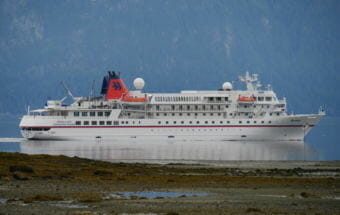
The cruise ship Le Soléal heads south in the Wrangell Narrows near Petersburg in June 2016. (Photo by Joe Viechnicki/KFSK)

Petersburg Borough Assembly heard Monday from mostly supporters of proposals to charge two new fees in the borough.

One would be an administrative fee for senior citizens who apply for an exemption from local sales tax.

Another would be a fee on cruise ship passengers visiting the area.

Both could be back in front of the Assembly later this year.

The proposed fee for senior exemptions is at $100 in a draft ordinance circulated as a starting point in the discussion this winter.

Local resident Barbara Fish thought the fee was a good idea but not that amount.

“I think the cost of producing the card should be covered by a fee,” Fish said. “I think $100 is too high. I think that $50 would be closer to the cost of producing the card and I don’t know what that cost is but I don’t think it’s $100 a card. And if something also should be added maybe that it’s based on income or a lower income person you can waive the fee, if that can be written into the ordinance that’s another possibility.”

The community of more than 3,000 people has more than 550 seniors who have applied for a card to avoid the borough’s 6 percent sales tax.

Borough officials say that number is growing as more people in the community reach retirement age.

Finance director Jody Tow reported 60 new cards were issued in the past year alone.

Assembly member Jeff Meucci has been leading the discussion on the new fees.

“It’s a tough process,” Meucci said during a work session Monday. “My intent is not to burden the people of the community who can’t afford it. I’m just trying to sort out the details to see if we can sort it out at the Assembly level.”

Meucci wondered whether the fee could be waived for low income seniors, using an application already in place for a discount on utility bills.

Tow thought that could be done. She estimated the cost of issuing the cards, leaving out about 150 low income seniors, would be around $60 a card per year.

Seniors would have to apply annually and pay the cost of the card each year. Previous cards have been good for three years, but the borough started issuing one-year exemption cards for 2018.

The group discussed waiving the fee for low income seniors. But they also continued to explore the possibility for a ballot question to limit the exemption itself to seniors.

“Going out and making basically a moral argument of like if you want this town to be successful in 50 years we need to find a way to limit this,” resident Chelsea Tremblay said.

“It’s true, you’re absolutely right, that has not been on the ballot, just limiting it to low income people,” said Tow, the finance director.

“Yeah, so that’s a very different conversation cause that’s always been the thought that people have had of knowing that there’s people on fixed incomes in town who are seniors and that’s kind of who a lot of people vote for when they go to the ballot with that question,” Tremblay said.

Meanwhile the borough’s harbor master Glorriane Wollen thought the exemption should end.

“We’ve got to figure out a way to do away with it because that number is growing,” Wollen said of the people who claim the exemption. “The number that’s paying taxes is dwindling too because people are leaving town and it’s just, it’s getting completely unsustainable.”

The City Council in 1980 created the senior exemption “with the intent of alleviating financial hardship and recognizing the valuable contributions which the senior citizens of Petersburg have made and continue to provide.”

The borough’s charter requires any change to sales tax exemptions be approved by a public vote.

Attempts to change or limit that and other exemptions have been mostly voted down, sometimes overwhelmingly. Voters have agree to end the exemption for alcohol and tobacco purchases and approved a residency requirement.

A question to stop issuing those cards in 2019 went down in a landslide in 2014.

The Assembly can approve a fee for issuing the exemption cards by ordinance and that could be in place for the following year.

Meanwhile the group also discussed a $5-a-head fee on cruise ship passengers.

A draft ordinance is based on a fee charged in Juneau.

And finance director Tow reported on the capital city’s use of that money.

“Whereas we’re talking about $35,000, they’re making $5 (million), $6 million a year and they use it for things such as additional police, hospital support because they have a few broken hips every week from passengers on the cruise ship, things like that, downtown restroom maintenance and supplies, downtown sidewalk cleaning and garbage, harbor operations, visitor center building maintenance, transient bus service.”

That $35,000 is the most Petersburg could collect from $5-a-head if all of the 116 boats scheduled to visit are filled to capacity.

It could be years before that fee built up enough money for any major projects.

“In a day and age where we’re looking for new revenue streams, $35,000 isn’t a big chunk but it’s a start.” Assembly member Meucci said.

He does not think an additional $5 a passenger will discourage people from visiting here.

Viking Travel owner Dave Berg, who’s also an agent for Cruise Line Agencies of Alaska, had some ideas for use of that money.

“I think that if we were spending money on you know access places, like Juneau’s doing, with you know downtown, not pay phones necessarily but rest areas, or an area out on Dock Street that would have a covered approach so that people, while they were waiting for a bus they wouldn’t be standing out in the rain,” Berg said. “Those types of things are certainly within the realm of acceptable uses of money that is going to come from those passengers.”

The Assembly ultimately would decide on how to spend the money during the annual budget process.

Petersburg’s draft ordinance would only apply the fee to ships with more than 20 passengers.

Berg hoped that Petersburg’s fee would be charged to ships that didn’t dock in downtown harbors but dropped their passengers off elsewhere in the borough, like the Kupreanof dock.

The harbors already charge boats for each stop, between $250 and $500 depending on where they tie up or anchor.

And that amount’s expected to increase along with a 12 percent across the board increase in moorage fees in the fiscal year that starts in July.

The passenger charge, like the senior exemption fee, could come before the Assembly in ordinance form sometime this year.

Site notifications
Update notification options
Subscribe to notifications