KFSK is our partner station in Petersburg. KTOO collaborates with partners across the state to cover important news and to share stories with our audiences.

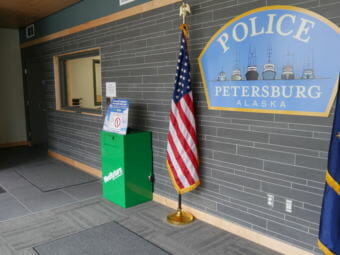
The drug take-back bin is in the lobby of the newly remodeled police station. (Photo by Joe Viechnicki/KFSK)
Petersburg Police Department has gathered over 11,000 unused prescription medication and other pills since it opened up a collection box in the new police station lobby in late February.
The department released the 2017 statistics this week.
The drug take back bin was opened Feb. 22 in the community of more 3,000 people. As of mid-December the pills collected was 11,550. Residents have also turned in 13 Epi Pens, 70 ounces of drug liquids, 26 grams of creams and 162 inhalant doses.
Police Chief Kelly Swihart was surprised by that level of use.
“Just an incredible amount of unused medications that were turned in and I really wanted to give a shout out to our evidence technician Barb Beasley and Becky Turland from (Petersburg) Mental Health who are collecting those stats and disposing of the unneeded medications for us,” Swihart said.
He noted some of the busier months for the collection box were later in 2017, so use by the public may be increasing.
As for other statistics, the department received a total of 3,833 calls last year, 497 of which were 911 calls.
Borough police keep track of calls with a software system from a Utah company called Spillman Technologies.
Swihart thinks crime statistics last year kept pace with those from prior years.
“This is the first full year that we’ve had Spillman as a record management system,” he said. “We implemented it back in mid-2016 so we’ve refined the way we collect statistics a little bit but I think we’re tracking pretty much with what we have done in the past.”
There were over 3,500 calls that were for the police, with 81 fire calls and 215 for emergency medical responders.
The police say more than 3,400 of the calls are closed cases. The department had 95 drug-related cases last year and had 75 jail bookings. Twenty-eight of the calls were determined to be unfounded. Borough police had 35 calls from outside of the old city limits.
Attorneys made oral arguments this month in a Petersburg civil suit challenging sealed search warrants under Alaska court rules.
The plaintiffs want to see the state institute some process for the target of a law enforcement investigation to regain property seized as evidence and in a “reasonable” period of time.
Former Petersburg resident Danny Thompson and current resident Greg Richeson are suing the borough, a local police officer and the regional drug task force Southeast Alaska Cities Against Drugs, or SEACAD.
The Alaska State Troopers also are named in the suit for their involvement with SEACAD.
The two men say in separate investigations in 2013 Petersburg police officers obtained search warrants and seized property from their homes.
The borough’s attorney Timothy Bowman argued that there has been no constitutional violation. He said property belonging to Thompson has been returned, but acknowledged that law enforcement still held some belongings from Richeson.
Superior Court Judge William Carey questioned Bowman on that point.
“How long does an investigation take? There’s no statutory limitation but my god, it has been kind of a long period of time,” Carey said.
“Your honor I understand that,” Bowman said. “I think that everybody realizes that it has been a long time and I think the issue has to do, well most of all, the investigation obviously started out as one for a marijuana grow operation.”
The hearing was held in the Petersburg courtroom with most of the participants on the phone from other locations.
Bowman said the investigation of Richeson has been taken over by the Federal Bureau of Investigation and valid search warrants have allowed law enforcement to look at Richeson’s phone and electronics.
“I think we all probably can surmise that it’s gone beyond just a marijuana grow or a controlled substances investigation,” Bowman said.
He thought lawsuits like this can be used to undermine a valid criminal investigation and he noted the investigation is out of the borough’s hands.
Carey came back to his questioning and said in practicing criminal law for over three decades in Alaska he’d never seen an investigation taking this long.
“There’s some interest in sort of keeping, maintaining some confidentiality to some of the proceedings but I think ultimately what you’re going to find is that it’s a reflection to some extent the resources that are available to a small town police force in Southeast Alaska,” Bowman said.
The plaintiffs are not challenging law enforcement’s use of the search warrants.
However the suit challenges the procedure under the state’s court rules that allow those warrants to remain sealed for four years in cases that do not result in criminal charges.
Plaintiffs’ attorney Fred Triem argued that seizure of property for years is a violation of the protection against unreasonable search and seizure prohibited in the fourth amendment of the U.S. constitutions, along with a similar provision in the state constitution.
“The police and the SEACAD people take the plaintiffs stuff but they do not return it within a reasonable time,” Triem said.
He argued people impacted include Thompson, Richeson and others in Petersburg. He’s hoping the case will be expanded into a class action to allow other plaintiffs. The men say the police seized coins, guns, computers, electronics, cameras, cell phones, personal papers, jewelry and other private property and did not return the items for years. Thompson’s belongings have been returned but he argues he was still injured by the loss of his property during that time. Richeson is still waiting for the return of his possessions.
Carey questioned Triem on the issue of a reasonable amount of time.
“What’s reasonable to keep a cell phone?” Carey asked.
“I think it should be measured in days, simply because the entire contents of a cell phone can be copied eo instante, instantly,” Triem said.
The judge kept up with that line of questioning.
“So you’re asking the court to set a reasonable period of a few days?” Carey wondered.
“I’m asking the court to recognize first and foremost that the current scheme of indefinite seizures is unreasonable and therefore it violates the fourth amendment,” Triem said. “Once we get past that point, there should be some mechanism for the aggrieved party, the target to complain, or to request the return of the stuff.”
Prosecutors opted not to bring charges against Thompson, but still could against Richeson.
Assistant Attorney General Marianna Carpeneti is representing state law enforcement. She argued that the suit asked the judge to set a reasonable time for returning property without specifying what that meant.
“It leaves law enforcement agencies in a position of saying you might be violating the fourth amendment by conducting a criminal investigating but you don’t know when you’re violating the fourth amendment,” Carpeneti said. “You don’t know if you’re going to be responsible if another agency, a federal agency steps in and takes over an investigation. You don’t know if you’re going to be responsible if the district attorney’s office is totally overwhelmed with cases and is not screening cases as quickly as they should be.”
Carpeneti argued that the two and a half years that Thompson’s money and other property was held was not unreasonable and said the state had little involvement in the other investigation.
Carey pressed Treim, the plaintiff’s attorney on the state’s involvement in this lawsuit.
“SEACAD is still aligned with, it’s in alliance with the local police who are trained by the state agency,” Triem argued.
“That alliance is enough to impute liability?” Carey asked.
“Yes, yes absolutely,” Triem responded.
Attorneys for both the plaintiffs and defendants have filed motions seeking summary judgement in the case, or a decision in their favor, which would avoid a trial.
He also has to rule on whether the case can be expanded into a class action. A trial in the case is scheduled for the week of Feb. 20.
Petersburg Volunteer Fire Department volunteers Rchard Burke and Alan Malone train five local teens November 20, 2017, in use of ladders at Petersburg’s fire hall. (Photo by Joe Viechnicki/KFSK)
Some Petersburg teenagers have been spending one night a week this fall learning many of the skills needed to become a volunteer fire fighter.
The junior fire fighters program is in its eighth year and has some youngsters thinking about joining the force when they’re older.
It’s a chilly night in November and five high school students and a handful of adults from the volunteer department have turned out for an evening training session at the Petersburg fire hall.
High school senior Austin Dow heard about the program during announcements at the high school.
“One day he was reading off the announcements and he said volunteer fire fighting department,” Dow said. “I just thought it was pretty interesting. When I was in middle school and like elementary school I was like, I wanna be a firefighter. Now I kinda am.”
Dow thinks he might be a volunteer when he’s older.
Sophomore Althea Malone said the whole experience has been a step out of her normal comfort zone but explains her father inspired her.
“My dad is a fire fighter and when I was little I used to come watch his fire fighter drills when he was doing them and when I learned about this opportunity I thought hey maybe I can do that too,” she said.
Her favorite part of the training has been learning to use a self-contained breathing apparatus.
“It was scary at first just kinda getting that used to there’s limited air around you but after a while it’s gotten a lot easier to feel comfortable with,” she said.
Malone’s father, Alan, is teaching the class on ladders this particular evening.
“They’re doing really good, really good,” he said. “I’m impressed with all of them. We’ve got some returning people and some first year people. They’re all doing great.”
Sessions started in October and have had as many as nine local teenagers this fall.
The students learn all the skills that the local volunteers do – from tying knots to setting up ladders, using fire hydrants and breathing gear and breaking into a building during a fire.
After a little class time, Malone sends the students scrambling into the fire station bay to put on their firefighting gear as quickly as possible
With only two paid staffers the local fire, emergency medical and search-and-rescue squads depend on volunteers to respond to emergencies.
The junior program started just after Devren Bennett joined the force in 2009. He took over in 2012 and says the training helps the students and the adult volunteers as well.
“I try to get firefighters to come in and teach these programs too,” Bennett said. “A lot of time it’s the first time they’ve put classes together and first time they’ve taught classes. And I’m still under the opinion that if you really wanna learn a subject, you teach. This is beneficial for not only the junior firefighters but for the firefighters, too.”
Students can’t join the department until they’re 18.
Trainers hope they will consider joining when they’re older, or use the skills they learn elsewhere.
Bennett said some former students have used their training after leaving Petersburg.
“We had one student go to the fire science program in Fairbanks and he is currently a firefighter in Juneau,” he said. “We’ve had a couple others go on to medical careers. And either way, whether they take this immediately on or maybe later on in life they decide to volunteer or something, this is an amazing skill set to have, something that I kinda feel like everybody should go through just to learn.”
After suiting up the students work on carrying ladders, setting them up, and learning to climb safely.
They set one up into the second story of the fire engine bay and practice.
The Monday night classes and training sessions will run into December.
Later on the winter, they’ll shift to drills, practicing many of the skills needed to respond to a fire.
Petersburg community cold storage manager Marv King, wildlife trooper Cody Litster and Salvation Army Maj. Loni Upshaw prepare two pallets of moose meat for distribution at the cold storage Thursday, December 7, 2017. (Photo by Joe Viechnicki/KFSK)
Volunteers picked up hundreds of pounds of moose meat from the community cold storage in Petersburg last Thursday afternoon, for distribution around town.
Service organizations and the schools will make use of the forfeited meat from this fall’s hunt.
Petersburg Community Cold Storage manager Marv King wheels two pallets into the front area of the building.
The pallets are stacked with boxes and contain hundreds of pounds of forfeited moose.
State wildlife trooper Cody Litster said the meat is ground up and packaged in 2 and 5 pound packs.
“Hammer and Wikan and Tonka Seafoods processed the meat for us,” Litster said. “So we’ve got two different pallets. We’ll see how much each of those are and today we’re taking, we’re gonna leave the school’s share here and then the other share we’ll move to the Salvation Army freezer for their distribution. We’ll see how much we’ve and how far it’ll go.”
The two stacks represent the meat from five moose shot during the month-long hunting season in September and October.
The animals did not meet strict antler requirements set by the state.
In total 12 moose in this year’s record-setting season were taken by the state and divided up between Petersburg, Wrangell and Kake. Hunters forfeit their kill and, if the court agreesm can pay the cost of processing instead of a fine.
Last year was the first year for an official distribution program that involves the court system, schools and local service agencies.
Before that it used to fall to Litster to drive around town with the meat and ask people if they wanted some. Now others are involved.
“The Salvation Army is going to disburse it to, there’s 10 service organizations in town,” said Salvation Army Maj. Loni Upshaw. “I don’t know if I’m going to keep any at all for food boxes but we have an extra agency so. It’ll depend on how much we get but I wanna make sure the service agencies which are child centers, the manor, the hospital and other people that feed homeless people. They’re gonna get it. It’s more for them.”
It’s Upshaw’s first year in town and her first time with the distribution but thinks it’s a good program.
“I haven’t worked with it yet. I don’t know about carrying a bunch of moose meat around but most of the people I’ve called they’re willing to come pick it up to pick it up for their agency,” she said. “That’s the good thing. And I know that they are blessed and honored to get this. I know it’s hard for the people who lost their moose but hopefully they can get a little bit of it some place down the line.”
The total is just more than 1400 pounds.
Volunteers help split that into two stacks. Nearly 800 pounds will go to the 10 service organizations through the Salvation Army. That’s almost 80 pounds apiece and nearly double the distribution from last year according to Upshaw.
The rest will go to the school’s food service program and will wind up in moose tacos and other lunch offerings throughout the year.
People who are interested in receiving some of the meat can contact the Salvation Army at 772-4586.
A distinct sub-species of lichen can only be found in a small part of Tongass National Forest. (Photo courtesy Karen Dillman/United States Forest Service)
Scientists have learned that a kind of lichen found in Southeast Alaska is a distinct sub-species that has evolved from the lichen of the same name found elsewhere in the world.
This particular lichen has only been found in a small part of the Tongass National Forest. It also has received a new name, honoring the Tlingit people of the area.
The lichen was first discovered by a U.S. Forest Service ecologist on the Sukoi Islands near Petersburg in 1992, the first discovery of it in North America. At the time though, it was thought to be something else.
“We sent it to Japan and the Japanese lichenologist said Oh yeah, this is Lobaria japonica,” said Karen Dillman of Petersburg, an ecologist with the Forest Service on the Tongass National Forest.
“And then he lost the sample,” Dillman said, adding, “So it sat in the question of what is it for many many years.”
Turns out it’s not quite the same as a similar species in Japan.
Another scientist classified the find as a species also found in Europe.
“So what happened was a Norwegian lichenologist came to the Tongass in the early 2000s and he found it over near Sitka, on an outer coast island. He called it Lobaria amplissima from Europe,” Dillman said. “So therefore he published it as Lobaria amplissima and that’s what we’ve been calling it forever, for probably 15 years.”
Turns out its not quite the same as the European species either.
Dillman, along with Chiska Derr of Juneau who made the original find back in 1992, and a third scientist Carolina Cornejo of Switzerland, studied the lichen, comparing its chemical composition and DNA.
“The DNA clearly shows that it is distinct from the European populations, however it’s not, timewise, it needs more time, in evolutionary time what is that, is it a hundred more years is it a thousand years,” Dillman said. “But it is already different genetically than the European. Therefore it had enough statistically significant differences to create a sub-species of it,”
It’s not yet its own species, but that’s expected to happen over time.
Even on the Tongass, this newly described sub-species is rare.
Dillman said it’s only been found in about 20 locations despite over two decades of searching.
Besides the Sukoi islands and McDonald Island in Frederick Sound near Petersburg, it’s also been found once on southern Mitkof Island, other small islands in Sumner Strait closer to Wrangell and in some wilderness areas on the outer coast.
The scientists wanted to have an indigenous name for this new sub-species and worked with the Petersburg Indian Association for suggestions.
“Previously to this work it was called Lobaria amplissima which is a genus that’s very common here, Lobaria,” Dillman said. “Now the genus is Ricasolia. The species is amplissima and the subspecies is sheiyi which is the Tlingit name for Sitka spruce. This lichen lives on the beach fringe areas of the Tongass and generally is growing on Sitka spruce.”
Specifically this lichen is only found at low elevations and on living trees on the fringe of beaches.
Dillman said the habitat it likes is vulnerable to air pollution, wind damage, storm flooding and erosion, threats that are expected to worsen with climate change. It’s also part of the forest that is the easiest access for logging.
The lichen already is on the sensitive species list, a list for plants or animals on the decline or facing a loss of habitat, for the Tongass National Forest. The Forest Service considers impacts from logging and other management on the forest for those species.
So what does it look like?
“It has like two sides like a piece of lettuce,” Dillman said. “But this one has, the lobes are very, we call ‘em lobes instead of like petals or leaves, the lobes are really, they almost look like melted wax, so really very textured. When it’s wet it’s this beautiful sagey green and when it’s dry it’s almost white.”
Lichens are a form of fungi.
Some are important to wildlife as food or nests, while others leach nitrogen into the forest fertilizing trees and other plants over time.
Lichens are very sensitive to environmental conditions and climate and in many parts of the world are studied for air quality and climate change.
Like all good discoveries, this one has generated more questions. Namely how did it get here?
“This is the fascinating part too,” Dillman said. “It’s not in the Lower 48. It’s not in Canada. It’s only here. So this lichen that we’re looking at here does not occur anywhere else like this. So where did it come from? Did it just come the European branch and it just blew over the poles and eventually landed here when we started getting more trees? And then it just evolved into its own sub-species and eventually species.”
Dillman said those are questions for someone else to answer in the future.
Meanwhile she expects scientists will continue to look for and find new lichen species in the rain forest of Southeast Alaska.
Scientists have found fewer younger halibut in survey fishing done up and down the U.S. and Canada coast this year, which could signal decline in upcoming years. (Photo courtesy International Pacific Halibut Commission)
Scientists monitoring halibut say there could be a decline in the bottom fish along the coast of the U.S. and Canada in upcoming years if the current level of fishing continues.
The International Pacific Halibut Commission oversees management of the fish along the coast from Alaska to California.
Commissioners had an interim meeting Tuesday and Wednesday in Seattle and heard about this year’s catch and the latest estimates of halibut stocks.
Scientists found fewer younger halibut in survey fishing done up and down the coast this year, which could signal a decrease in halibut numbers and what’s caught in the commercial fishery in upcoming years.
“What we are starting to see here is a projection we’ve got fewer young fish coming into the stock and that’s very consistent with the setline survey dropping in terms of numbers and it’s also why we’re really not seeing it yet in the commercial fishery,” said Ian Stewart, a quantitative scientist with the commission. “Because that fishery is still largely dominated by these better year classes that are still present in the fishery catch. But will be decreasing in the fishery catch over the next several years.”
The IPHC’s survey found a decrease from last year in the number of halibut caught.
Coast-wide that drop was 24 percent from 2016, with some variation between different parts of the coast. Meanwhile, catch rates actually increased in the commercial fishery in some areas.
Coast-wide commercial catches this year topped 26 million pounds.
Fishing fleets targeting other species caught another 6 million pounds of halibut as bycatch.
Staff scientists don’t recommend catch levels to the U.S. and Canadian commissioners. Instead they present the likelihood of future declines or increases in fish stocks based on different catch limits.
Because fish numbers are dropping, most areas of the coast could see decreases in the commercial and charter catch limits next year if the commission decides to stay with the same level of fishing intensity as 2017.
Commissioner Linda Behnken of Alaska asked for more clarity on the impacts of those catch limits for the future.
“It does seem as if the reductions we’re seeing you calling for here indicated are really driven by recruitment and the fact that there’s not small fish moving in to replace the bigger fish, or to recruit into the fishery,” Behnken said. “I think part of what we’re going to have to understand when we take action at the annual meeting is how sensitive the population is in the future projections to the fishing intensity levels.”
The commission will decide catch limits at their annual meeting in Portland, Oregon, in late January.
They’ll also be considering various regulatory changes and setting the season dates for next year.
Close
Update notification options
Subscribe to notifications
Subscribe
Get notifications about news related to the topics you care about. You can unsubscribe anytime.