KFSK - Petersburg

KFSK is our partner station in Petersburg. KTOO collaborates with partners across the state to cover important news and to share stories with our audiences.
Petersburg resident receives medal from King of Norway

A Petersburg resident has been recognized by the King of Norway for her dedication to promoting relations between Norway and the U.S.

The Norway Ambassador to the U.S. was in Petersburg last week to hand out the Medal of St. Olav.

A handful of Petersburg residents are gathered at Glo Wollen’s beach front home to have a cookout.

Wollen is the current president of the local Sons of Norway lodge and she’s also the town’s Harbor Master.

At this point, she had no idea she’s getting an award.

As far as Wollen’s concerned, she’s just hosting important visitors. The last time the Norwegian Ambassador visited Petersburg for the Little Norway Festival in 2016 Wollen also hosted a BBQ at her place.

“We’re hosting the Ambassador of Norway to the United States of America here and his assistant and our Norwegian consul that is located up in Anchorage,” Wollen said. “We’re having a little Alaskan party. And we also have the lieutenant governor of Alaska as well.”

Southeast Alaska’s Sen. Bert Stedman also was there.

People were socializing in the back yard while local black cod, salmon and shrimp are grilled over a fire.

Soon, people are called around the deck because Ambassador Kåre Aas wants to publicly thank Wollen for the hospitality. He also is here for another reason.

“His majesty King Harald V has told me to come here,” Aas said. “When his majesty wants to honor a person or persons he gives them the Medal of St. Olav.”

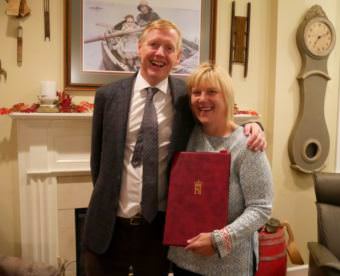
Ambassador of Norway to the United States, Kare Aas, and Glo Wollen pose for a photo Sept. 28, 2017, after she was award the Medal of St. Olav. (Photo by Angela Denning/KFSK)

The medal is round and silver and hangs from a red, blue and white ribbon. Wollen also receives a diploma.

Aas said the medal is given to Norwegians or foreigners who have been working hard to strengthen the relationship between Norway and another country — in this case, the U.S. He said he nominated Wollen for the medal.

Petersburg resident, Glo Wollen, received this Medal of St. Olav for her work to strengthen the relationship between Norway and the U.S. (Photo by Angela Denning/KFSK)

“Since you were born–your mother is here–you grew up in a fishing family, and your father he told you a lot about values, Norwegian’s values,” Aas said. “Your mother, she told you about how to interact with other persons, how to sew and how to cook.”

After the award is given, Wollen received hugs from friends and poses for photos.

Aas said the king’s medals are seldom given out, maybe one a year to Americans.

“It’s really a recognition of what Glo has been doing in working and promoting and maintaining Norwegian values in Alaska,” Aas said. “But also really emphasizing what many Norwegian Americans think about their relationship to Norway historically, politically but also culturally. And his majesty, he really honors those who are really advocating (for) our two countries.”

Aas said that based on this recognition he believes that when Wollen visits Norway – which she hopes to do – she will be able to meet the King of Norway himself.

Wollen herself didn’t give any speech after receiving the award but besides wearing a new medal on her chest, she also had a beaming smile on her face.

New research at LeConte Glacier predicts record retreat

Glaciologists have wrapped up two years of research on LeConte glacier near Petersburg.

Their preliminary findings show that the glacier could reach a record retreat by the end of the year. And it could be an indicator for what’s going to happen in Greenland.

Glaciers are like frozen rivers of ice, constantly moving. LeConte Glacier feeds into the ocean near Petersburg at a rate of 90 feet a day.

LeConte is the southern-most tidewater glacier in the Northern Hemisphere. Its accessibility makes it a draw for nearby scientists. But that’s not the only reason they’re interested.

The glacier also is a lot like hundreds of others that cover Greenland.

Glaciologist Christian Kienholz and colleagues used equipment to collect data on LeConte Glacier seven times over the last two years. (Photo courtesy of Christian Kienholz, University of Alaska Southeast)

And Greenland has the attention of climate specialists all over the world. When it melts, which they say is inevitable, sea levels could rise quickly.

Christian Kienholz, who is originally from Switzerland, is a glaciologist at the University of Alaska Southeast.

He’s been studying LeConte for the past two years to find models to predict glacial melt in Greenland.

“If we want to better understand than we need to look at an example like LeConte, which is much better accessible than the glaciers in Greenland,” Kienholz said. “LeConte has other advantages because it’s a fairly narrow fjord, which allows us to do the measurements from the boat like transects fairly efficiently.”

Kienholz and a colleague have visited LeConte seven times staying at a base camp about 1,200 feet above the glacier overlooking the end or terminus.

The research required lots of equipment.

They had six time-lapse cameras set up around the fjord taking snapshots every fifteen seconds.

A radar measured the glacier’s speed and elevation every three minutes.

A sonar measured the depth of the fjord.

Seismometers helped detect calving events and runoff. And they tracked the weather–the temperature and precipitation.

Some of the research continued year-round like the time-lapse cameras. Kienholz collected over a half-million images through them.

The winter snow would come and go but the cameras kept rolling.

“That’s something that recently became possible,” Kienholz said. “We have now cards, memory chips that are large enough to actually store that number of pictures. Ten years ago that was not possible.”

Time-lapse cameras caught this mountain goat gazing at the LeConte Glacier terminus. (Photo courtesy of Christian Kienholz, University of Alaska Southeast)

Newer computers are helping translate the still images into surface speeds of the water.

Scientists like Kienholz call LeConte and other tidewater glaciers non-linear systems.

The glaciers are traveling on top of water and become stable when they get to shallower spots known as sills.

So, the terminus usually stays near a shallow spot for a long period of time where there is less calving.

But when the glacier retreats beyond that point onto deeper water, there’s more calving and the terminus jumps back.

“That’s what we have seen with Leconte Glacier,” Kienholz said. “Typically it’s stable for a couple of years, a certain spot, typically on sill, and then it’s retreating pretty fast for a certain period of time and then stable again and then retreating.”

Students at Petersburg High School have recorded the terminus every year for decades and that’s initially what caught scientists attention.

The new and old information has Kienholz believing that the glacier might reach a record retreat this year.

“We know from maps where the glacier was in 1950, for example, and we know from the high school record every year where the glacier terminus was, and at the end of this year, very likely the glacier will be as far back as never before,” Kienholz said.

Christian Kienholz, Glaciologist with the University of Alaska Southeast gathered data at the Leconte Glacier seven times over the last two years. (Photo courtesy of Christian Kienholz, University of Alaska Southeast)

Kienholz was interested in glaciers early in life growing up in Switzerland. He said he has seen major changes just in his lifetime.

“There are quite a few small glaciers. They were already small when I grew up and some of them have gone away,” Kienholz said. “That’s definitely what you’re going to see in the years to come. There are a lot of glaciers that are predicted to retreat almost completely.”

Kienholz hopes that his research can help predict just how fast those changes will happen and maybe help people plan for what they’re going to do about it.

The two-year research project did not only included collecting data from the top of LeConte.

An oceanography team from Oregon State University and University of Oregon has been studying the water near the glacier. The two teams are sharing data and plan to publish their results.

Kienholz hopes that the scientists can secure funding to collect more data from LeConte in the future.

Petersburg assembly OKs BC mining resolution

Brian Lynch of Petersburg, with the Salmon Beyond Borders campaign, addresses the Petersburg borough Assembly on Monday. (Photo by Joe Viechnicki/KFSK)

Petersburg’s borough Assembly Monday passed a resolution seeking enforceable protections against pollution from mines in British Columbia on rivers that flow into Southeast Alaska.

Meanwhile, Alaska’s lieutenant governor said he is raising the issue with both provincial and federal governments.

The group Salmon Beyond Borders is asking municipal governments in Southeast Alaska this year to pass the resolution seeking the involvement of U.S. and Canadian federal governments under an international treaty on boundary waters between the two countries.

Assemblies in Ketchikan, Sitka and Wrangell have, while Juneau is reconsidering.

Petersburg’s Assembly passed a similar resolution in 2015 and voted to send a letter seeking federal involvement last year.

The resolution up for consideration this fall is an updated version.

Southeast tribes, fishing organizations and environmental groups are concerned with mine pollution near rivers that flow out of British Columbia into Southeast Alaska, like the Stikine, Taku and Unuk, as well as the Nass further south.

Salmon Beyond Borders’ Brian Lynch, a Petersburg resident and retired Alaska Department of Fish and Game biologist, called it both an environmental and economic issue.

“Something happens up there, we could be directly harmed,” he said. “It could cause great disruption in salmon fishing, also crab fishing in the Stikine flats and it has the potential to even affect fisheries across the Gulf and into the Bering Sea. It could be much more horrendous than just its effect on salmon.”

A report commissioned by Salmon Beyond Borders last year found that commercial and sport fishing activity along with tourism dollars from the waterways are worth a combined $48 million a year in economic activity including the paychecks for 400 people in Southeast Alaska.

The group wants to ensure that income is not threatened by precious metals mines already operating or being explored across the border.

Lynch also addressed a statement of cooperation the Alaska signed with the British Columbia government last year.

“The SOC was a good step forward but cannot provide for enforceable regulations or financial assurances in case of contamination or mining disaster,” Lynch said. “Only the federal government has that authority under the Boundary Waters Treaty.”

That treaty is from 1909. It’s implemented by an International Joint Commission, which “studies and recommends solutions to transboundary issues when asked to do so by the national governments.”

Petersburg’s Assembly passed the resolution unanimously, only adding language asking for baseline water quality monitoring on the waterways, a request from Assembly member Bob Lynn.

“We can talk about all kinds of enforceable protections and so forth but if we don’t have a baseline from which to be able to argue from or go to court with, we’ve not gained anything,” Lynn said.

Lt. Gov. Byron Mallott was in Petersburg in late September and said he plans to meet with officials in the new B.C. provincial government in October or November.

“Commissioner Larry Hartig of the Department of Environmental Conservation will be accompanying me,” Mallott said. “It will be our first visit with this new government. I’ve recently had the opportunity to be in D.C. and meet with the Canadian government officials there as well as our EPA and state department and emphasized the need for both federal and local action in maintaining both the habitat and the pristine waters of these transboundary rivers.”

Mallott said he’s tentatively planning a trip to Ottawa along with U.S. Sen. Dan Sullivan to discuss mining concerns and other topics with the Canadian federal government.

The lieutenant governor says he’s raised several specific concerns with the federal governments of both the U.S. and Canada, including baseline water quality monitoring and an existing polluting mine.

“We’ve asked that the Tulsequah Chief mine which has been emitting acid mine drainage for almost half a century that that be dealt with once and for all,” Mallot said. “It is not a major polluter by any stretch but it is essentially the poster child of British Columbia mining management and if you can’t deal with that what can you deal with kind of a circumstance. We are also talking with our federal government and the Canadian federal government about how do we deal with catastrophic failure?”

The Tulsequah Chief an abandoned precious metals mine 40 miles northeast of Juneau on a tributary of the Taku River. A coalition of 16 tribal governments in Southeast Alaska this summer said the BC government could not be relied on to clean up that mine and asked for U.S. and Canadian federal governments to do it instead. As for catastrophic failure, environmental and fishing groups are concerned about another disaster like the 2014 tailings dam collapse at Mount Polley in central BC in 2014.
With help from AD

Petersburg’s tribe uses new machine to make compost in bulk

Brandon Thynes, Petersburg Indian Association’s Tribal Resource director, and his assistant Clifton Gudgel stand next to the tribe’s new composting machine, which is housed in a portable building at the Petersburg Borough’s baler facility. (Photo by Angela Denning/KFSK)

A new business venture by the Petersburg Indian Association has begun to provide the town with locally made, environmentally friendly compost.

Walking on the road into the landfill, you pass by piles of automobiles and rubber tires, and eventually come to three large, white portable buildings.

This is where the local tribe makes compost. In one of the tents is a large stainless steel machine that’s cylinder shaped sitting on top of a trailer. (It’s called a Nioex Biovator.)

The tribe paid $15,000 for it and had it shipped in this fall from Manitoba, Canada.

“We have a load in it right now and it’s been cooking since last Friday,” tribal resource director Brandon Thynes said. “You just kind of layer it like lasagna with wood chips and fish waste and wood chips to cover it so it doesn’t smell.”

Thynes and his assistant Clifton Gudgel opened up the lid and he was right; it didn’t smell. It just looks like dark brown wood chips.

“The temperature should get up to 160, 140 (degrees). It’s pretty crazy to open up your pile and steams just rolling out of it,” Thynes said. “It’s pretty amazing.”

Before working for PIA, Thynes used to be a commercial fisherman. He knew there was a lot of fish waste. It gets ground up and dumped into the water in front of town by local processing plants.

Now, Thynes gets some of that leftover fish for free. The tribe uses up to 500 pounds a week for composting.

“It’s a great year-round business for the tribe, helping the environment by not pumping that fish waste into our Narrows,” Thynes said.

They could always use kelp if there’s a shortage of fish, Thynes said.

The wood they get from scraps around town that would otherwise get burned at the landfill.

It’s usually alder because it grows fast and people often want to cut it back.

PIA puts it through a wood chipper and its ready for composting. But they won’t just use any scraps.

They have to know where it’s from and that it hasn’t come in contact with pesticides or other chemicals.

“It’s not labeled organic, but it is organic because we don’t add anything to it,” Thynes said.

The composting machine is on a timer so it rotates every two hours.

It takes about two weeks for the fish and wood to become dirt and then it needs to sit and cure for a month before it can be used.

After a batch is done, they’ll filter out any leftover pieces of wood to go into the next batch.

“It’s actually like a little starter, kind of like sour dough where the microbes are on these pieces already,” Thynes said. “It spreads throughout the compost a lot faster.”

PIA has been making compost for years.

In the past, the tribe used an older model composting machine that kept breaking down.

Then workers made compost by hand by what’s called static aerated piles.

Wood chips and fish were layered in a heap on the ground, which would get aerated and turned occasionally. But the process was lengthy.

When Thynes started working for the tribe a year and a half ago, he wanted to expand. He said they were missing opportunities.

“Juneau wanted quite a bunch, like 50 cubic yards and we just couldn’t, I couldn’t make enough to get what they wanted,” Thynes said. “It was stuff like that, opportunities to make it a business, and hire some more tribe members so they can have a (full-time), year-round job that pays well.”

Gudgel said he likes having a job where he can work outside.

“Getting out there and getting the materials and throwing it all together, and just doing something different rather than standing behind a desk or stocking things on shelves,” Gudgel said.

Thynes keeps a detailed notebook of batch results, what goes in when and at what temperature. On average, this machine can produce about 40 pounds of compost a day.

PIA plans to sell it in 40 pound bags within a few months. It will cost about the same price as imported compost sells for at the store.

Thynes said this stuff will be pure, local product.

“You know the big companies that do it, they don’t care what they throw in there, they just throw it in, ‘Throw it in–it’s a nitrogen, throw it in–it’s a carbon,’ and people are just getting a mixed bag of who knows what’s in it but with us, you’ll know what’s in it,” he said.

And when it’s done?

“It kind of looks just like dirt,” Thynes said, laughing.

It’s like a fluffy, “mulchy” dirt.

PIA’s composting project is funded the Indian Environmental General Assistance Program.

State-federal agreement awards Ketchikan company second-growth timber sale

A U.S. Forest Service timber crew on Kosciusko Island (Photo courtesy U.S. Forest Service)

A Ketchikan company has been awarded a $2.6-million sale of second-growth timber on an island in Southeast Alaska.

The state of Alaska prepared and awarded the contract for logging on federal land on Kosciusko Island under an agreement with the federal government.

The sale is the first of its kind in Alaska under what’s called a good neighbor authority agreement, which allows the state’s Division of Forestry to handle sale preparation, administration and oversight for the logging on the Tongass National Forest.

The land is near the Southeast community of Edna Bay, west of northern Prince of Wales Island.

“The benefit for the state government is helping the Forest Service with capacity issues and actually getting timber sales prepared quicker and out for sale,” said Chris Maisch, state forester and director of the Alaska Division of Forestry. “Southeast Alaska has been struggling with the lack of timber volume off federal land and so this is a way for us to help get that volume out, which of course helps the economy of Southeast, the communities and people that depend on that for employment.”

Maisch said the Division of Forestry has been able to find the personnel to do the work.

“Because of the state’s budget problems we’ve had some cutbacks in my division, fairly steep cutbacks, about 42 percent over three fiscal years in my forest management side of my division and so I’ve actually been able to hire some employees back as temporary employees that previously been laid off.”

Staff in the division’s Haines office have been working on the project as well as newly hired employees on Prince of Wales Island.

Maisch expects the state to be working on other agreements with the Forest Service for similar sales elsewhere on the Tongass in the future.

Forest Service spokesman Paul Robbins said while all of the timber harvest will take place on national forest land, access will be across state property.

“The Kosciusko sale will be using state lands and roads as well as a log transfer facility on Division of Forestry land,” he said. “Even though all of the lands are federal, in order to harvest the sale and put the sale out there, we needed to use division of forestry lands. It just made sense to work alongside them on this sale.”

The sale will mean harvest of 29 million board feet of Sitka spruce and hemlock. Some of the money from the sale will reimburse the state for its costs.

The work-sharing agreement allows Forest Service staff to focus on other projects.

The 2014 Farm Bill authorized Forest Service use of such contracts with all 50 states.

The federal agency completed an environmental assessment on this project in 2015.

Since the logging is planned on federal lands, it has to be done under standards and guidelines of the forest plan, not less stringent standards under state law.

The Tongass is transitioning away from harvest of old growth to focus on younger trees that have grown back after logging in the mid-to-late 1900s.

In this project, harvest is planned for young-growth trees only, all around 60-75 years old. Old-growth trees originally included in the project were dropped from the final plan.

The state has applied for and received approval to allow export of all of the trees cut.

The company awarded the logging contract is Alcan Timber of Ketchikan.

Brian Brown, a partner in the company, said Alcan already is logging on Kosciusko and sees it as a good opportunity.

“It kinda speaks for itself,” Brown said. “It’s a large amount of volume for the recent history of what we’ve seen in the Tongass, so you know that’s good. It is second growth which allows us to do some things that we can’t do in old growth with mechanization and things like that. Overall we are looking forward to operating this timber sale.”

Brown said there’s no market for the second-growth timber in Alaska. But there’s a good market at mills overseas designed to handle the younger trees.

Regional environmental groups are glad the old-growth logging was dropped from the plan, but don’t like the export allowance because it means processing work is done elsewhere and not in Alaska.

Other concerns are about the impact on wildlife habitat even in the previously logged areas.

Larry Edwards is president of a regional organization now called the Alaska Rainforest Defenders, formerly known as the Greater Southeast Alaska Conservation Community. That group objected to the 2015 decision by the Forest Service to proceed with the project.

“Western Kosciusko’s just been hammered and will continue to be and this second growth that the Forest Service has remaining on west Kosciusko should really be allowed to go back to old growth just to help ameliorate all these excessive impacts on that island,” Edwards said.

Another young-growth project on Gravina Island near Ketchikan could be next up for the collaboration between the state and federal governments.

Commercial fishing for Southeast red king crab to open this fall after six years

The last commercial opening for red king crab in Southeast was 2011. (Photo by Alaska Department of Fish & Game)

Southeast Alaska will open to commercial fishing for red king crab this fall for the first time in six years.

The crab population has seen a steady increase, according to state surveys.

Red king crab are the largest shell fish in the state and can weigh up to 24 pounds and have a leg span of 5 feet.

What commercial fishermen in Southeast haul in is smaller, usually around 8 to 9 pounds but they are still worth a lot.

Red king crab brought nearly $11 a pound during the last opening in 2011.

It’s not unheard of to bring in a $100 crab. The last fishery was worth nearly $1.9 million at the dock.

But whether the opening set for November 1 will be lucrative is still to be seen.

Joe Stratman, who is Alaska Department of Fish and Game’s lead crab biologist for Southeast, said the red crab population has been on the rise since 2013.

“Basically, in the last four or five years we’ve seen improvement in legal, mature biomass estimates in Southeast,” Stratman said. “Now, they’ve gotten to the level where we reached this harvestable surplus.”

Fish and Game monitors the population through annual surveys where they catch and sample crab.

They also work with local fishermen on a mark and recapture project.

They track two groups of king crab: the legal biomass or crab that are big enough to be harvested in the commercial fishery; and the mature biomass, which also includes crab that are sexually mature but not big enough to be landed.

Stratman said both numbers look good this year.

“These adjusted biomass estimates amount to a 40 percent increase in the legal male biomass and the 41 percent increase in mature male biomass from last season,” he said.

Stratman said that’s the largest increase in a few decades.

The state can open Southeast’s commercial season if the estimated amount of legal size, male king crab tops a harvestable surplus of at least 200,000 pounds.

It’s just above that this year. Managers will be keeping close tabs on the fishery.

They are splitting the region into six fishable areas. They will open for only 24 hours, then close for four days for sampling. Then two areas will reopen for a length of time that will be decided later by managers.

Fifty-nine fishermen in Southeast have permits to participate in the fishery.

Nick Versteeg, a life long fishermen, said the opening is short but it’s better than nothing.

Craig Evens, who has been fishing in Petersburg for 40 years, said he was confused by the announcement. He said he’s not sure how it’s going to work with a 24-hour opening, then a closure and then a reopening.

Still, he said he’s glad there is at least some kind of opportunity.

Several other fishermen say they aren’t happy with the opening, but didn’t want to be interviewed.

The population of Southeast’s red king crab has been in flux, according to Fish and Game.

Back in the 1990s and early 2000s there were commercial openings nearly every year. But then there was a decline for about 12 years. The population was dropping about seven percent annually and then it started to rebound.

Stratman said they aren’t sure why the population has changed.

“We know what we see in the survey,” Stratman said. “We’ve seen a decrease in the early 2000s and it was fairly prolonged but now we’re seeing an increase.”

This fall’s commercial opening will allow fishing in more Southern, non-traditional areas than in previous fisheries. Stratman said managers have created Northern and Southern non-surveyed areas, with two separate harvest levels.

“Based on what we’ve heard from the fleet, I think splitting it up this way, I think it will allow for the time that they’re looking for,” Stratman said.

Fishermen can also take blue king crab in the fishery.

But they are incidental catches representing only about 1 percent of the king crab population in Southeast.

The increased population of red crab also is allowing more liberalized bag limits for the personal use fishery outside of the Juneau area.

Starting in November, the bag limit will increase from one crab a day to three or six depending on the location. But red king crab aren’t easy to get. They prefer deeper water starting around 150 feet.

Fish and Game managers are asking that fishermen comply with call-in rules during the fishery so they can track the harvest and coordinate port sampling.

Site notifications
Update notification options
Subscribe to notifications