KFSK is our partner station in Petersburg. KTOO collaborates with partners across the state to cover important news and to share stories with our audiences.
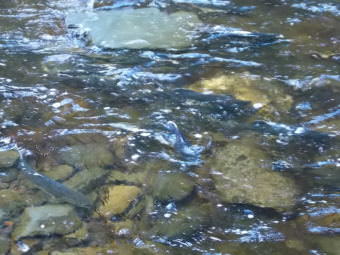
Pink salmon spawn in City Creek near Petersburg. (File photo by KFSK)
Alaska’s Lt. Gov. Byron Mallott has denied a proposed ballot initiative designed to offer greater protections for salmon habitat from mining or other development.
The group Stand for Salmon proposed an initiative requiring water quality standards in anadromous fish streams and giving the commissioner of the Alaska Department of Fish and Game greater authority to deny a development project if it would harm or alter salmon streams.
Supporters of the measure were hoping to gather signatures and get the proposal on a statewide ballot.
One of the initiative’s sponsors, Mike Wood of the Susitna River Coalitiion and Su Salmon Company, reacted with disappointment over the state’s decision.
“Since statehood you know we had a very strong fish habitat permitting system,” Wood said. “It’s been whittled away from administration to administration over the years in favor of industry and development. And we’re just trying to restore it back to where it was originally intended, to have some teeth and not just stop projects but to be sure to give everybody on both sides assurance that if development happens it will happen in a way that will not impact our fish resource.”
Mallot’s decision can still be appealed. Wood said the group may look to challenge the state’s decision in court.
The proposed law could have made it more difficult to develop proposed projects like the Pebble Mine in the headwaters of Bristol Bay or a dam on the Susitna River.
Assistant attorney general Elizabeth Bakalar recommended against certifying the initiative.
In an opinion, she wrote the proposed bill would deprive the legislature of its exclusive discretion to allocate state assets among competing needs.
She wrote “The initiative contains restrictions and directives that would require the Commissioner to reject permits for resource development or public projects in favor of fish habitat” unquote.”
She noted this version of the proposed law was similar to one already withdrawn by the bill sponsors because of constitutional concerns cited by the state.
A black bear was captured near early this month and moved to Farragut Bay on the mainland north of Petersburg. (Photo courtesy of Alaska Department of Fish and Game)
The Alaska Department of Fish and Game has trapped and moved two black bears that have been looking for an easy lunch and getting into garbage cans in Petersburg this summer.
Petersburg Police Department has been fielding calls about nuisance bears around town.
The borough is asking residents to make sure household trash is secure until it is picked up by the garbage truck.
Fish and Game wildlife biologist Rich Lowell said he received a request from the police department to place a live-bear trap near Kiseno Street not far from downtown Petersburg on Sept. 2.
“By the following morning we had captured a bear, about a 200-pound black bear, which we then loaded on the landing craft and moved up to the north side of Farragut Bay,” Lowell said.
Farragut Bay is on the mainland north of Petersburg. It’s the second bear to be trapped and moved by Fish and Game.
A slightly smaller black bear was relocated in August from the neighborhood near the Hammer and Wikan shopping center. That one was moved to the mainland in Thomas Bay.
Both bears are probably between 2 and 4 years old.
Lowell said he wouldn’t be surprised if there are other problem bears eating from garbage cans and other food at homes in town.
He’s also heard reports from Wrangell Avenue, Lake and Galveston streets. He thinks a number of factors could be causing an increase in bear problems this year.
“It can be a poor berry crop,” he said. “It can be reduced fish runs, fish not being as accessible and abundant as they are in previous years. Coming off of two to three years of very little bear activity, citizens have gotten complacent about securing their garbage. So all of those things add up to more bear problems than we’ve seen in the past.”
The department also relocated nuisance bears in 2012 and 2006.
There was also a major relocation effort in 1994 and others were killed here between 1998 and 2000. In some prior efforts the bears were released on the south end of Mitkof Island but were able to find their way back to the garbage cans of Petersburg in about a week.
Lowell is hoping that releasing the bears this year on the mainland will make that return too difficult.
He also sounds a word of caution with the start of moose hunting season on Sept. 15.
“Obviously some people will be successful and have meat hanging in town and you know it’s important that the hides, bones and butcher scraps be properly disposed of ’cause often times they get dumped close to town and it just further contributes to the bear problem by drawing bears into town that then discover garbage cans and so we need to be particularly careful as we head into not just moose season but people will be more actively deer hunting and stuff like that.”
Lowell recommends disposing of hide, bones and scraps by dropping them into the water from a boat if possible.
Or big game remains can be dropped off at the landfill, kept in the freezer until they’re put in the garbage can for collection or disposed of on the island far away from where people are living.
Lowell also reports continued bear problems at homes along Mitkof Highway. where people are raising chickens.
In those situations, he said electric fences should be put up around chicken coops and food storage areas.
This pictograph of canoes and sun is located near Petersburg. The exact location is kept secret for fear of public vandalism. (Photo courtesy of U.S. Forest Service)
The small island town of Petersburg in Southeast, Alaska, is known for its Norwegian heritage.
It’s celebrated throughout the year with events like the Little Norway Festival in May and Julebukking in December.
Nannuack enjoys talking about his carvings and paintings. He’s sort of a culture bearer, teaching about Tlingit artwork and history to Petersburg tourists and students.
Although Nannauck knows his Tlingit name he was never taught the language. His grandparents’ generation didn’t pass it on.
Ross Nannauck III sets up his artwork to sell in downtown Petersburg. (Photo by Angela Denning/KFSK)
“Assimilation has taken a big toll on our culture,” Nannuack said. “For a hundred years we were told to forget our ways. We were told our totem poles and our carvings were works of the devil and we should burn them. There’s a disconnect of just who we are.”
Still, artifacts are everywhere on Mitkof Island showing a long history of indigenous people.
Jane Smith and Gina Esposito are archaeologists for the U.S. Forest Service in Petersburg and it’s their job to keep track of artifacts found in the area.
Their offices are on the second floor of a downtown building. And it’s just what you’d think it’d look like: maps on the walls, shelves of rocks and bags of soil samples, a yellow hardhat on a back pack on the floor.
“As you can see we could use more space. It’s organized chaos what we have here,” Esposito said. “We have soil probes. Soil augers that help us find shell midden sites.”
Shell midden sights are like pre-historic trash piles.
Esposito said that Tlingit ancestors left mounds of shellfish remains, charcoal and fish bones.
“After they would harvest and eat and process they would just toss it outside their homes or outside their campsites or at their villages,” Esposito said. “And over time that builds up.”
The rain forest grows over the piles so the soil probes are used to find them. These sites indicate where people were living for long periods of time. And that’s what Esposito and her colleague recently discovered less than a mile from Petersburg.
“Right across from town, we’ve found evidence that there’s village-sized sites across the Narrows,” Esposito said.
The site was dated to 1,120 years ago.
On Mitkof Island itself, they’ve discovered a 5,000-year-old fish trap. In fact, large scale fish traps of various ages have been documented in all the major waterways on the island.
Smith and Esposito have worked together as an archaeology team for 20 years. Their oldest discovery is a 10,000-year-old site containing stone tool remnants was found on Kupreanof Island near Petersburg, Smith said.
The pair tracks over 900 archaeology sites including several rock paintings and carvings. Smith said they keep fastidious notes of the materials they collect and the GPS coordinates of the sites.
“One of the reasons we want to know where they are is so when the Forest Service does an action, like builds a road or puts in an outhouse or whatever they’re going to be doing that might be a ground disturbing activity, we know where the archaeology sites are so we can avoid them,” Smith said.
U.S. Forest Service Archaeologists, Jane Smith and Gina Esposito, record petroglyphs on the side of a rocky wall. (Photo courtesy of the U.S. Forest Service)
Smith and Esposito work with Petersburg Indian Association, the local tribe, to try to connect what they’ve found in the field to traditional knowledge.
The locations of the sites are not shared with the general public for fear of vandalism.
But the story that’s been perpetuated publicly is a different one.
Published articles and websites say that Mitkof Island was never inhabited permanently by Native people. It was an occasional stop over for fishermen and hunters for the past few thousand years. But that’s not the entire story.
“You know, it’s kind of emotional really,” said Brenda Norheim, a board member for the local tribal council.
Like other Petersburg residents, Norheim has grown up being told that no one was living around Petersburg when white settlers arrived.
But that left a hole to her past: where were her people?
She didn’t learn the answers at home.
When her mother was growing up in Petersburg there were signs that read, “No Natives”. She wasn’t told traditional stories or taught the Tlingit language by her elders.
“Natives weren’t allowed to buy land, so you know, were they just not here because somebody said they weren’t here?” Norheim said.
Some of these questions might never get answered. What Norheim hopes for now is that the archaeology finds bring a shared history to town — one of indigenous Natives and Norwegian settlers.
“I just can’t help but think we can get some positive results if we changed that story,” Norheim said.
Back on Petersburg’s main street, Nannauck watches the cars go by and says he’s not surprised by what the archaeologists have been finding.
“When we talk about ourselves we say that we’ve been here since time immemorial,” Nannauck said.
Nannauck said the science just adds to what he already knows, that his people have been living on and around Mitkof Island for a very, very long time.
Victoria Moore, aka Deckem, number 90 skates with the Petersburg Ragnarök Rollers in the Petersburg High School gym in May 2017. (Photo courtesy Rocket Raptor Films and Photography)
A Petersburg woman will be taking on some of the best skaters in the world next year at the Roller Derby World Cup in Manchester, England.
Victoria Moore, 45, who goes by Victoria Deckem in derby, is one of 20 skaters who made Team Indigenous Roller Derby. She’s the only Alaskan on the team, made up of First Nations and Native women from around the globe. That team will be among the 40 competing at the world cup next February.
Moore’s journey making the team started this year when a teammate on the Petersburg Ragnarök Rollers tagged her in a Facebook post. She applied, sent in a tryout video and made the cut.
Listen to Moore discuss the opportunity with KFSK’s Joe Viechnicki here:
Moore thinks the team is raising awareness about indigenous culture and the challenges they face around the world and hopes to learn more as she trains for the world cup.
Scrap metal and junk cars are piled up at Petersburg’s landfill this month. (Photo by Joe Viechnicki/KFSK)
Petersburg Borough Assembly approved Tuesday a preliminary agreement for shipping out recycled metal and junked vehicles.
The agreement is with the giant garbage and recycling company Waste Management and is the first step to actually sending collected scrap metal and cars out of town.
The borough’s public works director Karl Hagerman said the company is waiting until it can sell Petersburg’s metal for $200 a ton.
Waste Management would send a barge from Seattle and the collect recycled materials.
“That $200 a ton will cover most of the expenses if not all the expenses and provide some revenue to the communities for this initial cleanup,” Hagerman said. “Anything less than that and it’s pretty close and we’re looking at spending money to get rid of our metal, which I don’t recommend doing. We should sit on it until we can get some money back for it.”
Two other Southeast municipalities, Thorne Bay and Klawock, also may take part in the metal shipping.
The communities are part of a regional group called the Southeast Alaska Solid Waste Authority.
The agreement approved by Petersburg’s Assembly does not set the terms and price for the service. That will be an Assembly decision for a later date, a part of this agreement called exhibit A.
Hagerman explained that he hoped to see some money back for the metal.
“I would probably not recommend to the Assembly that we enter into any final agreement, any appendix A, that has us paying per ton,” he said. “We’ve got potentially 1,200-1,500 tons. Even at $10 a ton if we pay to get that out of here, it adds up pretty quickly. If we can make $10 a ton, that’s great.”
Waste Management bills itself as the largest environmental solutions provider in North Amercia with more than 21 million municipal, commercial and industrial customers in the U.S. and Canada.
Petersburg is offering free drop-off of metal and junk cars at its landfill through the end of October for both residential and commercial customers.
That could boost the amount shipped out of town as well as the money the borough could make on the deal.
The community used to enjoy free drop off days at the dump. The last one offered at the landfill was in 2003.
Hagerman said that year the community dropped off 191,000 pounds of metal in one day.
The vote was 4-0 to approve that agreement with Waste Management. Bob Lynn, Jeff Meucci and Nancy Strand were not at the meeting.
The vote also was 4-0 to approve a bid award for just under $43,000 dollars to Reid Brothers Construction for crushing recycled asphalt.
The borough’s public works department hopes to use that material to resurface some local gravel roads.
NOAA-trained marine mammal responders collect a sample from the exhalation of an entangled a humpback whale on Sunday, August 27, near the mouth of Tracy Arm, Alaska. (Photo courtesy of John Moran/ NOAA Fisheries)
A cruise ship in Southeast Alaska cut its anchor free Sunday to release a humpback whale tangled in the ship’s anchor chain.
The National Oceanic and Atmospheric Administration said numerous whales were bubble net feeding in Holkham Bay near Tracy Arm, about 45 miles south of Juneau early Sunday morning.
One humpback struck the ship Wilderness Explorer and became caught in the anchor line about 2:15 a.m.
The Wilderness Explorer is 186 feet long with capacity for 74 guests.
It’s owned by UnCruise Adventures and offers one to two-week tours of Southeast Alaska between June and September.
Company CEO Dan Blanchard said the ship had anchored near Wood Spit about 9 p.m. the night before.
“When the mate came on watch at midnight he noted that there were whales that had moved into the area,” Blanchard said. “We believed they were probably lunge feeding and can’t tell in the dark but one probably lunged and caught the anchor chain as best we can think of.”
NOAA Fisheries was notified of the entanglement just before 3 a.m. and contacted a network of trained specialists.
Alaska Whale Foundation researcher Fred Sharpe and a team of specialists traveled from Baranof Warm Springs to Holkham Bay that morning.
The team used a camera on a long pole to determine the anchor chain was wrapped around the lower jaw of the whale.
Sharpe said the situation was life threatening for the whale and it looked like it had injured itself trying to get free.
“The animal when we got there had been struggling for nearly eight hours and it was just sort of leaning over the chain, kinda draped on it,” Sharpe said. “It was resting. The crew of the Wilderness Explorer had done an excellent job of trying to prevent the animal from being pulled under by the weight of the chain, keep it near the surface and so the animal had the best chance of survival.”
After consulting with entanglement expert Ed Lyman by phone the team decided to cut the anchor chain at the vessel.
That cut was made about 2 p.m. Sunday.
Sharpe said it looked like the whale was able to get free of the remaining chain and he thinks the disentanglement was successful.
The team was able to get DNA samples from the whale’s spout and can learn about the animal’s health and gender.
“The spout is a highly diagnostic health indices,” Sharpe said. “We’ve been working for the past two years with Ocean Alliance collecting spout samples. We can get all kinds of information about stress hormones, reproductive hormones, DNA, potential pathogens, the whole microbiome of the animal. So we have these library of samples of animals that most of them we believe are quite healthy and an animal in distress like this, we can do a comparative analysis and we get some idea of how it might have been impacted by this event.”
Sharpe thinks it is a younger humpback, about 35 feet long, most likely from the Hawaiian population that spends the warmer months in Southeast Alaska.
NOAA Fisheries regional administrator Jim Balsiger said the agency is grateful for the ship reporting the entanglement quickly and the professional response of the Alaska Whale Foundation.
UnCruise’s Blanchard said the anchor is in about 100 feet of water, thinks it can be recovered and the ship can be repaired.
“We’re gonna take it to Ketchikan shipyard on Saturday and have a whole new chain put in and use either our emergency anchor or one we’re having sent up. So we’re gonna be fine either way. We’ll get back down there when the boat goes by and put an underwater camera on it and see what it’s gonna take to get it back up. But, we will plan, or we do plan on retrieving it.”
The ship returned to Petersburg for installation of an emergency anchor after the incident.
Close
Update notification options
Subscribe to notifications
Subscribe
Get notifications about news related to the topics you care about. You can unsubscribe anytime.