KRBD - Ketchikan

KRBD is our partner station in Ketchikan. KTOO collaborates with partners across the state to cover important news and to share stories with our audiences.
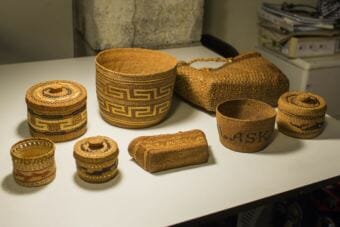
Videos, guide teach Annette Island weaving and Sm’algya̱x

Annette Island Tsimshian baskets from The Haayk Foundation collection. (Photo courtesy Wayde Carroll)

A Metlakatla-based nonprofit organization worked with the Smithsonian Arctic Studies Center to develop a series of instructional videos that teach the community’s unique form of basket weaving. It comes with an accompanying bilingual guide in English and the Tsimshian language.

Two of the Haayk Foundation’s co-founders Kandi McGilton and David R. Boxley say the whole project started during a conversation with master weaver Holly Churchill.

Boxley had mentioned how some original Sm’algya̱x words for formline design elements have been lost.

“As a result of potlach being outlawed, so the old masters stopped producing the work so the words stopped being used,” Boxley said.

“She suggested that we start documenting the different art forms (in Sm’algya̱x) and naturally weaving came up because she’s a weaver and I’m a weaver,” McGilton said. “It kind of just snowballed from there.”

Boxley and the foundation’s third co-founder Gavin Hudson flew up and met with Anchorage Museum officials, who agreed to help support the project.

Other backers joined the effort, including Smithsonian Arctic Studies Center in 2016.

Boxley said the center has supported other projects to preserve endangered art forms.

“It’s really the one art form that is uniquely from Metlakatla, Alaska, from Annette Island,” he said. “We felt it important to preserve that and preserve our language by making this bilingual guide.”

“Twining Cedar: Annette Island Tsimshian Basket Weaving” features about four hours of footage.

Those four hours represent a lot of work. McGilton credits the Smithsonian team for organizing, photographing and recording a couple of workshops.

“We had a week-long workshop twice in Metlakatla,” she said. “One for the harvesting of cedar, maidenhair and canary grass, and again in the fall to actually weave the baskets.”

Those workshops were led by master weavers Delores and Holly Churchill.

Their apprentice McGilton is featured in the videos.

For the guide, McGilton worked with fluent Sm’algya̱x speaker Sarah Booth.

Delores Churchill instructs student Jamie Thompson on how to pull bark from a red cedar tree in Metlakatla. (Photo courtesy Wayde Carroll)

“We wrote down from start to finish the instructions on how to weave a basket, and then translated the entire thing into Sm’algya̱x,” she said. “There’s a 54-, 55-page weaving guide that’s all in the language.”

McGilton and Boxley say their own language skills improved significantly through this project.

“It definitely helped with forming our own sentence structure,” McGilton said. “We’ve become quite skilled in writing Sm’algya̱x.”

“Thanks to Sarah, we’ve done so much transcription from listening to her translations,” Boxley added. “She’s just wonderful and infinitely patient with us learners.”

there’s been a great response so far to the free instructional videos and guide,” Boxley said.

Now that this project is complete, he said, they do have others planned.

One is a bilingual history of the Alaskan Tsimshian.

“So much of the Tsimshian history is based on the folks that didn’t leave who are still living over in B.C. or primarily on William Duncan,” he said. “I think it’s an interesting thing to put it back in context of where we fit as Alaskan Tsimshians in the total history of Tsimshian people.”

More than 130 years ago, the ancestors of Metlakatla’s current residents traveled from British Columbia to settle on Annette Island near Ketchikan.

William Duncan was an influential Anglican lay-priest who worked with those original settlers to build their new community.

Boxley said Sarah Booth is helping with the Sm’algya̱x version of that project, as well.

You can order the free videos and guide on the Haayk Foundation’s website.

Dunleavy brings gubernatorial primary message to Ketchikan

Sen. Mike Dunleavy, March 14, 2016
Then-Sen. Mike Dunleavy, R-Wasilla, speaks on the floor of the Senate during debate about the state operating budget on March 14, 2016. Dunleavy resigned from the Senate this past January to focus on his campaign for governor. (Photo by Skip Gray/360 North)

Former state Sen. Mike Dunleavy is campaigning for the Republican gubernatorial nomination, in hopes of challenging Gov. Bill Walker this November.

The Wasilla Republican was in Ketchikan earlier this month campaigning. He stopped by KRBD to talk about his goals if elected to the state’s highest office.

Dunleavy arrived in Alaska in 1983, a recent college graduate from Pennsylvania.

“First place I landed was Ketchikan,” he said. “Came up on the (ferry) Columbia from down in Seattle.”

From here, Dunleavy said he headed over to Prince of Wales Island to work at the Gildersleeve Logging Camp’s shop. That lasted a few months before Dunleavy headed north to teach. He worked in a village near Nome, then in Kotzebue, and finally landed in Wasilla.

Dunleavy’s first foray into politics was the Mat-Su Borough School Board. In 2011, he decided to run for state Senate.

“And was in the Senate from 2012 until this past Jan. 15,” he said. “Decided to resign so I could dedicate all my time and focus on the gubernatorial race.”

Dunleavy said people get into education because they want to help others, and that’s what drew him to politics, as well.

“Really, it’s public service from my perspective. The same goes for being a governor,” he said. “When I came to the state of Alaska in 1983, this place was incredibly optimistic. There were all kinds of jobs and opportunities. I always tell people, even today, I’d have to live eight lifetimes to do all the things I want to do in Alaska. It’s such a big, diverse, exciting state. The last several years have been tough on Alaska.”

Dunleavy said the upcoming governor’s election gives Alaskans an opportunity to try something new. He questions whether Gov. Walker has had a positive influence on the state’s economy.
“Our unemployment rate is the highest in the country at 7.3 percent and growing. We’re in recession – one of only two states – and the word is West Virginia is pulling out of that,” he said.

His solution is to control spending, and encourage revenue by supporting industry. In Alaska, that often means resource development and extraction. That means working with the federal government on more oil production, timber opportunities, mine development, etc.

“The natural resources is what sets Alaska apart, and the basis for revenue based on those natural resources is what sets Alaska apart,” he said. “You can tax people in California, you can tax people in Texas because you have a large tax base to do that. We have only 730,000 people.”

Spending solutions would include finding ways to be efficient, Dunleavy said. That could include consolidating health insurance for school districts throughout the state.

“There was a study done a couple years ago by the Legislature that if we were to consolidate those 54 school districts’ insurance policies into one pool, we could save upwards of $100 million,” he said.

And then, he said, the state could cut the equivalent of that cost savings from what it provides to public education.

“We could also look at our health and social service programs,” he said. “Do we have programs that are redundant? Is there duplication? Is there fraud?”

After implementing as many ways as possible to make the budget efficient, Dunleavy said state lawmakers then should reach out to the citizens about the best way to balance the budget, whether it’s a tax or taking part of Alaska Permanent Fund earnings that otherwise would go to dividends.

In the meantime, Dunleavy said the Legislature could fund government this year without taxes or taking from permanent fund dividends. The current budget deficit is about $2 billion. Dunleavy said $1.7 billion could be taken from permanent fund earnings without reducing dividends.

“Which leaves you with a $300 million gap. You have $2.6 billion left in the Constitutional Budget Reserve,” he said. “You could take $300 million, even if you didn’t want to reduce, even if you didn’t want to cut.”

And that, he said, would balance this year’s budget and give some time to find those efficiencies he mentioned earlier. And Dunleavy said that needs to start with a lower budget from the governor’s office, “then have the conversation (about) whether you need to build that budget up.”

While he supported cuts to the ferry system during previous legislative sessions, Dunleavy said he recognizes the importance of the Alaska Marine Highway System to Southeast residents.

“One of the reasons we’re down here in Ketchikan is to actually talk to people about the ferry system: people that actually use it, businesses that use it, folks that work on it. And get the feedback from them to see if there are ways to make it more efficient without the reductions in schedules and service,” he said. “I don’t envision at any time that there would not be a functional and robust ferry service in Southeast, the panhandle of Alaska.”

Dunleavy also has advocated cutting all state funding for public broadcasting in Alaska. He said that’s another area where he’d like input from Alaskans.

“That doesn’t mean that public radio, public TV is not a good thing. We all listen to and all watch public radio and public TV,” he said. “But some would say that with additional television stations and radio stations, it may not be as vital as it once was to the health and safety of Alaskans.”

As a public broadcaster, KTOO and KRBD are among the stations in Alaska that receives state funding.

Alaska’s primary election is Aug. 21.

Other candidates running for governor in the Republican primary are Scott Hawkins of Anchorage, Mike Chenault of Nikiski, Gerald Heikes of Palmer, Merica Hlatcu of Anchorage, and Michael Sheldon of Petersburg. Billy Toien of Anchorage is running in the primary as a Libertarian. There are no Democratic candidates for governor at this time, according to the Alaska Division of Elections website.

Incumbent Gov. Bill Walker is unaffiliated.

Commercial troller voices issues with derelict boat bill moving through Legislature

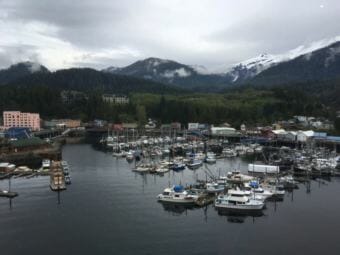
Ketchikan’s Thomas Basin Boat Harbor is seen from a visiting cruise ship. (File photo by Leila Kheiry/KRBD )

A bill meant to discourage boat owners from abandoning derelict vessels in public waters is moving through the Alaska Legislature.

It’s supported by a state harbors organization, but a Prince of Wales Island fisherman has objections.

Andy Deering is a commercial troller based in Craig. He has two boats. One is his home and the other is for work.

If Senate Bill 92 and the companion House Bill 386 pass, he and everyone else in the state who owns a boat will be affected.

“It will affect you negatively in the sense that, no question, everybody will be affected with more red tape and more expense,” he said.

Deering has been following the derelict vessels bill, and said there have been changes as it makes its way through various committees. As it stands, though, he said problems remain.

His concerns include the requirement that all boats be titled, like a car.

Deering said he can see how that might be helpful when selling a boat. But, people have been successfully selling boats in the state for a long time without titles.

“It’s potentially OK, but it’s also potentially kind of a pain in the neck with an additional $20 fee,” he said. “That applies not just to the big boats, but everything right down to the little 14-foot Lunds.”

Deering questions whether there’s any gain from requiring a title on top of state registration or federal documentation.

Speaking of registration: that, too, would change.

Deering said under the bill, boats that have federal documentation would also need to be registered in the state – with a fee of $30 every three years.

“Getting an additional Alaska state registration on top of that current documentation isn’t going to be anything more than a bunch of revenue for the state and a bunch of inconvenience for law-abiding boaters,” he said.

Rachel Lord helped craft the derelict vessels legislation.

Lord, who also is executive secretary of the Alaska Association of Harbormasters and Port Administrators, said there will be some extra fees involved – but only enough to pay for the program.

She said every section of the proposed bill was written to address a problem. Is registration on top of a title redundant? Well, yes.

“It is redundant because we have seen — time and again, case and case and case again, costing a lot of money – we’re seeing an inability for the state or municipalities, to be able to effectively hold somebody responsible for their property based just on the federal documentation,” she said.

Lord said she understands why responsible boat owners would object to additional regulations.

“I don’t want to make light of or disregard concerns about an added layer,” she said. “I will say however, it is in direct response to a very significant problem, a chronic problem throughout the state.”

Lord gave several examples of boats that became a problem, including a couple outside of Homer.

They had been denied entrance at various harbors, and eventually were tied up in state waters near some shellfish farms and abandoned.

Those boats eventually sank, causing an environmental-cleanup problem and shutting down the oyster farms for a while.

She said that incident and others highlighted the limitations of current state regulations. Lord was part of a task force that worked on updates to those statutes, leading to the current proposed legislation.

“We looked at what are the holes, and how do we start making progress to improve things,” she said. “It became pretty clear that our statutes were so outdated and not useful that it needed a full rewrite.”

Lord said every section of the proposed bill directly addresses a problem the group identified when looking at case studies of abandoned boats in Alaska.

The bill includes fines for boat owners who abandon their vessels, and that’s another area Deering questions because it’s the same fines for all boats.

Whether it’s a small skiff or a large seiner, the owner would pay from $5,000,up to $10,000. Civil penalties also can be brought.

Lord said that was discussed at length by the task force.

“Nobody could agree on what a high-risk vessel is because of the nature of our remote coastline, the sensitivity of some of our estuaries and fisheries,” she said. “The expense of dealing with almost any size boat, depending on where it is, can be astronomical.”

A responsible boat owner wouldn’t have to worry about getting fined, she said, no matter what size their boat is.

Lord added that the legislation includes increased protections for boat owners. So if a vessel is deemed abandoned and derelict by state officials, there would be more legal recourse than currently in the books for a boat owner to contest it.

While additional fees and fines are part of his concerns, Deering said those aren’t what bother him most about this proposed bill.

He primarily objects to more rules – like requiring a permit to store a boat in a protected cove, a traditional practice in some parts of Alaska.

“It’s more about the freedom,” he said. “It’s more about what sort of defines us as Alaskans. And the whole concept of freedom and taking away some of those freedoms for very little benefit.”

Deering said he and many others live in Alaska for a reason – they want to avoid all those formal regulations.

But, Lord said those very regulations would help protect Alaska in the long run.

Grants to help Kasaan build duplex for teachers, low-income residents

The Village of Kasaan on Prince of Wales Island has been awarded a $373,000 grant to build a duplex that will provide housing for teachers on one side and low-income tribal members on the other.
The Alaska Housing Finance Corp. awarded the grant in cooperation with the Rasmuson Foundation. It was part of about $2 million in housing grants for four rural Alaska communities.

Corporation spokeswoman Stacy Schubert said the group’s mission is to provide safe, affordable homes for state residents.

“One of the ways that we do that is through our teacher housing program, where we actually are able to provide what we call gap funding for projects that benefit housing in communities that support not only teachers, but also health professionals and safety professionals, VPSOs and the like,” she said.

For those grants, Schubert said the corporation uses dividends from its investments, along with contributions from Rasmuson.

Kasaan duplex project manager Dale Olney said the Alaska Housing grant is funding part of the duplex.

The rest is through the federal Native American Housing Assistance and Self Determination Act program.

“The project is estimated to be completed by May of 2020, with the foundation and initial construction beginning this year,” he said.

Olney said the duplex will be built on Kasaan school grounds.

“It makes it very nice for the teachers if they don’t also have to worry about getting around a long distance, if they’re able to walk or have a short commute from the housing to the place of work,” he said.

The other three Alaska Housing grants were $550,000 for Hoonah Indian Association for seven two-bedroom units and office space for the tribe’s behavioral health program; $381,000 to help the Village of Tunanak build a home to attract a village public safety officer; and $550,000 for Huslia Village Council to build a duplex for law enforcement and health professionals serving that community.

A bagpipe dirge for the ferry Taku’s last day in Ketchikan

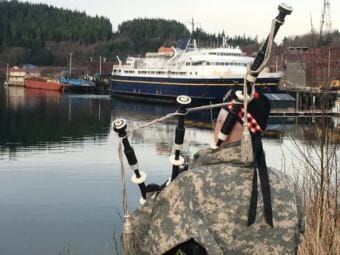
Rob Alley plays the bagpipes as a send off for the ferry Taku as the ship departs Ketchikan’s Ward Cove on March 13, 2018.
Rob Alley plays the bagpipes as a send off for the ferry Taku as it leaves Ketchikan’s Ward Cove on March 13, 2018. Alley first arrived in Alaska aboard the Taku in 1992. (Photo by Leila Kheiry/KRBD)

The former Alaska Marine Highway System ferry Taku left Ketchikan on Tuesday on what is either its final voyage, or toward its new life as a ferry in another part of the world.

About a dozen people gathered early in the morning at Ward Cove to wish the Taku farewell.

Ketchikan bagpiper Rob Alley played a send-off for the 55-year-old ferry Taku on her last day docked at Ketchikan’s Ward Cove. The Taku has been stored there since 2015, when the state took the ferry out of service.

Alley said he wanted to be part of the Taku’s farewell journey because that ferry was how he – along with so many others – first arrived in Alaska. Alley said it was 1992.

“And we slept out on the deck coming up here. We migrated up from Bellingham and it was a momentous experience,” he said. “I think there were other people on board coming up for the first time as well. The Taku, she carried us up here. It was like a member of our family. I’m getting kind of choked up just thinking about it.”

The Taku began its service in Alaska in 1963. It has carried countless people moving to Alaska, like Alley. It also carried Southeast Alaska school groups and so many others, traveling between communities for competitions and events.

Alley said the Taku and all the Alaska Marine Highway System ferries mean so much to the region.

“It’s more than just a highway. It’s a superconnection between family members in one part of Alaska and another,” he said. “It’s not just about work and play, it’s about the family here that we have in Southeast Alaska.”

The Taku was taken out of service due to its age, along with maintenance costs and budget cuts. The State of Alaska decided to sell the ferry in 2017, with an initial minimum bid of $1.5 million. There were no takers, though, and the price dropped.

Jabal al Lawz Trading is the Dubai-based company that finally bought the Taku for $171,000. The sale became final in mid-January.

Company co-owner Ben Evans has said that the ferry is in great shape and they hope to sell it for further service as a ferry. Otherwise, it will be sold for scrap.

Capt. Bill Hopkins was among those watching as the Taku prepared to leave. He served on the ship in a variety of roles, and said he was a relief captain on board when the Taku made its maiden voyage to Bellingham.

“I remember we got to the dock down there, a big greeting committee from the Port of Bellingham. They presented us with a big plaque with a ship’s bell on it. Really nice,” he said. “We put that on the Taku, but years later a passenger stole it. It disappeared. Somebody has a really nice trophy from the Taku.”

Hopkins has sailed on the Taku as third mate, second mate and chief mate, as well as relief captain. He said watching the Taku leave is sad.

“Because it’s going to happen to our other vessels, too,” he said. “They don’t last forever. Almost, though. It’s been a long time.”

Sounding its horn, the Taku backed out slowly. Everyone on shore took photos or videos, and a drone flew overhead shooting aerial footage. The ship rotated in the cove to face the Tongass Narrows before heading out.

From Ketchikan, the Taku’s planned 11,500-mile trip will take her first to Seattle, then Hawaii before sailing to the Philippines, Singapore and India.

Haida weaver Delores Churchill replicates ancient hat

Spruce-root hat by Delores Churchill. (Photo courtesy of Sealaska Heritage Institute)

Sealaska Heritage Institute earlier this year acquired a spruce-root hat made by Haida weaver Delores Churchill.

The hat is a replica of one found with ancient remains.

The original hat was found in 1999 in a melting glacier by three hunters in a British Columbia park.

Mummified human remains were found with it, and a helicopter was sent to retrieve the remains and artifacts.

Churchill said when she heard about the hat, she wanted to learn more.

“When the helicopter was landing, the first thing they saw was this hat, this spruce root hat,” Churchill said. “They didn’t know it was spruce root at that time, but they saw this hat, and I became so excited. I felt an instant connection because I’m a weaver and I needed to see that hat.”

According to Sealaska Heritage Institute, the man is believed to have lived approximately 570 to 620 years ago.

Pollen samples and other evidence indicated he traveled between the coast and inland.

He was given a name in the Tutchone First Nations language that translates as “Long Ago Person Found.”

Churchill said through DNA analysis, she found out that she was related to him.

“Amazingly, the only people related to this man are Tlingit, Haida and Bella Coola. The people who live there, if they’re related to him, it’s not through Champagne and Aishihik or Tutchone, it’s through Tlingit.”

Delores Churchill receives the Lifetime Achievement Award from Central Council of Tlingit and Haida Indian Tribes president Richard Peterson in 2017 (Photo courtesy CCTHITA).

Churchill said Sealaska and the Village of Klukwan wrote letters on her behalf requesting that she be allowed to study the hat.

She was granted permission and discovered though mostly of Tlingit design, a variety of weaving techniques were used.

“Haidas weave counterclockwise and Tlingit weave clockwise. But there’s an area down near the edge of the hat where there are two rows that are going counterclockwise,” she said. “Whoever did this hat knew both Haida and Tlingit techniques.”

She also rediscovered an extremely complicated edge known as the six-strand ending.

Churchill decided to add an ermine pelt to her replica of the hat.

“Because he probably was a high caste person to be able to be travel between (the coast and inland) in that country, so I put an ermine on it.”

Churchill considers herself a life-long student.

“Like I tell everyone, I am not a master. I am always studying. The people who wove the material in the museums, they’re the masters, and I’m still learning.”

Churchill was commissioned by Sealaska Heritage Institute, with support from the Rasmuson Foundation, to make the replica.


Here is the complete 20-minute interview with Churchill where she gives more details about the hat, weaving techniques and her studies.

Site notifications
Update notification options
Subscribe to notifications