KRBD - Ketchikan

KRBD is our partner station in Ketchikan. KTOO collaborates with partners across the state to cover important news and to share stories with our audiences.

Prince of Wales residents testify about spotty, nonexistent cell and internet

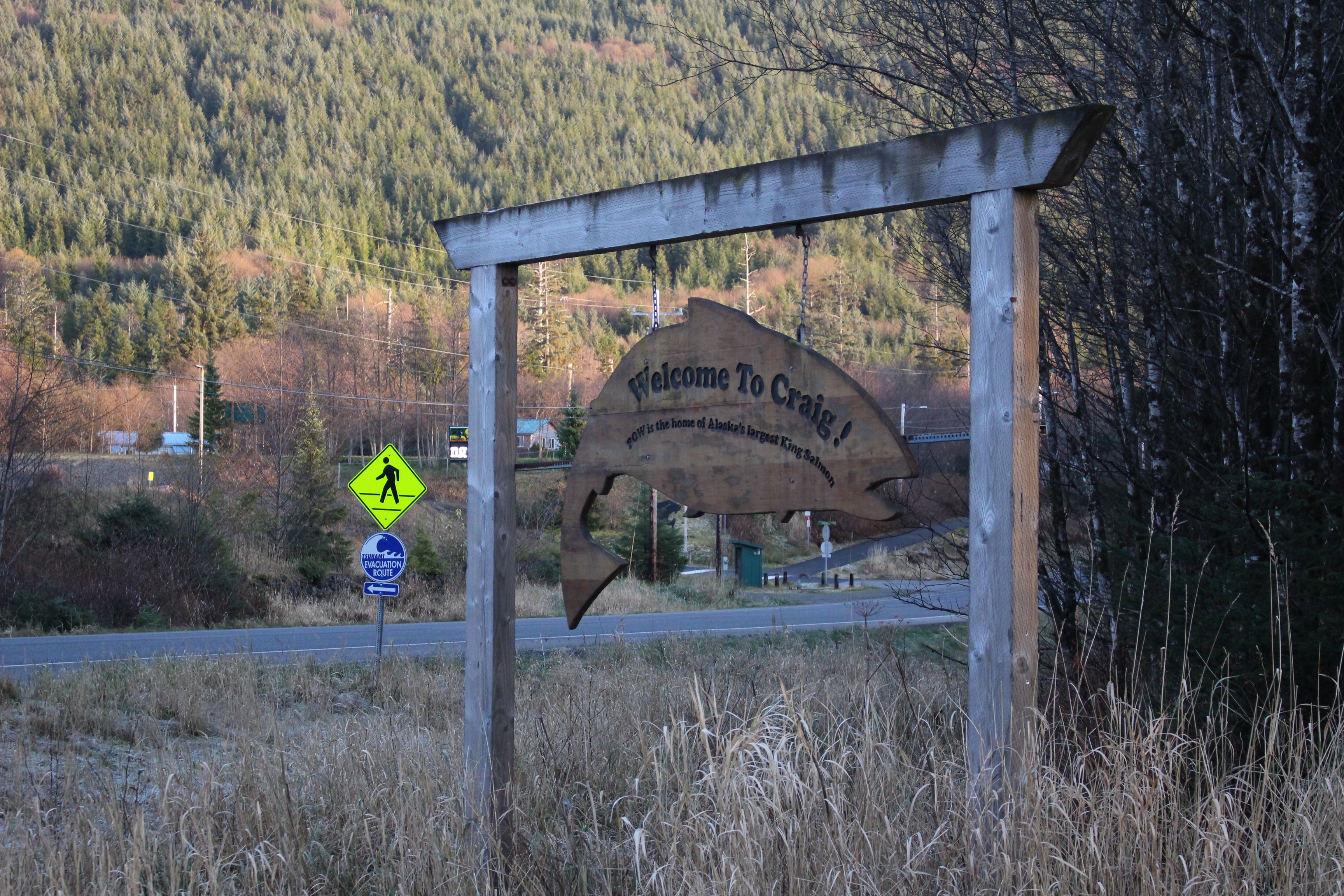
POW Craig sign (Photo by Elizabeth Jenkins/Alaska's Energy Desk)
POW Craig sign (Photo by Elizabeth Jenkins/Alaska’s Energy Desk)

Prince of Wales Island residents testified about limited internet, cell and landline service on the island during a public conference last week with the Regulatory Commission of Alaska.

Underscoring the problem, many of those testifying by phone from the big island were difficult to understand because of poor connections.

Most were quite clear, though, that they want something to change.

The Juneau hearing was chaired by James L. Walker, administrative law judge for the RCA.

Commissioners listened in, either in person or by phone from Anchorage as person after person talked about how better connections would help Prince of Wales.

A big concern is the ability to respond to emergencies.

Tyler Poelstra in Edna Bay said there’s no central power in towns like his, so options such as satellite internet, don’t work.

Poelstra said only three households in Edna Bay have a landline, and his is one of the few homes that’s elevated enough to also receive a cell signal.

During a recent tsunami alert, Poelstra said he was pretty much the only person who received an alert message.

“Once we got the notification, I was able to call, find out we needed to take this seriously, and it unfortunately put me in the position of having to drive to all the homes of people who don’t have working phone service and reach them in the middle of the night when their power is off,” he said. “That put my life in danger, and I had to make a judgment call on which homes I could reach and which ones I couldn’t. That’s not a position anyone should have to be in.”

Karen Peterson of Thorne Bay has a booster at her home to improve cell service there.

It still cuts out, she said, but it’s better than nothing.

Once she leaves her house, though, she can’t rely on her cell phone.

“From a pure emergency response standpoint, better and improved service that is covering all of Prince of Wales Island is a big necessity here in Southern Southeast Alaska,” she said.

Thorne Bay Administrator Wayne Benner concurred, adding that cell service is imperative for economic development, as well.

He said cell providers in different towns don’t “talk” to each other, so even if a community has service, it won’t always work for someone from another town.

Other speakers talked about large coverage gaps when driving the road system.

Misty Fitzpatrick traveled from Coffman Cove to testify in person in Juneau.

She said island residents have found special spots where cell service is available. There’s a tree near the beach in Whale Pass, for example.

“And they call it the cell phone tree. There’s a little sign on it. A homemade sign made out of wood. It says, ‘The Cell Phone Tree,’” she said. “In the right weather conditions, you can stand under the tree and get enough of a signal to make a call.”

In Naukati Bay, Fitzpatrick said there’s a pullout on the road outside of town they call the Phone Booth.

In other places, she said, cell phones can get a couple of bars with a booster, or if you are at a high enough elevation.

Fitzpatrick said that prompts a question: “If the signal is so close, why can’t a telecommunications company take it and boost it into something more usable?”

Michael Garrett is CEO of Alaska Power and Telephone, a landline and broadband provider for some communities on Prince of Wales.

He said they’ve been working on improvements, including fiber connections to improve internet speed.

Garrett said AP&T is not a wireless provider.

“But we can provide infrastructure that could help support the provision of the services on the island,” he said.

AP&T has a microwave connection to Ketchikan, Garrett said, which could be used to improve or expand cell service.

“We have the facilities to do that and we’ve talked with the carriers,” he said. “But, you know you can lead a horse to water but you can’t make them drink.”

The Regulatory Commission of Alaska regulates public utilities in the state. The RCA does not currently regulate cell or internet service, although the Legislature last year asked the commission to gather information about those services in Alaska.

The conference on Prince of Wales cell and internet service was requested by Rep. Jonathan Kreiss-Tomkins, who represents some Prince of Wales Island communities.
Body of snowboarder caught in avalanche recovered

Ketchikan Volunteer Rescue Squad teams concluded their recovery efforts Thursday for a Ketchikan man caught Sunday in an avalanche on Dude Mountain.

The body of Marvin Scott, 39, has been recovered, Alaska State Trooper James Kimura confirmed Thursday evening.

Team members took advantage of a break in the weather to get back on the mountain, said Jerry Kiffer, rescue squad principal officer.

They were helicoptered to a spot above the avalanche debris field, and started digging test holes to determine the snowpack’s stability.

“The results from those pits were OK enough for us to proceed downhill toward the avalanche site,” he said.

On Thursday evening, Kiffer said the teams finished their work, hiked down the trail and were headed down Brown Mountain Road via snowmachine.

Kiffer added that the rescue squad appreciates the community’s support in this, and other search efforts.

“The situation obviously is a tragedy,” he said. “A lot of our (team members) were friends and acquaintances with the victim. It hits everybody really hard. As our people are out working in the field to get the job done, we really appreciate the community’s support with the operation.”

Scott was snowboarding about noon Sunday on Dude Mountain with a friend when the avalanche was triggered.

Scott was buried in the snow. The friend tried to dig Scott out, using Scott’s avalanche beacon as a guide, but wasn’t able to find him.

Without cell phone coverage, the friend had to hike out before he could call for help.

It was too late Sunday to launch a recovery effort.

Teams tried Monday, but bad weather forced them back down the mountain and kept them off until Thursday.

Stedman sponsors resolution to control sea otter growth

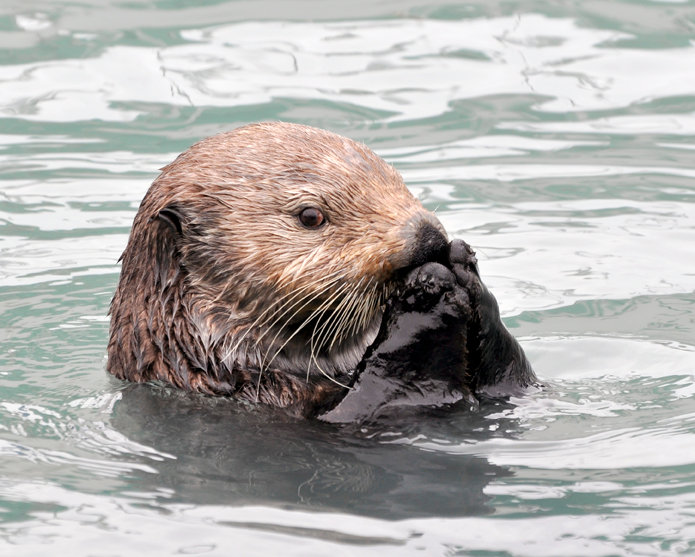
A sea otter in Resurrection Bay.
A sea otter in Resurrection Bay. (Photo by Heather Bryant)

A Senate resolution seeking an increase in the number of sea otters hunted in Southeast Alaska is making its way through the legislative process.

Sitka Republican Sen. Bert Stedman said the Senate Joint Resolution 13  is a way for the state to ask the federal government to do something about Southeast’s increasing otter population.

“I think this is a good starting point for the conversation,” he said. “We live a different lifestyle up here, and we want to preserve it and keep it in balance. And having the sea otters virtually run unchecked in Southeast puts some of our communities in peril dealing with subsistence. As an example: Kake, I’ve been told, is down to one clam bed for the community. Everything around the community has been ate up by sea otters.”

Sea otters’ primary food source is shellfish.

In recent years, otters have been blamed for less plentiful shellfish available for commercial and personal harvests.

As the resolution notes, after their population was decimated by unchecked hunting in the early 1900s, about 400 sea otters were reintroduced to the region in the mid-1960s.

The population of sea otters has increased significantly since then.

The resolution gives a 2010 estimate of 11,000, with an annual growth rate of 13 percent.

Sea otters are a federally protected species under the 1972 Marine Mammal Protection Act.

Only Alaska Natives are allowed to hunt them.

Stedman’s resolution calls for the state and federal governments to work with Alaska Native leaders to come up with a new plan to manage sea otters.

One suggestion in the resolution would allow Alaska Natives to assign their individual right to hunt otters to anyone with a state hunting license.

Stedman said it’s practically impossible that anyone currently hunting otters for their livelihood would get pushed out by such a move.

“We’ve had difficulty even getting to the targeted harvest quota of sea otters of roughly – several years ago, it was 2,500, if I recall,” he said. “Now that number is going to be substantially larger because the mass has gotten bigger. I don’t believe that’s going to be the outcome of this at all.”

Stedman said the goal is to check the population and allow for a shellfish industry.

“What we’re trying to do here is get the attention of the U.S. Fish and Wildlife Service that we have a problem and ignoring it on their end creates a lot of problems for people who live in Southeast that rely on subsistence lifestyle to feed their families, and it also impacts our commercial shellfish industry substantially,” he said.

Another way to increase sea otter hunting would be a local, reasonably priced way to process pelts.

Stedman said a tannery needs product, and more pelts would help such a business become feasible.

He stressed that he doesn’t want to eliminate sea otters in Southeast.

“Even if you go to their guideline harvest quotas, all you’ll be doing is slowing down the expansion,” he said.

SJR13 heads to the Senate Resources Committee for its first hearing next week.

The resolution isn’t Stedman’s first attempt at controlling the sea otter population in Southeast.

He sponsored an unsuccessful bill in 2013 that called for a $100 bounty on sea otters.

Coast Guard investigating diving death near Metlakatla

A Metlakatla man died last week while diving for geoducks in the Annette Island reserve area. The U.S. Coast Guard is investigating the death, but at this time it is considered accidental.

The Feb. 21 accident is close on the heels of an earlier diving death near Metlakatla. A man died in January while fishing for sea cucumbers, according to Lt. Dave Evans of the Ketchikan Marine Safety Detachment.

Evans is a marine casualty investigator with the Coast Guard, and is leading the investigation into both deaths.

He said crew members on the boat during last week’s accident noticed something was wrong and sent divers down to check on the man.

“And they found that he was unresponsive, so they brought him to the surface and started CPR, because all of them are trained in CPR,” he said. “(They) transferred him to the Coast Guard small boat, where they sent the individual over to PeaceHealth Ketchikan Medical Center. He was pronounced deceased.”

Evans declined to identify the man or the vessel, and Metlakatla officials declined to comment.

Evans said the cause of death is not yet known. A report is pending from the state Medical Examiner.

Evans said the Coast Guard also is analyzing the dive equipment. He stressed that the goal of the investigation is to improve safety.

“If we notice any kind of – a group of problems that’s happening, to where we need to create a new regulation to make it safer for these guys out on the water, then we’ll do that,” he said. “That’s kind of the point of Coast Guard marine casualty investigations in general.”

The January sea cucumber dive death happened on Jan. 10, Evans said. The man was found on the surface of the water, and was taken to Metlakatla’s clinic where he was pronounced dead.

Despite two deaths in a short time frame, Evans praised Metlakatla’s dive-safety training programs.

“To be able to get a permit from the fisheries manager, you have to have open water training, dive safety training, advanced open water training, and these are all real dive trainings that they go outside of this area to take, and then they have CPR and First Aid training,” he said. “So, these are certificates that these individuals hold. From my basic understanding, Metlakatla is one of the best trained as far as dive safety.”

But, Evans said, diving can be dangerous and accidents happen, even to a well-trained diver.

Annette Island is Alaska’s only Native reserve. The community of Metlakatla is about 40 miles from Ketchikan.

Forest Service chief, Murkowski hear from Tongass stakeholders

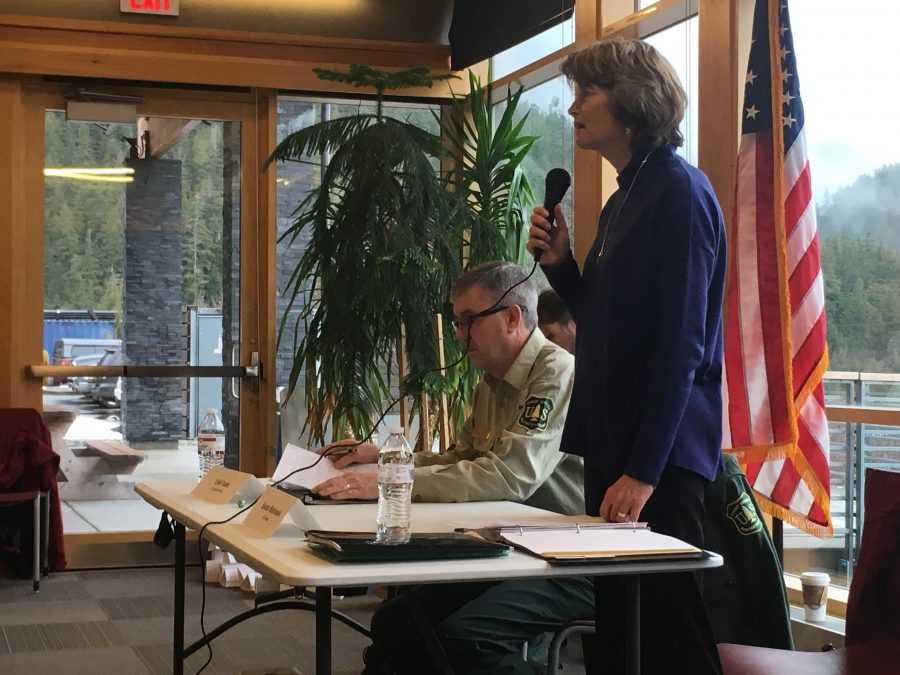
Sen. Lisa Murkowski speaks before a panel discussion about the Tongass National Forest Friday at the Ketchikan library. Seated is U.S. Forest Service Chief Tony Tooke. (Photo by Leila Kheiry/KRBD)
U.S. Sen. Lisa Murkowski speaks before a panel discussion about the Tongass National Forest Friday at the Ketchikan library. Seated is U.S. Forest Service Chief Tony Tooke. (Photo by Leila Kheiry/KRBD)

If one had to choose a theme for Sen. Lisa Murkowski’s roundtable discussions on the Tongass National Forest, it would be “access.”

Over and over, the senator and U.S. Forest Service Chief Tony Tooke heard panelists say they need more access to the forest: through roads, through less-cumbersome permitting, through whatever means. They want access.

It was a nearly three-hour discussion Friday at the Ketchikan public library.

“The communities on the island have said this over and over again: Access to the forest, access to the forest. It’s so important,” Jon Bolling, administrator for the City of Craig, told Murkowski and Tooke. “Those roads are a wonderful public asset that are best left kept open. Because when they’re kept open, they’re used. I could go on way longer than you want me to talking about the merits of keeping the roads open and the benefits to the people of Prince of Wales. It’s just so key.”

Bolling was one of many panelists chosen for a couple of public roundtable discussions about the Tongass National Forest.

There were two panels because there were so many panelists and They represented a wide variety of interests.

A few environmental groups were invited, along with Sealaska Native Corp’s Jaeleen Kookesh.

But, the panels leaned toward industry, commerce, and state and local governments.

For example, Ketchikan Gateway Borough Mayor David Landis told Tooke that the borough is more than 96 percent Forest Service land, with just a tiny amount available for development and taxation.

Landis said historically that was OK because of all the jobs available on national land, most notably timber.

But, he said, those jobs went away as the Forest Service started limiting the timber supply.

In response, Congress provided a Payment in Lieu of Taxes and Secure Rural Schools payments, but now those amounts are seeing cuts, too.

“That distresses us, and we’re finding way to fill those holes,” Landis said. “But, to be honest, we would rather have the jobs back.”

For Landis and Bolling, access would be improved by an exemption for the Tongass from the national Roadless Rule — which doesn’t allow new roads to be built in certain areas of the forest — as well as access for timber harvest.

The State of Alaska has filed a petition asking that the region be exempt from the Roadless Rule.

Access for other panelists means permits.

Ben Anderson, who owns a heliski business in Haines, is trying to get a permit to expand onto Tongass land.

They submitted their permit application in March of last year.

“We were told that it would take three years before the application would be reviewed,” he said. “Once it was reviewed, an environmental impact survey would most likely need to take place, and would take an unknown amount of time.”

Another recurring theme for many panelists was the plan for transitioning to a young-growth timber industry. The Forest Service went through a long process to come up with a transition plan that calls for a complete switch in 15 years.

Timber industry representatives have said, and continue to say that’s not feasible.

Bryce Dahlstrom from Viking Lumber on Prince of Wales Island said instead of switching from one to another, a solution would be to allow both, because his mill just can’t process young growth, and never will.

Dahlstrom gave an analogy: “I put it towards a fishing boat. You have a crew that you fish salmon. Your crew knows how to fish salmon. Your gear, your boat is set up to catch salmon. All of a sudden, someone comes and said, well you can’t catch salmon anymore, you’ve gotta catch halibut. Because, politically, we don’t want you to catch salmon anymore.”

Some of the conservationists on the panel, though, say the transition plan was the result of a great collaborative effort that shouldn’t be discounted.

Andrew Thoms is with the Sitka Conservation Society, and was a member of the Tongass Advisory Committee.

The advisory committee came up with the blueprint for transitioning to second growth.

“I would say that the recommendations that we made are one of the best blueprints for a viable approach to Tongass management,” he said. “The recommendations are the assemblage of a huge wealth of experience and knowledge from people on the Tongass who work with the agency and with other stakeholders and landowner groups.”

Other panelists talked about the need to protect fish streams and fisheries in general; still others talked about the need to build electric utility infrastructure, and how challenging the federal permit process is for that work.

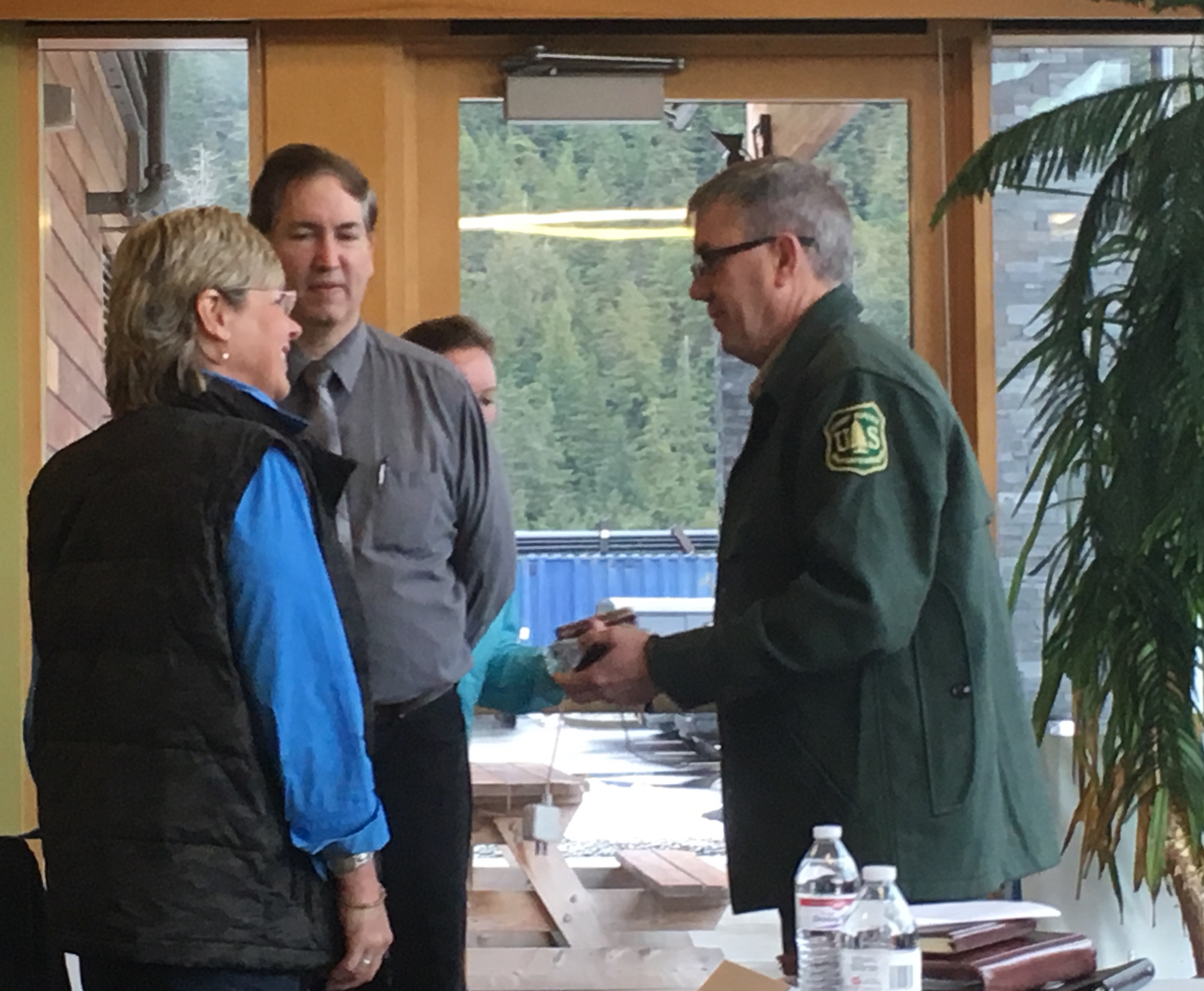
Forest Service Chief Tony Tooke, right, talks with panelists before Friday’s event at the Ketchikan library. (Photo by Leila Kheiry/KRBD)

Tooke was listening for common themes – such as access — and proposed solutions – such as a slower transition to young growth. After the discussion, He’ll take what he heard back to Washington, D.C., for discussions with the Secretary of Agriculture.

Tooke said he heard about the quantity of young growth that would be needed to keep a mill running, and “I heard about timing around permitting. I heard a lot about using science and using data. That seemed to be really important to people, no matter who they were, that they have really informed decisions.”

Murkowski said hearing directly from people who live and work on the forest was valuable for Tooke, and that’s why she invited him to visit Ketchikan and Prince of Wales Island.

She said it appears that with President Donald Trump’s administration, access to public lands will become easier.

“You have a new administration that has been relatively aggressive in talking about accessing America’s resources,” she said. “There hasn’t been the same spotlight on timber and management of our forests, you’re talking access generally. I think you have, at least at the top, I think you have a different perspective that we had.”

City of Ketchikan to try again to sell former youth facility

The Ketchikan Regional Youth Facility will close Sept. 15th due to state budget cuts. (Leila Kheiry, KRBD)
The Ketchikan Regional Youth Facility will close Sept. 15, 2016, due to state budget cuts. (Leila Kheiry/KRBD)

The Ketchikan City Council decided Thursday to try selling the former Ketchikan Regional Youth Facility without setting a minimum bid.

The state closed the youth detention center in fall of 2016.

The property reverted back to the City of Ketchikan, and has been vacant.

The city tried selling it for its appraised value of about $1.4 million, but there were no bids.

Agnes Moran of Women in Safe Homes spoke to the council about the facility.

Her organization is interested in the building as a possible transitional housing service. But, she said, there are some big obstacles.

“A) The cost of renovating it are very, very high because it’s such a secure facility and B) the cost of operating it in its current configuration also is high,” she said. “If you look at the numbers from 2015, the utilities on that building for water, electric and heat was $37,000, which is pretty much beyond the scope of any nonprofit to run it in its current configuration.”

Part of that expense is because of the large-diameter water pipe, which Moran said puts the facility in a more expensive water-rate classification. But, she said, if the building is renovated or somehow made more affordable, it could be useful.

Moran said WISH and First City Homeless Services have applied for a grant for transitional housing funds.

During council discussion of the issue, Council Member Mark Flora spoke in favor of selling it as soon as possible.

He said the building is a special-use institutional facility with no real market appeal.

“We’re gonna keep pumping money into heat and electricity while it slowly falls down,” he said. “And if we don’t do something pretty soon, we’re gonna wake up in five years and have something that’s worth nothing.”

Council Member Bob Sivertsen agreed, and suggested choosing an option of selling the facility without a minimum bid. But, the council has the power to reject any bids.

The council didn’t vote on the issue, but gave direction for management to move forward with that, and bring something back for the council.

Also Thursday, the council approved three ordinances in first reading that will increase utility rates. This year’s budget is based on rate increases of 6 percent for wastewater, 5 percent for electricity, and 5.5 percent for water. Seafood processor water rates are to go up 35 percent.

The ordinances will come back for a second reading.

Port and Harbors Director Steve Corporon told the council that water rates for cruise ships also will go up, by 20 percent.

Site notifications
Update notification options
Subscribe to notifications