KRBD - Ketchikan

KRBD is our partner station in Ketchikan. KTOO collaborates with partners across the state to cover important news and to share stories with our audiences.

Ketchikan substance abuse specialists talk treatment options

Like the rest of the nation, Ketchikan has seen an increase in people abusing opioids. But, some local experts say it doesn’t mean there are that many more addicts overall – it’s just a change in what they’re addicted to.

For this special report, we talked with three local substance abuse treatment specialists about the problem and treatment options available in Alaska’s First City.
Opioids is a term for a variety of drugs, some available legally if prescribed by a doctor, like oxycodone; others illegal in any form, such as heroin.

All are addictive, even the prescriptions. And, many people who become addicted start with a prescription.

Throughout the United States, including Ketchikan, opioid addiction has increased in recent years.

And yes, says Akeela Gateway Clinical Program Director Ruth Bullock, opioid addiction is a problem.

“I also think meth is a problem,” she said. “And alcohol is certainly a problem.”

Steve Parker, a substance abuse counselor at Gateway, says national and local addiction levels haven’t changed much overall. It has been about 20 percent of the population historically, and it’s still about 20 percent.

What changes, he says, is what people are abusing.

“I don’t see the opiate epidemic as anything but a switch from one drug to another drug that will probably switch to another drug and then back to the other drug, leaving the population that’s addicted at 20 percent,” he said.

He and Bullock agree that alcohol is, and always has been, a much bigger problem in Ketchikan than any other substance.

“But, because it’s the drug of choice of ‘normal’ people, there’s never an epidemic of it,” he said. “At the KAR House right now – which is the treatment facility – we have probably around…”

“You said about four times the number of alcoholics as the number of opioid addicts right now,” Bullock said.

Parker says Gateway treats addiction as addiction, no matter the substance used. Detox is different, though, because that process for certain substances — alcohol, especially — can be deadly.

There is no designated detox facility in Ketchikan. Some people have to leave town for that kind of service.

Gateway offers intensive outpatient – which is lots of group and individual therapy – and less intensive follow-up outpatient services. They also have a small residential program at the KAR House.

Gateway is looking into adding medically assisted treatment for opioid addiction. Bullock says it’s in the exploration phase, to see if it’s something that can work for the center.

Right now, there’s only one physician in Ketchikan who provides medically assisted treatment, prescribing low-level opioids to help people get off the hard stuff.

Dr. Wynelle Snow is a psychiatrist who has been working in addiction treatment for decades, starting on the East Coast.

“There wasn’t a lot of options then for detoxification,” she said. “We had a lot of methadone clinics in Connecticut.”

But, Snow says, people had to visit a certified methadone clinic daily to get their dose.

Other treatments were inpatient only, such as buprenorphine injections.

“The buprenorphine itself is an opiate, and it’s not a full stimulator at the opiate receptors, it’s a partial stimulator,” she said.

So, it fills in those opiate receptors and dulls withdrawal symptoms.

Buprenorphine later was developed into an outpatient medication commonly called Suboxone. That’s what Snow prescribes to her patients for detox and maintenance.

“A number of other doctors in town thought I should strictly use it to just detoxify people from opiates,” she said. “However, if you read all the studies, the people who were detoxified with Suboxone had a better chance of maintaining abstinence if they were on it as a maintenance medication for at least a year.”

And sometimes longer.

Snow says she used to believe that complete abstinence was the only way to go, but she’s since come to think that some people who are addicted to opioids need to be on maintenance for many years.

Snow explains that we all have opioid receptors because our bodies make opioids. They’re called endorphins – feel-good hormones. We make those when we exercise, eat chocolate, have an orgasm.

When people abuse opioids, she says, they overstimulate those receptors and their bodies stop making endorphins.

“Your body, through its feedback mechanisms decides: ‘There’s no reason for us to be making endorphins anymore. We have all this stimulation coming our way, anyway,’” she said.

For some of those people, their bodies completely forget – maybe forever – how to make natural endorphins. So, exercise, etc., won’t help.

Snow agrees that opioid addiction has grown in recent years. When she first arrived in Ketchikan in the late-1990s, it was more cocaine; later it was methamphetamine. But then prescription opioids started making inroads. Drug manufacturers have since changed the formula for those prescriptions so they couldn’t be abused as easily, Snow says.

“I remember the drug rep from Purdue came by my office and said, ‘Oh, I’ve got great news. We’ve changed the formulation for Oxycontin so it can’t be abused anymore,’” she said. “And my thought was, ‘That’s not great news. People will just start using heroin now.’”

And, she says, that’s what happened.

A third treatment provider in town is Ketchikan Indian Community’s clinic. Craig Ward is the substance abuse prevention coordinator there. He agrees that what people are addicted to has changed in recent years. And, he says, opioids hit a different segment of the population.

“There are plenty of people who say, ‘I’m not that person you see at the bus stop that’s inebriated. I’m not that person,’” he said.

KIC’s substance treatment program is outpatient only, and focuses on people who need a lower level of support – such as those who have already gone through detox and intensive therapy.

And often, they see the same people come back. The success rate for addiction treatment is low nationwide, and even those who are successful often need to go through treatment multiple times.

Because they get some state funding, KIC offers group and individual therapy to all residents, Ward says, not just tribal members. He says they saw 133 people in the past year.

“Our most common substance is alcohol, no doubt about it,” he said. “Our second most common substance is opiates. Then cannabis. Then methamphetamine.”

Alcohol always has been and probably will continue to be the biggest substance abuse problem in Ketchikan. But, Ward says, their number of alcohol-addicted clients has dropped over the past two years.

Why is that?

“Why alcohol is not as big of a problem? Because law enforcement is busy with opiate problems,” he said.

Which means people aren’t getting arrested as often, and sent to them as often. So, the problem is still there.

That’s the thing about substance abuse. The problem is always still there.

Green sponge discovered in Southeast could treat some cancers

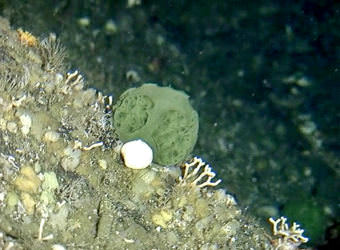
A green sponge found in the waters near Sitka could hold the key to curing pancreatic and ovarian cancer. (Photo courtesy NOAA Fisheries)

A green sponge discovered in 2005 in Southeast Alaska waters has unique properties that could be used to treat certain types of cancer.

The National Oceanic and Atmospheric Administration hosted a news conference Wednesday morning.

Bob Stone is a Juneau-based coral and sponge biologist with NOAA Fisheries, but he works all over Alaska’s oceans.

He was in a submersible, conducting habitat surveys off Baranof Island south of Sitka when he saw it.

“The second I saw it, I thought I should collect it,” he said. “I didn’t know what it was, (and) I like to collect anything I’m not familiar with.”

It was a green sponge — unusual for the region, where sponges are more of a brownish color.

Stone said it looked like some sponges he had been collecting in the Aleutians for Mark Hamann, a cancer researcher for the Medical University of South Carolina.

Those Aleutian sponges contain potentially useful biomedical compounds, and Stone said he suspected this one might, too.

“This was an undescribed species of sponge, but in the same genus as the ones from the Aleutian Islands,” Stone said.

Sponges don’t move, so to survive, they produce special compounds that help ward off predators. And, according to NOAA, some of those compounds can be developed for human medical treatments.

Another cancer researcher, Fred Valeriote of the Detroit-based Henry Ford Cancer Institute said he investigates natural products for potential treatments, and has collaborated with Hamann in the past.

Valeriote said Hamann’s lab studied the chemical diversity of that green sponge, and then sent an extract to the Detroit lab for them to take a look.

“We did that, and we found that this extract and eventually the pure compound that Mark discovered from the extract, had selective activity in our tissue-culture system for both pancreatic cancer and ovarian cancer,” Valeriote said.

The extract appears to target and kill tumor cells for those types of cancer, without also hurting normal cells. Those slow-growing cancers don’t typically respond to conventional treatments, such as chemotherapy.

Valeriote said he has looked at thousands of sponges, and found only one other that contains a molecule with similar effects.

The next step is to obtain more of the green sponge’s special cancer-killing molecule.

Collecting more sponges is one option, but challenging because of their limited habitat. The sponge’s known range is about 1,000 miles, from Southeast Alaska toward the waters off Washington State.

“Not only is the sponge relatively rare, then it turns out that the molecule is actually in very small quantities in the sponge, and at times perhaps not even in detectable quantities,” Hamann said.

Hamann is working on synthesizing the molecule in the lab.

This discovery is exciting, he said. He’s been doing this kind of research for more than two decades.

“We’ve been looking at sponges, plants, marine invertebrates, and bacteria,” he said. “This is certainly, for us, the best and most exciting-looking candidate for the control of pancreatic cancer that we’ve come across in that 20-year period.”

The unique molecule likely developed in the sponge in response to its habitat.

NOAA Fisheries science director Doug DeMaster said the sponge is found in patches from depths of 230 to 720 feet.

“It’s pretty remarkable that while the ocean covers 70 percent of this planet, and nearly half the U.S. population lives within 12 miles of the ocean, less than 5 percent of the ocean has been explored,” he said during the news conference. “The discovery of this green sponge shows the promise of the untapped potential of the ocean, (and) the possibility that a life-saving medical discovery is within our reach.”

But not for at least a dozen years, if at all. The development process takes time.

Although it’s looking good, it’ll be a while before we know for sure whether a relatively rare green sponge from Alaska will help save human lives.

Joplin pleads not guilty to murder, theft in Ketchikan doctor’s death

Jordan Joplin leaves the courtroom in the Ketchikan State Building after he pleaded not guilty to first- and second-degree murder. (Photo by Leila Kheiry/KRBD)

A 32-year-old Washington state man pleaded not guilty Monday to first- and second-degree murder charges related to the March 16 death of Ketchikan surgeon Dr. Eric Garcia.

Jordan Joplin arrived at the Ketchikan courthouse in handcuffs, ankle chains and a yellow jumpsuit, accompanied by an Alaska State Trooper.

Friends of Garcia along with local police and media observed the short hearing, which Juneau Superior Court Judge Phillip Pallenberg conducted by phone.

The case has been assigned to Ketchikan Superior Court Judge Trevor Stephens, but Stephens is out of town.

Joplin was indicted on Friday on the murder charges.

He already had been indicted on related charges of first-degree theft, and has been in custody since late March on those earlier charges.

A trial already has been scheduled in the case, starting Aug. 14, but as Pallenberg noted Monday afternoon, the new charges likely will delay that trial.

“It’s not my case, but it certainly does not appear likely that a case of this magnitude could be prepared for trial in the weeks that remain before that August trial date on the new charges,” he said. “I would tend to view that as essentially a placeholder trial date and I wouldn’t think that counsel should be anticipating that it is at all likely that the case will proceed to trial in August. But, that’s a matter I think you’ll have to discuss with Judge Stephens.”

A scheduling hearing with Stephens has been set for 8:30 a.m. Aug. 2.

Joplin remains in custody on $200,000 bail.

Prosecutors have so far not revealed the cause of Garcia’s death.

Police said in March that there were no obvious causes after a routine autopsy, so a toxicology screening was ordered.

The results of that screening have not been announced.

Man indicted for murder in death of Ketchikan Dr. Eric Garcia

(Photo by V1ctor/Flickr Creative Commons)
(Photo by Victor/Flickr Creative Commons)

First- and second-degree murder charges have been filed against 32-year-old Jordan Joplin for the mid-March death of Ketchikan surgeon Dr. Eric Garcia.

Joplin has been in custody since late March on related theft charges. A Ketchikan Grand Jury Friday handed down indictments also charging him with homicide.

Dr. Eric Garcia was found dead on March 27 in the upstairs living room area of his home on Summit Avenue. Police say Jordan Joplin, of Maple Valley, Wash., had called to report that Garcia hadn’t been seen for about 10 days.

According to the complaint filed in court by police, Joplin told investigating officers that he had visited Garcia on March 16 and left Ketchikan the next day. Joplin identified himself as Dr. Garcia’s close friend.

After the body was discovered, it was sent to the state Medical Examiner’s Office for an autopsy as a matter of routine. In the meantime, police say they learned Garcia had some valuable collections that were missing. Money also was missing from Garcia’s bank account.

Police announced in late March that they allegedly found evidence Joplin had shipped items to himself, and initiated electronic bank transfers on March 17, the day after Garcia is believed to have died.

The Ketchikan Police Department's headquarters.
The Ketchikan Police Department’s headquarters. (Photo courtesy KRBD)

Local police worked with law enforcement in Washington State to intercept the shipped items.

Here’s Deputy Chief Josh Dossett, speaking to reporters on March 31: “Officers recovered a large amount of Dr. Garcia’s property. An arrest warrant was issued for Mr. Joplin for theft in the first degree. Officers contacted Mr. Joplin a short time ago as he attempted to pick up the property, and he chose not to speak with officers.”

Joplin later was extradited to Ketchikan, where he already had been indicted on charges of first-degree theft. The murder indictments were added following additional investigation into Garcia’s death.

Garcia had last been seen at his workplace, PeaceHealth Ketchikan Medical Center, at about noon on March 16. He had been due to travel for a week-long conference and wasn’t expected back for a while.

During the March 31 news conference, Dossett said autopsy results showed no obvious cause of death, so a toxicology screening had been ordered.

Ketchikan District Attorney Ben Hofmeister said after the murder indictment that he couldn’t comment on the cause of Garcia’s death, in part because it’s not yet in the public record.

“All I can tell you is there was a death investigation going on. I think you can tell from the complaint that, at that time, the reason why the death investigation started in the first place is because Dr. Garcia was found deceased in his own home,” he said. “Based on that information and the investigation that followed, we were able to proceed to the Grand Jury this week and succeed in the superseding indictment.”

Hofmeister said the cause of death could come out during a court hearing, or during trial, if the case goes that far.

Garcia was a general surgeon at PeaceHealth Ketchikan Medical Center for about 10 years.

Joplin is scheduled to be arraigned on the new charges at 2 p.m. Monday in Ketchikan Superior Court.  Another hearing on Joplin’s court schedule is August 4, with a trial currently scheduled to start on August 11, although, with the new charges that trial likely will be rescheduled.

Move to fire Ketchikan Borough manager fails

Two Ketchikan Gateway Borough Assembly members made a move Monday to fire Borough Manager Ruben Duran, who has been on the job about seven months.

Ketchikan Gateway Borough Manager Ruben Duran. (Photo by Leila Kheiry/KRBD)

The motion to fire Duran failed in a 5-2 vote following an open discussion of his job performance.

Duran requested the discussion be in public rather than executive session.

After stating that this wasn’t a witch hunt, Assembly member Mike Painter led the charge against Duran.

Painter said he has been told that morale is low among borough employees, and that Duran’s work hours are not regular.

“I’ve heard from many people that typically the borough manager comes to work at about 9:30 in the morning; 11:30, he goes to lunch; comes back from lunch at 1:30; by 3:30, he’s typically out of the office… The way I add that up, that’s four hours a day,” he said.

Painter also was unhappy with Duran’s decision to purchase a mural by a local artist for the borough-run airport.

The $7,500 mural bought under the borough manager’s discretion also was cited by Assembly member John Harrington, the second vote to fire Duran.

Ricardo Burquez’s landscape mural of the town was created for a Ketchikan Area Arts and Humanities Council exhibit last fall.

A proposal was brought forward at that time that the borough and City of Ketchikan buy the mural for $15,000, and display it at Ketchikan International Airport.

The Ketchikan City Council rejected that idea.

The artist more recently offered the mural for half the cost to the borough, and Duran – working with the Arts Council – purchased it for the airport.

The manager is allowed to make purchase decisions up to $25,000 without Assembly approval.

Others on the Assembly defended Duran. Assembly Member Glen Thompson says he has heard nothing but praise for Duran from the majority of borough department heads.

He added that the mural purchase didn’t violate any rules.

“As far as I can tell, the monies that were spent were spent properly under the appropriations that this body approved and placed in the manager’s hands,” he said. “If after the fact, we’re not happy with his decision, certainly we can tell him that. And I think he’s heard that maybe it could have been done a little bit differently tonight.”

Assembly member Judith McQuerry, participating by phone, agreed that borough staff she talked to like Duran’s management style.

Assembly Member Felix Wong said he appreciates Duran’s participation in community events. And Assembly Member Stephen Bradford said there are steps that should be taken before trying to fire someone.

Bradford asked whether Painter talked to Duran about his concerns.

Painter said he had not.

In response to Painter and Harrington, Duran said he believes in empowering staff to make decisions, but some people don’t like that management style.

Duran said he has heard and accepts the concerns about his decision to purchase the mural. Other accusations, he said, he won’t respond to.

“I’m not going to respond to innuendo, second-hand comments. I’m always working. I’ve been working since I was 13 years old. I quite frankly don’t know how to stop. I enjoy it. If I didn’t like it, I wouldn’t be doing this,” he said. “If I wanted to do something else, I’ll go do it. But while I am under contract with you, my fiduciary responsibility is to perform the duties of the borough manager and get the job done.”

Duran said he works at the office, at home and elsewhere.

The Assembly also talked at length Monday about community nonprofit grant funding. We’ll have more on that topic in a later report.

Healthy housing market shows Ketchikan’s resilience

The Ketchikan skyline. Creative Commons Photo by Dave Bezaire)
The Ketchikan skyline. (Creative Commons photo by Dave Bezaire)

Like many industries in the city, the story of Ketchikan’s housing market is closely tied to the shutdown of Ketchikan Pulp Company in 1997.

Gateway City Realty broker Bill Bolling said the local market is quite healthy now. He said the robust local economy is in part due to the closing of the mill.

“If there was any silver lining in the loss of our mill, it was the diversification of our economy,” he said.

Ketchikan’s economy suffered in the years following the shuttering of the mill. The Great Recession affected Ketchikan just like it did the rest of the country. But the city bounced back, and so did the housing market.

“And then somewhere around 2012, 2013, things seemed to change for us, so far as activity and the number of sales, and prices started rising again,” Bolling said.

Bolling said real estate companies have seen Ketchikan become more of a seller’s market in recent years.

“There’s not a lot of product out there for people to look at or buy,” he said. “And so, it’s a macroeconomic love affair. There’s a lot of demand and not as much supply.”

Mary Wanzer, a broker for Coastal Real Estate Group, agreed.

“We’re seeing homes going on the market and selling within two or three days and getting multiple offers,” she said.

The average price of a single-family home in Ketchikan in 2016 was about $320,000. This is more than the national average price, which in June 2016 sat just above $290,000. Here’s Wanzer again.

“It stayed the same for quite a while, but I’d say definitely in the last three years, the average home price has increased,” she said. “Probably five to 10 percent in the last year would be my guess, without actually looking at all the data.”

She said companies are seeing more people coming to Ketchikan and building new houses.

“What we are seeing are [sic] more new construction,” Wanzer said. “So we’re seeing build-outs in areas like Emerald Forest, Ravenwood, White Rock. So we’re getting new construction, so more of a housing development that we haven’t seen in the past.”

Bolling attributes the market’s strength to the people of Ketchikan.

“Ketchikan has really been, kinda, this little engine that could,” he said. “And people here are tough. I mean, I think I’ve seen more businesses opened up since the mill shut down in Ketchikan than I remember ever opening up before. So, I think people have a good spirit here, and they have a can-do attitude, and they’re willing to put their money where their mouth is.”

Wanzer added that people of all kinds come to live in Ketchikan – people with the Coast Guard, the Forest Service and the hospital, especially. And they all need a place to live.

Site notifications
Update notification options
Subscribe to notifications