
KRBD - Ketchikan

KRBD is our partner station in Ketchikan. KTOO collaborates with partners across the state to cover important news and to share stories with our audiences.

Hydaburg boater goes missing, prompting search effort

Search-and-rescue efforts were under way Friday for a 21-year-old Hydaburg man whose empty boat was found floating off Prince of Wales Island on Thursday evening.
According to the online Alaska State Troopers dispatch, an empty boat operated by Francis Charles was found about 5.5 nautical miles southeast of Hydaburg.

The U.S. Coast Guard is in charge of the search.

Coast Guard Public Information Officer Meredith Manning said Friday
that Charles left Hydaburg on Thursday afternoon for a fish camp at Eek Point in his 18-foot skiff, but did not arrive.

“Coast Guard Sector Juneau Watchstanders had received a request for assistance from Hydaburg search and rescue personnel last night (Thursday),” she said. “They reported that they had located the skiff Francis Charles was in. It was located near California Island. And that one of their boat crews had located a pair of boots in the water at Round Point on Blanket Island.”

Charles last was seen wearing tan chest waders and a blue float coat, Manning said. Weather on scene was calm and about 50 degrees.

Searchers include a Coast Guard Jayhawk helicopter crew, the cutters John McCormick and Anacapa, and Hydaburg search and rescue.

Team Pure and Wild Freeburd wins 2017 Race to Alaska

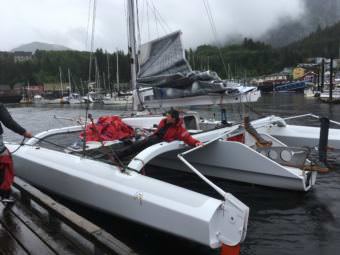
Chris Burd laughs as his brothers tie up their boat in Ketchikan after winning the 2017 Race to Alaska. (Photo by Leila Kheiry/KRBD)

Four days and 700 miles after departing from Victoria, British Columbia, Team Pure and Wild Freeburd sailed into Ketchikan, making them the winners of the 2017 Race to Alaska.
Amidst light rain, with fog eclipsing the tops of the surrounding mountains, brothers Tripp, Chris and Trevor Burd guided their trimaran, “Mama Tried,” into Thomas Basin Harbor.

They were met with a booming gunshot, cheers and whistles.

About 30 people gathered at the dock to welcome the winners to Ketchikan.

Many had been watching the race closely using the online tracker. It was an exciting finish, because Pure and Wild was neck and neck most of the last few hours with Team Big Broderna.

This was the closes finish for first place in Race to Alaska’s short history.

The Burd brothers stepped off the boat onto the slippery dock, groaning as only men who have spent four days whipped by the sea and wind can.

Tripp nudged Trevor, the youngest brother, to ring the bell stationed on the edge of the dock – marking their Race to Alaska finish.

“Ring the bell, Trev,” Tripp said.

Trevor protested. “All together, all together,” he insisted.

Tripp and Chris had both braved the Race to Alaska before – Chris in 2015, and Tripp both years – but this was Trevor’s first experience in the West Coast challenge.

“They’ve done the race before, and I don’t think they told me what it was all about, you know?” Trevor said. “I thought I was signing up for a sailboat race! But, no, it was definitely cool to do it with them and there’s no one I’d rather do it with. Even if they did, you know, trick me into it.”

Despite his years of sailing experience, he said conditions were fairly extreme just after they broke away from the protection of the islands.

“We got some big waves and some really nasty stuff that, kind of, all you’re doing is nursing the boat through and trying not to break yourself or anything like that,” he said. “I sail full time and those were the biggest waves I’ve ever seen, so… Pretty nasty.”

When asked whether he was considering racing again next year, he groaned.

“It’s too early to ask that question,” he said. “Way too early for that. We’ll see what schedule’s like next year with that. See if I can finally dry out before then.”

Minutes after Pure and Wild arrived, Big Broderna sailed past the finish line.

The Burd brothers will walk away with the first place prize of $10,000, and Big Broderna’s crew will receive a set of steak knives.

Pathfinder pole raised on last day of school in Ketchikan

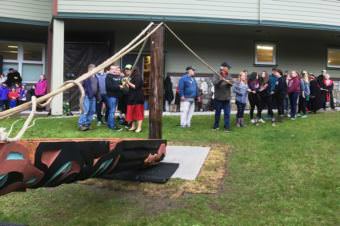
Schoenbar Middle School students and visitors prepare to raise the Pathfinder totem pole. (Photo by Leila Kheiry/KRBD)

Schoenbar Middle School celebrated the end of the school year with a special totem-raising ceremony.

The Pathfinder totem pole was carved by Schoenbar students over the past year under the direction of carver Kelly White.
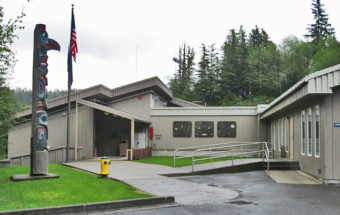
It now stands in front of the school, where an earlier pole used to stand decades ago.

A blessing song welcoming the ancestors kicked off the totem-raising celebration at Schoenbar Middle School.

Students and visitors filled the gymnasium bleachers, and the old totem pole, which had been in storage for many years, lay in a place of honor in front of the lectern.

The old pole will be returned to the earth, Principal Sheri Boehlert said following tradition, after the new pole is raised, also in the traditional way.

“The Pathfinder totem pole project is a striking example of our students, teacher and local community members collaborating and honoring our great strengths, diversity and finding our way,” she said.

The Pathfinder totem pole at Schoenbar Middle School. (Photo by Leila Kheiry/KRBD)

Diversity was a recurring theme among the speakers.

Ketchikan Gateway Borough Vice Mayor Stephen Bradford talked about his former home in Kansas, which is the historic land of several Native tribes.

But, he said, the schools there do nothing to honor that history.

“I’m just very proud to live in Ketchikan and Southeast Alaska, where we acknowledge the rich and wonderful history of people that have been here for centuries,” he said. “We’re doing that with this totem raising and I’m very proud to be part of it.”

Elder Richard Shields talked about the symbolism of the Pathfinder pole, saying everyone relies on their teachers, family, community members and ancestors to help them find their path in life.

Shields gave an example of weavers, first learning to make a basket. Their early attempts are full of bumps and holes, but as they get better their baskets are so tight they can carry water.

“Remember that the skills that are given to you are a gift,” he said. “Not only does it belong to you, it belongs to someone else that you’re going to be able to encourage. Everything that we’re given in our lifetime is a gift. Use that gift to support somebody else.”

Schoenbar art teacher Angel Williams received a standing ovation when it was her turn to speak.

She was the organizing force behind the pole, but she used most of her time at the lectern thanking others for their help.

Williams said the pole is about community. The school invited anyone who was interested to come and help carve or paint the Pathfinder pole.

“We had kids of all ages and all abilities working on this from little ones to big ones to adults to former students,” she said. “It is a community pole. It brings us together.”

Everyone filed outside for the pole raising, and the rain miraculously held off for the event.

Carver Kelly White organized students, teachers and others on the various ropes needed to get the pole into the air.

After it was up and bolted into place, White told the story of the pole. The top figure is a killer whale. White said that when traveling through treacherous waters by canoe, Native people often would follow the path of the killer whale, to find the safest, shortest route.

Carver Kelly White watches the Pathfinder totem pole as it’s raised. (Photo by Leila Kheiry/KRBD)

“We put the killer whale up there to represent people who would be considered role models,” he said. “People you would follow: Your parents, your teachers, your elders. All these people are trying to guide you through the safest passage while you’re traveling from village to village.”

Below the killer whale is the sun, which marks the seasons and when certain tasks must be performed.

Next is a wolf. White said wolves must communicate with each other for the pack’s overall success.

“Same things goes with anyone else in this world. You have to communicate,” he said. “You have to work with one another. You have to talk in order to ensure your survival. It’s not about just one. It’s about all of us.”

The octopus is a figure used by shamans, White said, and eight is a lucky number. So, that figure represents support, luck and spiritual healing.

Three human figures below the octopus represent the Tlingit, Haida and Tsimshian people. Beside them are salmon, which represent perseverance.

“They have to start at the very bottom of the creek and they have to work really hard up the streams,” he said. “That’s kind of like you children today. You are working against the tides and the waters in order to get to your destination.”

At the bottom of the pole is a bentwood box figure with lovebird design, representing people of non-Native descent.

After telling the pole’s story, White performed the traditional carver’s dance, but not by himself.

“I don’t know what particularly I’m supposed to do, but I’m gonna dance,” he said, laughing. “While I’m dancing, I want the people who were involved, whether they held a paintbrush, whether they just held a tool for a moment while standing next to the pole. Whoever has helped with this pole, please join me.”

White and others danced around the Pathfinder totem pole, then filed back inside the Schoenbar Middle School gym for more singing, dancing and celebration on the last day of school.

State grant to help Ketchikan agencies reduce recidivism

Hayward is begin kept at the Ketchikan Correctional Center. (Photo courtesy Alaska Department of Corrections)
Ketchikan Correctional Center. (Photo courtesy Alaska Department of Corrections)

A coalition of Ketchikan agencies is gathering to explore how to help people getting out of jail stay out of jail with the help of a state grant.
Akeela Gateway and Ketchikan Indian Community were awarded the grant through the Alaska Department of Health and Human Services Division of Behavioral Health.

The organizations plan to pull together representatives from state and local law enforcement, and social services groups to address that question.

Janalee Gage, who works with the substance abuse program at Akeela Gateway, said the state jail system is overcrowded.

Many of the people in jail are repeat offenders, which indicates that incarceration alone is not working.

“The idea is that instead of throwing people back in jail, we need to find a way to have them come back into society and invested in the communities they’re from or live in, and develop a productive lifestyle so they can actually be productive in their life versus in and out of the rotating door of the jail system,” she said.

Gage added that keeping people in jail costs a lot of money, and it’s more cost effective to help people stay out.

The effort is in the early stages now.

The first task is to identify what’s needed.

“We’re going to look at everything we have, what we do well, what are our strengths, what are the areas where we’re weakest in,” Gage said.

She said the goal is to provide people getting out of jail with some basic tools to help them stay on a law-abiding path, which includes signing them up for Medicaid so they can get substance abuse treatment, or helping them find safe, affordable housing.

But it’s still up to the individual to use those tools, she said.

Gage said after the group identifies what’s needed in the community, it will work on getting the community at large to help plan ways to implement any needed improvements.

A big role the community can play is a willingness to hire non-violent offenders who have recently gotten out of jail, or to not fire an employee who has made a mistake.

“We all make mistakes. We all screw up,” Gage said. “Some of us do it on a large scale. (But) we’re going to take the time to give you that chance.”

That can include requiring substance abuse treatment for an employee.

Gage said even if this effort helps only 30 percent of offenders stay out of jail in the future, that would be a huge improvement.

She said the initial planning and brainstorming effort will take place by the end of June. Community outreach will be scheduled later.

Defibrillators installed in the North Tongass Service Area

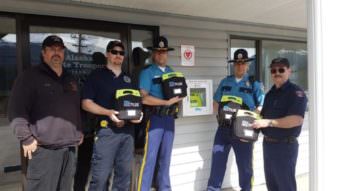
Members of the NTVFD and Alaska State Troopers installing AEDs.
Members of the NTVFD and Alaska State Troopers installing AEDs. (Photo courtesy KRBD)

The North Tongass Volunteer Fire Department recently purchased 34 automated external defibrillators, or AEDs, and is finishing installation of the units. Fire chief Jerry Kiffer says the project was funded through a Commercial Passenger Vessel grant due to the large number of cruise ship passengers bused into the service area.

He says time is critical if someone goes into cardiac arrest, and to be effective, defibrillation need to happen within five minutes of a heart attack. Kiffer says in the best-case scenario, after receiving a call, it will take emergency responders at least five to eight minutes to reach the scene.

“Our answer to that was, well, we need to move the defibrillator closer to the area in which these large groups of people are going to be taken. So we came up with the idea that the only way we can do that is to actually station the unit, and train people to use it, in those locations.”

Kiffer says 28 of the units have been mounted so far from Ward Cove to Settlers Cove, and two more will be mounted when approved by property owners. He says most are located at sites frequented by tourists.

“Knudson Cove Marina. The zip-line tours. The go-cart tours. Places that the tourists are actually being bused into. But we also have them stationed at Ward Cove Market, the post office, and in areas that the buses will be driving by.”

He says four units also were provided to Alaska State Troopers to be carried in patrol vehicles.

“They’re out patrolling the service area and, quite frankly, island wide. But, they’re mobile and a lot of times in a cardiac event, a State Trooper may be the first on scene.”

Kiffer says the AEDs have simple instructions and can be operated by anyone in the event of an actual emergency.  Though easy to operate, he says unit-specific training is provided to employees where the AEDs are located to ensure pads are applied correctly.

“So when an ambulance shows up, we don’t have to take the AED pads off the patient and put our pads on. What these pads do, is they give the medics the ability to look at what the underlying heart rhythm is while CPR is in progress.”

Kiffer says the units are clearly labeled and mounted in public places. He says the goal is to have an AED within five minutes of anyone in the North Tongass Service Area.

Delores Churchill honored with Lifetime Achievement Award

The Central Council of Tlingit and Haida Indian Tribes of Alaska will get about half the BIA settlement funds slated for Southeast tribal governments. (Photo by Ed Schoenfeld/CoastAlaska News)
(Photo by Ed Schoenfeld/CoastAlaska News)

The Central Council of Tlingit and Haida Indian Tribes of Alaska held its 82nd annual meeting last month in Juneau. At the welcoming banquet, Haida master weaver Delores Churchill of Ketchikan received the Lifetime Achievement Award from council president Richard Peterson.

Ninety-nine delegates from throughout Southeast, Anchorage and the Pacific Northwest attended the three-day event.

Before the award was presented to Churchill, Dana Ruaro gave an introduction.

“Ná anii has such an incredible background, but the most amazing about her is her personality, and how loving she is, how funny she is, the situations she puts herself in.”

Ruaro says Churchill is not only a master weaver, but also a master diver. She shared stories of Churchill diving for abalone. Ruaro says Churchill is also an avid hiker, and once was a taxi driver.

“She was telling me this story one time about how this gentleman, a nice looking man, wanted to ride up to Ward Lake. He wanted her to take all these back trails and she refused. She said, ‘I’m not going up there. If I get up there, I’m not going to be able to get back down, so you get out right here, right now!’  She said later on she saw him in the newspaper and he was a serial killer. And I’m not kidding. She really has had an incredible life, given to her by her stubbornness and bluntness.”

Ruaro spoke about the many honors Churchill has received, including an Alaska State Council on the Arts fellowship, and a National Endowment for the Arts National Heritage Fellowship Award for Haida basketry. Ruaro says Churchill studied at the British Museum and relearned the six-strand weave, which she brought back to Alaska.

She says basketry was taught differently in the past, and Churchill’s mother took steps to ensure Delores’ weaving was done properly.

“She spent five years (weaving) until she was actually able to keep one of the baskets that she wove. Because if they weren’t good enough, she would make them throw them in the fire and she’d have to start all over again. And so it made her really learn the technique of weaving, which she shared with other people.”

Churchill was raised in the Haida village of Masset in the Queen Charlotte Islands. In addition to working to continue the tradition of Haida basketry, Churchill also has worked to preserve the language.

Churchill says she is honored to receive the award, but wished it had happened when her mother, Selina Peratrovich, and other master weavers and artists who passed on the tradition were still alive.

“I think of them every time I see hats. And the slippers I’m wearing are ones that Jennie Thlunaut made for me before she died.”

At the ceremony, Churchill wore the same dress she wore in 1978, when her mother won an Alaska Native Brotherhood / Alaska Native Sisterhood lifetime achievement award.

“I also wore her bracelets, because when she was being honored, she also wore her gold bracelet. I very seldom wear them because I’m not a gold bracelet kind of person. Holly (Dolores’ daughter) is. Holly loves her jewelry.”

Before presenting the award, President Richard Peterson read a proclamation.

“…and whereas Delores is a world-renowned Haida master weaver of baskets, hats, robes and other regalia…And whereas Delores has carried her mother’s legacy as a teacher, and has taught and demonstrated basket weaving in many Alaskan communities, nationally, and in countries such as West Germany, Great Britain, Holland, Switzerland, Finland, Sweden and Norway…And whereas Delores is one of the few remaining speakers of Xaad kíl…”

The proclamation also noted that Churchill was appointed to the Governor’s Alaska Language Preservation and Advisory Council, received an honorary doctorate from the University of Alaska Southeast, is a Rasmuson Foundation Distinguished Artist, and received many other honors. Peterson also declared April 19, 2017, as Delores Churchill Day.

Site notifications
Update notification options
Subscribe to notifications