KRBD - Ketchikan

KRBD is our partner station in Ketchikan. KTOO collaborates with partners across the state to cover important news and to share stories with our audiences.
Hiker rescued after falling down cliff on Dude Mountain Trail

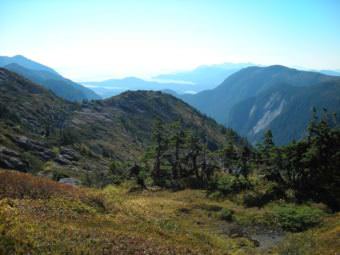
A view from the Dude Mountain Trail. (File photo by KRBD)

A Florida man fell Sunday afternoon and hurt his leg while hiking on Dude Mountain.

A hunter and his son heard the hiker, later identified as Zach Green, 27, signaling for help and called in the report, according to the Ketchikan Volunteer Rescue Squad.

The hunters said they had voice contact with the hiker, but the terrain was too steep for them to get closer.

A medical rescue team in a Temsco helicopter went out to the site, and with the help of the hunters was able to locate the hiker.

The team was set down below Green, who had landed on a small ledge in a steep area near the bottom of a 150-foot cliff.

The team hiked up to Green and provided treatment while a second Temsco helicopter was deployed with more equipment and personnel.

KVRS crews were able to use ropes to lower Green to a better helicopter-landing site.

He was flown to a waiting ambulance at about 7:15 p.m., and taken to PeaceHealth Ketchikan Medical Center for treatment.

Alaska Bar programs provide some legal help for low-income residents

Alaska Bar Association President Darrel Gardner meets KRBD’s official greeter Monday. Gardner stopped by the station to talk about ABA outreach programs. (Photo by Krista Scully, ABA Pro Bono Director)

Alaska Bar Association President Darrel Gardner was in Ketchikan this week to meet with local bar members.

He and ABA Pro Bono Director Krista Scully came by KRBD Monday to talk about some of the association’s outreach programs, meant to help low-income Alaskans facing legal matters.
When someone is charged with a criminal offense, they are constitutionally guaranteed a lawyer, even if they can’t afford one.

But, ABA President Darrel Gardner said, most people won’t ever be charged with a crime.

It’s much more likely they’ll end up in court for a civil matter.

“Child custody issues, divorce issues, housing issues, employment issues, wrongful terminations — the gamut of what people are involved with in their day-to-day lives – and oft times end up in some sort of legal dispute,” he said. “And attorneys are expensive, so there are a lot of individuals out there who simple get inadequate or, as the studies have found, no (legal) assistance.”

That’s because in civil matters, there’s no guaranteed legal representation.

Gardner cited some statistics from New York that show how much of a difference an attorney’s help can make in civil cases.

“The chances of someone in a landlord-tenant situation, I think it was 17 times more likely that the tenant could challenge the eviction as being wrongful with the assistance of an attorney,” he said. “For long-term domestic violence retraining orders, having an attorney again resulted in, I think it was 10 or 12 times more likely that a victim of domestic violence would be able to obtain a long-term restraining order with the assistance of an attorney.”

But, as Gardner said, lots of people can’t afford $400-$500 an hour for a lawyer. There are some agencies in the state that can help, such as Alaska Legal Services Corp., Alaska Network on Domestic Violence and Sexual Assault, Alaska Institute for Justice, and the Disability Law Center.

The Alaska Bar Association also has some programs for low-income residents who need a lawyer. Among those are walk-in clinics and an annual live phone bank on Martin Luther King Day, which falls in mid-January.

Scully said they have held those events in Anchorage, Juneau and Fairbanks, and next year they’ll expand the program to a few other communities.

“We do a phone bank from 4-7 (p.m.), so anybody throughout the state who might not have access to one of the walk-in clinics can call in and talk to a volunteer,” she said.

That’s just once a year, though. The Alaska Bar Association has some year-round programs, as well, and members are helping to develop new ones.

The national Justice For All project this year granted the state a cash award to develop a plan for providing legal services to every state resident in need.

Microsoft also provided a grant to develop a statewide online portal for legal services. That would supplement an online program the ABA started last year for low-income residents. Through that website, qualified residents can submit civil-law questions for volunteer attorneys to answer.

Scully said so far, there’s been a good response to the online program.

Volunteers like it, too, because they can pick and choose questions that intrigue them, and take some time researching an answer.

“They have a total of 10 days to be responsive, but the client will get a notification: ‘Your question has been selected to be answered. Please wait for a response,’” she said. “So, it’s a warm handoff. People aren’t just dropped.”

If a question isn’t selected and sits in the queue for too long, Scully said  she sends that person an email providing resources about how they could get more information on that topic.

Gardner said he’s focused his one-year term as the Alaska Bar Association president on increasing volunteerism among members.

He notes that there’s a requirement for all attorneys to provide some level of pro bono work every year.

“Pro bono is a fancy Latin word, and it’s basically ‘for free,’” he said. “Essentially, it’s an obligation. It’s a professional obligation that attorneys have when they become attorneys.”

Gardner is a lifelong Alaska resident, and works as a federal public defender. He previously worked with the state Office of Public Advocacy.

Ketchikan shatters summer rainfall record

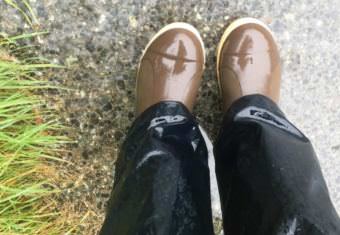
Rain gear proved useful Wednesday morning, when Ketchikan easily broke the previous record for summertime rainfall. The record was broken at 7 a.m., with 44.2 inches falling since June 1st. And it’s not stopping. (Photo by Leila Kheiry/KRBD)

Early Wednesday morning, Ketchikan broke its record for the most summertime rainfall.

With more than 45 inches at last count, this summer is officially the soggiest Alaska’s First City has experienced in its recorded history.
 “We been through every kind of rain there is. Little bitty stingin’ rain, and big ol’ fat rain, rain that flew in sideways, and sometimes rain even seemed to come straight up from underneath.” – Forrest Gump

That quote from the movie “Forrest Gump” is a pretty apt summary of Ketchikan’s weather since June 1.

That’s when “summer” starts, according to the National Weather Service. And it ends Aug. 31.

At the time of this story, August isn’t quite done.

And it’s still raining.

But that doesn’t matter. The summertime rainfall record is busted, but good.

“We have eclipsed 45 inches of rainfall for the entire summer for Ketchikan,” said Wes Adkins, with the Juneau-based National Weather Service.

So, let’s break that down by month. June got 10.97 inches. “That is 66 percent above normal,” Adkins said.

July, we got 11.17 inches. “That’s 70 percent above normal.”

And then, we had August.

Remember the first 11 days of August were dry. Lots of sunshine, warm weather, sunburns.

“Then you got to day 12,” Adkins said. “You had the rest of the month. All told, Ketchikan received 22.9 inches of rainfall for the entire month.”

So far.

“So, that was 133 percent above normal.”

Adkins said part of that was the fault of a typhoon, the remnants of which hit Ketchikan Aug. 21 and 22, when 9 inches fell, causing flooding and damage.

The grand total for the year so far is more than 104 inches. Ketchikan’s average annual rainfall is 150 inches.

Ok, so summer has been wet.

What about fall?

“Ketchikan and Southeast Alaska in general tends to get wetter towards October, so unfortunately for a lot of us, that is not the best news,” Adkins said. “But, looking at climate predictions, we’re not seeing a lot more rain than normal.”

And normal for October is about 20 inches.

But, last October, it was unusually dry in Ketchikan. So, maybe it will do that again this year?

“I would not bet on it. Unfortunate to say,” Adkins said. “Yeah, that would be a Las Vegas style gamble.”

Anyone willing to calculate the odds?

Lots of rain causes flooding in Ketchikan, some damage

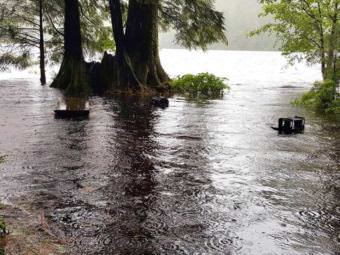
Flooding at Ketchikan’s Ward Lake Recreation Area. (Photo courtesy of Paul Robbins/U.S. Forest Service)

It’s rained enough in Ketchikan the past couple of days that fish are swimming across the road.

“We stopped our truck and watched a salmon swim across the road in front of us at Signal Creek Campground,” said Paul Robbins Jr., a Tongass National Forest spokesman. “We were not fast enough to get a photo, unfortunately.”

Robbins said he and Ketchikan-Misty Fiords District Ranger Susan Howle drove out to the Ward Lake Recreation Area to assess conditions after recent heavy rain.

Stopping to let a fish cross the road was a pretty good indication they would need to temporarily close Signal Creek Campground, which is right next to the lake.

From midnight Monday through about 1 p.m. Tuesday, Ketchikan received more than 8 inches of rain.

Rain is expected to continue for at least the next week, and Robbins said the campground closure likely will last seven to 10 days.

Other Forest Service recreation spots in that area remain open for now.

“It’s just Signal Creek Campground that we’re closing,” he said. “Perseverance Trailhead parking lot is still open, because people can still go up the trails and use the day-use areas. But we really want to encourage people to be cautious. There’s potentially fast-moving water. There could be falling trees, (and) erosion undercutting the roads and trails.”

There is water-related damage elsewhere in Ketchikan.

On North Tongass Highway sometime early Tuesday morning, part of the shoulder crumbled away, prompting Alaska Department of Transportation officials to issue a warning and redirect traffic pending repairs. There also was flooding on Shoreline Drive.

According to the Ketchikan International Airport flight service station, Monday saw a total of 4.39 inches of precipitation. Then, from midnight until mid-day today, an additional 3.9 inches fell.

The total for the month of August so far is 12.28 inches. The majority of that has fallen in the past two days.

Alaska class ferry Tazlina on track at Ketchikan shipyard

Vigor Alaska Shipyard Development director Doug Ward talks with Marine Transportation advisory board member Greg Wakefield inside the not-quite-finished Alaska Class ferry Tazlina. (Photo by Leila Kheiry/KRBD)

The Tazlina is the first of two new Alaska Class ferries that the Ketchikan Vigor Alaska shipyard is building for the state.

Its two halves are complete and welded together, and shipyard workers are busy getting interior spaces done.

In the cavernous main construction hall of the Ketchikan shipyard, Gov. Bill Walker prepares to sign a bill officially naming the Alaska-class ferry Tazlina, and its future sister ship the Hubbard.

We’re all standing on the Tazlina’s car deck: Local media, politicians, shipyard employees and members of the state Marine Transportation Advisory Board – in town for a special MTAB meeting.

Shipyard Development director Doug Ward takes a small group into the unfinished ferry for a tour soon after the signing.

“The last time I took anyone on a tour, I got lost,” he said. “We’ll see how I do today.”

“I’m lost.”

We soon get back on track, as we duck through plastic sheeting, skirt around equipment and peer into not-quite finished rooms.

If the smell of fresh paint is any indication, the ferry is getting to the final stages.

Vigor’s Ketchikan shipyard received the $100 million state contract to build two Alaska Class ferries in fall 2014.

Both are due for delivery in fall 2018.

Ferry officials have said the Hubbard won’t take as long to construct, because all the designs, templates and kinks in the plans were worked out with the Tazlina.

MTAB member Greg Wakefield asked Ward what makes the Ketchikan shipyard competitive with those in the Lower 48.

“That’s a great question,” Ward said. “And we’ve got a great answer.”

Ward said the state-owned facility’s amenities are a huge asset, but he credits the people – the employees – who he said are empowered to innovate.

Ward said they have a young workforce, with some seasoned professionals to mentor them, and an apprenticeship program to continue building skills.

“We think that we’re already competitive with certainly other shipyards in the Pacific Northwest. And when I say competitive, that means not only for price and schedule, but for quality as well. We’re already there. We can compete regionally,” he said. “Our next hat trick is to continue developing the skills and abilities in that workforce to get globally competitive, so we can win those contracts that we want, that fit our capabilities.”

Ward said Vigor intends to prove itself to the state with the Tazlina and Hubbard, and win more ferry construction contracts.

Wakefield said that he hopes that will be the case.

And during the signing ceremony earlier, state Sen. Bert Stedman echoed that hope.

“I really gotta take my hat off to the quality that the Vigor shipyard crew put into these new ships. And this is just the beginning. This isn’t the beginning of the end, this is the beginning of the whole project of several new ships over the next few decades that need to be built,” he said. “I’d like to see all of them built right here in this yard.”

The Alaska Marine Highway System’s fleet is aging with many ships due or overdue for replacement.

First things first, though. And the Tazlina is first.

Ketchikan shipyard general manager Yohl Howe was leading a separate tour of the ferry.

We combined forces briefly while Howe talked about finishing out different spaces on the ship.

He said that’s the most exciting and satisfying part of the process.

“Our closeouts go in order of which spaces we’re going to outfit first with joinering. We’re starting right below this deck in the quiet room and the library. Also the children’s play area,” he said. “We’ll get those joinered, then we’ll come up to the observation lounge, close that out, then we’ll keep following the outfitting as it goes through. The paint is probably the prettiest part, so we’re putting a big emphasis on paint this week and next.”

Closing out each section as they finish is one of those innovations Ward mentioned. Otherwise, he said, they might paint a section, then come through to work on something else, mess up the paint and have to do it again.

“It’s a whole collection of little innovations, little improvements like that in the ship building process that, put all together, is going to give you that competitive advantage,” Ward said.

An advantage that could lead to more jobs in the future.

Metlakatla celebrates traditions on Founder’s Day

A small crowd gathered outside a two-steeple white church. It was early in the day, but the sun was already beating down, glinting off of the lone headstone that stands beside the church. There lies Christian missionary William Duncan, a controversial and key figure in the story of this Southeast community’s history.

“No matter what anyone may think of him, William Duncan did what he thought was best for us,” David Robert Boxley said.

Boxley lives in Metlakatla, and explained to the crowd the origins of the town’s founder.

Mr. Duncan, as he is known, strove to convert the Tsimshian community to Christianity. In 1887 Duncan arrived at Annette Island with about 800 Tsimshians from British Columbia and founded what is now Metlakatla Indian Community, about 15 miles south of Ketchikan. That arrival is marked on August 7 and celebrated as Founder’s Day.

During the wreath-laying ceremony at Duncan’s grave, Boxley read remarks off his cell phone, alternating between English and s’malgyax, Metlakatla’s indigenous language.

“[s’malgyax] He loved us. And he worked hard to show us a good way to live,” he said.

Boxley asked for a moment of reflection and prayer. Those in attendance bowed their heads as a wreath was laid next to the headstone. Boxley is a renowned artist and co-chair of the Haayk Foundation, a non-profit aimed at preserving the s’malgyax language. The foundation was hosting and co-sponsoring the Founder’s Day feast later that evening.

“Have a wonderful Founder’s Day, and we’re gonna get back to work,” he said. Thank you.”

The day is filled with religious significance. In this small town, the line between the duties of elected officials and dedication to the Christian faith is blurred. About 50 people convened at the Metlakatla longhouse for a community church service. Mayor Audrey Hudson spoke.

“It’s very important that our children understand the word of the Lord and they grow to know that this is the norm and this is how it should be,” she said.

There are many schools of thought on how the role of missionaries like Duncan affected Native Alaskan culture. Despite the historical suppression of many Tsimshian customs, the last 30 years has seen an increase in Tsimshian cultural pride.

The interior of the longhouse is itself evidence of the ongoing cultural revival in Metlakatla. The floor and ceiling are all made of gleaming cedar. Artwork and handmade artifacts lined the walls.

Founder’s Day is about more than the town’s beginning, though. It serves as a homecoming of sorts for those who were raised in Metlakatla.

“My son did a good job,” said David A. Boxley.

He’s David Robert’s father. The senior Boxley was raised in Metlakatla. He lives in Seattle now but comes back every year for Founder’s Day.

The father-and-son team have carved many totem poles together and the elder Boxley’s carving work is on display at institutes and museums all over the country. He gestured to a pole just down the street.

“My son and I did that totem pole right there for all the women who started the children’s dance groups years ago,” he said.

He talked excitedly about the schedule of events for the day, including a parade, foot races and dance performances.

“It’s like 4th of July anywhere else, you know,” he said.

There are even fireworks.

Standing beside William Duncan’s grave, Boxley said he thinks the missionary changed the Tsimshian community for the better.

“It’s really important,” he said. “You know, our culture, our tribe. When this man came among our people, [he] changed our future. Absolutely changed our future. And his history, since he was 30 years old, is our history.”

Hundreds of Metlakatlans headed toward town. Around the street corner and into the ball field came the parade procession. A little girl dressed as Disney princess Moana sat on top of a paper-mâché canoe. Representatives from the Tsimshian tribes followed, dressed in traditional regalia and beating taught, tan drums.

Kimberly Wellington is part of the Wellington Clan. She said they are descended from Arthur Wellington Clah, the man who taught William Duncan to speak s’malgyax.

Wellington and her two sons were wearing matching purple shirts with her family’s crest and s’malgyax words emblazoned on the front.

“The saying on the top means ‘love one another,’ which was my grandmother’s favorite saying, and so this is in honor of her,” she said.

Many, many people milling around the ballfield were wearing these matching shirts. Wellington said making T-shirts has become a Founder’s Day tradition for the Wellington clan.

“Every year we do some sort of design with some sort of remembrance — for somebody within the family,” she said.

On the 130th anniversary of Metlakatla’s founding, it’s clear that Tsimshian residents are intent on keeping traditions alive – even newer ones that call for matching T-shirts.


Site notifications
Update notification options
Subscribe to notifications