KRBD - Ketchikan

KRBD is our partner station in Ketchikan. KTOO collaborates with partners across the state to cover important news and to share stories with our audiences.

Ketchikan elementary students gain gardening skills

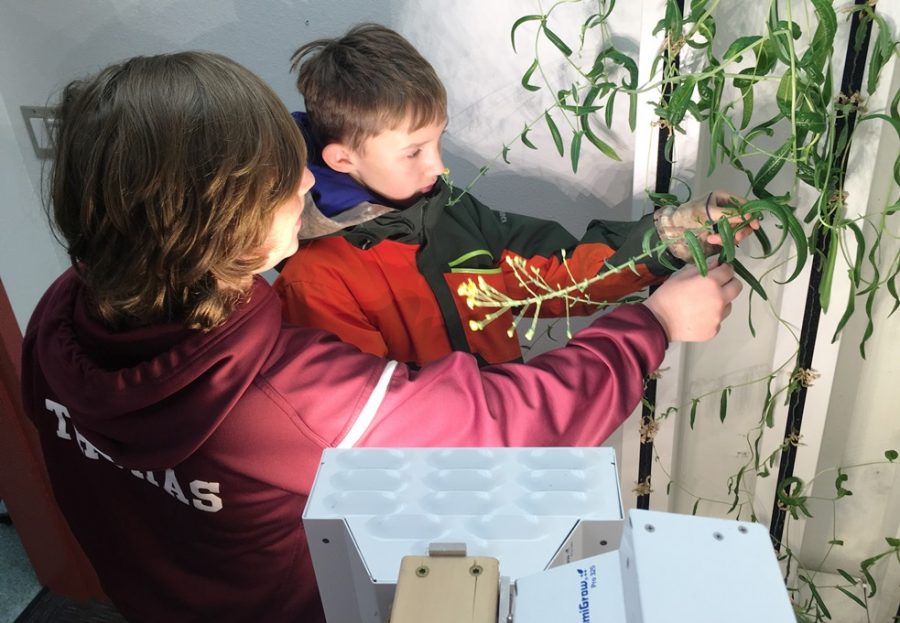
Fawn Mountain Elementary School students Cyress Tibbitts and Declan Thomas check some of the lettuce plants growing in the school’s aquaponics room. (Photo by Leila Kheiry/KRBD )

Inside a small room at Ketchikan’s Fawn Mountain Elementary School is a lush garden.

It’s tended by students, who are growing lettuce, zucchini and … knowledge.

“There’s another broccoli plant here. There’s zucchini, there’s basil growing here, tomatoes,” said Fawn Mountain Elementary School principal Alonso Escalante, pointing to some plants as he gives a little background on the school’s aquaponics room.

A bank of grow lights inside the windowless room provides substitute sunshine, and lots of pipes circulate water throughout the system.

The kids are mostly growing lettuce now, but there are a few other plants in the mix.

“It’s a work in progress and once we get it dialed in, it’ll be really interesting to see how much food we can actually grow,” Escalante said. “The ultimate goal is to see if we can actually produce food for our own cafeteria. See if we can get some lettuce into our salad bar, those sorts of things.

Escalante didn’t get into too much detail. Because he wants the school’s young gardeners to show off how the system works.
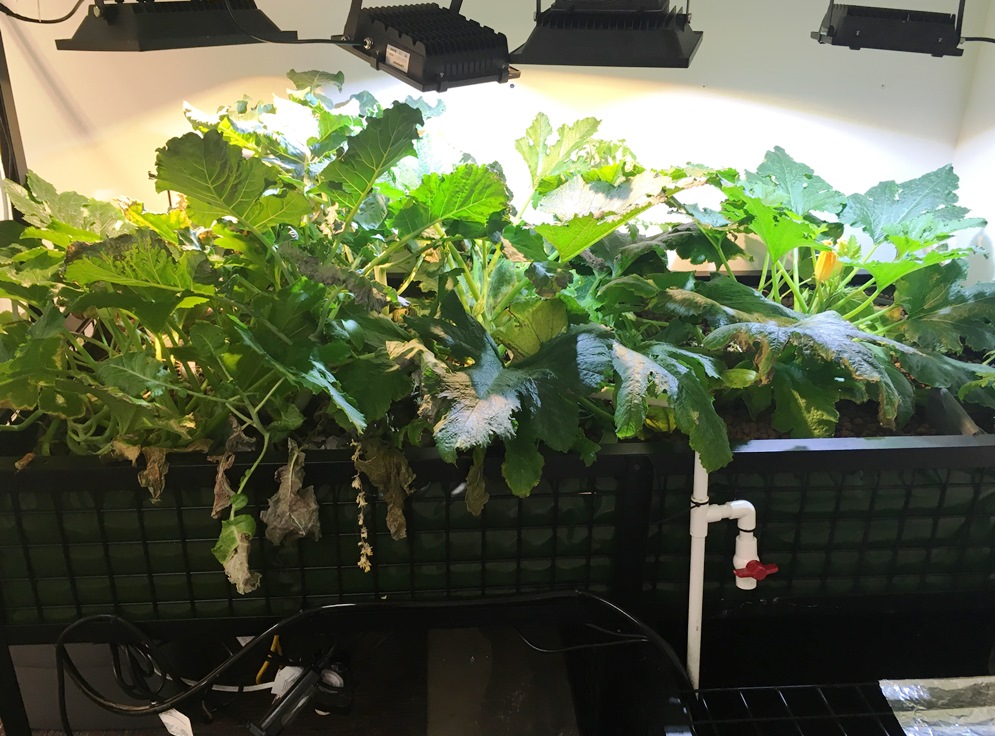
Plants grow in the Fawn Mountain Elementary School aquaponics room. On the table are zucchini, tomatoes, basil and lettuce. (Photo by Leila Kheiry/KRBD)

Soon, two sixth-graders Bree Johnson and Everr Kistler arrive.

Everr points to a tank of water next to a large table covered with plants. Swimming inside the tank are fish.

“The fish poop in the water and it does this thing to the water and it makes the plants grow,” he said.

The fish poop fertilizes the water, which then circulates among all the plants through the pipe system, feeding them the nutrients they need.

Bree said they don’t have to add more water too often.

She points out some of the plants on the table, growing in porous rocks – broccoli and cabbage, she thinks; then Everr describes the plants growing in vertical planters attached to the wall – different kinds of lettuce.

They each pinched off a lettuce leaf to eat. I ask Everr how he likes it.

“Tastes better with ranch,” he said.

Cyress Tibbitts and Declan Thomas are my next two tour guides. Cyress tells me a little more about the vertical planters.

“This is the vertical growing station. It’s where you put the plants to grow vertically, up and down,” he said. “And there’s water dripping down to water the plants. It never stops.”

Declan added that the water, fertilized with fish poop, filters through the plants before heading back to the fish tank.

There are some tiny bugs flying around the room. Declan said that wasn’t planned – the insects just showed up. But it’s a good thing, he said, “because we wouldn’t get fruit if they didn’t spread the stuff around. We’d have to get cotton swabs and get pollen and move it from other plants. But the flies do the work for us.”

Declan said that all the plants are grown without pesticides.

Escalante said Fawn Mountain’s aquaponics project started after the school won a grant from the local U.S. Coast Guard’s Chief Petty Officers Association. That group funds different projects each year through its annual Halloween Haunted House event.

“That was kind of the seed, so to speak — no pun intended – that got this whole thing going,” he said.

The original plan called for a separate greenhouse on school grounds, but building and heating that structure proved too costly.

The aquaponics room is more budget-friendly, and with it students are learning valuable lessons, among them how to grow their own food.
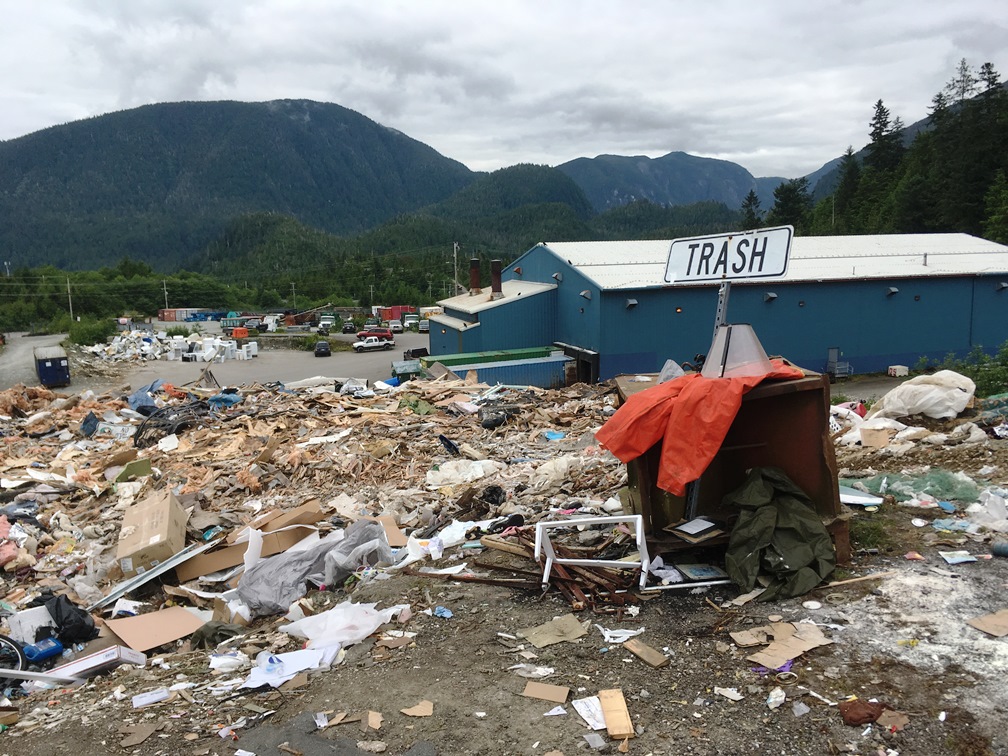
Talking Trash: In Ketchikan, you can salvage stuff from the landfill

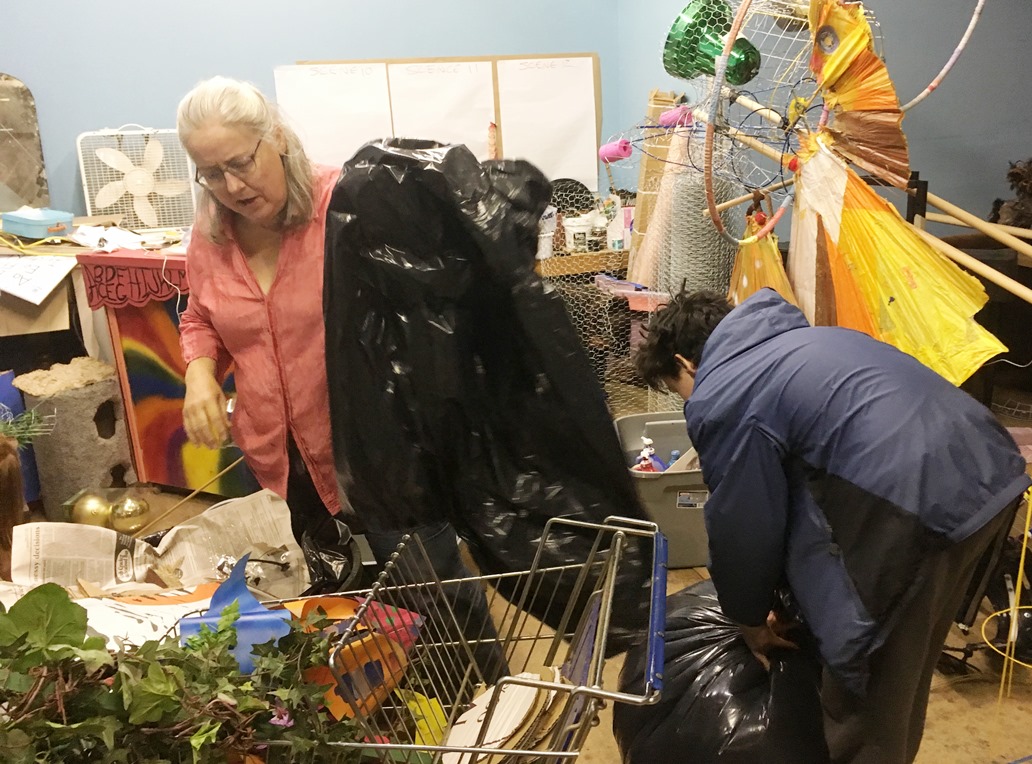
Ketchikan artist Halli Kenoyerleft, uses recycled trash to build a set piece for a community theater production. Ketchikan issues permits for locals who want to salvage metal, bowling balls and whatever else they find at the landfill. (Photo by Leila Kheiry/KRBD)
Artist Halli Kenoyer, left, uses recycled trash to build a set piece for a community theater production. Ketchikan issues permits for locals who want to salvage metal, bowling balls and whatever else they find at the landfill. (Photo by Leila Kheiry/KRBD)

Southeast communities are always looking at ways to reduce the amount of trash that ends up in their landfills or that they have to ship south. In Ketchikan, people can come up to the landfill and take what they want. In this report, part of CoastAlaska’s series, Talking Trash, we learn how that program saves the city time, space and money.

“I love the dump! I go to the dump for all of my wearable art needs. That’s where I go first,” said Ketchikan artist Halli Kenoyer.

She said the local landfill is a great place to gather material for the large, complicated pieces she makes for Ketchikan’s popular Wearable Art Show.

Kenoyer also goes there when helping to build sets for First City Players, the city’s community theater.

“We’re making trees right now for “Shrek Jr.,” the children’s musical and we need tall things that will not break. The dump is a great place to go find things for free,” she said in an interview this summer.

Nissa Dash is another Ketchikan artist who loves the landfill. She’s helping Kenoyer with sets for “Shrek Jr.,” but she also gathers material for her own art. Dash has a penchant for the patina of rusty metal.

“I have to be careful, because I will go to the dump and — I have to sneak it,” Dash said, laughing. “I have stuff in the garage and in little places tucked away. And God forbid we have to move.”

“‘Honey, I need to bring my rust collection!’” Kenoyer joked.

“Exactly!” said Dash.

Those two aren’t alone in their scavenging.

Up at the landfill, surrounded by opportunistic ravens, Solid Waste Supervisor Lenny Neely said about 40 people are signed up for the city’s salvage permit program. He said they take more than 100 tons of stuff out of the landfill every year.

That’s 200,000 pounds.

“And in some way, shape or form, all that material is getting reused,” he said. “That’s the nice part.”

That saves the city money in a variety of ways. It reduces the work load, cuts back on space taken up by trash, and reduces the volume of items the city has to barge south.

Ketchikan’s landfill offers a permit program that allows people to come up to the fill and take anything that strikes their fancy. It saves the City of Ketchikan money, and recycles items that otherwise would take up space in the fill. (KRBD photo by Leila Kheiry)
Ketchikan’s landfill offers a permit program that allows people to come up to the fill and take anything that strikes their fancy. It saves the City of Ketchikan money, and recycles items that otherwise would take up space in the fill. (Photo by Leila Kheiry, KRBD)

Neely said it’s tough to know exactly how much money the city saves a year. For some context, the city pays almost $60 per ton to ship household garbage south.

Beyond art material, Neely said salvagers collect for commercial use. Popular material includes metal pipes and wooden boards, often discarded after a home remodel project.

Neely points to a tangle of copper pipe sitting on the ground next to the fill.

“This piece laying here. Whoever came up and dumped laid that there because they know a salvager will grab that,” he said.

And the person who picks it up likely is after metal they can sell for scrap. But, there’s other salvageable stuff in the fill.

“The possibility, I guess, is the foosball table,” Neely said, pointing. “I see some metal over there that somebody will grab. Bicycles are a big item. We get a lot of bicycles for whatever reason. A little bit of everything.”

Some people come for spare parts, others for specific collectable items. Landfill employee Tim Morgan said bowling balls are one example.

“There’s two bowling ball ladies,” he said. “They just collect them for decoration in their gardens and yards.”

Staffers don’t see as many bowling balls now as they did back when Ketchikan had a bowling alley.

Neely said he was surprised by Ketchikan’s salvage permit program when he first came to work at the landfill years ago, mostly because of the liability.

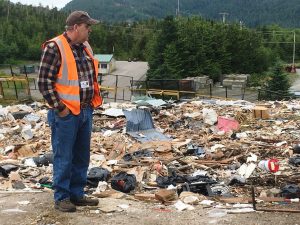
City of Ketchikan Solid Waste Superintendent Lenny Neely stands at the local landfill. He says discarded metal, construction material, bicycles and more are taken out of the dump through the city's salvage permit program. (Photo by Leila Kheiry, KRBD)
City of Ketchikan Solid Waste Superintendent Lenny Neely said discarded metal, construction material, bicycles and more are salvaged from the landfill. (Photo by Leila Kheiry, KRBD)

“But, the reality is here, it’s worked really well,” he said. “That’s recycling at its finest. When I first got here, I couldn’t believe. I was like, ‘We do what?’ We may be one of the very few places in the state that does that.”

Liability is one concern cited by other regional facilities, although Wrangell used to have a salvage program before it capped its landfill years ago.

Petersburg has something similar to Ketchikan’s salvage program. The fill there is open for salvagers just twice a week, though, and the permit fee is quite a bit higher: $10 per day versus $5 a month in Ketchikan.

Ketchikan’s landfill requires permit holders to sign a waiver, wear a safety vest and stay out of the fill when equipment is running.

Back at the First City Players building, Kenoyer leads a set-building workshop for kids participating in the “Shrek Jr.” production. She said when she’s on the hunt for supplies, she goes to the landfill daily.

She showed off some of her recently salvaged items: discarded Christmas decorations, metal tomato-plant cages and a big bag of fabric leaves.

“We have two long bamboo sticks that are 12-footers from the dump,” she said. “You don’t find that very often anymore, so it’s a real treasure to find that. Tied that sucker on top of my truck and I hit the road.”

That’s salvage success.

Chief Johnson totem pole restoration underway


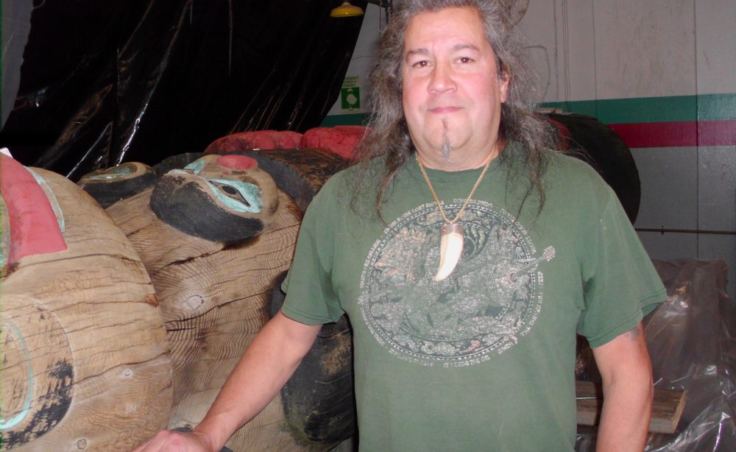
The Chief Johnson totem pole, which stood at the south end of the Centennial Building parking lot adjacent to the city museum, was taken down for cleaning and repairs in late September.

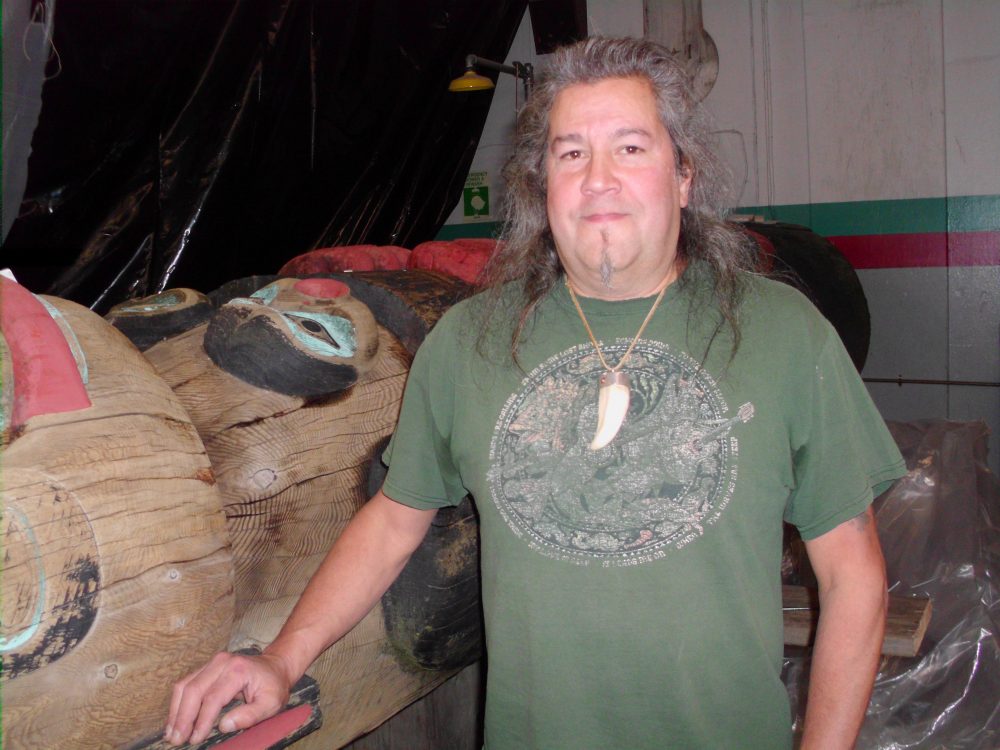
The 55-foot pole is a replica carved by Israel Shotridge and raised in 1989. It is now at the old fire hall on Main Street where Tommy Joseph is undertaking the restoration process.

“I’m a Tlingit wood carver, also wood conservator, originally from Ketchikan, Alaska. I now live in Sitka, Alaska. I’ve been there for 33 years.”

Joseph has more than 20 years’ experience with totem pole restoration. He began with an assessment of the overall condition of the pole.

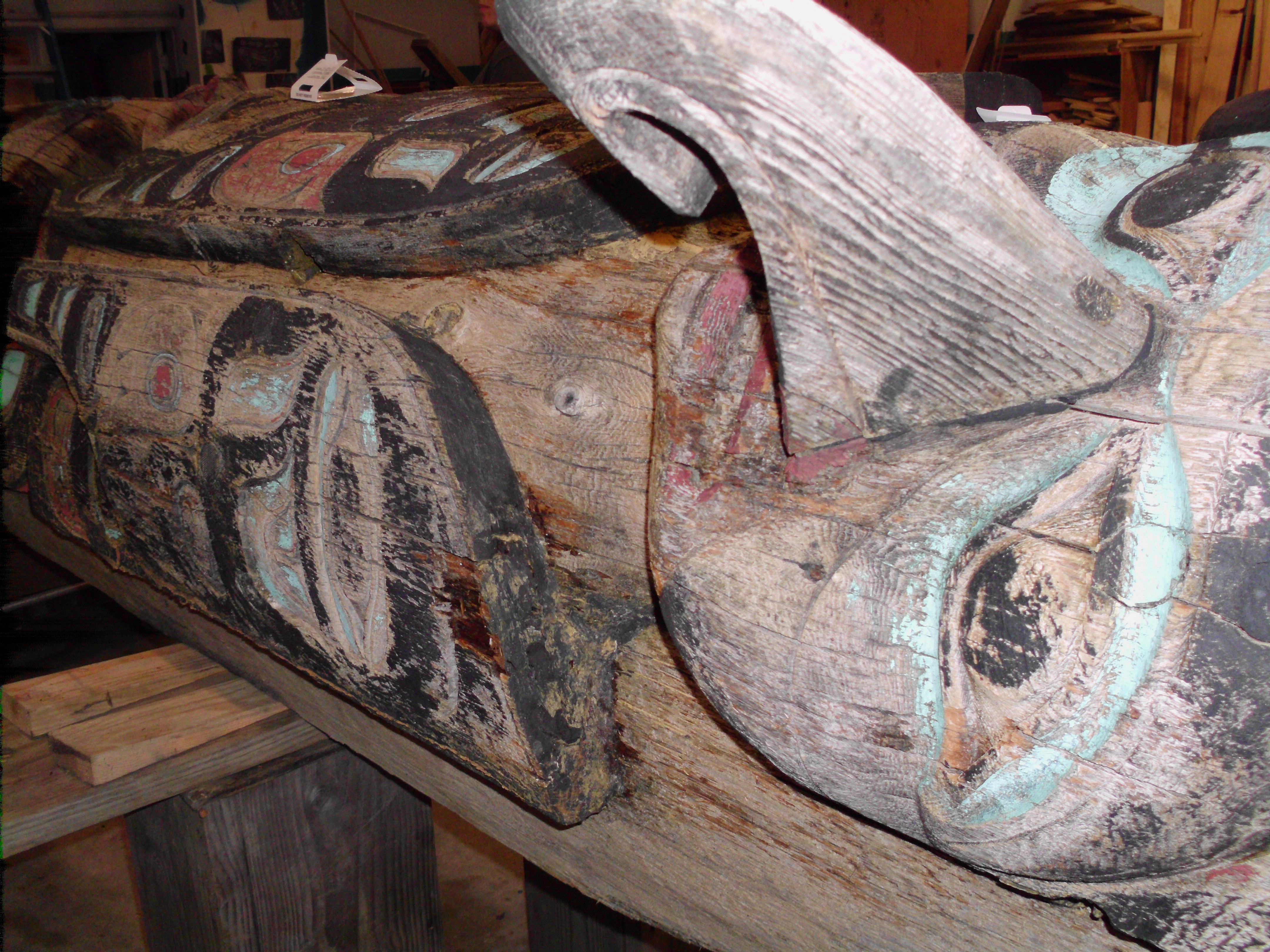
“The first thing I did was check to see that it was going to be suitable to put back out(side). And it is. It’s a solid log – mostly. It’s got a few soft spots here and there, but going over and checking to make sure it wasn’t all just a shell.”

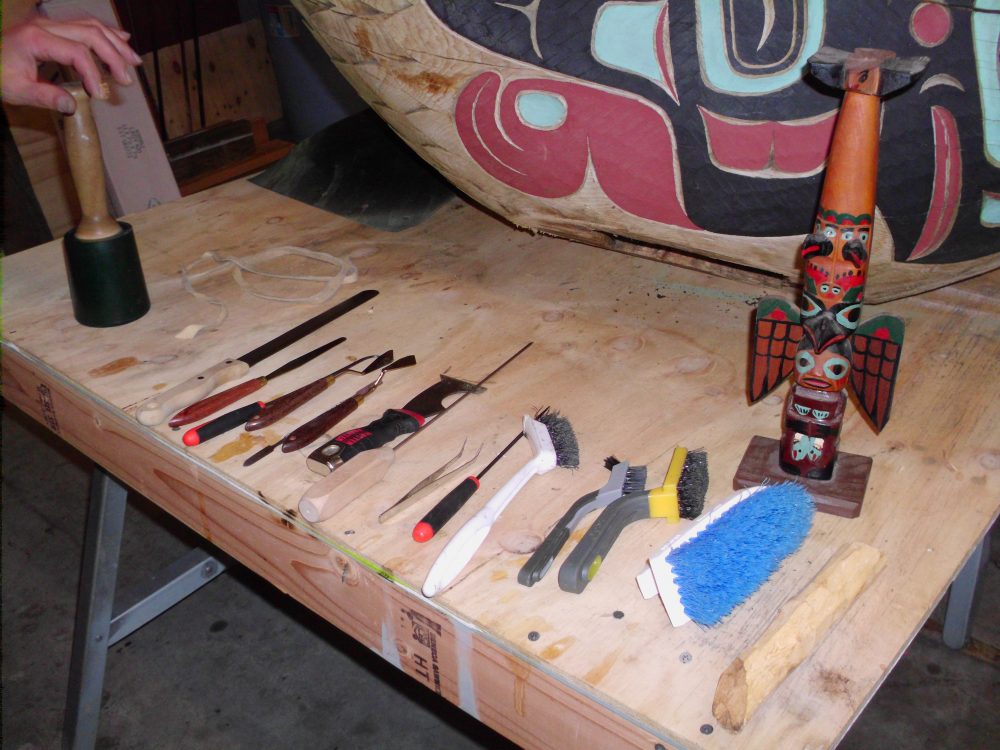
Joseph has completed the cleaning phase of the process.  He used a variety of tools to examine and clean the pole: tweezers, scrapers and what look like dental instruments. Joseph begins with a long probe to determine the extent of rot and identify areas damaged by carpenter ants.

“I’m probing to find the soft spots or what’s hard. After that, it’s scrubbing it down and using a pretty potent soap to scrub it. It’s scrubbers of different sizes and shapes. Softer ones for the delicate spots, and harder ones for the areas that you’re just trying to get the surface cleaned out.”

He uses trowels, painter’s tools and picks to remove lichen, moss and other debris from small areas.

Sitting on the table with the tools is a small replica of the Chief Johnson totem pole. Joseph said it was carved in the 1950’s in Ketchikan by a Tsimshian carver.

“The Mather family that made this, they were my grandmother’s next-door neighbors when I was a kid. I’d go over there and watch and look in the window and see all these little totem poles and things they were making in there all the time. I saw this and got it off eBay some years ago. Last year somebody gave me a 6-foot one. I have a little collection of these little miniature totem poles by other people.”

Since he is working on the larger pole, he thought it would be fun to have the small version with him.

Now that the cleaning stage is completed, Joseph is now starting the process of repair and restoration.

“Some wood needs to be replaced. Others just treated and reassembled and consolidated. I need to make the soft, deteriorating wood into a hard solid again.”

Joseph will need to recarve some pieces, including the raven’s beak that broke away from the pole in 2016. He said he also will refresh the paint to make it more vibrant.

Joseph estimates it will take six weeks to complete the restoration.

New public art piece dedicated at Ketchikan’s airport

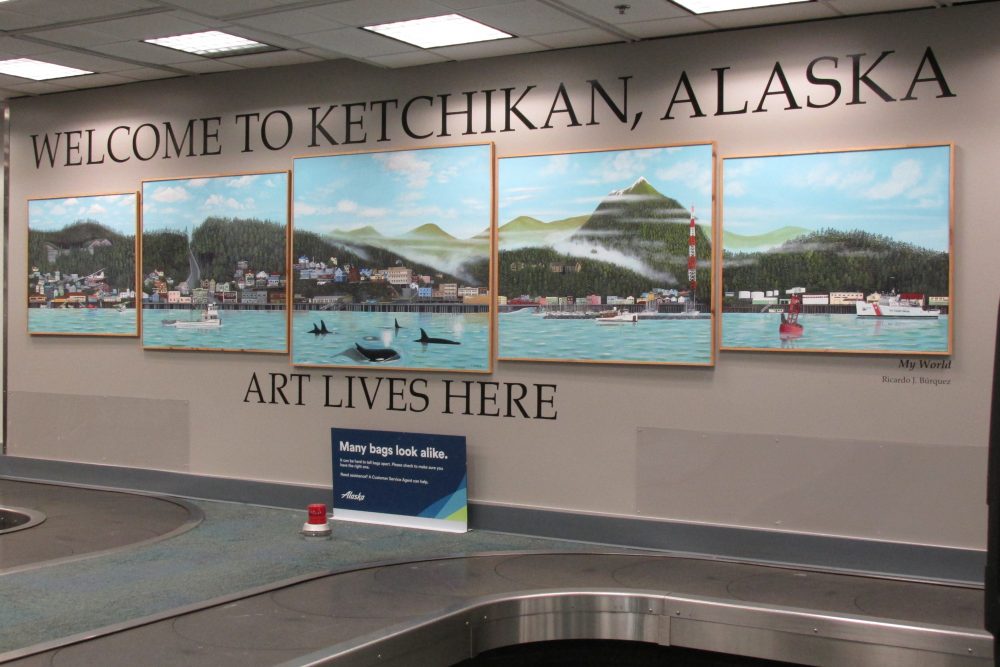
“My World” by Ricardo Burquez at the Ketchikan International Airport. (Photo by Maria Dudzak/KRBD)

A new piece of public art was dedicated Tuesday at Ketchikan’s airport.

As people gathered in the Ketchikan International Airport’s baggage claim area awaiting the start of the dedication, Ketchikan musician Dave Rubin provided entertainment. All were there to celebrate the work of artist Richardo Búrquez.

Kathleen Light is executive director of the Ketchikan Area Arts and Humanities Council. She thanked those who made the event possible and congratulated Búrquez. She says the art piece will play a significant role in the community.

“We are so proud of Ricardo, we are so proud of his work, and we are so proud of the borough for making this possible to have in our airport, to welcome our guests as they come in, but also the community of Ketchikan as we come home. And remind ourselves what we look like and why we love to live here.”

Before presenting Búrquez’s piece, Borough Mayor David Landis spoke about some of the art previously installed at the airport. One is a set of panels carved in 1973 and 1975 by Ketchikan artist Nathan Jackson. Landis says this was Jackson’s first commissioned public art piece.

“When we came over on the airport ferry I was talking to Mr. Ricardo Búrquez who, of course, painted this art. And he said that this was his first commissioned piece to be publicly owned as well. So he’s following along in Nathan’s capable footsteps.”

Landis then spoke about Búrquez’s piece, entitled “My World.” The set of five panels was painted in October 2016 as part of an exhibit at the Arts Council’s Main Street Gallery. Búrquez began with blank canvases, and over the course of the month painted a panoramic of Ketchikan’s waterfront.

“Mr. Búrquez spent every last minute of the month working on this at the location of the Main Street Gallery. Visitors came to watch as he painted and to ask questions. Mr. Búrquez’s decision to paint the waterfront of Ketchikan came out of his love for the people and the environment of Ketchikan.

Búrquez was born in Tijuana, Mexico, and came to Alaska in 1998 to fish. He worked in the fishing industry in Kodiak and Ketchikan, and, after sustaining a back injury, decided to retire in Ketchikan and make the First City his home. Landis says Búrquez painted and created sculptures his entire life, but it wasn’t until after his injury that he decided to focus on painting.

“Mr. Búrquez’s work can be seen throughout Ketchikan in private businesses and in homes. However, as I mentioned before, “My World” is Mr. Búrquez’s first work to be owned by a public entity.

Landis says the painting was added to the borough’s art collection in July of this year.

Bύrquez said he did not prepare anything to say. He thanked those in attendance and those who wanted to attend but were unable to. Búrquez acknowledged Arts Council staff, the city and borough, and Ketchikan artist Ray Troll.

“I have to mention my padrino, Ray Troll, who forced me to sign up for an exhibition. This is something that I’m going to remember with great, great joy.”

A padrino is one’s godfather or patron.

In closing, Búrquez asked people to think of those affected by recent disasters, including those in his home country of Mexico, that was devastated by earthquakes.

“Because I have followers from my country. Right now you know (about) all the natural disasters (there) and in our brother countries too. I ask for everybody to think a little for them.”

Travelers to and from the Ketchikan International Airport can view “My World” in the baggage claim area, along with other art pieces throughout the building.

Large cat sightings reported in Ketchikan

There were a couple of reported sightings of mountain lions in Ketchikan recently.

Local Alaska Department of Fish and Game officials say they’d like more evidence.

Ketchikan resident Shauna Lee lives near the bottom of the Schoenbar Bypass in the Newtown area. She said she was standing at her kitchen window when she saw something moving outside.

“Which is not irregular for this area, we have a lot of deer that cross the street. But when I looked at it, my brain tried to register, ‘Oh, it must be a dog.’ But as I looked at it, I realized no, it’s a cat because the shoulder blades were rotating really prominently,” she said. “And then I looked at the back and the tail went all the way down to the street and it had a dark end to the tail. And I thought, ‘Oh my gosh! That is a mountain lion.’”

Lee said she tried to get a photograph of the animal, but it leaped over a cement wall and then a fence separating the road from the woodsy hillside. She said the cat was about half as tall as that cement wall.

“It was about the size of a Labrador retriever,” she said.

Lee said she called Fish and Game to report the sighting, and was told that there had been another report of a big cat, maybe a mountain lion, from someone in the nearby Bear Valley area.

Fish and Game wildlife biologist Boyd Porter said there were two reports of possible mountain lion sightings. But he’s not convinced that it wasn’t just a particularly large domestic cat

Porter said there have been previous sightings of mountain lions, also called cougars, in the region.

“There’s been one confirmed sighting around the Margaret Creek area on Revilla Island, so it’s not out of the question,” he said. “There’s also been other sightings over the years in the early ‘90s out on the Cleveland Peninsula – Myers Chuck.”

For the most part, though, Porter said this area doesn’t offer the right kind of habitat for cougars. He’s never seen one in this area, and never seen signs of one anywhere near town.

Shauna Lee said it could have been a really large domestic cat, like a Norwegian mountain cat. But she did a little research, and what she saw was pretty similar to online photographs of mountain lions.

Porter said fully grown mountain lions are bigger than most dogs, even large dogs. They weigh up to 150 pounds, and their tails are about as long as their bodies.

Porter said anyone who believes they’ve seen a cougar in the Ketchikan area should try to get a photograph, and send it his way.

Ghost tour hopes to show off haunted Ketchikan

Ketchikan is home to plenty of supernatural phenomena. That’s the theory, at least, behind a new venture: Ketchikan Ghost Tours.

“Do you ever feel like someone is watching you?”

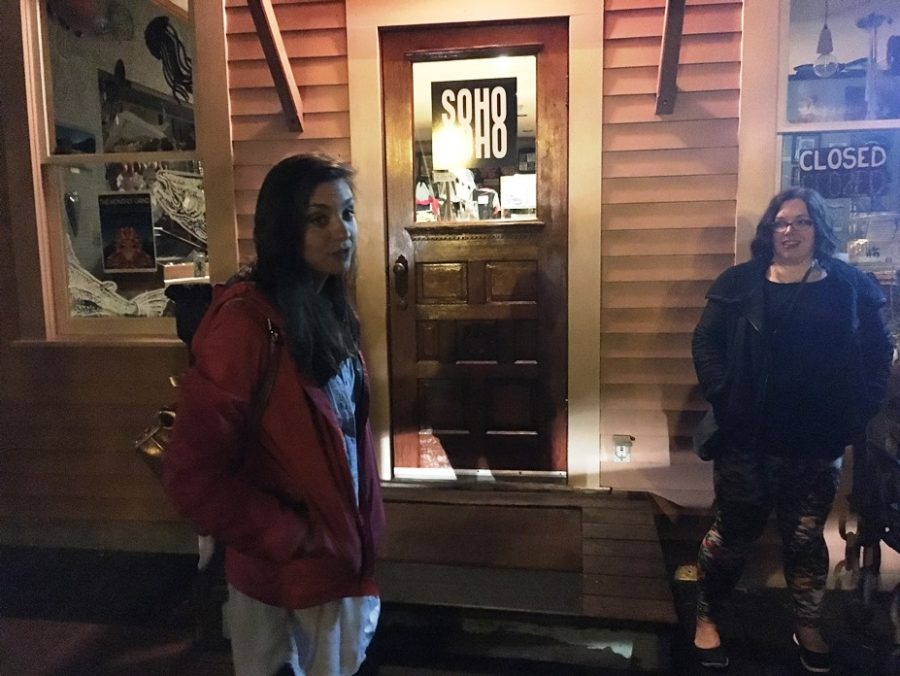
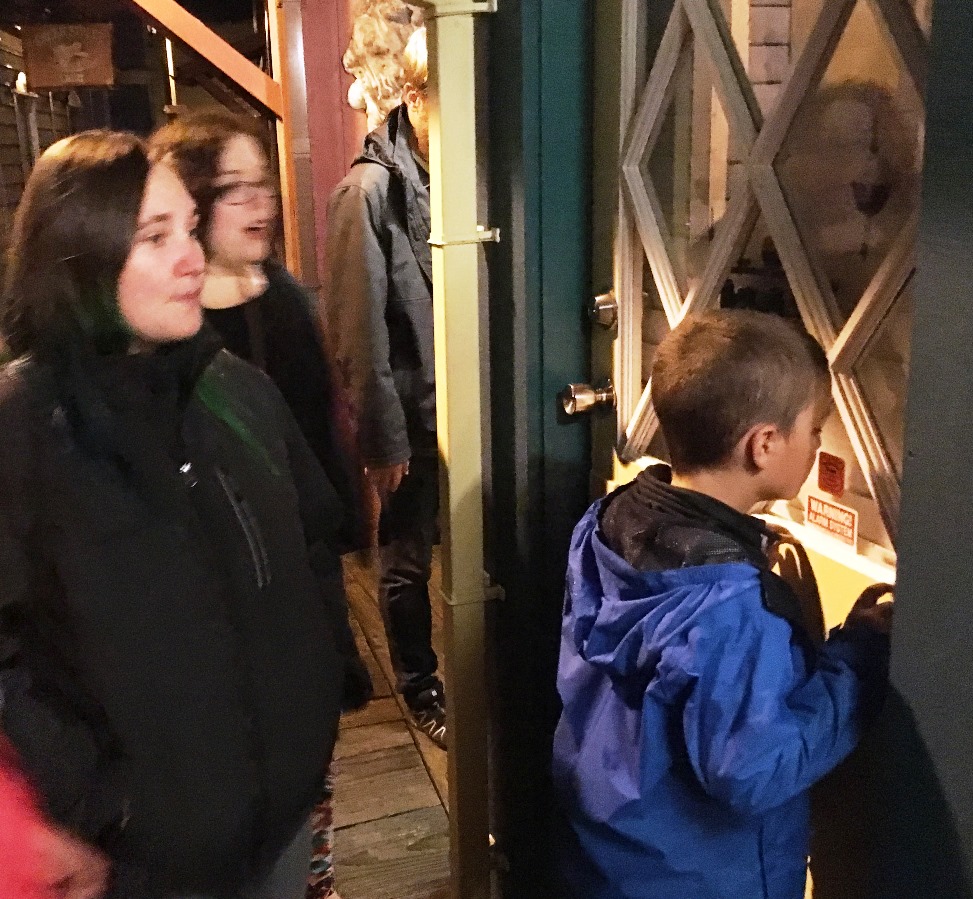
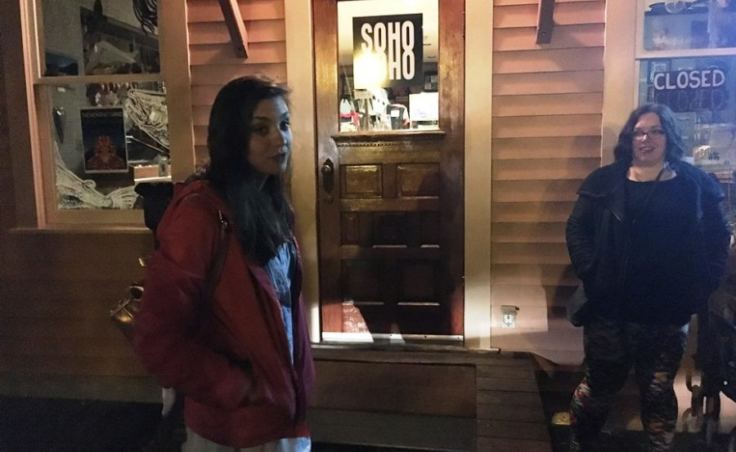
On a dark and misty night, ghost-tour guide Kelli Klees leads about a dozen people to some of downtown Ketchikan’s haunted spaces. We start on Creek Street, the city’s historic and rather shady red light district built along the shores of Ketchikan Creek.

Klees explains that in its heyday, Creek Street boasted more than 30 brothels. And this was during prohibition. So, many of the houses had trap doors to bring in bootlegged liquor for their male clientele.

“A lot of those men also found themselves being thrown out of those trap doors,” she said. “So part of the history of this creek is there were an awful lot of dead salmon and dead bodies.”

Klees says when she first arrived in Ketchikan, she was warned to never walk on Creek Street alone at night. She didn’t heed that warning.

“I’m from Chicago, I’ve got a knife, we’re fine,” she said, recalling her reaction at the time. “So, I proceeded to walk down Creek Street alone at night one night and I’ve never been more scared in my life. Because there were about three different people that came out of nowhere. They might as well have gone, ‘Boo!’ There’s shadows everywhere; there’s a weird energy happening in this place.”

For example, Klees says there are reports of ghostly shadows and noises inside Dolly’s House. That Creek Street home, now a private museum, belonged to Dolly Arthur, Ketchikan’s most well-known sporting woman.

Other former brothels on the creek, now shops, reportedly are home to ghosts that move displays around during the night.

As we walk along the boardwalk, a light suddenly flickers.

“Ghost,” Klees says. “Light just came on. Ghost.”

Or, maybe, a motion-activated security light?

“You gotta open up your imagination on a night like this,” she said. “What’s real? What’s not? What’s ghosts? What’s automated lights? You never know.”

The ghost tour is the brainchild of Diane Fast, a musician who recently moved to Ketchikan. She says she had taken ghost tours in other cities, and always had fun.

“I just noticed how many people enjoy ghost tours,” she said. “And I enjoy them myself and I was like, ‘Wow, you could totally do one here.’ And that spawned the idea for an entire walking tour company.”

Some of the other walking tours Fast offered over the summer got more interest from tourists. But the ghost tour appealed mostly to local residents. And that’s who was on the tour with Klees.

The next stop after Creek Street is Ketchikan’s original hospital, next to the Episcopalian church on Mission Street. That 100-plus-year-old building was vacant for a long time and fell into disrepair, but now is under renovation by Historic Ketchikan.

Klees says people don’t like to go upstairs alone.

“There’s an energy in there,” she said. “The quote is, ‘You could cut it with a knife.’”

As Klees finishes up her story about the old hospital, a woman on the tour tells her own story about the former Bon Marche building across the street, where she worked in the late 1990s.

She didn’t want to give her name, but said it was OK to use the story.

“(A) couple of us would work after hours and would hear kids running,” she said. “More than once, we came upstairs — because we worked belowground. More than once, we came upstairs trying to see who got into the building. To the point where nobody worked after hours by themselves.”

Another stop for a future ghost tour.

Fast says she’s not absolutely sure ghosts are real, but she is sure there are things in the world that we don’t or can’t understand.

“I’ve had experiences that I can’t really quite explain,” she said. “I don’t know what it is, but I don’t know what it isn’t. I don’t claim to know if it’s an actual person that’s haunting a place or just residual energy like when you take a Polaroid photograph. I have no idea. But it’s fascinating and people are interested in it.”

One of the last stops on the ghost tour is the Gilmore Hotel, where there are reports of actual ghostly people. Klees says a man in a top hat and a woman make regular appearances, not at the same time.

“This top-hat man is apparently pretty friendly, but likes to creep people out in one specific room. I believe it’s 208,” she said. “He just sits there very peacefully. There’s another woman who sits in a chair very peacefully.”

Klees says it’s not clear who the Gilmore ghosts were. They’re in good company, though, with all the other ghosts haunting Alaska’s First City.

Site notifications
Update notification options
Subscribe to notifications