
KRBD - Ketchikan

KRBD is our partner station in Ketchikan. KTOO collaborates with partners across the state to cover important news and to share stories with our audiences.

UAS student first in U.S. to receive Tsimshian language credential

Victoria McKoy, left, John Russell Reese and Terri Burr pose during McCoy’s capstone presentation on Nov. 30 at the University of Alaska Southeast Ketchikan Campus Library. (Photo by Maria Dudzak/KRBD)

A University of Alaska Southeast student will be the first ever to receive credentials in Tsimshian language studies.

Victoria McKoy presented her capstone project Nov. 30 at the UAS Ketchikan Campus Library.

Victoria McKoy’s mother is Haida-Tsimshian, and her father is Haida.

“My Tsimshian name is Ggoadm ˈDeebn. It translates to ‘heart of a sea lion.’ When I was given the name, my brothers and sisters said that I appear shy, but I go straight for my target.”

And one target for McKoy has been learning her Native languages.

It started about five years ago, through classes at Ketchikan Indian Community.

KIC offers immersion classes in X_aad Kíl, the Haida language, and Shmˈalgyack, the Tsimshian language.

Terri Burr, a language apprentice under Tsimshian elder John Russell Reese, and Reese have been teaching Shmˈalgyack for about eight years, but realized more apprentices were needed to keep the language alive.

Burr said McKoy was attending Shmˈalgyack classes regularly, and was offered an apprenticeship last year.

“She’s just continued to come and be a part of the mentor-apprentice sessions, the immersion sessions in John’s house, and helping with documentation and transcription.”

McKoy also helps teach classes, Burr said.

McKoy originally was a psychology major but changed her degree to Alaska Native language studies.

Along with Shmˈalgyack, McKoy studies the Haida and Tlingit languages. She’s on track to graduate in December with a bachelor of liberal arts in Alaska Native language studies, and when she does, she will be the first person to receive the Shmˈalgyack credential in the United States.

Burr said having the Native language arts program in the university system allows others to study the languages more fully and helps with language preservation.

“Students now, after Victoria, can pursue this degree specifically to study Shmˈalgyack.”

Burr said McKoy can also start teaching.

“John and I screen her and assess her speaking ability, and I’ve been teaching her different teaching methods that we use in class,” Burr said. “She’s experienced as a student and instructor with them. So she can begin helping us in our language revitalization efforts. She becomes a member of our team – our revitalization team.”

McKoy first attended language classes with her mother, brothers and sisters.

“It was my mother’s wish that we would all speak Shmˈalgyack. She passed away the day after my son was born. So I continued her wish and I continued to teach my son our Native language.”

McKoy said she taught her 3-year-old son Shmˈalgyack before English, so Shmˈalgyack is his first language. She said he also speaks the Haida language, X_aad Kíl.

McKoy says after she graduates, she plans to continue to teach and learn, and to translate more Tsimshian stories with Reese and Burr.

“I got a job offer to teach beginning Shmˈalgyack with the UAS campus. And I would like to continue on with my master’s degree. I’m applying to Simon Fraser University, and the program starts in July.”

Terri Burr said the key to language revitalization is immersion programs and more teachers. She hopes McKoy’s degree will inspire others to become apprentices and learn Native languages.

Ketchikan man arrested for allegedly smuggling meth

A 53-year-old Ketchikan man was arrested Monday night for allegedly attempting to import approximately $40,000 worth of methamphetamine into Ketchikan.

Richard Eric Anderson was arrested and charged with second-degree misconduct involving a controlled substance with intent to manufacture and deliver.
Ketchikan police Sgt. Andy Berntson said Anderson was the subject of interest in an on-going investigation conducted by the police, Alaska State Troopers and U.S. Coast Guard Investigative Services.

Anderson allegedly shipped meth from Seattle, Washington, to Ketchikan by barge through Alaska Marine Lines.

Berntson said a drug dog alerted on a pallet, a warrant was executed, and approximately 4 ounces of methamphetamine was found welded inside a hydraulic jack.

“There was a hydraulic jack that had a floor mount, like a metal plate, so that it could be bolted to the floor,” Bernston said. “It was basically a tube within a tube that had that bolted plate on the bottom, and then the jacking apparatus was on the top … that was the area where it had been stored, and then the plate was put in place to hold it in and secure it and hide it during shipping.”

Berntson said there were other tools and household goods on the pallet, but that did not prevent the canine from detecting the drugs.

“No matter what you do, a drug canine, they’re pretty impressive animals, and it’s pretty hard to conceal that odor completely from a dog,” he said. “It’s one thing to conceal it from sight. It’s another to conceal the odor from a drug canine.”

Anderson was taken to the Ketchikan Correctional Center. Bail was set at $16,000, cash only. His next court appearance is scheduled for Dec. 8.

Phlight Club helps POW students learn life skills while having fun

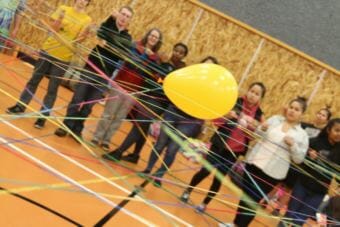
Students participate in a Phlight Club event. The colored strings represent a students’ web of support. (Photo courtesy Amy McDonald)

A couple times a year, students in different parts of Prince of Wales Island are locked up together for three days. It’s Phlight Club, a program that aims to increase kids’ ability to cope with challenges, and improve their support system.
ROY G BIV is the common acronym for all the colors in the spectrum: red, orange, yellow, green, blue, indigo and violet. Those colors also represent seven components that Phlight Club – spelled with a “PH” rather than an “F” – works on with kids.

Amy McDonald is a facilitator with Brightways Learning, a nonprofit that coordinates Phlight Club events in Alaska. Speaking from Thorne Bay School, she described what each of the colors represents.

Red is the “rule of five.” McDonald said all kids need at least five caring, connected adults in their life.

“Oftentimes, teenagers don’t have five caring and connected adults,” she said. “We celebrate whatever they have. If they have one, we start with one.”

Those adults don’t have to be relatives. So, McDonald said they decided to call those adults “phamily,” with a PH, rather than an F. That phamily makes up a student’s anchors. The connections – anchor lines, so to speak — are represented by colored strings.

“Orange is tangible strings. Tangible strings are things like safe home, safe school, nutritious food, appropriate clothing. So, things you can see, smell, taste, touch, that you know you have or don’t have,” she said. “Yellow are intangible strings, which are more of those values, like curiosity, respect, or sense of humor or faith.”

More strings mean a thicker, stronger web of support.

Green represents the balloon students sit on in the middle of their web. Different factors determine how big that balloon is. Girls generally maintain their connections longer. And more social people have larger balloons.

“That means, not that you’re the most popular person, but that you’re comfortable walking into a room full of people,” she said.

A natural sense of curiosity also increases a balloon’s size, along with an optimistic attitude, and the ability to recognize your own strengths.

Blue represents scissors, which are things that happen in life that cut your strings and weaken the web of support. Indigo reminds students to show their appreciation to their caring and supportive adults.

“And then violet is social norms. Social norms in our story are like wind. If it’s a positive social norm, it can blow and lift your web up,” she said. “If it’s a negative social norm, it can blow and blow your web apart.”

McDonald said they focus on the positive norms, and ways to amplify those within a community.

Whew. That’s a lot of really important, deep stuff; how do you get kids to participate in something like that?

Well, McDonald said, you make it fun.

“We lift people up and fly them around the gym, we do trust falls, lots of relay teamwork, kind of team-building activities that are really fun,” she said. “And for our small rural schools, we start sometime on Thursday, stay up until midnight or 1 a.m., get up early in the morning Friday and do it again, get up early in the morning Saturday and we’re usually done by Saturday afternoon. So it’s a lot of really fun time with a whole bunch of kids and adults who are excited to be there.”

Some of the kids on Prince of Wales have been to six or more events, she said. And while they initially came for fun, they came back to learn.

“Then they’re actually like sponges, right? Learning all that stuff about finding more anchors, adding more strings,” she said. “Kind of looking at the world with a different lens, we call it a full-color lens. So they can set their futures up for success.”

The most recent Phlight Club was this fall in Hydaburg.

They’re planning another one on the big island this coming spring.

McDonald said there have been around 10 so far on Prince of Wales. And they don’t just work on POW.

“Galena, and then YKSD, Project Grad, which is part of Kenai; Chatham School District, which is Angoon, Gustavus, Klukwan and Tenakee Springs,” she said. “And then we’ve done a few elsewhere like Houston High School outside of Wasilla, we’ve done one; we’ve done a couple in Ketchikan, Russian Mission.”

And a few out of state.

McDonald recalls a couple of specific students whose lives were affected by Phlight Club, one dramatically.

“We had a girl here a few years ago who had been sexually abused in a community prior to moving here. Very traumatic. She was very withdrawn, contemplating suicide” McDonald said. “She started to come to Phlight Clubs. Her mom made her come at first. She will attribute Phlight Club to turning her world around.”

McDonald said that young girl learned to trust adults again, and learned how to advocate for herself. That girl is now in college.

Another participant – a boy – is naturally independent and has a really big green balloon. But because he relied on himself so much, his web wasn’t very strong.

“The first time he failed at something, he realized how much a web of support was important to him, because when he failed he was all by himself,” McDonald said. “(He) had to really work at finding people and finding other avenues in order to get back up on his feet again. Had he had that web of support built prior to that, he thinks it would have been easier to step back up.”

McDonald said it’s not only youths who are struggling that benefit from Phlight Club; all kids – and even adults — would benefit from more support in their lives.

Phlight Club has organized a couple of events in the Ketchikan School District years ago as part of Challenge Day. They’re working with some local organizations to offer another event in Alaska’s First City.

Rural Southeast schools get traveling music teachers

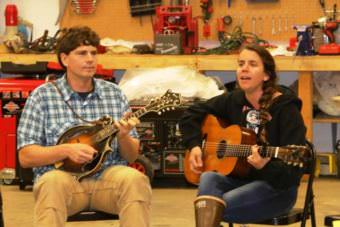
Jason Norris, left, and Stella Lyn are music instructors with the Alaska nonprofit Dancing with the Spirit. (Photo courtesy Hollis School)

The small, rural schools that make up Southeast Island School District don’t have the means for formal year-round music programs.

Recognizing the importance of music in education, though, the district brought down two music teachers from the Fairbanks-based nonprofit Dancing with the Spirit.

Those teachers spent one week with students from each school, laying a foundation students can build on for the rest of the year.

In a short video clip, students in Kasaan on Prince of Wales Island strum instruments while singing a classic Alaska folk song.

Many of these kids had just learned to play.

Kasaan School is one of eight schools in the Southeast Island School District.

Another is Hollis School, where teacher Lisa Cates took a break from lessons to talk about Dancing with the Spirit.

Teachers in rural schools like Hollis have to teach everything, Cates said, and she does try to get music into the program. But, “there was no way for me to bring it in an authentic way that really stuck.”

She heard about Dancing with the Spirit from local musicians, and started looking into how to bring that program to the island.

And then “something really fortuitous happened,” she said. “I got word that they were coming to Hydaburg last spring.”

Hydaburg has its own school district, but it’s relatively close to Hollis. Cates said the music teachers were able to add some time for Hollis during that trip.

“When they left, my kids were still playing the instruments,” she said.

That inspired Cates and Priscilla Goulding from the Southeast Island School District main office to work on funding to bring Stella Lyn and Jason Norris back to Prince of Wales.

During this trip, the two are spending about a week with each Southeast Island School District school.

They already had their week in Hollis.

Student Ben Moots talked about the instrument he ended up liking the most.

“One of my favorite things that we did, like the instrument, was the fiddle,” he said. “Mostly because I felt like I had a connection with it.”

Ben said he didn’t expect to choose the fiddle, but it turned out to be easier than one might think to learn the basics.

“There was a couple little tricks they had,” he said. “Because there’s four string, they have green, purple, yellow and red.”

So the strings are color-coded, and there are markers showing where to place your fingers.

Accompanying sheet music uses those colors and markers to indicate how to play notes.

Cates said the schools get a digital version of the sheet music, so students can continue working on their own.

The instructors brought instruments with them – guitars, fiddles, ukuleles and mandolins – so students could try a variety.

Hollis student Kimejoe Lambeth said it took her a few tries to pick her favorite.

“I tried the guitar, but I can’t play the guitar,” she said, laughing. “Then I tried the fiddle, and couldn’t play the fiddle. But then I tried the weird-shaped thing that turned out to be a mandolin.”

Students from Hollis School practice playing ukuleles. The school recently had visiting music teachers from Alaska-based non-profit Dancing with the Spirit. (Photo courtesy Hollis School)

Each week of music instructions ends with a community performance and dance. Cates said the Hollis dance was at the fire hall.

“People who don’t have students in our school showed up at our hoe-down,” she said. “Hollis is a small community, and we had 65 or 70 people there.”

Music teachers Stella Lyn and Jason Norris said community tie-in is a key element to Dancing with the Spirit’s program. It’s provided music education in rural Alaska for more than a decade, mostly in the Interior.

“Until we started bringing the program down to Southeast Alaska, the furthest south it’s been in Alaska was Yakutat,” Lyn said. “But now we’ve brought it to Prince of Wales, Angoon and Pelican.”

The two spoke by telephone from Coffman Cove School, where they had just finished up that community’s week of music instruction — combined with Naukati School because of some time constraints.

Norris said music can help kids learn about themselves, gain confidence, and avoid risky behavior.

He knows that through personal experience.

“When I was younger I didn’t have a lot of self-confidence and didn’t have a lot of friends and had a broken family situation,” he said. “When I discovered music, it turned out to be something I was really good at that I never would have realized otherwise.”

Norris is a charter member of Bearfoot, an award-winning Alaska bluegrass band that grew out of music camps in Cordova.

Bearfoot recorded albums, traveled extensively for performances and led workshops for youth.

Crediting Belle Mickelson, Norris said Dancing with the Spirit is an offshoot of that earlier summer music camp program.

“Belle, seeing the positive results of her idea to put together the staff band, decided to take it a step further and started this organization and started teaching camps in the villages,” he said. “But instead of them being after school, she got the school districts involved.”

The two instructors were headed next to Port Alexander and will finish up this tour in Thorne Bay.

Lyn said the schools have been great to work with and they hope the district will be able to bring them back next year.

“This whole tour, we’ve been so impressed with the kids everywhere,” she said. “We work them hard and we think, ‘Oh we better give them a break,’ and say, ‘OK, everybody take a break.’ But they just won’t. They won’t leave the room and keep playing the instruments. They’re really hungry for it.”

One school they traveled to off Prince of Wales Island is the 11-student school in Hyder, an old gold-mining town in a tiny corner of mainland Alaska, right on the border with British Columbia.

Hyder School head teacher Chad Dillman said the kids loved the program, and learning music enhances skills for a range of subjects.

“When they’re learning how to read music and play instruments, they’re working on math because they’re learning how to count time,” he said. “When they play songs from different regions of the world and different regions of the United States, that ties into our social studies lessons. So, the music curriculum really ties into the rest of our school day.”

Dillman said he is working on grants to buy a few instruments for the school.

He also wants to sign up musicians in the community to mentor students, building on the new foundation to help Hyder’s kids become well-rounded, confident adults.

Body recovered downstream of Ketchikan’s Carlanna Lake Dam

Ketchikan’s Carlanna Lake was created by a dam, and includes a popular hiking trail. The watershed is a backup source of water for the City of Ketchikan. (File photo by Leila Kheiry/KRBD)

The body of a woman was recovered Thursday morning downstream from Ketchikan’s Carlanna Lake Dam.

While the body has not yet been identified, the Ketchikan Police Department sent an announcement Friday noting that the body was found close to the last known location of a young woman missing for about a month.

Police Chief Joe White said police were notified on Oct. 21 that a 24-year-old Ketchikan woman was missing.

“On the 22nd and 23rd we started questioning people, trying to figure out the last known place she was at, who she was with,” he said. “We came across information that somebody believed they had seen her up at the Carlanna Lake Dam the afternoon of the 1st.”

White said police searched the area, and found some items that appeared to belong to the missing woman.

On Wednesday, police, Alaska State Troopers and Ketchikan Volunteer Rescue Squad members searched the area but didn’t find anything.

The rescue squad went back the next day with search dogs. The started at the bottom of the creek, close to the main road, and walked up toward the dam.

“They located a body just before noon, about a quarter mile down from Carlanna Lake Dam. Down in the creek,” he said.

White thanked the rescue volunteers for their work.

“This group of community members who come together to volunteer their own time to do this did an amazing job,” he said. “They were able to bring tools and resources to bear on this that we don’t have. It was instrumental in helping locate her so quickly and getting some headway on this case.”

White said the body will be sent to the State Medical Examiner’s office for identification and to determine cause of death.

At this point, he said, there is no indication of foul play.

White said the family of the missing woman has been in regular contact with police, and knows about the recovered body.

He hopes for a positive identification sometime next week.

Ketchikan man charged in shooting death at Prince of Wales logging camp

A Ketchikan man was arrested Wednesday on first-degree murder charges related to the shooting death of Brian Stanton, 64, also of Ketchikan.

Timothy Murphy, 26, is being held at the Craig jail.

The shooting took place at the Phoenix Logging Camp at Keete Inlet on Prince of Wales Island, according to Alaska State Troopers.

Alaska State Trooper Robert Jensen’s affidavit filed in the Prince of Wales court office states that the POW Troopers station received a call about Stanton’s death about 6:30 a.m. Wednesday.

Stanton had been found dead inside his trailer at the remote camp.

Jensen reports that as troopers were preparing to travel to the camp, they received a second call.

The caller told troopers that it appeared the victim had been shot in the back of the head while he sat on a couch. They had found spent shell casings, and the caller told troopers that Murphy had admitted he was responsible.

Jensen arrived at the camp about 10:30 a.m., and writes that he detained Murphy while investigating the shooting.

Jensen reports that Stanton shared the trailer with two other men.

One roommate told Jensen that he saw Stanton alive at 6 a.m. as the roommate was leaving for breakfast. He told Jensen that he walked past Murphy standing in the door of another trailer, and that Murphy looked surprised and concealed something.

The roommate told Jensen that a few minutes later, he heard a commotion, returned to his trailer and found Stanton dead.

The other roommate was asleep at the time of the shooting. He told Jensen that he woke up when he heard shouting followed by two pops.

According to the affidavit, he came out of his bedroom, saw the shell casings and saw Stanton dead on the couch.

Murphy’s roommate told Jensen that while others responded to Stanton’s death, Murphy told him that he’d shot someone.

Murphy allegedly also told the camp boss that he was responsible for Stanton’s death.

Murphy did not make any admissions to Jensen, according to the affidavit.

Site notifications
Update notification options
Subscribe to notifications