KRBD is our partner station in Ketchikan. KTOO collaborates with partners across the state to cover important news and to share stories with our audiences.
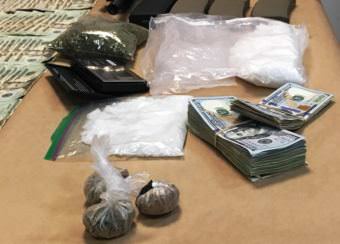
Methamphetamine, heroin and cash seized in a Tuesday night drug bust are seen on display at the Ketchikan Police Department. (Photo by Leila Kheiry/KRBD )
Ketchikan police seized a pound of meth, 2.75 ounces of heroin, a handgun and a semiautomatic assault rifle loaded with armor-piercing bullets in a drug bust Tuesday night, the result of a months-long investigation.
Three people were arrested in the drug bust. All three defendants made their first court appearance Wednesday afternoon.
Loretta Garcia, 52, Arthur Castillo, 31, and Alfonso Sandoval, 31, were each charged with two counts of second-degree misconduct involving a controlled substance.
Castillo faces an additional charge of third-degree misconduct involving a controlled substance.
Also during the raid, police seized about $16,500 cash, paraphernalia they say is related to drug sales and some pot.
During a news conference at the police station hours just after the raid, the drugs, cash and weapons were laid out on display in the briefing room.
Police Sgt. Mike Purcell estimated the street value of the drugs, starting with the methamphetamine.
“Two-tenths of a gram will sell for about $100. This is a little over a pound, so you’re looking at well over $200,000 worth of methamphetamine alone,” he said. “The heroin, if you break it down to street level, one-tenth of a gram typically goes for $100, so total value of that was, I think over $70,000.”
The three suspects were contacted downtown, on Main Street, Police Sgt. Andy Berntson said. Police knew ahead of time about the firearms, and made sure to make the arrest away from where those weapons were kept.
Berntson said the cash and firearms were found at Garcia’s home on North Tongass Highway.
“The AR-15, the assault rifle, which was loaded, was propped up inside, leaning against the side of her closet,” he said. “Right up above it was a large stack of over $5,000 of the cash, literally sitting on top of that 44-magnum revolver you can see right there. In the middle, behind the divider of the closet was a locked safe that contained the bulk of the rest of the cash.”
Berntson said the drugs and more cash were seized from Castillo’s apartment.
He said this is the largest drug bust at a residence in Ketchikan that he can remember, and is the first time that they seized an assault rifle with armor-piercing bullets.
The guns are not illegal to own, but if guns are used in connection with a crime, they can be forfeited.
So far, the defendants have not been charged with weapons misconduct.
Berntson said more charges are possible as the investigation continues. He said the defendants were charged initially with crimes police felt confident they had immediate evidence to support.
About 10 officers, including Alaska State Troopers, participated in the drug bust, Bernston said.
“It was kind of a rolling event that started early in the evening and went until about 1:30 in the morning before we all left,” he said.
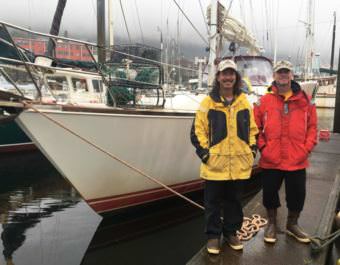
Shawn Meyer, left, and Chris Anderson stand at Ketchikan’s Bar Harbor South, where the Sea Bear was tied up Sept. 22, 2017. (Photo by Leila Kheiry/KRBD)
A U.S. Navy veteran has spent the summer sailing up the coast into Alaska’s Inside Passage.
Shawn Meyer, accompanied by other veterans during his journey, has been filming the experience and uploading episodes along the way for YouTube show, Sailing the Sea Bear.
Meyer has had some interesting life experiences. He was a Navy bomb tech for 22 years. Through that service, he traveled all over the world.
When he retired, Meyer says he tried doing the same thing as a civilian contractor, but hated it.
In the meantime, he’d seen a show about traveling through Alaska.
“I was in the desert and had the boat and I was like, ‘I wonder what it would take to do that myself? I’d like to do that,’ he said.
That was about three years ago. He went to the San Francisco School of Digital Filmmaking.
His final project was his first episode of “Sailing the Sea Bear,” filmed in Drakes Bay in Northern California.
“I just decided that was the course I wanted to take,” he said.
That course brought him to Alaska this year.
Meyer recruited friends to help him on the journey. He started in early May, sailing up the coast, meeting family, friends and former Navy buddies along the way.
“Went kind of through the San Juan Islands to Vancouver. Through the southern part of the Inside Passage, through all the islands. Through Prince William to Ketchikan,” he said. “When we got to Ketchikan, it started raining.”
This summer was a record-breaking year for rain in Ketchikan, which is saying a lot for a community that gets an average of 150 inches a year.
It also rained in Ketchikan when they arrived on the way back.
Joining him for much of the Alaska portion of the trip was fellow veteran Chris Anderson, who pointed out that all the rain made it easy to find where all the leaks were in the Sea Bear.
Meyer was able to fix most of them during the journey.
On board the Sea Bear, Shawn Meyer shows the route through Alaska’s Inside Passage. (Photo by Leila Kheiry/KRBD)
Meyer shows their route through Alaska’s Inside Passage on a chart.
Pointing to the map, he shows how, from Ketchikan, they sailed up to Wrangell and Petersburg. Then they made their way into Fords Terror, in Tracy Arm.
“This was just amazing. It’s like 2,000 feet high on both sides,” he said. “And there’s a small, narrow entrance with a rapids. You can only get in there for about half an hour every day, once a day.”
In addition to the sheer rock walls, there were waterfalls and huge chunks of ice from the glacier.
Big enough to seriously damage the Sea Bear, a 1985 Landfall 39.
Meyer said he didn’t plan for navigating around icebergs on the way out, especially after the sun went down.
Luckily, there was a cruise ship headed out at the same time.
“Like a small cruise ship, an adventure cruise ship, pulling out, and we just tucked in behind it and it broke ice for us,” he said. “Not only that, but he kinda knew what we were doing so he was spotlighting the icebergs for us.”
They continued up to Gustavus and Glacier Bay, where they had the whole park pretty much to themselves.
They came back through the outside waters, which Meyer said was pretty rough.
But they got to see the northern lights while tied up at Red Bay off Prince of Wales Island.
“I was sitting on deck and had my audio gear out,” he said. “I was shooting pictures of the northern lights and a whale breached right next to the boat. I have that on audio. It was pretty amazing.”
Meyer has been filming throughout the journey, editing at night and uploading episodes when he’s able.
One of the biggest challenges was finding a connection.
“Yeah, it’s really tough,” he said. “Even right here, I don’t have service on my phone. The harbor WiFi doesn’t work. You have to go and look for a place, like a coffee shop to upload stuff. We spent like six hours outside of a coffee shop in Seattle. In Seattle!”
Not downtown Seattle, he clarified, but at the port.
Meyer still has three more episodes to edit and post from this trip.
Over the winter, he says he’ll go back through all the footage in hopes of creating a feature-length documentary.
Meyer also is headed back to school to study boat building.
He doesn’t necessarily want to build boats; he wants to know how to refurbish and repair the Sea Bear for more adventures.
“Making it ready for a really long voyage where I’m going to go down to South America, across the Bahamas and up to Europe,” he said.
The refurbishment will include interior boat design, to maximize use of the space. It is pretty crowded in the cabin.
In addition to various gear, food and cooking equipment for two people, they had all the stuff for filming and editing.
Meyer pulls out a laptop to show some photos from the trip, including a salmon stream and fishing bears.
“It looks like it’s growling, but it’s yawning,” he said of one close-up of a black bear. “I have this on video. He’s a horrible fisherman, this bear. The other bear walked down and got a salmon before we could even turn on the camera. This thing was sitting in the water for 15 minutes, like ‘I can’t get a fish.’”
Meyer said his Southeast Alaska journey rates high.
“I’ve been around a lot of places, like 45 countries, and this is definitely my favorite adventure of my whole life,” he said.
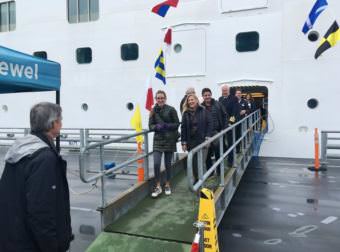
The Borda family disembarks from the Norwegian Jewel on Monday, Sept. 25th. Candy Borda is Ketchikan’s 1 millionth cruise visitor for 2017. (Photo by Leila Kheiry/KRBD)
The future remains bright for the cruise industry in Alaska, a cruise line association president said Monday during a shared during a luncheon.
Cruise Lines International Association Alaska president John Binkley delivered the optimistic news to the Ketchikan Visitors Bureau and Greater Ketchikan Chamber of Commerce.
Binkley said September 25, 2017, was an historic day as Ketchikan welcomed its 1 millionth passenger for the season.
He then spoke about the economic impacts of the cruise industry to Southeast as a whole, to Ketchikan specifically, and around the globe.
He cited data from a 2016 McDowell Group survey looking at current and projected numbers.
For Southeast, Binkley says total visitor spending in the 2014-2015 season was $1.17 billion. There were a total of 11,200 jobs associated with the cruise industry, and payroll in Southeast amounted to $436 million.
He said this is new money brought into communities.
“No different than mineral extraction or oil development where we send our crude oil outside,” he said. “Money is brought back into the state. It’s the same way with visitors who come up with new money from outside our communities, outside our state, and bring new economic vitality to our state and communities.”
For Ketchikan, Binkley said 96 percent of visitors coming into the First City arrive by cruise ship.
On average, each passenger spends about $160, amounting to more than $1 million each cruise ship day.
“If you’re on Front Street stuck behind a motor coach or waiting for crossing guards to let you through, just think about the million and a quarter dollars,” he said. “That’s $12,500 $100 bills falling out of everybody’s pockets, flying out the windows of those motor coaches, so keep your head down and look for those $100 bills on the sidewalk and see if you can pick up a few of those.”
Binkley said adding the amount of money the cruise lines and crew members spend in Ketchikan amounts to $188 million per season.
Statewide, Binkley says a total of 1,060,000 passengers are expected this year, an all-time record high for cruise ship visitors in Alaska.
Binkley said though cruise ships aren’t seen in Interior communities, they also receive economic benefits from the cruise ship industry.
“But we see about 225,000 cruise ship visitors that get off the ships in Seward or Whittier, go through Anchorage, usually by rail or motor coach up to Denali National Park, and then on to Fairbanks in the Interior.”
Binkley said there are several reasons why there has been growth in the Alaska cruise industry.
They include successful marketing, tax and regulatory stability, and Alaska’s attractiveness.
John Binkley of Cruise Line International Association Alaska speaks at a luncheon with Ketchikan Visitors Bureau and Chamber of Commerce. (Photo by KRBD)
Also, he says recent expansion of the Panama Canal allows more ships to come to Alaska.
“With the new canal, they can bring bigger ships from the Caribbean, in the winter time, right through the canal, into the Pacific and up to Alaska for the summer time,” he said. “That makes a difference as well, getting the larger ships that they can position in two profitable markets in different times of the year.”
Political stability in the country also benefitted Alaska, he said.
In addition, Binkley said the cruise industry is strong globally, especially in the Asian market. Ketchikan holds about 4 percent of the global market, and that percentage is expected to increase.
The demand for Alaska will remain high, Binkley said, and 2018 will surpass 2017 as a record year.
Larger ships, with greater capacity, will be coming to the state over the next two years. Binkley says communities need to be ready to embrace that growth, and have the infrastructure necessary to accommodate it.
“Ketchikan really has been one of the leaders in looking forward to what is going to be needed – planning, making sure they are setting aside the money to be able to fund the infrastructure to meet the demand of the industry. And that really has allowed Ketchikan to grow and have that capacity here to meet demand.”
Binkley said new cruise lines will be visiting Alaska in the coming years.
Windstar Cruises has sailings planned for next season, and Viking, Azamara and Cunard will arrive in 2019.
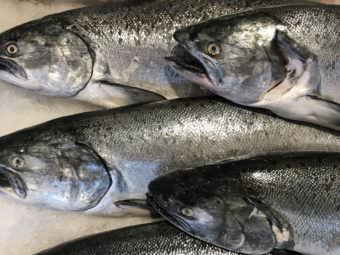
The Alaska Department of Fish and Game announced Wednesday that it is opening king salmon fishing in Southeast Alaska, beginning Oct. 1.
In early August, escapement surveys in Southeast indicated productivity and production for wild king salmon were lower than anticipated.
The decision was made to close king salmon fisheries throughout the region.
State fisheries managers decided to reopen the fishery starting in October because the summer closure provided some breathing room for kings, and the catch rate for kings during the winter season tends to be low, according to Wednesday’s announcement.
Once the fishery reopens, Alaska residents’ bag and possession limit will be two kings of at least 28 inches. Nonresidents’ bag and possession limit will be one king salmon, with an annual limit of three.
The winter king season in Southeast lasts through the end of March.
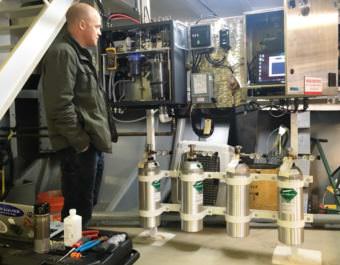
Researcher Wiley Evans installed equipment on the Alaska Marine Highway System ferry Columbia, to monitor ocean acidification along the ferry’s 2,000-mile route. (Photo by Leila Kheiry/KRBD)
The Alaska Marine Highway System ferry Columbia will be part of an international science experiment starting this fall when it resumes its weekly run between Bellingham, Wash., and Southeast Alaska.
Equipment has been installed to continuously measure the ocean’s acidity along the ferry’s nearly 2,000-mile route. The goal is to better understand how acidification affects regional fisheries.
The 418-foot ferry Columbia is docked at Ketchikan’s Vigor Alaska shipyard while undergoing repairs to its propeller system.
That’s not great for ferry passengers, who have been sailing on the smaller Malaspina instead. But, it worked out for a team of scientists who installed a seawater-monitoring system on the Columbia before the ferry is due to resume service.
Wiley Evans is a researcher with the Canadian Hakai Institute, and is the technical lead in the program. Tucked under some stairs in a corner of the Columbia’s car deck, he shows me the newly installed equipment.
Evans said getting to this point took about three years.
“Allison Bidlack from Alaska Coastal Rainforest Center and I started talking about this in 2014,” he said. “In 2015, we did a similar installation on another passenger vessel. That was a glacier tour vessel that operated out of Whittier.”
That was a small catamaran.
“At the time, I felt it was fairly difficult, but now, having been through this installation – that was pretty easy,” he said. “The size of the (Columbia), The fact that it’s a ferry, and they’re very cautious about seawater flowing through the vessel and how it’s moving around the vessel.”
The seawater lines had to be engineered and installed.
Through those lines, seawater enters the system at the bow thruster cavity, and is pumped up to the equipment on the car deck.
“The water first flows through an oxygen sensor, then through a thermosalinograph, which measures the temperature and salinity of the water, and then into these boxes here, these larger boxes,” he said, pointing to some of the equipment. “The first is the wet box. Water goes into the wet box and is equilibrated with air.”
In other words, ocean water is sucked up while the ship is under way, and then is measured for oxygen, temperature and salinity – that’s how much salt it contains. Then it’s pumped into the wet box, where it is sprayed into a little container.
Air in that container picks up carbon dioxide contained in the water. That air then is pumped into dry box, which analyzes CO2 levels. Those levels indicate the acidity of the water.
Separate sensors measure carbon dioxide levels in the atmosphere, to compare that with the seawater.
“What we’re after is trying to understand the time and space patterns in surface ocean CO2 chemistry near shore,” he said. “In this area, it’s extremely data-poor.”
Evans said they hope to discover patterns of CO2 concentrations along the entire Southeast Alaska and British Columbia coastline. And the ferry is the perfect platform for gathering data.
“The fantastic thing about this vessel is it’s going from Bellingham to Skagway and back every week,” he said. “That’s a 1,600-kilometer run. Nowhere in the world is there a ferry system that’s outfitted with CO2 sensors that’s running that scale of a transit. This is really exciting.”
Evans said they expect to see seasonal changes in carbon dioxide, related to temperature; changes related to freshwater sources, such as glacier melt and stream outfalls; and changes connected to areas of large development.
“It’ll be a mosaic of different signals we’ll be seeing along the transit, and really fun to analyze from my standpoint,” he said.
Evans hopes the study can continue at least five years, but he’d really prefer it to last closer to a decade.
“The challenge is really first understanding what the natural variability looks like in this data-poor region, and then making measurements long enough that we can tease out the long-term ocean acidification trend, which is this gradual increase through time,” he said “It’s really hard to see with just one or two years of data.”
Evans said the data will help fisheries management, especially oyster farmers.
For example, a small, local study in Ketchikan has given area oyster farmers a better idea of when to put animals into the water.
“We’ve been able to define a seasonal window of opportune growth conditions,” he said. “That’ sort of starts around March or April, and ends about now.”
Crab also are affected by ocean acidification. Evans said it’s not clear yet how much it affects other fisheries.
“We’re still trying to work out what the links are and who exactly the winners and losers are going to be,” he said “It’s really clear that shellfish are on the losing side.”
The monitoring equipment will run continuously and automatically, so nobody needs to be there watching it. Evans said they do plan on one or two ride-alongs per year to make sure everything is working correctly.
The data will be available daily, though, through an antenna on the bow. It will upload automatically to a website, available through the Alaska Ocean Acidification Network’s site.
Evans said they’re designing it so that non-scientists can understand the data.
Alaska Marine Highway System environmental specialist Christy Harrington said ferry system officials were happy to work with the science team.
“It’ll be the biggest survey taking place in North America, from Bellingham to Skagway,” she said. “The route that the ferry takes is very close to shore compared to other units on board other vessels. It will give them a lot more data that they can use. We’re just very excited to be able to provide the resource for the oceanographic equipment to be on board.”
Evans said the study wouldn’t be possible without partners like the ferry system.
He also mentioned the Canada-based Tula Foundation, the Alaska Ocean Observing System, Alaska Coastal Rainforest Association, University of Alaska Southeast and NOAA.
“One of my colleagues from NOAA, who is sort of the brains behind this equipment, Geoff Lebon, we wouldn’t be able to do this without their support,” he said.
All those partners eagerly await the first data. The Columbia is currently scheduled to resume its regular run in late October.
The entrance to the First City Homeless Services Day Shelter is seen this spring. The organization is working with the Salvation Army to open a separate night shelter. (File photo by KRBD)
The Ketchikan City Council agreed Thursday to fund a seasonal warming center for homeless residents at a cost of $80,000.
The program is a partnership between First City Homeless Services and the Salvation Army.
The organizations worked together last winter, too, to provide a warming center at the Salvation Army building on Stedman Street.
But, that facility doesn’t meet code requirements for people to sleep there, and Salvation Army Lt. Sam Fowler told the council that his group doesn’t have the funding to pay for it a second year.
The Rev. Evelyn Erbele of First City Homeless Services told the council that a safe place where people can sleep off inebriation following alcohol or drug use will save the city money in the long run. It will cut back on unnecessary work by police and emergency services personnel.
There was some concern from council members about the city fully funding the program.
Agnes Moran, who is working with the group on setting up the warming center, said they are applying for funding through the federal Department of Housing and Urban Development, and the Alaska Mental Health Trust; and they plan to apply for funding through PeaceHealth, which runs the local hospital.
Moran said because of when the plan came together, it didn’t work out to get applications in for this year. They hope to open a warming center at the start of October, and run it through the end of March.
Most of the funding will go toward salaries. The rest is for rent and supplies.
Erbele said they are negotiating to rent a downtown location.
The motion to fully fund the warming center this year passed unanimously.
Also Thursday, the council approved two loan applications to the state for new water and wastewater pipes on Schoenbar Road.
The council also agreed to meet in special session Sept. 14 to vote on a plan to dredge sediment from a washout on Carlanna Creek. The sediment is causing navigational issues in the Tongass Narrows.
Editor’s note:KTOO’s building sits on land leased from the Alaska Mental Health Trust Authority. KTOO has also applied for and received occasional grants for special reporting projects from the authority.
Close
Update notification options
Subscribe to notifications
Subscribe
Get notifications about news related to the topics you care about. You can unsubscribe anytime.