KUAC - Fairbanks

KUAC is our partner station in Fairbanks. KTOO collaborates with partners across the state to cover important news and to share stories with our audiences.

Shooting at Fairbanks Safeway leaves 1 dead, another injured

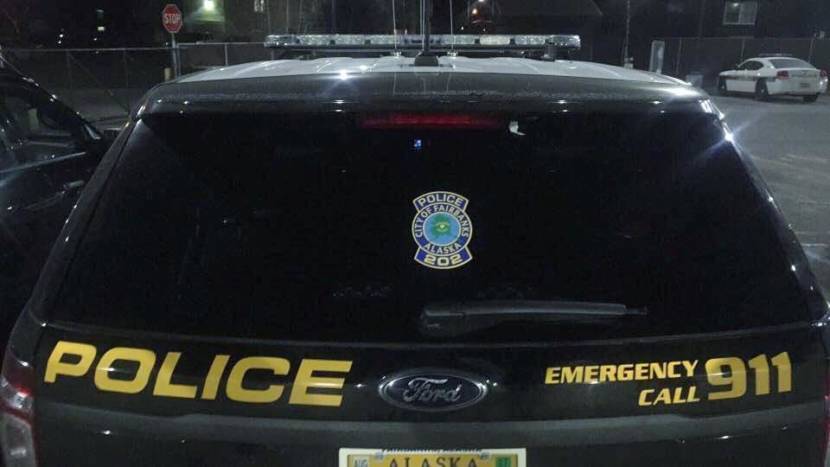
Fairbanks police vehicle. (KUAC file photo)

Update — Monday, Nov. 8, 3:05 p.m.:

A 41-year-old man has been arrested and charged with first-degree murder in the Sunday shooting outside of a Safeway grocery store in Fairbanks, according to police.

Fairbanks police identified the man as Joshua Eric Butcher.

Police say Butcher turned himself in around 6:53 p.m., roughly 11 minutes after officers first received reports of shots fired.

Butcher was arrested at the police department and said he would not answer questions without a lawyer, according to police. He was in possession of an empty gun holster and empty magazine holders, said police.

Butcher was taken to the Fairbanks Correctional Center.

Police have not yet identified the person killed or the person injured in the shooting. The person injured has been released from the hospital, police said on Monday.

Police say security camera footage shows the suspect approaching an entrance of the Safeway and shooting a person in the abdomen.

“The suspect then continued into Safeway and can be seen holding the firearm in his hand as he walked behind the registers heading north, before turning around and heading back out the entrance that he came in,” according to police.

At the scene, officers found multiple firearm magazines and multiple spent and unspent bullet rounds.

Police say they’ve yet to determine a motive.

Original story:

One person was killed and another injured in a shooting at a Fairbanks grocery store Sunday night, according to police.

Fairbanks police reported they received several 911 calls before 7 p.m. about shots being fired at a Safeway store on Airport Way. Fairbanks police and other area law enforcement officers responded.

“At the scene, they found two victims that had been shot. Both were adult males,” said City of Fairbanks spokesperson Teal Soden. “They were both transported to Fairbanks Memorial Hospital. One of the males was unfortunately pronounced deceased, and the other male is expected to survive.”

The name of the man who died will be released after next of kin are notified, she said. A suspect is in custody.

“Shortly after the shooting, an adult male suspect turned himself in to Fairbanks Police Department, where he asked for an attorney,” Soden said.

The suspect’s name will be released if and when charges are filed, she said. She would not comment on a motive for the shootings.

“This is still really early in this situation, and there’s a lot of investigating to be done, but we will try to give the community an update as soon as possible,” she said.

There were other people in the store when the shooting happened.

“There are several witnesses. Fortunately, many, most of them that were there were able to get out of the area,” she said.

Soden said there have been no reports of anyone else being injured. The public was asked to stay away from the area near the store last night as police worked the crime scene.

Alaska Public Media’s Wesley Early contributed to this story.
Eielson Air Force Base may have a small nuclear power plant by 2027

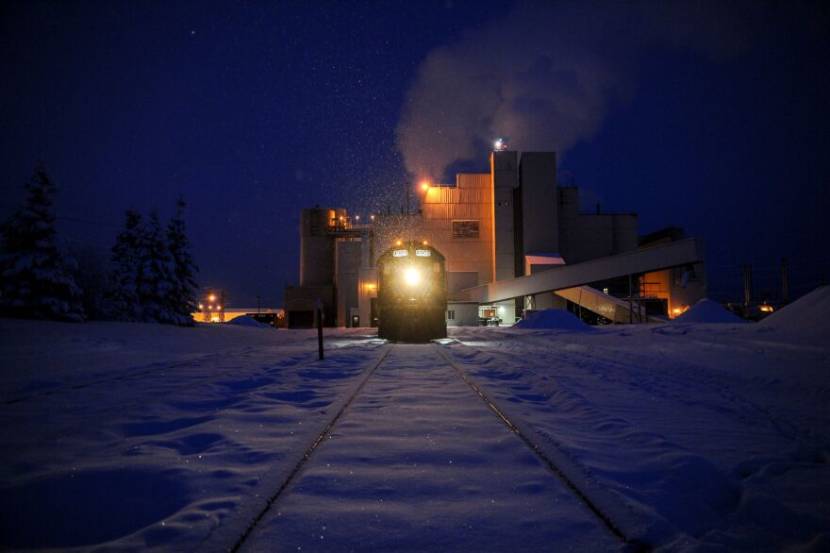
A locomotive that pulls railcars filled with coal idles next to Eielson’s heat and power plant. The Air Force says it will build a microreactor to ensure key parts of the installation would be able to function if problems arose with its 70-year-old heat and power plant. (Isaac Johnson/354Th Fighter Wing Public Affairs)

The Air Force plans to build a small nuclear power plant on Eielson Air Force Base that would generate up to half of the installation’s electricity needs. Air Force officials say the so-called microreactor is part of a pilot project to test the viability of using nuclear power to ensure military installations can continue operating after they lose their main source of electricity.

A microreactor similar to the one Air Force officials are considering for the Eielson pilot project.

Air Force officials came up with the plan to build a microreactor at Eielson after the agency adopted a policy a few years ago to ensure its installations could continue to carry out their missions even if they lose their primary source of electricity.

Which, in this case, is Eielson’s 70-year-old coal-fired heat and power plant.

“This is really about energy resilience,” says Mark Correll, a deputy assistant secretary of the Air Force who oversees management of the service’s environment-, safety- and infrastructure-related issues.

“We’re looking to make sure that at any point in time, any of our bases with any mission will have the power it needs, where it needs it, when it needs it, in the quantities that it needs, to assure that we can continue to do the defense mission that we have,” he said.

Correll says a provision in the 2019 National Defense Authorization Act required the Defense Department to build a microreactor and ensure it’s operational by 2027.

“We expect to meet that goal without any difficulty, and we expect to do that at Eielson,” he said in news conference Friday.

Air Force Deputy Assistant Secretary for Environment, Safety and Infrastructure Mark Correll in 2018. (Brian Garmon/Air Force IMSC Public Affairs)

Correll says the Air Force chose Eielson because it’s an important installation that’s located in a relatively isolated area, about 20 miles south of Fairbanks. And he says that if its 15-megawatt heat and power plant were to go offline, the base has only one backup source of electricity – Golden Valley Electric Association.

He says in that situation, the microreactor would continue generating electricity to keep parts of the base operating. But Eielson does not have a backup source of steam heat, which would be a serious problem during the winter.

“If that central heat and power plant goes down,” Correll said, “we’ve got some real issues on the installation, besides just being able to launch aircraft.”

A local energy expert says another possible reason Eielson was chosen for the pilot project is that it’s a very expensive base to operate.

“Of all the Air Force bases, it is the one that has the highest energy cost overall,” says Gwen Holdmann, who directs the University of Alaska Fairbanks’ Alaska Center for Energy and Power.

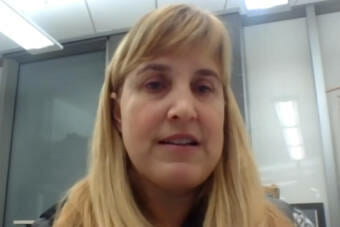
UAF Alaska Center for Energy and Power Director Gwen Holdmann fields questions during an online presentation to the Fairbanks Economic Development Corp. (screenshot)

Holdmann told the Fairbanks Economic Development Corporation Tuesday that the microreactor could serve as a backup source of heat.

“It would probably meet all of the base’s needs, in terms of thermal energy,” she said during an online meeting conducted by the Fairbanks Economic Development Corporation.

Eielson on average needs 10-15 megawatts daily to operate, and demand sometimes peaks as high as 25 megawatts.

Correll says the Air Force did not include the base’s aging power plant among its reasons for selecting Eielson for the microreactor. But he says the potential reduction in emissions that it could facilitate is an additional welcome benefit.

“There’s no doubt that the elimination of greenhouse gases as a result of that is integral are extraordinarily positive, and we’re happy to do it,” he said. “But it wasn’t the main focus.”

Correll says the microreactor would be contained in a structure that’s about the size of a conex shipping container that’ll be located in a site of about 5 acres.

He says it won’t cost the Air Force any money upfront. Instead, it’ll pay for it through power purchases from the company that’ll build and operate it, at a rate that’s competitive with what the base pays now.

“The discussions we’ve had with a couple of companies that are doing this,” Correll said. “They assert that their cost to produce power is going to be comparable to what it costs us to produce it or what it would cost us to buy it from Golden Valley.”

Correll says the Air Force hopes to begin soliciting proposals from qualified companies in February and will select a vendor later in the year. The service will then begin working on licenses and permits from the Nuclear Regulatory Commission, which will oversee the project.

Construction of the microreactor will begin in 2025, and it’s scheduled to begin operation in 2027.

2,000 University of Alaska Fairbanks employees must get their COVID vaccines due to federal funding

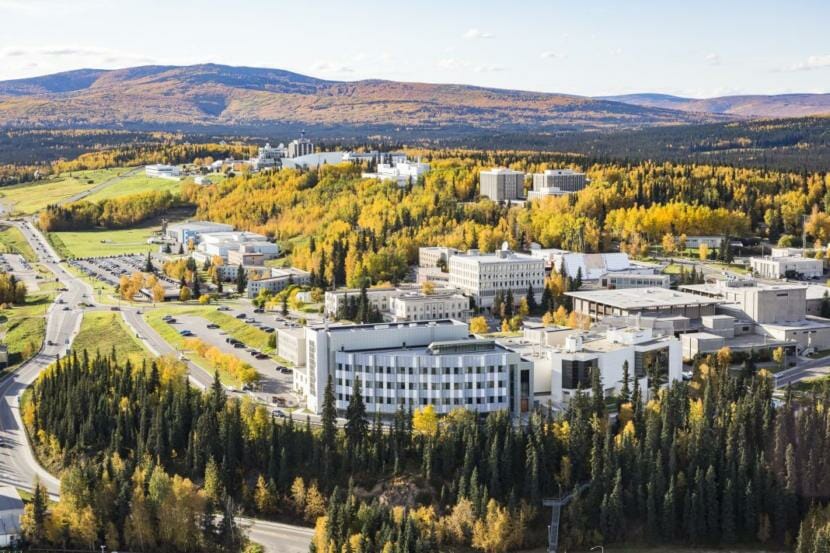
The University of Alaska Fairbanks campus
The University of Alaska Fairbanks campus. (University of Alaska photo)

A large group of University of Alaska Fairbanks employees must get their COVID-19 vaccines by Dec. 8 due to federal contract requirements. University of Alaska interim President Pat Pitney announced the mandate Tuesday, citing $300 million in recently renewed, or soon-to-be signed federal contracts.

“With the federal contract provisions that require vaccinations,” Pitney told reporters during an online news conference on Tuesday.

Pitney said the federal contract vaccination requirement applies to a large but defined set of employees estimated to total 2,000. The group includes anyone paid by a federal contact — estimated at more than 750 UAF and UA employees. Plus, it includes “anyone who supports them or works near them,” Pitney said.

The federal contract employee vaccine mandate is in addition to existing UAF vaccination requirements for students living in dorms, those in certain classes where social distancing isn’t practical and student athletes.

Noting that while medical and religious exemptions will continue to be offered, UAF Chancellor Dan White said employees covered by the federal contract vaccine requirement must comply to keep their jobs.

“With respect to what happens on Dec. 8 or soon thereafter, this vaccine requirement becomes a condition of employment,” he said.

White said he’s already received some feedback.

“There have been different opinions expressed, but the majority have been support,” he said.

Alaska is challenging federal vaccination mandates and Gov. Mike Dunleavy issued an administrative order Tuesday defending Alaska from “federal government overreach.” President Pitney said the university does not fall under the order because it is not a state agency, adding that it voluntarily chose to sign the contracts.

“We’ve chosen to protect the jobs of more than 750 individuals and to protect the research mission and in some sense the economy of the state,” she said.

Pitney said she supports state efforts challenging the scope of Biden administration vaccination mandates.

Editor’s note: This story has been updated to clarify how many university employees the vaccine mandate impacts. It applies to about 2,000 workers — not about 750 — after accounting for those who work with and near staff directly paid through federal grants.

Alaska Air National Guard reports first incursion of Russian military planes since January

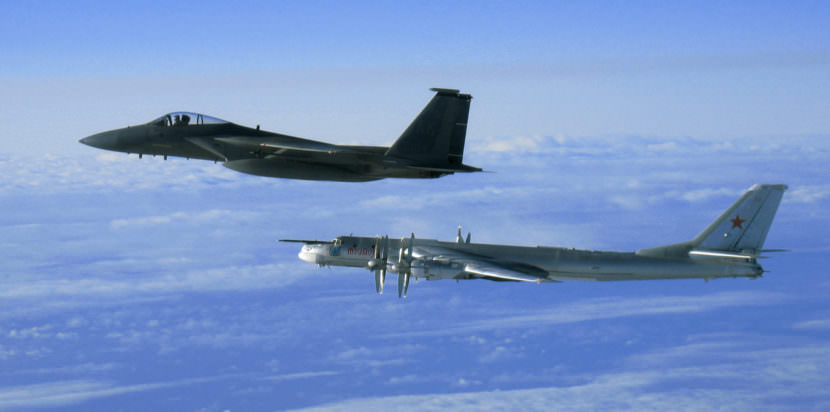
An F-15 Eagle from the 12th Fighter Squadron at Elmendorf Air Force Base, Alaska, flies next to a Russian Tu-95 Bear Bomber on Sept. 28, 2006, during a Russian exercise near the west coast of Alaska.
An F-15 Eagle from the 12th Fighter Squadron at Elmendorf Air Force Base, Alaska, flies next to a Russian Tu-95 Bear Bomber on Sept. 28, 2006, during a Russian exercise near the west coast of Alaska. A pair of Tu-95 bombers were among the five Russian planes that flew near Alaska last week. (Public domain photo courtesy U.S. Air Force)

Members of an Alaska Air National Guard unit at Joint Base Elmendorf Richardson detected and tracked five Russian aircraft that flew near Alaska last week.

The Alaska Air National Guard’s 176th  Wing identified the Russian aircraft on Oct. 21 when they entered international airspace off Alaska.

A news release issued by the wing Monday says its Air Defense Squadron continued tracking the aircraft as they flew through the Alaska Air Defense Identification Zone, then relayed that information to the North American Aerospace Defense Command, or NORAD.

A NORAD news release says the Russian aircraft entered the identification zone at about 6 p.m. Thursday and left about 90 minutes later. The news release didn’t say from which direction the aircraft approached Alaska.

The Air National Guard’s news release says the 176th Air Defense Squadron’s surveillance and weapons teams identified the Russian aircraft with help from the JBER-based 611th Air Operations Center. The Russian formation included an AWACS-type reconnaissance and control plane, two Su-35 Flanker jet fighters and two Tu-95 Bear long-range bombers.

It’s unclear whether U.S. fighters were scrambled to escort the Russian aircraft through the identification zone. That’s what the Air Force did more than dozen times last year to intercept more than 60 Russian planes that had entered the identification zone off Alaska and Canada.

Observers say last week’s Russian aircraft incursion off Alaska was the first since January.

Lieutenant General David Krumm, who heads the Alaskan Command, said that was the busiest spate of Russian aircraft incursions since the fall of the Soviet Union in 1991.

Correction: An earlier version of this story misspelled Lt. Gen. David Krumm’s name. It is David Krumm, not David Crumm.

Episcopal Diocese of Alaska to investigate the history of church-run boarding schools for Indigenous children

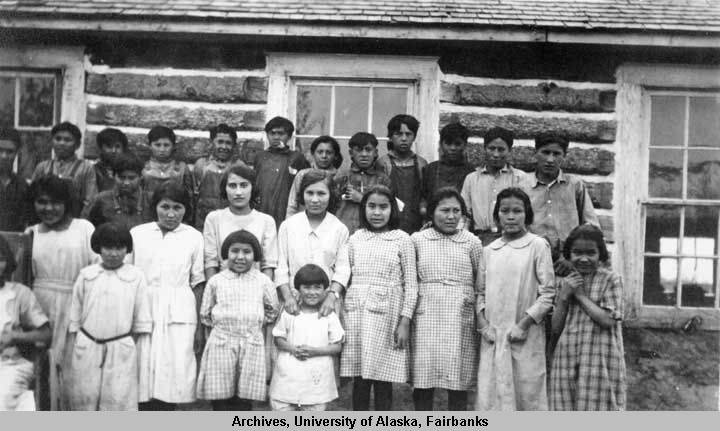
Boarding pupils of St. Mark’s Mission in Nenana in May 1924. It is from the Drane Family Collection, courtesy of the University of Alaska Fairbanks, APRCA (UAF-1991-46-782).

The Episcopal Diocese of Alaska says it will join a national effort to investigate the history of church-operated boarding schools for Indigenous children.

Episcopal Diocese of Alaska Bishop Mark Lattime said the action was prompted by the discovery this summer of unmarked graves where Indigenous children were buried at Canadian boarding schools run by churches.

“We recognize that it opened wounds that have been carried by so many of our Alaska Native brothers and sisters,” he said. “And the fact that the church was involved in this process is something that concerns us.”

The Episcopal Church was among those that ran boarding schools in Alaska and the Lower 48 in the 19th and 20th centuries.

Lattime said the Alaska church must look beyond its own account of history.

“The history that we’ve received is that those missions in schools were operated with care and respect for Indigenous culture and children. You know, we also have to recognize that history is written by one side of the story,” he said.

Lattime said the church in Alaska and nationally must “stand in the light of truth.”

“We might be able to say, ‘This wasn’t an issue in the Episcopal denomination.’ The fact is, if it happened in any church denomination, we, as a Christian body, I think are all responsible,” he said.

Lattime said the church is going through archival records and will work with Alaska Native organizations to hear from former boarding school students and their descendants.

The Episcopal Church hosted a national webinar on Indigenous’ Peoples Day about boarding schools, during which speakers described cultural genocide.

Pearl Chanar, who grew up in the Interior Athabascan village of Minto, recounted attending a boarding school hundreds of miles away.

“And what I remember most is that loneliness, missing my parents,” she said.

Pearl Chanar of Anchorage shares her story of attending a boarding school. (Episcopal News Service)

Chanar said she was denied expression of her culture.

“Not being able to speak my Native language, not being able to enjoy my traditional cultural activities such as my singing, dancing,” she said.

Chanar said she’s heard from other boarding school survivors who were abused. And she cautioned the Episcopal Church to be careful asking people about their experiences.

“That individual is going to tell you a story that happened 70 years ago,” she said. “It might have been traumatic for them. And if it was, then you’re asking them to repeat something that they’ve had buried for a very long time.”

Chanar noted that many boarding school survivors were subsequently lost to alcohol, drugs and suicide.

“And this is part of the truth of the Episcopal Church,” she said. “It’s a part of the history now. It’s not pleasant and it hurts.”

Chanar said the trauma experienced at boarding schools is passed to successive generations.

Bishop Lattime said the church is looking for Native guidance as it pursues “truth and reconciliation.”

“We need to be about listening and hearing and then following the lead of our Alaska Native people on the best way forward, and so really we’re just at the start of this process,” he said.

Lattime said Alaska Natives will be well represented in a state delegation which will attend a national Episcopal Church convention next summer in Baltimore, during which the boarding school issue will be a primary topic.

University of Alaska interim president turns down UAF’s request for broad COVID vaccine requirement

The University of Alaska Fairbanks campus
The University of Alaska Fairbanks campus. (University of Alaska photo)

University of Alaska interim president Pat Pitney has turned down a request from University of Alaska Fairbanks Chancellor Dan White to implement a COVID-19 vaccine requirement for all Fairbanks-based faculty, staff and students.

During a call with reporters on Monday, Pitney pointed to practical, legal and health requirements that weighed in the decision.

“The practical application of going with a broad mandate at only one of the universities when we’re a single employer was both, from a practical standpoint and a legal standpoint, a little bit different,” she said. “And from a health standpoint was really not differentiable.”

Pitney said an existing system-wide mask mandate and targeted vaccination requirements for some groups at individual campuses, including those living in dorms, are proving effective.

White said that the broader vaccination mandate was sought by UAF faculty, staff and student organizations. They asked Pitney to approve it earlier this month, with a Jan. 1 start date.

Pitney said she expects a federal COVID-19 vaccination mandate to apply to the entire UA system soon.

“The federal OSHA mandate we’re anticipating sooner than later, with an expectation of implementation on Jan. 1,” she said.

Pitney said the federal mandate will apply to the university system because it has federal contracts. She said that all campuses could also be subject to a potential U.S. Department of Education COVID-19 vaccination requirement.

Pitney said she supports vaccination regardless of mandates.

“I encourage that from a health perspective,” she said.

White said earlier-approved UAF vaccination requirements for students in dorms, student athletes and some classes remain in place. The university will also consider additional vaccine requirement requests on a case-by-case basis.

“We have scuba diving classes, for example, that require that you share a respirator, and those kinds of situations we’ve already approved,” he said. “It’s my expectation that over the last two weeks there’s been a number of other requests that have been kind of waiting for President Pitney’s response. So I do expect to get more vaccine requirement requests, and we’ll look at those on a case-by-case basis.”

White said about half of UAF faculty have said they’re vaccinated against COVID-19, with lesser percentages for staff and students. As of Monday, UAF said it knew of 446 COVID cases among students, employees and contractors at all of its locations since March 2020.

Site notifications
Update notification options
Subscribe to notifications