KYUK - Bethel

KYUK is our partner station in Bethel. KTOO collaborates with partners across the state to cover important news and to share stories with our audiences.

Fansler lays out position on taxes, opioid disaster, subsidies

District 38 state Rep. Zach Fansler laid out his position on proposed taxes, the governor’s opioid disaster declaration, changes to oil and gas subsidies, and more Friday during a live KYUK call-in show with constituents.
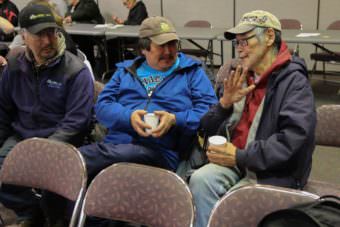
State Rep. Zach Fansler meets February 11, 2017, with District 38 constituents at an open house meeting at the Kuskokwim University Campus. (Photo by Katie Basile/KYUK)
State Rep. Zach Fansler meets Feb. 11, 2017, with District 38 constituents at an open house meeting at the Kuskokwim University Campus. (Photo by
Katie Basile/KYUK)

Fansler said he supports House Bill 115, the proposed fiscal solution for the state from the House Finance Committee.

The bill combines earnings from the Permanent Fund with an income tax to generate state revenue, while using a formula to maintain a Permanent Fund Dividend.

“This is something that I’m very supportive of,” Fansler said, referring to the state income tax, “and something that I’ve heard from folks over and over in the region about. That this is really the fair way to make sure all Alaskans are giving with equity.”

Fansler expects to see those revenues flowing back to help the region.

“We have water and sewer issues,” he said. “We have a lot of issues with erosion. We’re on the forefront of climate change, and the only way to get these services is to raise more money.”

A proposed tax the representative has not made up his mind about is House Bill 60 and Senate Bill 25, a bill to triple the state’s motor fuel tax over the next two years from a national low of 8 cents per gallon to 24 cents per gallon by July 2018.

The tax has not been raised in almost 50 years.

“It’s probably something that does need to happen,” Fansler said. “But I think that we need to make sure we are raising it in a way that doesn’t price people out of living here on the YK Delta.”

The tax would go into a designated fund to repair state roads, airports and ferries. Fansler said he will need to hear from constituents to make his decision on the proposed increase.

Gov. Bill Walker’s disaster declaration for the state’s opioid epidemic earned applause from Fansler. The governor said his orders will require legislation to address the epidemic on all fronts, and Fansler had some ideas.

“We need to make sure we’re fully funding these programs that are in place already,” Fansler said. “We need to make sure we’re passing legislation that is intelligent and that is going to get critical services such as rehab programs, such as return to work programs, things like that, that are going to help people kick the habit and move on with their lives, and stay away from it in the long term.”

Fansler said he met with the governor last week to discuss ways to cut off the supply of illegal opioids and heroin to bush communities.

Reforming the way the state taxes the oil and gas industry is an issue Fansler campaigned on, and he says he doesn’t think House Bill 111 on that issue goes far enough.

“I think it’s a good first step,” he said. “It’s important to note that it doesn’t immediately make a large scale difference.”

Fansler said it’s too early for him to take a position on Sen. Lyman Hoffman’s proposed Senate Bill 18, a bill to create a new kind of borough that would have taxing power to build energy infrastructure.

“To lower energy costs, I applaud that,” Fansler said. “We’ll see as this bill goes on if this is a vehicle to do that.”

Hoffman says the bill will likely see substantial changes made in committee.

Senate Bill 91, which passed last year, overhauled the criminal justice system and, according to some critics, has made consequences too light for serious offenses.

There are no specific changes to the bill that Fansler said he supported at this time, but he’s open to suggestions from constituents.

Fansler said that he supports tribes developing their tribal courts, and he wants his office to act as a clearing house on that issue.

Bethel city manager plans crack down on city truck drivers

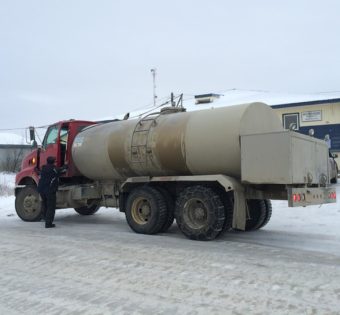
Bethel water truck.
Bethel water truck. (Photo by Anna Rose McArthur/KYUK)

Bethel city water trucks get more than their fair share of abuse, but after an incident that left a brand new water truck tipped on its side, the Bethel City Manager decided to change the accident policy to give city truck drivers who are found to be negligent tickets and drug tests.

It’s pretty common to hear about water and sewer trucks crashing into things in Bethel. They’re huge vehicles driving on tiny, often slick roads.

But Bethel City Manager Pete Williams said at Tuesday’s City Council meeting that it is more than city roads that are the problem in these accidents. He should know; Williams was a truck driver.

“I drove truck for 20 years, and I would never have been a truck driver if I went through all the accidents I see out there,” Williams said.

He says the high number of accidents in Bethel has to change, and he has a plan on how to make that happen.

“We’re gonna kinda take a different approach to how to deal with these when they happen. We’re gonna sit the driver down, take a drug test,” Williams said.

Federal law requires drug tests after major accidents, but the ones the City Manager is focusing on are minor ones that are not covered under federal law. What Williams wants to do is reduce the kind of bumping and scraping that has become common in the Bethel fleet.

Earlier this year, the city received new water trucks costing $250,000 each after the previous City Manager secured funding for them. Williams says that the latest accident was unacceptable.

“Running into houses, these aren’t incidences, these accidents, and you should get a ticket. We might lose some drivers, but we just can’t continue the way we’ve been going on this,” Williams said.

Losing drivers could mean a slowdown in water and sewer service until new drivers are found. Drivers are drug tested before they are allowed to drive for the city, but until now, they haven’t usually retested for drug use unless they are in a major accident.

Governor issues disaster declaration on Alaska’s opioid epidemic

Gov. Bill Walker declared on Wednesday Alaska’s opioid epidemic a state disaster and ordered state and federal money for overdose medication.

In the declaration, Walker said the opioid epidemic goes “beyond the timely and effective response and recovery capability of local resources.”

The declaration will cost $4,058,316 from regular appropriations for the Department of Health and Social Services and from federal grants to fund naloxone distribution statewide. Naloxone is a drug that can reverse opioid overdoses.

In a letter to the state’s legislative leaders, Walker said the declaration will not draw funds from the Disaster Relief Fund or from additional state general funds.

The declaration authorizes the commissioner and the State Medical Officer of the Department of Health and Social Services to coordinate a response to the crisis.

According to the declaration, that response could include creating a statewide overdose response program and allowing anyone in Alaska to dispense and administer naloxone.

Walker plans to announce more information on his plan today.

Spike In alcohol-related calls straining Bethel Search and Rescue resources

Bethel Search and Rescue President Mike Riley and Vice President Fritz Charles address BSAR members at a regular meeting on Feb. 2, 2017. (Photo by Anna Rose MacArthur/KYUK)

It’s the first winter in Bethel since a liquor store opened after almost 40 years of illegal sales. Alcohol is easier than ever to get, and Bethel Search and Rescue says the number of calls they receive, almost all alcohol-related, has spiked.

Volunteers are getting worn out, resources are depleting and the organization is asking the community for help.

Two weeks ago, Bethel Search and Rescue got a call.

A man had left Bethel sometime after midnight, heading to Akiak on a four-wheeler.

He had been drinking, hadn’t arrived in the village that morning, and the caller was worried.

Search and Rescue went looking and found the man, Charles Williams Jr., 29, dead on Steamboat Slough. He had apparently frozen to death.

It was Search and Rescue’s first body recovery of the winter, but the all-volunteer group doesn’t know if it will be the last.

“We ask if you come to Bethel to buy booze, bring it home first, and then start consuming it there for your own safety and the safety of others,” said Mike Riley, Bethel Search and Rescue president.

Since November when the river and overland trails froze, opening the paths to Bethel from the surrounding villages, the organization has seen a spike in calls. Most involve alcohol.

Historically, about 95 percent of the calls Bethel Search and Rescue receives involve alcohol. That percentage is still basically true, but instead of getting a few calls a month during the winter, like past years, Search and Rescue is getting about two calls a week.

Usually the calls come between midnight and 6 a.m., and responding to such a call can be tough.

John Wassilie has volunteered for Bethel Search and Rescue for more than 30 years.

When a call comes late in the night, he’s usually the first to grab his gear and go, jumping on his snowmachine to head out in the dark and the cold to look for someone.

All he knows is that the person was heading in a general direction and maybe the color of the person’s vehicle or coat, but finding them is just half the work.

“They don’t want to listen to you,” Wassilie said. “They don’t want to reason with you, and they want to try to get home.”

when people have been drinking, they’re not thinking clearly, he said. They’re verbally aggressive, and they’ll often use whatever they have on them as a weapon: broken sticks, bottles, “even their groceries when they’re drunk, because they don’t know what they’re doing,” Wassilie said.

Half the time, Wassilie hog-ties the person he’s found just to contain them, so he can get them out of the cold and somewhere safe.

The late nights, the physical danger, the emotional abuse, it all adds up.

Bethel Search and Rescue has 100 members, but only about 10 regularly respond to calls. At least one has talked about quitting and others are taking indefinite breaks.

Riley said that the group is funded through donations, and that the current call rate is unsustainable for their budget.

“It’s OK for now,” Riley said, “but if we keep this up, and we keep going out, and we’re out of our own pocket, we’ll be hurting for funding.”

The group is all volunteers, and most have jobs, families and other commitments.

Dozens will come out for big searches, the kind the group was created for, when people get trapped in unforeseen circumstances like a blizzard descending on a snowmachine or a storm stranding a boat.

Now, members say it’s become a drunk patrol, and a lot of people aren’t willing to head out looking for another intoxicated person at 3 in the morning.

But when the group was formed, it made a commitment, a commitment to help anyone who needed them, a commitment it’s kept, and one that Riley said it will continue.

“We’re going to keep on going for the people’s sake out there, for their families’ sake,” he said. “The biggest part of it is keeping everyone safe and bringing them home.”

Anyone can become a member of Bethel Search and Rescue.

The next meeting is the group’s annual assembly at 7 p.m. Feb. 15 at the Bethel Search and Rescue building.

After rejecting plea deal, judge sentences Pilot Station man to five years

A judge rejected a plea deal that would have let a Pilot Station man serve less time.

Dale Thomas Fancyboy was sentenced on Thursday at the Bethel Courthouse to five years in prison for theft and assault after being convicted of breaking into a jail, holding guards at gunpoint, and then stealing a snowmobile to escape.

The presiding Judge Dwayne McConnell rejected a deal that would have let Fancyboy out with half the time and more probation. The judge has also taken a dim view of earlier plea deals.

McConnell said at Thursday’s hearing that he did not believe that Fancyboy was going to learn from his mistakes, no matter how much time he got. So he gave him more time, not less.

“The reason I rejected the other plea, the one that gave you lesser time, was, I think you need to be out of the community as long as I can keep you out of the community. I don’t think it will change anything, other than maybe people will get a rest.”

The judge went on to cite the numerous instances where Fancyboy had broken the law over the years, and the harm he did over those years.

“From Pitka’s Point, to Pilot Station, to Marshall, to Saint Mary’s, in one form or another say that they’re afraid of you,” McConnell said.

Bethel’s District Attorney Michael Gray argued that the probation terms could protect the public.

“Given a sufficient amount of time to serve, I’m always willing to trade essentially double in suspended time because I think it puts the state in a better position to have control over Mr. Fancyboy,” Gray said.

But the judge did not agree.

McConnell earlier sentenced Daniel Misner, another violent offender, to a reduced sentence with probation after he was presented with a finished plea deal by the district attorney.

In the cases of Fancyboy, Misner and another case, that of Derek Adams, the district attorney sought deals for violent offenders with the bulk of the sentence kept in reserve for if and when defendants violated their conditions of release.

Derek Adams ended up back behind bars when he was found selling heroin after his release.

Misner is currently out on probation.

In the case of Fancyboy, McConnell put his foot down, saying he wanted to send him away for as long as he could.

Wandering bison that ‘captured the hearts’ of Western Alaska poached near Quinhagak

Wood Bison No. 124, seen here from the air, was illegally shot and killed January 27, 2017 near Quinhagak. The Alaska Department of Fish and Game is calling the animal's death a setback for the Alaska Wood Bison Restoration Project. (Photo by Alaska Department of Fish and Game)
Wood Bison No. 124, seen here from the air, was illegally shot and killed January 27, 2017 near Quinhagak. The Alaska Department of Fish and Game is calling the animal’s death a setback for the Alaska Wood Bison Restoration Project. (Photo by Alaska Department of Fish and Game)

She was a wanderer. Instead of sticking with her herd, Wood Bison 124 headed out on her own, traveling hundreds of solitary miles from the Alaska Yukon, down the Kuskokwim, to the sea.

A bullet ended her journey Friday near Quinhagak.

She was shot illegally.

A man from the village of Quinhagak has been charged for poaching.

Benjamin W. Moore, age 25, has been charged with two misdemeanors for illegally taking and possessing game.

The meat has been donated to the McCann Treatment Center in Bethel.

The animal was one of 130 wood bison released along the lower Innoko and Yukon rivers in 2015, between April and June. That release was the beginning of the Alaska Wood Bison Restoration Project, an effort to rebuild a population of wood bison here after they disappeared about 200 years ago.

The plan was to give the bison 10 years to have babies, find their range and become a bigger herd before hunters would get a chance to harvest them.

During the few years she had, Wood Bison 124 became a bit of a celebrity.

Tom Seaton, the wildlife biologist who oversees the wood bison reintroduction project with the Alaska Department of Fish and Game, described her as a wanderer that “captured the hearts of rural communities across western Alaska.”

He called the death “a sad loss.”

According to the state, during her wanderings 124 had a “knack” for finding good bison habitat.

Now, she can no longer share this information with the rest of the herd, leaving what Seaton calls, “a void that could slow (the) herd’s expansion.”

Site notifications
Update notification options
Subscribe to notifications