KYUK - Bethel

KYUK is our partner station in Bethel. KTOO collaborates with partners across the state to cover important news and to share stories with our audiences.
Bethel native sets American record in women’s powerlifting squat

Bethel native Natalie Hanson has set a new American record in women’s powerlifting.

Hanson squatted 578.7 pounds, more than three times her body weight, and more than 33 pounds over the former record Saturday, Jan. 28, in Milwaukee.
The 26-year-old set the new all-time-high at the USA Powerlifting Wisconsin State Open Championship.

Natalie Hanson set a new American record in women’s powerlifting on January 28, 2017 in Milwaukee, WI when she squatted 578.7 pounds at the USA Power Lifting Wisconsin State Open Championship. (Photo by Ryan Carrillo/Lurchman Productions)
Natalie Hanson set a new American record in women’s powerlifting on January 28, 2017, in Milwaukee, Wis., when she squatted 578.7 pounds at the USA Power Lifting Wisconsin State Open Championship. (Photo by Ryan Carrillo/Lurchman Productions)

Hanson knew she had three chances to break the American Women’s Open Division record in her weight class. Hanson stands 5-foot-3 and weighs 185 pounds.

On her first lift, Hanson started light. That is, if you consider a quarter of a ton to be light.

“So my opening squat was 240 kilograms, which is 529 pounds. So I was just, like, 15 pounds off the American record on my opening squat,” Hanson said.

On the second squat, she went for it.

“I broke the record on my second attempt squat with 255 kilograms, which is 562 pounds,” Hanson said.

Not content with that, on the third lift Hanson broke the record that she had just set.

“The weight was 262.5 kilograms, which was 578.7 pounds,” Hanson said.

That squat raised the American record by more than 33 pounds, and automatically sends Hanson to the national competition in Orlando, Florida, in May.

The double-record-breaking lifts were part of her plan to reclaim her former title as the American Women’s Open Division record holder.

“When I first broke the record was 2015,” Hanson said, “I set it with 535 pounds, or 242.5 kilograms, at USA Powerlifting Nationals.”

Hanson would have broken her own record the following year, but she failed a drug test.

This is how she explains it: “I injured my back at that meet, and I took a pain killer at the end of the meet when I was done competing, when I hurt my back, to relieve myself of that pain. I was drug tested, and I failed the drug test.”

After that experience, Hanson said she was ready to have her record back.

And this past weekend, she took it along with two additional personal records: in the deadlift with 474 pounds and in total weight lifted with 1,400 pounds.

“It’s exciting and it’s really rewarding to achieve it, but I was ready for it,” Hanson said, laughing.

In the world of weights, Hanson is a celebrity. That’s why she was invited to compete as a guest lifter by Tonya Lambeth, the Event Director for the USA Powerlifting Wisconsin State Open Championship in Milwaukee.

“For many here in Wisconsin, to see this young lady from Alaska squat, and bench, and deadlift these really superb numbers was quite impressive,” Lambeth said. “And it was inspiring to a lot of the teenagers and young people that we had at the competition. Natalie just has a great personality where she met many of the younger lifters, and they thought it was great that they talked with a powerlifting celebrity.”

Hanson trains about 16 hours a week at Southside Strength and Fitness in Anchorage. During the rest of the week, she works as the Executive Director of Nuvista Light and Electric Cooperative. She calls power lifting “addicting.”

“It’s really fun. It’s really fun to compete in something that I can see my personal progress in a daily or weekly basis. And it’s also really empowering to be extremely strong,” Hanson said.

Lambeth in Wisconsin said that when she started lifting 35 years ago, there was no women’s division. Only herself and a bunch of men. Lambeth hopes to see a 50-50 split one day between men and women. At this competition, women comprised 40 percent of the power lifters.

Hanson plans to be one of those competitors for many years to come, continuing with Nationals in May and then hopefully the World Championships to follow.

Evidence suggests harmful algae blooms impact species from humans to whales

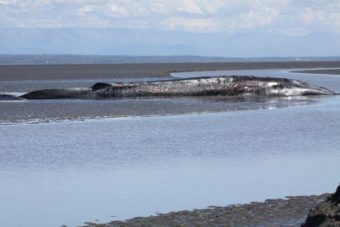
A beached fin whale in the upper Knik Arm on June 21, 2016. (Photo by Christopher Garner/JBER biologist)

There is growing evidence that harmful algae blooms have widespread health impacts on everything from humans to whales.

When fin whales were found floating dead in Alaska’s oceans and stranded on beaches last year, some researchers suspected that toxic algae blooms might have been responsible.

According to Nicholas Pyenson, a paleo-biologist and curator of the Smithsonian Natural History Museum’s fossil marine mammal collection, it would not be the first time such a thing may have occurred.

He points to a huge graveyard of 900-year-old fossilized whales recently discovered in Chile.

“Something else about this site, there’s not just whales there; there’s dolphins, early seals. That’s what we call a multi-species stranding event,” Pyenson said. “So this happened many times. Harmful algal blooms are the only explanation that really explains why we have the profile of death that we see at this site.”

Pyenson said that the red halo of iron they found around the bones is a telltale sign of toxic algae blooms.

“So we do have a candidate; a smoking gun. Could it have been domoic acid? Sure, but dinoflagellates red tide is, I think, probably the most likely explanation,” he said.

That’s the same red tide that closes clam beaches today when it occurs in Alaska, something that has been happening more frequently as a result of our warming seas.

It’s not just whales that are suffering.

Kathi Lefebvre with the National Oceanic and Atmospheric Administration’s Northwest Fisheries Science Center said that marine mammals, like sea lions, are being found with the beginnings of seizures from harmful algae blooms associated with red tide.

“You may or may not know, but on the central California coast we get dozens to hundreds of sea lions each year coming onto beaches, having seizures, and suffering from domoic acid poisoning,” Lefebvre said.

NOAA scientists found evidence of memory loss and excitability in the sea lions that did not die from that exposure. That led them to wonder if the same thing was happening to humans who consume things like razor clams.

“Pacific Northwest recreational and tribal communities subsistence harvest razor clams, which we know retain low levels of toxins below the regulatory limit for up to a year or more after the bloom,” Lefebvre said. “So that we know that populations are exposed to that.”

Lefebvre and her colleagues exposed laboratory mice to low levels of domoic acid and trained them to run through mazes. At first they saw no effects, but after six months the change was striking.

“Exposed mice simply did not learn,” Lefebvre said. “This big of an effect just completely shocked us. Doing chronic exposures is really risky, because a lot of times you don’t see something, so this was a pretty dramatic effect; way more than we had expected.”

More study is needed to understand the effects on humans, but Lefebre points out that existing standards are based on one-time high exposures that can cause seizures and permanent brain damage.

The good news is that the kind of effects showing up in laboratory mice from long-term low exposure can be reversible.

How does this relate to beached whales?

Even if the exposure to domoic acid wasn’t high enough to kill them, memory loss could have still made it tough to navigate.

EPA grant funding available again after temporary hold sparks concern

A crew works on a sewer system in a rural Alaska village. Photo courtesy USDA Rural Development.

Alakanuk, and other villages seeking federal sewer and water money received good news Friday afternoon.

The Environmental Protection Agency announced that its funding for grant projects is once again available. This means that tribes receiving money for infrastructure projects can proceed as normal.

Over the last week, many have questioned the need to review the EPA’s operations and speculated that there might be possible cuts to vital programs. However, the EPA explains in their statement that no aspect of the process has changed and that the grant amounts have also remained the same.

This will come as a relief to tribes and rural communities seeking funding for essential projects like water/sewer. The village of Alakanuk recently expressed concerns about the future of the program in the face of a massive overhaul of their sewer system.

The EPA says that it is still evaluating contracts that were put on pause by the Trump Administration, but as of Friday afternoon, that review was nearly complete as well.

Pete Kaiser wins third consecutive Kuskokwim 300

Pete Kaiser won his third consecutive Kuskokwim 300 Sunday morning.
Pete Kaiser won his third consecutive Kuskokwim 300 Sunday morning. (Photo by Katie Basile/KYUK)

His was the team to beat and no one could. Sunday morning for the third year in a row, Pete Kaiser won the 2017 Kuskokwim 300 Sled Dog Race, crossing the finish line in Bethel at 10:37 a.m. to loud cheers from his hometown crowd…  His leader Palmer brought home the nine-dog team, 28 minutes faster than last year.

Sass, last year’s runner up, followed 46 minutes later at 11:23 a.m.

Kaiser left the final upriver checkpoint of Tuluksak with a 20-minute edge over Sass, pulling the snow hook from the river ice at 5:22 a.m. Sunday morning for the final run to Bethel. At the finish line Sunday morning, Kaiser said the dog team signaled early in the run that they could make it home for the prize.

“When we left Tuluksak, they looked really good. We were on step within a few miles, and I could feel the power in the handlebar,” said Kasier.  “I knew at that point that if we could keep that going, he’d [Sass] have a hard time time catching us. As far as knowing that you’re going to win, not until you get here. But he’s a heck of a competitor; I knew he’d be coming after us.”

A 29-year-old member of the next generation of mushers, Kaiser had eight K300 finishes to his name coming into the race and an experienced core team who has raced the past three years. He also brought several “up and coming” two-year-olds into his race team. Kaiser wins the $25,000 top prize from the $150,000 purse.

In a frigid race with temperatures reaching minus 40, Kaiser had to contend with a set of challenges from the cold.

“You put a couple extra layers on — the dogs gets coats. A little extra care makes every task a little more difficult. It was nice to have a cold race with snow. It actually feels like winter here,” said Kaiser.

Brent Sass placed second for the second year in a row in the Kuskokwim 300.
Brent Sass placed second for the second year in a row in the Kuskokwim 300. (Photo by Katie Basile/KYUK)

Thirty-six-year-old Sass, a seasoned Yukon Quest musher based in the interior community of Eureka, was never far behind from Kalskag onward.

Kaiser banked the six hours of rest he was allowed on the 300-mile trail earlier than his closest competitor did. He took four hours in Kalskag on the outbound trail and an hour each in Aniak and on the way back through Kalskag.

Sass took his first three hours in outbound Kalskag and completed the Aniak and Whitefish Lake loop in one big march before taking the next three again in Kalskag. While Sass pushed through Aniak during the day Saturday, Kaiser’s team was able to tack on the advantage he needed to secure the victory.

Aniak musher Richie Diehl earned his highest-ever place in the K300, coming into the Bethel finish in third place.
Aniak musher Richie Diehl earned his highest-ever place in the K300, coming into the Bethel finish in third place. (Photo by Katie Basile/KYUK)

His team built a small lead by running 24-minutes faster than Sass into Aniak and 16 minutes faster into Kalskag. But with the fresh inbound Kalskag rest in his team, Sass began to slash into Kaiser’s buffer, gaining 14 minutes on the trail into Tuluksak for the final rest. That set up a classic final sprint on the 50 miles from Tuluksak to Bethel. The mushers’ rest schedules match last year, when Sass chased Kaiser but was unable to overtake him in the final stretch. Richie Diehl placed third in the K300, his best career finish.

In 2015, Kaiser became the first local musher in nearly three decades to win the Kuskokwim 300. Now he matches Mitch Seavey for the second-most titles with three. Only Jeff King with nine victories has more.

New alcohol healing center opens in Bethel, renewing hope for recovery

James Charlie Sr., YKHC Honorary Board Member, and Gloria Simeon, YKHC Board Vice Chair, perform the ribbon cutting ceremony at the opening of the Yukon Kuskokwim Ayagnirvik Healing Center on January 11, 2017, surrounded by YKHC board members.
James Charlie Sr., YKHC Honorary Board Member, and Gloria Simeon, YKHC Board Vice Chair, perform the ribbon cutting ceremony at the opening of the Yukon Kuskokwim Ayagnirvik Healing Center on January 11, 2017, surrounded by YKHC board members. (Photo by Dean Swope/KYUK)

Between the two open blades of a pair of scissors stretches a thick red ribbon across the hallway of the new Yukon-Kuskokwim Ayagnirvik Healing Center. Holding the scissors are Gloria Simeon, YKHC Board vice chair, and James Charlie Sr., honorary board member.

The ribbon falls in half with one cut, and the two ends flutter to the new wooden floor of the approximately $12.8 million facility as the crowd applauds and cheers. At one end of the hallway are 16 beds for inpatient alcohol treatment as well as an exercise room, craft rooms, and a kitchen. Down the other end are rooms for outpatient counseling for both alcohol and opioid addiction.

People in the Yukon-Kuskokwim Delta seeking treatment for alcohol addiction now have a newer, more spacious facility to help them. And with the new building, there is renewed hope for treating a disease that has long affected many lives in the region. The Yukon-Kuskokwim Health Corporation celebrated the opening of the Yukon-Kuskokwim Ayagnirvik Healing Center on Wednesday.

The Yukon Kuskokwim Ayagnirvik Healing Center celebrated its opening on January 11, 2017.
The Yukon-Kuskokwim Ayagnirvik Healing Center celebrated its opening on January 11, 2017.
(Photo by Dean Swope/KYUK)

In the middle sits a small gym with a single basketball hoop. Here, dozens of community members and YKHC board members and employees are gathering to commemorate the building’s opening.

Honorary Board Member James Charlie Sr. begins the ceremony with a prayer of thanksgiving.

“Quyana for this opportunity to get together to open this building,” he prayed, “which will help our people who need help in getting rid of alcoholism or other drugs.”

Gratitude and hope for a better future echoes throughout the morning’s speeches. Board members thank those who first began offering alcohol treatment in Bethel in the 1970s. Administrators thank the funders and construction workers who made the building possible. Ray Watson, Director of the Healing Center, thanks the employees filling the room, who every day guide patients toward recovery.

Ray Watson, Director of the Yukon Kuskokwim Ayagnirvik Healing Center, thanks all the employees who help guide patients toward recovery.
Ray Watson, Director of the Yukon Kuskokwim Ayagnirvik Healing Center, thanks all the employees who help guide patients toward recovery. (Photo by Dean Swope/KYUK)

“I always say,” Watson told the crowd, “I have a deep respect for those kind of people who choose this kind of work because it takes a lot of humility and love towards their fellow human beings to help them heal.”

Watson knows this work well: first as a patient in the 1980s, then as a counselor, and now as the center’s director.

“I always say the people who enter into counseling are the lucky ones because there are so many out there who don’t have that, or at this point in time, they’re not there yet,” Watson said.

Many speakers noted that everyone in the Delta knows someone in the region who struggles with alcohol or drugs. They might even one day seek treatment themselves.

The facility actually opened six weeks ago. Watson said the patients were sent on an ‘outing’ for the ribbon cutting to protect their confidentiality. But after the ribbon is thrown away, the cake eaten, and the balloons taken out, those patients will return. They may have to come back repeatedly if they relapse.

This new center, located behind the Bethel post office, was set to open a couple years ago. But in October of 2014, the partially constructed building caught fire and burned to the ground. Construction began again.

Diane Kaplan is the President and CEO of the Rasmuson Foundation, one of the building’s funders. She said that the fire and rebuilding can be seen as a metaphor for recovery.

Diane Kaplan, President and CEO of the Rasmuson Foundation, addresses the crowd at the ribbon cutting ceremony at the Yukon Kuskokwim Ayagnirvik Healing Center on January 11, 2017.
(Photo by Dean Swope/KYUK)

“People who don’t understand a lot about this disease will say, ‘Well how many people went into this facility and got sober?’ Well very often it doesn’t happen the first time,” Kaplan said. “So I think we can look at what happened to this building as there was a great effort to build it, and then something happened, and it fell down, and now it’s been picked up again. And that really is the message for people who struggle with alcohol.”

But as Director Watson said and can attest, recovery, like the new building, is possible.

Study finds disturbing trend in mortality rate in Kusilvak Census Area

A graph showing the age standardized mortality rate from self-harm and interpersonal violence for both sexes in 2014 from a University of Washington study. The study showed the rate of suicide and homicide in Alaska's Kusilvak Census Area more than doubled between 1980 and 2014; a 130 percent increase and the highest rate in the nation. (Graphic by Institute for Health Metrics and Evaluation at the University of Washington)
A graph showing the age standardized mortality rate from self-harm and interpersonal violence for both sexes in 2014 from a University of Washington study. The study showed the rate of suicide and homicide in Alaska’s Kusilvak Census Area more than doubled between 1980 and 2014; a 130 percent increase and the highest rate in the nation. (Graphic by Institute for Health Metrics and Evaluation at the University of Washington)

The rate of suicide and homicide in the Kusilvak Census Area, located along the lower Yukon River, more than doubled since 1980, a rate increase higher than anywhere else in the nation.

A study from the University of Washington mapped how people in the U.S. died during those years. Its finding for the area is disturbing.

It’s a sobering increase from 51 deaths per 100,000 people in 1980 to 181 per 100,000 by 2014.

The area’s small population numbers were adjusted to be able to compare rates with larger population areas.While the finding from the University of Washington does come with some caveats, Abraham Flaxman, an assistant professor at the University of Washington’s Global Health Department, says it raises a red flag.

“Let me start by saying that 130 percent increase is huge,” he said. “And anytime we see an increase like that, and it’s an increase in something bad, we want to know about that.”

The data came from death certificates from across the nation, and using this source brings a potential defect to the study.

Flaxman said that even though death certification has been improving since the 1980s, quality varies and coroners in many areas would often list an alternate cause of death to avoid the stigma of suicide.

Another limitation of the study is that it doesn’t show how much of that 130 percent increase is from suicide and how much is from homicide.

But according to the State of Alaska’s death statistics, since 1999, which is about halfway through the study’s timeframe, suicides in the Kusilvak area have far exceeded homicides.

For example, there were 13 suicides and four homicides between 1999 and 2001. Between 2011 and 2013, there were 24 suicides and six homicides.

Presumably suicides account for most of the 130 percent increase, and Flaxman hopes that the numbers help local officials take action.

“So now it is out there, and what happens from there, I really hope this is something people find helpful and can use to improve population health,” Flaxman said.

Suicides in Alaska Natives is no secret.

In this same Census Area in 2015, four people killed themselves in Hooper Bay in a period of weeks.

While the continued high rate of suicides in Natives communities took center stage at the Alaska Federation of Natives Meeting that year, one Native man underscored the issue by flinging himself off the balcony and dying in front of the delegates.

One of the people trying to plug the flow of Alaska Native despair is Ray Daw, head of Behavioral Health at the Yukon Kuskokwim Health Corporation.

“Our prevention department, which is about four years old, has done a lot of work at understanding the impact of boarding schools, the impact of the epidemics that occurred two generations ago upon families in the region,” Daw said.

Colonization disrupted the local culture by killing whole families and communities with epidemics and then taking children away from the survivors to educate them in white-run schools. This led to family dysfunction and substance abuse, conditions ripe for suicide because youth lose the capacity to see a viable future.

The YKHC suicide prevention department works to reverse these forces by strengthening the Yupik culture.

It bases its treatment on ways Yupik people lived healthy lives less than a century ago, before there were such high suicide rates.

The department is fully staffed by local Alaskan Natives who all speak Yupik, Daw said.

“Research says that if you’re going to have effective work in behavioral health, you have to have people who are closer to the culture in terms of how they think, feel and behave, and understand the dynamics of problems and solutions a lot more effectively than someone who isn’t,” Daw said.

To get more Alaska Natives providing behavioral health care to Alaska Natives, the department partners with Dr. Diane McEachern at University of Alaska Fairbanks Kuskokwim Campus.

McEachern teaches the rural human services certificate program, and the human services associate degree program. Both are paths to a degree in social work.

Two Yupik elders are always in the classroom with McEachern.

The classes work on how to counsel people and how to heal communities.

McEachern is convinced that these classes can make a real difference.

“So we’re looking at what does it mean for a whole community to experience more health and well-being? And if that happens, what are all the ways to help that happen? And then, what outcomes can we imagine from that in terms of the rates of all these issues? Well, they would plummet,” McEachern said.

Professionals are putting their hope in historical healing and resiliency, strengths the elders in the classroom embody; strengths that the students work to build in their communities; and strengths that, when they were present, the young did not to take their own lives, but instead grew up and became elders and leaders in their own right.

The classes are rooted in the understanding that the rates of suicide, domestic violence and substance abuse are ways that the fallout from colonization manifest when one culture violates another.

From there, the students can move beyond the past to create a viable future.

“It’s is a social condition that happened to the Yupik people,” McEachern said. “And that’s a powerful insight for people to have, because now they can sit back and go, ‘Oh, it really wasn’t us. So what is us that kept us safe before? And let’s embrace that.’”

But will that be enough to curb a trend that has built and increased over more than 30 years?

No one knows the answer to that question.

There have been efforts to bring highly visible discussion of the issue, such as the Pulitzer Prize-winning series “A People in Peril: A Generation of Despair” published in 1988 by the Anchorage Daily News.

There has also been controversy and discussion, both public and private, along with community and private healing sessions. But despite all of this, there is still no sign of a reversal in the trend of increasing suicides in Alaska Native youth.

Johanna Eurich and Steve Heimel contributed reporting to this story.

Site notifications
Update notification options
Subscribe to notifications