

KYUK - Bethel

KYUK is our partner station in Bethel. KTOO collaborates with partners across the state to cover important news and to share stories with our audiences.

Bethel Schools Archery team headed to nationals after taking first place in two divisions

Bethel Schools Archery team earned first place in the state in both the elementary and middle school divisions.

Students now have their sights set on the national competition this May in Louisville, Kentucky.

Practice begins at Gladys Jung Elementary School, when two whistles sound, it’s time for the students to grab their bows. They line up at several different targets: the bull’s-eye shot, placed at 15 meters, and the 3-D animal shots, starting at 11 meters and moving back to 15 meters.

“The kids go through extensive training,” team head coach Rafe Johnson said. “It doesn’t seem like it’d be hard, but there are 11 steps to the archery success and they start there with handling their bows, pulling their arrows out one at a time. Only one kid at a target at a time.”

Johnson also teaches physical education and math at Gladys Jung. He gestures to his daughter, 10-grader Rylee Johnson, who also is on the nationals team.

“Notice how they carry their arrows,” Rafe Johnson said. “Rylee’s got her tips covered and she’s carrying them with two hands so she won’t stab or hurt anybody.”

Students practice twice a week, and this year have added new techniques like flipping around the colored bull’s-eye targets to shoot at the black surface on the back.

“We want the kids to be concerned with their form rather than what the end result is,” Rafe Johnson said.

The National Archery in the Schools Program, or NASP, national tournament awards student finalists in both the team and individual class divisions. For the individual portion, boys compete with boys and girls compete with girls.

Rylee Johnson came in second in the high school girls individual category, but at this practice she doesn’t feel quite in the zone.

“It’s more of a mental thing,” Johnson said. “Like, some days I’m really mentally OK and I shoot really well. But then other days I’m not mentally stable. Well it’s not, like, ‘crazy,’ but it’s not focused I guess. So, you don’t shoot as well as you think.”

Days off the mark aren’t fretted over, though, as this is Rylee’s sixth time qualifying for nationals.

“You see a thousand kids on the line at a time, so … there is always shooting happening, so it sounds like rain and it’s in this big stadium,” she said. “You can look down for 3 miles and it’s just targets. It’s so cool.”

For nationals, students will shoot at bull’s-eye targets and three-dimensional animal targets.

Scholarships also are given out for team and individual tournaments. For instance, first-place teams in the boys and girls bull’s-eye shoot-off receive a $20,000 scholarship each.
 
The Bethel Schools Archery team is made up of 74 students, ages 9 to 18, from Ayaprun Elitnaurvik, Gladys Jung Elementary School and Bethel Regional High School.

To get to Louisville this May, the team has fundraised 60 percent of their travel and hotel costs, Rafe Johnson said. The 13 students selected for the national competition will compete as a team in the high school division, despite their varying ages.

The team will compete May 11-13 at NASP’s national tournament in Louisville, Kentucky.

2 muskoxen illegally shot near Bethel

Muskoxen
(Photo Courtesy National Parks Service)

Two muskoxen have been poached near Bethel, and Alaska Wildlife Troopers are searching for whoever is responsible. The Troopers found the two animals near a snowmachine trail between the Bethel dump and Akiachak on Sunday.

The scene described by Troopers was one no hunter could condone:

“One muskox was dead and another appeared to be shot in the eye and other parts of its body. It was limping badly and couldn’t see because of the bullet wound to the eye, so it was kind of staggering around, kind of out of it,” said Brett Gibbens, an Alaska Wildlife Trooper out of McGrath who is handling the case. “So the decision was made to put that second animal down since it was fatally wounded.”

Both muskoxen had been shot multiple times with small caliber firearms.

“Not large caliber rifles like you would normally use if you were going to target muskox if you were going muskox hunting,” said Gibbens.

No meat had been salvaged from either muskox.

Several four-wheelers and one snowmachine were seen leaving the area by the person who discovered the animals. Troopers are seeking information regarding who’s responsible for the poaching. The Alaska Wildlife Safeguard Program is offering a cash reward for information that leads to prosecuting the offenders.

“I know how it is in small communities, and people are sometimes hesitant to step forward with information,” said Gibbens, “but they can do that anonymously through that program.”

Offenders could be charged with taking muskox in a closed area and failure to salvage edible meat.

Poaching animals that are part of a small population affect the whole herd. Gibbens says that illegal killings like these undercut the ability for the muskox herd to grow into a population the area could one day legally hunt.

“Basically, these satellite herds of muskox that move in from the coast come in and establish new territories,” said Gibbens. “And the exciting thing about that is if they’re not poached, they could set up new herds and new territorial ranges and those herds could grow, possibly, to legally huntable populations.”

Troopers salvaged the meat from the two muskoxen and have donated it to charities in Bethel.

Anyone with information about this case can contact the Alaska Wildlife Troopers at 907-574-0491 or Alaska Fish and Wildlife Safeguard at 1-800-478-3377.

YK tribes look for solutions to impacts of alcohol on villages

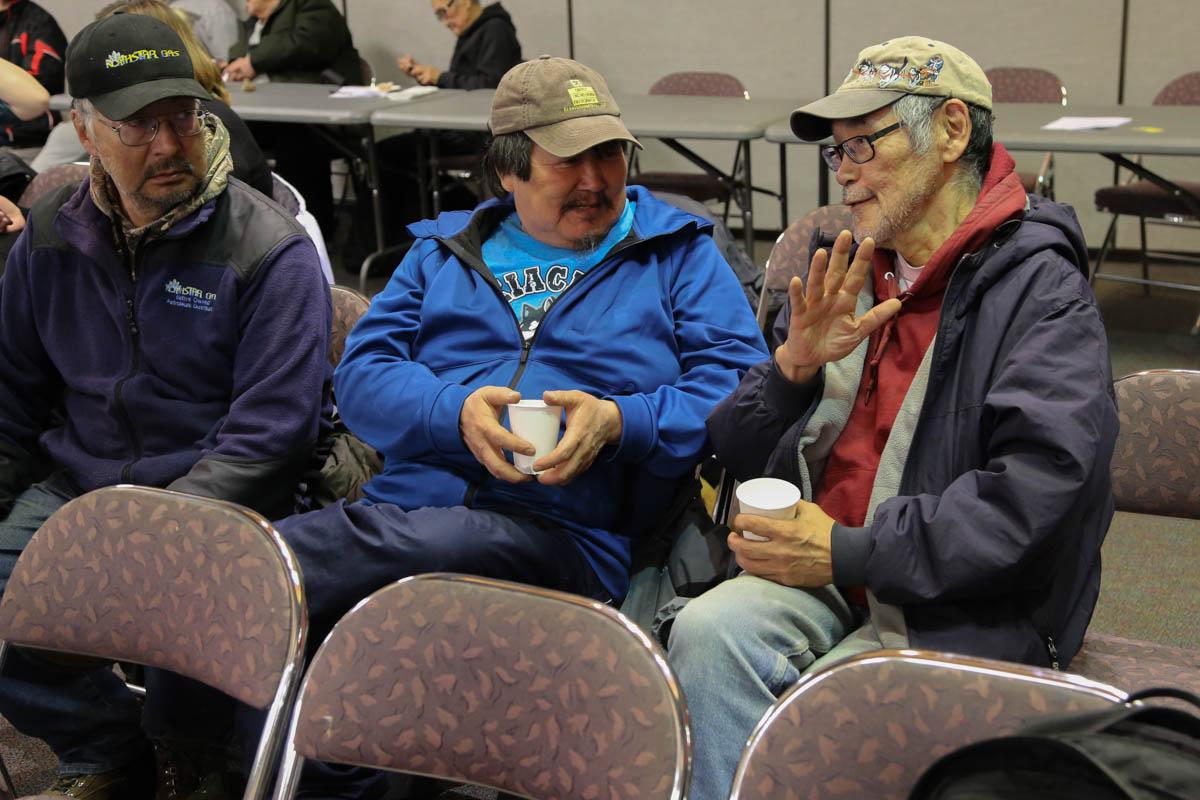
Tribal members from more than a dozen YK Delta tribes met March 8, 2017, in Bethel to discuss how their villages have been affected since alcohol sales began in Bethel last spring and what tribes can do about it. (Photo by Gale Ekamrak/KYUK)

Representatives from more than a dozen tribes across the Yukon-Kuskokwim Delta came together to share how their communities have been affected since Bethel started selling alcohol last spring.

Bethel’s alcohol stores are affecting the entire region, and it’s up to the tribes to do something about it. That’s the message from a tribal gathering held Wednesday in Bethel.

But before the meeting began, a tragedy underlining its purpose struck.

A woman was thrown from a snowmachine Wednesday morning and died. Alaska State Troopers responded to the crash west of Akiachak on the Gweek River trail.

The driver was intoxicated, and at about the time he was being charged with a DUI and criminally negligent homicide, the meeting in Bethel was beginning.

Tribal members — one after another — stood up and shared their stories about how their villages have been affected since Bethel started selling alcohol.

“The bootlegging issue has increased,” said Nick Duney, Tribal Council president of Marshall, a dry village.

“Kids are depressed, walking around like they have no hope. Gunshots heard outside of my house multiple times. Neighbors that are always drinking,” said Kimberly Smith, substance abuse prevention coordinator in Akiak, another dry village.

“Since I started in December,” said Steven Andrew, an Atmautluak tribal police officer, “I’ve already got one locker filled with empty bottles of booze. I can’t even count how many bottles I’ve taken away so far.”

At one point, Andrew apologized for pausing during his speech, saying he’d only gotten three hours of sleep the night before after responding to a call involving alcohol.

The testimony continued. People shared stories of domestic violence increasing, of people drinking and dying from exposure, of children being taken from their parents, and of suicide. The problems, they said, have gone up since Bethel opened its alcohol stores.

Harold Napoleon, of the Native Village of Paimute, summed up the meeting by saying that, “You cannot have a liquor store in Bethel and have it not affect every single village in the region. The result is always people dying, being beat up, abused, neglected, or dead.”

There were solutions offered, but nothing voted on.

Solutions included hiring more law enforcement officers, collecting data on rising social ills, and even suing the City of Bethel.

Robert Henderson with the Alaska Attorney General’s office also offered a way to help through empowering tribal courts.

He explained how tribes can form an agreement with the state, like Anvik did in January, to send low-level criminal cases to tribal court instead of state court. Those cases often involve alcohol.

The group also heard an update on the Emmonak Women’s Shelter from Lenora Hootch. The community voted to legalize alcohol in October, and Hootch says that issues similar to what the villages around Bethel are seeing are also appearing in Emmonak and its surrounding villages.

“We’re seeing the rates of domestic violence have risen,” she told the room. “We’ve had more suicides. The vandalism has risen.”

Gov. Bill Walker’s rural affairs adviser Gerad Godfrey attended the meeting and said he could bring the consensus of what the group decides to the governor’s ears.

The meeting will reconvene Thursday at the Bethel Cultural Center to vote on how to address the villages’ alcohol issues.

The group will also discuss state Sen. Lyman Hoffman’s proposal to create a new kind of energy borough in the region under Senate Bill 18.

Bethel wind turbine expected to displace hundreds of thousands of gallons of diesel fuel

A new, large wind turbine is coming to Bethel.

Anna Sattler, the rural liaison for the Alaska Village Electric Cooperative, said that the 900 kilowatt wind turbine is expected to be delivered next year, and it will be the largest turbine in the cooperative’s fleet, by a factor of nine.

A wind turbine stands outside the Yukon-Kuskokwim Fitness Center. Alaska Village Electric Cooperative plans to erect a larger 900 kilowatt wind turbine near the Bethel airport in 2018. (Photo by Dean Swope/KYUK)

The electric cooperative has purchased the $1.9 million turbine, and it should arrive in Bethel via barge in 2018, Sattler said.

With an estimated total project cost exceeding $5 million, the cooperative partnered with the Bethel Native Corporation to apply for federal funds to help buy the wind turbine.

The bulk of the project costs will be paid by the Alaska Renewable Energy grant received by the City of Bethel in 2009 and transferred to AVEC by the City.

The electric cooperative plans to erect the turbine near the airport.

It’s going to be hard to miss the new tower with its long, spinning blades. It’s almost 300-feet tall, similar to the larger wind turbines installed by Kotzebue Electric Association in recent years, but not as big as the wind turbines on Fire Island, which are 1,500 kilowatts each.

The new turbine will reduce the cost of generating electricity in Bethel by displacing about 200,000 gallons of diesel fuel per year, Sattler said.

Homeowners that use less than 500 kilowatt-hours a month are not going to see much difference in their bills, because the state’s Power Cost Equalization program reduces the rate for most residential consumers.

“When our rates go down, PCE goes down,” Sattler said. “But if PCE were ever to go away or be reduced, as it has many times in the past, having wind and having these other resources in the community is beneficial in the long run.”

Seventy-five percent of the electricity in Bethel is used by customers who are not eligible for PCE, and their fuel charge will decrease by about 6 percent with this turbine.

The larger consumers of electricity, such as local schools, corporations and businesses, paying unsubsidized power costs in Bethel, may notice the difference in their bills after the wind generator goes online.

The Bethel region has a good wind potential because the wind is steady, but not too strong.

Government and nonprofits shakeup village of Oscarville with clean water and cheaper power

Oscarville students dance in the village school in February 2016.
Oscarville students dance in the village school in February 2016. (Photo by Dean Swope/KYUK)

A group of representatives from a variety of government and nonprofit agencies are headed to Oscarville on Friday. The group is going there to observe the changes that have been made to the village since it became a pilot project for what is being called a holistic approach to community development.

Jack Hebert of the Cold Climate Housing Research Center was one the people who came up with the idea of working with a community so small that it did not have the capacity to do its own planning. The group included people from the Department of Energy, the Department of Agriculture, the Alaska Native Tribal Health Consortium, and the Bureau of Indian Affairs, among others. They approached the Association of Village Council Presidents to see which community would be a good pilot project for their holistic approach.

“AVCP recommended Oscarville because the community of Oscarville is very tight knit,” said Brent Latham, a program administrator with AVCP. “They work well together. They spearhead projects, and that is really needed to get things done.”

Though it was connected to Bethel’s electric utility by a six-mile-long cable, Oscarville was seeing many of the challenges facing much of bush Alaska. The village of about 60 people has no roads in or out. During fall freeze-up and spring breakup, residents are stuck in the village, unable to get to Bethel for groceries or health care.

The pilot project started with a meeting in Bethel two years ago and included a site visit to Oscarville, and the community met with agency people. At first, the residents thought what they wanted was a recreational facility for the kids and community, but after discussing the difference between what they wanted and what they needed, it became obvious that what they needed was much more basic: water.

Hebert and others at the initial meeting did not know that the village well had failed some time ago and that families were making do with rainwater, melting snow, and river water. Unfortunately, Oscarville is downstream from Bethel’s wastewater discharge.

“So there were some real health concerns,” said Hebert. “And this is the part that the Alaska Native Tribal Health Consortium was addressing. And that’s being done now. They have a new well that’s been drilled. It has to be developed and brought into their water treatment plant with upgrades there, but now they’re going to have water.”

That left another big need: cheaper electricity. Though Oscarville is part of the Bethel grid, in that it has a line coming into the community, there was only one official buyer: the village corporation, which was not eligible for the state’s Power Cost Equalization subsidy. The community then had its own grid, and each household paid for its share of the village’s bill.

“That means they were paying four times more for power than people in Bethel,” said Hebert. “This is a small community with very little economic resources paying their bills, but basically held to that standard: one meter for a whole town, plus the line-loss.”

The Alaska Village Electric Cooperative helped Oscarville bring its grid up to current standards and helped install meters that allow villagers to qualify for Power Cost Equalization. Oscarville’s electricity now costs almost the same as what’s paid by homeowners in Bethel.

There are other projects in the pipeline, like more energy efficient buildings, but according to Hebert the biggest change is that the community feels it now has control over its future and doesn’t have to just get by with whatever is provided.

“I think the greatest success of Oscarville has been that sense of empowerment of the people themselves,” said Hebert. “Of taking control of where that community is going to go.”

Members of the group representing agencies and nonprofits are visiting Oscarville Friday, and are hoping to come away with ideas that they can apply in other small communities.

“It was an advantage for us on the scalability of this first pilot project on the holistic approach for Oscarville to be that size, because we could get our hands around it,” said Hebert.

“But what we want to do, and what we are working on at the housing research center, is a template for the holistic approach for other communities, communities that are larger. We are taking that same approach with our multi-agency partners and the community of Newtok to develop a whole new community at Mertarvik because of climate change and issues they are having to deal with.”

Among the future plans for Oscarville are a new boat ramp for the village, a board-road extension to Bethel, and that multipurpose building the community wanted when the planning process began.

Kuskokwim salmon management group wants earlier meeting with state managers on summer king run

Chinook King Salmon Yukon Delta
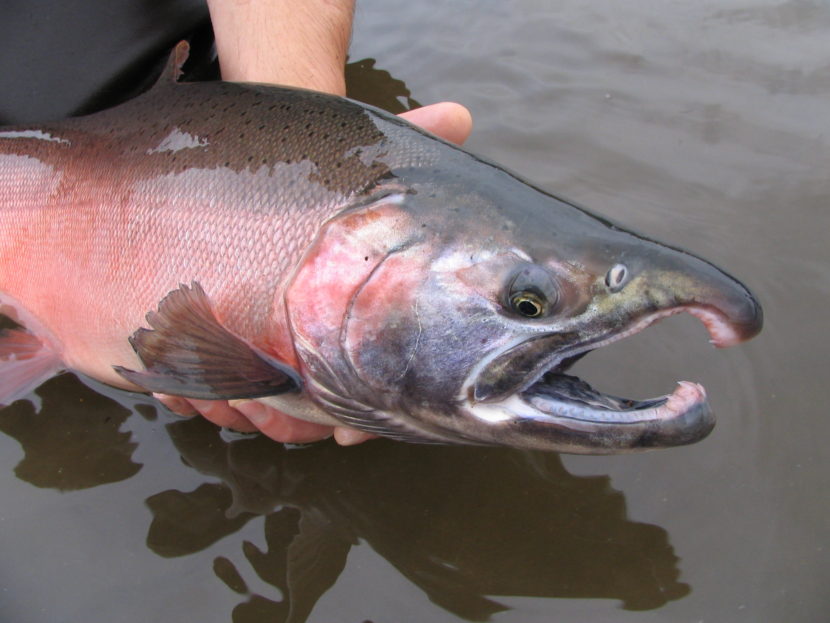
Chinook salmon, Yukon Delta NWR. (Public domain photo by Craig Springer/U.S. Fish & Wildlife Service)

There may be fewer king salmon on the Kuskokwim River this summer than hoped, and some residents want to meet with state biologists now to figure out how best to manage both expectations and the fishery.

“Our preference is that preseason plan doesn’t start being discussed the very last few days of March, or April or May,” said Mary Sattler Petola, one of four members of the Kuskokwim River Salmon Management Working Group who sent a letter to the State Fish and Game Department asking for a meeting well before the season begins. “(In) May we are all preparing for fish camp.”

In the letter, Peltola, along with Fritz Charles, Bev Hoffman and LaMont Albertson, said biologists have the information they need by January to begin a summer management plan and should have been consulting with the working group in February.

Peltola and the other signers of the letter are concerned that state biologists’ estimates of King returns this summer may be too optimistic.

She points to the parents of this year’s kings, which swam up the Kuskokwim in 2013. They showed up in such low numbers that there were practically no late kings to speak of that year.

“We harvested it pretty heavily,” Peltola said. “So I think it would be best if the department did have conversations with us about the possibility about it being another tough summer.”

Nowhere near enough kings made it to the spawning grounds, but luckily for the fishermen, there was a nice silver run to help fill nets and pantries that summer.

Fish are not a small issue for Yupik people.

“Our word for fish, neqa, is our word for food. Our generic word for food; the same word,” Peltola pointed out.

In their letter, the four working group members worry that the projections for the king return may be too optimistic. They point to Fish and Game’s reliance on models that may not truly reflect what is going on in the salmon populations. The members say those models need to be reviewed by independent scientists.

“Getting really solid peer review is important,” Peltola said. “There is this concern that Fish and Game may be having these conversations among just Fish and Game people or retired Fish and Game folks. Maybe the peer review should happen earlier and with a broader group of people.”

The king runs on the Kuskokwim have been struggling for some time.

Peltola, who grew up fishing the river, said that 2010 was the year she first realized that the king run was in major distress.

“When I think about fish camp and king fishing I have the pre-2010 memory, and then the more recent memory after 2010 that has been much much tougher,” Peltola said. “Even with me it was very emotional. Thinking about kings being weak, weak runs, it was like a family member being sick.”

In their letter, the four members of the Kuskokwim River Salmon Management Working Group said they want the state to take a conservative approach and limit fishing on kings to help restore the run to its former strength.

Fish and Game is trying to schedule a meeting of the Working Group in Bethel for the end of March.

Site notifications
Update notification options
Subscribe to notifications