KYUK - Bethel

KYUK is our partner station in Bethel. KTOO collaborates with partners across the state to cover important news and to share stories with our audiences.
Social worker receives national award for suicide prevention efforts in Y-K Delta

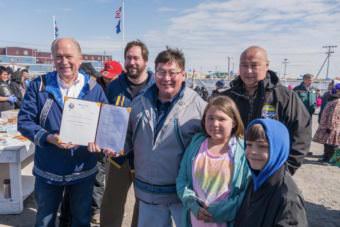
A Lower Kuskokwim School District social worker received a national award this week in Washington D.C. for his work in the Yukon-Kuskokwim Delta on suicide prevention.

James Biela is an itinerant Social Worker for LKSD, frequently traveling out to Newtok, Tununak, Toksook Bay, Nightmute, Mekoryuk, and Nunapitchuk to hold trainings and lectures on suicide prevention.

He received the Sandy Martin Grassroots Award, given out to three members of the National American Foundation for Suicide Prevention, for work in grassroots programs. Beila is a volunteer and the founder of the AFSP Alaska Chapter.

Winning the award was an honor, says Biela, an honor he was not prepared for.

“Actually, I was totally shocked that I’d be receiving this award. I didn’t have anybody giving me a heads up,” said Biela. “I feel it’s an honor, but it was also a sad time because one of my friends out in a village before I got on the plane, died by suicide.”

For Biela, the news underscored his life’s work.

“It gives you more power to do more,” said Biela. “Actually, this year I was very fortunate to have a young man from Newtok, an Alaska Native, come with me to Washington D.C. to talk to the congressional leaders about suicide. But on this one it just makes our work more important. To be the voice about how suicide can be prevented and get the Congressional leaders in D.C. to listen.”

And they did just that. They sat down for twenty-five minutes with Senator Dan Sullivan and Senator Lisa Murkowski, discussing village suicides in the YK Delta.

“I know everybody needs to pitch in with the leadership that they can afford to understand our needs,” said Biela.

That’s especially important now, said Biela, with the ongoing healthcare debate and the possibility that mental health care will be cut out of the budget.

Bethel’s homegrown women’s powerlifter breaks a national record again

Natalie Hanson set a new American record in women’s powerlifting on January 28, 2017 in Milwaukee, WI when she squatted 578.7 pounds at the USA Power Lifting Wisconsin State Open Championship. (Photo by Ryan Carrillo/Lurchman Productions)
Natalie Hanson broke yet another American powerlifting record last month at the U.S. National Championships in Orlando, Florida. Hanson’s squat lift of 270 kilograms, or 595 pounds, also broke the unofficial world record. (Photo by Ryan Carrillo/Lurchman Productions)  

Natalie Hanson of Bethel has broken both an American record, and an unofficial world record in powerlifting.

Hanson said that part of her record setting success has been due to her ability to appreciate her body for function over appearance, which has led her to create a movement within the sport.

Natalie Hanson broke yet another American powerlifting record last month at the U.S. National Championships in Orlando, Florida. Hanson’s squat lift of 270 kilograms, or 595 pounds, also broke the unofficial world record.

Part of Hanson’s success is due to her careful workout, diet and lifting schedule, but it’s also the result of a shift from paying attention to what her body looks like to what her body can do.

“When I found a sport where I could just be as strong as possible and there were no extra points given for how I looked,” Hanson said.“That’s where I found a lot of freedom.”

Growing up in Bethel, Hanson was an athlete at Bethel Regional High School. But, she said, she’d always felt like she was striving for something that was unattainable.

“I played volleyball and basketball in high school, and you were always wanting to lose weight so you could run faster or jump higher, and I never felt like I was educated on eating for performance,” Hanson said. “It was always just, like, eating as little as possible so that I could try to lose some weight, but I would be faster on the court.”

When Hanson got to college she stopped doing team sports, thinking that might help, but she still found herself running, lifting weights and eating as little as she could to narrow down.

By her senior year she got into CrossFit, which she said started to pull her out of that rut, but she soon realized that many of the gymnastic movements were less accessible for her body type; they work better for slender, lightweight people.

For instance, it’s more difficult to do a pullup if you weight 160 pounds than if you weigh 130 pounds.

Standing at 5 feet 3 inches, Hanson said she’s always been a more muscular, stoutly structured person.

She started seeing her body as an asset when she started lifting weights.

“When I started powerlifting, I realized this is the physical strength that I am capable of, and there is no component here that forces me to lose weight and fit into this society’s mold of the ideal body for a woman,” Hanson said.

Over the next four years she put on more muscle and more weight, slowly transforming herself from 160 pounds to 185 pounds. But this time, it didn’t bother Hanson in the least.

 “You know, I tell people I weigh 185 (pounds) and they don’t believe me,” said Hanson.

To Hanson, that’s because people are focused on the arbitrary numbers shown on a scale rather than what their bodies can do.

They also don’t realize that they can be physically appealing and healthy without being small.

But, even in the women’s powerlifting world, Hanson said women are still plagued by the male gaze, resulting in more sponsorships and media attention going to women based on appearance alone.

“Even though we’re in a sport where all that matters is how much weight you can lift, this is still happening,” Hanson said.

This prompted Hanson to start “Beefpuff Barbell,” an online powerlift coaching and apparel business with fellow lifter, Chelsea Savit.

The two wanted to create a positive space to train, where all genders could find “self-love and acceptance.”

Hanson said their mission aligns with “The Representation Project,” a non-profit group aimed at breaking gender stereotypes for girls and boys.

Hanson donates a percentage of Beefpuff Barbell’s yearly profits to the organization.

Hanson hopes women and men will learn to stop working against their bodies with her and Beefpuff Barbell’s effort.

“I hate to see people who are trying to completely change their genetics,” Hanson said. “You know, it’s exhausting and it’s not fun either. Just take what you’ve been given and roll with it, and make the most of the rest of your life because that’s what we’re supposed to be doing. It’s supposed to be enjoyable.”

Hanson will get her shot to set an official world record for the women’s squat lift next November.

Rural veterinary group hopes to improve the lives of people and dogs in Delta villages

A dog in Kwethluk. (Film Academy Students / Lower Kuskokwim School District)
A dog in Kwethluk. (Film Academy Students / Lower Kuskokwim School District)

The Yukon-Kuskokwim Delta has more dogs than it can care for.

A veterinarian travels to Bethel once a month, but no such service exists in the villages.

Unvaccinated and uncared-for stray dogs threaten a community’s well being.

Now, two organizations have teamed up to work with Delta communities to fix the issue.

Two weeks ago, the city of Napaskiak decided it needed to reduce its stray dog population, so it did what many communities in the Delta do: the city offered a bounty of $20 per dog.

Three were killed.

Napaskiak city clerk Valerie Kaganak said that it’s hard to find people to participate. People don’t like shooting dogs, and many don’t collect their bounties. But people agree that loose dogs are a problem.

“They open trash bags and let it scatter all over. And they steal (subsistence) food that we put away in our porch,” Kaganak said.

Dogs also hurt people.

Over the past decade there were nearly 1,000 reported dog bites in the YK Delta, according to the Alaska Native Tribal Health Consortium.

More than half the victims were children younger than 10 years old. In the worst cases, children died.

For the past five years, volunteer veterinarians have tried to address that issue by traveling to rural Alaska and offering basic veterinary services like spaying, neutering and vaccinations.

This year, for the first time, the vets at Alaska Native Rural Veterinary Incorporated are teaming up with the Humane Society to work with three Delta communities to find solutions to their stray dog problems.

The groups are visiting Kwethluk on Wednesday, May 31, and Napaskiak and Napakiak on Thursday, June 1.

“We want everyone to show up. Everyone is invited,” said Angie Fitch, executive director of Rural Veterinary.

To attend, head to the Bingo Hall with your stories and ideas.

“Which will help us determine the best way to address the lack of veterinary care,” Fitch said.

Using this information, the groups will return three times this year to offer spaying, neutering and vaccinations.

They’ll also offer a doghouse building project where the group works with students in the schools to build doghouses from donated wood.

“They learn carpentry skills, but also learn how to do something good for the community,” Fitch said. “Then the dogs will get new dog houses, also.”

The groups will hire one person from each community to help organize and run the visits.

“They just need to enjoy helping people, and like animals, and be good at collecting data,” Fitch said, “because they’ll have to get all the names of the families and the dogs, and keep track of the shot records.”

The goal is to use the program as a pilot project to improve the lives of people and dogs across rural Alaska.

Fishermen are pulling up empty nets from Kuskokwim’s low water

The Kuskokwim River Salmon Management Working Group met for their first meeting of the season on May 21, 2017, where they heard many subsistence fishermen report low water and low harvests. (Photo by Anna Rose MacArthur/KYUK)

Subsistence fishermen along the Kuskokwim River are reporting water on the is low, and nets are coming up mostly empty.

Other fishermen, facing tight restrictions and cultural tension, have decided to refuse to fish.

“I’m a lifetime fishermen. I’m 72 years old,” said John Alegyuk Andrew, a subsistence fisherman in Kwethluk.

He represents the Lower Kuskokwim in subsistence fishing on the Kuskokwim River Salmon Management Working Group.

The group advises the Alaska Department of Fish and Game on management decisions. It held its first meeting of the season Wednesday.

The meeting opened on a solemn note, with a moment of silence for Greg Roczicka, a founding member, who has left a big hole. Roczicka died last week at his home in Bethel at the age of 61. Andrew worked with him for decades on fish and game issues.

“He accomplished a lot in this region. And we just…we’re missing him right now,” Andrew said.

The lower and middle Kuskokwim had its first gill net fishing opening this past weekend: 4-inch mesh, set gill nets; a 12-hour opener from 9 a.m. to 9 p.m.

But, when fishermen pulled up their nets, some came up empty. Many had about three fish. Others had none.

About a dozen subsistence fishermen, representing every section of the Kuskokwim River, called in or showed up at the meeting to report these findings.

And they all said the same thing as Andrew:

“The water is very, very low. The lowest I’ve ever seen in my lifetime.”

Andrew says the water is about 8 feet lower than it usually is this time of year, and that makes fish hard to catch.

“When the water is really low, the water is clear,” he said. “The fish can see the net and avoid it. They can swim under it or on the sides.”

It’s also more difficult to find an eddy to set the net in. With less water, fishermen are noticing that the water is warmer.

The higher water temperature is another problem; the fish die faster in the net.

There was another issue: The fishing opening was on a blue sky, clear day. Not good fishing weather.

“We do our best fishing when it’s a little windy or stormy,” Andrew said.

Even if fishing conditions were good, there still might have been fewer fish caught than normal.

Andrew said some Yup’ik fishermen refused to fish during the opening. The 4-inch gear that was allowed is meant to target whitefish and other non-salmon species.

Managers are asking fishermen to return king salmon alive to the water so that they can reach their spawning grounds during this conservation period.

“That’s more of a cultural slap in the face for my people,” Andrew said. “We the people have a tradition. If we catch something, we bring it home. We bring it home and prepare it to be our food, not the other people’s tradition of catch and release. When we do that, we are playing with our food.”

Many fishermen said that they are waiting until the 6-inch mesh openings begin in mid-June to start fishing.

They’ll be more likely to catch salmon, and they won’t be encouraged to release their kings.

Yukon subsistence fishermen needed to collect king salmon samples

Over the past several years, fishery managers have placed extremely tight harvest restrictions on king salmon fishing in the Yukon River.

A subsistence fishermen collects biological samples of king salmon. (Photo courtesy Spearfish Research)

The hope is that conservation will lead to larger runs.

When managers make those decisions — telling fishermen when and where they can fish and what gear they can use — they need to know how those measures affect subsistence harvests; they need samples of the fish.

The state is working with subsistence fishermen in a voluntary program to get those samples.

“Currently, we’re restricting fishermen to smaller mesh sizes,” said Holly Carroll, who manages the king salmon run on the Yukon for the Alaska Department of Fish and Game. “We’re also reducing the amount of time they can fish, so it’s really important for us to understand what effects those management actions have on the harvest.”

Understanding these effects can help guide in-season management decisions and refine management in future years.

For instance, last year more males were harvested than females. Also, Carroll said, “We do find that lately they’ve been using smaller mesh, so they’ve been harvesting much younger fish, which is what we would expect.”

This is the fourth year of the subsistence sampling program on the Lower Yukon.

Collecting biological samples has several steps.

First the subsistence fishermen takes a fin clip off each fish.

“Then we analyze the genetic component of the harvest,” said Carroll.

The genes show where the fish hatched and where it was heading.

“The other metrics we get are length and sex,” Carroll said.

The state also tracks the age of the fish, which is measured by the number of rings on a fish’s scales.

“Each fish has to have three scales come off and onto the scale card, and you have to check that scale and make sure it’s a viable scale,” Carroll said.

In all, each sample takes about five minutes per fish and is completed during processing.

The state hopes that more data will lead to better management.

Training sessions with subsistence fishermen on how to collect the samples are beginning this week in Lower Yukon villages.

Spearfish Research, a fisheries biology consulting company, will conduct the training and explain what makes a scale viable and how to deal with the samples.

Subsistence fishermen will receive $10 per sample.

Only the samples will go to the state; no personal information, not even names, will be sent.

Training sessions will be held in Kotlik, Alakanuk, Emmonak, Mountain Village, St. Mary’s, Russian Mission, Kaltag, Nulato, Galena, Ruby and Tanana.

To attend, contact fisheries biologist Cody Strathe at 907-452-3828 or cody@spearfishresearch.com.

Bethel to decide on lease for state air quality monitoring

Bethel City Council member, Leif Albertson, visits the site of a proposed Air Quality Monitoring System behind AC on May 10, 2017. Albertson believes the monitoring system could eventually lead to better air quality for Bethel citizens.
Bethel City Council member, Leif Albertson, visits the site of a proposed Air Quality Monitoring System behind AC on May 10, 2017. Albertson believes the monitoring system could eventually lead to better air quality for Bethel citizens. (Photo by Christine Trudeau/KYUK)

The Alaska Department of Environmental Conservation is looking for a lease agreement with the City of Bethel to set up an air quality monitoring system. The state-funded project is part of an effort to collect better data on what’s in our air.

Behind Alaska Commercial Company, off Fourth Avenue, is the proposed site for the air quality monitoring system. Bethel City Council member, Leif Albertson, said this area will make for a great location.

“There’s sort of just an empty space here,” said Albertson. “It’s got some brush on it right now, and what will be here is a trailer with a small shed on it that will have the air monitoring equipment in it.”

It’s also near a gravel road. The idea was introduced at Tuesday night’s City Council meeting.  It would be part of a lease agreement that allows the state Department of Environmental Conservation to install the system.

The proposed site for the air quality monitoring system is behind Alaska Commercial Co. off of Fourth Avenue.
The proposed site for the air quality monitoring system is behind Alaska Commercial Co. off of Fourth Avenue. (Photo by Christine Trudeau/KYUK)

Council member Albertson says it’s important for the community of Bethel to get good air quality data.

“The plan right now is to be able to measure particulate matter in two different sizes. PM 2.5, and PM 10,” said Albertson. “PM 2.5 is the small stuff, and that is generally what a lot of health concern is around. Because the particles are so small they can really get very deep into your lungs and even get into your bloodstream.”

Albertson hopes better monitoring will help inform policymakers in improving air quality for residents, especially those with chronic breathing conditions.

“There is sort of an assumption that the air is bad here. We have a lot of really bad road dust problems, but we don’t really have any hard data to back that up,” said Albertson.

At the next City Council meeting, on May 23, Albertson says the public will have another opportunity to comment on the proposed location for the air monitoring station when a motion to adopt the lease comes up on the agenda.


Site notifications
Update notification options
Subscribe to notifications