KYUK - Bethel

KYUK is our partner station in Bethel. KTOO collaborates with partners across the state to cover important news and to share stories with our audiences.

Six enter not guilty plea in Bethel drug case

Six suspects have now been arraigned after the raid of a Bethel home in connection with the sale of heroin and crack cocaine.

All pleaded not guilty to the charges, but bail was not lowered for any of the accused.
The six defendants — Melissa Beans, Ryan Daniels, Shawayne Jenkins, Eric Kinegak, Anthony Washington Jr., and Anthony Washington Sr. — appeared in court Monday afternoon.

All of the defendants entered not guilty pleas to their charges, which range from selling heroin to attempting to destroy evidence,

Police found large amounts of drugs recovered at the scene: 47 grams of heroin, and a half-pound of crack cocaine.

When attorneys requested reduced bail, each request was flatly denied and met with reasons why it would not change.

A calendar call for all six defendants was set on Dec. 22, with a pre-trial date of Jan. 6 and a trial date of Jan. 9.

Albert Cleveland, who also was arrested during the raid, was not present at the arraignment.

Bethel eye doctors travel to the Dominican Republic to lend a hand

Children’s eye development is something most of us rarely think about when we talk about raising kids, but it’s enough of an issue in the Dominican Republic to prompt volunteers to travel thousands of miles to help out.

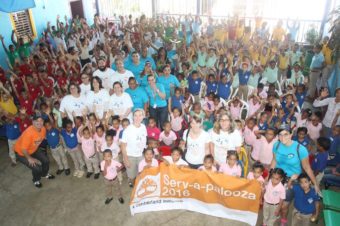
Three Yukon Kuskokwim Eye Center optometrists flew to the Dominican Republic to give much needed eye exams to school children living in poverty.

Cien Fuegos means “One Hundred Fires,” and refers to the many trash fires that burn in a landfill near the small village in the Dominican Republic.

“Not only are they exposed to dangerous fumes, toxic fumes and starvation, but also the dump trucks would end up crushing some of these kids because they don’t see them,” said Brian Blum, an optometrist who lives in Bethel, and one of three eye doctors that heard about the conditions the people were living in and decided to help. “The kids would sleep there. I heard stories about an arm that got stuck in a dump truck. They live there, they eat there, they scavenge for food there.”

Blum describes the system of poverty that traps the children born there and forces them to stay:

“In order to eat they need money,” Blum said. “So they go to the landfill and pick up recyclables, such as plastic bottles.”

The recyclables are traded in for cash, but that’s often not enough to survive.

The children borrow money to buy food, and then continue to work the landfill in an effort to pay it back.

“They can’t just relocate because they’re stuck,” Blum said. “They owe money and so they’re forced to live there, continuing to try to make money living there.”

It might seem like eye exams are the last thing these children need, but Blum would disagree.

“What we wanted to focus on was providing glasses for those who need them, because it’s very critical to see clearly when going through school,” Blum said.

Another group of volunteers recently provided a school, which the kids can’t take full advantage of if they’re having trouble with their vision.

Back in Western Alaska, Blum said that the availability of eye care can also be a problem.

“One of the biggest struggles that we have is travel,” Blum said.

Even though health care can be free for Alaska Natives living in villages, often getting to the health care is not.

Children who haven’t gotten exams and have undiagnosed eye issues are likely to fall behind in the classroom.

Blum said telemedicine is one solution, but as in the Dominican Republic, access to that can be a challenge too.

How early voting can favor urban residents

Voting booth at the Bethel City Hall.
Voting booth at the Bethel City Hall. (Photo by Adrian Wagner)

Hillary Clinton is campaigning in the south this week, pushing for voters to come and vote early at the polls. While many urban voters are doing so nationally, people in rural communities may be finding that more difficult.

In the last election, the Obama campaign encouraged voters to come out and participate in early voting, which they did, so the Democrats are trying it again. In Bethel, in-person absentee voting numbers are up this year, according to Lori Strickler, Bethel’s City Clerk.

“We’ve had 66 in-person voters. I normally see 30 or 40,” Strickler said.

Strickler has been talking to people who’ve tacked absentee voting onto their trips to Bethel.

“The opportunity arose to come out and do my early voting, so I thought ‘Okay, I’ll take advantage of it,'” said Peter Hjem, who came out on Thursday afternoon to do what he thought would be early voting, but was actually in-person absentee.

The difference between the two ballots is that absentee ballots cast after October 28 are counted after Election Day, while actual early votes are counted the day they are cast. Lauri Wilson, an official with the State Division of Elections in Juneau explains:

“The national polls, of course, do their polling on election night and they typically like to report who they would like to call as the winner,” Wilson said.

Unlike absentee voting, early voting can only be done in person at regional hubs: Nome, Anchorage, Fairbanks, Wasilla, and Juneau.  Wilson says that those offices have computer access that other locations don’t.

“The early voting locations are available in our regional office locations because we have to have access to our voter registration data base in order to pull up the voter’s record at the time that they’re in front of us voting,” Wilson said.

The idea that he would have to buy a plane ticket to Fairbanks, Anchorage, or Nome in order for his early vote to be counted on Election Night doesn’t sit well with Mr. Hjem.

“Access to early voting should be across the board,” Hjem said.

However, it’s not.

National Guard seeks Alaska Natives with subsistence skills

The Army National Guard has announced the start of a three-year pilot program that gives waivers to Alaska Natives who might try to join the guard, but face barriers to qualification. Some of these potential recruits have the very skills the military is looking for.

Not only is the National Guard making it easier for Alaska Natives to join up, it’s seeking them out. And that’s because of soldiers like Spc. David Smart.

David Smart Alaska Army Natioanal Guard
David Smart is a third generation serviceman from Hooper Bay. (Photo courtesy David Smart)

“My grandfather would take me out to the Bay, and we would go set a net for whitefish,” Smart said.

Smart, 28, who grew up in Hooper Bay, is a third generation serviceman. His grandfather inspired him to join the military.

“Going through the house, came across his discharge papers and his medals,” he said.

Smart said that he’s lucky to have this job.

“Pretty hard to get a job in the village, because there’s only so many places to work,” said Smart.

Smart is one of a relatively small number of Alaska Natives to get into the guard recently, but that might change. The new program, among other things, relaxes requirements for the Armed Services Vocational Aptitude Battery, a general knowledge test that the guard admits favors people for whom English is their first language.

The guard is going to make it easier to join, and what it wants in return is something many Alaska Natives already possess.

“Somebody that grows up in rural Alaska lives the weather, they don’t watch it on the weather channel,” said Bob Doehl from the state’s Department of Military and Veterans Affairs.

Doehl said that not only do Alaska Natives make better soldiers in the Arctic, practicing subsistence makes them better soldiers in general.

“Studies found that those from rural locations, who are active outdoors, are better able to spot patterns and changes in patterns,” said Doehl.

Doehl said this increased awareness can make the difference between life or death. He asks why the military would spend years training people when it’s already taken care of, which is something that Spc. David Smart agrees with.

“Give somebody fish, you feed them a day. Teach em’ how to fish, you feed em’ for life,” Smart said.

Lt. Gov. Byron Mallott, traveling with Doehl to Bethel to spread the news about the recruitment thrust, said that in the face of a troubling fiscal situation, he still supports increased enlistment.

“It comes at a difficult time because the state does not have financial resources to significantly support such an effort,” Mallott said.

Mallott said he remembers when the military was a major leadership avenue for Western Alaska, and he wants to get back to that place.

“As a young man, having grown up in Southeast Alaska and traveled the state, the National Guard was once a major presence in rural Alaska, and it was a point of inspiration,” Mallott said.

Mallott echoes a thought frequently heard in many of the state’s rural locations, and throughout much of Indian Country in the Lower 48.  Now the effort is underway to rebuild that force.

Bethel police investigate body found in home; no foul play suspected

The body of a young woman found dead in a Bethel home Monday will be sent to Anchorage for an autopsy.

No foul play is suspected in the death of Deanna (Michaels) Pete, 33, of Bethel, according to a news release published on social media by the Bethel Police Department.

Bethel police received a call of an unresponsive person around Bethel’s Atsaq Street about noon Monday.

The investigation continues, and police are asking that anyone with information that might be useful to the case call (907) 543-3781.

Kongiginak tribal police officer charged with assault after drinking confiscated alcohol

A tribal police officer from Kongiginak was charged with two counts of assault after he allegedly had a party with confiscated alcohol from the police station.

Scott Hill, 25, a tribal police officer from Kongiginak, fought with Derek Black, 26, from Kongiginak while they were drinking alcohol that Hill took from the Tribal Police Station, according to a trooper dispatch.

Black had to be treated at the Yukon Kuskokwim Health Corporation in Bethel for injuries sustained during the fight, troopers said.

The alcohol had been confiscated in a case being prosecuted at Kongiginak’s tribal court.

Hill was arrested and charged with assault in both the second- and fourth-degree.

Site notifications
Update notification options
Subscribe to notifications