NPR News

KTOO is the NPR member station in Juneau. NPR offers its members radio and digital stories.
Former President Trump is found guilty in historic New York criminal case

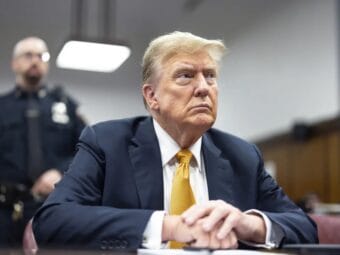
Former President Donald Trump sits in a courtroom at Manhattan Criminal Court on May 21 for his trial for allegedly covering up hush money payments. (Justin Lane/Pool/Getty Images)

NEW YORK — Former President Donald Trump has been found guilty of 34 counts of falsifying business records to influence the outcome of the 2016 election, a historic verdict as Trump, the presumptive Republican presidential nominee, campaigns again for the White House.

This is the first time a former or sitting U.S. president has been convicted of criminal charges.

On Thursday, 12 New York jurors said they unanimously agreed that Trump falsified business records to conceal a $130,000 hush money payment to adult film star Stormy Daniels to influence the 2016 election.

The decision came after about a day and a half of deliberations.

Trump spoke to reporters outside the courtroom, calling it a “rigged, disgraceful trial,” and said the “real verdict” will be Election Day.

The jury heard from 22 witnesses during just over four weeks of testimony in Manhattan’s criminal court. Jurors also weighed other evidence – mostly documents like phone records, invoices and checks to Michael Cohen, Trump’s once loyal “fixer,” who paid Daniels to keep her story of an alleged affair with the former president quiet.

The facts of the payments and invoices labeled as legal services were not in dispute. What prosecutors needed to prove was that Trump falsified the records in order to further another crime – in this case violating the New York election law that makes it a crime for “any two or more persons who conspire to promote or prevent the election of any person to a public office by unlawful means.” The jurors were able to choose whether those unlawful means were violating the Federal Elections Campaign Act, falsifying tax returns, or falsifying other business records.

Trump’s defense focused intently on the credibility of Cohen, and argued that influencing an election is not illegal.

The verdict came more than a year after a grand jury indicted Trump, on March 30, 2023, marking the first time a former or sitting president faced criminal charges.

Republicans quickly dismissed the indictment as an overreach of power by Democratic District Attorney Alvin Bragg, who had brought the charges. Trump has continually blasted the case as “election interference” affecting his 2024 campaign.

What the jury heard

In August 2015, two months after Trump announced his 2016 presidential bid, David Pecker, then the publisher of the National Enquirer tabloid, met with Trump and Cohen at Trump Tower, according to testimony from Pecker and Cohen.

At that meeting, Pecker testified, it was agreed that he would be the “eyes and ears” of the Trump campaign. His job was to look out for negative stories from women he could “take off the marketplace,” by buying up the rights but never publishing them.

The plan, as Pecker outlined it, was that he would suppress these stories, and at the same time publish negative stories about Trump’s opponents. Some of these stories, Pecker said, were sent to Trump and Cohen for approval prior to publication.

Over the next year, Pecker said he carried out this role. His testimony was corroborated by Keith Davidson, an attorney who represented both Daniels and former Playboy model Karen McDougal. In about June 2016, McDougal considered going public with her story of a year-long affair with Trump. But Pecker bought the rights to that story, with the expectation that he would be reimbursed by Trump. That never happened.

In early October 2016, according to the testimony of former Trump communications aide Hope Hicks, the campaign was rocked by the release of the Access Hollywood tape, where Trump could be heard boasting “When you’re a star they let you do it. You can do anything. Grab ’em by the p****.”

The next day, according to Pecker, Cohen and Davidson, Daniels threatened to go public with accusations she’d had a sexual encounter withTrump in 2006 in a Lake Tahoe hotel suite during a celebrity golf tournament.

In her testimony, Daniels said there was a “power imbalance” when, after leaving the suite’s restroom, she found Trump on the hotel bed in his underwear. That’s when, Daniels said, they had sex.

She testified that Trump had dangled a possible role on his TV show Celebrity Apprentice. This detail — that the sex wasn’t entirely wanted — caused the defense to request a mistrial, which was denied. It also provided a motive for Trump to suppress the story. Prosecutors said, “Trump knew what happened in that hotel room” and didn’t want it to come out. The adult film actor’s testimony also included intimate details of her alleged sexual encounter, some of which Judge Merchan agreed with the defense were not necessary.

As October drew to a close, Cohen testified, he frantically opened bank accounts and tried to come up with a way to pay the $130,000 to keep Daniels quiet. But Trump, Cohen said, wanted to delay the payment until after the election, with the idea that after that it wouldn’t matter if Daniels was paid.

This point, that Trump was making the payment to influence the election by keeping women voters on board, was corroborated by a number of other witnesses. Hicks testified Trump, by then in the White House, told her that it was better the story came out in 2018, rather than 2016.

Cohen ultimately wired the money himself to Daniels, with the understanding, he said, that he would be repaid by Trump. Cohen testified to a number of conversations with Trump, backed up by phone records, including on the day he wired the payments. But the defense rattled Cohen on cross-examination when it presented evidence that one of the calls which Cohen had said was made through Trump’s bodyguard, Keith Schiller, was instead with Schiller about threats from a 14-year-old prankster.

Still, the heart of the case rested on the testimony of what happened after the election, when the records were falsified, in particular the handwritten notes and documents from the Trump Organization’s former comptroller, Jeff McConney.

McConney authenticated a key record: the bank statement showing Cohen’s wire transfer. That record included handwritten notes from Cohen and Trump’s former chief financial officer, Allen Weisselberg, describing the $130,000 payment that would be “grossed up” to cover Cohen’s taxes. That sum, combined with another reimbursement and a bonus, for a total of $420,000, was paid out over 12 months at a rate of $35,000 per month.

The payments would be described as pursuant to a “legal retainer.” (Weisselberg, who is serving jail time for perjury in Trump’s civil fraud trial, did not testify.)

On the stand, Cohen described a repayment scheme that formed the basis of the 34 counts of falsified business records: 11 falsified invoices, 12 falsified ledger entries and 11 checks falsely recording the repayment as legal “retainers.” Nine of the checks were signed by Trump, himself.

Cohen said he and Weisselberg met and discussed the agreement with Trump shortly before he left for Washington, on or about Jan. 17, 2020. Cohen said Trump approved the deal, saying at the end of the meeting that “it was going to be one heck of a ride” in Washington. Cohen said he and Trump discussed the arrangement again, in early February, in the Oval Office. Photos and White House records corroborated that the two met in the Oval Office at the time.

The defense presented just two witnesses, including Robert Costello, an attorney who wanted to represent Cohen after Cohen’s home and office were searched by the FBI in 2018. Costello had been put on the stand to refute Cohen’s claim that Costello was pressuring Cohen to stay on Trump’s “team.” But Costello’s emails showed that Trump was deciding which of Cohen’s lawyers he wanted to pay, and that Costello was concerned about not giving “the appearance that we are following instructions from [Rudy] Giuliani or the president,” referring to the former New York City mayor who was Trump’s lawyer at the time.

How this conviction could affect the 2024 election

This likely is the only one of Trump’s four ongoing criminal cases that will be heard ahead of the 2024 election in November, since federal trials in Washington, D.C., and Florida, and a state case in Georgia are in various stages of delays.

This decision in New York is likely to have rippling effects as Trump campaigns as the presumptive Republican presidential nominee. For now, the other 54 criminal charges he faces have not turned off potential voters and, among some Republicans, the cases have bolstered support for him. However, a conviction may not play well with independent and swing voters.

The latest NPR/PBS NewsHour/Marist poll, from May, showed that 17% of voters said they would be less likely to vote for Trump if he is convicted, while 15% said they would be more likely to vote for him. And 67% of registered voters nationally say it makes no difference to their vote if Trump is found guilty in his hush money trial.

6 key facts about abortion laws and the 2024 election

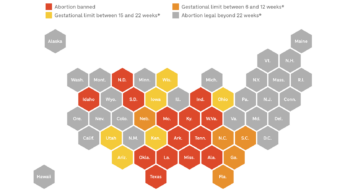
*Weeks since Day 1 of last menstrual period (Source: KFF analysis as of May 2, 2024/Credit: Hilary Fung/NPR)

In the nearly two years since the Supreme Court overturned Roe v. Wade, abortion access has been in an almost constant state of flux.

State laws keep changing – with new bans taking effect in some places while new protections are enacted in others. And there have been a slew of lawsuits and ballot measures that may motivate voters come November.

Here are 6 facts about where things currently are with abortion and the election.

1. About half of states restrict abortion.

In 14 states, there are total bans on abortion, with very limited exceptions in cases such as rape or to save the life or health of the mother. A few more states – including Florida – have six-week bans, and often that’s so early in a pregnancy most people don’t yet know they’re pregnant. Another half dozen states have restrictions that limit abortion after 12, 15, 18 or 22 weeks of pregnancy.

In the states that ban or severely restrict abortion access, the number of abortions has dropped drastically.

But legal challenges and ballot initiatives mean the map could keep shifting. So far, voters will be weighing in on the right to an abortion in four states: Colorado, Florida, Maryland and South Dakota. Six more states are in the process of getting it on the ballot, including Missouri, Nebraska, Nevada, Arizona, Arkansas and Montana.

2. Bans are affecting where doctors work.

Idaho illustrates how abortion bans can affect a state’s broader health care system. Doctors are leaving the state, and three maternity wards have closed since the abortion ban took effect there.

“We lost 58 obstetricians either to moving out of state or retiring, and in that same time period, only two OB-GYNs moved into Idaho,” says Dr. Sara Thomson, an OB-GYN in Boise. “That is not really a sustainable loss-to-gain ratio.”

It’s not just Idaho – a lot of hospital systems in states with abortion bans are having recruiting problems. The Association of American Medical Colleges earlier this month reported a decrease in medical students applying to residencies in states that limit abortion access. Essentially, these early career doctors are saying they don’t want to practice medicine with the threat of fines, jail time, and the loss of their medical license.

3. Abortions are actually increasing nationally.

Since the Supreme Court overturned Roe v. Wade, the number of abortions in the U.S. has continued to grow.

“We are seeing a slow and small, steady increase in the number of abortions per month and this was completely surprising to us,” says Ushma Upadhyay, who co-leads the Society of Family Planning’s WeCount project. According to their recent report, in 2023 there were, on average, 86,000 abortions per month compared to 2022, when there were about 82,000 abortions per month. “Not huge,” says Upadhyay, “but we were expecting a decline.”

A major factor in the uptick in abortions nationwide is the rise of telehealth, made possible in part by regulations first loosened during the coronavirus pandemic. Telehealth abortions now make up nearly 1 in 5 of all abortions in the U.S. Patients don’t need to take off work and go to a clinic, they can connect with providers over text messages, phone calls or video, no matter where they live. Abortion medication is then mailed to them at home.

John Seago, president of Texas Right To Life, is concerned with the rise of abortions and increased access through telehealth.

“I’m afraid that we are going to wake up in 20 years and just kind of realize that we won in Dobbs, and then we’ve been losing ever since,” Seago says. He told NPR his group is currently working on how to bring criminal and civil challenges to tamp down on the number of abortions.

4. Some states have moved to make abortion access easier.

Abortion was heavily regulated even while Roe v. Wade was the law of the land, and states like Michigan, Colorado, California, Minnesota and others have made moves to undo some of those regulations.

They are passing laws to get rid of waiting periods and gestational limits, and they are allowing more types of providers like nurse practitioners, for instance, to perform abortions. Some states have stockpiled mifepristone, one of the medicines that can be used for abortion, in case access is curtailed federally in the future.

New York City made an abortion hub as part of its health department, including a hotline and chat for people to find out where to get an abortion and how to get funding to cover the costs.

5. “Shield laws” create new access in untested legal terrain.

Another way some states have expanded abortion access is by passing “shield laws.” These are laws that say doctors and nurses in states where abortion is legal can’t be prosecuted by another state if they provide abortion across state lines. They apply if a woman travels to another state for an abortion or if the abortion provider mails pills to someone in a state with restrictions.

Lauren, who is 33 and lives in Utah, got a telehealth abortion from a provider in a state with shield laws. Lauren got pregnant on birth control and decided quickly that she couldn’t afford another child. (NPR is not using her last name because she’s worried about professional repercussions.)

Abortion is technically legal in Utah until 18 weeks, but access is severely restricted. It can only be performed in hospitals, for instance. So Lauren chose an online company called Aid Access, that provides telehealth abortion for people in all 50 states.

“In my situation, I felt more at ease than I would in a physician’s office and more comfortable, to be honest,” she explains. “Especially with a provider within the state of Utah – I feel like there’s always a judgmental indication or undertone.”

She filled out a form online with questions about how far along she was and her medical history, connected with a doctor via email and text messages, and received abortion medication in the mail. She had her abortion at home.

Some anti-abortion rights groups are hoping to test the legality of shield laws by bringing charges against a doctor, but that hasn’t happened yet.

6. The Supreme Court could shake things up again.

There are two major decisions on abortion pending right now before the Supreme Court.

One is about the abortion pill mifepristone. The Court could restrict this drug for the whole country and totally change access to medication abortion through telemedicine. Court watchers think it won’t go that way, but no one knows for sure.

The other case is about abortion in emergency situations and it centers on Idaho’s medical exception. It’s a fight over whether federal or state law should have priority. The oral arguments left legal analysts unsure about which way the Court was leaning.

Both of these decisions are expected in late June or early July, just a few months before the election. Regardless of what the justices decide, it’s going to catapult abortion back into the headlines a few months before the election.

Copyright 2024 NPR

A big survey asked Americans about their finances. Here are some trouble spots

Rising prices remain a top concern for Americans, according to a new survey by the Federal Reserve. But 72% of adults say they’re living comfortably financially or at least doing OK. (Frederic J. Brown/AFP via Getty Images)

Americans overwhelmingly say they’re “doing at least OK financially,” but most remain worried about rising prices, and 1 in 6 says they have bills they can’t pay, according to a report released Tuesday by the Federal Reserve.

Each year the Fed surveys thousands of people about their household finances, including income, savings and expenses. This year’s snapshot shows family budgets generally held steady over the last year, but they’re not as solid as they were two years ago, when pandemic relief payments helped pad people’s bank accounts and inflation was just beginning to take hold.

The survey, conducted last fall, found that 72% of adults are living comfortably financially or at least doing OK. That’s down from 73% in 2022 and 78% in 2021.
Child care is a significant expense

One group that saw a bigger drop in well-being was parents. Just 64% of those with children under 18 said they were doing at least OK — down from 75% in 2021. Child care is a significant expense for many families, often costing at least half as much as their housing. The median monthly cost for child care was $800, or $1,100 for those using more than 20 hours a week.

About a third of those surveyed said their monthly income had increased during the year, while a slightly higher percentage — 38% — said their monthly expenses had grown.

2 in 3 Americans say inflation has made their finances worse

Although inflation is lower now than it was a year ago and less than half what it was in 2022, two-thirds of Americans say rising prices have made their financial situation worse, including 19% who say they’re much worse off. About 1 in 3 people said inflation had little effect on their family finances.

1 in 3 Americans couldn’t cover a $400 surprise expense

Unsurprisingly, lower-income households reported more financial hardships, such as an inability to pay their bills every month or skipping meals or medical care. Overall, 48% of those polled said they had money left over after paying expenses, while 17% said they had unpaid bills in the previous month.

Faced with an unexpected $400 expense, 63% of survey respondents said they could cover it with savings. That’s unchanged from 2022 but down slightly from 2021. About 1 in 8 people said they would be unable to handle such an expense by any means.

Double-digit price increases in home insurance

This year’s report included a new question about home insurance, which has seen double-digit price increases in the last year. While the vast majority of homeowners have insurance, some of the most vulnerable people do not, including more than 20% of low-income families in the South.

“This perspective continues to help the Federal Reserve better understand how families are coping with the ongoing economic challenges they face,” Federal Reserve Board Gov. Michelle Bowman said in a statement.

Copyright 2024 NPR

DOJ says Boeing broke deal that avoided prosecution after 2 fatal 737 Max crashes

The U.S. Justice Department says Boeing broke a deferred prosecution deal with the government following a pair of fatal 737 Max crashes more than five years ago. (Samuel Corum/Getty Images)

WASHINGTON — Boeing has violated the terms of a deal to avoid prosecution after the fatal crashes of two 737 Max planes more than five years ago, the U.S. Justice Department told a federal judge on Tuesday.

That means the troubled plane maker could be subject to criminal prosecution for defrauding federal regulators, though Justice Department lawyers stopped short of saying whether they will pursue that remedy.

“The Government has determined that Boeing breached its obligations” under the agreement it reached with the Justice Department in early 2021, “by failing to design, implement, and enforce a compliance and ethics program to prevent and detect violations of the U.S. fraud laws,” prosecutors wrote in a letter to Federal District Judge Reed O’Connor in Texas.

The two-page letter does not mention Alaska Airlines Flight 1282, when a door-plug panel blew off a 737 Max jet in midair in January. But that incident has sparked renewed scrutiny of Boeing’s operations by federal regulators, as well as the Justice Department, which has opened a separate investigation.

Boeing says it disagrees with the DOJ’s conclusion that it has violated the deal.

“We believe that we have honored the terms of that agreement, and look forward to the opportunity to respond to the Department on this issue,” spokeswoman Jessica Kowal said in a statement.

Boeing 737 Max jets are pictured outside a Boeing factory on March 25, 2024 in Renton, Wash. (Stephen Brashear/Getty Images)

Boeing agreed to the deferred prosecution deal with the DOJ in January 2021 and paid $2.5 billion in fines. The plane maker had been accused of misleading regulators who approved the 737 Max.

The Max crashes — one in Indonesia in 2018 and another in Ethiopia in 2019 — killed a total of 346 people. The accidents were blamed, in part, on a new automated flight control system. That system, called MCAS, powerfully pushed the noses of those jets down repeatedly not long after takeoff, killing all on board.

The DOJ agreement essentially placed Boeing under probation for three years — a term that ended just days after the midair blowout on Jan. 5, 2024.

Family members of the crash victims have long criticized the prosecution agreement with Boeing as a sweetheart deal for the company, and have been waging a years-long legal battle to overturn it.

Their lawyers welcomed the DOJ’s announcement, and urged prosecutors to go further.

“This is an important first step toward holding Boeing accountable for the deaths of the 346 passengers and crew on the two flights,” said Paul Cassell, a former federal judge and law professor at the University of Utah who is representing the families.

“But the Justice Department needs to now follow through with effective, transparent, and vigorous prosecution of the conspiracy charge it has filed,” Cassell said.

“We hope that DOJ will continue to pursue justice for Boeing’s victims, and move forward with a prosecution against Boeing for its egregious criminal acts that resulted in the deaths of 346 innocent people,” said Erin Applebaum, a lawyer at the firm Kreindler & Kreindler who represents victims’ families.

The Justice Department could also seek to essentially extend Boeing’s probation under the prosecution agreement.

Prosecutors told the judge they are still determining how to proceed. Under the terms of the agreement, Boeing has a chance to reply to the Justice Department. The DOJ has also scheduled another meeting to seek input from family members of the victims on May 31 in Washington.

Copyright 2024 NPR. To see more, visit https://www.npr.org.

Scientists welcome new rules on marijuana, but research will still face obstacles

For decades, researchers in the U.S. had to use only marijuana grown at a facility located in Oxford, Mississippi. A few other approved growers have been added in recent years. (Brad Horrigan/Hartford Courant/Tribune News Service via Getty Images)

As the Biden administration moves to reclassify marijuana as a less dangerous drug, scientists say the change will lift some of the restrictions on studying the drug.

But the change won’t lift all restrictions, they say, neither will it decrease potential risks of the drug or help users better understand what those risks are.

Marijuana is currently classified as a Schedule I controlled substance, which is defined as a substance with no accepted medical use and a high potential for abuse. The Biden administration proposed this week to classify cannabis as a Schedule III controlled substance, a category that acknowledges it has some medical benefits.

The current Schedule I status imposes many regulations and restrictions on scientists’ ability to study weed, even as state laws have made it increasingly available to the public.

“Cannabis as a Schedule I substance is associated with a number of very, very restrictive regulations,” says neuroscientist Staci Gruber at McLean Hospital and Harvard Medical School. “You have very stringent requirements, for example, for storage and security and reporting all of these things.”

These requirements are set by the Food and Drug Administration, the Drug Enforcement Administration, the Institutional Review Board and local authorities, she says. Scientists interested in studying the drug also have to register with the DEA and get a state and federal license to conduct research on the drug.

“It’s a burdensome process and it is certainly a process that has prevented a number of young and rather invested researchers from pursuing [this kind of work],” says Gruber.

Reclassifying the drug as Schedule III puts it in the same category as ketamine and Tylenol with codeine. Substances in this category have accepted medical use in the United States, have less potential for abuse than in higher categories and abuse could lead to low to moderate levels of dependence on the drug.

This reclassification is “a very, very big paradigm shift,” says Gruber. “I think that has a big trickle down effect in terms of the perspectives and the attitudes with regard to the actual sort of differences between studying Schedule III versus Schedule I substances.”

Gruber welcomes the change, particularly for what it will mean for younger colleagues. “For researchers who are looking to get into the game, it will be easier. You don’t have to have a Schedule I license,” she says. “That’s a big deal.”

The rescheduling of cannabis will also “translate to more research on the benefits and risks of cannabis for the treatment of medical conditions,” writes Dr. Andrew Monte in an email. He is associate director of Rocky Mountain Poison and Drug Safety and an emergency physician and toxicologist at the University of Colorado School of Medicine.

“This will also help improve the quality of the research since more researchers will be able to contribute,” he adds.

But the change in classification won’t significantly expand the number of sources for the drug for researchers, says Gruber. For 50 years, researchers were allowed to use cannabis from only one source – a facility at the University of Mississippi. Then, in 2021, the DEA started to add a few more companies to that list of approved sources for medical and scientific research.

While she expects more sources to be added in time, she and many of the researchers she knows have yet to benefit from the recently added sources, as most have limited products available.

“And what we haven’t seen is any ability for researchers –cannabis researchers, clinical researchers – to have the ability to study products that our patients and our recreational consumers or adult consumers are actually using,” she adds. “That remains impossible.”

There is very little known information about what is in cannabis products on the market today. Some studies show that the level of THC, the main intoxicant in marijuana, being sold to consumers today is significantly higher than what was available decades ago, and high THC levels are known to pose more health risks.

And Monte cautions that the reclassification itself doesn’t mean that cannabis has no health risks. Monte and his colleagues have been documenting some of those risks in Colorado by studying people who show up in the emergency room after consuming cannabis. Intoxication and cyclical vomiting (cannabinoid hyperemesis syndrome) and alarming psychiatric symptoms such as psychosis are among the top problems bringing some marijuana users to the hospital.

Research on cannabis has been lacking surveillance of these kinds of impacts for decades, he says. And rescheduling the drug will not fill that “gaping hole in risk surveillance,” he writes.

Copyright 2024 NPR. To see more, visit https://www.npr.org.

Deer are expanding north. That could hurt some species like boreal caribou

(Jim Cumming/Getty Images)

White-tailed deer have expanded their range in North America over many decades. Since the early-2000s, these deer have moved north into the boreal forests of western Canada. These forests are full of spruce and pine trees, sandy soil and freezing winters with lots of snow. They’re basically your typical winter wonderland in theory — but actually living there can be harsh.

Ecologists haven’t known whether a warmer climate in these forests is drawing deer north, or whether human land development might play a bigger role.

“Human land use and climate change are both leading causes of biodiversity loss. But more often than not, those two things are highly intertwined, and it’s really tricky to tell which one is the root cause — or if it’s both,” Melanie Dickie, a wildlife biologist at the University of British Columbia, Okanagan says. “We really need to know which one it is so we can have a better idea of what to do about it.

Dickie described these deer as an “invasive species.” Because more deer in these forests can have an impact on other species like boreal caribou. With deer come more predators like wolves. While deer are able to cope with living alongside predators like wolves, caribou are not. Dickie says they’ve evolved to mostly just avoid areas with lots of predators. And that gets tricky when there are more wolves around.

She also says that deer are really just one piece of the puzzle for boreal caribou — but having more information about what exactly is driving deer expansion helps her and other researchers figure out where to start when it comes to restoring land and protecting wildlife.

Read the study in Global Change Biology

Curious about more wildlife news? Email us at shortwave@npr.org.

Listen to Short Wave on Spotify, Apple Podcasts and Google Podcasts.

Listen to every episode of Short Wave sponsor-free and support our work at NPR by signing up for Short Wave+ at plus.npr.org/shortwave.

Today’s episode was produced by Rachel Carlson and Kai McNamee. It was edited by Rebecca Ramirez and Christopher Intagliata. Emily Kwong, Regina G. Barber and Rachel Carlson checked the facts. Patrick Murray and Stu Rushfield were the audio engineers.

Copyright 2024 NPR. To see more, visit https://www.npr.org.
Site notifications
Update notification options
Subscribe to notifications