Quinton Chandler, KTOO

‘Artful Teaching’ in Juneau schools couples art — including this awkward pose — and curriculum

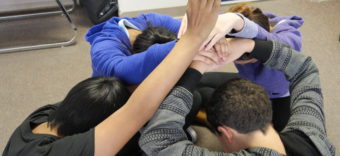
A group of four made a pumpkin using only their bodies, Monday.
A group of four students make themselves a pumpkin after their teacher asked them to become something related to Halloween. (Photo by Quinton Chandler/KTOO)

Jessica Collins’ social studies classroom in Dzantik’i Heeni Middle School is full of energetic seventh- and eighth-graders. Chairs and desks are pushed to the sides of the room.

The students are separated into groups of four and they’re frozen in awkward poses.

One group is sitting with their legs crossed and all four kids are facing each other. Their heads are bowed, their arms are stretched up into the middle of the circle and they’ve stacked their hands on top of each other.

One boy’s right arm is above the others and it’s pointing straight up into the air.

The kids have made a tableau – a picture made with nothing but their bodies. They’ve become a pumpkin.

Jessica Collins asked the kids to make something related to Halloween.

“I really want to see that they get — showing me what they know in a different way because they’re used to paper and pencil,” Collins said. “Some kids do really well with that and some need a different method of learning and communicating what they know.”

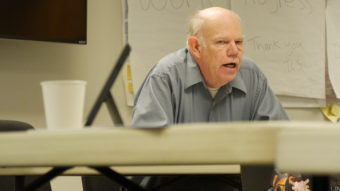
Jessica Collins gives instructions to her social studies class on class on Monday. (Photo by Quinton Chandler/KTOO)
Jessica Collins instructs her social studies class on Monday. (Photo by Quinton Chandler/KTOO)

What Collins is doing is part of an initiative called Artful Teaching that Juneau School District officials said was adopted about a year ago.

The district, in partnership with University of Alaska Southeast and Juneau Arts and Humanities Council, has been inviting artists into classrooms to show teachers how to use art to teach their classes.

The point is to help kids learn and express themselves in ways they can’t through standard book learning.

Amy Rautiainen, the artful teaching coordinator for the district said it’s, “kind of like coupling arts, whether it’s drama, or visual arts, or music with curricular content – so math, or reading, or language arts.”

Amy Rautiainen is the Juneau School District's artful teaching coordinator.
Amy Rautiainen is the Juneau School District’s artful teaching coordinator. (Photo by Quinton Chandler/KTOO)

Rautiainen said the district-wide project is funded through a grant provided by the Margaret A. Cargill Foundation.

She doesn’t have documentation, like test scores, to prove it’s making a difference, but she said it has been researched.

“An organization that we work with a lot is the Kennedy Center, out of Washington D.C.,” Rautiainen said. “They have funded a lot of research based around arts integration as an effective instructional method.”

Back in Collins’ classroom things are escalating. Now they’ve got the steps down and she’s asking the kids to make something related to their subject material – ancient Egypt.

“You’re going to show me: Why might it be difficult to travel upstream on the Nile River,” she asked.

First, the kids get to think about the question. Next, they share ideas on how to answer with their group. Then they decide what they’ll do. Once they know what they’re making, they have 30 seconds to create their tableau.

One student said two members of his group represent, “boat like … rowers … (they have) like lack of energy because the river is really long.”

Another group of students made cataracts – waterfalls or rapids that they say will smash a boat up against rocks.

That is how a tableau works.

Collins has been teaching her kids about Egypt and then asking them to demonstrate what they learn. She said the strategy helps kids use skills they don’t usually get to tap into.

“Through the experience of working together and moving their bodies … a lot of students learn better that way than traditional reading from a book, or listening to a lecture and taking notes,” she explained.

“They can make connections between the information that they read and the movements that they make.”

Collins said this method also helps kids learn from each other and acting these concepts out might help them hold onto the information they learn.

But at the same time, she admitted some kids learn better from standard book work.

“This is kind of an equalizing sort of thing where if you’re a really strong reader and writer, you may not be comfortable with acting and cooperative group work – so it pushes kids equally,” she said.

As much as Collins and the kids seem to enjoy this artful way of teaching, she doesn’t believe it can defeat the teenagers’ short attention spans.

Soon she said they’d drop the tableaus for a while and start learning about Egyptian hieroglyphics, cartouches and of course, the pyramids.

Enrollment dollars could save Juneau schools from Walker vetoes

David Means addresses the Juneau School Board on Saturday.
David Means addresses the Juneau School Board on Saturday. (Photo by Quinton Chandler/KTOO)

David Means, the Juneau School District’s director of administrative services, delivered good news on top of more good news to the Juneau School Board during a weekend retreat.

He told the board that additional state funding triggered by a surprising growth in the district’s student population, along with some financial juggling, might give the district enough money to close its spending gap for student transportation.

The district was in a bind after Gov. Walker vetoed hundreds of thousands of dollars from its budget this summer. Some of that money was restored, but the district still had to figure out how to replace about $248,000 it intended to spend on its busing contract.

“We’re looking at carry-over money from last year, and we did reduce one school bus route,” David Means said. “So the bottom line is basically the reductions and that additional carry-over money, and additional revenue will offset Gov. Walker’s veto.”

Students board buses outside of Glacier Valley Elementary School.
Students board buses outside of Glacier Valley Elementary School. (Photo by Quinton Chandler/KTOO)

Means said the kids who used the route the district scaled back are being picked up by other buses.

He added that his math is based on budget projections. He won’t know the exact balance until the school year is almost over.

Means first learned the district’s enrollment was higher than expected when the school year started in August.

Back then, he estimated there were about 230 more students than expected but he said that number could change.

He said he’d get more headcounts in October and those numbers would help determine how much additional money the state would give the district.

The numbers did change. Means said in the past couple of months, enrollment has fallen a little but there are still about 180 more students than originally expected.

“That will bring in, probably $1.4 million,” he said. “In addition to that, we’re finding the number of special education students who are receiving intensive levels of service has gone up from where we thought we would be. It’s gone up by 16 students.”

Means said the state gives school districts about 13 times more money for each intensive needs student than for other kids.

“So altogether on the state monies, we’re going to have about $2.6 million more than what we have budgeted for,” he said

Those additional students also mean some additional costs. Means said the district is paying for about three additional teaching positions and more paraeducators have to be hired to handle the increase in intensive needs students.

Means told board members he would send the district’s latest enrollment numbers to the state within the next week.

Former child soldier tells Juneau high schoolers to work for peace

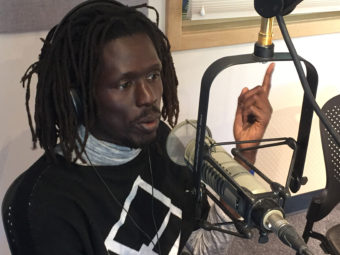
Emmanauel Jal talks about his transition from child soldier in Sudan to peace activist and hip hop artist during an interview on Tuesday.
Emmanuel Jal talks about his transition from child soldier in Sudan to peace activist and hip-hop artist during an interview on Tuesday, Oct. 25, in Juneau. (Photo by Rashah McChesney/Alaska’s Energy Desk)

Teenagers this week in Juneau are worried about Halloween costumes, grades and the other daily dramas of high school. But when Emmanuel Jal was even younger — he isn’t sure how old he is — he was starving and fighting in a civil war in Sudan as a child soldier.

A lot of the good things in Jal’s life he said happened by accident. He has a business centered on food he “created” to change his diet because doctors told him he was showing symptoms of diabetes.

“And the food that I used and created is what I packaged and put in Whole Foods in Canada,” Jal said.

Jal said he also fell into music by accident.

“I was just doing music for fun. It was a place (where) I was able to see heaven again. It was a place where I was able to become a child again,” he said. “So I just did it for fun and it turned out to create a platform.”

Jal is from South Sudan. He visited Juneau this week to encourage Juneau-Douglas High School and Thunder Mountain High School students to fight for peace.

He travels around the country speaking about the horrors he experienced during Sudan’s most recent civil war.

“During that time my country was at war and that war really took all my family. All my aunties died during the war, all my uncles except two. My mom too was claimed by that war,” Jal said.

He said his father sent him to Ethiopia and he had to walk hundreds of miles to get there.

He said a lot of people died on the trip and when he reached Ethiopia he was eventually trained to be a child soldier.

The story he shared with the high school students was the lowest point in his life – the time he was starving and was tempted to eat his friend.

“That night I went through a fight with my mind,” he said. “Part of my mind tell me, ‘Eat your friend.’ Part of my mind tell me, ‘If you’re gonna eat your friend, it’s going to haunt you for the rest of your life.’”

He didn’t. He got a bird to eat.

Emmanuel Jal performing at Juneau-Douglas High School on Tuesday.
Emmanuel Jal performs at Juneau-Douglas High School on Tuesday. (Video still courtesy 360 North)

Jal said it can be hard to know how much of his story to share with people because sometimes he doesn’t want to remember all of the details.

“So when I go to an audience, (I’m) kind of prepared mentally. And then I end the whole thing with a dance, music. Boom, high energy, high vibration – I’m not haunted,” he said. “Before, I used to tell the story where there was no music and it used to give me (a) terrible time.”

Jal believes his story can inspire Juneau’s high school students to try to learn how they can work to make the world better.

“Basically I’m just contributing to the greater calling,” he said.

“(I’m) just saying, this is where I came from. This is where I am now. And you can do the same. And then they say, ‘Oh yeah. Let me take a part in making this world better.’”

Jal said sometimes when people don’t know others are suffering, they won’t do anything. But he said once they know, they will act.

Juneau talks Trump, Clinton and the 2016 presidential election

Trump and Clinton campaign signs posted in Juneau. (Photos by Quinton Chandler/KTOO)

Multiple polls indicate the presidential race in Alaska is much closer than the state’s conservative voting record would suggest. Juneau residents with different political beliefs shared their thoughts on this season’s very unusual race.

Let’s start in downtown Juneau at a wine tasting for the local League of Women Voters. The group bills itself nonpartisan, and there are a mix of political ideologies, but a lot of the attendees are voting blue.

Geny Del Rosario could be an exception. She said the recent polls for Alaska are reflecting that this race is unorthodox.

She’s a registered Republican and said she’s undecided, but she’s also leaning toward Trump. Why? She pointed to the recent presidential race in her former home, the Philippines.

“I’ve been following our political arena in the Philippines and our president is unpredictable. But, the thing is the sincerity in his heart. What (is it that) he is going to do, really?” Del Rosario asked.

Philippine President Rodrigo Duterte is extremely controversial, but Del Rosario said he gets things done.

“There’s something there that needs to be done,” she said. Who’s got the” — she clears her throat — “to fix it? Not really fix it but somebody that has the guts, or the thing to really stand up strong enough to go against all odds. Somebody really has to be strong enough to make changes.”

One issue Del Rosario is passionate about is affordable health care. She called Clinton a “good lady,” but doesn’t think she will bring change.

Many of the other people at the wine tasting were decidedly against Trump.

Betty Stidolph sat at a table in the back with three friends. They all work in health care and they are mostly voting for Hillary Clinton.

“Hillary stands for children and women in our country, has always been strong and admirable, and I’m so proud to be a woman in Alaska that supports her,” Stidolph said. “I think that Alaskans are smart and that’s why the race is close in Alaska. They’re not buying the Kool-Aid on this guy and what he’s offering the country.

Bob Weiss is a Republican, but he will vote for Clinton.

“Well, I think he’s kind of a blow hard to tell you the truth,” Weiss said. “I would support most of the people that would run for the Republican Party but not Trump.”

There were also some third-party voters and some undecideds, but the crowd seemed to favor Clinton.

About 15 minutes down the road, Trump hopeful Don Kubley is attending an open house for Republican U.S. Sen. Lisa Murkowski.

Don Kubley (left) and U.S. Sen. Lisa Murkowski. (Photo by Quinton Chandler/KTOO)
Don Kubley and U.S. Sen. Lisa Murkowski. (Photo by Quinton Chandler/KTOO)

Kubley is a registered lobbyist for Alaska Independent Power Producers Association and Juneau Hydropower. He wants it to be clear his opinions are his own and have nothing to do with Sen. Murkowski.

He said the polls are reflecting fallout from a 2005 video of Donald Trump making lewd comments about women and allegations of sexual assault.

“He was at a normal place in the polls before the controversy with the ladies. There’s no doubt, this has had an impact, especially on women,” Kubley said.

But it hasn’t changed Kubley’s decision to vote for Trump. He said he wants to get back to the “issues.”

“I want to get past this locker room stuff and junior high talk back and forth. ‘You did this. I did that,’” he said. “To me it’s all about the economy of the United States, bringing jobs back, and what’s going to happen in the future, especially with the Supreme Court.”

Kubley believes Trump still has a chance to win because of issues with Hillary Clinton’s candidacy. He accused her of theft and using her position as Secretary of State to line her and her husband’s pockets. Kubley also doesn’t think Clinton will do any favors for Alaska.

“She doesn’t want to open up ANWR, she doesn’t want to build pipelines. She shut down Keystone. How is that possibly going to help our pipeline?” he asked.

He said Alaska needs jobs and additional state revenue to improve its economy – things he doesn’t believe Clinton will deliver.

Tom Dawson is an independent and he won’t vote for Clinton – period.

“If Trump is still there when the time comes, he’ll get my vote. If it’s not Trump, if something else happens between now and then, it’ll probably be the next person, whether it’s an Independent or a Republican,” Dawson said.

Dawson thinks Trump is doing better than most people think. He believes the “mainstream news media” is skewing the polls and reporting disproportionately negative news about Trump.

“Because they’re so heavily for Clinton, you don’t get the benefit of the doubt there,” Dawson said.

He said there are more problems with Clinton that the “news media” won’t report. When asked to name specific issues he said you only had to watch the debates.

Correction: An earlier version of this story misidentified the Philippines president. The president is Rodrigo Duterte, not Roberto Duterte. 

Juneau beats Fairbanks to first snowfall for first time in 70+ years

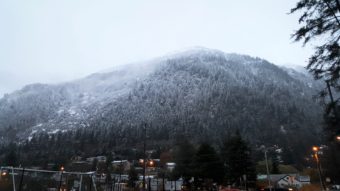
Snow covers Mount Juneau, Sunday, Oct. 16. (Photo by Tripp Crouse/KTOO)

National Weather Service meteorologist Edward Liske said this season is the first-time Juneau has seen measurable snowfall before Fairbanks since about 1940.

The National Weather Service reported Sunday that Juneau is one of the first communities in the state to see measurable snowfall this year.

“Fairbanks has not seen any snow yet so far this season, neither has Anchorage. Nome has had zero. Kotzebue has had zero,” Liske said. “The only place that really has had measurable snow this season has been Barrow with a tenth of an inch so far.”

Liske said Juneau has seen snow earlier in the past. In 1974 and again in 2000, Juneau saw its earliest snowfalls on Oct. 2.

This year, Liske said Juneau saw 2 inches of snow in downtown Sunday, 5 inches near the airport and 8-9 inches at the National Weather Service Forecast Office in the Mendenhall Valley.

The precipitation started as a sudden mix of rain and snow that hit Juneau on Saturday, interrupting what Liske called unusually warm conditions.

“As we started getting heavier and heavier rain, or heavier and heavier (precipitation), it just made the surface temperatures colder and colder to the point that the rain changed over to snow during Saturday evening,” Liske explained.

But, he said the snowy weather was short-lived. It was already reverting to rain Sunday evening.

He predicted Juneau will continue to see warmer and rainier weather through the rest of the week, and the snow will most likely melt.

Before the early snowfall, Liske said an area of high pressure called a ridge surrounded much of Interior Alaska and the Gulf of Alaska giving Juneau uncharacteristically dry October weather.

“That ridge has actually been deflecting a lot of our storm systems that we usually see farther south,” Liske said.

“The storms that the Pacific Northwest has been seeing over the last several days (are) basically those storm systems that have been deflected farther south.”

He said that ridge has mostly collapsed.

Liske also said this entire year has been much warmer than usual for Juneau.

That plus this month’s earlier dry weather, and this most recent early-season snowstorm, has led him to conclude: this year has been “odd to say the least.”

3-vehicle collision partially closes Mendenhall Loop Road

JPD SUV on Sunday, Sept. 11, 2016.
JPD vehicle. (Photo by Quinton Chandler/KTOO)

Seven people were treated for injuries at Bartlett Regional Hospital on Saturday after a three-vehicle collision in the Mendenhall Valley. The injuries weren’t life-threatening.

Sgt. Jeremy Weske with Juneau Police Department said the crash happened at about 11 a.m. near the intersection of Mendenhall Loop Road and Thunder Mountain Road. One driver, 41-year-old Jana Pierce, was cited for failing to maintain a safe distance.

All three vehicles were disabled and had to be towed. Police estimated the damage at over $15,000. Part of Mendenhall Loop Road was closed for about an hour after the crash.

Site notifications
Update notification options
Subscribe to notifications