Quinton Chandler, KTOO

New addition will help food bank store even more food than before

Jim Wilcox holds up a $100 donation on Saturday.
Jim Wilcox holds up a $100 donation on Saturday. (Photo by Quinton Chandler/KTOO)

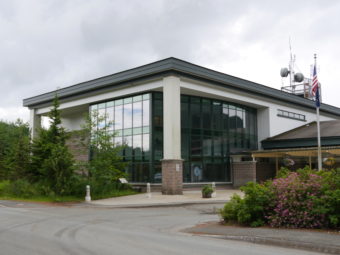
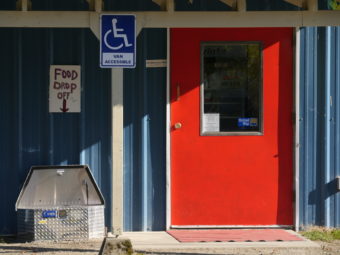
The Southeast Alaska Food Bank celebrated an increased capacity during an open house Saturday.

The new addition allows the food bank to give away even more food than before.

Last year, Jim Wilcox was the board president, but he gave that up to head the food bank’s warehouse expansion.

“I couldn’t do both, so I turned the presidency over to one of my buddies,” said Wilcox, who sits on the Southeast Alaska Food Bank’s board of directors.

In the last four years, the number of people asking for food increased by 30 percent to 40 percent, he said, wearing a red cap with the food bank’s logo over his white hair.

That’s why adding space onto the warehouse was paramount.

“We can probably store probably six months of food in here right now,” Wilcox said.

“Before that, it was down in that little end down there and we’d be lucky if we could get a month that we could store. That was piled clear to the ceiling.”

Wilcox planned for the entire project — a 2,200-square-foot expansion — to take a full three months. Some said it would take double that.

He said they did it in just 52 days.

“And four of them days were half days,” Wilcox said.

“They said it could take up to a year just to get a permit from the Corps of Army Engineers,” he said. “The guy come out here, walked over, dug a couple of holes. He was here about an hour and a half and come and sign the paper off and said, ‘You got it.’ These contractors couldn’t believe it.”

He gave part of the credit for the quick turnaround to a former Juneau contractor who he hired out of Hoonah.

“I asked him if he’d come back to Juneau and be my ramrodder, because he knew all of the contractors and everything too.”

“When the guys were still here cutting the floor, the next contractor to put all the walls up was here laying out the walls before we even had the floor done,” Wilcox said. “And that’s the way we went with the whole job.”

Wilcox gave another round of praise to the businesses who helped build the space and the others that contributed. He estimated a third of them gave their services for free.

“Engineers, surveyors – they were all free. The people who drew the building and drew all the blueprints – they were free. The electricians, 99 percent of the work they did for free,” Wilcox said.

The rest the food bank covered – mostly through donations. Wilcox said it cost them less than $70 per square foot when it should have cost about $250.

Darren Adams is the food bank manager. (Photo by Quinton Chandler/KTOO)

The food bank’s manager Darren Adams said that right before the new and improved warehouse’s open house and ribbon cutting, about 45 people came to collect close to 1,600 pounds of food.

The new space is going to go a long way toward the food bank’s day to day operations, he said. There’s an obvious divide between the old space and the add-on.

Adams pointed out a sharp contrast between the two.

“In years past whenever I’d get a huge food drive, or get a huge food donation, I’d have to make it all fit in here,” he said.

Adams recalled pallets scattered everywhere and food stacked to the ceiling.

“I had to call in a lot of favors and ask people who don’t normally store food for us to store food for us,” he said.

But, not anymore.

“This will help us bring in more food, keep enough back to where we’ve got food for today and for tomorrow, and it will also help us buy food in bulk,” Adams said.

One thing the extra space can’t do is give Adams more manpower. He’s the only full-time employee and said the food bank is always looking for volunteers.

Wilcox left the warehouse in a good mood, but not before insisting on getting a photo of a wall covered in the names of all the organizations that helped make the expansion possible.

One of the warehouse's walls was dedicated to the organizations that helped make the expansion possible.
One of the warehouse’s walls was dedicated to the organizations that helped make the expansion possible. (Photo by Quinton Chandler/KTOO)

New curriculum standards are changing instruction in Juneau schools

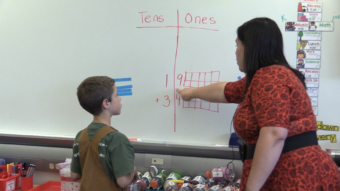
Eli Wyatt is a second-grader at Glacier Valley Elementary School. He answered 19+34 =53.
(Photo by Quinton Chandler/KTOO)

“Nineteen plus 34. Can you do it,” Tia Vreeland, a kindergarten and first-grade teacher at Glacier Valley Elementary School, asked her former student, Eli Wyatt.

Eight-year-old Eli is in second grade. He made a return visit to Vreeland’s classroom to prove second-graders can add double digit numbers.

This is the fifth year of a six-year curriculum review in the district and it is rethinking how hard it should make its classes.

Adding double digit numbers in first grade is a direct result of the district’s adoption of new core curriculum standards from the state in 2012.

That’s why Eli’s class had to learn last year.  Vreeland had Eli demonstrate with magnets on a whiteboard. Some look like sticks and the others are what Vreeland calls “dot” magnets.

They have number values. One stick equals ten.

Vreeland asked Eli to find the answer to the problem 19 plus 34 with the magnets.

She watched him add up his magnets and use them to show how to get the answer: 53.

In the end Eli has five of the stick magnets and three of the dots.

Vreeland said this strategy is supposed to help kids understand the meaning behind addition and subtraction rules like carrying and borrowing.

“I take seven ones, I take eight ones, I put them together and if, ‘Oh it’s over 10,’ I need to regroup,” Vreeland said. “(I) clear my board, and get a 10 so that they can see and touch and feel and understand what that magic one, what I considered a magic one – why it moves over to the next place and that is the value of a 10.”

Vreeland wants her students to understand how the numbers they’re using relate to each other so it’s easier for them to do math in their heads.

“(That’s) instead of trying to hold everything in their head like, ‘OK, I need to take this one and my ones place is only four and I need to do this with my 10,’” she said.

Using the sticks and the dots in her lessons isn’t new for Vreeland. What is new is using them to teach first-graders to add double digit numbers.

Tia Vreeland is a kindergarten and first grade teacher at Glacier Valley Elementary School.
Tia Vreeland is a kindergarten and first-grade teacher at Glacier Valley Elementary School. (Photo by Quinton Chandler/KTOO)

The new state standards cover English language arts and math.

Ted Wilson, director of teaching and learning support for the district, said its core curriculum is the set of academic goals students are required to reach. He said the math has gotten harder.

“In general the standards were a year ahead of where each grade level was at – starting at kindergarten and going through ninth grade, when they first enter Algebra 1,” said Wilson.

Wilson said the higher standards make the kids learn more complicated math, but they’re also supposed to make them more comfortable with numbers.

“So taking numbers apart, putting them back together,” he said. “Understanding how they relate to each other so when you get to more advanced math later on, you have that foundation of, ‘I get how numbers work.’”

Ted Wilson speaks at a Juneau School Board meeting on Aug. 9, 2016. Wilson is the director of teaching and learning support for Juneau School District.
Ted Wilson speaks at a Juneau School Board meeting on Tuesday, Aug. 9. Wilson is the director of teaching and learning support for Juneau School District. (Photo by Quinton Chandler/KTOO)

By the time they hit third grade Wilson said the kids will start learning how to multiply and divide. They’ll even be introduced to fractions and decimals which kids used to see around fifth grade.

It’s similar for reading standards. Wilson said in the past, elementary kids mostly read narrative stories. Now, they’re being introduced to more nonfiction and they have to answer tougher questions to strengthen their critical thinking skills.

Wilson said in addition to the new state standards the district is also implementing national standards for other subject areas, like world language, social studies and music.

“And in fact this coming year, we’re working on the science curriculum, and so that will be the next subject that jumps up from the previous standards,” Wilson said.

Once the district finishes with science it will be done with the six-year curriculum review, and then they will start a new review cycle with math .

But, Wilson doesn’t think they’ll change the standards again.

They need to make sure the standards line up at each grade level so second-graders like Eli won’t have trouble walking across the hall into third grade.

2 hunters rescued, 1 mauled near Hoonah

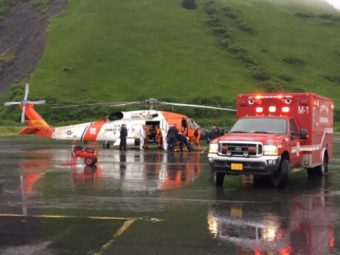
U.S. Coast Guard search & rescue demo at the 2016 Juneau Maritime Festival (Photo by David Purdy/KTOO)

A brown bear mauling prompted the Coast Guard to rescue two hunters from a mountain near Hoonah and bring them to Juneau Saturday afternoon. Only one of the hunters was injured.

Coast Guard Lt. Greg Isbell said the injured hunter explained they were hiking a mountain when the bear ambushed them.

“He had described that he had multiple puncture wounds, and the bear had grabbed his leg and bit into his thigh,” Isbell said.

Isbell said the bear was a mother with two cubs. One hunter said they had to kill the mother to save their lives. He said the cubs appeared to be about two-years-old.

Isbell said after the mother was killed it was still a tense situation.

“The hunters had to continue to shoot warning shots at the other two bears to keep them away because they kept trying to close in while they waited (for) transportation,” he said.

The Coast Guard launched a helicopter from Sitka with a corpsman and rescue swimmer aboard. They brought the hunters to Juneau and the injured hunter was taken to Bartlett Regional Hospital.

Isbell did not know the full extent of his injuries.

SHI program trains educators to see Thru the Cultural Lens

Jackie Kookesh is in charge of Thru the Cultural Lens.
Jackie Kookesh is in charge of Thru the Cultural Lens. (Photo by Quinton Chandler/KTOO)

Juneau teachers and administrators were the students on Saturday at a Sealaska Heritage Institute seminar intended to help them see the world from their pupils’ perspectives.

It’s part of an ongoing series called Thru the Cultural Lens in which educators learn about Southeast Alaska Native culture and history. Saturday, they gave presentations on 10,000 years of education in Southeast Alaska.

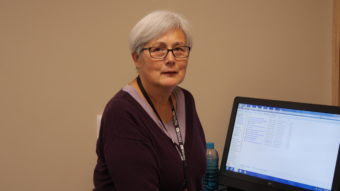
Jackie Kookesh is the education director for Sealaska Heritage. She is Tlingit and is part of the L’uknax.ádi clan. She was born and raised in Juneau’s Indian village. Kookesh is in charge of Thru the Cultural Lens.

“We provide a semester-long symposium or seminar that is about 50 hours commitment on the part of the teachers once they apply and register for the course.”

Kookesh said this is Sealaska’s fourth year offering the program and in that time they’ve worked with 67 educators in Juneau School District.

Nineteen people are participating this year, including Juneau School Board member Josh Keaton. The last session will be held in November.

Kookesh said the program leads its participants through the politics and history of Southeast, and it gives them an overview of Southeast Alaska Native culture.

“We explore topics like the arts, subsistence life ways; we explore it all in that 50 hours,” she said.

She hopes those who complete the program become “culturally responsive educators.”

“It will help them in terms of how they relate to Alaska Native students in their classroom, how they communicate, how they engage,” Kookesh said. “The outcome is that our students realize their own potential (for) success in schools and in the classroom. Not only Alaska Native students but all students.”

Kookesh said she saw firsthand how damaging a school that doesn’t reflect Native students’ culture can be to be to them. She was in the Juneau School District in the late 1950s and in the 1960s.

She said the atmosphere back then was much worse than today. She left the district to attend a Bureau of Indian Affairs school.

“If I hadn’t attended the boarding school, I probably wouldn’t have graduated from high school,” she said. “At the time that I was attending school here in the Juneau School District, (it) was very racist, and Alaska Native students were very disenfranchised within the district.”

Kookesh’s experience is part of the reason she wants to continue offering Thru the Cultural Lens.

She believes the program is successfully helping teachers fulfill their own desire to build stronger relationships with their students.

Ed Becker is a social studies teacher at Yaakoosgé Daakihídi Alternative High School.
Ed Becker is a social studies teacher at Yaakoosgé Daakihídi Alternative High School. (Photo by Quinton Chandler/KTOO)

Ed Becker is a social studies teacher at Yaakoosgé Daakihídi Alternative High School. He has high praise for the program.

“I teach Alaska history and world history, and U.S. government. It’s definitely going to cause pause and create some more work for me, but more opportunities for my students to be engaged and learn,” Becker said.

Last year, 17 percent of the district’s students were Alaska Native.

Juneau School District included this table and chart in its Budget Documents for FY2017. (Courtesy of Juneau School District)
Angie Lunda is an assistant professor of education at the University of Alaska Southeast.
Angie Lunda is an assistant professor of education at the University of Alaska Southeast. (Photo by Quinton Chandler/KTOO)

Angie Lunda is an assistant professor of education for the University of Alaska Southeast. She is Tlingit from the Kaagwaantaan clan and she is teaching today’s session.

“What I hope is that it will cause teachers to dig deep in themselves to really try to reach students where they’re at, to really build on the background knowledge that students bring, to really base the education in this place,” Lunda said.

She said connecting to students through their culture and what they already know about Southeast can help with real problems like the achievement gap between Alaska Native students and non-Native students.

The state Department of Education has reported that in 2015 more than a third of Alaska Native students failed to graduate after four years of high school. That’s compared with one in four students overall.

Dianne Zemanek teaches math and science at Dzantik'i Heeni Middle School.
Dianne Zemanek teaches math and science at Dzantik’i Heeni Middle School. (Photo by Quinton Chandler/KTOO)

Dianne Zemanek is a math and science teacher at Dzantik’i Heeni Middle School. She sees Sealaska Heritage’s seminar as an opportunity to continue building on efforts at her school to bring Native culture into their classes.

“We took the core cultural values of the Native Tlingit, Haida, Tsimshian people and took those values to our kids and then asked them to connect to those cultural values and explain what it looks like in our school,” Zemanek said.

In her own classroom, she’s trying to use Alaska Native methods for building halibut hooks in her math lessons.

Traffic light malfunction limits access to Egan Drive

JPD SUV on Sunday, Sept. 11, 2016.
JPD vehicle. (Photo by Quinton Chandler/KTOO)

A traffic light on Egan Drive malfunctioned Saturday afternoon, closing one lane inbound and outbound.

The problem was caused by a damaged wire. Jeremy Woodrow, a spokesman for the Alaska Department of Transportation, said it’s possible the wire was cut during construction work or it could have been shorted by rainwater.

Woodrow said the Juneau Police Department arrived on scene to help manage traffic at about 4 p.m. Telise Watkins, a police dispatcher, said the light was repaired by 7:40 p.m.

House window shot in Auke Bay

Juneau Police Department badge logo
An arm badge for the Juneau Police Department on Lt. Kris Sell’s uniform, April 1, 2016. (Photo by Jeremy Hsieh/KTOO)

The window of a house was shot out in the Auke Bay area Saturday morning.

The Juneau Police Department said in a press release one shot was fired in the 13000 block of Glacier Highway. Police and an Alaska State Trooper responded.

Two people were inside the house during the shooting. They told police they didn’t hear the shot being fired.

No one was injured, but police said it does not appear to be a random shooting. The investigation is ongoing.

Site notifications
Update notification options
Subscribe to notifications