Quinton Chandler, KTOO

University of Alaska reorganization planning advances toward second phase

Board of Regents meeting on Friday, Sept. 16, 2016.
The University of Alaska Board of Regents met on Friday in Juneau. (Photo by Quinton Chandler/KTOO)

The University of Alaska is in the middle of a year-long review of its academic programs and administration. It’s called Strategic Pathways and is an attempt to save money and make the university system more efficient.

“How can we take advantage of our oneness, being ‘The University of Alaska,’ and at the same time take advantage of the unique strengths of our campuses all across the state?” asked University of Alaska President Jim Johnsen in a video on the university website.

President Jim Johnsen explains Strategic Pathways at University of Alaska Southeast's Egan Lecture Hall Tuesday, Sept. 13, 2016.
President Jim Johnsen explains Strategic Pathways at University of Alaska Southeast’s Egan Lecture Hall on Sept. 13. (Photo by Quinton Chandler/KTOO)

His question strikes at the heart of what university system officials hope Strategic Pathways will accomplish.

University spokeswoman Roberta Graham called Strategic Pathways a framework.

“The university will review its administrative and academic functions to find where there is the possibility of greater alignment, greater efficiency,” said Graham.

She said the goal is to improve students’ experience with the university system and to save money. Because of steep budget cuts and a multibillion-dollar state spending gap, Graham said the university’s board of regents asked President Johnsen to find ways to save money and give students a quality education.

The university built teams to study how its academic and administrative areas could be improved. The teams started phase one of their work in late June.

Graham said they looked at “the schools of education, engineering and business management. On the administrative side: information technology, intercollegiate athletics, research administration and procurement.”

The teams’ developed options for the board of regents to consider during its latest two-day meeting in Juneau. The board chose the options they liked and now, new teams will consider how to bring those into fruition.

For example, the University of Alaska will move to a single college of education with one dean for the entire state — rather than three.

University of Alaska Southeast Chancellor Rick Caulfield in the Egan Lecture Hall on Tuesday, Sept. 13, 2016.
University of Alaska Southeast Chancellor Rick Caulfield listens to President Jim Johnsen’s presentation in the Egan Lecture Hall on Tuesday, Sept. 13, 2016. (Photo by Quinton Chandler/KTOO)

University of Alaska Southeast Chancellor Rick Caulfield hopes the regents choose his school.

“The location of that dean or the location of the lead university for that has not yet been determined,” Caulfield said. “Southeast has long been a leader in that area and we’ll see how that conversation unfolds. It’ll be the president’s recommendation in the end to the board of regents.”

University officials said the regents adopted Johnsen’s recommendation for UAS to continue offering its bachelor’s of administration and master’s of public administration programs online.

Caulfield said, “What is proposed for change is that we would combine what’s now in our school of management into our school of arts and sciences. We would consolidate the administrative side of things, but maintain those important programs.”

Graham said phase two of the Strategic Pathways review will begin in October. Teams will consider a new set of areas to reform. There will be a third phase during the winter, and the entire process is scheduled to end with a final presentation to the board of regents in June 2017.

The university also considered reorganizing to hold one accreditation instead of three in Anchorage, Fairbanks and Juneau.

Graham explained that an accreditation is “sort of the stamp of the academic approval of a university’s curriculum and a university’s course offerings and that they are up to the standards of the accrediting body – which in our case is the northwest regional accrediting body.”

She’s unsure how a single accreditation would have changed the university system’s organizational structure. In any case, the board of regents put the option on hold.

“I believe the regents felt that it was just a bit too much at this time because it is such a complicated and time-consuming process,” Graham said.

The university also released a report that concluded a single accreditation probably wouldn’t save a significant amount of money, improve student experiences or improve academic performance, like some hoped.

Graham said the university is placing its bet on Strategic Pathways for now, but a single accreditation is still an option for the future.

Advocacy group says beer is “100% better” than heroin

Crowd at the 5th Annual Capital Brewfest Saturday.
The crowd at the 5th Annual Capital Brewfest on Saturday. (Photo by Quinton Chandler/KTOO)

The party was on at the Juneau Rotary’s Capital Brewfest.

There was a stage, live music and a large room packed with people drinking from short glasses of beer. The organization Juneau – Stop Heroin, Start Talking passed out koozies that said “BEER AND BACON ARE 100% BETTER FOR YOU THAN HEROIN.”

Beer and Bacon 100% Better than Heroin koozie
Koozies distributed at the Capital Brewfest on Saturday read “BEER AND BACON ARE 100% BETTER FOR YOU THAN HEROIN.” Some of the proceeds from the fifth annual Capital Brewfest went to Juneau – Stop Heroin, Start Talking. (Photo by Jeremy Hsieh/KTOO)

The group fights against heroin abuse and will take a quarter of the money raised from the brew fest.

Its participation raised the question: Is it appropriate for an anti-heroin group to take donations from a beer festival – especially considering Alaska’s high rates of alcoholism?

Adam Buechler wasn’t too concerned.

Keg at the Capital Brewfest Saturday.
Keg at the Capital Brewfest Saturday. (Photo by Quinton Chandler/KTOO)

“It’s weird, but a lot of programs will substitute one addiction with another and I think the majority of people will agree that beer is a better addiction than heroin,” Buechler said.

Hailey Ward was on vacation from her job at a homeless shelter in Calgary, Canada. She’s a nurse and said addictions are her specialty. The koozies caught her off guard.

Heroin is not something I joke about,” Ward said. “It’s something I see as a very serious thing in my work environment, so mixing my vacation life, going to a beer festival and seeing them almost joking about heroin, yeah, it caught me for a moment for sure.”

Still, she said it’s a beer festival and she wasn’t offended.

“I’m also here so I can’t be like, ‘Oh I’m very offended about this,’” Ward said.

Outside the Capital Brewfest Saturday.
Outside the Capital Brewfest on Saturday. (Photo by Quinton Chandler/KTOO)

Izzie Felstead thought the koozies had a good message.

“I thought it was really cool because I don’t use koozies very much but if I’m going to have a koozie at least it says something better than like, ‘drink beer,’” Felstead said.

She also liked the rubber wristbands making the rounds.

“I have a wristband that says ‘Stop Heroin, Start Talking,’” Felstead said. “I think that’s a better message because kids will wear them rather than having something they have to put on a beer.”

Each year the Juneau Rotary partners with another organization to help throw the brew fest. The partner gets 25 percent of the money the festival raises. Rotary officials said historically, the event has raised about $25,000.

But should Michele Morgan’s organization, Juneau – Stop Heroin, Start Talking, take that money?

The CDC has reported Alaska has one the highest rates of binge drinking in the country. The state reported in 2010 Alaska had the highest rate of fetal alcohol syndrome.

Morgan agreed that alcohol can be dangerous, but said the brew fest is a legal event and it gives her a chance to spread her message.

“I did the bacon fest and we did the same thing, ‘Bacon is 100 percent better for you than heroin.’ Anything is better for you than heroin. I mean, it can kill you with one mistake,” Morgan said.

She said she will go to any event to spread awareness and try to save the next generation from the dangers of heroin.

“I don’t eat bacon. I don’t eat farmed meats, but I did bacon stickers for the bacon fest. I did the beer ones for the beer fest. I don’t drink beer,” Morgan said.

Michele Morgan founder of Juneau - Stop Heroin, Start Talking.
Michele Morgan founded Juneau – Stop Heroin, Start Talking. (Photo by Quinton Chandler/KTOO)

Morgan got one complaint about the brew fest. She said a woman whose son is an addict emailed her and said she was upset by the organization taking part.

“We talked and I explained to her, ‘These are decisions. Not everyone is an alcoholic,’” Morgan said. “‘These people here, alcohol is legal in the United States. I’m not the one who makes it legal.’”

She told her, the opportunity to bring awareness to a new group of people and get some much-needed money for their cause was huge. And she’s thankful for it.

“We talked and emailed and she actually understood and apologized, and said ‘I understand. This event is happening. If this is an adult event and these people are maintaining and doing well, why do we have to take that away from shining a light on how horrible heroin is?’” Morgan said.

Morgan said the money she gets from the Rotary will help fund her awareness campaign. It will also help in a new venture. She and a woman whose son died from heroin abuse are planning to take the message into Juneau’s schools.

She wants to talk about the state’s report that Southeast Alaska saw a near 500 percent increase in Hepatitis C cases in five years. The report links the increase to injection drug use.

Editor’s note: KTOO is a sponsor of Capital Brewfest. 

Playwright Edward Albee, Who Changed And Challenged Audiences, Dies At 88

Playwright Edward Albee — whose works included The Zoo Story, The Sandbox and Who's Afraid of Virginia Woolf? — has died. Above, he speaks to a packed house at the University of Toronto in 1971. Boris Spremo/Toronto Star via Getty ImagesEdward Albee, the three-time Pulitzer Prize-winning playwright of Who’s Afraid of Virginia Woolf? among many others, died Friday at the age of 88 following a short illness, according to his longtime personal assistant.

Albee didn’t particularly like it when people asked him what his plays were “about.” As he wrote in a 2007 letter to the audience of Me, Myself and I, that question made him “become uncooperative — and occasionally downright hostile.” Albee acknowledged that his plays could be “occasionally complex” but were “infrequently opaque.” The best way to enjoy them, he advised, was without any baggage. “Pretend you’re at the first play you’ve ever seen,” he suggested. “Have that experience — and I think ‘what the play is about’ will reveal itself quite readily.”

Albee was adopted as an infant but didn't have a good relationship with his adoptive parents. "We didn't belong in the same family," he said. He's pictured above circa 1967 in England, where the Royal Shakespeare Company was performing his play A Delicate Balance. Hulton Archive/Getty Images
Albee was adopted as an infant but didn’t have a good relationship with his adoptive parents. “We didn’t belong in the same family,” he said. He’s pictured above circa 1967 in England, where the Royal Shakespeare Company was performing his play A Delicate Balance.
Hulton Archive/Getty Images

Albee’s plays have challenged, engaged and, at times, confounded audiences since he first burst upon the scene in 1960 with The Zoo Story — an unsettling and, ultimately, shocking encounter between two men in Central Park.

Ben Brantley, chief theater critic of The New York Times, thinks Albee was one of the great American dramatists. “Is there anyone else who dares to take on questions that are that big?” Brantley asks. “I’m not talking about questions of politics or immediate topical issues. Edward Albee asks questions — the most basic existential questions — he confronts death, he confronts sex with, I think, eyes that remain very wide open.”

Despite his protests, when we discussed his plays, Albee let this slip out:

“You know, if anybody wants me to say it, in one sentence, what my plays are about: They’re about the nature of identity,” he said. “Who we are, how we permit ourselves to be viewed, how we permit ourselves to view ourselves, how we practice identity or lack of identity.”

Albee’s questioning of identity came from a deep personal place. He was adopted, as an infant, by Reed and Frances Albee — his father ran a chain of vaudeville theaters — and his relationship with them was chilly.

“These people who adopted me I didn’t like very much and they didn’t like me very much, I don’t think,” Albee said. “We didn’t belong in the same family.”

But it did become grist for his mill. The late Marian Seldes starred in several Albee plays — including the Pulitzer Prize-winning Three Tall Women, a play all about Albee’s adoptive mother.

Seldes said that as an actress, she appreciated Albee’s precise, grammatically expressive language.

Albee, shown here in 1995, won Pulitzer Prizes for A Delicate Balance, Seascape and Three Tall Women and Tony awards for Who's Afraid of Virginia Woolf? and The Goat, or Who Is Sylvia? Jack Mitchell/Getty Images
Albee, shown here in 1995, won Pulitzer Prizes for A Delicate Balance, Seascape and Three Tall Women and Tony awards for Who’s Afraid of Virginia Woolf? and The Goat, or Who Is Sylvia?
Jack Mitchell/Getty Images

“I feel it’s like a piece of music, a musical score,” she said. “I think Edward’s punctuation — the ellipses, the number of periods, of dots after a line — if you allow it to go into you, as you would if you were going to sing, you would follow what he suggests.”

Regardless of the style and the language of each play, Brantley says, Albee displayed a rigorous clarity of purpose.

Brantley says Albee believed that “theater should hold up a mirror to society — but not just a mimetic mirror — not just to show us what we have, but to show us what’s beneath, what’s to the side; to force us to look at things from another perspective.”

Indeed, Albee said it was his mission.

“All art should be useful,” he said. “If it’s merely decorative, it’s a waste of time. You know, if you’re going to spend a couple of hours of your life listening to string quartets or being at plays or going to a museum and looking at paintings, something should happen to you. You should be changed.”

Copyright 2016 NPR. To see more, visit http://www.npr.org/.

‘Shoeless Joe’ Author William Patrick Kinsella Dies At 81

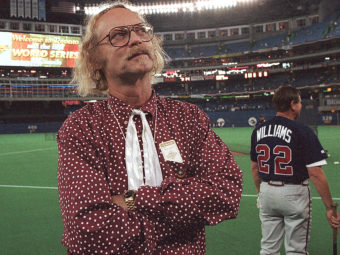
Canadian author W.P. Kinsella standing on the baseball field before game five of the 1992 World Series between Toronto Blue Jays and Atlanta Braves in Toronto, Ontario. Rusty Kennedy/AP
Canadian author W.P. Kinsella standing on the baseball field before game five of the 1992 World Series between Toronto Blue Jays and Atlanta Braves in Toronto, Ontario.
Rusty Kennedy/AP

William Patrick Kinsella, the Canadian author whose award-winning book Shoeless Joe was adapted into the beloved film Field of Dreams, had died at the age of 81.

His literary agent Carolyn Swayze issued a statement Friday confirming his death, calling him “a unique, creative and outrageously opinionated man.”

And as NPR’s Rose Friedman tells our Newscast unit, the most famous line he ever wrote was whispered – “If you build it, he will come,” in 1982’s Shoeless Joe.

As Rose explains, the book told the story of “an Iowa farmer who builds a baseball diamond in his cornfield, hoping to attract the ghost of a long dead player. The book was made into the movie, Field of Dreams, starring Kevin Costner and James Earl Jones, as the man who convinces the farmer to follow his heart.”

Watch a clip here, where the farmer played by Costner first hears the mysterious voice telling him to build a baseball diamond:

Kinsella wanted Shoeless Joe to be a “gentle read,” as Rose reported. “I put in no sex, no violence, no obscenity, none of that stuff that sells,” he said,” I wanted to write a book for imaginative readers, an affirmative statement about life.”

He published almost thirty books of fiction, non-fiction and poetry, and many of them centered on his great love – baseball. “There’s theoretically no distance that a great hitter couldn’t hit the ball or that a great fielder couldn’t run to retrieve it, and that makes for myth and for larger-than-life characters,” Kinsella said in an interview with the CBC.

He also wrote about the indigenous people of Canada, including his first book Dance Me Outside.

His final work, titled Russian Dolls, will be published by next year, according to his agent. She describes the book as a collection of linked stories about a struggling author and his muse, who tells him “dark, dangerously inconsistent stories of her past.”

His biographer Willie Steele told CBC radio that Kinsella was always generous, even when he knew his time was limited. “He essentially told me a couple of weeks ago, ‘You know, I’m not going to be here much longer, so whatever questions you’ve got, let’s get them done,'” Steele said.

He told the news service that in a recent interview, Kinsella reflected, “I’m a storyteller, in that my greatest satisfaction comes from making people laugh and also leaving them with a tear in the corner of their eye.”

Kinsella died of assisted suicide, according to multiple Canadian news outlets.

Copyright 2016 NPR. To see more, visit http://www.npr.org/.

How ‘Equal Access’ Is Helping Drive Black Renters Out Of Their Neighborhood

About 5,000 people have entered the lottery for the proposed Willie B. Kennedy development in San Francisco's Western Addition neighborhood. Courtesy of Tenderloin Neighborhood Development Corp.
About 5,000 people have entered the lottery for the proposed Willie B. Kennedy development in San Francisco’s Western Addition neighborhood.
Courtesy of Tenderloin Neighborhood Development Corp.

The city of San Francisco is in a quandary. Like many big cities, it faces an affordability crisis, and city leaders are looking for a way to build housing to help low- and middle-income residents stay there.

But one proposal to give current residents of a historically African-American neighborhood help to do that has run afoul of the Obama administration.

Consider the case of Mack Watson. At 96, he is a vision of elegance in his freshly pressed ribbon collar shirt, vest and sports coat. He has called San Francisco home since 1947.

“Nothing is like San Francisco. Like the song, I lost my heart in San Francisco,” he says minutes after finishing lunch at the Western Addition Senior Center on a recent day.

But Watson lost more than his heart in San Francisco. He is among thousands of black San Franciscans who are being displaced by gentrification. He can still recall when this neighborhood, the Western Addition, was a hub of African-American life.

“The mom and pop businesses. They’re all gone. Nightclubs and restaurants, all that stuff. Theaters. They all gone,” says Watson.

Watson witnessed firsthand as San Francisco’s African-American population plummeted from about 13 percent in 1970 to less than 6 percent today.

He might be gone, too, except that he lives with his grandson’s family in a house with stairs that are tough on his aging legs.

That’s why he applied for a lottery for a brand-new, 98-unit affordable housing development for seniors partially financed by the federal government. The complex, named for Willie B. Kennedy, a former San Francisco supervisor, is scheduled to open before the end of the year.

The city wants to give current residents, many of them African-American seniors like Watson, something called a “neighborhood preference” in that lottery.

London Breed, a San Francisco supervisor who grew up in the Western Addition, supports the neighborhood preferences. “And all we’re doing with neighborhood preference is saying that for the people who live here we’re going to give you a priority, the right of first refusal, you still have to compete in a lottery with other residents of the neighborhood, but you have a better shot,” says Breed.

But officials at the Department of Housing and Urban Development said no, you can’t do that. They told the city last month that its neighborhood preference plan would violate federal fair housing laws by limiting equal access and perpetuating segregation in this historically African-American neighborhood.

In other words, the law designed to give African-Americans a fair shake in getting housing is being cited as a reason why they can’t get a preference to stay in the community they’ve called home.

That leaves the city in a tough spot, says Tim Iglesias, a University of San Francisco law professor.

“Yes, there is an irony in this and the city is, in its own sense, trying to turn this neighborhood preferences, which have been used to discriminate, on its head to enable it to help maintain diversity in the city,” says Iglesias.

This issue also divides fair housing advocates. In New York, for example, a fair housing group has filed suit against that city’s policy of using “community preferences” for affordable housing units, saying it perpetuates segregation.

San Francisco officials met recently with HUD to press their case to use neighborhood preferences. They say the plan is vital to stemming the tide of gentrification that has driven thousands of people of all backgrounds out of the city. The agency agreed to review its decision.

Breed, the city supervisor, says that while she is optimistic, she is also realistic.

“It’s not going to reverse the African-American population in San Francisco. It’s not going to reverse the gentrification that’s also happened in the community,” Breed says. “But what it will do is give just a tad bit of hope to some people who are still struggling to stay here.”

Still, time is short. About 5,000 people applied for the complex’s 98 units, and the lottery is scheduled for next week.

Copyright 2016 NPR. To see more, visit http://www.npr.org/.

JPD asks for school board’s help in kindness initiative

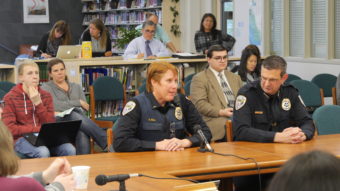
JPD Lt. Kris Sell (left) and Chief Bryce Johnson (right) speak at Tuesday's Juneau School Board meeting. (Photo by Quinton Chandler/KTOO)
JPD Lt. Kris Sell, left, and Chief Bryce Johnson, right speak at Tuesday’s Juneau School Board meeting. (Photo by Quinton Chandler/KTOO)

The Juneau Police Department wants to boost residents’ quality of life with kindness.

JPD Police Chief Bryce Johnson and Lt. Kris Sell presented their idea to the Juneau School Board Tuesday night.

The department wants the community to spend a year trying to make Juneau a more peaceful place by encouraging people to perform random acts of kindness for others.

“What we want to do is encourage people to do at least one kind act per day for another person. And to once a week make that kind act directed at someone who’s not in their normal circle of associates,” said Sell. “Maybe someone of a different culture, different background, different religion, different socioeconomic status.”

Sell said the department asked the nonprofit Random Acts to track what impact kindness will have on the Juneau community through 2017.

She said Random Acts will send a researcher to Juneau in January to gather data on the town. Then the organization will return a year later to see if Juneau’s quality of life has changed.

“And that’s numbers about our crime rates, about our disturbances, about discipline issues in the school, and we’ve talked to the hospital even about tracking our level of disease in Juneau,” Sell said. “We know from studies that being kind actually improves your immune system.”

A column in the Washington Post recently cited a study that found patients who gave their doctors a perfect score for empathy tended to recover from colds faster than patients who gave their doctors lower scores.

But the columnist, who is also a doctor, said evidence of a direct link between empathy and better health outcomes was limited. He also said kindness can’t hurt.

Sell said Random Acts had never heard of an entire town leading a kindness initiative and they said Juneau would be the first.

Sell said she and Chief Johnson came to the Juneau School Board meeting, hoping to recruit young people to take part in the initiative.

She hopes Juneau’s youth will continue making deliberate acts of kindness after the year is up.

She said kindness is “the drug that can replace all other drugs.”

Site notifications
Update notification options
Subscribe to notifications