"Through my reporting and series Tongass Voices and Lingít Word of the Week, I tell stories about people who have shaped -- and continue to shape -- the landscape of this place we live."
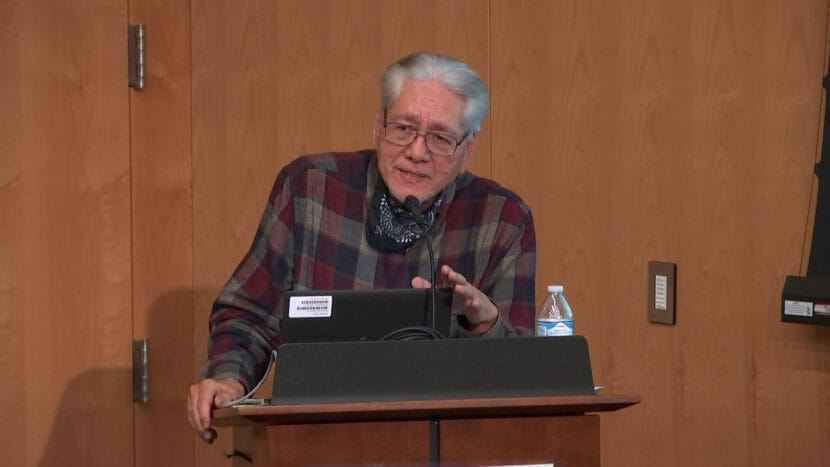
Oscar Peñaranda speaks at the Alaska State Museum on Oct. 7, 2022 (KTOO screenshot)
Canneries are a big part of Alaska’s history. Throughout the 20th century, waves of immigrants – primarily from the Philippines – came to work alongside Alaska Native people in the canneries.
The Mug Up exhibit at the Alaska State Museum in Juneau highlighted this history for the last six months.
The exhibit features lots of historic films and photos. There are black and white posed photos from the turn of the 20th century, and more candid photos taken by friends from the 1960s, 70s and 80s. Some panels explore the histories of the different labor movements that swept through Alaska’s canneries.
There’s even a recreation of a bunkhouse, with a door covered in names of the workers who slept there from the 1980s to 2009.
Next to it, a mess hall, with a hand-painted table, and a handwritten weekend menu. The backdrop is a photo of young women in hairnets smiling around a table, a few holding cigarettes.
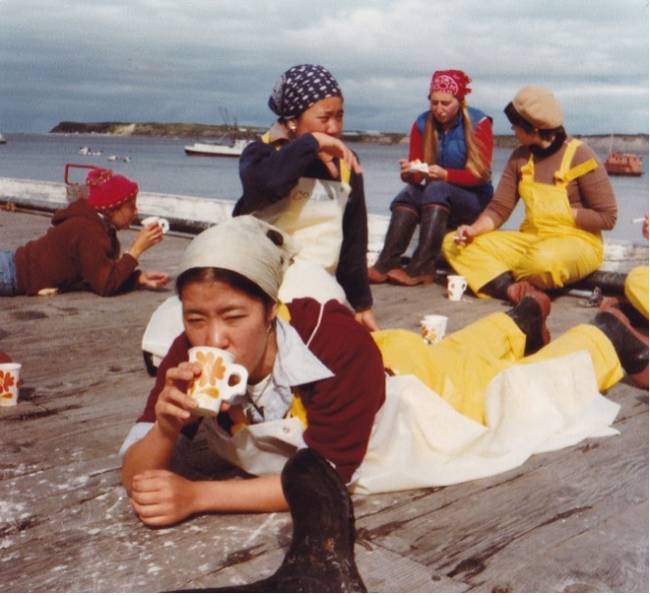
Cannery workers gather on the Diamond NN Cannery dock for a “mug up” in ca. 1976. Mug Up or coffee break gave cannery workers a 15-minute reprieve from the monotony of slime line work and canning machines. (Photograph by Mike Rann)
Jackie Manning is the exhibit’s curator. Her favorite thing is a little cart used to serve coffee to workers during what was called Mug Up time. That’s where the exhibit gets its name.
“When I went up to Bristol Bay, and I saw that little Cushman cart – is what it’s called – and heard the stories about how diverse the canary crew was, and how important that mug up time was for camaraderie and everybody meeting and taking their breaks. And just all the different languages you’d hear on the docks,” she said.
Oscar Peñaranda moved from the Philippines to Canada and eventually to California before coming to Alaska to work in a Bristol Bay cannery in the 1960s. And he kept coming back. He worked 15 summer seasons in Alaska, before deciding to stay in San Francisco full-time.
Now, he’s a historian. He founded the San Francisco chapter of the Filipino American National Historical Society and wrote about his experiences as an Alaskero – the term for Filipinos who worked in Alaska’s canneries.
For Filipino American History Month, Peñaranda was in Juneau last week for the closing of the exhibit. He recognized some names and faces in the exhibit, like the Filipino union leaders who formed the Alaska Cannery Workers Association. They were murdered in 1981, and he said that’s when he stopped going to work in Alaska.
Peñaranda worked at the cannery for 14 years, even after he started teaching at San Francisco State University and James Logan High School in California.
He said he kept going back for the comradery.
“But the thing was, we didn’t feel like we had to get in touch between seasons,” he said. “Because we were gonna go the next season and catch up. That’s part of the reason why we kept going.”
Peñaranda’s language skills helped him to prosper at the cannery. He speaks four Filipino languages, as well as English, Spanish and some Italian.
“Language is how you see the world. You know two languages, you get two ways of seeing the world,” he said.
It allowed him to work as a sort of peacekeeper between different groups at the cannery.
The labor movements happening in the canneries paralleled his life in San Francisco in the winters. In 1968, he participated in strikes at San Francisco State University that led to the forming of the school’s College of Ethnic Studies.
Peñaranda went on to teach literature and Filipino language in high schools and colleges.
He’s now 78, and he’s thinking of returning to Bristol Bay next summer to work with an old friend. It would be the first time he will have worked at a cannery since he stopped over 40 years ago.
His friend is also in his late 70s and he operates the palletizer – the machine that puts all the cans into pallets to ship out.
Another reason Peñaranda said he kept going back to cannery work was the chance to be a new version of himself.
“When you go work in the canneries and go to Alaska, you can reinvent yourself – you’ll be a completely different you. You don’t like the way you are in San Francisco? Come to Alaska. Make your own reputation.”
So, a different Oscar Peñaranda may return next summer.
This story is part of KTOO’s participation in the America Amplified initiative to use community engagement to inform and strengthen our journalism. America Amplified is a public media initiative funded by the Corporation for Public Broadcasting.
America Amplified
KTOO is amplifying the voices of Filipinos in Alaska. We want to hear from you. What stories would you like to share or learn more about?
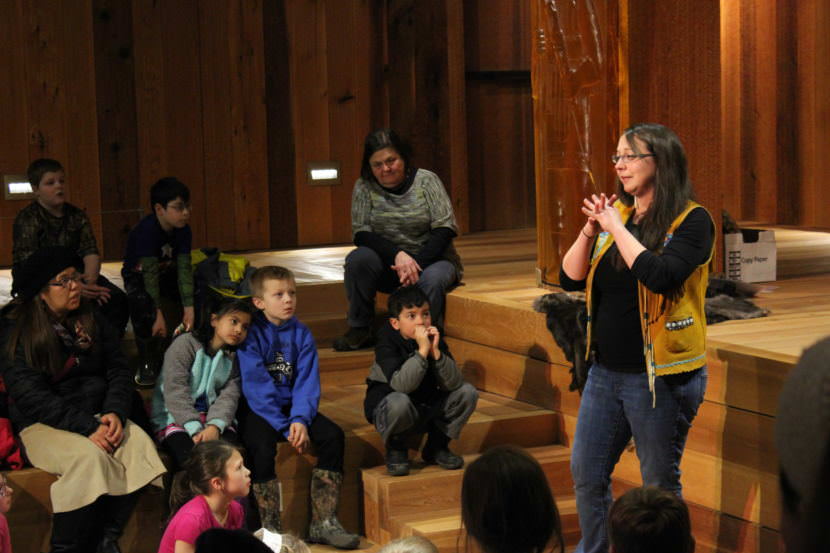
Culture Bearer Daaljíni Cruise tells Juneau second-graders a traditional Alaskan Native story during an excursion to the Walter Sobeloff Building on Nov. 16, 2017. (Photo by Adelyn Baxter/KTOO)
On Monday afternoon for Indigenous Peoples’ Day, the University of Alaska Southeast is hosting a panel on language revitalization efforts for three Southeast Alaska Native languages.
“One of the most Indigenous things is the language that was born on this land,” said UAS Lingít professor X’unei Lance Twitchell. “And that was maintained and allowed ancestors to survive, and was a gift to us to give to future generations.”
Often, the discussion of language serves as both a celebration of Indigenous identity and a reflection on harm done to Native languages, he said.
“As we talked about language revitalization,we’re also looking at some of the most damaging elements of colonization, and attempted genocide,” Twitchell said.
The featured speakers are Jaskwaan from the Haida language community, Daaljíni from the Lingít language community and Alex Roehl from the Juneau Sm’algyax learners group.
“What’s exciting as these are growing language movements, and so there’s multiple people to pick from,” Twitchell said. “They’ll just share their perspectives on what’s happening and what’s shifting.”
The speakers will give updates on the current status of language revitalization for all three languages, as well as what they think the future of the languages looks like.
The discussion can be joined at 3:00 p.m. via Zoom here.
Also on Monday, Sealaska Heritage Institute is offering free admission to the Shuká Hít clan house and Juried Art Show exhibit for Indigenous Peoples’ Day
In 2015, Alaska was the second state to designate Indigenous People’s Day on the second Monday of October to replace Columbus Day, after South Dakota. In 2021, the day was recognized nationwide by the Biden administration.
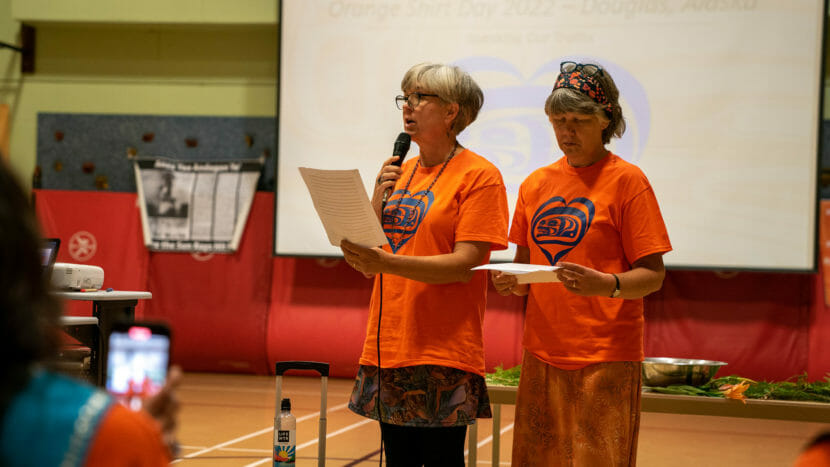
Cathy Walling and Jan Bronson from the Alaska Friends Conference reading the apology at Sayéik Gastineau Community School in Douglas on Sept. 30, 2022. (Photo by Paige Sparks/KTOO)
Two representatives from the Religious Society of Friends in Alaska — or Quakers — read a formal apology on Friday for a school and orphanage the church opened in the late 1800s.
The apology was part of an Orange Shirt Day gathering at Sayéik Gastineau Community School in Douglas, which was built on the grounds of the former Douglas Island Friends Mission.
In 2012, graves were found on the school grounds during renovations.
The school was renamed five years later. Sayéik loosely translates to “spirit helper.” The Douglas Indian Association said at the time that the word reflects the original Lingít name of the land and a need to acknowledge historical trauma Indigenous people experienced there.
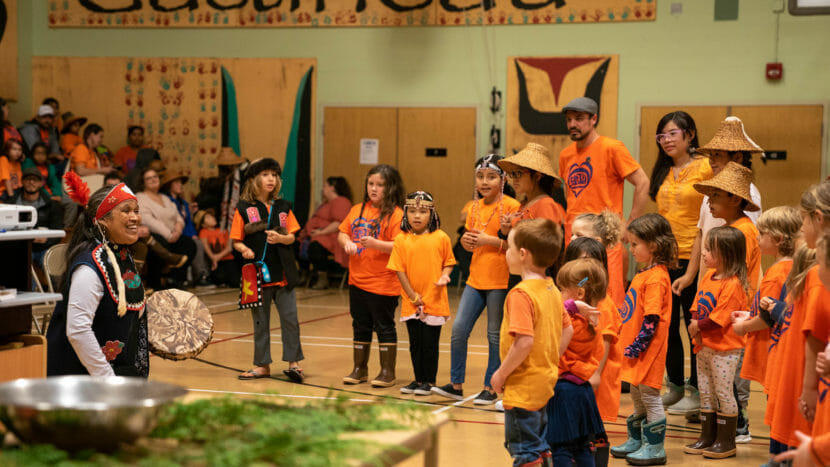
Goldbelt Heritage Foundation’s Victoria Ann Johnson leads Juneau Montessori School students in singing Lingít songs on Sept. 30, 2022, in Juneau. (Photo by Paige Sparks/KTOO)
Cathy Walling and Jan Bronson are from the Alaska Friends Conference. They read aloud from the apology.
“To the Áak’w Kwáan people, we honor you. We honor your lands. We hear you. We believe you and we are here expressing our deep wishes for healing, for transformation, for truth, and we commit to not stop at truth. But to move them to the reparations. We want land back for you. We want you back. We want your languages back.”
According to the letter, the Religious Society of Friends ran around 30 schools for Native youth in the U.S., with the intention of forcing Indigenous children to assimilate into white society.
“The methods used in some of the Friends schools were harsh and often cruel. Alaska Native people have described to members of Alaska Friends Conference and other listeners what it was like for them or their relatives to go to a school where children were tortured and/or physically, sexually, emotionally, spiritually or otherwise harmed.”
Bronson and Walling brought a written history of Quaker missionaries in Alaska as a gesture of the “truth” part of “truth and reconciliation.” The book contains a list of all members of the church in Alaska from part of the time the school operated, which they said may help family members of survivors and victims — or archivists researching the school — to find names of students.
Jamiann S’eiltin Hasselquist, with the Alaska Native Sisterhood, organized the gathering and worked with Bronson and Walling to include the apology in the event. She said the apology will “encourage other denominations to maybe help other denominations come forward with their own recognition of the past and the lasting effects of that.”
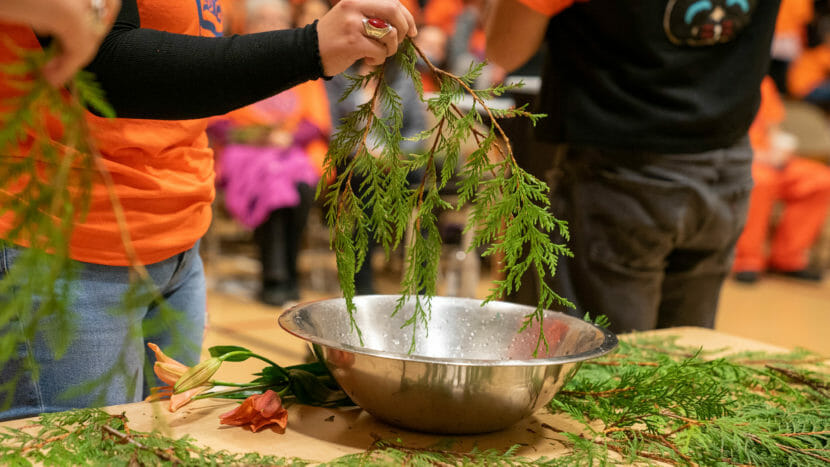
Daxkilatch Kolene and Xeetli.eesh Lyle James prepared a cleansing ceremony with cedar branches dipped in ocean water.
Cedar branches dipped in ocean water used in the ceremony at Sayéik Gastineau Community School in Douglas on Sept. 30, 2022. (Photo by Paige Sparks/KTOO)
“The symbolism of our cedar is peace and then but ocean water, of course, we go to to heal ourselves,” Daxkilatch Kolene said.
The boughs were handed out to those in attendance, who brushed them on the walls and doors of the school.
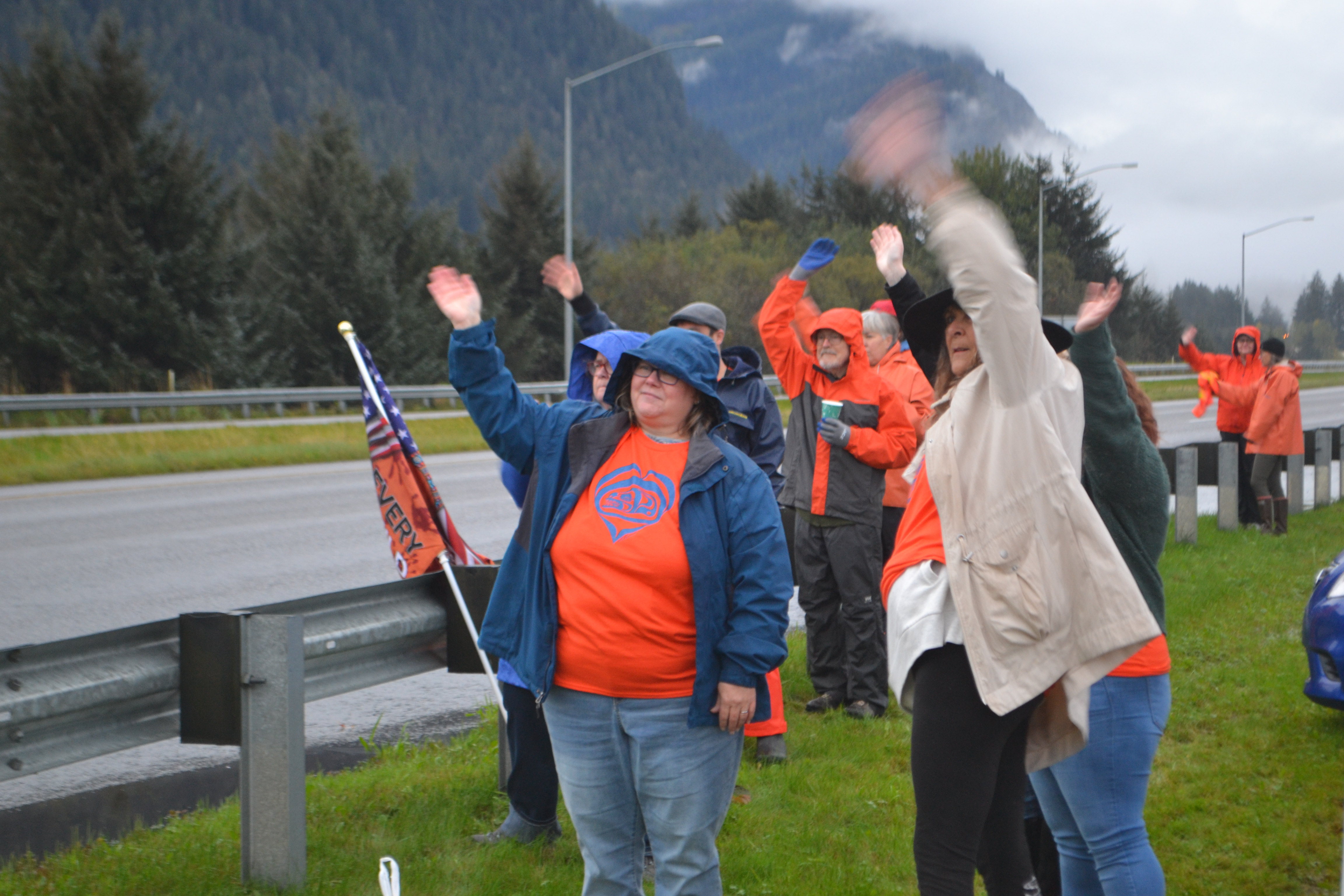
People gather in the Mendenhall wetlands along Egan Drive Friday morning for Orange Shirt Day, Sept. 30, 2022, in Juneau. (Photo by Chen Chen / KTOO)
Friday is Orange Shirt Day, a day to draw awareness to the history of Indian Boarding Schools in the U.S. and Canada.
Events are being held across both countries. In Juneau, the day started off with dozens of people drumming and holding banners along Egan Drive as residents commuted into town.
Cars honked their support as they drove by in the rain, while the gathered supporters, wearing orange, cheered and waved.
Bambi and Jessica Kinville-James were there, with the drumming group Litseeni Sháa, or “strong women.”
Orange Shirt Day is personal for them, they said.
“We have five kids. They get to stay home, they get to be with us forever,” Bambi said. “And they’re safe. We’re not going to be finding them in the ground somewhere else, or sent off to a different adoption agency just because the state didn’t want to deal with them.”
Jessica said it’s important that their kids have the connections to their culture that were severed in the boarding school era.
“And they’re not going to be ripped away from us and told that they can’t know their language, they can’t know their songs, they can’t do what we do as Lingít people, as Indigenous people,” Jessica said.
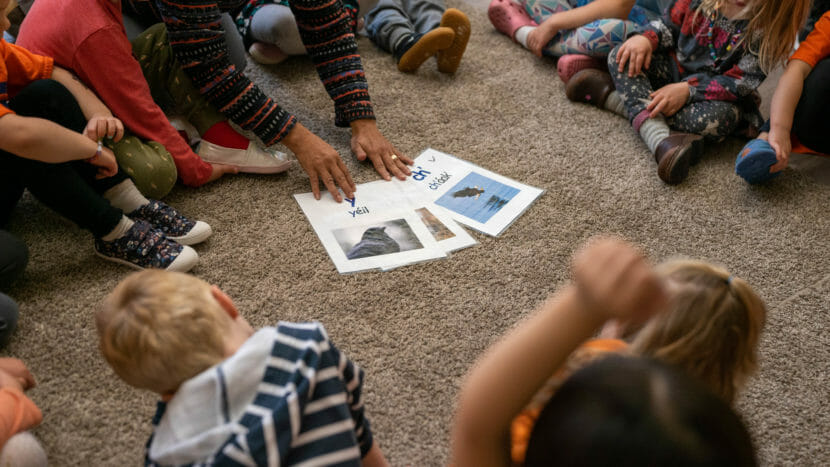
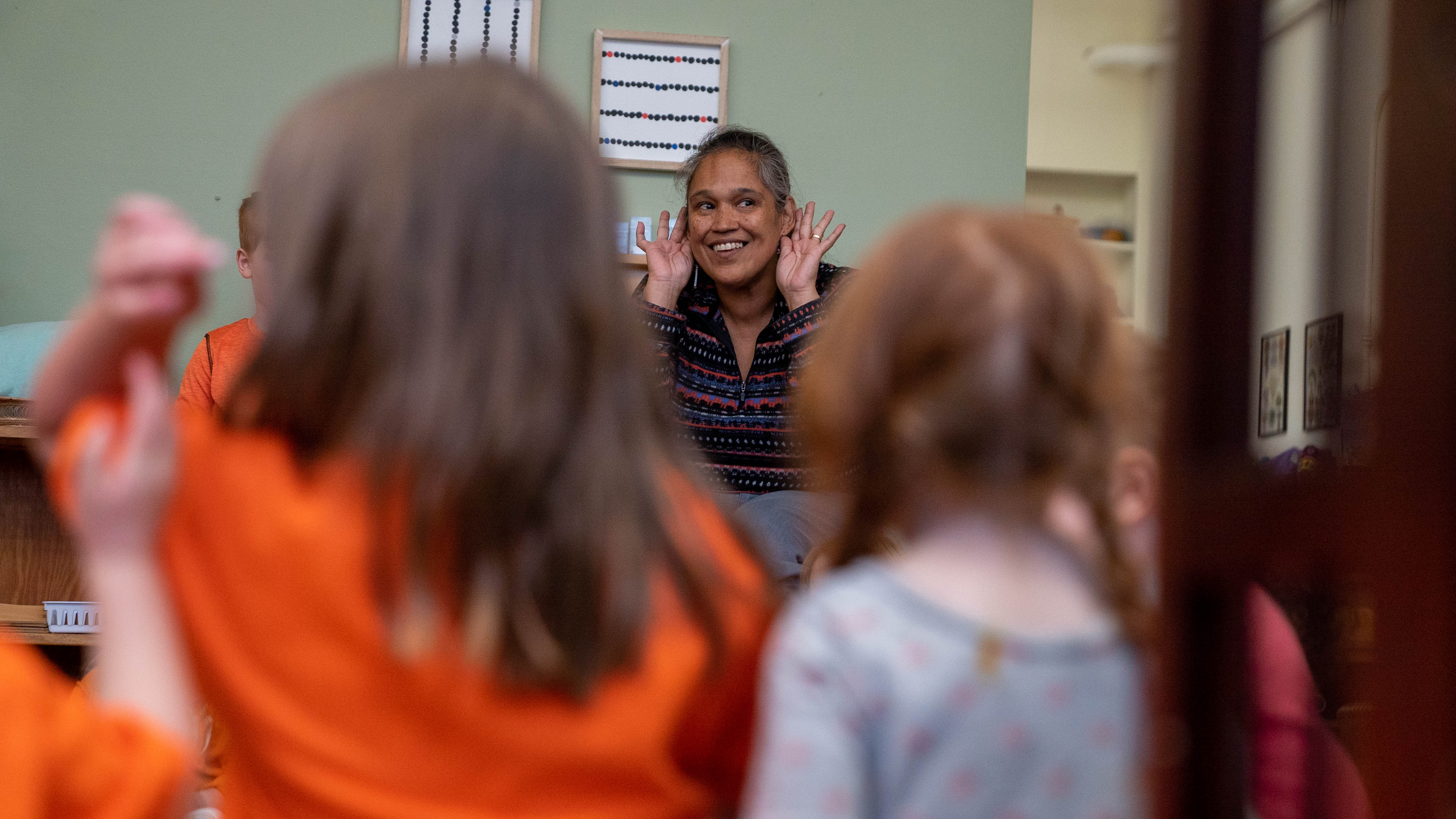
Victoria Ann Johnson teaches kids at Juneau Montessori School on Orange Shirt Day, Sept. 30, 2022. (Photo by Paige Sparks / KTOO)
Jamiann S’eiltin Hasselquist, with the Alaska Native Sisterhood, has organized many Orange Shirt Day events for Juneau.
She said days like this matter because even though the boarding school era is over, Indigenous children are still being taken from their families through the foster system and adoption, which she says a continuation of that system.
“And when we understand that system, then we can find the right tools to sort of undo some of those things,” she said.
Victoria Ann Johnson is a cultural specialist for Goldbelt Heritage Foundation. She spent part of the day working with young kids at the Juneau Montessori School, which meets in the building of the former Mayflower School run by the Bureau of Indian Affairs.
She brought cards with Ch’áak’ (Eagle), Yéil (Raven) and Guwakaan (Deer) on them.
“These were the images that we’ve learned about in the language, so I figured I could use it this way to explain about Orange Shirt Day, a little bit,” Johnson said.
Victoria Ann Johnson teaches kids at Juneau Montessori School on Orange Shirt Day, Sept. 30, 2022. (Photo by Paige Sparks / KTOO)
“This one school was where all the Eagles went. And only the Eagles could go to that school,” she told the students. “And they got to learn lots. But in this other school over here, only these animals and other animals could only go to this school.”
That’s how she introduced the concept to kids under five.
“This is something that happened a long time ago. And that’s why today, all the animals get to go to the same school … And now that’s how we are today in our schools. We’re all learning about the different languages, the different people. And that’s why we wanted to remember this Orange Shirt Day.”
This story has been updated with details from the event at the Juneau Montessori School.
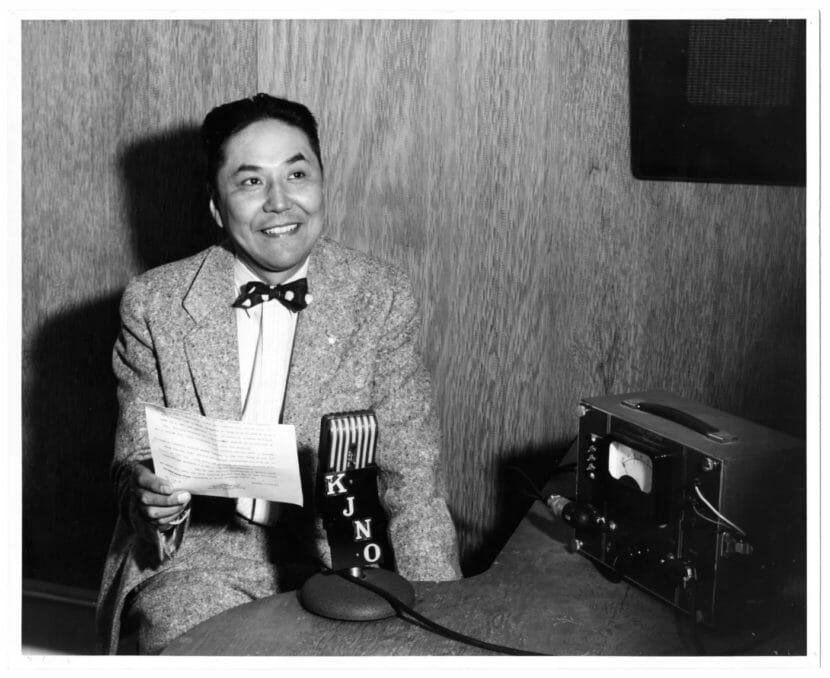
Rev. Walter Soboleff preparing to go on the radio. (Photo courtesy of the Presbyterian Historical Society)
This summer, the national branch of the Presbyterian Church issued a formal apology and committed to pay $1 million in reparations for closing a church in Juneau in the 1960s.
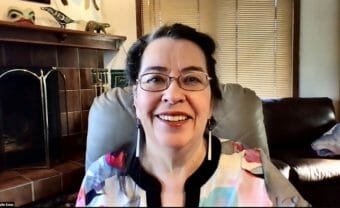
Longtime journalist Joaqlin Estus, Lingít, is a national correspondent for Indian Country Today. (Courtesy of Joaqlin Estus)
The Memorial Presbyterian Church had a Native congregation led by Pastor Walter Soboleff. Presbyterian church leaders have determined that closing the church was an act of racism.
Joaqlin Estus has a story about the apology in Indian Country Today. She spoke with KTOO’s Yvonne Krumrey.
Listen:
The following transcript has been lightly edited for clarity.
Yvonne Krumrey: Can you tell me the story of Memorial Presbyterian Church?
Joaqlin Estus: So, Memorial Presbyterian Church was heir to an earlier church that actually started in 1887. In Juneau, the town had two churches. They were segregated. There was a white church, and then the Native church and Walter Soboleff took over the Native church in 1940, I think it was. And by 1962, it was just the heart of the Juneau Indian Village. People thought of it as part of their extended family. And he had all kinds of events going on there all the time. And it was packed during holidays and very active all the time.
So then, the white church went to the National Presbytery and the Board of Missions, and said they wanted to build a new church and asked for a loan of $200,000. And, in part to accommodate them, no doubt, the National Presbyterian, the Board of Missions, shut down the Native church — and they did it without any explanation.
And very late in his life, people would ask Walter Soboleff what happened. He said, “I don’t know why they did it.” And I think he was just being polite because the reason they did it was because they were racist.
So a group at Northern Light Presbyterian Northern Light United Church formed a Native ministries committee, and they went to the National Presbytery, which is now called Presbyterian Church USA, and the Northwest Coast Presbytery and the Northern Light Church. And they asked for reparations. And the document that they used is called an overture. And basically they said that it was a racist decision, and it was very unfair, it was unjust, and it was very hurtful and painful to the people who belong to the Presbyterian Church, the Native Presbyterian Church.
So the Ḵunéix̱ Hídi Northern Light United Church — it’s been renamed. Ḵunéix̱ Hídi, it means “house of healing.” And that was kind of the first step in the reparations that the Presbyterian church made towards the Native ministries committee and the Native members of the Northern Light Church.
And then they voted in July to allocate about a million dollars for a huge range of programs and services, all aimed at language and cultural preservation, and support for Alaska Natives who want to go into the seminary to become ministers, and that kind of thing.
So they’re also going to contribute some money to establish a memorial at the site of the former church, which was situated across from the federal building, where the fire station is now.
So that’s what happened.
Yvonne Krumrey: You mentioned that the closure of Memorial was devastating for the community here in Juneau. Can you tell me more about that and what impact that had on the Lingít community here?
Joaqlin Estus: There was something going on there seven days a week, all hours of the day and night. And not all of it was church related. They also opened the doors to civic groups, and you know, for health clinics, they opened a children’s daycare. And this was back when the Juneau Indian Village was based all in the flats basically. And so it was a cohesive and kind of fairly extended neighborhood. And the church was right at the heart of it.
And so right after the church was closed, there were two devastating events. One was developers in Douglas burned down the Douglas Indian village there. They condemned the land, saying it was needed for development, and then burned the village.
And then the Juneau Indian village — most of it was knocked down for urban renewal. And so you had these two, you know, they were segregated communities, but within themselves, within the communities, there was a lot of cohesion and community. And those two acts of development and renewal were really hard.
I mean, they dispersed the Native community, basically, and the people I interviewed said it was shocking, and some never went back to church. They didn’t want to join Northern Light. They didn’t feel welcome there. And they either switched to another denomination or they quit going to church completely. So it was a huge spiritual loss for many people.
Yvonne Krumrey: You mentioned that the national branch of the church is issuing an apology as a part of this process. What does the apology say?
Joaqlin Estus: Well, let’s see, I can actually read the first couple of lines:
“The forced closure of this thriving multi-ethnic intercultural church was an egregious act of spiritual abuse, committed in alignment with the prevailing white racist treatment of Alaska Natives, statewide, and of Native Americans nationwide.”
And then the church goes on to say, to acknowledge that, that the closure, the justification for the closure “merely substituted assimilationist racism for the previous practice of segregationist racism.”
And then what they’re going to do is acknowledge, confess and apologize to the late Walter Soboleff and his surviving family members for the act of spiritual abuse committed by the Presbyterian Church’s decision to close the Native church.
The overture also calls for some soul searching on the part of the Presbyterian Church.
This is significant, because this is something that people wanted the Pope to do, when he visited Canada recently. The Presbyterian Church urges everyone to walk away from the Doctrine of Discovery, which is the idea that when a European nation discovers land uninhabited by Christians, it acquires rights to that land.
Native Americans and other people would like to see a more thorough repudiation of the of the idea behind the doctrine of discovery, which was basically the idea that was prevailing at the time was that Western Europeans were superior to the people who lived in these places, and therefore had the right to take over land and resources.
Yvonne Krumrey: I think that’s one thing that’s kind of interesting about this story is that it’s a church closure, that was the harm. While so many of it is focused on the church coming in and doing harm.
And I’m wondering if you have thoughts on that, or anything to say about the fact that the church came in, was a force of assimilation, but then was run by Walter Soboleff and became a community center and then was taken away, and how that impacted people?
Joaqlin Estus: I think the difference between what Walter Soboleff was doing and what mainstream Presbyterian boarding schools and churches were doing is that he spoke in both Lingít and English. He did give the message of God’s love and God’s mercy, and encouraged people to share his faith in the church and in God.
But my sense of things is that he was far from a negative force. I mean, people wanted to learn about this, and they wanted to belong to a church. Their earlier modes of spirituality had been destroyed. And people need that in their lives on some level. He provided it in a way that was more palatable and more accepting and more loving than in other churches. So I think there’s a big difference between what he did and what other churches did.
Yvonne Krumrey: When you look at Juneau after the closure of Memorial Church, and even up to today, what would you say the effects and the legacy of the closure are? And are we still living with those impacts today?
Joaqlin Estus: Well, I think combined with the destruction of the Douglas Indian village, and the Juneau Indian village, I think that the sense of cohesion and community that Alaska Natives felt in Juneau is not as strong as it used to be.
And I mean, it’s, it’s growing, and there is a community and there is cohesion. But it’s not to the extent that there was when the church was there, and when those two villages existed.
Yvonne Krumrey: Why did the overture and this whole process happen now, after nearly 60 years?
Joaqlin Estus: You know, I think it’s just part of the language and cultural revitalization that’s been going on for several years now. Some evidence of that is the land acknowledgments and more place names in the Lingít or Haida or Tsimshian language. There’s been a movement to reclaim what is ours. And this is part of that.
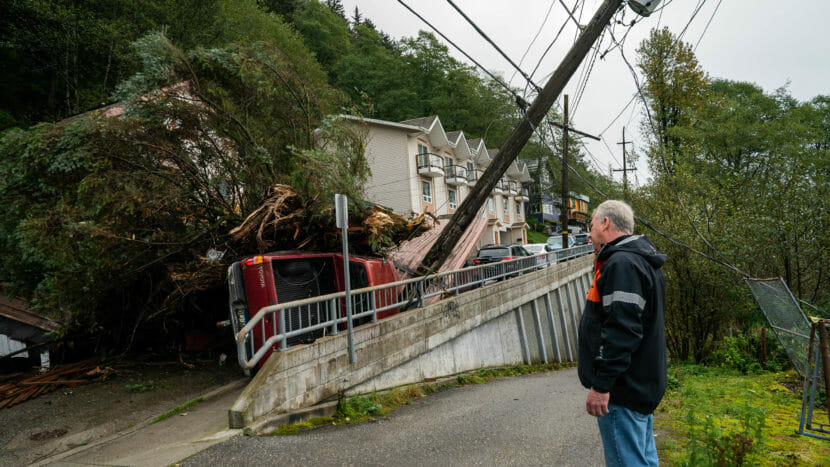
Juneau Emergency Programs Manager Tom Mattice assesses landslide damage on Gastineau Avenue on Sept. 27, 2022. (Photo by Paige Sparks/KTOO)
People who left Gastineau Avenue after Monday’s landslide can return home, the City and Borough of Juneau said in an information release Tuesday afternoon. But they’re asking everyone else to stay away for now.
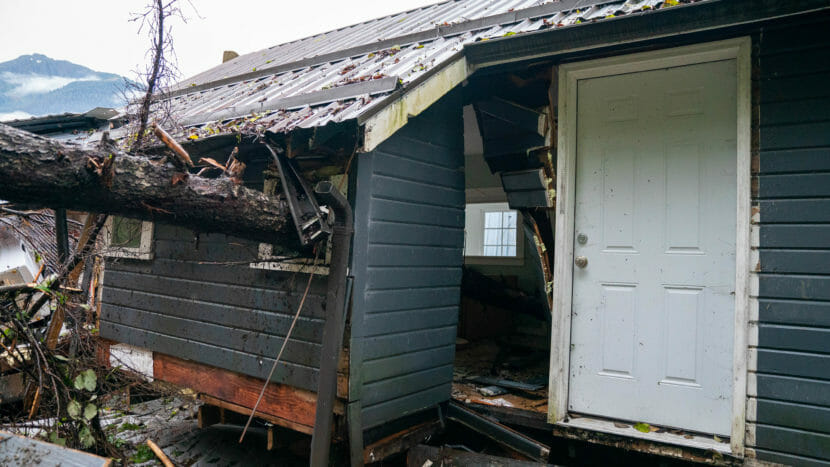
Tom Mattice, Juneau’s emergency programs manager, said one home was completely destroyed by the slide, and two more were damaged.
Mattice said people will have to decide on their own when they feel safe returning.
“We can’t tell them when it’s safe or when it’s not safe, but with no rain over the last 12 hours, that hazard is definitely declining,” Mattice said. “And this hazard is a channelized, localized hazard.”
Mattice said the city is still assessing whether it will need to do anything to stabilize the slide area.
A Gastineau Avenue home impaled by a tree and pushed downslope by a landslide on Sept. 26, 2022 in Juneau. (Photo by Paige Sparks/KTOO)
Late Tuesday afternoon, AEL&P tweeted that power had been restored to most of Gastineau Avenue.
Power has been restored to the majority of Gastineau Ave customers. There are a few houses that have been damaged by the slide that cannot be restored at this time.
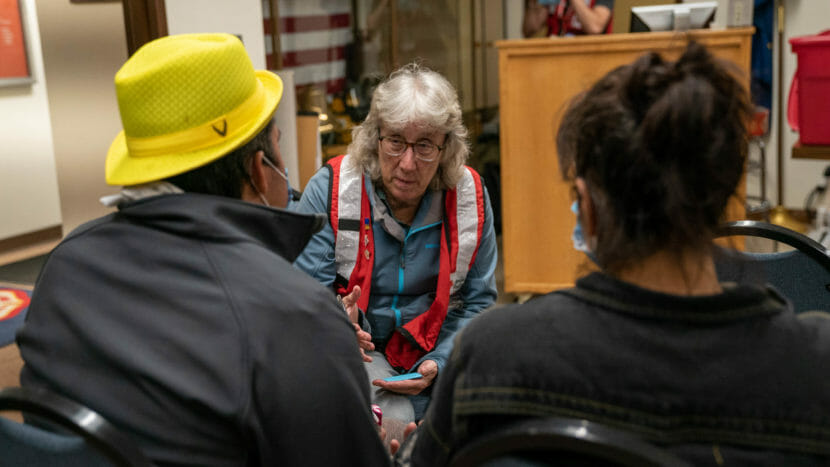
Taylor Sausen, with the Red Cross, said 12 people came to the emergency shelter after the landslide. They were given hotel vouchers for the night.
For those wondering how to help, Sausen said there isn’t much to be done right now. But she said the slide was a reminder that everyone should be ready to go in case of emergencies.
“It’s really a good idea to make sure that you have an evacuation kit or an emergency kit somewhere in your home, so that if you have to evacuate at a moment’s notice, you’re not spending those precious moments that you could be getting to safety, packing items that you may need,” Sausen said.
The American Red Cross assists evacuees after a landslide on Gastineau Avenue in Juneau Alaska on Sept. 26 2022. (Photo by Paige Sparks/KTOO)
The city says that debris removal could take several days. Cars parked within a block of 187 Gastineau Avenue will be towed, free of charge, to the Zach Gordon Youth Center if owners do not move them first.
This post has been updated with information from AEL&P about the power situation on Gastineau.
Close
Update notification options
Subscribe to notifications
Subscribe
Get notifications about news related to the topics you care about. You can unsubscribe anytime.