Yvonne Krumrey

Justice & Culture Reporter, KTOO

"Through my reporting and series Tongass Voices and Lingít Word of the Week, I tell stories about people who have shaped -- and continue to shape -- the landscape of this place we live."

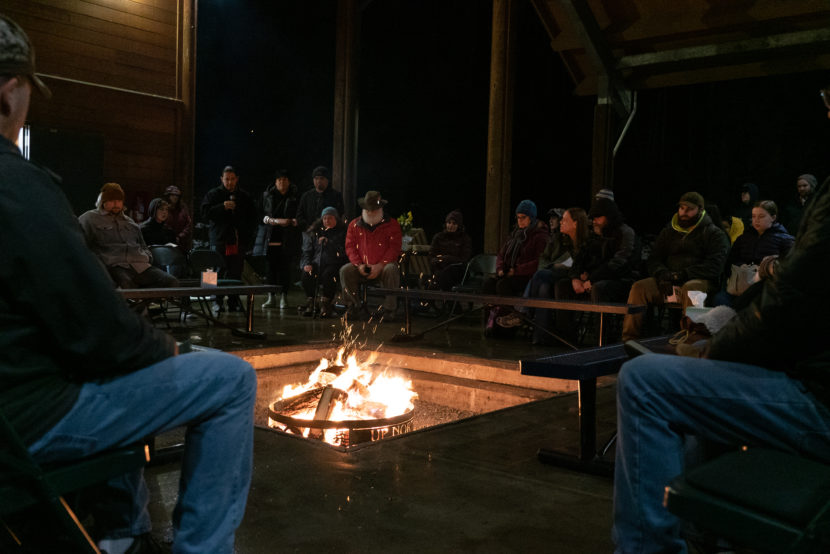
Former UAS professor Sol Neely honored with a fire dish memorial in Juneau

Mourners gather at Noyes Pavilion at the University of Alaska Southeast campus for a fire dish ceremony honoring former professor Sol Neely. Nov. 12, 2022 (Photo by Andrés Javier Camacho/KTOO)

Sol Neely used to give lectures around a fire at an outdoor pavilion on the campus of the University of Alaska Southeast –— even on cold and wet November days. On Saturday, dozens of people gathered at that same spot to remember Neely at a fire dish memorial, a Lingít cultural ceremony.

Neely was a professor at UAS for more than a decade. He taught English literature and was a community advocate for criminal justice reform through programs like the Flying University, a higher education program inside Lemon Creek Correctional Center.

He died in October on a backpacking trip in Washington state, where he was living. Even though he left Juneau in 2020, there was still a large group of people left at UAS and throughout the community who wanted to gather and celebrate his life here.

Alaska Native Languages professor X̱’unei Lance Twitchell was a close friend of Neely’s. He led the fire dish ceremony, which serves as a way to give those who recently died food and messages of strength to prepare them for their long journey after death. The offerings are passed through the fire. 

“For our guests that are here that we share love with and courage, sometimes we offer abbreviated versions of our cultural ceremonies with them,” Twitchell said. “The way that we grieve, the ways that we move on as Lingít peoples. So we thought we’d offer a fire dish.”

Twitchell invited those in attendance to write names of anyone else they would like to honor on notecards to be added to the fire.

“Because we’re inviting them to come. The things that we offer to our ancestors we give to the fire,” Twitchell said.

Fellow educators and former students say Neely always approached his work with love for people and for place.

Éedaa Heather Burge was a student of Neely’s who now teaches Lingít language classes at UAS.

“He started reconnecting with his own Indigenous family identity and understanding at the same time I did,” Burge said. “He was an incredible example for what that looked like, as an adult, to build that community, to build those places, to build those relationships with people, both where you were transplanted and where you where you came from.”

She asked all of his former students to stand with her, and a dozen or so rose. 

“I’m not quite sure what we’re going to do now that he’s gone,” Burge said. “Aatlein gunalchéesh, Sol, for everything you’ve given us. You’ve laid a foundation, we’re going to keep building on it.”

Will Geiger said it was fitting that Neely’s memorial be held at the Noyes Pavilion, when he attended each class of Neely’s postcolonial literature class outside, even on cold November nights like this one.

“I’ve been thinking lately that Sol often talked about how, based off something Cornel West said, he considered time to be a gift and a giver, rather than a limitation placed on what we’re able to accomplish,” Geiger said. “And so I’ve been thinking about what a gift we all received, having Sol here with us, rather than an impediment it is that he left us sooner than we would have wanted him to.”

Many people talked about how much Neely loved his daughter. Neely’s wife and daughter were at the ceremony, but neither spoke.
Recent house fires in Juneau a reminder of heater safety as winter sets in

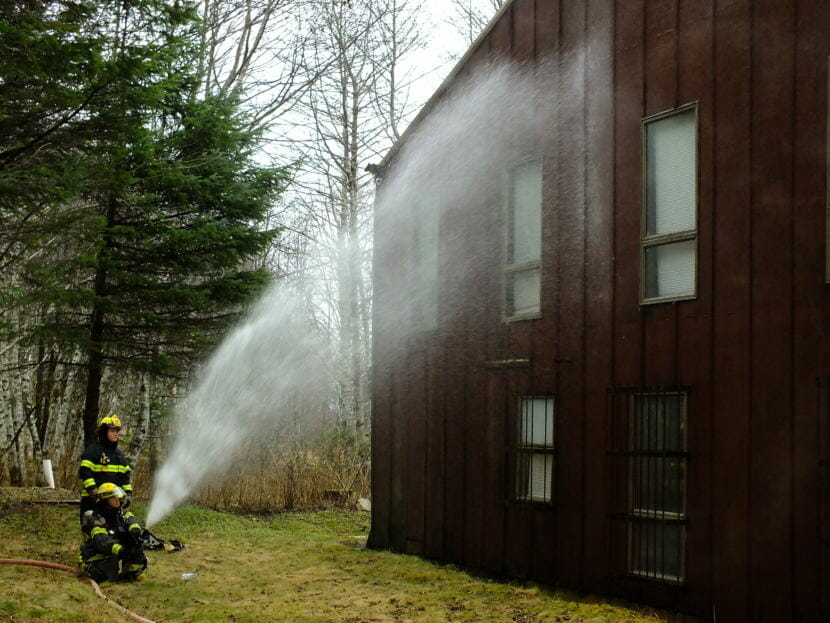
Steam billows off the side of a nearby building as Capital City Fire/Rescue firefighters hose it down to prevent it from catching fire as the adjacent Thane Ore House burns on Nov. 24, 2018.
Steam billows off the side of a building as Capital City Fire/Rescue firefighters hose it down to prevent it from catching fire as the adjacent Thane Ore House burns on Nov. 24, 2018. (Photo by Matt Miller/KTOO)

Over the last three weeks, three Juneau homes have burned. 

Dan Jager is Juneau’s fire marshal. He says the fires aren’t connected and there isn’t any evidence of crime.

But there is a common thread – using heaters for the first time with the onset of cold weather. 

“It’s been definitely busy around here as far as fires go,” Jager said.

He said that’s typical for early winter. 

In late October, a duplex on Wood Duck Avenue in the Mendenhall Valley caught fire. That fire was traced to an electric space heater.

In early November, separate fires destroyed two homes in the Sprucewood mobile home park, also in the Valley. One of those was attributed to a wood stove, and the other is still under investigation.

“Sometimes the [heating] systems hadn’t been inspected, or, you know, really up to par. Sometimes it’s user error,” Jager said. “And sometimes it’s none of that. It’s just, you know, just what happened.”

Jager says it’s important to make sure any heat source has three feet of clear space around it, and is maintained regularly. Electric space heaters should be turned off when no one is in the room with them.

Two fire stations in town offer wood stove chimney brushes that residents can borrow. But Jager also recommends that residents have professionals come to their homes and check out their heating elements.

Finally, he says it’s important to keep house numbers visible in case of emergencies – especially as snow starts to accumulate. 

Juneau’s new transit center and bus routes bring changes for Valley bus riders

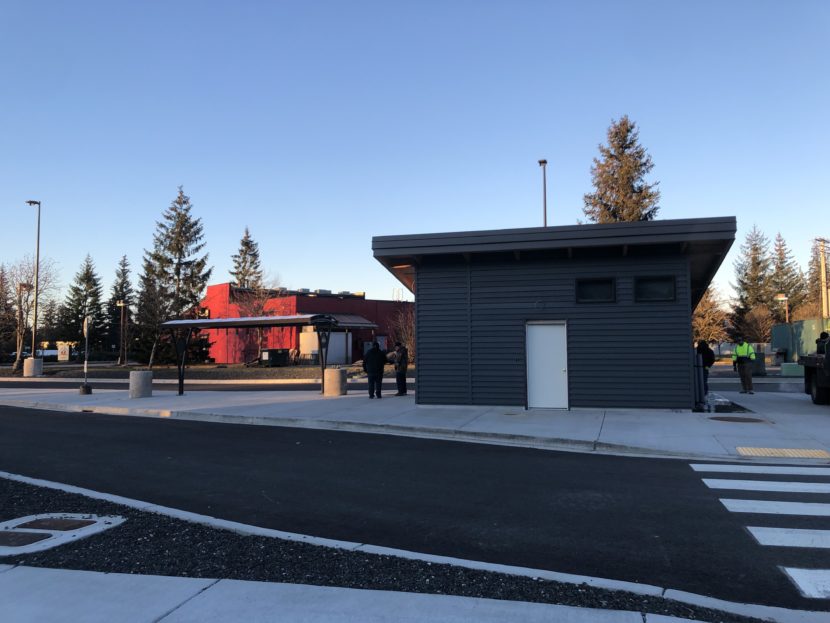
The new Mendenhall Valley Transit Center,. Nov. 7, 2022. (Photo by Yvonne Krumrey/KTOO)

A new transit center opened on Monday at Juneau’s Mendenhall Mall. It comes with revamped bus routes that the city hopes will provide faster, more consistent service.

A few riders were at the transit center Monday morning, looking at their phones to find out where they should stand and when their buses would come. The new building still had boards covering a couple of its doors, and the shelters were still under construction.

One rider was Abbi Dixon, who was commuting to University of Alaska Southeast. She doesn’t drive, so she relies on Capital Transit to get around. After the pandemic started, route changes meant it took much longer for her to get to school.

“With the COVID change, they stopped the express totally,” she said. “I’d be on the bus for like 45 minutes to get out to UAS.”

Now she’ll have to change buses, but her commute will be far shorter. That was the city’s goal. The city surveyed bus passengers, and 76% said they cared more about consistent service than getting closer to their destinations. 

The new routes have fewer stops, but the city is promising faster rides and fewer delays in return. The transit center acts as a hub, with five spaces for buses to pick up passengers. It has a park-and-ride lot, with a few EV-charging spots. 

Juneau Assemblymember Michelle Hale has been working on the project for years. For her, it was personal. She and her partner lived in the Valley without a car for about a year and a half, she said. 

“I like to joke about my life as a public policy experiment, except in this case, it was our lives as a public policy experiment,” Hale said. “And I learned a lot about public transit in Juneau, from that public policy experiment.”

She says the new transit center will reduce the burden on parking downtown by letting people park and ride into town on the express bus.  

“There are so many commuters who could be taking the bus who don’t,” Hale said. “And if we can take this step where commuters realize, you know, you go park there, you jump on the bus, in 15 minutes you’re downtown.”

Hale has a car now, but she’s still eager to see Juneau’s transit system get more usable. 

“I have lots of thoughts, because when you ride the bus for a year, you have a lot of time to think about these things,” she said. 

For commuters like Dixon, that time may have gotten a bit shorter. 

Juneau has a cold, dry…and windy weekend ahead

The popular downtown Overstreet Park is covered in snow on Dec. 22, 2021, in Juneau, Alaska. (Photo by Rashah McChesney/KTOO)

Saturday and Sunday aren’t expected to get above freezing, and that’s unusual for this time of year. 

According to Brian Caffrey with the National Weather Service in Juneau, high pressure systems like the one headed into the region this weekend typically come in mid-winter. 

“It’s not unusual for Southeast Alaska to see these cold temperatures. It’s just usually in January or February when we typically have snow on the ground,” he said. 

The front is coming from the north, and could bring 30 to 40 miles per hour winds, with gusts up to 60 miles per hour.

“We just have an unusually strong high pressure building over Interior Alaska and Yukon, which is pushing the Arctic air through the region,” Caffrey said.

There’s a high wind warning in effect for downtown Juneau for Saturday and Sunday. The National Weather Service office warns that damaging winds could blow down trees and power lines and that widespread power outages are possible.

Lows may be between 14 and 17 degrees, and highs may be 25 to 27 degrees, but no rain or snow is in the forecast. 

Caffrey recommends making sure household pipes are insulated to prevent bursting, and says there may be some slick roads with the low temperatures.

Study looks at the return of tourism’s impact on whale stress levels

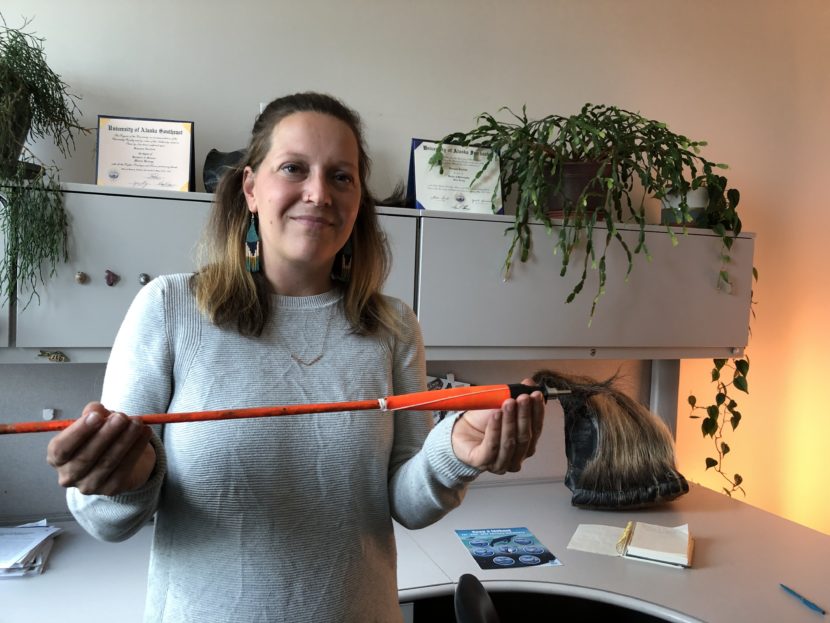
Suzie Teerlink holding a whale blubber sampling dart. Sept. 16, 2022. (Photo by Yvonne Krumrey/KTOO).

The pandemic offered a unique chance for scientists to sample stress levels in whales while there was minimal tourism activity in Juneau’s waters. Federal biologists took advantage and took samples in 2020 and 2021.

In 2022, tourism was almost back to pre-pandemic levels, so samples taken this year will show the difference in the whale’s stress levels when there are and aren’t boats in the water all summer. 

Suzie Teerlink studies whales and coordinates whale watching practices with NOAA’s Whale SENSE program in Juneau. 

For the study this year, researchers collected samples of the stress hormone cortisol from whales in Juneau waters. Teerlink said they take those samples from blubber, which stores the hormone longer than blood does. 

“In blubber, it takes weeks and months to accumulate,” she said. “And so we’re getting more of a cumulative average of what their physiological stress environment has been in the weeks and months prior.” 

That also makes sure that the sample doesn’t reflect the whale getting temporarily stressed out by the dart that takes the sample. Teerlink said the whales often show that they feel it a little bit, sort of like a bee sting.

“Generally speaking, after we take a biopsy sample, we do monitor whales for some period of time,” she said. “And by and large, they go back to what they were doing before, so we think that it’s a pretty small impact.”

A 2019 study used instruments posted on land that observed the whales without influencing their behavior. The instruments record respiratory rates, dive patterns and speeds of whales. This tracked the more immediate behavior differences, minute by minute.

“And what they found is that, especially as the number of boats increased, they did see faster swimming speeds, faster rates of respiration, longer downtimes, and changes in direction,” she said.  

That study was led by Heidi Pearson with the University of Alaska Southeast. Pearson is also the lead investigator for this year’s stress study. 

Pearson said they biopsied 24 whales in total and will use photographic data to track which whales are coming and going. 

“We’re also trying to determine if there’s a change in residency, or how long whales are here each year,” Pearson said. “And also how many whales are here each year, because we predict that there might be changes in how many whales are here, or how long they stay, depending on the vessel traffic.”

Teerlink, Pearson and their research group are expecting results from this latest round of data next spring, which will be just in time to help better inform whale watching practices in Juneau for next season. 

Hands-on healing: Dugout canoe dedicated in Angoon on bombardment anniversary

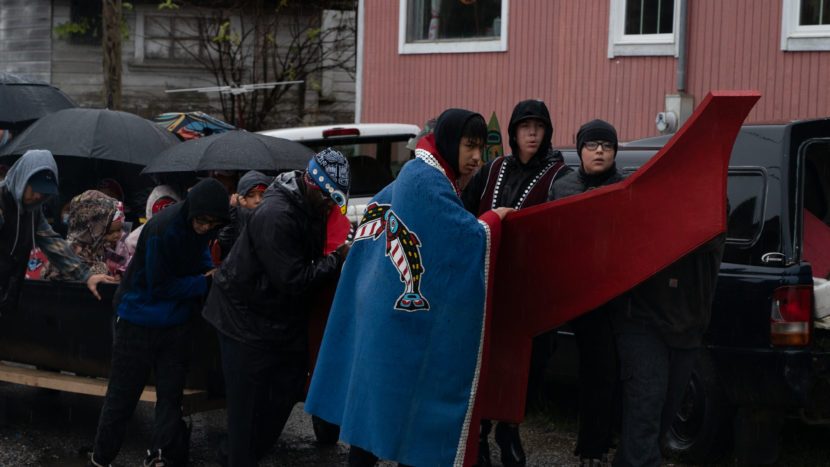
Shgein Kyle Johnson and classmates guide a canoe through Angoon. Oct. 26, 2022. (Photo by Andrés Javier Camacho/KTOO)

Angoon High School students surrounded Wayne Price as he helped them guide a canoe down Angoon’s roads to the waterfront. 

This dugout canoe, or yaakw, is special. It’s the first one built in Angoon in 140 years — that is, since Angoon was attacked and destroyed by U.S. military forces. Students who helped carve the canoe say the project helped them see their own resilience. 

In 1882, the U.S. Navy bombarded Angoon, burned their clan houses and food stores and destroyed their canoes — except for one that was away from the village. 

The people of Angoon — or Xutsnoowú Ḵwáan — were left for the winter with only one boat to fish and no shelter. It’s not known how many died as a result of this. But many of the families of those who survived are still in Angoon today. 

The U.S. Navy has never apologized.

The bombardment happened along the waterfront where Price and the students walked, their hands steadying the boat as they wheeled it along.

Shgein Kyle Johnson, who helped carve the yaakw with Price, led songs for the procession. He and five other students fasted for a day as they steamed the canoe open last month. That’s the process of painstakingly adding hot rocks to the boat and using trapped steam to expand the inside. It can be a make-or-break moment for canoes. 

“I am very, very proud of my teammates that helped me with the steaming process, and as a community just proud to finally have this new beginning,” Johnson said. 

This yaakw is Shaagaa Eesh Anthony Johnson’s second. He was in Hoonah when Price worked with students there to carve a dugout.

Anthony said it feels different, being six years older this time. 

“I was just putting wood on the fire then,” he said. “Now I’m one of the steamers taking out the rocks and stuff like that, and working on the canoe with Wayne.”

Price says the yaakw is seaworthy. 

“All of the dugouts that I’ve built are ready and able to meet each other on the water, and what a day that will be,” he said. 

Kyle’s mother, Kookeesh Tlaa Chenara Johnson, is a Lingít language teacher in the Chatham School District. She coordinated the youth who assisted in the yaakw carving. She says this history shows the resilience of the Xutsnoowú Ḵwáan.

“We’re still here, and our community is thriving,” she said. “And our students and our children are eager to learn and eager to carry on that part of our culture.”

Kyle says he’s hoping for more opportunities like this one.

“It’s a lot easier to learn about our culture and our traditional ways when it’s hands-on,” he said.

In the spring, the yaakw will be given a name and launched on the water for the first time — with Anthony, Kyle and several of their classmates aboard. 

Site notifications
Update notification options
Subscribe to notifications