"Through my reporting and series Tongass Voices and Lingít Word of the Week, I tell stories about people who have shaped -- and continue to shape -- the landscape of this place we live."
Dude Mountain playing at the Crystal Saloon. Oct. 22, 2022. (Photo by Yvonne Krumrey/KTOO)
Jillian Pollock says she’d follow Dude Mountain to the ends of the earth.
So far, that hasn’t been necessary. But Pollock did fly from Ketchikan to Juneau with a bunch of friends to catch their hometown band at the Crystal Saloon on Saturday night.
“We’ve been talking about how exciting it is to be in such a vibrant scene, because Ketchikan is amazing!” Pollock said. “But it’s a little bit sleepy.”
Pollock and friends were part of what the Juneau bar’s sign called a “Ketchikan takeover.” Stasha McCormick, the wife of frontman Cullen McCormick, had rallied their close friends and fans at bars and on Twitter before the show.
“I just started talking them into it,” Stasha said. “Dividend checks, air miles, end of season: everyone had a little extra money, and I said, ‘Let’s go!”
Dude Mountain say their music is a mix of psychedelic rock and blues. The trio formed two years ago, first playing the instrumental backing for open mic nights in Ketchikan, which they say helped them learn to improvise and communicate in the moment.
Their musical chemistry was immediate, said drummer Kalijah LeCornu.
“Right from the first jam. There were some songs we played at our show that were literally from the first time we played together at his house,” LeCornu said.
The Crystal Saloon show was just their second gig outside of Ketchikan. McCormick says it was easily their best.
“We went backstage, and we’re talking, and we’re like — we didn’t miss a note,” Cullen said. “Not one note was missed. Not one.”
Next, the band is planning to record an EP featuring songs they performed at the Crystal Saloon on Saturday night, including a tribute to their hometown called simply, “Ketchikan.”
Correction: A previous version of this story incorrectly described the band’s drummer as its bassist.
The first cruise ship of the 2022 season arrives in Juneau on April 23, 2022. (Photo by Paige Sparks/KTOO)
The last cruise ship of the season left Juneau’s docks on Tuesday.
The final tally of passengers who came through Juneau this year hasn’t been released yet, but Cruise Lines International Association is projecting it to be 1.15 million. They haven’t counted people who came in October yet, which is why the number is still a projection.
The estimate represents about 74% of the capacity for all the ships that sailed to Juneau this year.
Alexandra Pierce, the city’s tourism manager, thinks the projection is accurate. The city anticipates having official numbers at the end of the month.
“[City finance director] Jeff Rogers and [city manager] Rorie Watt and I were wagering how many passengers we thought, when we came to that number in the spring,” Pierce said. “And we all guessed — our most popular guess was a million to 1.25 — and I think that’s about where we’ll fall.”
Their guesses were based on the capacity of cruise ships sailing in other parts of the world and on bookings that had already been made for cruises that stopped in Juneau.
Cruises had high vaccination rates this year — around 90% — but they still saw high rates of COVID, and that impacted travel. Staff shortages meant that people weren’t getting the service they expected, and passengers were often kept in the dark about COVID cases on board.
In the end, though, Pierce thinks the season allowed Juneau to get used to cruise tourism again.
“I also think that it was a bit of a blessing in disguise that things operated at about 74% of capacity,” she said. “It gave us the ability to bust the rust off.”
If the ships had been at 100% capacity, the number would have exceeded the 1.3 million people who came in 2019, the last season before the pandemic.
The city is currently conducting its annual survey on the public’s opinion on tourism.
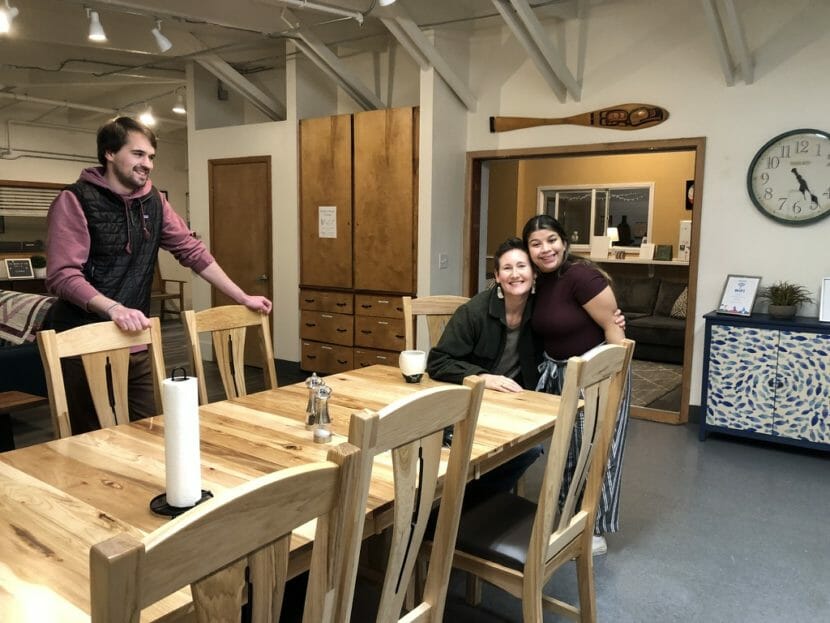
Shelter Supervisor Forrest Clough, Youth Services Manager Jorden Nigro, and Youth Action Board Member Tiana at Shéiyi X̱aat Hít Youth Shelter. Oct. 14, 2022. (Photo by Yvonne Krumrey/KTOO)
For two long years, there was no dedicated shelter for young people in Juneau who needed a safe place to sleep. But last July, Shéiyi X̱aat Hít, or Spruce Root House, opened. In partnership with Tlingit and Haida Regional Housing Authority, the city designed the shelter with input from youth who had direct experience with homelessness.
In the fifteen months since the shelter opened, Jorden Nigro says dozens of individuals have been helped. If you multiply the number of individuals by the number of nights spent at Shéiyi X̱aat Hít, it’s around 1,600.
Nigro is the youth services manager for Juneau Parks and Recreation, and she runs the Zach Gordon Youth Center and Shéiyi X̱aat Hít Youth Shelter.
“I’ve known kids who have traded, you know, sexual favors for places to stay, who have been exposed to things that they really should not have been exposed to, in order to have a place to stay,” Nigro said. “So yeah, there’s some real sad stuff that will happen when there aren’t places like this for kids to go.”
The kids use the shelter for a few different reasons, Nigro said.
“For the most part, our youth who are coming into the shelter have either run away from home or threatened to run away from home, or they are living at home in an unsafe situation,” she said. “And they come in because of abuse or neglect.”
The average time spent per youth at the shelter is about 13 days.
A large part of the role of the staff of Shéiyi X̱aat Hít is to work on family mediation, Nigro said. So far, more than 90% of the youth who have used the shelter have gone on to a safe and stable place.
“And we do these exit surveys when kids leave and ask them a bunch of questions, but one of the things is like, ‘Would you recommend this to a friend?’” she said. “And 100% of the youth have said ‘yes.’”
Before Shéiyi X̱aat Hít opened, Tiana struggled to find a safe place to stay, when her family home wasn’t safe. KTOO isn’t using her last name due to the stigma attached to homelessness.
She’s 19 now and has her own apartment. She joined the city’s Youth Action Board in 2020, where she has been sharing her ideas about what would help kids who are in situations similar to hers growing up.
The board meets weekly and is open to any youth who want to give input.
One thing that was important to her when designing the youth shelter was that each person should have their own room.
“Maybe if I was in this situation, which I was,” Tiana said. “I wouldn’t want to do that with somebody else, I would want to have the privacy of being able to be alone and sit in my room.”
Another project she pushed for on the Youth Action Board was a place for people aged 18 to 20. So the shelter also hosts transitional housing, a four-room apartment, which is currently rent-free.
Eleven people have used the apartment since the shelter opened. Usually, people stay there for about two or three months, says Nigro.
Shéiyi X̱aat Hít Youth Shelter is more than a place to stay for a while. Nigro said the staff work to foster community with youth by cooking and eating together, encouraging “normal” daily routines, and having downtime when youth can watch TV and play games together.
Nigro said about half of the youth at Shéiyi X̱aat Hít are LGBTQ+ identifying, and a quarter of them are transgender.
This is consistent with national trends: 28% of LGBTQ+ youth experience housing insecurity or homelessness. But having at least one supportive adult in their life decreases their chance of attempting suicide by 40%.
Tiana says that the adults at Shéiyi X̱aat Hít and Zach Gorden were a lifesaver for her, too.
“I know there’s a lot of kids out there who grew up, or is growing up right now that don’t have a safe place to go and don’t have people to turn to. And that was me,” Tiana said. “And these people are the people that I learned how to turn to, so being involved in this has changed my life for the better.”
Nigro says she wants more people to know about Shéiyi X̱aat Hít, so any youth who find themselves in an unstable housing situation know where they can go.
Correction: An earlier version of this story gave an incorrect age range for people eligible to stay in the apartment. It serves ages 18-20.
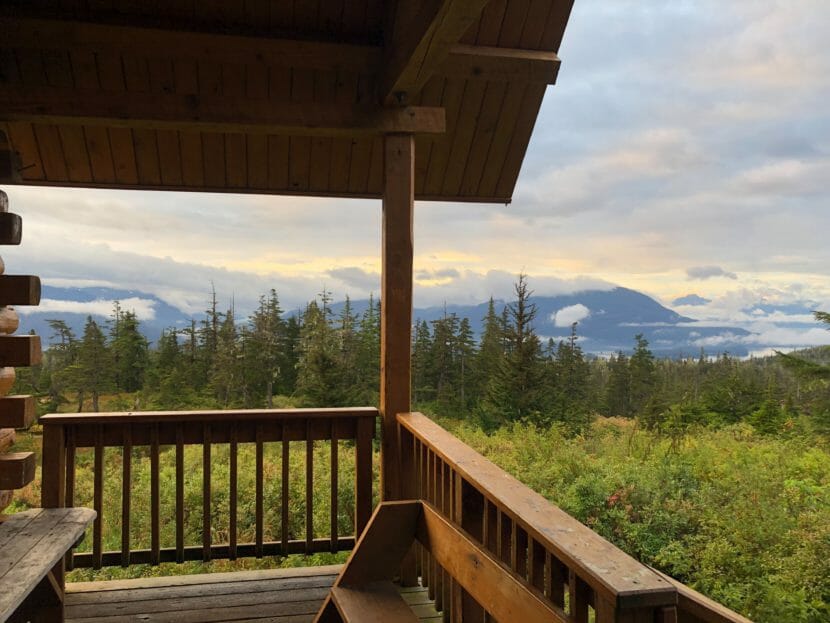
John Muir Cabin. Sept. 16, 2022. (Photo by Yvonne Krumrey/KTOO)
Juneau’s public use cabin system is beloved — and often booked far in advance. Now, more cabins may be available soon for overnight stays.
The U.S. Forest Service just received $20 million for public cabins, said Regional Director of Recreation, Land and Minerals James King.
“Alaska did very, very well,” he said. “We’ve got $14.4 million of that $20 million to go towards either repairing, restoring or constructing new cabins.
There are currently about a dozen public cabins accessible from Juneau’s road system. Some are owned and maintained by the state, some by the Forest Service and others by the City and Borough of Juneau.
Now, the Forest Service is proposing several new cabins in Juneau, out of 50 proposed cabins statewide.
Most of the existing cabins are found along trails that take several miles to hike to, and King said a goal is to build cabins that are more accessible for people who can’t necessarily hike out to one.
“A big emphasis of this money for us with the new ones is to put these cabins where the demand exists,” King said. “For a lot of that, it’s near communities.”
The new proposals vary in purpose: some are right by the Mendenhall Glacier and would be accessible by car; another along Montana Creek creates a cabin “thru-hike” opportunity, where folks can hike from cabin to cabin to traverse a longer trail in Juneau.
These ideas are getting a lot of feedback.
“We’re really happy with the response,” he said said. “We’ve received over 500 comments on cabin locations.”
Ryan O’Shaughnessy leads Juneau’s trail maintenance nonprofit, Trail Mix, Inc. He says that part of their partnership with the city is to support new cabin projects.
“We really like to think of ourselves as a tool in the toolbox for land managers for recreation projects, so we’re super happy to help build cabins or happy to help build trails to cabins, clearing land for cabins, any and all,” O’Shaughnessy said. “We’re very supportive of these projects.”
Proposition 2 on Juneau’s local ballot will also help fund more cabins, O’Shaughnessy said. That measure is poised to pass once the city certifies election results later this week.
All the cabin proposal projects can be explored on an interactive map, and comments for the new Forest Service cabins can be made until Oct. 31. King said some plans were already in the works prior to the new federal funding, which means new cabins could be available as soon as next summer. He hopes others will be constructed in the next four years.
Correction: A previous version of this story misstated that the U.S. Forest Service Alaska Region had received $20 million for new public use cabins. In fact, the U.S. Forest Service as a whole received that money.
A recent destructive slide in downtown Juneau left homeowners and the community grappling with how to respond,
An Iranian in Alaska speaks on recent protests in Iran,
Hundreds of hotel rooms and emergency shelter beds in Anchorage will continue to be available to people without homes through at least the end of the year
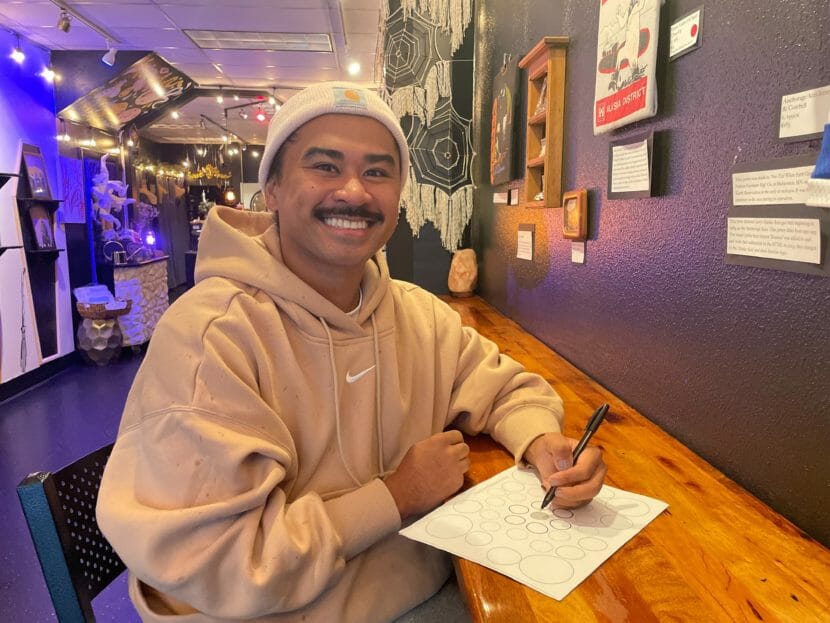
David Abad demonstrates pod mapping inside Black Moon Koven in Juneau on Oct. 13, 2022. (Photo courtesy of David Abad)
A workshop in Juneau later this month will help LGBTQ+ people learn an intentional approach to getting the support they need.
The strategy is called “pod mapping.” It involves visually drawing out your community so you’ll know where to go for different needs.
Organizer David Abad works for AWARE, Juneau’s domestic violence support organization. He says approaches like pod mapping can help in moments of crisis.
“When I’m experiencing trauma, or when I’m experiencing anything, who do I turn to?” he said. “And I just wanted to see who I turned to.”
AWARE is hosting the workshop with the National Alliance on Mental Illness Juneau. While Abad works in violence prevention, he says the workshop will address harm reduction, too. In other words, when something does happen, it’s important to know who you can turn to for help.
Abad says a pod — pod as in community — map can have friends, family or more official resources.
“Another aspect of this workshop is to identify local resources and or national resources, if that’s more comfortable,” he said.
But those resources may not be accessible for everyone in Juneau.
“Maybe it’s, ‘Oh, I don’t want to go to this local resource. I’ve done it, I’ve gone to it, it’s not a resource. I don’t feel safe,’” he said.
And for some people in Juneau, Abad says it can be hard to find the right resources at all.
“Juneau can sometimes be pretty limiting, and it gets compounded with other things,” he said. “Maybe they’re queer friendly, but they’re not maybe POC friendly. And then having those multiple identities can maybe impact someone’s experiences. ”
Abad says this pod mapping can help fill those gaps by giving a clearer sense of who in your community you can go to for support, before it’s needed.
The Mapping and Building Intentional Support Systems Workshop is scheduled for 6 p.m. on Oct. 25 at the Douglas Library.
Close
Update notification options
Subscribe to notifications
Subscribe
Get notifications about news related to the topics you care about. You can unsubscribe anytime.