An Anchorage Superior Court judge has declined to quickly order Gov. Mike Dunleavy’s administration to address a complaint that he’s not providing a safe environment for state workers.
Judge Thomas Matthews decided on Tuesday not to issue a temporary restraining order requested by the Alaska State Employees Association, the largest state employee union.
Matthews didn’t rule on the overall lawsuit.
The union is suing the state, alleging that it’s violating its legal responsibilities to provide workers with a safe workplace during the coronavirus pandemic. The state argued that it’s already taking the actions the ASEA demanded.
Matthews wrote that the union fundamentally failed to address the impact of Dunleavy’s disaster declaration.
Matthews wrote: “Particularly in times of crisis, the executive branch must be afforded deference to do its job in a manner that promotes the health, welfare and safety of all Alaskans. In effect, ASEA is inviting this Court to substitute its judgment for the expertise of State officials who are charged with managing several thousand workers.”
Attorney General Kevin Clarkson responded to the decision by saying the state is doing all it can to ensure workers’ safety.
Union Executive Director Jake Metcalfe said there’s been an “impressive increase” in the number of state workers allowed to work from home since the ASEA filed the lawsuit. But Metcalfe said the union is still hearing from workers that don’t feel safe.
Cruise ship passengers look to book a whale watching trip on Juneau’s docks. The cruise season will be severely curtailed in 2020 due to the COVID-19 pandemic, that’s leaving many small businesses in financially precarious positions. (Annie Bartholomew / KTOO)
In mid-March, Alaskan businesses and non-profits became eligible to apply for federal economic disaster loans. And, because the true economic cost of the coronavirus pandemic hasn’t yet become clear, the U.S. Small Business Administration is allowing people to apply for loans through December.
Even though it’s the off-season, some cruise-related business owners need the help now.
But the coronavirus pandemic brought all of that to a screeching halt.
And now, people like Midgi Moore are hemorrhaging money. She runs Juneau Food Tours. Her husband runs a sport fishing and whale watching company. Ever since the cruise season stalled, people have been cancelling their vacations in droves — that means, they want their deposits back.
“You know, I’m looking at several, probably $5,000 – 10,000 in refunds. But my husband is looking at tens of thousands of dollars of refunds. So those loans are not to help us stay in business, it’s to pay back people who aren’t coming,” Moore said.
Generally, the cruise season runs from May through September, but the smaller companies spend the early months of the year gearing up for the season.
Moore said they use funds people pay in deposits to keep the businesses running in the off-season and to ramp up during the shoulder season. Usually they’d be hiring.
Instead, her husband had to lay off 19 people. She laid off 10. This year has turned into something of a worst case scenario.
“We’re at the point where we don’t want to look at our phones or check our emails because we’re terrified that it’s a request for a refund,” she said.
This story is playing out for small businesses owners who rely on the visitor industry all over the state.
Before lawmakers left Juneau, John Bittner of the Alaska Small Business Development Centertold a Senate Finance committee that between coronavirus-related shutdowns and the dramatic drop in oil prices, the state’s economy is taking a beating.
“To be honest, this is such a wide ranging economic upheaval that every industry in the state is going to be negatively impacted in some sense, with a handful of exceptions,” he said.
He said the federal small business loans could help keep some of them afloat.
“This will help. It’s not a silver bullet. Not everybody will be eligible but this is a step in the right direction,” he said.
On offer is up to $2 million in low-interest loans to small businesses that can be used for things like payroll and paying bills that cannot be paid because of the coronavirus outbreak.
The interest rates are low: 3.75% for small businesses and 2.75% for non-profits.
Rick Jenkins is a spokesperson for the disaster assistance program at the Small Business Administration. The economic injury disaster loan isn’t a new program, but he said this is a new scenario.
“It’s the first time in our history that SBA [has] been able to declare an event such as this,” Jenkins said. “So when H1N1 — or the swine flu — was sweeping the country or the HIV epidemic — and they impacted businesses — SBA couldn’t step in with disaster loans. Now, they can.”
One other difference is that normally the loans are the result of disasters that are confined in some way: fires, earthquakes, hurricanes. Typically they impact a few states at a time. But in this case, these loans are available for the whole nation.
Still, a loan won’t be the best option for all small business owners. Jenkins said there are counselors at the state’s Small Businesses Development Center that can help with those decisions.
Moore said she heard about the program and applied online. She said it’s complicated for those without a strong financial background. There’s some lingo that’s not easy to understand, and she’s a little nervous she didn’t do it right. But she didn’t have to collect a lot of paperwork or tax documentation. She just linked last year’s return to her loan application and that made the process a lot easier.
It took more than 4 hours for her to get through the process.
“And this is not SBA’s fault, but I am certain that pretty much half of the United States is applying and the system — the website — it just keeps shutting down, it’s crashing,” she said.
Right now, Moore has all of this anxiety about her business because it’s just not clear how she’s going to make a living this year. But, there have been these moments of joy in the last few weeks.
When people reach to tell her that they’re cancelling their trips, she’s been asking them to consider leaving their deposits with her, turning them into essentially gift cards.
This guy in Florida reached out. He’d paid about $500 in advance and he’s not coming until next year. At first, he told her he wanted his money back. But after they emailed back and forth a few times, he asked her how she was doing.
“I was just really frank with him, I said I’m struggling. I said I’m really struggling. Of course, no one in any way shape or form could have predicted something like this being so global,” she said.
She also explained to him that her whole operation was coming to a screeching halt, and that not only was she going to make zero money, she also has to give back the money she already has.
Pretty soon, she gets another email.
“He goes — I would like to buy a gift card for $1,000,” she said. “I, of course, burst into tears. And I was like, ‘oh my gosh not only are you buying your tour but you’re paying and additional $500 just to be a nice person.’ And, I emailed him back and I said that is just so generous. And he goes, ‘we need to help one another.’”
There might be some other help on the way for businesses like Moore’s. The federal CARES act that just passed — that’s the massive $2 trillion dollar coronavirus aid bill — it gave SBA access to $350 billion in loans for small businesses.
They can be used to cover things like operating costs or employee expenses like payroll, healthcare premiums and vacation or sick leave.
A rural Alaska air carrier has agreed to step in and fly into North Slope communities that RavnAir said today it will no longer be able to serve.
Ryan Air has been operating primarily as an air cargo service in rural Alaska — but will now fly mail, freight and “essential passengers,” to the North Slope Borough, it said in a joint statement with the North Slope Borough late Thursday. Essential passengers could include medical or trade professionals who have been cleared of COVID-19, a borough official said.
The partnership comes the same day RavnAir Group, the state’s largest rural air carrier, announced that it’s cutting its service by 90 percent. The company cited a huge loss in passenger bookings due to the COVID-19 outbreak.
According to the media release, Ryan Air will use RavnAir’s existing infrastructure. While details are still being worked out — Ryan Air could begin operating in the North Slope borough by the weekend.
There are still communities all over the state, from the Yukon-Kuskokwim Delta down to the Aleutian Islands that will see far fewer flights from the loss of Ravn Air’s service.
Clarification: This story has been updated to clarify that Ryan Air will not be operating regular passengers service but will transport “essential” passengers to the North Slope Borough.
A website went live at 5 p.m. Thursday to take in applications for small business relief loans in Juneau. By midday Friday, dozens of completed applications had come in for the publicly financed program. (Read more)
Original story
Small businesses in Juneau could have emergency cash headed into their accounts as soon as Friday.
The Juneau Assembly approved an emergency measure Wednesday night to make up to $3 million of public money available as low- or no-interest loans to qualified businesses.
Public health mandates to combat the spread of COVID-19 have frozen a lot of economic activity. The loan program is intended to help small businesses get by until federal and state relief is available.
Assembly member Wade Bryson is a business owner. He framed it as an obligation. Specifically, because the Assembly shuttered many local businesses to combat the pandemic.
“I understand that some businesses won’t use this help. Debt is bad. Business owners don’t like debt. We are now giving them a tool to help them in the form of debt, which is not universally liked. … But here we are, we have to solve this. ”
The Assembly’s debate Wednesday centered on tradeoffs between getting the money out to the community quickly, oversight and unforeseen expenses the money could be spent on.
Assembly member Maria Gladziszewski tried to amend the program so the $3 million wouldn’t be released all at once. She wanted to build in what she called some “minimal oversight” from the Assembly.
“OK, the state of Utah — not a city in Utah, but the state — is considering doing loans of ($5,000 to $20,000). And here we are way early, and I commend us for moving quickly, but we’re talking about giving loans in a city of Juneau from ($25,000 to $50,000).”
Mayor Beth Weldon got the last word.
“I appreciate where everyone’s coming from, but quite honestly, there are two businesspeople in this room. While everyone else was doing whatever their — the usual whatever they did today, I did payroll,” she said, choking up. “And paid bills. And hoped I had enough money in the bank to make it. So by delaying this with this amendment, you’ve taken the legs out from under it. So with that being said, madame clerk, call roll.”
Gladziszewki’s amendment failed. The overall measure passed unanimously.
Today, the city wired its $3 million to the Juneau Economic Development Council, which is administering the loans. JEDC Executive Director Brian Holst said a dry run for the web-based application process happened this afternoon. If it goes well, he said applications and money could start flowing as early as Friday.
The application and particulars of the loan conditions will be at JEDC.org.
The loan program will add a $3 million expense to the city’s annual budgeting process, which is filled with unknowns.
“We don’t know the effect of COVID to our economy,” City Manager Rorie Watt told the Assembly. “We don’t know how much we’re going to end up spending. We don’t know if the governor’s going to sign the budget with or without veto. We don’t know if the federal aid, the one and a quarter billion (dollars) or so to the state, is going to make it our way.”
Watt said he did recommend, at least as a starting point for budget deliberations, a significant property tax increase to balance the budget. He proposed an increase of one mill, which works out to $100 more per $100,000 of assessed property value.
The city’s budget must be complete before the new fiscal year begins in July.
Correction: The nonprofit administering the loans was misidentified in an earlier version of this story. JEDC is short for Juneau Economic Development Council, not Corp.
Update — Tegan Hanlon, Alaska Public Media, and Rashah McChesney, KTOO
Alaska’s chief medical officer is encouraging Alaskans to wear homemade masks when they go out in public, as the number of people diagnosed with COVID-19 continues to grow.
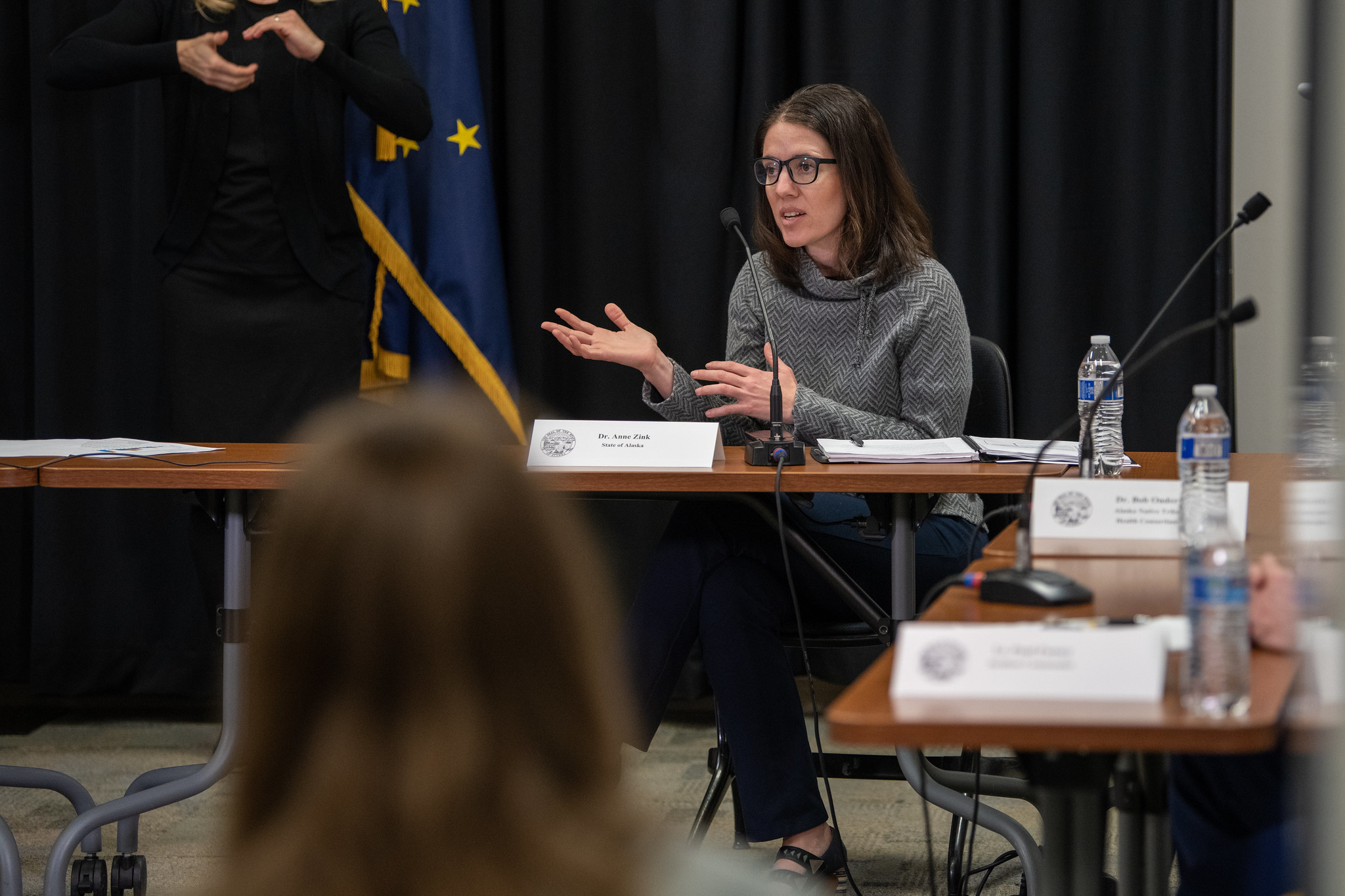
Dr. Anne Zink said it’s one of several things Alaskans can do to help limit the spread of COVID-19, the disease caused by the coronavirus.
“We’re encouraging people — if you’re going to go out in public, if you’re going to go to the grocery store — to consider wearing a tightly-woven homemade mask to be able to minimize the spread, in case you are asymptomatic or early symptomatic,” she said.
Zink made the recommendation at a Thursday evening news conference, where Gov. Mike Dunleavy gave an update on the number of confirmed cases in the state.
The number of coronavirus-related hospitalizations increased by four, to a total of 13, “and thank goodness, no additional deaths,” Dunleavy said.
Three Alaskans died in March after they were diagnosed with COVID-19 — two in state and one out of state.
Both Dunleavy and Zink thanked Alaskans for the efforts they’ve taken so far to try to help slow the spread of the virus, including social distancing. Dunleavy said Alaskans are buying the state time to build up its health care system in preparation for a peak of cases.
“What Alaskans are doing right now is literally saving lives, and we just cannot thank you enough,” Zink said. “We’re not far enough into this to let up the gas yet. We really need to hold that curve.”
Zink underscored that Alaskans should wear handmade masks and keep medical masks for health care providers. She also said people need to remember to stay at least 6 feet away from others — if not more. She reminded Alaskans to wash their hands often and clean their surfaces.
More than 5,500 COVID-19 tests have been performed in Alaska.
Original story — Rashah McChesney, KTOO
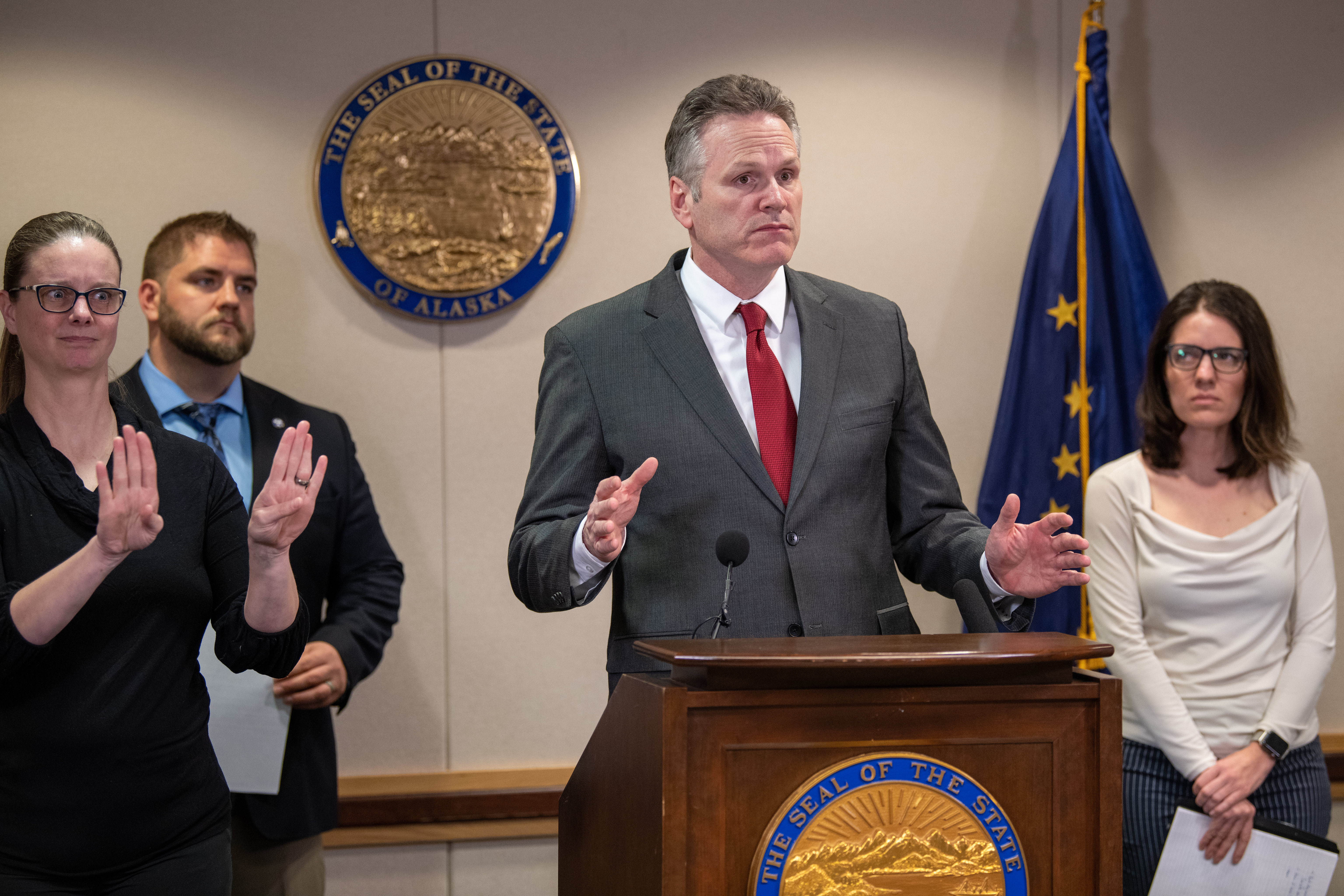
Alaska Gov. Mike Dunleavy speaks about the state’s COVID-19 response from the Atwood Building in Anchorage on March 20, 2020. Also pictured: Department of Health and Social Services Commissioner Adam Crum, Chief Medical Officer Dr. Anne Zink, and an unidentified sign language interpreter. (Creative Commons photo courtesy Alaska Governor’s Office)
Gov. Mike Dunleavy’s latest COVID-19 press conference is scheduled for 5 p.m.
The governor, Health and Social Services Commissioner Adam Crum and Chief Medical Officer Dr. Anne Zink have been holding these briefings almost daily since March 10.
In previous briefings, administration officials has shared updates on the number of people in the state with confirmed cases, announced public health mandates and explained the administration’s strategy and rationale.
To date, they’ve imposed 12 public health mandates that have reshaped daily life across Alaska to combat the spread of the virus. Those mandates and other Alaska-specific COVID-19 resources and information are available at coronavirus.alaska.gov.
Correction: This story has been corrected to reflect an adjustment in the number of confirmed COVID-19 cases reported by the state of Alaska. There were 147 confirmed cases in Alaska by Thursday, not 151.
Correction: An earlier version of this story incorrectly said that the state had issued 10 public health mandates as of Thursday. The state had issued 12 mandates by then.
A hydroelectric generator with the valves controlling the water supply is recessed into the floor in the AEL&P Gold Creek Hydro Plant on July 20, 2018. (Photo by David Purdy/KTOO)
Juneau’s utility operators are taking steps to protect staff from COVID-19, but they say they’re well-prepared to continue running throughout the pandemic.
Juneau City Manager Rorie Watt used to be the city’s engineering director for about 8 years. He said the city and borough is prepared for a worst-case scenario.
“I feel confident that we’re not going to have problems continuing to run the utilities, even if we have a pretty big outbreak here,” Watt said.
Watt said the city’s water and wastewater treatment systems don’t require a large number of employees to operate. Some controls can even be operated remotely.
The city also has emergency diesel generators capable of running the water system if they lose power.
“We’re just kind of battening down the hatches, waiting for the storm and not really having any idea how big the storm’s gonna be,” Watt said.
Deb Driscoll from Alaska Electric Light & Power said the situation is similar for the local hydropower system. Much of their staff is working remotely or in shifts.
She said they also rely on local internet and phone providers and helicopter companies to help AEL&P function and do regular equipment maintenance.
“We can continue to do the job that we’re doing to provide this essential function, because others are continuing to do their essential functions as well,” Driscoll said.
The company has closed its Lemon Creek office to the public, but staff are now available during extended hours to respond to customer questions and concerns.
For now, both AEL&P and the city have suspended late fees and electricity and water shutoffs for customers who cannot pay.