Alaska coronavirus news

Live updates and information on COVID-19 in Juneau and Alaska

Hair stylists, barbers, tattooists among those with fewest options amid coronavirus closures

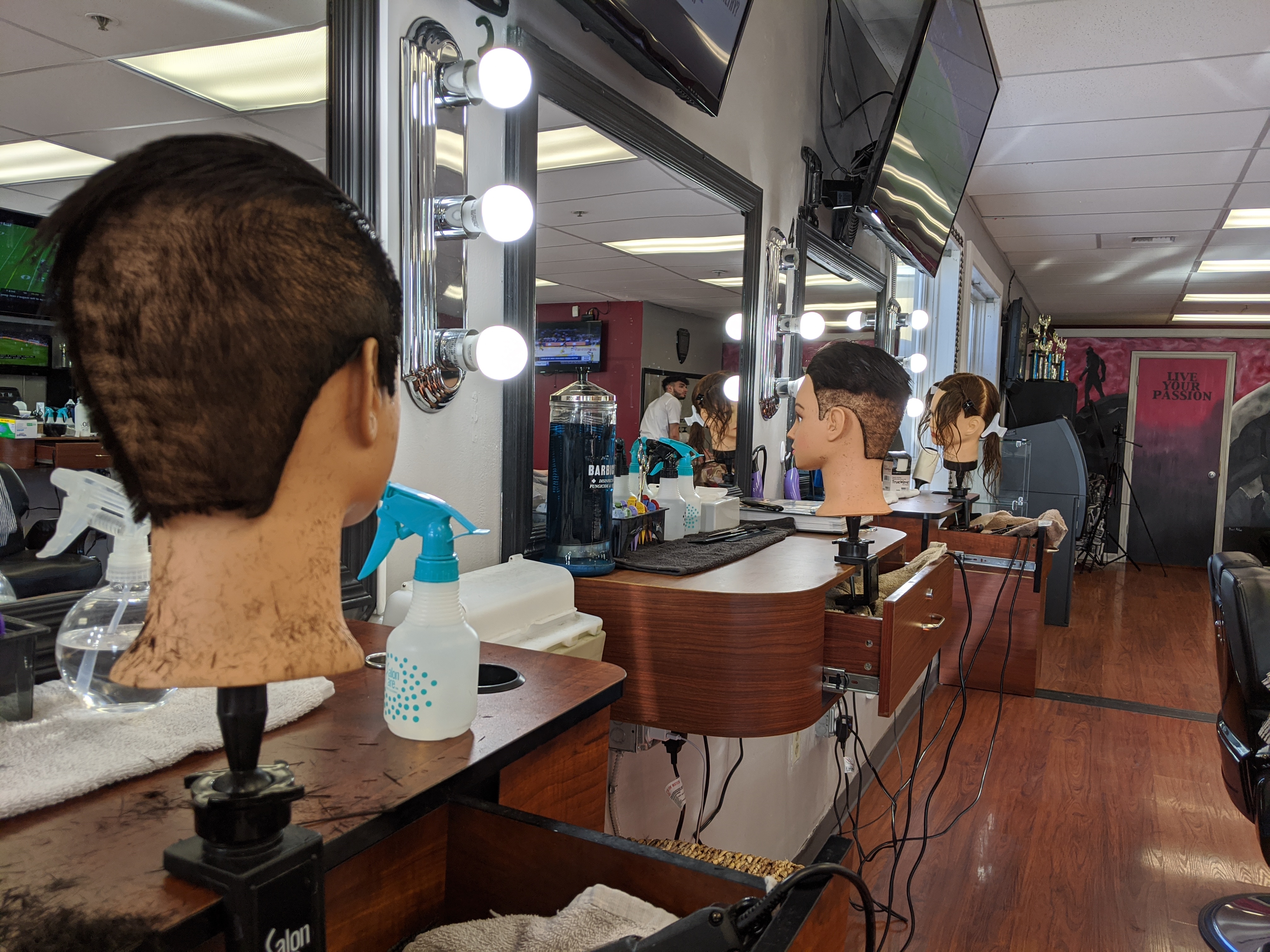
Mannequins at the Hair Science Barber Shop and Barber School, run by Shawn Idom. The shop is now closed because of a state health order meant to curb the spread of coronavirus. (Photo by Mayowa Aina/Alaska Public Media)

You can’t cut hair from six feet away.

“There’s no way we could really practice our job and follow the social distancing guidelines,” said Meg Hronek, owner of Drift Salon in Anchorage.

The business has been undergoing an expansion, and last week construction was finally wrapped up enough for Hronek to operate at its new, full capacity. But over the weekend she decided to close up shop, just days ahead of a state order that would have required the same thing.

For weeks, she and her staff managed coronavirus concerns by exercising extra caution with hygiene and sterilization around the salon. But with 12 chairs for customers and the stylists to them, Hronek said there was just too much traffic and uncertainty for things to feel safe.

“One of my hairdressers came to me,” she recalled. “She had had somebody in her chair that had just traveled, and then right after that her very next client was an older woman on oxygen.”

Hair salons all over the state are closed under an order by the governor intended to prevent the spread of the coronavirus by enforcing social distancing in the commercial sector. Also shuttered are spas, nail salons, barbershops, tattoo and piercing parlors, and just about every business that falls under what the state calls “personal care services” in a March 23 health mandate closing them indefinitely.

But because of the employment structure in these industries, its workers are uniquely ill-equipped for the mass closures in place for the foreseeable future.

In Hronek’s salon, for example, half the stylists are employees of the salon; the other half, though, are independent contractors. Such a hybrid arrangement is irregular, according to Hronek. Businesses like hers will usually have one or the other, not both.

The perks to independent contracting are control and flexibility. But right now, you’d almost certainly prefer to be in the other category.

“I think all of my independent contractors are wishing they were employees at this point,” Hronek said.

The big reason why: unemployment insurance.

Independent contractors, whether you’re an Uber driver or an esthetician, don’t qualify for it under state rules. Many of the labor protections and safety net programs people are looking to now, as the pandemic upends normally stable industries, do not apply to a broad swath of workers who are suddenly without income.
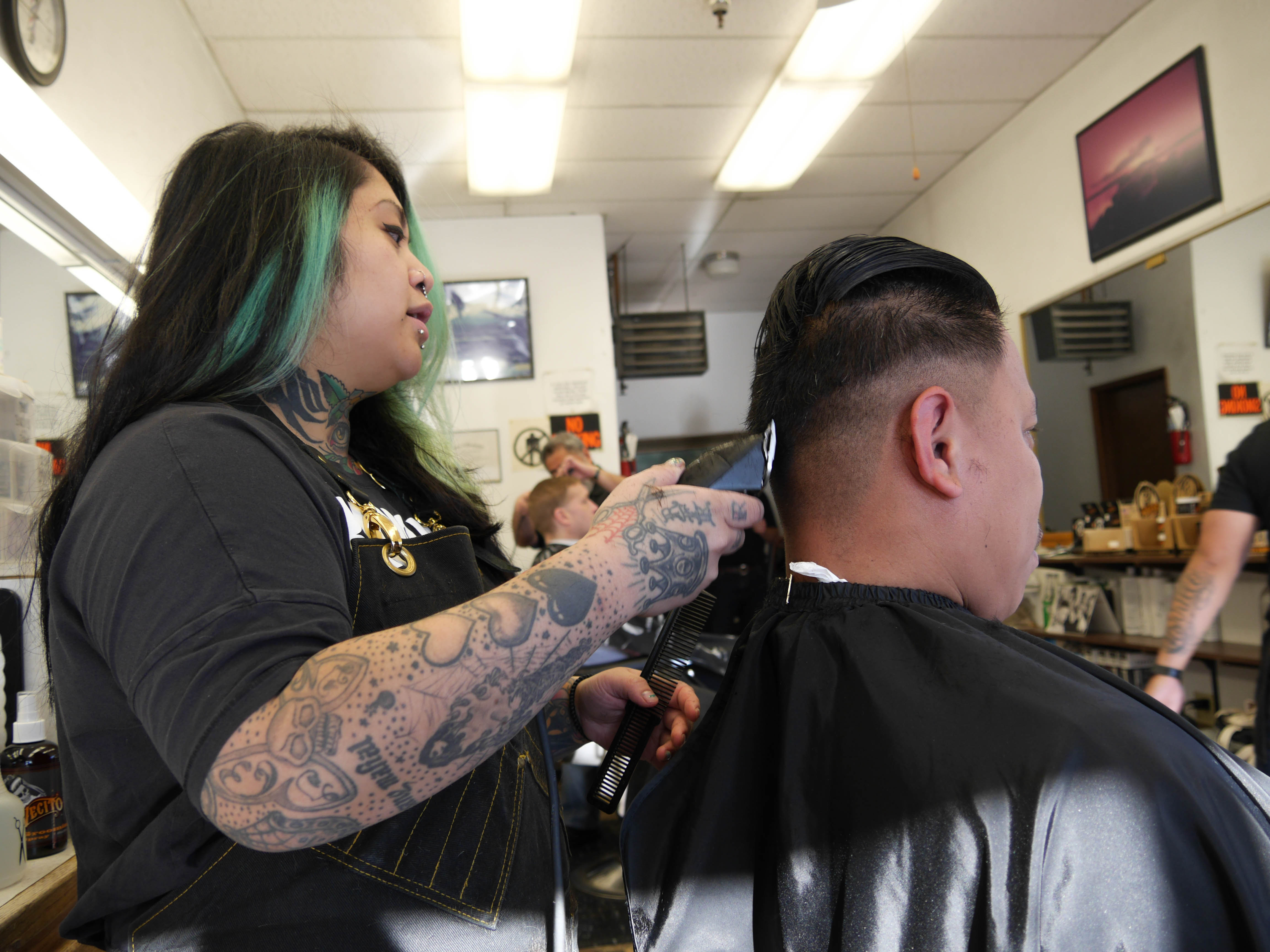
Eva Carillo cuts Silver Ligsay's hair
Eva Carillo cuts Silver Ligsay’s hair at Gerry’s Barbering & Styling Shop in Juneau in 2016. A statewide health mandate issued this month has closed hair salons and barber shops. (Photo by Lakeidra Chavis/KTOO)

Rene Meza has been cutting and styling hair for 16 years. She said people keep telling her to just apply for unemployment.

“It’s like, you guys don’t understand: We’re sole-proprietor businesses,” Meza said.

She originally got into the field because of the flexibility it afforded: If she needed more money, she could book more appointments. And as a single mother, she was able to adjust the work to her kids’ scheduling needs.

One of the trade-offs, though, is she’s responsible for a lot more overhead expenses, with few of the perks or protections covered by labor laws.

“There’s no backup plan,” she said. “We don’t have sick days we can cash in on, none of that kind of stuff.”

According to Meza, it’s a one-two punch for a lot of the stylists she knows, because many of them supplement their salon work with jobs in bars and restaurants. But those are mostly closed, too.

About a year ago, Meza began restructuring her finances so that she was saving more as part of her business plan. Now she’s grateful she did — but she knows it’s a position not everyone in the industry is afforded.

“It’s a very cash-in-hand industry,” she said. “If you aren’t financially savvy or budget savvy, these women are going on a day-to-day basis, a lot of them.”

For the first time in her adult life, Meza said, she can’t work, and she’s debating whether it might make sense to apply for a job stocking shelves at a grocery store. Those are one of the few places hiring amid the shutdown.

One of the silver linings to the current situation, she said, is that her clients have gone out of their way to support her, booking appointments in the future or buying gift cards.

That’s not an option for tattoo artist Jake Scrivner.

“My schedule is out almost a year. It’s like six or seven months,” Scrivner said. “I can’t book, because I don’t know where I can put people.” Without knowing when the health mandate will end, he can’t rebook or change plans with clients.
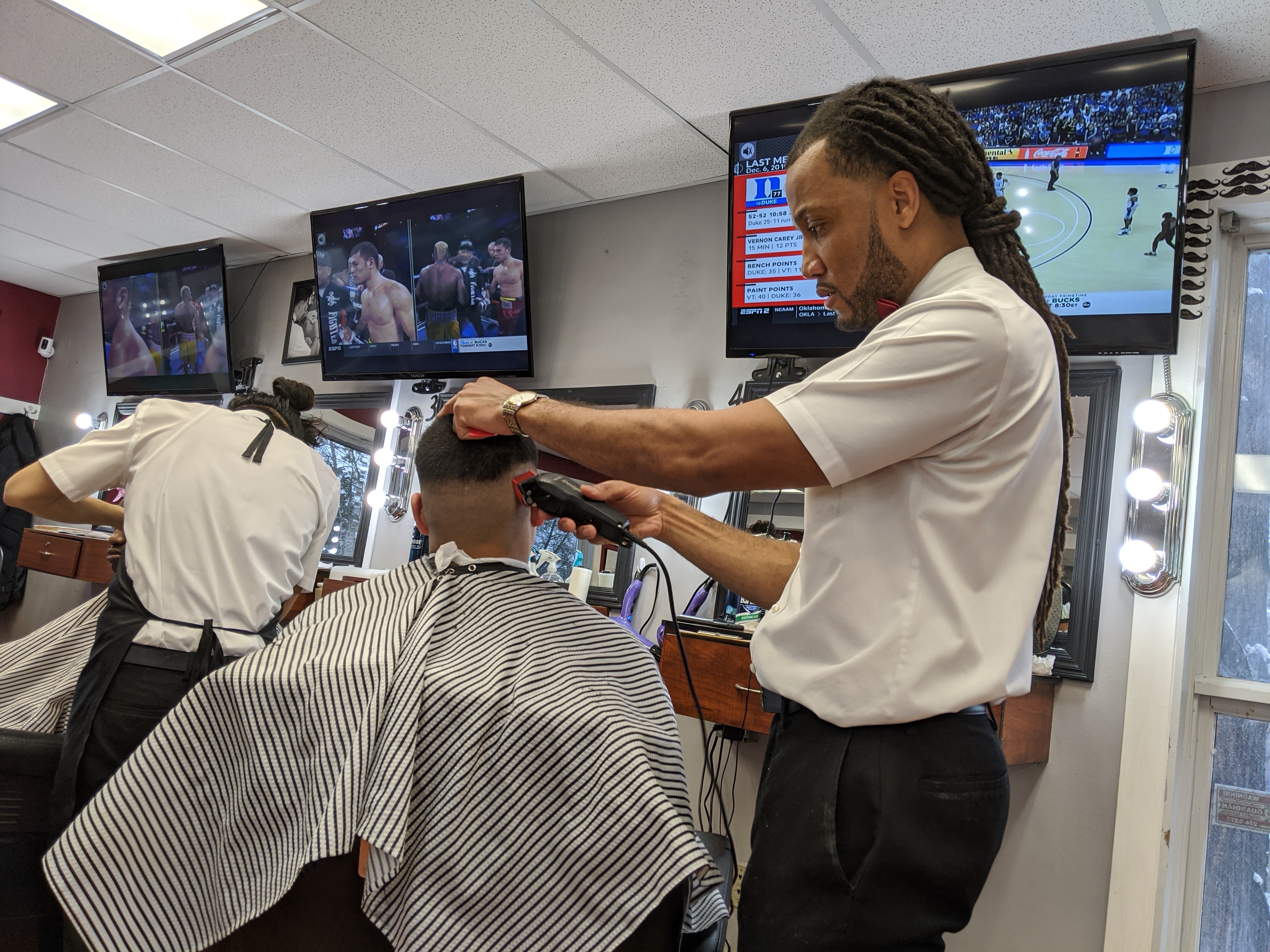
Shawn Idom provides a haircut at his barbershop Hair Science on Feb. 22. (Photo by Mayowa Aina/Alaska Public Media)

Scrivner owns Ultra Violence Tattoo in Anchorage. Piercers and tattoo artists working in his shop rent booths from him — but they’re independent contractors, not employees.

“Some of the tattooers have reserves, and some are on a pretty limited income,” he said. “Missing a week of work really matters. We all have house payments and truck payments, and there’s not a lot of alternative (to) their income. You have to work every day. And that’s what we do.”

For the time being, Scrivner is suspending the shop rent his artists would normally pay until more details about the business closures are clear. He’s keeping a close eye on state and federal legislation that might help keep him afloat. He has some emergency funds to draw on for the time being.

But if the shop has to stay closed for, say, longer than three months?

“We would be in trouble. Serious trouble. And we’re one of the most successful tattoo shops in Alaska.”

According to Shawn Idom, a member of the Board of Barbers and Hairdressers, which oversees most of the personal care services in the state, there are about 7,000 licensees in Alaska affected by the closure order.

“That’s a lot of families,” Idom said. If you consider children and spouses who might also depend on those incomes, he said, it accounts for tens of thousands of people now without essential revenue.

“It’s crazy to think of the scale of this thing,” he said.

According to a press release from U.S. Sen. Lisa Murkowski’s office, the Senate-approved stimulus bill in its present form would cover 39 weeks of unemployment assistance to workers not currently eligible under state laws, “including the self-employed” and “independent contractors.”

 

Alaska manufacturers retool to produce test swabs, face shields

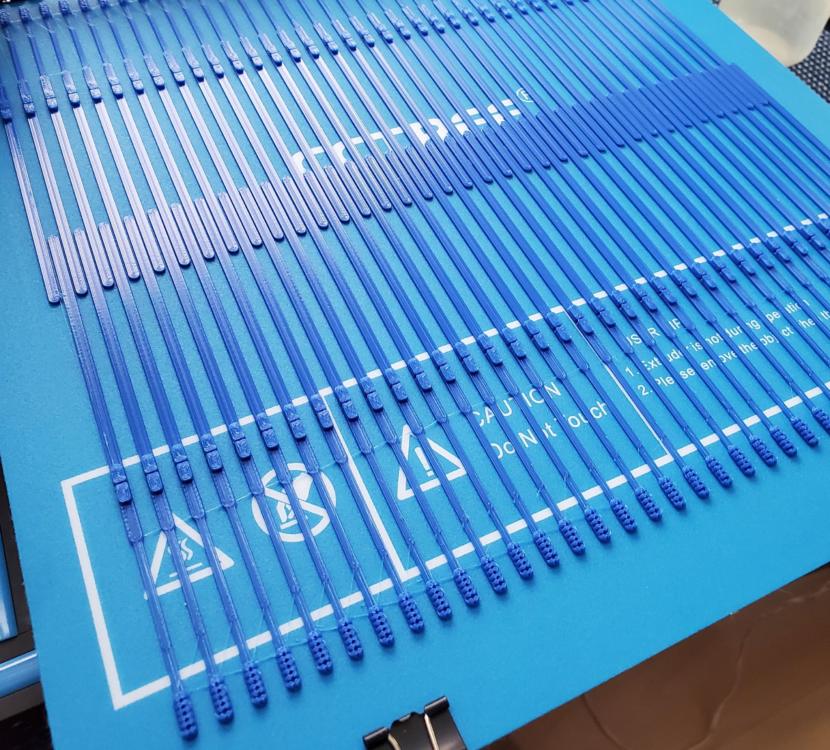
TriJet Manufacturing in Palmer is printing swabs that medical workers can use to collect samples for coronavirus tests. (Hans Vogel/TriJet Manufacturing)

Alaska is not known for having much of a manufacturing sector, and at the end of a long supply chain there’s been concern that the state will run out of the medical supplies it needs to fight coronavirus.

But at least two small businesses in Alaska are retooling their operations from making things like custom car or gun parts, to producing face shields for protecting healthcare providers and printing the long swabs needed to test for the virus.

At TriJet Manufacturing in Palmer, a 3D printing machine is constantly whirring, busy printing plastic test swabs. These swabs don’t have cotton tips, more of a scraper on the end, and they’re longer than the swabs you might have in your bathroom. They’re long enough, actually, to reach through a person’s nose all the way to the back of their throat to collect a sample of mucus.

“It’s not that comfy,” said TriJet CEO Hans Vogel. “Honestly, I wasn’t really aware you could stick things to the back of your throat through your nose, but who knows?”

That uncomfortable procedure was unknown to Vogel, because the company’s typical work involves creating, from scratch, everything from custom gun parts and helicopter fuel tanks, to huge steel carts used to move entire turbine engines or pieces of oil drilling pipe.

But now TriJet is starting to crank out thin, blue, plastic test swabs, each one about six inches long, as well as clear plastic face shields for medical workers administering those tests.

Vogel said his company isn’t the only one. He pointed to distilleries around the state switching to making alcohol for hand sanitizer instead of alcohol to drink. In some hard-hit countries, engineers and manufacturers have also reconfigured to meet demand in what has become a life-or-death struggle.

“Instead of watching, you know, silly cat videos at home while you’re stuck in your house, I mean, some of these people are looking at how they can help,” Vogel said. “I think people in all walks of life are doing that. But we just happen to have some of the ingredients necessary, the people and the machines, and so that’s why we’re going after it.”

Here’s how it works: A company like TriJet with an industrial-sized 3D printer can download the digital design for swabs and maybe modify it a little to fit their particular machine’s needs or other technical specifications. They input the design to the printer, punch a couple buttons and it starts printing swabs from a string of plastic filament.

“Like a thick fishing line, and it goes through this thing called an extruder. Just think like a hot glue gun,” Vogel said. “And it just kind of wiggles around. There’s a robot that moves around, as this little noodle of hot plastic is coming out. It’s basically taking that model, and layer by layer, it’s building your part.”

Gov. Mike Dunleavy approached TriJet in mid-March asking if the company could produce swabs and what their capacity might be, Vogel said. As members of the greater design community, his engineers were already thinking about it, he said.

And just Thursday, the state approved TriJet’s first batch of 140 swabs. They’re currently capable of producing a couple hundred a day but could quickly scale up to make hundreds more per day if needed, Vogel said.

For now, the company isn’t seeking compensation for the swabs, though that’s something that could change if they have to hire more workers to increase production, Vogel said.

“We might need some resources, and (if it) starts becoming a big level of effort, we’re going to have to do it. Yeah, clearly, like any normal company at this point, we’re all looking at our own mortality,” Vogel said.

Another Alaska company looking to help is Perfectionist Auto Sound in Anchorage. Company CEO John Schwartz described Perfectionist as a “tailor” for vehicles, modifying suspensions, wheels and tires, installing audio systems, custom interiors and backup cameras.

Perfectionist Auto Sound CEO John Schwartz wearing a protective face shield he made in his shop. (Perfectionist Auto Sound)

“We build people’s dreams of what they want their car to be,” Schwartz said.

Now, though, Schwartz is staying busy producing face shields for medical workers.

Schwartz appeared in a video on Perfectionist’s Facebook page, standing next to their busy 3D laser cutter.

“Got the laser going. We’re going to get as many face shields done as we can and get these out in the public,” Schwartz said in the video. “We’re going to start assembling soon.”

The machines are usually busy making things like logos or special brackets for after-market fog lights. But Schwartz said he switched to face shields after a friend in Boston started doing the same thing.

“So this part of it is like my contribution back to the community,” he said. “Because I can be open, I can work, where some people can’t. So at least if I can help people, then I have some purpose to be here.”

Schwartz delivered a load of face shields to Alaska Native Medical Center in Anchorage on Thursday and said he’s made about 200 total, with a goal of 500. A competitor in town even provided more materials to keep going, and he’s also sent the digital design files to other, larger, companies with similar printing and cutting machines, he said.

The work is making him feel useful, Schwartz said, but he’d also like to think it could save lives.

“I have a lot of smaller practices and, you know, people running the testing centers and things like that, that really need them,” Schwartz said. “So we’re just going to keep producing as we can.”

Citing coronavirus disaster, Alaska’s investment authority wants to bypass regulations to fund Ambler Road Project

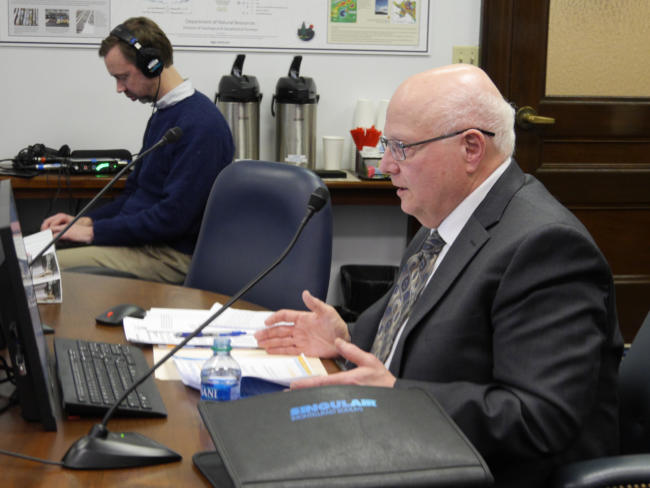
Tom Boutin, executive director of the Alaska Industrial Development and Export Authority. (Photo by Skip Gray/KTOO)

Citing Gov. Mike Dunleavy’s coronavirus emergency declaration, the state’s investment authority is looking to bypass regulations to put funding into the Ambler Road Project.

The Alaska Industrial Development and Export Authority (AIDEA) Board of Directors is meeting Friday to vote to allow the group to waive the standard requirements for taking loans from its revolving fund. That would allow them to put $35 million into the a fund that could later benefit the road, which they’re also scheduled to vote on.

Initially, the Board had a resolution to put the money from the revolving fund to the Arctic Infrastructure Development Fund, and then directly into the Ambler Road project. After a special Thursday board meeting, however, the resolution was amended to reflect that the board would have to take additional action to put the money into the Ambler Road.

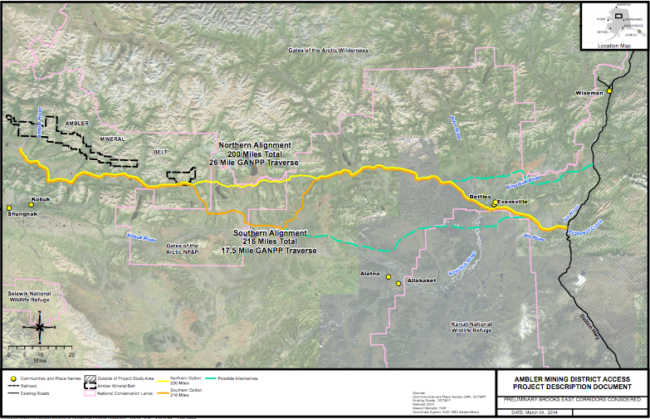
The Ambler Road would stretch from Dalton Highway to the Ambler Mining District northeast of Kotzebue and cross Gates of the Arctic National Park. Critics say there are environmental concerns over routing through a national park. Others are concerned with impacts to federal subsistence rights.

AIDEA president Tom Boutin says the action by the board will allow AIDEA to issue loans more effectively to offset potential economic issues brought on by the coronavirus disaster. He says they want to ensure funding is secure for rural Alaska projects, like the Ambler Road.

The move has been criticized by environmental groups. The conservation nonprofit Alaska Wildlife Alliance called it inappropriate to fund the road project when there are other more pressing economic impacts facing Alaskans.

A map of AIDEA’s proposed routes for the Ambler Mining District Industrial Access Road. (Image courtesy the Alaska Industrial Development and Export Authority)

Here’s what Alaskans who are out of work can do now, and more help that’s on the way

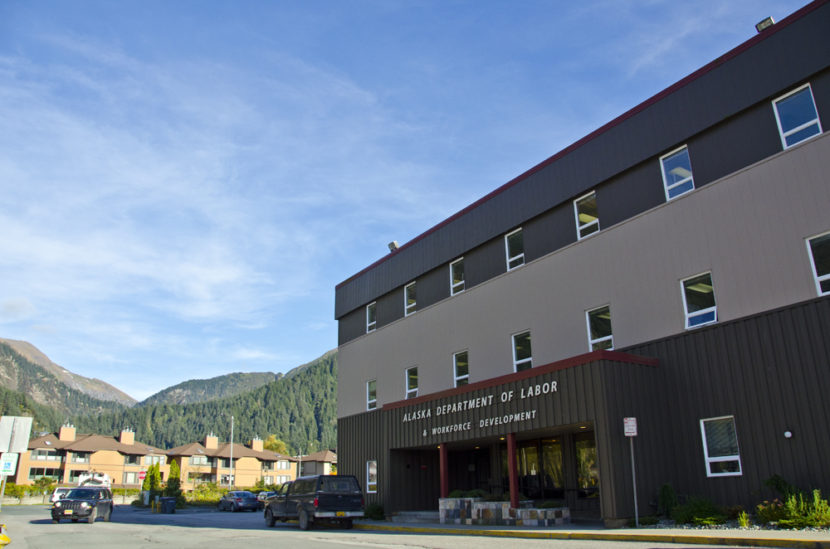
The Alaska Department of Labor and Workforce Development building in Juneau. (Photo by Heather Bryant/KTOO)

With unemployment claims skyrocketing around the country, state and federal leaders are scrambling to get bills passed to expand unemployment and other benefits to workers whose jobs have been affected by the crisis.

According to numbers from the U.S. Department of Labor, new unemployment insurance claims in Alaska were up to 8,225 for the week ending March 21 — a nearly eight-fold increase from previous weeks.

Those workers are eligible for up to $370 in payments per week, plus $24 per week for up to three dependents. The compensation is based on how much workers earned in previous pay periods and the more they earned, the higher the unemployment payments.

But HB308, recently signed by Governor Mike Dunleavy, will improve those benefits. The bill does a couple of things to the current unemployment insurance benefits: It cuts the standard one-week waiting period to receive unemployment benefits and it increases the payment for each dependent from $24 per week to $75 per week.

The provisions of the bill would also expand the definitions of unemployment by making people eligible who are taking time off work to care for children who are out of school, for example. The new provisions would also allow people who have the coronavirus or for those workers trying to contain the spread of the coronavirus to take unemployment benefits.

Still, not everyone who has been affected by the coronavirus is covered. One glaring loophole in the state legislation is that it doesn’t cover people who are self-employed or contract work, such as hair and nail salon workers, unless they’re specially set up to pay unemployment taxes.

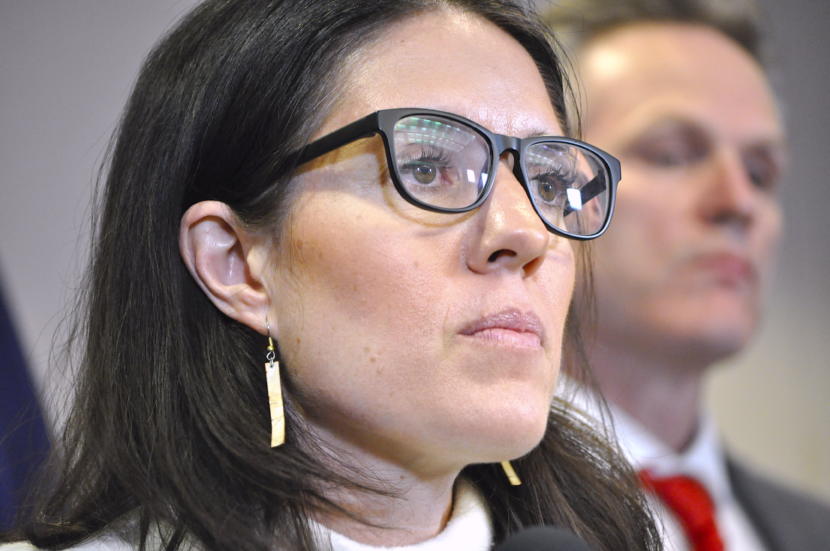
“The program right now doesn’t cover individuals who work in the gig economy, so our Uber drivers, Lyft drivers, individuals who are self-employed and independent contractors,” said Patsy Westcott.

Federal relief in the CARES Act

But that could change. Since unemployment benefits are paid by the federal government but administered by states, the $2-trillion federal aid package, called the CARES Act, that is being finalized in Congress has some potential solutions for that.

For one, it would create a whole new division called the Pandemic Unemployment Assistance program that would provide work to people “not traditionally eligible for unemployment benefits” including people who are self-employed, independent contractors and those with limited work history.

The bill would also add an additional $600 per week for unemployment programs. That would be a big boost for Alaskans, who are also eyeing extra dividend money – and up to a $1200 payment from the federal government.

As of Wednesday evening, the CARES Act was still being debated by Congress.

What does it mean for Alaskans out of work?

For most Alaskans whose work has been reduced due to the coronavirus response, the Department of Labor has a simple message: apply for unemployment.

“That is the purpose of the program, is to help individuals during these times when you’re unemployed through no fault of your own,” says Westcott. With phone lines busy and staff already working overtime to process the new claims, that means that the best bet is to apply online through the state’s website.

But for the self-employed or independent contractors – they’ll have to wait until the federal legislation is finalized.

“We are not currently set up to take those claims,” says Westcott, “As soon as that legislation passes and we can start developing that program.”

For those workers, the Department of Labor says it’s doing its best to get information out in the coming days.

Other options

There are also other benefits available that require separate applications.

Medicaid provides health care for low-income residents across the country. Previously, workers applying outside the open enrollment period in the federal marketplace had to prove a change in circumstances, for example, a lost a job or reduced hours cut. But according to Shawnda O’Brien, director of the Alaska Division of Public Assistance, requirements for documentation have been waived.

O’Brien says that other documentation requirements have been made to other programs such as senior benefits, heating and childcare in order to make things easier and more hygienic for applicants.

There are also several food assistance programs for low-income residents. SNAP (Supplemental Nutrition Assistance Program) provides food credit for people who meet income requirements, while WIC (Women, Infants & Children) can provide benefits to expectant mothers and young children. The Food Bank of Alaska also has a SNAP outreach team to help Alaskans determine their eligibility and answer other questions about the program.

“A lot of people think they don’t qualify and I think in this instance, we would just encourage people to call and talk with either someone at the Department of Public Assistance or someone on our SNAP outreach team and we could kind of estimate their eligibility,” said Cara Durr, director of public engagement at the Alaska Food Bank.

While staff with the Division of Public Assistance has been reorganizing to more efficiently process applications, there is still usually a seven to ten-day wait period for processing, according to O’Brien. That means that people should apply as soon as possible to get benefits as soon as they can.

For those with immediate needs, there are also food resources available thorough the Alaska Food Bank’s network of distributors. The organization works statewide to distribute food to 150 partner organizations statewide, including in rural Alaska.

Durr says that there has already been an increase of 50% in the number of new individuals or families seeking food but that increased donations have helped keep the Food Bank able to provide for everyone who comes, though the nature of food distribution has changed slightly to prevent the spread of the coronavirus.

“They can expect that they’re gonna be getting a pre-boxed box of food, pre-selected, they’re going to be waiting in a line I assume, but there should be sufficient spacing in some instances that may be in the car,” said Durr.

As number of COVID-19 cases grows, state officials warn of a limited healthcare system

Dr. Anne Zink, chief medical officer for the state of Alaska, briefs reporters on the coronavirus at a news conference with Gov. Mike Dunleavy on Tuesday, March 10, 2020. (Photo by Liz Ruskin/Alaska Public Media)


After this story published, a spokesperson from Gov. Mike Dunleavy’s office said a planned press conference scheduled for Friday has been postponed. They have not yet announced what time they’ll hold the conference.

As coronavirus continues to spread in the state, Gov. Mike Dunleavy and state medical officials doubled down Thursday on the message that Alaskans need to socially isolate themselves, because the state does not have the medical infrastructure to handle a severe outbreak of coronavirus. 

The State’s Chief Medical Officer, Anne Zink, said the state is working to scale up its ability to respond to the virus. But, she said, it’s not going to be enough if Alaskans don’t work to slow the rate of infection. 

“All of the modeling and all of the predictions show that the current infrastructure in Alaska alone is not going to be enough to handle this disease,” she said.

Zink said frontline medical workers are at a higher risk of contracting COVID-19 and, because medical supply chains have been disrupted globally, medical personnel are having to ration safety equipment like masks and gowns. 

“Literally every day that we can buy to get more [protective equipment] for the front lines, to get more ventilators, to get more alternative care sites set up — helps us to be able to help you when we see this disease really take hold in Alaska,” she said.

This coronavirus primarily affects the lungs and, in severe cases, patients have to be hooked up to ventilators to survive. Other states that currently have major outbreaks are reporting severe shortages, which means medical providers have to decide who gets them and who doesn’t. 

For days, reporters have been asking how many ventilators the state currently has — and Zink has said repeatedly that it’s tricky to pin down. 

One of the reasons, she said, is that individual hospitals are supposed to self-report that number to the state. 

“We ask them to report that data to us. There are limitations in that reporting, it’s not mandatory,” she said. “So we’re working with them to get that information.”

Between hospitals, surgical centers and private practices, Zink estimated that there are about 200 ventilators in the state. But, that’s not representative of how many adults could be treated at one time. Some of the ventilators are built for children or specially built for travel and would need to be repurposed, she said.

For about three weeks, Zink, Health and Social Services Commissioner Adam Crum and Gov. Mike Dunleavy have held regular updates on the state’s strategy and rationale — including several public health mandates that have changed daily life across Alaska. 

But they did not issue a statewide shelter-in-place order on Thursday, though many Alaskan communities have already imposed versions of them. And there have been calls from doctors and local leaders — to do so. 

Dunleavy said there will be another update on the state response to the virus on Friday.  At that point, he said, the state will “have a discussion about travel within Alaska.” 

He said they’ll also talk about the economic impact of the virus. Though, that discussion will be ongoing, Dunleavy said, as details of the state legislature’s stimulus plans and the federal government’s stimulus package emerge.  

This story has been updated.

Alaska health department confirms 10 new COVID-19 cases

Update (6:16 p.m.) — Tegan Hanlon, Alaska Public Media

Alaska Gov. Mike Dunleavy speaks at a news conference on COVID-19 in Anchorage, March 25, 2020. (Creative Commons photo by Office of Gov. Mike Dunleavy)

The number of known COVID-19 cases in Alaska grew to 69 by Thursday, up from 59 confirmed cases the day before, as the disease continues to spread throughout the state and the country.

The new cases include five newly-diagnosed Alaskans from the Anchorage area and two from Fairbanks. Two are from North Pole and one is from Juneau, according to the latest data from the Alaska Department of Health and Social Services, updated daily.

One person is under the age of 18, two are between the ages of 19 and 29, five are between the ages of 30 and 59 and two are over the age of 60, Alaska Chief Medical Officer Dr. Anne Zink said at a news conference Thursday evening. Four are male and six are female, Zink said.

The number of coronavirus-related hospitalizations remained the same. Three Alaskans have been hospitalized with COVID-19, the disease caused by the coronavirus. The disease has killed one Alaskan.

Of the newly-infected Alaskans, four had been in close contact with someone who also had the disease and six of the cases remain under investigation, Zink said.

More than 2,300 COVID-19 tests had been performed in Alaska by Wednesday, according to the health department.

The Associated Press reported Thursday that the U.S. now leads the world in the number of known COVID-19 cases, with the number of people known to be infected topping 82,000, according to a count by Johns Hopkins University. The Centers for Disease Control and Prevention reported more than 990 deaths.

This story has been updated.

Original story — Rashah McChesney, KTOO

Alaska Gov. Mike Dunleavy speaks about the state's COVID-19 response from the Atwood Building in Anchorage on March 20, 2020.
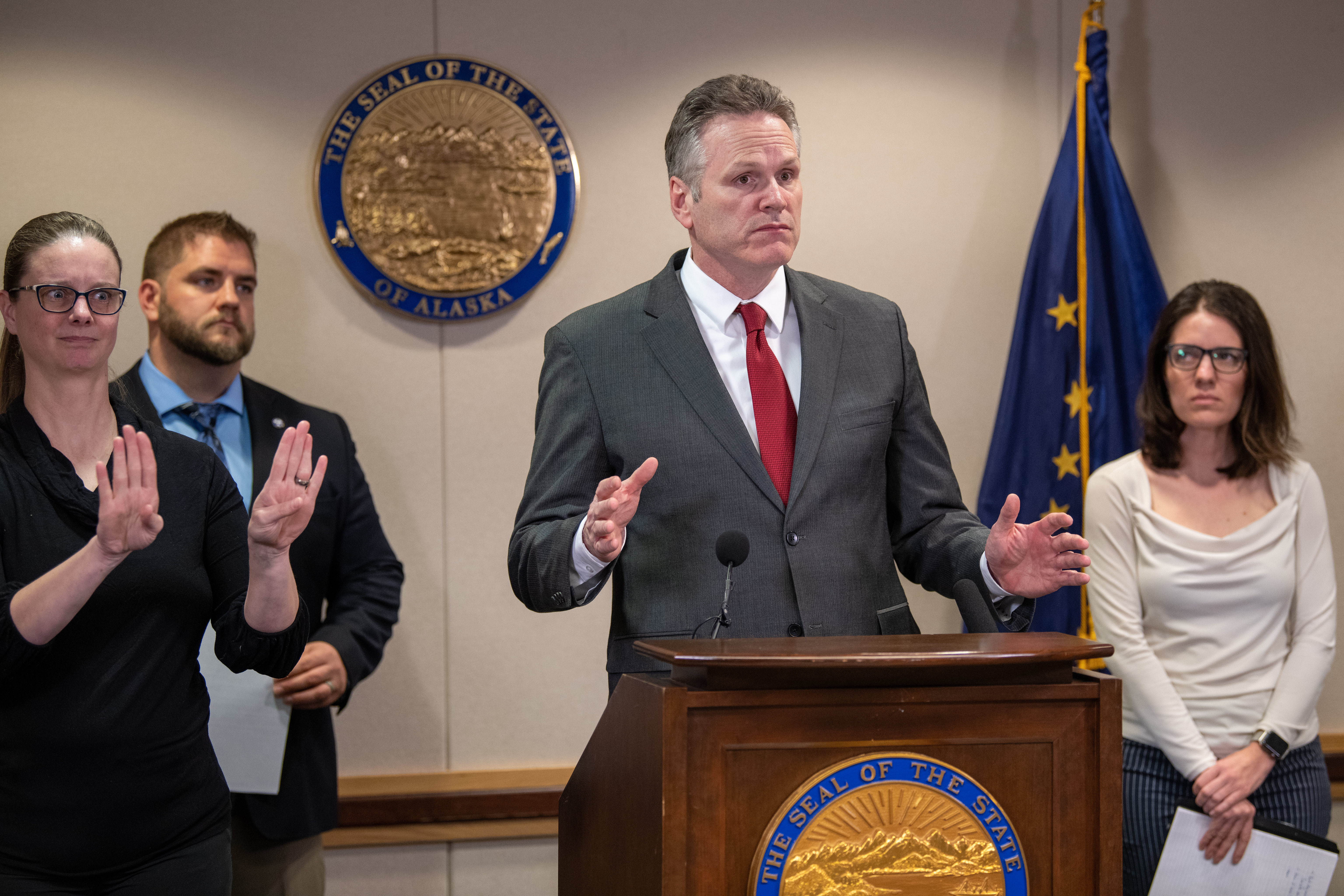
Alaska Gov. Mike Dunleavy speaks about the state’s COVID-19 response from the Atwood Building in Anchorage on March 20. Also pictured: Department of Health and Social Services Commissioner Adam Crum, Chief Medical Officer Dr. Anne Zink, and an unidentified sign language interpreter. (Creative Commons photo courtesy Alaska Governor’s Office)

Gov. Mike Dunleavy’s latest COVID-19 press conference is scheduled for 6 p.m. today.

The governor, Health and Social Services Commissioner Adam Crum, and Chief Medical Officer Dr. Anne Zink have been holding these briefings almost daily since March 10.

They’ve shared updates on the number of people in the state with confirmed cases, announced public health mandates, and explained the administration’s strategy and rationale.

The number of known COVID-19 cases in Alaska grew to 69 by Thursday, up from 59 confirmed cases the day before.

That’s according to the latest numbers from the Alaska Department of Health and Social Services, updated daily.

The new cases include five newly-diagnosed patients from Anchorage, two from Fairbanks, two from North Pole and one from Juneau, according to the department’s data. COVID-19 is the disease caused by the coronavirus.

To date, Dunleavy’s administration has imposed 10 public health mandates that have reshaped daily life across Alaska to combat the spread of the virus. Those mandates and other Alaska-specific COVID-19 resources and information are available at coronavirus.alaska.gov.

There is no statewide shelter-in-place order, though many Alaskan communities have imposed versions of them.

During an extended press conference on COVID-19 on Wednesday night, the state’s former chief medical officer spoke to the effectiveness of those types of orders. Dr. Jay Butler is now the deputy director for infectious diseases at the Centers for Disease Control and Prevention, or CDC.

“In terms of what’s happening in the United States, we’re probably only about a week into — in some parts of the country — doing that kind of hunkering down,” Butler said, calling into the meeting from Atlanta. “The cases that are being diagnosed now were most likely acquired seven to 10 days ago. So we’re only at the point where we might begin to see some impact from the steps that had been taken.”

Across the United States by Thursday, there were more than 68,000 confirmed cases of COVID-19 and 994 deaths, according to the CDC.

You can watch today’s press conference live on this post, the governor’s Facebook or Livestream pages, or on 360 North television.

Site notifications
Update notification options
Subscribe to notifications