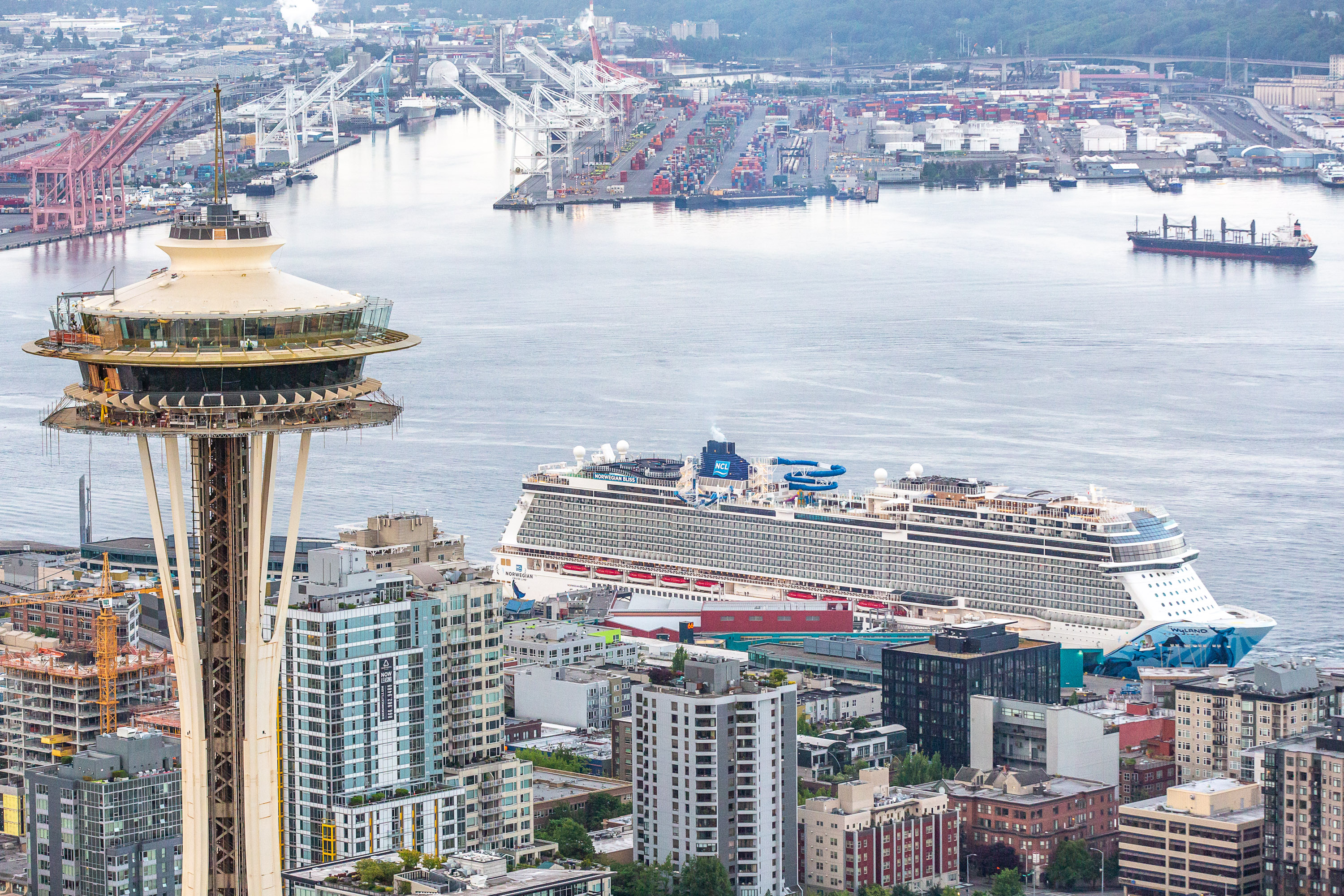
The Norwegian Bliss arrives at Bell Street Pier Cruise Terminal on its maiden voyage to Seattle on May 30, 2018. The Port of Seattle announced this week its cruise ship season would be delayed “until the resolution of the public health emergency.” (Photo courtesy Port of Seattle)
The Port of Seattle announced this week its cruise ship season would be delayed “until the resolution of the public health emergency.” It’s another variable in the indefinite suspension of Alaska’s cruise season.
According to a spokesperson with Cruise Lines International Association Alaska, cruise ships were expected make 199 port calls in Seattle, carrying more than a million passengers. Most would have gone through Alaska.
However, the big ships were already effectively barred from sailing in Alaska after Canada closed its ports to cruise ships through July 1. That’s because of a maritime law that prohibits foreign-flagged cruise ships from exclusively visiting U.S. ports.
Cruise giant Royal Caribbean also announced a longer suspension of its global fleet this week. Due to port closures, the company says it doesn’t expect any Alaska or Canada sailings until July 1. The company had planned to send three ships to Alaska: the Ovation of the Seas, Radiance of the Seas and Serenade of the Seas.
Port of Seattle Commission President Peter Steinbrueck said the decision to block cruise ships from berthing followed a strong recommendation from public health officials not to let cruise ships into port.
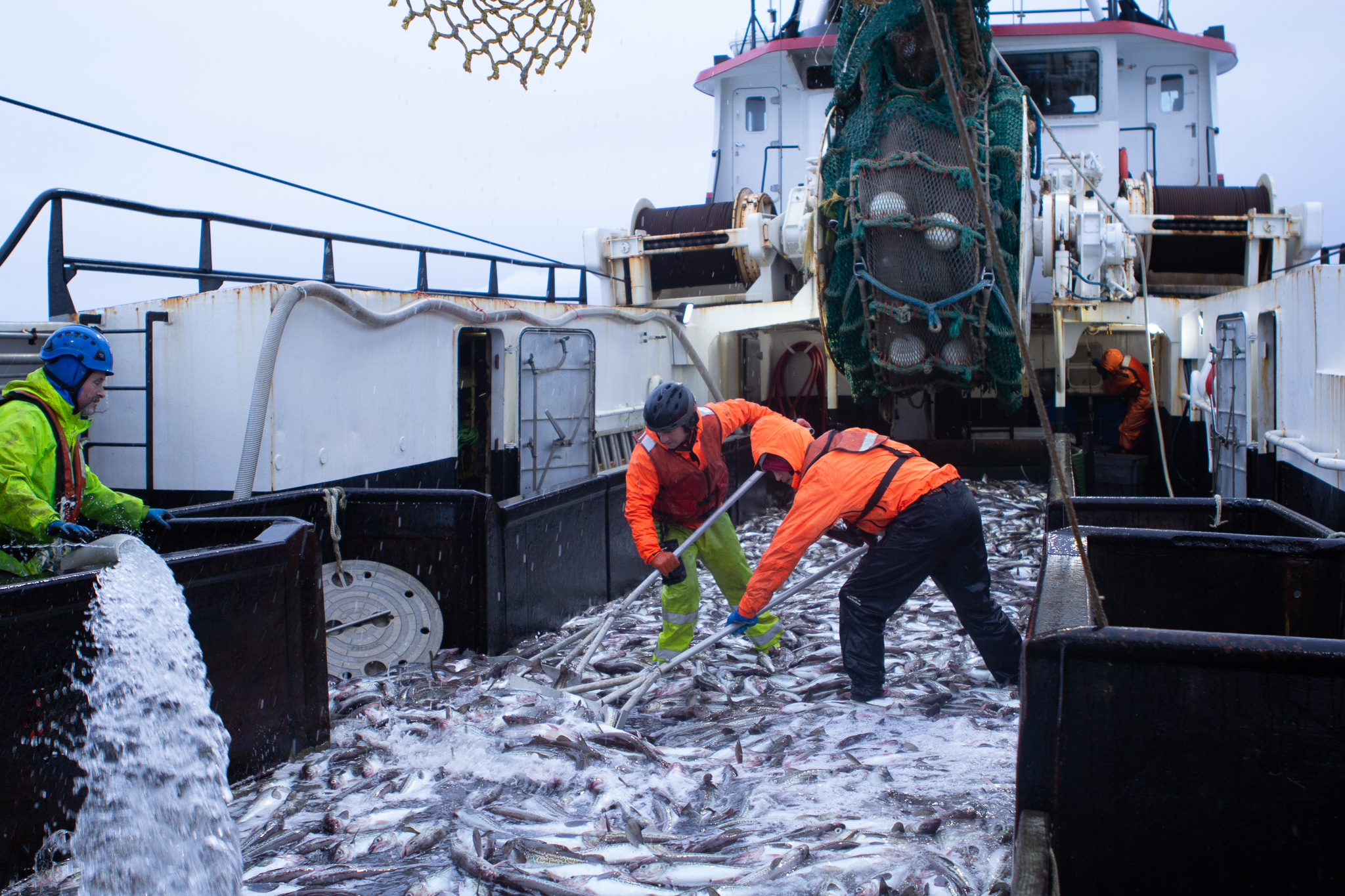
Crew members Brian Hagen, left, and Derrick Justice shovel pollock on the deck of the Commodore on Thursday, January 24, 2019. (Photo by Nathaniel Herz / Alaska’s Energy Desk)
Some 600 business entities have filed plans with the state outlining how they’ll safely bring out-of-state workers into Alaska to support “critical infrastructure” amid the coronavirus pandemic, officials said Wednesday.
Starting Wednesday morning, Gov. Mike Dunleavy is requiring people arriving in Alaska from out of state to self-quarantine for two weeks to prevent the spread of COVID-19, the disease caused by the coronavirus. People who disobey the order can be fined up to $25,000 or imprisoned for a year.
Exemptions are possible, however, for businesses in what Dunleavy’s administration calls “critical infrastructure.” Those include the oil, logging and mining industries, health care, grocery stores, airlines and fishing.
Businesses in those industries who have workers coming to Alaska before May were required to file pandemic plans with the state by Tuesday afternoon. The plans call for procedures for safely bringing in workers from out of state, and for protecting other employees and the surrounding community.
Dunleavy’s administration said that to the greatest extent possible, incoming workers should still self-quarantine once they get to Alaska. But in cases where that’s not possible, businesses were asked to explain why, and to outline their alternative to quarantining.
The deadline for businesses to submit the plans originally came less than 24 hours after Dunleavy announced the travel restrictions, which forced some of them to scramble.
“I was hearing from fishermen who were relaying through their processors that they’re out on the ocean right now fishing, and what are they supposed to do?” said Frances Leach, executive director of the United Fishermen of Alaska.
Leach said the state allowed different fishing industry associations, like the ones representing crabbers or cod harvesters, to submit general plans for their vessels and captains, which made the process easier.
She said members have had a hard time keeping up with the information and protocols they’re supposed to be following amid the pandemic. But they also recognize that these are unprecedented times, she added.
“You know, we’re all in this together. We’re all trying to quickly get up to speed,” Leach said. “And so far, I have found that most everybody has been really patient and understanding. And they get the severity of this.”
Jeremy Zidek, a spokesperson for the state’s unified COVID-19 command, couldn’t give a timeline for how long it would take the state to review all of the businesses’ response plans. Leach said the state is allowing vessels that have turned in their action plans to continue their operations as if the plans have been approved.
Meanwhile, Alaska’s economic development agency is proposing a loan guarantee program of up to $100 million to support the state’s businesses as they fight for survival amid the coronavirus pandemic.
If approved by the Alaska Industrial Development and Export Authority board at an emergency meeting Friday, the program would work with banks, not directly with businesses. Businesses that have established borrowing relationships with banks would be able to add up to $1 million to their existing loans, and AIDEA would guarantee the extra amount.
The program would be called the Sustaining Alaska’s Future Economic Guarantee Program, or “AK SAFE,” and it would last as long as Dunleavy’s coronavirus emergency proclamation. The initial proposal is to budget $50 million for the program, which could rise to $100 million if state lawmakers approve.
A spokesman for the authority, Karsten Rodvik, declined to share additional information about the proposal.
The pandemic of COVID-19 has devastated Alaska’s economy. The price of oil, the state’s major industry, has crashed amid lower demand and a standoff between some of the world’s major producers. Tourism is also facing a barren summer as people curtail their travel, and in-person service at restaurants and bars is closed indefinitely.
AIDEA’s agenda at its Friday meeting underscores that economic havoc. One item is a request by an oil company BlueCrest Energy, to delay principal payments on a $13.2 million state loan for a year due to the pandemic.
“The collapse in oil prices due to actions of foreign governments, exacerbated by the economic downturn from the COVID-19 pandemic, has resulted in the borrower encountering severe cash flow problems, and oil prices are not expected to recover in the immediate future,” the proposal said.
A second agenda item asks board members to add $2.5 million to an existing loan to the Blood Bank of Alaska. The request cites Dunleavy’s order that health care providers stop performing elective procedures for three months to free up capacity for COVID-19 patients.
“Elective procedures are approximately 50% of the blood bank’s revenues,” the authority’s staff wrote in a memo to board members.
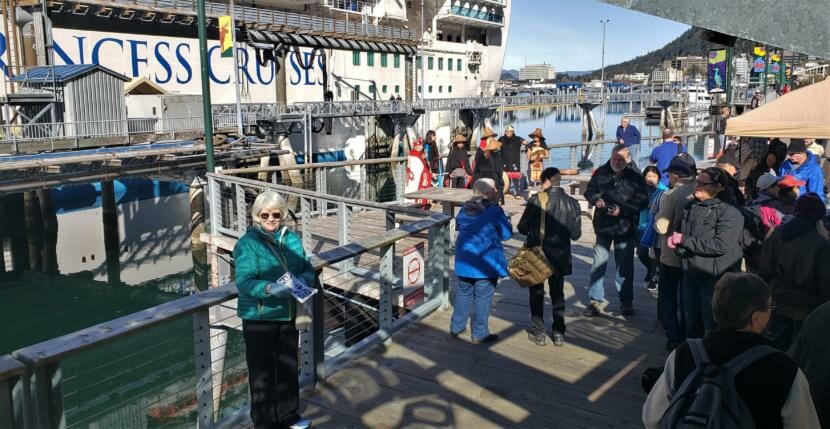
Vicki Logan of Travel Juneau greets and hands out walking maps to passengers of the Ruby Princess at the Franklin Dock on Sunday, April 28, 2019. The Yées Ḵu.Oo dance group performs behind her as part of a welcome party for the first big cruise ship of the season. (Photo by Jeremy Hsieh)
Legislation providing $2 trillion in relief for individuals and businesses hard hit by the coronavirus pandemic has been approved by the U.S. Senate. President Donald Trump has repeatedly said the cruise industry is among those he’d like to help.
“We can’t let the cruise line lines go out of business,” the president said last Sunday. “I mean, that would be massive numbers of jobs for our country.”
Cruise Lines International Association, a trade group, says its industry helps support more than 421,000 American jobs and contributes $53 billion to the U.S. economy. That’s threatened in Alaska and nationally following the global outbreak of COVID-19.
These economic figures include indirect economic benefits to smaller Alaska operators which are feeling the hit from a stalled cruise season.
“You’d be hard to find an operator in Alaska that’s not currently adapting schedules and figuring out plans to survive summer,” Colleen Stephens, who helps run a family owned boat tour operation in Valdez.
She’s also president of the Passenger Vessel Association (PVA), the national trade association representing U.S.-flagged passenger ships. In Alaska, that’s everything from private whale watching tour boats to the Alaska Marine Highway System.
The PVA recently penned a letter to the White House highlighting the “economic damage” being inflicted on its members by the coronavirus pandemic.
“The message we wanted to put forward is, ‘to remember us,’” she said. “We are providing U.S. jobs, we are providing taxes into the U.S. economy and local economies. And as we feel the hit which — we are all feeling very drastically — we wanted the message to be there to remember your U.S. domestic operators.”
A major union representing U.S. crew members is against any public money flowing to the cruise lines.
“We’ve heard discussions about a cruise industry bailout and it just, I can’t tell you how inappropriate and outrageous It really is — when you start thinking about it,” said Don Marcus, president of The International Organization of Masters, Mates & Pilots.
He says domestic, U.S.-flagged vessel operators should be first in line, not cruise lines that flag their ships in foreign countries to avoid paying taxes.
“My concern is it would be an outrageous misappropriation of, of tax dollars to bail out international cruise ship companies that are U.S.-owned that don’t pay taxes,” Marcus said in an interview. “When you have ferries, marine transportation industry around the country that are going to be in a similar position.”
Alaska’s U.S. senators haven’t said directly whether they support aid to the cruise lines.
“Senator Sullivan is focused on lessening the impacts of the coronavirus pandemic to Alaska’s working men and women, and many businesses throughout the state, including our tourism businesses — many of which are dependent on the cruise industry,” spokesperson Mike Anderson wrote in a statement.
“Senator Murkowski is working with her colleagues to mitigate the impacts of this pandemic on Alaskans, small businesses, non-profits, and industries,” spokesperson Karina Borger wrote.
The Senate bill establishes a nearly $500 billion fund for struggling industries, though it doesn’t specify exactly how the money will be doled out. That will come later.
A Washington, D.C. watchdog group that’s tracking the recipients of the stimulus package, says the big cruise lines like Carnival, Norwegian and Royal Caribbean shouldn’t be allowed to tap into this money.
“The cruise industry has been abusing the US taxpayer for years — for decades,” said Steve Ellis, president of Taxpayers for Common Sense in an interview.
He says COVID-19 took a lot of people by surprise. But big players can’t pretend like they didn’t see a potential pandemic as possible, “particularly in the cruise industry that has had problems in the past with viruses and other illnesses and sick ship syndromes.”
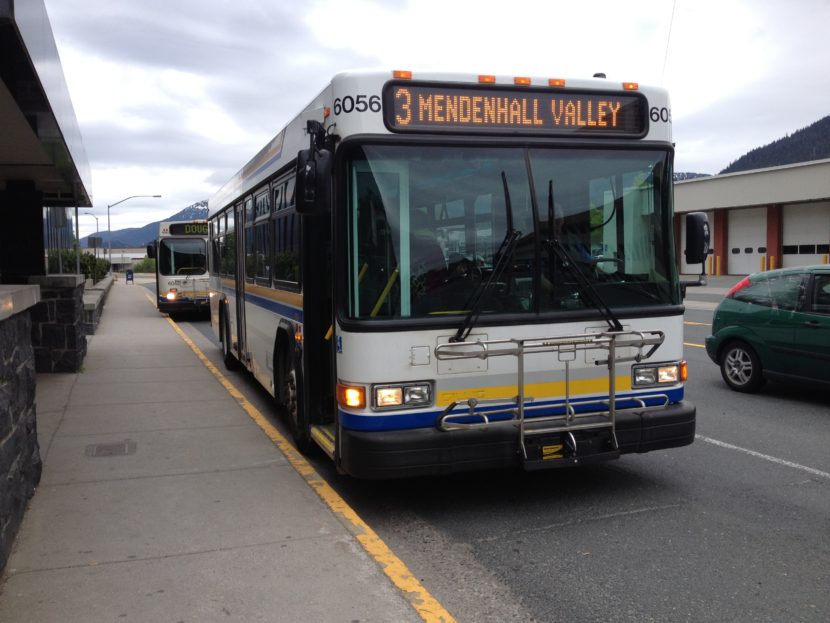
A Capital Transit bus stops at the Federal Building. (Photo by Lisa Phu/KTOO)
Capital Transit is asking Juneau residents to use buses strictly for essential travel during the COVID-19 outbreak.
In addition to free fares announced last week, it has enacted new measures effective today.
Engineering and Public Works director Robert Barr said it’s crucial that residents stay at home unless they absolutely must use the bus for critical reasons such as:
Healthcare appointments and pharmacy visits
Grocery shopping
Employment at a critical job
Barr said the service has already implemented measures to keep people safe — they’re requiring passengers to board the bus from the back door to create distance between passengers and bus drivers. Riders with disabilities can still board from the front door.
All passengers are encouraged to follow social distancing guidelines.
“Please only ride the bus when you really need to ride the bus,” Barr said. “Do your best to practice all those good hygiene practices. Cough into your shoulder if you have to cough. Don’t touch your face. Wash your hands. Try not to touch surfaces unless you need to touch them.”
That goes along with new changes the service made to its routes to adapt to official prevention guidelines. As of today, the following changes go into effect:
Limiting bus capacity to nine riders at at time
Canceling Express Routes 5 and 6 — those go to the University of Alaska and Riverside Drive
Adding additional buses on Routes 3 and 4 — those travel between downtown and Mendenhall Valley
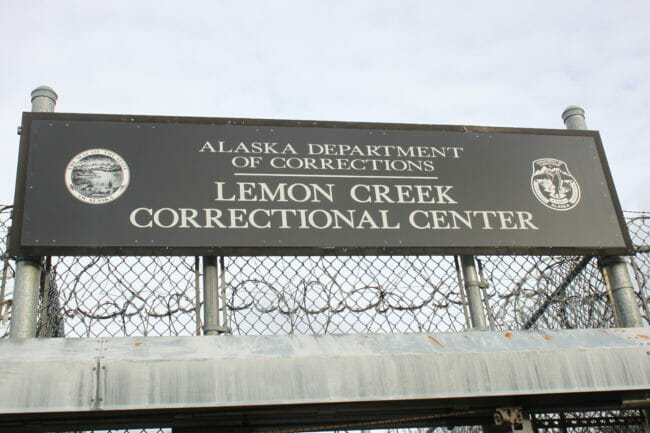
Lemon Creek Correctional Center in Juneau. (Photo by Lisa Phu/KTOO)
There have been no confirmed cases of coronavirus in Alaska’s jails or prisons. But as of Wednesday, there had only been two tests conducted, both of which came back negative, according to the state’s Department of Corrections.
Meantime, the department has put several new policies in place in an attempt to stop the virus from spreading among inmates or staff.
“Social distancing in a correctional setting is a challenge, but we’re really doing the best that we can,” Corrections spokeswoman Sarah Gallagher said.
The department has suspended all visitation and is instead offering inmates two free 15-minute phone calls per week to keep up with family and friends on the outside. And while cellmates are, of course, still in close proximity to each other, the department has suspended any group activity outside of cells that involves more than 10 people.
“They’re doing other things,” she said. “We have encouraged superintendents to, kind of, increase recreational activity, whether it’s showing more movies and having popcorn in the housing units to kind of fill that time.”
The department is also having inmates produce personal protective equipment for use by medical professionals outside prison walls by sewing gowns and surgical masks, Gallagher said.
The ACLU of Alaska also called on the department to allow hand sanitizer in its facilities to keep up good hygiene.
Gallagher said that because hand sanitizer has alcohol in it, and alcohol is banned within correctional institutions, that is not an option. But the department is providing inmates with free bars of soap, which they would otherwise have to pay for, and encouraging more hand-washing, she said.
Current plans call for anyone showing symptoms of coronavirus to be given a surgical mask, taken to a medical unit and isolated while awaiting results, Gallagher said. That person’s housing unit would also be quarantined from the rest of the facility’s population, she said.
If the inmate’s test is negative, the quarantine will be lifted, Gallagher said. If it comes back positive, the inmate will be treated by medical staff and their housing unit will remain under quarantine for 14 days to monitor the other inmates for symptoms, she said.
Alaska’s chief medical officer and an epidemiologist with the Centers for Disease Control and Prevention say more evidence is coming that will inform policymakers’ public health mandates.
Dunleavy did not issue a shelter-in-place order for the state, though many local leaders in Alaska have imposed versions for their communities.
Dr. Jay Butler is the deputy director for infectious diseases at the CDC, and formerly Alaska’s chief medical officer. Butler said it’s unclear how long hunkering down measures will be recommended or mandated. But in another week or so, he said, the CDC may have the data to gauge how effective hunkering down is at curbing new cases.
“In terms of what’s happening in the United States, we’re probably only about a week into — in some parts of the country — doing that kind of hunkering down,” Butler said, calling into the meeting from Atlanta. “The cases that are being diagnosed now were most likely acquired seven to 10 days ago. So we’re only at the point where we might begin to see some impact from the steps that had been taken.”
He said the CDC is monitoring the numbers and impact very closely in places like New York City. He called it “an ongoing analytic process” that will inform the CDC’s guidance. That puts policymakers in Alaska, where the outbreak is several days younger than other hotspots in the country, in a better position to flatten the curve and avoid overwhelming the health care system.
How those cases get identified — testing — has been a major bottleneck in the COVID-19 response globally.
At the national level, Butler said, a lot of the work being done to open that bottleneck is in the private sector. He said he couldn’t offer a timeline for when that would change, but said companies are working hard at it.
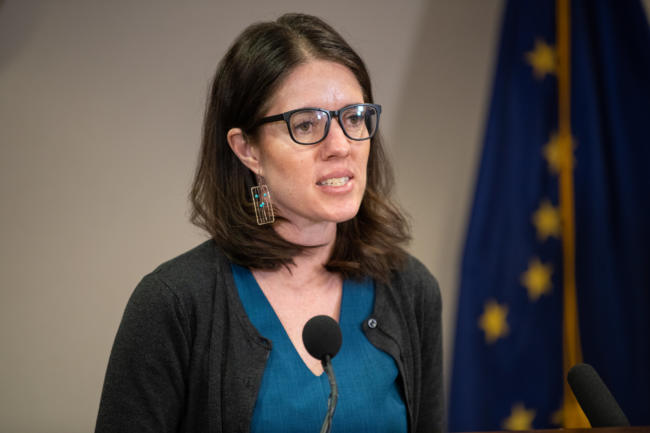
In Alaska, Chief Medical Officer Dr. Anne Zink said testing capabilities are improving, including a one-day spike of over 600 tests on Tuesday.
”We’re seeing a sort of an exponential climb in the testing, which we like to see,” Zink said. “We see that increasingly climb. So we are working through those bottlenecks here.”
She said a lack of swabs used in testing had been a major limiting factor for Alaska. They’re now being produced in state, and the state received a shipment of 4,000 on Wednesday.
Dunleavy was asked when he would mandate Alaskans stay at home.
“When our medical team says … that that is a trigger we absolutely have to pull,” he said.
Zink said her recommendations have to do with how Alaskans act.
“So when people stop moving, and they respect that? We don’t have to mandate it,” she said.“But when people continue to do it, we have to mandate it. So we are trying really hard to explain the purpose and the reasoning of this. We are Alaskans, we pride ourselves on being free and independent and making those decisions. But this virus isn’t going to be stopped by any one of us. It’s going to be stopped by all of us working together.”
The state’s latest counts, public health mandates and other resources are available at coronavirus.alaska.gov.
Close
Update notification options
Subscribe to notifications
Subscribe
Get notifications about news related to the topics you care about. You can unsubscribe anytime.