Alaska coronavirus news

Live updates and information on COVID-19 in Juneau and Alaska

Distance-learning lesson plans take shape as Alaska’s students settle in for coronavirus closure

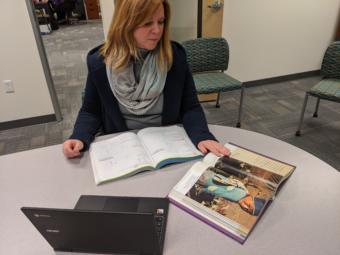
Jennifer Knutson, the senior director of teaching and learning for the Anchorage School District, shows some textbooks and a district-issue Chromebook that students have access to on March 13. She says that there will need to be a combination of traditional and e-learning opportunities for students during school closure. (Photo by Mayowa Aina/Alaska Public Media)

There’s a lot of uncertainty surrounding education right now. Schools statewide are closed until at least May 1, but that doesn’t mean instruction has ended.

State Deputy Education Commissioner Karen Melin said she understands how uncomfortable that feeling of uncertainty is for families looking for answers.

“Information is changing rapidly, and new information is coming out hour by hour,” Melin said in an email. “What may have been the situation on Friday is no longer how things are today. The same may be true for tomorrow.”

Melin said the state is working closely with partners across Alaska to keep the public informed.

Districts maintain that they will continue to provide a curriculum to students. And now, what that curriculum will look like is starting to take shape.

Melin said each of Alaska’s 54 school districts will handle remote education differently.

For example, St. Mary’s City School District near Bethel, with a total enrollment of 200 students, can use more of an in-person approach.

“That might be that, when they come to get their their meals, they’re handed their daily packet of work,” Melin said. Then they might turn in their work in exchange for a new homework packet the next day.

“That’s not a long term solution, but it’s one that the district has figured out as a way to continue a student’s learning in a disruptive time,” Melin said.

Other districts like the Anchorage School District, which serves over 40,000 students, are more equipped to offer e-learning opportunities.

ASD already has an online learning program that some high school students and middle school students use to take classes not offered at their school. Some home school programs or other alternative programs use online classes too.

But Jennifer Knutson, ASD’s senior director for teaching and learning, said there isn’t much data on how online learning works at the elementary level.

Most of the online classes right now are geared toward older students and are self-paced. She said there would need to be more supervision for elementary students.

“We still want to have the human connection with all this,” Knutson said. “So one of the components we’re going to emphasize is on a regular basis having personal contact through phone calls to just check in and see how things are going.”

After conducting a needs assessment with families, ASD reported 4% of families had no internet in the home, and 5% of families had no devices at home.

Recently, in a letter to families, ASD Superintendent Deena Bishop stated that the district is on track to begin offering remote learning options for all grade levels on March 31.

For elementary students, ASD plans to offer live online tutoring opportunities, particularly for English language arts and math, as well as pencil-and-paper support materials that families can pick up.

Middle school teachers will use a combination of offline activities and online coursework.

And high school students can expect the first online courses to be the ones needed for graduation.

The district said it is planning to offer extended time in the summer for anyone missing necessary credits to graduate.

The Anchorage School District has about 22,000 devices like Chromebook laptops and tablets that it can loan to students during closure, but that’s not enough for every student to have one. Teachers will also rely on traditional pen and paper materials to continue to teach students. (Photo by Mayowa Aina/Alaska Public Media)

There is a lot of focus on the curriculum right now, but seventh grade science teacher Ben Walker in Anchorage said his main concern has been ensuring his students have everything they need physically and mentally.

Families are mostly positive, he said. But his students are a little anxious. This is the first time they’re living through a worldwide event on this scale.

“They want to see their friends. They want to know and make sure their friends are OK,” he said. “Hopefully, as time rolls on, there’s a lot more connections that we can make between kids, because that’s really a big piece that that they miss: that socialization part of coming together every day.”

Being out of class has been hard for him too. But Walker said if there’s any silver lining to this crisis, it’s that the education community is being challenged to think in new and creative ways.

He hopes to introduce students to activities that don’t require sitting in front of a screen, but he’s also looking forward to using new tools.

“I’m definitely excited,” Walker said. He said there are techniques that he’s always wanted to try, and now he is almost forced to do so. “I think you know, everyone will come out of this with this kind of an improved practice in this in this online space.”

ASD has listed several educational resources and activities for families to do on its website while official instruction gets up and running next week.

The state’s Department of Education and Early Development has also launched a website dedicated to remote learning resources.


Juneau tells residents to ‘hunker down,’ votes to close nonessential businesses for 2 weeks

Traffic moves down Marine Way past Juneau City Hall on Sept. 25, 2017. (Photo by Jeremy Hsieh/KTOO)
Traffic moves down Marine Way past Juneau City Hall on Sept. 25, 2017. The City and Borough of Juneau voted late Monday to close all nonessential businesses and told residents to stay home as much as possible to limit the spread of COVID-19.  (Photo by Jeremy Hsieh/KTOO)

Starting Tuesday at 5 p.m, most residents of the City and Borough of Juneau are required to stay home in order to slow the spread of coronavirus. 

The Juneau Assembly unanimously passed a resolution in a special meeting Monday night ordering people to “hunker down.” It also closes nonessential businesses for the next two weeks.  

The resolution includes a number of exemptions for critical businesses related to health care, construction, shipping and home repair. Those businesses must still comply with “social distancing” guidelines, like maintaining a 6-foot distance between employees and members of the public. 
Juneau learned of its first confirmed case of COVID-19 the disease caused by the new coronavirus — on Sunday. Officials reported that the adult patient is quarantining at home. 

The state issued a mandate similar to the Assembly’s earlier in the day Monday. It bans gatherings of more than 10 people. The state also issued a mandate requiring a 14-day quarantine for travelers arriving in Alaska from out of state, similar to a mandate the Assembly passed on Sunday.

This post has been updated. 

Physicians object to Juneau’s coronavirus quarantine exemptions

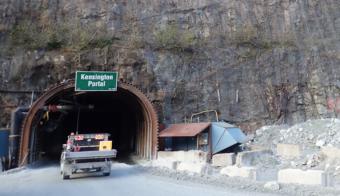
A mine vehicle enters the Kensington Portal on Oct. 15, 2019.
A mine vehicle enters the Kensington Portal on Oct. 15, 2019. It’s one of two accesses for a network of about 28 miles of underground tunnels. (Photo by Jacob Resneck/CoastAlaska)

Update (Wednesday, March 25, 3:56 p.m.) — Jacob Resneck, CoastAlaska

Employees and contract workers at Kensington Mine will now be required to spend 14 days in quarantine in a Juneau hotel if they arrive from outside Alaska or a coronavirus-infected community. The move follows a similar protocol by Hecla Greens Creek Mine. (Read more)

Original story

Doctors are criticizing Juneau’s elected officials for carving out broad exemptions to the city’s new coronavirus quarantine rules.

As originally written, the Juneau Assembly’s emergency resolution would institute a mandatory 14-day quarantine for anyone arriving from out-of-state or from a community with confirmed coronavirus cases.

But Juneau’s two largest private employers objected.

“The mandated quarantine is problematic for business,” Mike Satre of Hecla Greens Creek Mine told the Assembly on Sunday. “We have many of our workers who come from throughout Alaska as well as Outside.”

He penned a letter on behalf of the mine seeking an exemption as a “critical industry.”

Coeur Alaska — which operates Kensington Mine — also warned that the quarantine would impact its 383-person operation as the company brings in out-of-state workers who work in two-week shifts.

“Passage of any resolutions restricting the ability of our workforce to travel to and/or work at the mine would have severe unintended consequences for operations,” Kensington’s General Manager Mark Kiessling wrote in a letter to elected officials.

The Assembly heard these concerns and acted: By a one-vote margin, it added exemptions using the federal government’s guidance on “essential critical infrastructure workers.”

That includes miners. And health care workers.

But Bartlett Regional Hospital’s medical staff are observing the quarantine anyway.

Dr. Steven Greer divides his time between Oregon and Juneau. He flew into town last Wednesday, so it’ll be about a week before he can start seeing patients.

And he said he’s not going back to Oregon any time soon.

“I told my wife goodbye and said, ‘I’ll see you down the road when all this is over,’” he told CoastAlaska by phone on Monday. “I can’t travel anymore, because every time I travel, I’d have to go into quarantine.”

He’s among several doctors that penned a letter to Assembly members urging them to rethink exempting industries.

“My recommendation is if the miners want to work, that they should come up and stay and not go back south until this thing is over,” he added.

Already one of the mines has reversed itself.

On Monday, Greens Creek sent a memo to its workforce saying everyone arriving into Juneau first be quarantined for 14 days at a local hotel. The mine is moving to a 28-day shift to accommodate the change.

A spokesperson for Coeur Alaska said Kensington Mine is considering “other options,” including moving to longer shifts.

In a statement, Bartlett Regional Hospital’s CEO Chuck Bill wrote that, “for the public good the travel quarantine needs to be as restrictive as possible for the time being.”

That’s what hospital doctors have been saying.

“We have a disaster coming, and it’s like we’re watching the tsunami come,” said Dr. Joanne Gartenberg, who runs Bartlett’s behavioral health section. “But this time, we can actually mitigate the tsunami — we can make choices.”

She said the only effective way to slow the spread of coronavirus is to not travel.

One of the physicians in her section had been commuting from Arizona, where he has a wife and young son.

“And he’s really facing being separated (from) his family now for several months, really — it’s a really difficult choice,” she said. “But he made the right choice, because he wants to protect Juneau, wants to protect himself, and he wants to be here to be able to treat our population.”

It isn’t clear what other exempted industries will continue to function. The federal guidelines give broad latitude to the fishing industry, government workers, the energy sector and others.

Marijuana business owners had appealed to the Juneau Assembly for an exemption as well. That’s because federal prohibition on mailing cannabis requires individuals to courier product within the state. But cannabis suppliers aren’t included in the federal exemptions for critical businesses, nor did the Assembly add them.


Dunleavy administration mandates 2-week quarantine for people arriving in Alaska

Alaska Gov. Mike Dunleavy speaks about the state's COVID-19 response from the Atwood Building in Anchorage on March 20, 2020.
Alaska Gov. Mike Dunleavy speaks about the state’s COVID-19 response from the Atwood Building in Anchorage on March 20. (Creative Commons photo courtesy Alaska Governor’s Office)

Update — On July 28, 2020, Alaska Gov. Mike Dunleavy announced that starting August 11th, nonresident travelers to the state will be required to have a negative COVID-19 test.

Alaska Gov. Mike Dunleavy’s administration announced on Monday that anyone entering Alaska from out of state must self-quarantine themselves for 14 days and monitor for symptoms.

The mandate goes into effect at 12:01 a.m. on Wednesday.

“Arriving residents and workers in self-quarantine should work from home unless you support a critical infrastructure,” Health and Social Services Commissioner Adam Crum said at a news conference on Monday.

The administration also ordered all businesses in the state where people are within six feet of each other to close, including nail salons, hair salons and massage therapy locations. The order goes into effect at 5 p.m. Tuesday, Crum said.

Dunleavy’s administration issued the new mandates Monday in response to the ongoing coronavirus pandemic. The administration also ordered that Alaskans stay six feet away from each other unless they are part of the same family unit, banning gatherings of more than 10 people.

The number of known coronavirus cases in Alaska had also grown to 36 by Monday, up four cases from the last announcement on Sunday, according to Dunleavy.

Alaska Chief Medical Officer Dr. Anne Zink said Monday the four new positive tests are from Anchorage, all related to travel outside the state.

“There’s going to be changes in the way we live,” Dunleavy said. “We’re doing that now.”

This story has been updated.

Senate adds $1,000 stimulus checks before sending budget back to House

Sen. Mike Shower, R-Wasilla, questions Assistant Attorney General William Milks in the Senate Judiciary Committee in Juneau on March 22, 2019. Milks was testifying on Senate Bills 23 and 24, which would compensate Alaskans for past cuts to the Alaska Permanent Fund dividend.
Sen. Mike Shower, R-Wasilla, speaks in a committee meeting last year. On Monday, Shower proposed a $1,000 economic stimulus payment to everyone who received a 2019 permanent fund dividend. The Senate passed the proposal, 12-7, before passing the entire budget bill, 17-1. (Photo by Skip Gray/KTOO)

The Alaska Senate passed the state budget on Monday, including a $1,000 economic stimulus payment to everyone who received a permanent fund dividend last year.

Wasilla Republican Sen. Mike Shower proposed the payment as an amendment to the budget bill. And he said federal stimulus isn’t certain.

“I would love that we did not have to do something like this right now, and that we could save the money moving forward,” Shower said. “But, again, we are betting on those things to happen, while people are suffering right now. It’s not a want. This is a need.”

Senators intend for the payments to be made immediately after the bill passes.

Sen. Bert Stedman, R-Sitka, speaks on the Senate floor in 2019 in Juneau. (Photo by Rashah McChesney/KTOO)

Sitka Republican Sen. Bert Stedman opposed the stimulus payment. He said Alaskans will have specific needs — like food banks, housing, hospitals and ambulances — that would be better served with more targeted spending.

“We have a limited amount of funds,” Stedman said. “We need to be targeted in how we allocate them, so we don’t see a COVID-19 virus flying by like a flock of ducks, and we grab our 12-gauge and just shoot in the air and hope something falls out.”

The House passed the operating budget, House Bill 205, earlier this month. The Senate added the capital budget to the bill.

If the House doesn’t agree to the changes the Senate made, a conference committee would meet to hash out the differences between the two versions.

The stimulus payment would be drawn from the Alaska Permanent Fund’s earnings reserve account. It would not follow a limit on spending from fund earnings passed in a 2018 state law.

The stimulus payment passed 12-7. The budget passed 17-1. Eagle River Republican Sen. Lora Reinbold was the only “no” vote on the budget, saying that it contained no meaningful spending reductions.


Watch the latest legislative coverage from Gavel Alaska.

Bush Alaska lawmakers seek extension of REAL ID deadline due to coronavirus concerns

Rep. Neal Foster, D- Nome, discusses budget issues at a House Majority press availability on March 21, 2017. Foster co-chairs the House Finance Committee, and was concerned about the potential effect of further budget cuts.
Rep. Neal Foster, D- Nome, at a House Majority press availability on March 21, 2017. (Photo by Skip Gray/KTOO)

Update (Tuesday, March 24, 11:55 a.m.) — Wesley Early, KOTZ – Kotzebue

At a news conference Monday, President Donald Trump said he will be extending the deadline for Americans to be REAL ID compliant. Trump did not give specifics as to when the new deadline will be announced, stating it will happen “very soon.” (Read more)

Original story

Legislators who represent the bulk of Alaska’s villages are asking the state’s congressional delegation to try to extend the deadline for Alaskans to get REAL ID-compliant identification. The request comes amid concerns over the coronavirus.

The federal government is mandating that any Alaskan who wants to travel commercially on a plane must have one of those IDs by Oct. 1.

In a letter to Sens. Lisa Murkowski and Dan Sullivan, as well as Congressman Don Young, the Alaska House Bush Caucus wrote that the state Division of Motor Vehicles has yet to come up with a process to help rural Alaskans. Many of them don’t have DMV access in their villages to get their REAL IDs.

The lawmakers say those problems have been compounded by travel concerns brought on by the coronavirus. As of Monday morning, there were no confirmed positive cases of coronavirus in any of the state’s numerous village communities, but several villages have enacted various travel restrictions for their communities.

The caucus notes that the federal government has already extended several deadlines, including the deadline to file taxes and suspension of student loan interest and nationwide standardized testing.

The Alaska House Bush Caucus is made up of Reps. Bryce Edgmon, I-Dillingham; Tiffany Zulkosky, D-Bethel; Neal Foster, D-Nome; and John Lincoln, I-Kotzebue.


Site notifications
Update notification options
Subscribe to notifications