Alaska coronavirus news

Live updates and information on COVID-19 in Juneau and Alaska

Alaska unemployment claims skyrocket after coronavirus shuts down restaurants

Some businesses have closed to the public due to concerns about the spread of coronavirus. The result is a surge in unemployment claims statewide. Others, like the business pictured — Devil’s Club Brewing — are still open but suggesting that patrons take their food and beer to-go as they cannot dine-in. (Photo by Adelyn Baxter/KTOO)

The number of Alaska workers applying for unemployment insurance exploded in the days after elected officials ordered restaurant and bar closures around the state to prevent the spread of the coronavirus, according to preliminary figures from Gov. Mike Dunleavy’s administration.

Last week, people opened 687 new claims with the Alaska Department of Labor and Workforce Development. In the first five days of this week there were 4,046 new claims, Lennon Weller, an economist with the agency, said in an email Thursday.

That’s a more than seven-fold increase in the rate of applications, if they continue at the same pace through the end of the week.

The state’s unemployment insurance trust fund has roughly $500 million and is considered “fully solvent,” Weller said.

“We are in a rather good position to handle a significant increase in claims,” he said.

Nationally, the number of new unemployment claims has already started surging amid the coronavirus pandemic. The U.S. Department of Labor said there was an increase of 70,000 — or some 30% — in new unemployment claims during the second week of March. Some states have been reporting increases of more than 1,000%.

notice on the state labor department’s website noted that the full economic impact of the coronavirus won’t be clear until mid-April, when March’s employment figures come out. Those will be the first to account for state and local closures.

Workers who lose their jobs are eligible for weekly payments ranging from $56 to $370, based on previous earnings, if they are unable to work, plus $25 a week in additional payments for up to three dependents.

A new bill passed by the Alaska House of Representatives on Thursday would bump that payment to $75 for each dependent, and remove the cap on the total number of dependents. The bill, if passed by the Senate, would also add three new reasons that someone could qualify for unemployment benefits. Those are:

  • For providing care, including medical care, to one or more persons.
  • For preventing or limiting the spread of COVID-19.
  • For preventing or limiting economic loss or harm.

Those new rules would include parents who are forced to stop working to stay at home to provide childcare while schools are canceled.

“Those individuals where their employer says, ‘you have to go home, you have to quarantine yourself for 14 days,’ we want to be able to pay those individuals unemployment insurance benefits while they’re home on that quarantine,” said Westcott, speaking telephonically at a Senate Finance Committee meeting on Thursday, “Or the parent who isn’t able to work right now because the schools are closed. Currently, under current unemployment insurance laws, we can’t help those parents out during that time, so that’s exactly what this legislation seeks to do.”

The legislation would also waive the one-week waiting period for workers from the time of their application to receiving benefits.

The bill comes on the heels of the U.S. Department of Labor’s new guidance for states announced last week for administering unemployment insurance to workers who have been laid off, quarantined, or leave their jobs to avoid infection or care for a family member.

Editor’s note: The caption of the photo has been updated to reflect that while some businesses have closed entirely others, like Devil’s Club Brewery, are still open but have had to change the way they operate. Devil’s Club is still open, but is suggesting take-out of the items on its menu. 

How to maintain mental wellness — for yourself and others — during social isolation

Dr. Elaine Schroeder, host of KTOO’s “Mind Over Matter.” (Photo by Sheli DeLaney/KTOO)

“We often say that Juneau is an amazing community. I think this is going to prove it.”
— Dr. Elaine Schroeder

On Tuesday, Juneau Afternoon host Scott Burton interviewed psychotherapist Dr. Elaine Schroeder. Schroeder explored ways to maintain mental wellness during the pandemic and social isolation.
She is also the host of KTOO’s Mind over Matter, a program focused on social justice and mental health, and has lived in Juneau for over 30 years.

Before delving into mental wellness, Schroeder emphasized the unprecedented nature of the pandemic and being patient with the feelings that it evokes: “Like everybody else, I’m scared. It’s human. This is a pandemic that has never occurred in the history of our lives,” said Schroeder.

Some of the strategies for mental wellness that Schroeder recommended include:

  • Grounding oneself in trusted, reputable sources rather than consuming information in passing. “WHO (World Health Organization), reputable scientists, and research intuitions we can trust,” said Schroeder.
  • Finding creative ways to stay connected with others, while upholding a responsibility to practice social distancing and isolation.
  • Building routine and structure, such as making sure to get outside everyday. “I try to get out, rain or shine!” said Schroeder.
  • Taking preventative measures to prepare for isolation — especially for those with depression or other pre-existing psychological conditions. These include setting up calls with a therapist, establishing routine, or unearthing old creative projects.
  • Figuring out ways to help and receive help from others, whether that’s through engaging with online mutual aid groups. The new Juneau Mutual Aid group on Facebook is one example.
(Creative Commons illustration by The People Speak!)

“Social isolation is going to be a challenge for all of us,” said Schroeder. “Offering to help others can really help create a sense of community. Loneliness is a very serious health risk for older people living alone, for anyone living alone. I’m sure that in Juneau, because of the strength of our community, that there will be remedies for things that individuals may be worried about: How am I going to get groceries? How am I doing to do this, how am I going to do that?” said Schroeder.

The measure of these next uncertain months will be about how individuals and communities respond to crisis, taking care of themselves and one another.

Schroeder ended her interview with an eye toward hope: “We often say that Juneau is an amazing community. I think this is going to prove it,” said Schroeder.

Listen to the full interview here:

As Legislature looks to pass budget and coronavirus response, oil prices plummet

Pat Pitney, then the state director of the Office of Management and Budget, gives a budget overview in 2016. On Thursday, Pitney — now the director of the Division of Legislative Finance — said the state is facing the budget impact of low oil prices. (Photo by Skip Gray/KTOO)

As the Alaska Legislature weighs passing the budget and coronavirus relief in the coming days, lawmakers are considering how to pay for them.

The recent collapse in oil and stock prices raise questions about everything from the size of permanent fund dividends to the future of state finances.

The price of Alaska North Slope oil has plummeted to $23.91 per barrel on Wednesday. On Feb. 20, it was $57.20 per barrel.

This kind of price drop has happened before, noted Pat Pitney, director of the Division of Legislative Finance, the nonpartisan office that analyzes the state budget for the Legislature.

“We had a similar oil price crash in 2014,” Pitney said. “The state was in a very different position at that time. We had $16 billion in our savings accounts, plus a growing permanent fund.”

That $16 billion will be down to $1.6 billion in July. That’s because the state’s been taking money out of reserves for the last six years. And the oil price drop means less oil tax money for the state, forcing the state to make more draws from savings this year.

“At this low-price environment, we’re all impacted,” Pitney said, adding: “With the coronavirus: We can’t ignore the economic impact of that.”

Gov. Mike Dunleavy and the Legislature are seeking to respond to the virus, potentially with economic stimulus.

A major question is how this will affect the dividend. Legislative Finance projects a deficit of $192 million next year, even if the state had no dividend at all.

It’s already clear that the state wouldn’t have enough money in the Constitutional Budget Reserve to pay the roughly $3,000 dividends using the formula in state law.

The debate over dividends is being pulled in two directions: On one hand, there’s less money available for dividends than there has been in a long time. On the other, there’s a potential benefit to putting cash quickly into the pockets of Alaskans, many of whom are losing their jobs.

Rep. Lance Pruitt, R-Anchorage, speaks with reporters during a House Republican press availability in Juneau following the governor's annual State of the State address on Jan. 22, 2019.
Rep. Lance Pruitt, R-Anchorage, speaks with reporters during a House Republican press availability on Jan. 22, 2019. (Photo by Skip Gray/KTOO)

Anchorage Republican Rep. Lance Pruitt said some Alaskans — including lawmakers — want to pay back money cut from earlier dividends to balance the state’s budget.

“I’ve had people flat-out ask me, ‘Is it time to give the back dividend?’” Pruitt said.

As lawmakers look to pay for dividends and COVID-19 response funds, the Alaska Permanent Fund is a potential source. But the fund’s earnings reserve is more strapped than it has been in years. Including current plans for draws and transfers, the balance available could be as low as $5.1 billion in July.

Pitney said lawmakers face multiple challenges.

“I think everyone is very conscious of making sure we come out of this well and focused on solutions together,” Pitney said.

It’s not clear how quickly the session will end.


Voluntary screenings begin at Juneau airport as local leaders advise would-be travelers to stay home

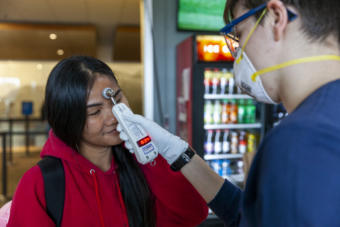
Namfon Noisai gets her tempoerature checked by Capital City Fire and Rescue's Lily Kincaid during a voluntary screening at the Juneau International Airport on Saturday, March 21, 2020 in Juneau, Alaska. Lily Kincaid asks Richard Clarke questions about where he traveled and who he was with before taking his temperature on Saturday, March 21, 2020 in Juneau, Alaska. The airport sees multiple daily flights to and from Seattle — one of the epicenters of coronavirus spread in the United States. Passengers arriving at the airport can request to have their temperature checked. Anyone with a temperature above 100.4 degrees will be advised to contact medical providers and to self-quarantine. (Photo by Rashah McChesney/KTOO)
Namfon Noisai gets her temperature checked by Capital City Fire and Rescue’s Lily Kincaid during a voluntary screening at the Juneau International Airport on Saturday, March 21, 2020 in Juneau. The airport sees multiple daily flights to and from Seattle — one of the epicenters of coronavirus spread in the United States. Passengers arriving at the airport can request to have their temperature checked. (Photo by Rashah McChesney/KTOO)

As more positive cases of COVID-19 continue to appear in Alaska, the City and Borough of Juneau is eyeing the community’s main point of entry: the airport.

The Juneau International Airport sees multiple daily flights to and from Seattle — one of the epicenters of coronavirus spread in the United States. Starting Thursday, passengers arriving at the airport can request to have their temperature checked.

Anyone with a temperature above 100.4 degrees will be advised to contact medical providers and to self-quarantine.

Capital City Fire/Rescue Chief Rich Etheridge said EMTs are stationed outside the departure lounge exit. They estimate they’ve screened about 50% to 70% of passengers exiting the airport so far.

The Juneau Assembly voted unanimously Thursday to send a letter to Gov. Mike Dunleavy urging him to officially restrict non-essential travel.

On Friday, the state issued a health advisory recommending Alaskans avoid non-essential travel in and outside the state.

Assembly member Greg Smith said it’s important for Juneau residents to avoid travel right now to prevent possibly transmitting the virus.

“We’ve seen from the recent cases, the confirmed cases in Alaska, that they’ve been travel-related,” Smith said Friday. “We know we don’t have the screening and the testing that we need, and as a result, it’s important for people to take action to really reduce the transmission of this virus.”

Earlier this week, the state issued a health mandate requiring anyone returning from countries with widespread coronavirus transmission to self-quarantine for 14 days.

Smith recommends that anyone who has been outside of Juneau do the same.

This post has been updated.


Without clear guidance, child care providers make tough choices on whether to close or stay open

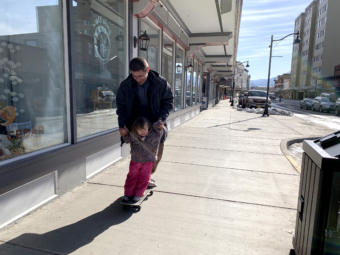
Tim Lopez skates with his daughter Samantha Lopez as a way to pass the time with her on March 17 in Juneau. Typically the 2-year-old would be at a child care facility in the middle of the day, but most in Juneau have closed. (Photo by Rashah McChesney/KTOO)

On a sidewalk in downtown Juneau, Tim Lopez balances on a skateboard with his 2-and-a-half-year-old daughter Samantha.

Normally the wiggly toddler would be in a child care program at Little Eagles and Ravens Nest.

“The coronavirus scare has her child care shut down right now,” he said.

In fact, most of the child care facilities in Juneau have shut down.

The Discovery Preschool is still open. Director Blue Shibler said it would have a big impact on parents if she closed, so she doesn’t want to do it without some kind of official guidance.

“We have parents here who are essential to the work of the Legislature, the work of the state. We have parents here who are essential medical providers,” Shibler said.

Right now, there isn’t any official directive to close. In fact, even though hundreds of thousands of schoolchildren were sent home until the end of March, the state put out a memo on Tuesday recommending that child care facilities stay open “if they can safely do so.”

But Shibler and others said it’s not clear what that means. The state’s guidelines pull from advice from the Centers for Disease Control and Prevention. According to those guidelines, no child who has been outside of the state should be allowed in. Neither should anyone one who has a fever or respiratory symptoms.

Those are things Shibler is already doing.

But she said other guidance is tricky. For instance, there should be fewer than 10 in a group. But does that mean students and teachers?

And the state suggests that child care facilities should stay open so that children aren’t at home with aging grandparents or elders while parents are at work. But Shibler said she has staff who are vulnerable — including an older person and two who are pregnant. She laid them off so they wouldn’t be exposed to the virus.

She said other guidance just doesn’t make sense to try with children.

“The notion that while the children are in a classroom, they should practice social distancing? I want someone to come here and watch me try to keep toddlers six feet apart from each other,” she said.

Shibler said she plans to stay open for now. But she is frustrated with the state’s guidance and feels that, with restaurants and bars closed, there are two different safety standards for adults and children. And she said she hasn’t had a lot of luck getting anyone at the state to respond.

But shutting down would come with its own set of problems. A lot of child care providers have slim profit margins. And that means the choice to close comes with a cost.

Gretchen Boone flips through a picture book for an infant at the Gold Creek Child Development Center in Juneau on May 11, 2018. Boone is the center's director.
Gretchen Boone flips through a picture book for an infant at the Gold Creek Child Development Center in Juneau on May 11, 2018. (Photo by Jeremy Hsieh/KTOO)

“We have decided not to refund tuition for March, because we need to pay teacher wages,” said Gold Creek Child Development Center Director Colleen Brody. It closed earlier this week.

That decision was hard enough. But there are some uncomfortable questions left to answer. What if they have to stay closed? Child care facilities need to keep paying staff, so it’s easy to reopen quickly. But do they ask parents to front the cost of tuition and keep children at home?

“Especially if parents can’t work because there’s not child care, expecting them to pay that tuition is difficult,” Brody said.

Closing also puts staff at child care centers in a tough spot, according to a Rain Coast Data analysis — they generally make about half the average Juneau wage and have few benefits like health care or retirement.

Brody said there are other problems with closing too. Gold Creek has a number of low-income families that rely on state child care assistance funding to pay their tuition.

“We have to fill out attendance forms for them, and if they don’t meet a specific (attendance), then they might not receive their funding,” Brody said.

She doesn’t know if the state will make exceptions because they’re closed. Additionally, the facility relies on a grant that is based on attendance.

“If we’re closed for half of the month, then our grant will be halved,” she said. “So what kind of allowances will be made for that?”

No one from the state Department of Health and Social Services returned repeated phone calls and messages seeking answers to those questions.

Dr. Anne Zink, chief medical officer for the state of Alaska, briefs reporters on the coronavirus at a news conference with Gov. Mike Dunleavy on March 10 in Anchorage. (Photo by Liz Ruskin/Alaska Public Media)

During a Wednesday press conference, the state’s chief medical officer, Dr. Anne Zink, talked about why the state chose to close schools but asked child care facilities to stay open.

Zink said they closed schools for until the end of March for two reasons: As a precaution to keep students who are coming back from spring break from mixing with other students; and to prepare for tele-education.

For child care facilities, Zink said the state wants them to follow CDC guidelines. According to those guidelines, in communities like Juneau, where there isn’t yet a case of the virus, it may not be time to close. The CDC recommends that before making the decision to close, child care providers should coordinate with local and state health officials.

“We do feel like child care is an important thing to be able to keep businesses up and running, hospitals up and running and to keep kids engaged ,and we know that we’re not as concerned about those kids itself,” she said.

Zink and others from the Department of Health and Social Services said that providers can reach out to a state email address — but it’s backed up and might take awhile to get answers.


State extends Alaska school closures and enacts new restrictions as coronavirus count grows to 14

State officials announced on Friday that Alaska’s public and private schools will remain closed to students through at least May 1. That extends the prior classroom shutdown by a month, in an effort to slow the spread of the coronavirus.

“Students will receive instruction through distance delivery methods,” said State Health Commissioner Adam Crum at a 6 p.m. news conference. “All after-school activities will be suspended during this time.”

The school announcement came as the number of known coronavirus cases continues to grow in Alaska. By Friday evening, there were 14 confirmed cases out of more than 700 people tested. That’s two more since Thursday — one in Ketchikan and one in Fairbanks.

Across the country, more and more local governments and states are restricting people’s movement to try to curb the rapidly-growing number of coronavirus cases, including orders to stay home in New York and California. In the United States, there were about 15,200 cases of COVID-19 by Friday, and 201 deaths, according to the Centers for Disease Control.

In Anchorage, Mayor Ethan Berkowitz issued an “emergency hunker down order” that goes into effect Sunday. He’s asking residents to minimize social contact and limit movement in the city to essential errands.

Gov. Mike Dunleavy has not taken similar action at a state level. At Friday’s news conference, he said most of Alaska’s known cases so far are believed to be travel-related. If the virus is spreading within Alaska communities, that could trigger more restrictive action, he said.

“The moment we see that happening, again, these tools that we have on the table, many of them will be implemented, to slow it down even further,” Dunleavy said. “We’re trying to make sure that we don’t shut the entire state down, because we believe that is also going to have some serious, serious impacts and ramifications for the state of Alaska, if that occurs.”

The state is, however, asking Alaskans to limit their travel.

“We know that this virus is spread as people move around, and as a result it’s really important that we have people not move around as much right now,” said Dr. Anne Zink, Alaska’s chief medical officer.

Zink said the state is “strongly advising” that all Alaskans stop non-essential out-of-state travel, including personal, business and medical trips. She encouraged Alaskans who are out of state to return home, and those visiting Alaska return to their home communities now.

The travel advisory is not a mandate, and Gov. Dunleavy has not issued a “shelter in place” order as other governors have.

“We feel right now that we are employing the right tools for the moment, but it changes moment by moment,” Dunleavy said.

Also on Friday, Crum, the state health commissioner, announced new business closures for the boroughs of Fairbanks and Ketchikan. The mandate for those boroughs closes hair salons, tattoo parlors, massage therapy and other personal care services that require close contact. It’s a response to “the increasing concerns of new cases of COVID-19,” Crum said.

The mandate for the Ketchikan and Fairbanks boroughs goes into effect Saturday at 8 a.m.

Personal-care providers who fail to comply with the closure orders for the Fairbanks and Ketchikan boroughs could face action against their professional licenses, Crum said, and possibly misdemeanor charges.

The order does not apply to medical services or urgent care clinics, Crum said, though it does apply to alternative healing therapies such as Rolfing, reiki, acupuncture and acupressure.

This story has been updated.

Site notifications
Update notification options
Subscribe to notifications