
Staff for the JACC were busy packing and moving things to Centennial Hall Thursday in preparation for the shelter, which is currently housed at St. Vincent de Paul Society near the airport.
The Juneau Arts and Humanities Council operates both the JACC and Centennial Hall, which are owned by the city. Executive Director Nancy DeCherney said both are effectively closed right now, with most staff working from home since events have been canceled.
“Reliable Transfer is going to move the grand piano tomorrow. Other things are being moved into our gallery,” DeCherney said. “It’s a very fluid situation and hopefully everything will work itself out in a positive way soon.”
The cold weather shelter will continue to operate under the same hours for now — 11 p.m. to 7 a.m. — whenever the temperature is below freezing. The city contract to operate the warming shelter is through April 15, but could be extended if necessary.
City Housing Officer Scott Ciambor said the JACC is a first step to address immediate needs for the warming shelter. They’ll continue to work with other providers to explore options such as using additional public buildings. The JACC could also be used as a potential quarantine or isolation site.
In a phone meeting Thursday morning, service providers discussed how to safely isolate healthy people and screen others for illness.
Mariya Lovishchuk is the director of the Glory Hall homeless shelter. She said she won’t send any of the people who typically stay at the shelter to the JACC, because it doesn’t have adequate facilities and space.
She feels the city isn’t doing enough to address the immediate needs of Juneau’s most vulnerable community.
“We propose that the city immediately gets people who do not need any kind of supervision, and who are only at the shelter because they saw hard times and they’re experiencing homelessness, in a hotel room, and we do this for two weeks starting tonight.”
Lovishchuk said they would need 36 rooms, and this would also help reduce pressure on the JACC — giving those who can’t stay on their own in a hotel a less crowded space.
Laura Norton-Cruz’s home in Anchorage this week as she worked on her fellowship and cooked lunch with her two children home from daycare and kindergarten, 3-year-old Rio and 6-year-old Ida Luna. (Photo courtesy Laura Norton-Cruz)
Thousands of Alaska parents are in a tailspin as they scramble to find care for their kids during the global coronavirus pandemic that has closed public schools across the state.
For some, daycares are still an option. But for parents of school-age children, the choices are slim. And that means staying home with kids while working, considering grandparent care, which can be risky for elders, or leaning on older children to care for the younger ones. Other parents say they still don’t know what they’re going to do. In some homes right now, the days are chaos.
“We’re just trying to find creative ways to keep everybody busy. Or keep the kids busy, we’re plenty busy with work.” said Jen Collins in a phone interview while her two children played outside in the snow.
Gus Collins, 4, and Woodson Collins, 8, play outside in Anchorage on Tuesday. (Photo courtesy Jen Collins)
Collins and her husband, Wade, are both working from home this month. They have jobs in the oil industry in environmental permitting. Collins said they’re balancing meetings and conference calls with taking care of their two children: 4-year-old Gus and 8-year-old Woodson.
“It can be a little tough,” she said. “We work in an industry right now where, you know, things aren’t going very well. So we’re trying to do our best to be as efficient as possible because it’s a little scary with oil at such a low price right now.”
Collins’ oldest son, Woodson, is in second grade at Rogers Park Elementary School. Children across the state didn’t go back to school after spring break this month, and won’t be back in classrooms at least through the end of March in an effort to slow the spread of the coronavirus. There are more than 125,000 children enrolled in Alaska’s public schools.
Collins said she and her husband decided to pull their younger son, Gus, out of daycare, which stayed open.
On Tuesday, Alaska’s state health department recommended child care facilities stay open if they can safely do so. The department said it didn’t want elders to care for children because older people are at an increased risk of severe COVID-19 illness. It recommended child care sites take aggressive measures for screening children for respiratory infections and keep groups small.
Collins said her family decided last week to keep themselves as isolated as they could as the number of known coronavirus cases continues to grow.
“We kind of made a decision as a family on Friday that we were going to practice social distancing, and not really go anywhere,” she said. “So we’ve basically, as of Friday, stayed put in the house, and if one of us had to go run an errand or get something that we needed, we did it solo.”
Collins said they’re focused on keeping some semblance of normalcy at home. That means daily schedules, and waking Woodson and Gus up at 7 a.m., like they would get up for school.
Woodson Collins, 8, sleeps with the day’s schedule next to his bed. It includes making his bed, letting the chickens outside, reading books, doing puzzles and going outside. (Photo courtesy Jen Collins)
“We try to have it so that they have clear expectations of what the day looks like. My older son is very driven by schedules and order and rules,” Collins said. “He asked me to make two copies of the schedule so he could keep one on his nightstand so he could read it first thing in the morning.”
Their schedule includes time for academics and exercise — whether going outside or following karate lessons online. Collins said she’s fielding questions from her kids about the coronavirus too like: “Can our dog Junebug get the virus?”
They’re also using FaceTime to connect Woodson and Gus with their friends for what Collins calls “virtual playdates.”
Woodson Collins, 8, and Gus Collins, 4, video chat with friends in Anchorage with schools closed because of coronavirus. (Photo courtesy Jen Collins)
Some Alaskans can’t work from home, and are facing different challenges.
Ashley Robbins is a single mother in Anchorage who searched online this week for affordable, reliable child care options. She just landed a new job in customer service at a local distribution center. It’s great news, she said. But she needs to find someone to watch her 1-year-old son Carson. And she needs that person right now.
“I did my interview over the phone today and they said, ‘OK, you’ve got X amount of days to find child care or this position will be filled because it needs to be filled soon,’” she said.
Normally, Carson goes to daycare at the Boy’s and Girl’s Club in West Anchorage. But, following the school district’s lead, the agency has shut down its child care centers and clubs for at least the rest of the month. That impacts about 4,000 children in Anchorage and roughly 8,000 statewide between the ages of six weeks old and 18 years old.
With no family close by to ask, Robbins requested help in one of the COVID-19 Facebook groups that are popping up online. Within an hour, she said, she had more than a dozen people offering to help watch Carson. Many of them had recently gotten laid off after the city mayor shut down dine-service at restaurants and bars, and later the governor issued a similar order for all of Alaska.
“My phone’s been going off, even still I’m getting messages,” she said about two hours after posting her request online. “There’s a lot of people that are also out of work because they’re in the food industry. So they’re now looking for something to kind of help with their income.”
Robbins said the response has given her a strong sense of community. She’s now going through background checks and interviews.
Across the city, parents like Robbins are trying to figure out how to balance at least two weeks — and possibly more — with their children out of classrooms. Some, like Collins, say they’re trying to stick to a schedule and homeschool their kids. Some are simply trying to figure out how to keep their children safe and also keep their jobs.
Another Anchorage mom, Laura Norton-Cruz, is still figuring it out. She has a 3-year-old son, Rio, and a 6-year-old daughter, Ida Luna. She’s keeping Rio home from daycare and Ida Luna’s public elementary school is closed.
“I would usually rely on my parents but I don’t want to expose my parents to my kids, because they’re little vectors for viruses,” she said.
Six-year-old Ida Luna Avellaneda-Cruz plays inside of a box at home this week. She goes to kindergarten at Government Hill Elementary School in Anchorage. The school is closed for the rest of the month in an effort to slow the spread of the coronavirus. (Photo courtesy Laura Norton-Cruz)
Norton-Cruz was working on her fellowship on Tuesday and will start a new job at the end of the week with the state health department. She’ll mostly be working on Alaska’s response to coronavirus.
She said she hopes her ex-husband, a freelancer, and his girlfriend — who has a job at a restaurant but is out of work with the closures — will mostly watch Ida Luna and Rio. They’re working on coordinating their schedules.
While she was still home earlier this week, Norton-Cruz said Ida Luna wrote a to-do list for them each day and practiced her Spanish on an online app. She’s enrolled in a dual-language program at the Anchorage School District. Together, they’re also making crafts and taking long morning walks.
Laura Norton-Cruz and her children practice writing their names in the snow this week in Anchorage. (Photo courtesy Laura Norton-Cruz)
Six-year-old Ida Luna Avellaneda-Cruz writes a to-do list each day with schools closed for the rest of the month in an effort to slow the spread of the coronavirus. (Photo courtesy Laura Norton-Cruz)
There’s still a lot of emotions to process, Norton-Cruz said. Her son Rio said he’s sad he’s not with his daycare friends. And Norton-Cruz, like many, is adjusting to the new coronavirus reality.
“It is so strange. I feel sometimes really calm and present and accepting of where we’re at,” she said. “And I also wake up in the middle of the night with a startling realization that everything is going to be different now.”
Are you a parent in Alaska wrestling with child care in the rapidly evolving coronavirus situation? Reporter Tegan Hanlon wants to hear from you. What are you doing that works? What problems are you trying to solve? What are you learning? And what questions do you still have? Reach Tegan at thanlon@alaskapublic.org or 907-550-8447.
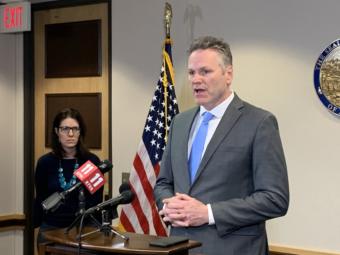
Alaska Gov. Mike Dunleavy and state health officials announced Thursday that the total number of confirmed COVID-19 cases in Alaska has grown to 12.
The case count has risen every day this week, and includes patients in Anchorage, Fairbanks, Ketchikan and Seward. The test results announced today add two more cases from Fairbanks and one more from Ketchikan to the list.

Alaska Chief Medical Officer Dr. Anne Zink said the new cases in Fairbanks were not related to the patients having traveled out of state, as with the earlier cases, indicating that the virus has spread in Fairbanks.
“It is troubling that neither of those patients had traveled in the past 14 days,” Zink said.
Catch up on the latest news about the coronavirus in Alaska.
Zink said health officials are trying to determine how the new patients came into contact with the earlier patients.
“What’s hard about this virus is it’s moving at an exponential rate,” Zink said, asking Alaskans to restrict their movement in their communities and to practice good hygiene, including frequent hand-washing.
Zink also announced two new health mandates: One bans elective medical procedures, and the other bans elective oral health procedures. She said the mandates were aimed at maintaining stocks of medical supplies.
Related: Anchorage airman is among those who have tested positive for COVID-19
Dunleavy said he was on a phone call this morning with President Donald Trump and the governors of other states, many of which Dunleavy said had been hit harder than Alaska.
“To this date, we’ve had no deaths in the state of Alaska,” Dunleavy said. “And we’re going to continue doing everything we can to prevent any deaths in Alaska.”
An fighter jet taking off from Joint Base Elmendorf-Richardson during exercises in 2015. (Photo by Zachariah Hughes/Alaska Public Media)
Officials at Joint Base Elmendorf-Richardson (JBER) say an active-duty airman tested positive for coronavirus.
The airman is one of the state’s nine confirmed cases of the virus. According to a media release, the airman recently traveled overseas and is now self-quarantining at home.
Right now, JBER is at an elevated level of health protection for military members and those who access the base. That includes the same protocols seen in other parts of the state, like social distancing, extra hand-washing, and self-isolating.
In addition, JBER’s public affairs representative Master Sgt. Jonathan Foster says they’ve closed some facilities, cancelled youth services and sports events, and they’re taking other measures to reduce the risk of person-to-person transmission.
“Like, for instance the base gates,” he said. “We’re doing a no-touch ID Card procedure. You just hold up your ID card and the gate attendant will look at it and then scan it after you turn it over and show us the bar code on the back.”
Foster says the air force has also delayed physical fitness testing for the next several months to avoid having large groups of airmen in close quarters with each other.
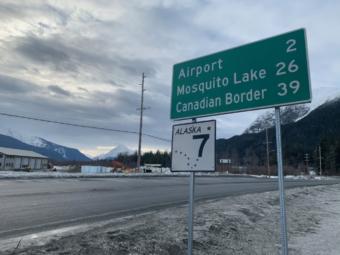
Gov. Mike Dunleavy said on Thursday that Canada’s border restrictions are not affecting Alaska’s crossings in Southeast Alaska or the Alaska Highway. (Read more)
Original story
Canada is closing its land borders to “non-essential travel” to slow the spread of coronavirus. And that’s leaving many Alaskans scrambling for answers.

Canadian Prime Minister Justin Trudeau said the decision follows a conversation with President Donald Trump.
“And we have agreed that both Canada and the United States will temporarily restrict all non-essential travel across the Canada-U.S. border,” he told reporters in Ottawa.
It’s not immediately clear when the closure will take effect or how “non-essential” will be defined.
And with no state ferries scheduled to sail up from the Lower 48 for a month, Alaskans like Ron Jackson want to know. He’s currently in Washington state, trying to get home to Haines.
“So I’m trying to figure out if I qualify as essential or not trying to get home,” Jackson said.
A Canada Border Services Agency spokesperson said early Wednesday the situation is evolving rapidly, and details are being finalized as quickly as possible.
A spokesperson for the Alaska Marine Highway System said the ferry system is working with U.S. Customs and Border Patrol to figure out what the closure means for future sailings to Bellingham, Washington.
Mike Swasey was on the road in Utah when the news of impending border restrictions broke. He’s trying to get home to Skagway and hopes to cross the northern border as soon as he can.
“Because it could happen at any second,” he said from near Salt Lake City. “I’ve been in touch with border guards from both the U.S. and Canadian side. I’ve been in touch with the mayor of Skagway, who has been in close contact with a state senator from Alaska — nobody knows.”
But it’s not just travelers that would be immediately affected by border restrictions.
For the Southeast Alaska community of Hyder, it’s only road access runs through the neighboring town of Stewart, British Columbia.
The two communities are interlinked. Alaskans there buy most of their groceries in Stewart, which has the area’s only gas station.
“But at the same time, all the Canadians that live in Stewart, a lot of them have to go through Hyder to go to work at the mines,” said Wes Loe, president of the Hyder Community Association, on Wednesday.
So far it’s business as usual. But he said cutting off the town’s only road access would be a major disruption.
“If they do close the gate, it’s going to be hard for us, “Loe said. “All of our food comes from Ketchikan, and our mail, prescriptions and everything has flown in on Mondays and Thursdays,” Loe said. “And this winter has been a real rough winter, because we’ve gone up to three weeks without any supplies at all.”
Other Alaskans are putting off travel through Canada.
Delta Junction farmer Randy Peterson recently purchased some farm equipment in the Lower 48. But he’s having second thoughts about driving down to get it.
“It’s just depending on what the virus does,” he said. “If it doesn’t ease up, I have no intention of going to get (the equipment) anyway, because it’s not worth it to me. I think this place is as good a place to be as any right now.”
There are five main border crossings between Alaska and Canada: on the Alaska Highway south of Tok; the Top of the World Highway, east of Chicken; and three in the Southeast, at Pleasant Camp, British Columbia, east of Haines; at Fraser, British Columbia, between Skagway and Whitehorse; and between Hyder and Stewart, British Columbia.
Correction: A previous version of this story incorrectly stated that Bellingham is in British Columbia. Bellingham is a city in Washington state.
Dean Graber opened a second downtown location last summer. This summer, he was considering a year-round lease in a building but had to forego those plans. (Photo by Elizabeth Jenkins/KTOO)
The COVID-19 virus is drastically altering the social landscape we live in, and it’s also forcing Alaskans to reconsider their plans for the future.
Juneau typically sees more than a million cruise ship passengers a year. But with cancellations and travel restrictions stretching well into the summer, those numbers are now out of reach.
One business — now one of many — is making the tough decision to scale back their dream.
Entering Dean Graber’s wood shop, you’d think he’s moving in or moving out. There are boxes everywhere. An unplugged point of sale system shares a table with handmade sushi boards and wooden clocks.
“Cheese boards. I have a couple hundred of those right now,” Graber said. “I’ll probably need more.” He catches himself, adding, “I would have needed more.”
In anticipation of the summer, Graber created the cutting boards for his business, Rainforest Custom. Some of them are stacked around this workspace, not even oiled yet.
He mostly makes his wood pieces for custom orders. But he said his family had big dreams for a downtown retail space this summer, and it was guaranteed to get a lot of foot traffic from cruise ship passengers.
“I wanted it to be a place that people remembered when they came back to Juneau,” Graber said. “I wanted it to be a place the people of Juneau would like to come.”
Graber was planning on opening this second space year-round. He’d taken out a loan to help support the business.
He was about to sign a lease on a new building. Then, news of the COVID-19 virus struck.
“This last two weeks, my wife and I have gone back and forth, crunching numbers, looking at spreadsheets, cash flow,” Graber said. “And looking at the news and daily, it was just, ‘Yes let’s do it. No let’s not. Yes let’s do it.'”
Dean Graber had been working for many months on the items he’d sell at his downtown location. (Photo by Elizabeth Jenkins/KTOO)
On Wednesday, a coronavirus relief package passed a major hurdle in Congress. It could provide paid sick leave, enhanced unemployment benefits and free coronavirus testing.
And billions more dollars could be on the way to help small businesses. But if that relief comes in the form of secured loans, Graber said that won’t be of much help.
“I don’t need a zero or no-interest loan, because I’ve already got debt to pay,” Graber said. “I don’t need any more debt. I don’t want any more debt.”
In an attempt to recover, Graber is selling some of the inventory of wood items flooding his shop for half off. He’ll still make custom pieces.
“I hope my son graduates — is able to graduate, otherwise. I hope my mother makes it OK. My daughter is coming from college in New York City. She’s being sent home,” he said.
As news of the pandemic unfolds, Graber said he’s taking it one day at a time. He hopes the United States pulls through quickly. He thinks it will. He says people are resilient.