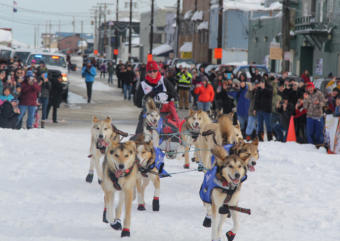
Aliy Zirkle and her team arrive in Nome at the end of the 1,000-mile Iditarod Trail Sled Dog Race on Wednesday, March 13, 2019. (Photo by Zachariah Hughes/Alaska Public Media)
Iditarod mushers will still be finishing on Front Street in Nome next week, but the city of Nome will not be hosting any festivities.
After meetings with state medical officials, the Iditarod Trail Committee announced Thursday that they are postponing the Iditarod Finishers’ Banquet and Musher Meet and Greet.
The Nome Common Council voted to follow suit and postpone all Nome Iditarod events, including the famous annual Lonnie O’Connor Iditarod Basketball Classic, an event that attracts visitors from the across the state and hosts crowds of between 500-800 people in the Nome Recreational Center.
After listening to recommendations from public health officials and hearing testimony from the community, the Nome Common Council reasoned that the precautions were necessary to restrict any potential spread of the coronavirus — not only just within the city, but also especially for rural communities outside of Nome, where Elders may have more limited access to medical care.
Before the Iditarod started, race officials said they planned to step up sanitation this year and distribute information about best practices to avoid getting sick, including washing hands.
The Iditarod confirmed Thursday that there are no plans to call off the race.
Alaska Public Media’s Tegan Hanlon contributed to this report.
Katie Klan and Angela Brock of the Homer band Burnt Down House perform a Red Carpet Concert at KTOO Public Media during the 2019 Alaska Folk Festival. (Photo by Annie Bartholomew/KTOO)
After an emergency meeting on Thursday, Mar. 12, the Alaska Folk Festival’s Board of Directors has cancelled the event.
The board says they’re concerned about safety due to the COVID-19 virus. It’s the first time the festival has been cancelled in its nearly 46-year history.
In a letter, the festival’s Board President Ian Putnam wrote that the board has been consulting with the state and the City and Borough of Juneau. All agreed that the only “socially responsible” option was to cancel the event.
Vice-President Andrew Heist says that in searching for a silver lining, the board is proud to make this difficult decision early to help set an example for other organizations in similar situations.
The annual festival draws thousands of musicians and spectators to Juneau each year.
Sayéik Gastineau Community School will be closed Friday, Mar. 13. School officials were notified on Thursday that a student was tested for “multiple viruses.” They are still waiting for the results.
The school district emailed parents Thursday evening saying they’re closing the school and cancelling all after-school activities and meetings as a precaution. And, so that they’ll be able to clean the school and gather more information.
All of the other schools in the district will operate on normal schedules Friday according to the email.
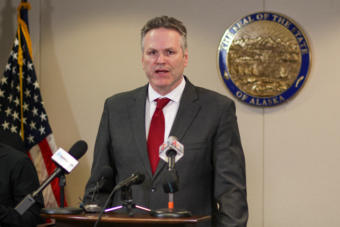
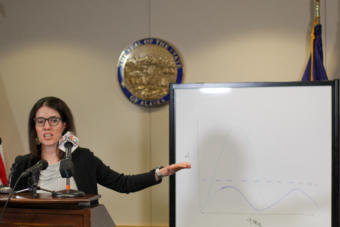
Alaska Chief Medical Officer Dr. Anne Zink stresses the importance of slowing the spread of the coronavirus at a news conference at Gov. Mike Dunleavy’s Anchorage office on Wednesday. Zink said on Tuesday that state public health workers are on the phone daily with groups weighing whether to cancel or postpone events due to the virus. (Photo by Nat Herz/Alaska Public Media)
Alaska organizations are weighing whether to cancel or postpone conferences, sports tournaments and other events as the coronavirus response escalates rapidly. And they’re relying on state public health leaders to help make those decisions.
Alaska’s annual state basketball tournaments were a week away when organizers made the call on Wednesday to postpone the March Madness events.
Billy Strickland leads the Alaska School Activities Association. He said the association relied on advice from the state Department of Health and Social Services.
“Working with the state on how we’re going to try to keep people as safe as possible, it really becomes a pretty easy decision at that point, as unfortunate as it is,” he said.
Strickland’s group’s decision was one of the most prominent of the many decisions Alaska groups are having to make about special events, conferences and sports tournaments that bring people together.
And he has a piece of advice for these groups.
“You know, to use a current catchphrase: Stay in your lane,” Strickland said. “We’re not doctors, we’re not people that really understand this. When we’re being told stuff by experts, we need to heed their advice.”
The state has not issued a blanket recommendation to cancel mass public gatherings.
But state Chief Medical Officer Dr. Anne Zink said Alaskans should be working together to reduce the risk from the virus. The goal is to reduce the disease’s peak in the state, so that the health care system has the capacity to treat patients.
“We are on the phone with conferences, sporting events, travel agencies, the North Slope, industry, cruise lines on a daily basis,” she said.
The advice looks different depending on who the gathering attracts.
“Part of it depends on what that group looks like,” Zink said. “So, right now, if we had a group of people in their 70s with significant medical conditions who are having a close gathering, we would highly discourage that. We wouldn’t prohibit it at this time, but we would very highly discourage that, because that is a higher risk group.”
Other groups would get an OK from the state.
“That’s different than kids going outside to go sledding. And they’re spread apart and they’re young and they’re healthy and they’re lower risk,” she said.
Zink said on Wednesday the state will mandate closing events if that becomes necessary, but it’s not there at this point.
“Right now, we’re not mandating anything. We’re trying to get that information out there,” she said. “I really believe that Alaskans are better off when they’ll be able to make some of those (decisions) themselves, rather than just coming out and saying, ‘This is what’s going to change all at once.’”
Some organizations that haven’t postponed or canceled events have posted online that they will take steps to lessen the risk of spreading diseases. And organizations whose events are further in the future have more time to make decisions. For example, Sealaska Heritage Institute’s board will decide in mid-April on whether to postpone or cancel Celebration, its biennial gathering scheduled for mid-June.
Alaska officials said Thursday that they’ve confirmed the state’s first coronavirus case.
“Again no reason to panic, no reason to get upset. We’re going to have more cases as time goes on,” said Gov. Mike Dunleavy during a Thursday evening press conference.
Alaska Chief Medical Officer Dr. Anne Zink said the case was in an international traveler who had flown into Anchorage. She called it an “isolated case” that was identified Thursday afternoon. It’s a “presumptive positive,” she said, meaning that the lab case will be sent to the Centers for Disease Control and Prevention for confirmation.
Zink said the patient kept himself apart from others, and called his health care provider. He went to the emergency room at Alaska Regional Hospital in Anchorage, which was prepared for his arrival.
“He knew about the virus that causes COVID-19,” Zink said. “He was monitoring himself, and as soon as he developed any symptoms that could be potentially consistent with it, this individual protected themself, called ahead and was able to be seen and assessed.”
Zink had warned that the first cases of the disease were likely to appear in the state soon, given the rapid spread of the coronavirus around the world.
The state has been posting the number of tests daily. As of Thursday afternoon, 59 patients had been tested.
Across the country, there were more than 1,200 cases of COVID-19, the illness caused by the coronavirus, by Thursday, according to the Centers for Disease Control and Prevention. More than 450 cases, including 31 deaths, were reported in Washington state, and almost all were in the greater Seattle area, which is a hub for travelers flying to and from Alaska.
The CDC say the immediate health risk from COVID-19 is still thought to be low for most of the American public, who are unlikely to be exposed to the coronavirus. People in communities where the virus is spreading face elevated risk, depending on their location, the CDC says.
Serious illness appears to occur in about 15% of cases, the CDC says, citing a report from China, where the coronavirus originated. The agency recommends that people get the flu vaccine and take everyday steps to prevent the spread of germs: avoiding close contact with sick people, staying at home when sick and washing hands or using hand sanitizer.
If you’ve been in an area where COVID-19 is spreading, or if you’ve been in close contact with a person known to have the disease, and you develop a fever and a cough or difficulty breathing, the CDC says to call ahead before seeing a medical professional.
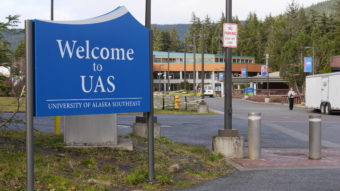
University of Alaska Southeast’s Juneau campus on Tuesday, Nov. 15, 2016. On Mar. 12, 2020, the University of Alaska system extended spring break, moving classes online in response to the spread of coronavirus. (Photo by Quinton Chandler/KTOO)
The University of Alaska (UA) system is extending spring break, moving classes online and canceling gatherings in response to the spread of coronavirus, President Jim Johnsen announced Thursday, Mar. 12. It’s also asking students to leave on-campus dorms for the rest of the semester.
“While, as we know, there are no confirmed cases of COVID-19 yet in Alaska, we think prevention is absolutely critical,” Johnsen said during a phone call with reporters. “We want to make sure that our university communities across the state, from Ketchikan all the way up to Kotzebue and many places in between, are safe and that we do our piece to slow the spread of the disease as it may take place here in the state.”
Across Alaska, the coronavirus threat is canceling events, suspending travel and disrupting the economy. Gov. Mike Dunleavy has signed an emergency declaration. All Anchorage public schools will remain closed for one week after spring break, and the school district is preparing for possibly a longer closure. Alaska Public University is also moving its classes online.
UA will suspend most in-person classes for the rest of the spring semester, Johnsen said. Faculty will instead deliver lessons by other methods such as email, video or over the phone.
Johnsen said he extended spring break an extra week to give faculty time to prepare.
“Classes will restart via distance delivery on March 23,” said a statement from UA. “University offices will remain open throughout the rest of the semester, unless the situation warrants changing that.”
Alaska’s public university system has more than 6,500 employees and 21,000 students across three main universities and about a dozen community campuses. Students have been on their week-long spring break since Monday and were supposed to return next week.
Johnsen said university chancellors may make some exceptions and allow some classes to be held in person, such as lessons that require lab work.
“But again, personal safety measures are paramount whenever these few exceptions will be made,” he said.
He acknowledged that not all students have computer access, and said UA is working to provide ways for students to get online, through computer labs, libraries or other facilities “again ensuring social distancing.”
UA is also asking students to leave on-campus dorms for the rest of the semester as a preventative measure. There are about 1,600 students who live in the dorms.
“Students can either move completely out of the residence halls now, or gather anything they need for the rest of the semester and return later to move out of their rooms,” said UA’s statement. “There will be a mechanism for students to request exceptions if they are unable to leave the residence halls until later in the spring.”
UA is canceling or postponing all events and gatherings of 25 people or more through the end of March.
“University leaders will revisit events guidance later this month and make a determination regarding whether to cancel events for the rest of the semester,” the statement said. “That discussion will include a decision on commencement ceremonies.”
The university joins a host of other academic institutions that have cancelled or postponed in-person classes. That includes the University of Washington, Seattle University, University of California, Berkeley and UCLA, as well as many Ivy League and East Coast schools.