
Alaska coronavirus news

Live updates and information on COVID-19 in Juneau and Alaska

As Alaska prepares to spend millions on coronavirus response, years of cuts have starved the public health system

Sitka Community Hospital will suspend scheduled surgeries on February 28, the same day the city will unveil the draft of their hospital sale agreement to the public. (Photo by Emily Kwong/KCAW)
A hsopital bed at the Sitka Community Hospital. (Photo by Emily Kwong/KCAW)

In December, budget documents for Alaska’s public health nursing program carried a warning: Years of budget cuts have starved the state’s public health wing of resources and staff.

“The reduced workforce decreases capacity to provide timely and effective response to emerging outbreaks and threats while maintaining other core services,” the program warned.

This week, Gov. Mike Dunleavy proposed $13 million in new spending to monitor and prevent the spread of the new coronavirus.

But state officials and legislators familiar with the state’s public health system say that funding injection cannot erase years of budget cuts.

In 2014, when state spending reached its modern peak, Alaska was spending $28 million per year from the state treasury on public health nursing and $7.6 million on epidemiology. Six years later, those figures have dropped to $22 million and $2 million, respectively.

That 2014 budget called for 110 public health nurses statewide, plus aides and support staff. The budget now calls for 90 nurses, but the state has been unable to fill all of those positions. Budget cuts mean the state’s pay and benefits for public health nurses now lag behind similar positions in other states. The state’s personnel directory lists 70 public health nurses on staff.

Those cuts, some legislators say, have left Alaska vulnerable to a threat exactly like the one it faces now.

“Definitely we’re in a worse spot right now. The cuts that have gone on have been detrimental to the retention of those people who are so needed at this point,” said Sen. Donny Olson, D-Golovin.

In addition to serving on the Senate Finance Committee, Olson is a doctor.

In December, budget documents for Alaska’s public health nursing program carried a warning: Years of budget cuts have starved the state’s public health wing of resources and staff.

“The reduced workforce decreases capacity to provide timely and effective response to emerging outbreaks and threats while maintaining other core services,” the program warned.

This week, Gov. Mike Dunleavy proposed $13 million in new spending to monitor and prevent the spread of the new coronavirus.

But state officials and legislators familiar with the state’s public health system say that funding injection cannot erase years of budget cuts.

In 2014, when state spending reached its modern peak, Alaska was spending $28 million per year from the state treasury on public health nursing and $7.6 million on epidemiology. Six years later, those figures have dropped to $22 million and $2 million, respectively.

That 2014 budget called for 110 public health nurses statewide, plus aides and support staff. The budget now calls for 90 nurses, but the state has been unable to fill all of those positions. Budget cuts mean the state’s pay and benefits for public health nurses now lag behind similar positions in other states. The state’s personnel directory lists 70 public health nurses on staff.

Those cuts, some legislators say, have left Alaska vulnerable to a threat exactly like the one it faces now.

“Definitely we’re in a worse spot right now. The cuts that have gone on have been detrimental to the retention of those people who are so needed at this point,” said Sen. Donny Olson, D-Golovin.

“If we do have a coronavirus emergency, we’re ill-prepared for it,” he said.

In a Monday news conference, Dunleavy said Alaska is prepared. State officials assisted in the evacuation of Americans from the Chinese city of Wuhan in January, and the governor said the state has been planning since then.

No cases of coronavirus have been found in Alaska, but Dunleavy is asking the Alaska Legislature for $13 million — $4 million in state funding and permission to accept $9 million in federal money.

“We really do feel like we’re maxing out on Department of Health and Social Services resources … and we need help,” said Dr. Anne Zink, the state’s chief medical officer.

That money would pay for 10 temporary workers: five public health nurses, three nurse epidemiologists, one microbiologist and one emergency manager.

Zink said the worry is that the state’s health care system might not have enough resources to cope with a flood of additional patients on top of ordinary needs.

“We don’t have systems set up to deal with that increase,” she said.

Half of the governor’s request involves the state’s public health nursing system. In small communities across Alaska, public health nurses are frontline health care workers. The new additions may be based in hub cities, but they would be responsible for a swath of rural Alaska, Zink said.

“I think of public health nurses as the worker bees keeping things running,” Zink said.

Compounding the funding problem, state reports indicate budget cuts have made those nurses less efficient.

“Recruitment difficulties, including delays in recruitment of administrative staff, has required nurses to take on administrative duties,” a 2018 report said.

With nurses filling out paperwork instead of treating patients, “the Section of Public Health Nursing lost over 8,000 hours of reimbursable professional nursing time,” the report said.

“Budget cuts have consequences,” said Sen. Natasha von Imhof, R-Anchorage and co-chair of the Senate Finance Committee.

Von Imhof also serves as chair of the Senate subcommittee in charge of the state’s health budget. She said she and other lawmakers will be watching to see if the governor’s request is enough.

“It’s hard to say if this is the tip of the iceberg or this is sufficient,” she said.

This story was originally published by the Anchorage Daily News and is republished here with permission.

State of Alaska is exploring options for housing people quarantined for coronavirus

(Illustration by Alissa Eckert and Dan Higgins/Centers for Disease Control and Prevention)

The state of Alaska put out a request this week “seeking information from interested parties for providing housing units that are quarantined to allow for monitoring for COVID-19.”

“The State wishes to identify companies that are capable of providing the housing units and gain an understanding of the potential project cost for budgeting purposes,” the request said.

The state is seeking “motel rooms, apartments, trailers, or other suitable dwellings,” the request said. The units must be located so the general public can avoid interaction with those being quarantined, it said. Apartments or hotels may not be suitable if there is a common hallway, for example.

Outside of Alaska, many communities with a large number of patients in quarantine have repurposed buildings to provide temporary space. King County in Washington, which is a center of the West Coast coronavirus outbreak, for example, is in the process of purchasing an EconoLodge in the suburban community of Kent to house patients, a move that has been controversial with some of its neighbors.

The state’s Chief Medical Officer Anne Zink said that the housing wouldn’t necessarily be in one place, but there may be a variety of options that it could be used for including people who are homeless, people who need to disembark from cruise ships, people who can’t be quarantined in their homes or people traveling through the state for some other reason.

“We want to make sure we are nimble,” she said.

Gov. Mike Dunleavy said the state is assessing all potential resources.

Alaska Public Media reporter Nat Herz contributed to this report.


Listen: This Anchorage resident’s elderly parents were stuck on the coronavirus cruise

Robert Jackson, 84, and Karrold Jackson, 81, were passengers on the Grand Princess, the cruise ship held for days off the California coast after passengers tested positive for coronavirus. (Photo courtesy Erin Jackson)

Imagine this: Your parents are in their 80s. They both have chronic health conditions. And they’re stuck on a cruise ship with people who have the coronavirus — and they can’t get off.
For Anchorage resident Erin Jackson, this isn’t a nightmare — it’s reality. Her parents were on the Grand Princess, the cruise ship kept at sea for days off San Francisco as officials debated what to do with the passengers.

Jackson said her parents had heard about the virus before leaving on the trip to Hawaii and Mexico, but without a stern warning from federal health officials, they decided to go anyway.

Jackson’s parents were supposed to leave the ship Tuesday, but she doesn’t know whether or where they may have to be quarantined.

Dunleavy has signed an emergency declaration due to ‘slow-moving storm’ of coronavirus spread

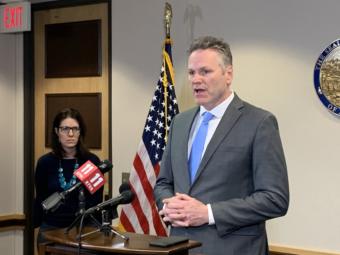
Gov. Mike Dunleavy talks to reporters at a press conference about the novel coronavirus on Monday, March 9, 2020, while Alaska Chief Medical Officer Anne Zink stands in the background. (Photo by Joey Mendolia/Alaska Public Media)

Anticipating what he describes as the coronavirus’ inevitable spread to Alaska, Gov. Mike Dunleavy signed an emergency disaster declaration Wednesday to free up additional resources to help the state prepare.

At his third consecutive daily news conference at his downtown Anchorage office, Dunleavy compared the situation to a slow-moving storm.

“We can see it coming. We just wanted to gear up now,” he said.

There were no confirmed coronavirus cases in Alaska — 60 tests have been done, with 46 negative and 14 still pending as of midday Wednesday. But “we’re anticipating that’s going to change,” Dunleavy said.

“It’s going to be in Alaska,” he said. “It’s probably here now.”

The declaration allows the state to access federal money and will help expedite government processes as it makes plans to fight the virus, he said.

The state is also now confident it can perform more than 1,000 tests, health officials said.

Anne Zink, the state’s chief medical officer, said the challenge now is to get hospitals and outpatient clinics set up to run tests. Zink also warned that people who are used to getting health care in Seattle should be checking with their providers because the health care system in the city is overloaded.

This story has been updated.


On high alert for coronavirus, services to Anchorage elders roll on

Hand sanitizer is prominent for an art reception at the Anchorage Senior Activities Center. (Photo by Liz Ruskin/Alaska Public Media)

One subset of Alaskans is particularly at risk from the coronavirus – the elderly – and that has Anchorage facilities that serve senior citizens on high alert.

Still, the Anchorage Senior Activity Center was busy with the usual traffic last week: People coming in and out for lunch at the restaurant, to take art classes and to use the gym.

Fitness Manager Brittney Mitchell says she hasn’t noticed any decline in participation.

“Our members in the fitness department are very inclined to continue to come in,” she said. “We’re just making sure that everyone’s washing their hands before and after classes, wiping down equipment … . We’ve had these rules implemented for quite some time but we’re being extra careful.”

That, more or less, was also the response from the state Pioneer Homes and Providence, which operates several residential facilities that serve seniors. They say they have protocols to prevent infection, and they’re making sure everyone follows them.

The Anchorage Senior Center is a community hub, with all sorts of classes and social events. It’s a meeting place for several clubs, formal and not. It’s open to the public.

The center’s director, Rebecca Parker, said about 200 people visit daily. Every year they take measures to protect their clientele the flu, she said. The center is relying on those practices now, with some extra emphasis.

“We already had signs in the restrooms, but now they’re bigger and laminated. So we’re trying to get people to really pay attention,” Parker said. “And you can see we’ve got (more hand) sanitizers.”

They’ve decided to use disposable dishes and cutlery in the restaurant, for now. Parker hasn’t ruled out wearing a mask at work. But, she said, some habits die hard.

“I notice still there are lots of seniors who come here and they just want to be hugged. And they will open their arms,” she said. “I haven’t declined a hug yet, and I hope I don’t have to.”

A few dozen people gathered at the senior center Friday for the judging of an art show. Sandwiches and cookies were served.

“Just to remind everybody: Before you have something to eat, please wash your hands for 20 seconds,” announced Gordon Glaser, president of the senior center’s board. He pointed out where the bathrooms are, and noted the bottles of hand sanitizing gel on the food table.

Glaser said the day is coming when they may have to do more than focus on hand-washing.

“We also have to make some hard decisions. Like this is a crowd,” he said, looking around the art show in the center’s lobby. “Do we have these type of activities? And what kind of activities do we do and don’t do?”

But Glaser said there is a cost to being overly cautious.

“A lot of people depend on programs like this,” he said. ” Some people – this is where they get their main meal. Or this is where they meet their friends.”

Mary Belton is a participant at the senior center. She thinks all the attention on the coronavirus might be a bit overhyped.

“Well, I think it’s a political thing,” she said. “They’re trying to get rid of Trump. And whatever bad thing comes down the road, ‘It’s Trump’s fault.’ You know.”

Belton said she’s washing her hands more, and she’s concerned about a woman she knows in Washington state who is in her 90s. Belton said other parts of Anchorage might be more risky, but she feels safe at the senior center.

“I’m going to keep coming,” she said.

Leaders of the senior center, like those of the Pioneer Homes and Providence, say they’re following the recommendations of the Centers for Disease Control and other government authorities, and they are ready to adapt if the advice changes with the spread of the coronavirus.

The Pioneer Homes sent a letter to elders and families last week saying it’s likely they will begin asking all visitors to sign in, and answer a few questions before they enter.


City working through ‘what ifs’ as the Westerdam — and cruise ship season — makes its way toward Juneau

Cruise ships in port in Juneau (Photo by Heather Bryant/KTOO)
Cruise ships in port in Juneau in August 2012. (Photo by Heather Bryant/KTOO)

When Juneau residents learned that Holland America’s Westerdam would be arriving in Juneau early to wait for the start of the summer season, the reaction was immediate.

City leaders say they received hundreds of emails and phone calls from the public. People wanted to know why the ship was coming here, what it would do once it arrived and how the city could be sure there were no cases of COVID-19 on board.

At a special Juneau Assembly meeting Monday night, a panel of public health experts and cruise officials tried to address as many of the outstanding questions about the Westerdam and the upcoming cruise season as possible.

In February, Holland America’s ship Westerdam was turned away from multiple Asian ports — not because there were any confirmed cases of coronavirus disease on board, but because countries were reacting to news of the Diamond Princess, which was at the time a floating quarantine off the coast of Japan.

Ralph Samuels, an executive with Holland America, told the assembly that the only Westerdam passenger who tested positive for coronavirus was an 83-year-old woman. And the company believes it was a false positive.

“She tested negative a couple days after that and proceeded to test negative every time,” Samuels said.

They ended up testing every single passenger and crew member on board.

“There were 2257 people. They all got tested. There was one positive, for two days,” Samuels said.

That was more than a month ago. The Westerdam is now crossing the Pacific. It’s scheduled to reach Honolulu March 16, where it will stop for customs and to resupply before continuing on to Alaska.

Some crew members got off the ship in the Philippines, but the remaining people have not left the boat since Feb. 19, when the last passengers left.

“So this crew, by the time the crew gets to Juneau, they will have all been tested and all been on the ship for a month,” Samuels said.

The ship will dock at the private AJ dock, which Holland America partially owns. The dock does not have hookups for electricity, so the ship will run on fuel while it’s in port.

For the roughly three weeks it’s in Juneau, the ship will be hooked up to city water and pump out graywater — non-hazardous runoff from sinks and showers. They’re not planning to pump any sewage into the city’s system.

As for trash, that’s going to get offloaded in Honolulu. Samuels said Holland America was not happy to learn its ships and those of other companies have been dumping trash in Juneau’s landfill.

It’s not yet clear exactly how many crew will be on board when the ship arrives, but Samuels estimates it’s between 500 and 700 people. Samuels said no crew will change out in Hawaii and he does not believe any crew will depart in Juneau.

But the crew will be allowed off the ship. Samuels said they’ve already received offers from community members who want to show crew members around.

“They kind of want to be a welcoming committee before the hubbub of the summer gets going to show off their town to these folks that have been bobbing around the sea for quite some time,” he said.

City Manager Rorie Watt said there are a lot of unknowns right now, including how travel warnings about taking cruises from federal officials will impact business.

As of now, dozens of ships are expected to bring 1.4 million passengers to Juneau this summer.

“The Westerdam will leave and around a week and a half after that the first ship of the season is scheduled to arrive,” Watt said. “That April 24 date is coming very fast.”

The city is discussing many possible scenarios with federal and state partners, including whether it would be possible to close the port to prevent the arrival of a ship carrying coronavirus.

Mike Tibbles with Cruise Lines International Association Alaska said the industry is continuing to update its prevention policies according to directions from national and international health agencies. That includes things like pre-screening passengers based on their recent travel history and any existing symptoms prior to their trips.

“All CLIA members are required to have medical professionals on board and available 24/7,” Tibbles said. “All CLIA members are also required to have a well-equipped health facility which meets certain guidelines. And those guidelines include the ability to isolate passengers.”

Bartlett Regional Hospital has stocked up on extra supplies and is preparing to respond to a potential coronavirus outbreak locally.

Even still, Watt said many “what ifs” remain as cruise season approaches.

“We are not ready today like we need to be on April 24,” he said. “We are not.”

The Grand Princess, which regularly visits Juneau, is due to arrive May 12. That ship is is now quarantined in Oakland, California, after a number of passengers tested positive for COVID-19. Princess Cruises canceled its next scheduled sailing to Hawaii. The company has not yet said whether the ship’s Alaska season will go on as planned.

Watch the City and Borough of Juneau’s Facebook Live from Monday’s special meeting: 

https://www.facebook.com/cbjuneau/videos/561670894443351/?__xts__[0]=68.ARBIDtNyGE7fBMuPoBXxi__TDLyZ1rcY4AbhGFApV6R7kuPmyKaaF1vkNN0ff1xtkr-U17ad-I6vLcPEmQqow_FAK5gtLnrMsJhZPfzVEJ0Fa6jU5LfYSkV3g29wKCjht2wzQd_Hhgg7hh5ZH2yaZkqXep3rEVfSNbJotu7RayYNk4oq_smFDdaTuNvDdfyBRWmI53T0G463LTr3-Gr-t9Tvto3GxKuDImtAptc1NTG-Yaoqzsx9z87PwXffkSVacI7s02PS0EMZJlrN8sPWiXrb3rw1uxXhCpYSt67vJm-VrEVHk3f6ZhN5oa54xMQd77C95na3PixaBJYZf8zGVUHBgby3JnGjuVqs-Q&__tn__=-R

Site notifications
Update notification options
Subscribe to notifications