Alaska coronavirus news

Live updates and information on COVID-19 in Juneau and Alaska
Already low price for Alaska crude oil falls further as the world responds to coronavirus

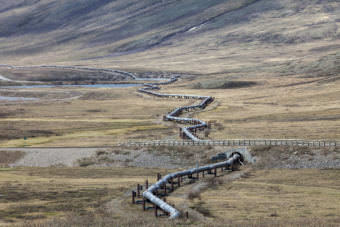
An above-ground section of the Trans-Alaska Pipeline System near the Toolik Lake Research Station in the North Slope Borough. (Photo by Rashah McChesney/Alaska's Energy Desk)
An above-ground section of the Trans-Alaska Pipeline System near the Toolik Lake Research Station in the North Slope Borough. (Photo by Rashah McChesney/Alaska’s Energy Desk)

Oil prices are way down. The price of U.S. and global benchmarks are both below $40 per barrel.

Alaska North Slope crude is in the $30 range. In the last 20 years, it’s only been that low a few times. From 2000-2004, in 2008, and in late 2015-2016.

The COVID-19 pandemic is driving some of the recent decline. But prices were low even before the outbreak.

Larry Persily is a former federal pipeline coordinator in Alaska. He says the drop comes down to supply and demand.

“It’s pretty much basic economics,” Persily said. “More oil out there, and buyers are thinking ‘hey it’s going to be cheaper tomorrow, and next week and next month and if you don’t want my $34 today, heck, I’ll get it for $32 tomorrow.’ It’s not a good situation.”

Persily says reduced demand has been a problem for a while, and there are many factors at play. A big one: China’s economy weakened, and with it, demand.

And then came a global health emergency.

“The coronavirus outbreak came, demand in China went down, the world economy is contracting as people are producing less, flying less, manufacturing less,” Persily said.

So, already low demand has been pushed even lower.

Russia and the Organization of Petroleum Exporting Countries, or OPEC, met recently and tried to help balance global supply and demand. But, Persily says they were unsuccessful and now, to add to existing uncertainty, he says we’re seeing an oil price war.

In recent years, the price of Alaska North Slope Crude has been reliably higher than the U.S. benchmark, West Texas Intermediate. That also has to do with supply and demand. Alaska oil competes with foreign exports, rather than West Texas. Persily says different markets have different channels of supply and demand.

“2018, 2019, there was a period there where Alaska oil was worth $10 per barrel more than Texas,” Persily said. “Of late, we’re back to the $2 or $3 bump as was historical practice. Because global demand was weakening, global prices were going down, and Alaska rode it down with them.”

That’s why right now, the two commodities are much closer in price, and that price is low.

The big question now is: how far will oil prices drop and how long will they stay so low?

“We’ll get out of this and oil will start climbing, I think during this year certainly back into the $40s, maybe the $50s,” Persily said. “A lot will depend on the economy and how bad the coronavirus outbreak gets around the world.”

If oil prices don’t bounce back, it could mean more trouble for Alaska’s oil-dependent economy.


Oil companies are screening employees for fever before flying them up to Alaska’s North Slope

BPfacility_Harball
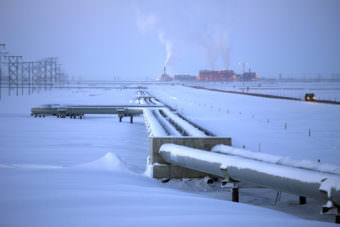
Pipelines lead to one of BP’s facilities on the North Slope. (Photo courtesy BP)

Alaska’s major oil companies are screening workers for fevers before they fly to remote operations on the North Slope, in an effort to fight the spread of coronavirus.

The companies met last week and agreed to start screening all of their workers when they check in in Anchorage, says Heidi Hedberg, Alaska’s public health director.

BP operates the North Slope’s largest oil field, Prudhoe Bay, and is conducting those screening measures, a spokeswoman says. Another major North Slope operator, ConocoPhillips, is checking passenger temperatures as they board planes headed north, a spokeswoman says.

The companies are also reviewing their contingency plans in the event a case is discovered on the North Slope.

The North Slope’s oil patch employs thousands of workers in an isolated area nearly 400 miles north of Fairbanks, the nearest big city. Most workers travel there by plane, and live and eat in shared spaces.

The major companies operating in the area have released few specifics about how they’re working to prevent a coronavirus case there, or how they’d respond if one was discovered. A BP spokeswoman said in an email last week that the company is closely monitoring the spread of the virus, along with the guidance from the World Health Organization and the U.S. Centers for Disease Control and Prevention.

Both BP and ConocoPhillips say they’re prioritizing the safety and well-being of their employees.

Quieter than expected start to Alaska cruise season as Princess and Viking suspend operations

The Coral Princess Cruise ship prepares to dock in Juneau.
The Coral Princess Cruise ship prepares to dock in Juneau. (Photo by Heather Bryant/KTOO)

The start of Alaska’s cruise season will be quieter than initially planned. Two companies have announced that they are suspending global operations for the next several weeks.

In a video address posted on Twitter, Princess Cruises President Jan Swartz said the company will cancel all cruises through early May. And some trips that are currently sailing will be cut short.

“This is is perhaps the most difficult decision in our history because we understand the incredible impact it has on countless people,” she said.

Viking Ocean Cruises also announced a suspension of operations through the end of April.

The cruise ship season in Southeast Alaska starts April 23 when a Carnival ship is scheduled to arrive in Skagway.

There are three Princess Cruises scheduled to come to Alaska during the suspension period, starting with the Star Princess scheduled to arrive in Juneau on May 6.

There is one Viking ship scheduled to visit Southeast Alaska before the end of April.

Sarah Leonard, president and CEO of the Alaska Travel Industry Association, said she understands why these companies made these decisions to cancel.

“We want to continue to provide safe experiences in Alaska,” she said. “And I think that that’s what we’re seeing from cruise ship partners and from other tourism businesses.”

It’s hard to know what the impact of these cancellations will be on the state’s summer tourism season, but Leonard calls it a delayed start at least.

“And beyond that, I can’t really project as the situation is really evolving daily, sometimes hourly,” she said.

Both Princess and Viking assured customers they would offer vouchers for a future cruise or a cash refund.

Howard Sherman, an executive from Norwegian Cruise Line, said Thursday that the company has no plans to delay or cancel sailings to Alaska. On Friday, the company announced it would suspend cruise operations from March 13 to April 11. The Norwegian Joy is scheduled to arrive in Ketchikan on April 27 and Juneau the next day.

If more companies cancel, Patti Mackey of the Ketchikan Visitors Bureau said that could mean a lean summer for tourism businesses in Ketchikan.

“We have businesses that are concerned about everything from employees, and, you know, are they going to be able to afford to pay them? Do they suspend or, you know, narrow down their operations?” she said.

Mackey said the Viking and Princess ships that would have come to Ketchikan during the early season would have brought more than 6,000 passengers to the downtown docks.

KTOO’s Adelyn Baxter, KRBD’s Eric Stone in Ketchikan and KHNS’s Claire Stremple in Haines contributed to this story.

This story has been updated.


Updated: Alaska state basketball tournaments canceled

Noorvik’s and Kiana’s girls basketball teams, seen playing here in Kotzebue, both qualified for the 2020 ASAA 1A Basketball tournament. The tournament has been postponed due to coronavirus travel concerns. (Photo by Wesley Early/KOTZ)

Update (Monday, March 15, 11:03 a.m.) — Wesley Early, KOTZ – Kotzebue

The Alaska School Activities Association canceled this year’s state basketball and cheerleading tournaments due to concerns over the coronavirus. They had previously been postponed.

In a statement released Saturday, the ASAA says “MarchMadness Alaska is possibly the largest statewide gathering each year and ASAA would not be acting responsibly if we were to host this year’s event.”

The move comes a day after Gov. Mike Dunleavy ordered schools closed through March 30. Health officials have advocated people practice social distancing, limiting physical contact with others.

The state tournament had originally been scheduled for the week of March 15, with teams traveling from across the state to compete in Anchorage.

Original story

As Alaskans prepare for the first confirmed case of coronavirus in the state, the state’s high school athletic department is taking safety precautions.

In a statement on their website, the Alaska School Activities Association wrote that the ASAA/First National Bank state basketball and cheer tournaments have been postponed until further notice.

The ASAA has also canceled the Alaska Association of Student Governments Spring Conference to be held at Mt. Edgecumbe High School in Sitka.

The ASAA says that “the decision on whether or not to cancel the basketball and cheer championships will be made at a later date.”

To prevent the spread of coronavirus, the ASAA also recommends that anyone over the age of 60, anyone with underlying health conditions or respiratory issues should avoid travel to this weeks regional and conference tournaments.


Alaska Legislature quickly passes state funding for coronavirus response

Members of Alaska Senate Majority hold a press conference about funding for COVID-19 preparedness outside Senate Chambers in Juneau on March 11, 2020.
Members of Alaska Senate Majority hold a press conference about funding for COVID-19 preparedness outside Senate Chambers in Juneau on Wednesday. From left to right: Sens. Bert Stedman, R-Sitka, David Wilson, R-Wasilla, Natasha von Imhof, R-Anchorage, and Senate President Cathy Giessel, R-Anchorage. The Senate and House passed a bill funding the state response to the coronavirus. (Photo by Skip Gray/KTOO)

On the same day that Gov. Mike Dunleavy signed an emergency disaster declaration in order to free up resources to help the state prepare for coronavirus, the Alaska Legislature voted on Wednesday to approve $4.1 million in state funding to respond to coronavirus.

The Legislature sped up the normal budget process for the emergency funds, passing the money nine days after Dunleavy said he would ask for it.

Senate President Cathy Giessel, an Anchorage Republican, described the urgency of approving the money.

“What you see today is the Legislature — the Senate leading the way — (acting) nimbly to provide the funding that our health care professionals need,” said Giessel, an active nurse practitioner.

The Legislature also voted to authorize the state to receive $9 million in federal money to respond to the virus, and reduce the risk of an outbreak.

The money includes funds for five public health nurses; three infectious disease specialists; an emergency management specialist; and a microbiologist.

The Senate Finance Committee added the money to a mental health budget bill, House Bill 206, that was already making its way through the Legislature.

Sitka Republican Sen. Bert Stedman said this helped speed up the process.

“Today you could see that the Legislature can take pretty fast action when we need to,” he said. “And clearly with the impact of this virus in Washington state and its proximity to Alaska, we need to respond and be ready quickly.”

All 19 senators present voted for the funding. Anchorage Sen. Mia Costello was absent.

The House voted 36 to 2 for the bill. Wasilla Republican Rep. David Eastman and North Pole Republican Rep. Mike Prax voted no. Eastman said the money should have been included in a separate bill. Anchorage Republican Sara Rasmussen and Homer Republican Sarah Vance were absent.

Administration officials and legislators have said more money could be budgeted as the needs caused by the pandemic become clearer.

Correction: This story has been corrected to reflect the fact that Sen. Cathy Giessel is an active nurse practitioner.


Cama-i Dance Festival postponed over coronavirus concerns

Byron Nicholai (center) and the Toksook Bay Traditional Dancers perform at the 2016 Cama-i Dance Festival in Bethel. (Photo by Laura Kraegel/KNOM)
Byron Nicholai, center and the Toksook Bay Traditional Dancers perform at the 2016 Cama-i Dance Festival in Bethel. (Photo by Laura Kraegel/KNOM)

The Cama-i Dance Festival in Bethel has been postponed until fall 2020 out of concerns over the coronavirus. Dance groups from across the region, the state, and the Lower 48 gather every year in Bethel to share dance, culture, tradition and community.

Linda Curda is the coordinator for the festival. She said in an email that the decision came to protect the health of Elders, and because spring break is in full swing for many schools with teachers and families who are traveling. Many of them would return the weekend of the festival, and Curda didn’t want to place anyone in jeopardy should someone be carrying the virus.

Health officials expect to detect a case of COVID-19 in the state soon, and the Yukon-Kuskokwim Health Corp. has suspended all non-essential out-of-state business travel for its employees. YKHC is one of the largest employers in the Yukon-Kuskokwim Delta.


Site notifications
Update notification options
Subscribe to notifications