
Alaska coronavirus news

Live updates and information on COVID-19 in Juneau and Alaska
If you need to be tested for coronavirus in Alaska, it’s likely free

COVID-19 diagnostic panel. (Public domain photo from Centers for Disease Control and Prevention)

If you need to be tested for coronavirus in Alaska, it’s likely free.

The Alaska Division of Insurance is barring the companies it regulates from charging people for COVID-19-related testing, as long as it’s medically necessary. It’s also asked that companies waive any payments for the office visit associated with testing.

Alaska’s health department has been doing all the state’s testing free of charge, but private testing providers are starting to ramp up to ease a supply crunch.

“We want people, certainly, if they are presenting symptoms, to be able to go to their physician or their provider and not have to worry about the cost-sharing,” said Lori Wing-Heier, Alaska’s insurance director.

Wing-Heier’s division has also asked insurers to allow members to get early refills of their prescriptions, in case they’re required to isolate themselves at home.

About 50,000 people are in plans impacted by the directives — those who get their insurance through the individual marketplace or a small group plan. If your plan is through a large employer, a public agency or a union, Wing-Heier recommends asking your insurer for details about testing costs.

At least two of Alaska’s private insurers, Premera Blue Cross Blue Shield and Moda Health, say they’re complying with the state’s order to provide free testing. They’re also following the recommendation that fees for office visits be waived.

“We don’t want to have any barriers to access for testing or any other related expenses to get in the way of people getting tested and treated for this,” said Jim Grazko, the top Alaska executive at Premera, which has about 150,000 members in the state.

Grazko spoke from his home office in the Seattle area, as Premera employees try to avoid infection amid more than 260 diagnosed coronavirus cases in Washington state.

The free coverage applies to both in- and out-of-network providers, Grazko said.


Watch: Chief medical officer says Alaskans over 60 should avoid crowds, work from home

It’s just a matter of time before Alaska confirms a case of coronavirus, state epidemiologist Joseph McLaughlin said Tuesday, speaking on Alaska Public Media’s “Talk of Alaska.”

McLaughlin said measures we take now can slow the spread of an eventual Alaska outbreak. McLaughlin said the strategy is to help hospitals keep up with the demand from the sickest patients for ventilators and other life-saving care.

“In the face of an epidemic like this, we really want people to be vigilant about staying home and self-isolating if they’re sick, even if they have just flu or cold, whatever,” he said.

Alaska still has no confirmed cases. The state reported that 47 people had been tested by Tuesday afternoon. Sixteen of the tests were pending; the rest were negative.

In Washington state, officials confirmed 267 cases of the coronavirus, including 24 deaths, most of them in the Seattle area.

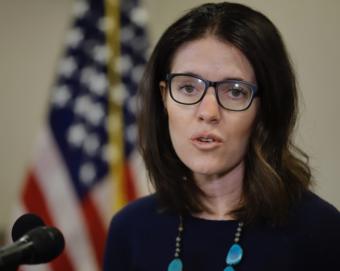
At a press conference on Tuesday afternoon, Alaska’s Chief Medical Officer Dr. Anne Zink said that the state had automated the testing process to make it faster, and that two commercial labs are now able to test.

“The test is not a cure,” she said. “Nor is the test preventative.”

The state will begin holding daily press conferences and sending health alerts, advisories and mandates, she said.

“The data that we see, every year of life, people are more and more at risk,” she said.

Zink recommended that people over 60 stay at home as much as possible, avoid crowds, stay at least six feet away from people who are sick and telecommute to work if possible. She also discouraged gatherings of people in that age group.

The state and the Legislature announced travel restrictions for employees, and the state also froze hiring late Monday. Tuesday, the Legislature began making plans to end the session early if there was an active case in Juneau.

China’s experience with the coronavirus suggests most Alaskans will have only mild or moderate symptoms if they become infected, McLaughlin said. He also said people over 60 are at risk for more serious illness, even if they are fit and active.

The state now has enough kits to test about 800 patients. McLaughlin acknowledges that’s inadequate.

“Every state is struggling with the fact that we have limited testing supplies. The good news, however, is that our testing supplies are increasing, you know, almost daily,” he said.

As an epidemiologist, McLaughlin wants more testing and more surveillance. But he said not every ill person needs to be tested. He recommends consulting the Centers for Disease Control and Prevention website, CDC.gov, to see the risk criteria.

“If you meet any of those high-risk categories, what we want you to do is contact your health care provider. And it’s really important for folks to call in ahead of time and not just go to the emergency room, not just go to an urgent care or your clinic, because if in fact you do have COVID-19, we don’t want you to be in a waiting room potentially infecting other people,” he said.

High-risk groups include older adults, even those that are fit and active, and those with chronic illnesses.

Alaska’s Energy Desk editor Julia O’Malley contributed to this story.

This story has been updated.


Arctic Winter Games in Whitehorse canceled over coronavirus concerns

Athletes participate in the stick pull, one of the many games at the 2020 Traditional Games in Juneau. (Photo by Lyndsey Brollini/courtesy Sealaska Heritage Institute)

Organizers of the Arctic Winter Games in Whitehorse, Yukon, made a decision to cancel the event over coronavirus concerns.

Kyle Khaayák’w Worl has been participating in Native games for the past 11 years. And for about the past four years, he’s coached young athletes and helped reintroduce the sport in Juneau.

A veteran of three Arctic Winter Games, Worl was saddened by what the cancellation means for his athletes, who were looking forward to the international competition.

“It’s hard to believe. You don’t want to believe it,” Worl said via telephone. “When I heard it, I immediately thought of my team. Because I’ve got six of my own athletes on that team.”

The winter games — which are held every two years — were scheduled for March 15 to March 21. The event usually attracts about 2,000 international visitors, including several Alaska competitors, coaches and officials.

“It’s a life-changing opportunity, and it’s really a dream come true. Just to think that it’s canceled for — I mean, how many thousands of youth were going to go and had their dreams set that they made it?” Worl said. “They’re going to represent Team Alaska or Team Yukon or whatever team. And it’s hard, and I know my athletes when they got their uniform, they didn’t want to take it off. They were just so proud.”

The Winter Games announced the decision at a news conference, based on the recommendation of Yukon’s acting chief medical officer, Dr. Catherine Elliott.

“This is an event that can bring together so many northerners from Canada and other circumpolar regions to celebrate sport, art and culture,” Elliott said, choking up, while giving a prepared statement at the news conference. “It is with a heavy heart that I have to make this recommendation. It is the responsible recommendation. And it is very unfortunate.”

While there were no confirmed cases in Yukon, Elliott said the games created potential risk.

Native sports coach Kyle Khaayák’w Worl speaks during the opening ceremony of the 2020 Traditional Games held in Juneau. (Photo by Lyndsey Brollini/courtesy Sealaska Heritage Institute)

The cancellation sent shockwaves of disappointment across the Arctic Circle. Worl said he heard about it during the 2020 Traditional Games — a Native games competition in Juneau. Worl said an estimated 130 athletes participated.
“People just didn’t believe this was something you could cancel. And I mean, I understand why, but you just don’t believe it’s something that can just be canceled a week before we’re ready to get on our flights or ferries or buses.”

Worl said that while the news was upsetting for him and his team, at least they were together when they heard it.

Since the inception of Arctic Winter Games in 1970, this marks the first year that the games will not be held as scheduled. But Worl said it’s a reminder that coaches and athletes should reinforce healthy hygiene habits.

“I mean, one of our rules … is hygiene. So we put that there when we travel is personal hygiene because, I mean, not all young people are good at that yet. And especially when you’re staying in a hotel or a school in close quarters. It can get smelly,” he said with a slight chuckle. “So it’s something I always tell my athletes. I think it’s even more on the minds of people than ever before.”

Worl hopes organizers reschedule the games — or even hold them next year.


Lawmakers crafting plan to end session soon if coronavirus comes to Juneau

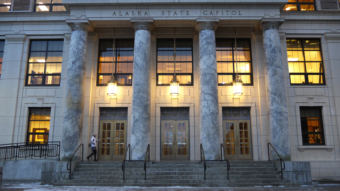
Alaska State Capitol main entrance, Jan. 23, 2017. (Photo by Skip Gray/KTOO)

Lawmakers are considering ending the session soon if the coronavirus arrives in Juneau.

The Legislative Council formed an emergency response preparedness subcommittee Tuesday that would develop a plan for an early adjournment of the session.

Kodiak Republican Sen. Gary Stevens, the council chair, said the plan could include the possibility of closing the Capitol to the public, or allowing lawmakers to vote by phone.

“The goal is to be prepared to respond should the coronavirus arrive here in Alaska and in Juneau particularly,” Stevens said.

Stevens said there are a limited number of votes that must occur before adjournment.

“We’ve got to pass a budget. That’s the one requirement in the constitution,” he said. “And the second requirement is — or not necessarily a requirement, but a responsibility — is to make sure that we confirm the governor’s appointments or not.”

Stevens said the emergency response preparedness subcommittee plans to hold its first meeting Wednesday in private. He said future meetings will be public.

The subcommittee members include the leaders of both the House and Senate.

The session is 90 days under a 2006 voter-passed initiative, and up to 121 days under the state constitution. Tuesday is day 50. The emergency preparedness response subcommittee could recommend ending the session before the 90 days are up.

The subcommittee members are Stevens; Senate President Cathy Giessel, an Anchorage Republican; House Speaker Bryce Edgmon, a Dillingham independent; rules chairs Sen. John Coghill, a North Pole Republican, and Rep. Chuck Kopp, an Anchorage Republican; and minority leaders Sen. Tom Begich, an Anchorage Democrat; and Rep. Lance Pruitt, an Anchorage Republican.


Alaska’s tourism industry prepares for cruise season amid federal travel warnings

Passengers walk a downtown Juneau dock where three cruise ships are tied up June 11, 2017. (Photo by Ed Schoenfeld/CoastAlaska News)
Passengers walk a downtown Juneau dock where three cruise ships are tied up, June 11, 2017. (Photo by Ed Schoenfeld/CoastAlaska)

The U.S. State Department and federal health experts are now advising people against cruise ship travel.

That’s led to questions over whether precautions over coronavirus could reverse the visitor industry’s meteoric growth in Southeast Alaska.

The cruise industry projects 1.44 million cruise passengers will visit Alaska this season. But whether that’ll materialize is an open question.

During a Sunday appearance on NBC’s “Meet the Press”, the head of the National Institute of Allergy and Infectious Diseases was blunt.

“If you’re a person with an underlying condition, and you are particularly an elderly person with an underlying condition, you need to think twice about getting on a plane or on a long trip,” said Dr. Anthony Fauci, the federal institution’s director. “And not only think twice — just don’t get on a cruise ship.”

The State Department had a similar message. It posted a Sunday travel warning that said “U.S. citizens, particularly travelers with underlying health conditions, should not travel by cruise ship.” It added that the Centers for Disease Control and Prevention notes increased risk in a “cruise ship environment.”
A day before, Vice President Mike Pence met cruise industry executives in Florida. He told reporters Saturday that an industry-led response to improve passenger screening was planned to ensure people could cruise safely.

“We want to ensure that the American people can continue — as we deal with the coronavirus — to enjoy the opportunities in the cruise line industry and be confident that the industry and our government at every level are working in concert to ensure their health and well-being,” Pence said.

Alaska cruise industry representative Mike Tibbles released a statement on Monday that said cruise lines were developing better screening and other precautions.

“We are surprised at the (State Department’s) advisory,” Tibbles of Cruise Lines International Association Alaska wrote, “but are moving forward and remain focused on development of an aggressive, responsive plan as agreed to during the meeting with Vice President Pence that goes beyond the already significantly enhanced protocols that are in place. We look forward to submitting our plan to the Vice President imminently.”

So what will that mean for Alaska’s visitor sector?

In the capital city, Travel Juneau’s Liz Perry isn’t making any predictions.

“We’re seeing a few individual cancellations among our travel Juneau partners, but nothing major,” Perry said Monday. “One of our partners has indicated that it’s a little early in the season actually to get a really good gauge on the effect of this message from the State Department.”

But looking at the demographics of those most at risk of becoming seriously ill, there are reasons to worry: According to a 2018 profile of cruise visitors by the industry, a fifth of Alaska’s cruise visitors are retirees.

Gov. Mike Dunleavy told reporters Monday that’s who public health officials are working to protect.

“Young people, children don’t seem to be impacted as older folks with underlying issues,” the governor said. “That’s the group that we’re focusing on.”

He said the first cruise passengers won’t arrive until next month, giving the state time to plan.

“We’re working with the cruise ship industry right now as we speak,” Dunleavy said, “to make sure that when that season starts that we are prepared to guarantee that our folks are safe here in Alaska.”

Screening passengers and crew for coronavirus will be challenging. Current studies suggest people can go two weeks – and in some cases longer – before they show symptoms, yet they could still spread the virus.

Some business owners in port communities are rattled.

Skagway has a year-round population of about 1,000 people. But it was projected to receive more than a million cruise passengers this year.

“There’s definitely kind of a pall over the town. We’re definitely discussing it,” said Karla Ray, who owns five businesses in Skagway that cater to visitors. “There’s already a feeling that the passenger count will be down.”

She said she felt a blanket warning against cruise travel was too broad. It should’ve been targeted to high-risk groups.

“But I think people are making their plans now to cruise,” she added. “And I do feel like, that older people are going to look at this and say, ‘I can just cruise next summer, let’s not go this summer.’”

Ray has dug back to her records from after 2008. That’s when cruise visitors plummeted in the wake of the global financial crisis. Reviewing those figures, she’s put in a hiring freeze and scaled back plans for what had been the promise of another record-breaking cruise season for Alaska.


Dunleavy urges calm as a volatile economy adds to coronavirus anxiety

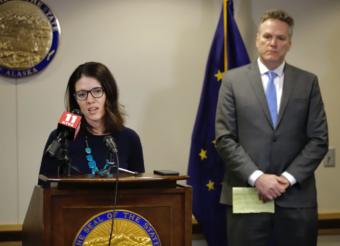
Alaska Chief Medical Officer Anne Zink talks to reporters at a press conference about the coronavirus on Monday, while Gov. Mike Dunleavy looks on in the background. (Photo by Joey Mendolia/Alaska Public Media)

As the coronavirus continued to upend the global economy Monday in ways that threaten the stability of Alaska’s budget, the Alaska Permanent Fund and the tourism industry, Gov. Mike Dunleavy called a news conference to soothe Alaskans’ anxiety.

“I just want to reassure Alaskans that we’re on this,” he said to reporters gathered in his Anchorage office. “We’ve got this.”

Alaska still has no confirmed cases of the virus. The state reported that 32 people had been tested by Monday afternoon. Nine of the tests were pending, but the rest were negative.

In Washington state, the center of the epidemic in the U.S. and a hub for travelers heading to and from Alaska, officials confirmed 162 cases of the virus, including 22 deaths.

Across Alaska, businesses and local officials were making emergency plans. The Municipality of Anchorage partially activated its Emergency Operations Center, allowing staff to work longer hours and draw support from other agencies. The University of Alaska said it had formed an “incident team” to plan for outbreaks on its campuses, while the Anchorage School District began its emergency planning before spring break. Dunleavy also canceled a series of community meetings to focus on the state’s response to the virus.

State health officials said they have loosened limits on who can be tested for the coronavirus, as their capacity to test ramps up. The state can now test as many as 500 people, up from 200 or fewer last week, health officials said.

Before Friday, the state was prioritizing tests for people in the hospital with an unexplained fever and “severe, acute lower respiratory illness,” like pneumonia. Now, that criteria has been broadened slightly to include any respiratory illness requiring hospitalization, not just pneumonia.

Louisa Castrodale, a state epidemiologist, said the change was “to really give providers a little more leeway in saying, ‘Yeah, this person’s sick, but they’re not in that really intensely severe category.’”

She stressed that sick patients who weren’t tested under the tighter criteria have still been followed by their healthcare providers.

“We definitely have providers who say, ‘My plan is to continue to have a conversation with this patient — and you might hear from me tomorrow,’” she said.

One other thing that’s helping to stretch test supplies, Castrodale said, is new federal guidance allowing labs to mix together some of the multiple swabs it collects from each person. Previously those swabs had to be tested individually.

Meanwhile, politicians, economists and tourism officials were pondering what the coronavirus-related volatility in the national and global economy means for business and Alaska’s budget.

Benchmark oil prices crashed some 20% Monday, which could erase hundreds of millions of dollars in state revenue unless that trend reverses.

Meanwhile, federal officials warned against traveling on cruise ships, which are a lynchpin of Southeast Alaska’s tourism economy. The cratering stock market has also stripped more than a billion dollars in value from the Alaska Permanent Fund, which pays for residents’ permanent fund dividends and part of the state budget.

If Monday’s drop in oil prices persists for the long-term, it could cost the state some $300 million in revenue. But Dunleavy said he has no immediate plans to change his budget proposal.

“I would say this is definitely a momentary bump in the road for Alaska. Our oil patch is in it for the long haul,” he said. “With regard to the stock market I, too, believe that the underlying fundamentals of the U.S. economy is pretty strong.”

Not everyone is as optimistic. Mouhcine Guettabi, an economist at University of Alaska Anchorage, said he’s far less certain that the downturns will be temporary, pointing to the cancellation of classes at Ivy League schools as one example. At the University of Washington in hard-hit Seattle, meanwhile, classes are shut down until the end of the spring semester.

“I wish I could tell you, ‘Three months is the maximum amount of time we will be dealing with this,’ or, ‘It’s a two-year situation,’” Guettabi said. “I honestly don’t know.”

Guettabi noted that some 90% of the state’s revenue comes from oil and the permanent fund’s investments, and he said the state can’t hide from that.

“The thing that it exposes is just how vulnerable Alaska is,” he said. “Because it’s the perfect storm of sorts — there’s exposure, from a budgetary standpoint, to the two big sources of money.”

Alaska’s Energy Desk editor Julia O’Malley contributed to this story from Anchorage.


Site notifications
Update notification options
Subscribe to notifications