National News

These 5 charts show how life got pricier, but also cheaper, in 2023

Supermarket sticker shock eased this year, as egg prices fell back to earth. Despite gloomy recession forecasts at the beginning of the year, consumers kept spending and the economy continued to grow. (Brandon Bell/Getty Images)

For our wallets and the U.S. economy, 2023 was in many ways the year life began to look more like it did before the pandemic.

The American shopping frenzy slowed and credit card debt inched up, while the labor market continued to hum along and unemployment remained near historic lows. Prices continued to climb but at a slower pace, and by year’s end wage growth was outpacing inflation.

How does it all add up? Here are some of the ways our lives got both pricier and cheaper in 2023.

Breakfast

Supermarket sticker shock eased this year, and some grocery prices are actually declining. Last year’s eye-popping costs of eggs (due to bird flu) and butter (due to lower dairy production) have finally come down. So have coffee and sugar costs. Let them eat cake! (Or at least scrambled eggs.) Frozen orange juice is still expensive, because of weak production in Florida and Brazil, but overall, grocery prices in November were up a modest 1.7% compared to a year ago. The previous year, grocery prices had soared by 12%.

Adulting

Housing costs continued to climb this year, but the worst could be behind us. Mortgage rates, which approached 8% in the fall, eased to an average of 6.67% in recent weeks. The average sales price for a home in November was up 4% from a year ago. Outstanding credit card debt rebounded this year, topping a trillion dollars after falling early in the pandemic. But hey, at least our savings rate is also climbing from rock-bottom levels. And to address that auto insurance price hike: Turns out, premiums are fueled by riskier drivers, natural disasters and costlier car parts.

Trips and entertainment

It’s time to fly! The lower price of gasoline was a major driver of cooling inflation, and falling jet fuel prices helped lower the price of airplane tickets. Restaurant meals are still pricier because of higher costs of both food and wages, but we’re still eating out a ton. Spending at restaurants and bars soared 11.3% in November compared to last year — more than double the increase in menu prices.

Work stuff

This was the year when higher wages finally caught up to and ever-so-slightly outpaced inflation. It was also a year of big strikes and big wins by established unions, although fledgling unions are still battling behemoths like Amazon and Starbucks for recognition. The labor market has shrugged off high-inflation woes and rising interest rates. Millions of people joined or rejoined the workforce this year, but the unemployment rate remains very low at 3.7%. It’s early days, but ChatGPT has yet to take our jobs.

Big picture

While many forecasters expected rising interest rates to tip the U.S. economy into recession this year, we appear to have dodged that bullet. GDP grew at a relatively robust 2.9% in the 12 months ending in September, and it seems on track to keep growing as shoppers are spending through the holidays. Inflation is still higher than the 2% target set by the Federal Reserve. But Fed officials have signaled that they’re probably done raising interest rates and may be ready to start cutting rates in the coming year. The prospect of lower borrowing costs cheered investors, pushing the stock market to near-record highs.


Methodology

Calculations rely on the latest data. Most compared November 2023 to November 2022. Credit card debt, student loan debt and unfair labor practices filings are from September, compared to a year earlier. S&P 500 and the dollar data are from Dec. 26, compared with a year earlier. The dollar value is measured against a basket of currencies using the U.S. Dollar Index.

Sources:

Copyright 2023 NPR. To see more, visit https://www.npr.org.

Congress passed so few laws this year that we explained them all in 1,000 words

Lawmakers left a lot of work undone in 2023, creating a pile up of work for the start of next year. (Catie Dull/NPR)

Much of the news in Congress this year had little to do with actual legislation, but lawmakers did manage to send 27 bills to President Biden’s desk for a signature. That’s a dramatic productivity decline relative to previous years, even when compared to other eras of divided government.

But they’re set to start next year with a slew of legislation, if they can muster it. There are two government funding deadlines, Jan. 19 and Feb. 2, that they can solve by passing the 12 annual federal spending bills.

There are also ongoing negotiations about a foreign aid and immigration reform package, as Biden calls for military aid to Ukraine, Israel and the Indo-Pacific and Republicans push for policy changes to stem the record tide of migrants at the U.S.-Mexico border.

While all of that percolates, here is a list of everything Congress did pass in 2023 — and what it accomplished.

Keeping the government open and avoiding default

On June 3, Congress passed the Fiscal Responsibility Act of 2023, an agreement to raise the limit on the amount of money the U.S. government is allowed to borrow. It was a protracted fight between House Republicans and the White House.

As Republicans struggled to reach consensus on full-year government spending bills, Congress passed two short-term government funding measures: the Continuing Appropriations Act on Sept. 30 and the Further Continuing Appropriations Act on Nov. 16.

The next government funding deadlines are on Jan. 19 and Feb. 2, 2024.

Addressing the needs of service members and veterans

In June, Congress passed a cost-of-living adjustment for veterans’ disability payments (Veterans’ COLA Act) and expanded the eligibility for a military academies’ financial aid program (CADETS Act). In July, the authorized the construction of several new Veterans Affairs facilities (VA Major Medical Facility Authorization Act).

Through the fall, Congress expanded coverage and extended policies around various Veterans Affairs programs, including adding coverage for people with spina bifida who are the children of Vietnam veterans (Bills To Amend Title 38).

Additional legislation extends benefits eligibility to certain veterans who served in the South Korean army with U.S. troops in Vietnam (Korean American VALOR Act) and mandates an VA online records request portal (Wounded Warrior Access Act).

The National Guard and Reservists Debt Relief Extension Act waived some means-testing requirements for some servicemembers and reservists seeking bankruptcy relief.

Congress also named two VA clinics and commissioned a commemorative coin for the 250th anniversary of the U.S. Marine Corps.

Health, safety and COVID-19

In the spring, Congress formally ended the COVID-19 emergency declared by then-President Trump in March 2020 (Relating to a national emergency declared by the President). They also ordered the Director of National Intelligence to declassify all information relating to potential links between a Chinese research institute and the coronavirus pandemic (COVID-19 Origin Act).

The TRANQ Research Act is intended to find ways to curb illicit use of the animal tranquilizer xylazine.

Two laws aim to improve U.S. air safety (NOTAM Improvement Act) and the organ transplant network (Securing the U.S. Organ Procurement and Transplantation Network Act), while another nullified a local Washington D.C. criminal justice reform law (Disapproving the action of the District of Columbia Council in approving the Revised Criminal Code Act).

Hunting education and reform

Schools are now allowed to purchase “dangerous weapons” for the purposes of educational instruction or educational enrichment activities including archery and hunting under the Protecting Hunting Heritage and Education Act.

The Duck Stamp Modernization Act digitizes some aspects of the bureaucracy associated with federal hunting regulations.

Potpourri

The Providing Accountability Through Transparency Act requires new federal rules to include links to summaries of the rules, which must be fewer than 100 words.

Another law, the Pala Band of Mission Indians Land Transfer Act, establishes a federal land trust for the Pala Band of Mission Indians in California.

The United States-Taiwan Initiative on 21st-Century Trade First Agreement Implementation Act, as you might guess, implements a trade agreement between the U.S. and Taiwan.

A bill to amend the Federal Election Campaign Act of 1971 extends the ability for federal elections regulators to fine campaigns for violating disclosure requirements for ten additional years.

The 5G SALE Act allows the government to vet applications for use of parts of the electromagnetic spectrum that were auctioned for use in March 2023.

The biggest headlines had nothing to do with legislation

Kevin McCarthy, R-Calif., was fired by his colleagues as Speaker of the House and ultimately chose to quit Congress.

George Santos, R-N.Y., was expelled by his colleagues after a series of lies about his background and 23 federal criminal charges related to fraud.

Sen. Robert Menendez, D-N.J., has so far refused to resign after being accused by federal prosecutors of taking bribes in exchange for committing corrupt acts for committing corrupt acts, including providing sensitive information to the government of Egypt.

House Republicans formalized their impeachment inquiry into President Biden, despite no direct evidence of wrongdoing. They could vote on articles of impeachment as soon as next month.

Finally, aid to Ukraine, Israel and Taiwan is held up over disagreements about immigration policy – negotiations are ongoing between a select group of Senators, but it is almost certain no deal can be inked until next year.

Copyright 2023 NPR. To see more, visit https://www.npr.org.

2023 was a tragic and bizarre year of wildfires. Will it mark a turning point?

Two women embrace and cry as they look out over Lahaina, in Maui, Hawaii, which was severely damaged by a wildfire in August. (Claire Harbage/NPR)

Come August, it’s usually the massive wildfires in California and the West that are dominating the headlines. But not this year. The remnants of Hurricane Hilary were dumping record rain on the mostly arid region and instead it was the tropics that were on fire.

In Hawaii on Aug. 8, gale force winds from a different hurricane — Dora — collided with extremely dry terrain on the western coast of Maui. Toppled power lines helped ignite what would become the deadliest wildfire in modern U.S. history, killing 100 people and destroying most of the historic tourist town of Lahaina.

Some had no other means of escape but to jump into the ocean.

In the aftermath of the fires, a seaside resort just north of Lahaina was transformed into an emergency assistance center and shelter. A shaken David Ormsbee said he was grateful to make it out alive along with his girlfriend and cat.

“The smoke just kept getting blacker,” he said. “It started getting hotter and hotter and we just got the hell out.”

The fire destroyed his apartment and the business where he worked. The couple felt fortunate to have a car on loan from his sister.

“It’s just the matter of the waiting game, you know, what do you do next? I’m working one day at a time,” Ormsbee said.

A waiting game that could take months if not years to return to some sense of normalcy, if recent climate-driven wildfire disasters are any indication.

In terms of land burned, 2023 was a relatively quiet fire year

Tragic, unthinkable and even bizarre may be words that best sum up 2023 when it comes to wildfires. There were the deadly blazes in the tropics, but also near the Canadian arctic, causing thick, toxic smoke to blow down the US eastern seaboard for weeks. Meanwhile, the western U.S. seemed to enjoy a relative reprieve. Nationwide, about 2.6 million acres burned, compared to 7.5 million last year and more than ten million in 2020.

On Maui, it’s widely believed it could take a decade or longer to fully recover. Reconstruction is still a long ways out as crews are still clearing debris. There was also already a severe housing and labor shortage before the fires.

People put up a fence around the homes burned by the wildfire in Lahaina on Aug. 22. (Claire Harbage/NPR)

“When we think about recovery in basic terms, we’re often thinking, well, how long does it take to rebuild a house, maybe a couple years if there’s a backlog in contractors,” says Catrin Edgeley, professor of forestry at Northern Arizona University. “But a rebuilt house does not mean that you’re recovered.”

Even rebuilding a home in two years after a wildfire is considered fast. Edgeley researched survivors of the Marshall Fire that ignited in the winter near Boulder, Colorado two years ago. She found that many fire victims can be retraumatized during the recovery because they have to prove and rehash the crisis again to their insurance companies and FEMA. It can slow everything down further.

“And that can take a significant toll if you think about the stress that can create, the re-living of that experience over and over,” Edgeley says.

2023 also marked a milestone for Paradise, California

Many survivors of wildfires today are quickly encountering a sobering reality: Even if they have insurance, it’s usually not enough to cover the costs of rebuilding, particularly in this era of high inflation.

In some parts of the West, particularly California, fire survivors are also struggling to even get insurance for homes they plan to rebuild.

In a forest just outside Paradise, California, Bernadette Grant and Richard Fox have only recently come up with a long term plan to rebuild on property she owns that the family used to use as a camping area.

“As you can see we’re slowly but surely clearing out the space,” Grant says.

Grant, who grew up in Paradise, lost her home in the 2018 Camp Fire, as did her mother who is in her 80s and recently moved back into a newly built home on her property in town.

Bernadette Grant and Richard Fox stand in front of solar panels on property where they plan to build a home near Paradise, Calif. (Kirk Siegler/NPR)

During a break from thinning trees on the property, her partner Richard Fox says they’re not even sure if the property can be insured. He points to a cluster of trees 100 yards or so to his left which he says would catch fire almost immediately with lightning or some other ignition.

“We’re not even close yet to that stage of bringing someone in and trying to get insurance on it,” Fox says.

Before Lahaina, the Camp Fire had been the deadliest wildfire in the U.S. in a century – it claimed 85 lives. For survivors like Fox and Grant, the crisis in Maui stirred up bad memories. It’s still fresh they say, as they continue work cutting trees that they’ll use for lumber to build a modest cabin. Right now, they’re living in an RV on the property.

“In the meantime we just keep clearing the property,” Grant says as Fox chimes in: “Trying to make it safe, that’s all we can do.”

This Fall, Paradise leaders and other Camp Fire survivors have been meeting with their counterparts in Lahaina, guiding them on how to recover from the unthinkable.

This year marked some positive milestones for Paradise, however, where state of the art power lines were buried underground, the downtown was refurbished with sidewalks and new bike paths that also serve as egress escape routes.

“There’s a tremendous amount of optimism and sense of community,” says Mitchell Snyder, a disaster recovery expert at the University of California-Davis. “They’re rebuilding something and they know that they’re an underdog in all this and they’re excited about that.”

A vacant lot in Paradise, California where a home stood before the 2018 Camp Fire. (Kirk Siegler/NPR)

Today, about a third of Paradise has been rebuilt. Snyder says that’s remarkable when you consider that almost 19,000 homes and businesses burned in and around Paradise in 2018 – including 90% of the town itself.

“In the future, as we look towards the one year anniversary of Lahaina, just remember that there are people behind the numbers that we see on the headlines,” Snyder says. “For so many people this was the worst day of their life.”

Is 2023 finally a turning point in U.S. Firefighting Policy?

One silver lining of this tragic and bizarre fire year, according to experts, is that the wildfire threat might be a lot more real to decision makers in Washington, D.C.

Toxic smoke turned the skies an apocalyptic orange up and down the east coast, obscuring the Manhattan skyline for weeks, giving a glimpse of what many summers in the West are already like. Pressure is building to prioritize prevention, instead of waiting to fight these modern megafires later.

In Hawaii, a shell-shocked Curt Hanthorn was waiting in line to get his mail at the Post Office in Lahaina a couple weeks after the fire in August. He said he was frustrated by all the finger pointing after the crisis.

“Pointing blame, it’s the electric company’s fault, it’s the county’s fault, it’s Joe Biden’s fault, it’s everybody’s fault,” Hanthorn said. “The fact of the matter is I saw it from the beginning it moved so fast…like a blow torch.”

No one is stopping fires like these, he said.

Copyright 2023 NPR. To see more, visit https://www.npr.org.

Colorado’s Supreme Court disqualified Trump from the state ballot. What happens now?

The Colorado Supreme Court ruled that Donald Trump’s actions on and around Jan. 6 disqualify him from the presidency and from appearing on the state’s 2024 primary ballot. (John Minchillo/AP)

Legal scholars and activists — mostly on the left — have argued for months that a Civil War-era constitutional clause should disqualify former President Donald Trump, the current Republican frontrunner, from holding office again.

They contend that Trump’s words and actions on and around the Jan. 6 U.S. Capitol attack violate Section 3 of the 14th Amendment, which bars from office anyone who “engaged in insurrection or rebellion” against the United States. And liberal-leaning groups have brought that argument to court in many states.

Colorado became the first to agree on Tuesday, when its Supreme Court ruled that Trump is disqualified from appearing on its state primary ballot.

“Because he is disqualified, it would be a wrongful act under the Election Code for the Secretary to list him as a candidate on the presidential primary ballot,” reads the 213-page opinion.

The landmark 4-3 ruling — which overturns a district court decision from last month — is the first time a high court in any state has found that Section 3 applies to both Trump’s conduct and the office of the presidency itself.

The justices — all appointed by Democratic governors in the increasingly blue state — acknowledge that this amounts to “uncharted territory.”

And “to maintain the status quo,” they stayed their ruling until Jan. 4, the day before the secretary of state’s deadline to certify primary ballots (Colorado’s presidential primary will be held on March 5). That means that if the U.S. Supreme Court agrees to hear the case and is still in process by that date, Trump’s name should be included on the ballot after all.

Trump campaign spokesperson Steven Cheung called the decision “completely flawed” and pledged to “swiftly file an appeal to the United States Supreme Court and a concurrent request for a stay of this deeply undemocratic decision.”

For his part, President Biden said Wednesday that Trump “certainly supported an insurrection, but added: “Now whether the 14th Amendment applies, I’ll let the court make that decision.”

So what could happen next, in Colorado and beyond?

Justin Levitt, a constitutional law professor at Loyola Law School, told NPR that as long as there’s a petition for U.S. Supreme Court review in place by Jan. 5, there’s a “99.9%” chance that Trump will remain on the Colorado primary ballot.

And if Trump — with his consistently steady lead in GOP polls — does win the primary, Levitt expects there will be a similar legal effort to keep him off the general election ballot for the same reason.

“All of this is extremely important for a couple months down the road where we’re going to get to have this fight again,” he adds. “But the immediate impact is very unlikely to be determinative in the primary.”

Republicans threaten to withdraw from the Colorado primary

Prominent Republicans — including Trump’s rivals for the presidential nomination — are lining up to slam the Colorado court’s decision and are already promising to take action against it.

Ronna McDaniel, chair of the Republican National Committee, wrote online that “our legal team looks forward to helping fight for a victory,” referring to Trump’s expected appeal.

Just hours after the ruling Tuesday, Trump’s team sent an email with the subject line “REMOVED FROM THE BALLOT,” urging supporters to give to his campaign. This is not the first such ask related to the Colorado case from Trump, who has been known to fundraise off his legal woes — and whose political persona is driven by a narrative of being persecuted by enemies.

The Colorado Republican Party similarly launched an online campaign urging donors to “help us keep Trump on the ballot and fight this election interference.”

Colorado Republicans also threatened to withdraw from the primary and convert to a party-run caucus system if the ruling stands.

“We’re not gonna take this lying down, and if need be we’re going to withdraw from the primary and go to a strict caucus process that would allow our voters to choose Donald Trump if they want,” state Rep. Dave Williams, the staunchly conservative chair of the Colorado Republican Party, told CNN on Tuesday.

That may be easier said than done, however, since the RNC has already approved the state party’s nomination plan, ABC News reports. Williams told the outlet that Colorado Republicans would “seek a waiver and probably get it.”

Even some of Trump’s GOP challengers are siding with him in this case.

Vivek Ramaswamy pledged in a statement and video to withdraw from the Colorado GOP primary ballot “until Trump is also allowed to be on the ballot.”

New Jersey Gov. Chris Christie, who’s campaigned to stop Trump from returning to office, criticized the court’s ruling shortly after it came out. Speaking at an event in New Hampshire, he said Trump shouldn’t be prevented from being president by any court, but rather by the country’s voters.

The Colorado Supreme Court in Denver heard arguments earlier this month. Their decision reversed that of a lower court, who had said the constitutional clause applied to Trump’s actions but not the office of the presidency. (David Zalubowski/AP)

What Colorado’s decision could mean for the country

Legal experts and election officials have long predicted the Trump 14th Amendment challenges would end up in front of the U.S. Supreme Court, to be decided for the country as a whole rather than on a state-by-state basis.

Courts have ruled against similar efforts in Arizona, Minnesota and Michigan, though other legal battles are still pending — or have yet to be introduced — in other states.

Levitt, of Loyola, said Colorado’s decision won’t directly impact any of these other cases.

The “thoughtful” opinion gives other courts something to look at, to see if they agree or disagree, he noted. But he said the incentives remain basically the same for Trump’s team to slow the process down and for the other side to speed things up.

“It punts this a few months down the road but doesn’t actually stop the clock on any of the other proceedings,” he explained.

And while the Supreme Court has a conservative supermajority, including three justices appointed by Trump himself, it’s not clear how it would rule on the Colorado appeal.

Kim Wehle, a professor at the University of Baltimore School of Law, told Morning Edition that she believes the Supreme Court would take this case seriously because of the massive implications it holds not just for 2024 but for future elections.

“I think there should be an incentive along the way to say to would-be presidents, ‘Listen, don’t do what happened on Jan. 6, there’ll be consequences for it,'” she added. “But we’re in a politicized world and we have, arguably, a politicized Supreme Court.”

Experts say it could choose to send the case back to the state level, or avoid ruling on the merits in some other way (like focusing on the wording of the clause, as the lower court in Colorado did).

This is not the only consequential case regarding Trump at the Supreme Court. The federal special counsel has asked the justices to quickly decide whether the former president enjoyed broad immunity from criminal charges as a result of his office.

When considering the 14th Amendment, Levitt says the tough question is not whether Trump is qualified to hold office, but who gets to make that call. He believes the courts will want to leave it up to voters, and says he’s a little skeptical that “the law is going to decide this issue before the people do.”

“There are a lot of questions that, if we get to November and the American people decide they don’t want him as their chief executive, that the courts never have to decide,” he adds.

NPR’s Vanessa Romo contributed reporting.

Copyright 2023 NPR. To see more, visit https://www.npr.org.

Artificial intelligence can find your location in photos, worrying privacy experts

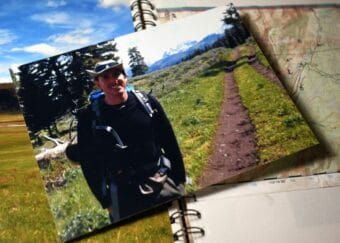
The PIGEON algorithm was able to geolocate this 2012 photo of the author on a backcountry trail in Yellowstone National Park to within roughly 35 miles of where it was taken. (Courtesy of Geoff Brumfiel)

A student project has revealed yet another power of artificial intelligence — it can be extremely good at geolocating where photos are taken.

The project, known as Predicting Image Geolocations (or PIGEON, for short) was designed by three Stanford graduate students in order to identify locations on Google Street View.

But when presented with a few personal photos it had never seen before, the program was, in the majority of cases, able to make accurate guesses about where the photos were taken.

Like so many applications of AI, this new power is likely to be a double-edged sword: It may help people identify the locations of old snapshots from relatives, or allow field biologists to conduct rapid surveys of entire regions for invasive plant species, to name but a few of many likely beneficial applications.

But it also could be used to expose information about individuals that they never intended to share, says Jay Stanley, a senior policy analyst at the American Civil Liberties Union who studies technology. Stanley worries that similar technology, which he feels will almost certainly become widely available, could be used for government surveillance, corporate tracking or even stalking.

“From a privacy point of view, your location can be a very sensitive set of information,” he says.

AI has arrived at your destination

It all began with a class at Stanford: Computer Science 330, Deep Multi-task and Meta Learning.

Three friends, Michal Skreta, Silas Alberti and Lukas Haas, needed a project, and they shared a common hobby:

“During that time we were actually big players of a Swedish game called GeoGuessr,” says Skreta.

GeoGuessr is an online game that challenges players to geolocate photos. It has a pretty straightforward setup, Skreta says: “You enter the game, you’re placed somewhere in the world on Google Street View, and you’re supposed to place a pin on the map, that is your best guess of the location.”

The game has over 50 million players who compete in world championships, adds Silas Alberti, another member of the project. “It has YouTubers, Twitch streamers, pro players.”

The students wanted to see if they could build an AI player that could do better than humans. They started with an existing system for analyzing images called CLIP. It’s a neural network program that can learn about visual images just by reading text about them, and it’s built by OpenAI, the same company that makes ChatGPT.

The Stanford students trained their version of the system with images from Google Street View.

“We created our own dataset of around 500,000 street view images,” Alberti says. “That’s actually not that much data, [and] we were able to get quite spectacular performance.”

The team added additional pieces to the program, including one that helped the AI classify images by their position on the globe. When completed, the PIGEON system could identify the location of a Google Street view image anywhere on earth. It guesses the correct country 95% of the time and can usually pick a location within about 25 miles of the actual site.

Next, they pitted their algorithm against a human. Specifically, a really good human named Trevor Rainbolt. Rainbolt is a legend in geoguessing circles —he recently geolocated a photo of a random tree in Illinois, just for kicks — but he met his match with PIGEON. In a head-to-head competition he lost multiple rounds.

“We weren’t the first AI that played against Rainbolt,” Alberti says. “We’re just the first AI that won against Rainbolt.”

Noticing the little things

PIGEON excels because it can pick up on all the little clues humans can, and many more subtle ones, like slight differences in foliage, soil, and weather.

The group says the technology has all kinds of potential applications. It could identify roads or power lines that need fixing, help monitor for biodiversity, or be used as a teaching tool.

Skreta believes ordinary people will also find it useful: “You like this destination in Italy; where in the world could you go if you want to see something similar?”

To test PIGEON’s performance, I gave it five personal photos from a trip I took across America years ago, none of which have been published online. Some photos were snapped in cities, but a few were taken in places nowhere near roads or other easily recognizable landmarks.

That didn’t seem to matter much.

It guessed a campsite in Yellowstone to within around 35 miles of the actual location. The program placed another photo, taken on a street in San Francisco, to within a few city blocks.

Not every photo was an easy match: The program mistakenly linked one photo taken on the front range of Wyoming to a spot along the front range of Colorado, more than a hundred miles away. And it guessed that a picture of the Snake River Canyon in Idaho was of the Kawarau Gorge in New Zealand (in fairness, the two landscapes look remarkably similar).

The ACLU’s Jay Stanley thinks despite these stumbles, the program clearly shows the potential power of AI.

“The fact that this was done as a student project makes you wonder what could be done, by, for example, Google,” he says.

In fact, Google already has a feature known as “location estimation,” which uses AI to guess a photo’s location. Currently, it only uses a catalog of roughly a million landmarks, rather than the 220 billion street view images that Google has collected. The company told NPR that users can disable the feature.

Stanley worries that companies might soon use AI to track where you’ve traveled, or that governments might check your photos to see if you’ve visited a country on a watchlist. Stalking and abuse are also obvious threats, he says. In the past, Stanley says, people have been able to remove GPS location tagging from photos they post online. That may not work anymore.

The Stanford graduate students are well aware of the risks. They’ve written a paper on their technique, which they co-authored along with their professor, Chelsea Finn — but they’ve held back from making their full model publicly available, precisely because of these concerns, they say.

But Stanley thinks use of AI for geolocation will become even more powerful going forward. He doubts there’s much to be done — except to be aware of what’s in the background photos you post online.

Copyright 2023 NPR. To see more, visit https://www.npr.org.

People are leaving some neighborhoods because of floods, a new study finds

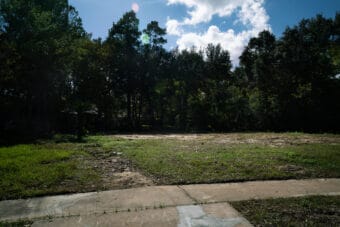
An empty lot where a house once stood in Houston. The former residents moved because of flood damage. A new study suggests that people are moving away from the most flood-prone neighborhoods in cities that are otherwise growing in population. (Claire Harbage/NPR)

Hundreds of thousands of neighborhoods in the United States are seeing population decline as a result of flooding, new research suggests. Those neighborhoods are often located in areas that are growing in population overall, including parts of Florida, Texas and the region around Washington, D.C.

The results underscore how flood risk – which is growing due to climate change – is already affecting where Americans live.

“People are being more selective about where they live,” says Jeremy Porter, one of the authors of the study and a researcher at the First Street Foundation, a research and advocacy organization that publishes analyses about climate hazards including flooding. The study was published in the journal Nature Communications.

Americans are flocking to some of the most flood-prone parts of the country, including coastal areas, and low-lying cities in Florida, Texas and coastal Virginia. At the same time, heavy rain and sea level rise from climate change means floods are getting larger and more frequent.

As a result, the cost of flood damage in the U.S. has skyrocketed in recent years. The Federal Emergency Management Agency, home insurance companies and climate and housing experts all warn that huge financial losses from flood damage are not sustainable for families or the economy.

At the same time, people buying homes are increasingly aware, and wary, of flood risk. More and more states are requiring that homebuyers receive information about whether a house has flooded before, and whether it is likely to flood in the future. Some real estate listing sites include information about flood risk. And people are less likely to search for flood-prone properties when they are given information as part of the listing about whether a home flooded in the past or is likely to flood in the future, according to a study by the real estate website Redfin.

But if people are trying to avoid moving to flood zones, why are so many people ending up in the most flood-prone parts of the country? The authors of the new study offer some new insight.

They looked at the number of people living in each of the more than 11 million census blocks in the contiguous U.S., and analyzed how that number changed in places with high exposure to floods versus lower exposure to floods. They found that about 7% of census blocks – which are roughly the size of a city block – are experiencing population decline due to flood exposure.

They estimate that those neighborhoods saw a net loss of about 9 million residents between 2000 and 2020. And they found that many of those neighborhoods are located in places that are growing overall, such as South Florida and Southeast Texas.

The results suggest that the influx of new residents into flood-prone cities such as Miami and San Antonio may obscure the millions of people who are moving more locally to get away from the lowest-lying neighborhoods in those cities.

Moves to the Sun Belt “are a macro migration trend,” explains Porter. “But they’re dwarfed by the amount of people that move within their same city. Keep the same job, keep the same friends, stay close to family.”

Previous research has found that most people stay local when they move to a new home, including in situations where a flood disaster forced them to relocate. That means decisions about where to live and how to stay out of harm’s way often come down to block-by-block or even house-by-house comparisons.

And, while flood risk appears to play a role in where people choose to live, social factors including race and class are also hugely important, says Kevin Loughran, a sociologist at Temple University who studies relocation from flood zones.

“Flood risk, or environmental risk in general, is not the only criteria they’re using to make these decisions,” says Loughran.

The new study offers a new level of national insight into how flood risk might be affecting local trends in population, he says. But the details are still fuzzy, and further research is underway by social scientists and others to study exactly how people who live in areas threatened by climate hazards decide whether, and where, to move.

Copyright 2023 NPR. To see more, visit https://www.npr.org.
Site notifications
Update notification options
Subscribe to notifications