National News

With ChatGPT turning 1, Americans wonder whether AI is coming for their jobs

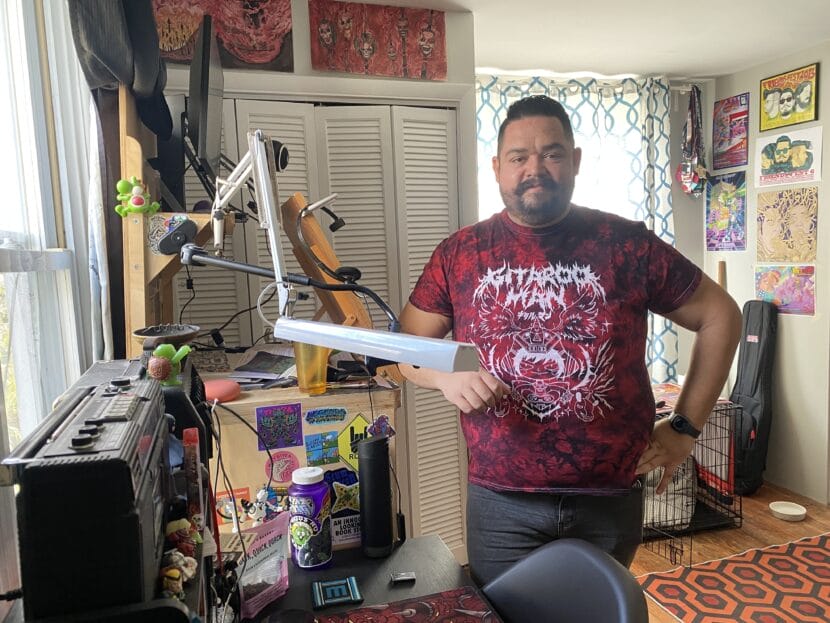
Baltimore illustrator John de Campos isn’t happy that AI is being used to create images for commercial purposes, supplanting artists whose real life experience is reflected in their work. (Andrea Hsu/NPR)

Baltimore illustrator John de Campos was irate when he discovered that some of his original work had been used to train an artificial intelligence chatbot — without his permission.

“It’s so gross,” he says.

In just the past year, AI-powered programs like Midjourney and DALL-E have made it possible for anyone to create highly sophisticated images with just a few clicks of the keyboard.

For de Campos, that’s an outrage.

“The fact that human expression and art is now at risk and on the chopping block is super duper scary to me,” he says.

At the same time, de Campos, who aspires to make a living as a board game designer, has found ChatGPT to be a very effective helper when it comes to marketing his games on social media.

“I’ll say, these are the qualities of the game that we’re selling. Take all of this information, melt it down into 15 words or less. Give me five different versions written to sell this product on Instagram,” he says.

De Campos acknowledges the hypocrisy that this presents and says he’s trying to decide whether he should divorce himself from using any AI tool.

“I feel so strongly about the art side and not so much about the text side, but I’m kind of figuring it out,” he says.

John de Campos says he spent 50 or 60 hours on illustrations for his latest board game Black Mold, which he describes as a survival horror escape. Some of his competitors in the board game space are turning to AI for art. (Andrea Hsu/NPR)

A year after the launch of ChatGPT, people in all kinds of occupations are figuring out where to draw the line with AI. Attitudes toward the new technology vary widely, with little consensus over which tasks can and should be handed over to bots.

The fastest writing assistant

In Michigan, Ethan Kissel has been turning to AI for help with his job producing television commercials for local businesses.

“It’s really good for spitballing ideas,” he says.

In the past, Kissel would spend an hour or more writing a 15- or 30-second script, with the hardest part being the tagline — the last, most memorable sentence. He discovered ChatGPT can deliver dozens of taglines in just a matter of seconds.

“Most of them are probably trash,” he says. “But you take a bit from one and a couple words from another and fashion them all together, and suddenly you have something that you actually kind of like.”

Kissel can easily can envision a future in which copywriters become dispensable, along with voice actors who do narration. His company already uses an AI tool to fix mispronunciations if they’re short on time.

For now, though, Kissel is less worried about his own job. In addition to writing scripts, he also shoots and edits video and meets with clients. Being a jack-of-all-trades, he says, offers some protection.

“I don’t think it’s as scary of a problem for ‘the right now.’ But it is one that we need to discuss and plan for,” he says.

Change is coming fast

Across professions, there are hints of what the future holds. Newspapers have used AI to write recaps of high school sports matches. Video game companies are using AI to create new characters. Software developers are using AI to write code.

Karin Kimbrough, chief economist for LinkedIn, which is owned by Microsoft, doesn’t see AI coming for everyone’s jobs right away. But she says AI will undoubtedly change how most people spend time on the job.

“You might spend less time on routine tasks,” she says. “You might spend more time on things… that are really using your human-powered skills, your skills of empathy and ethical judgment, your skills of managing and leading people.”

Ultimately, Kimbrough says, the hope is that AI will make people more efficient and productive.

But there are lots of pitfalls to avoid along the way. The internet is filled with stories of AI chatbots confidently delivering complete fabrications.

A New York lawyer was sanctioned this year after being caught citing bogus cases in a lawsuit against an airline. In court, he admitted he had used ChatGPT for legal research and hadn’t bothered to double check the bot’s work.

Such cases make it easy to see how irresponsible use of AI could end up harming people and society.

Learning the shortfalls and potential

Jeffrey Garcia, a program manager for a tech company, has taken it upon himself to figure out what AI is good at and what it’s not, partly for fun but also to stay on top of developments that could shape his future employment.

His experimentation over the past year has given him a glimpse into the technology’s shortfalls and potential.

As a child, Garcia was always frustrated with his inability to replicate on paper beautiful images conjured up in his mind.

“I have a deep love for art,” he says. “But I suck at it.”

This past spring, he wondered, could he open an Etsy store with a few products created with Midjourney? His first undertaking: a vintage-style poster of a favorite bird, the Baltimore oriole.

The program delivered a fairly sophisticated image of an oriole in front of a Baltimore skyline, but there were a few problems. Garcia’s wife, a biologist, found extra toes on the bird’s feet. The skyline did include a few recognizable landmarks but wouldn’t hold up for anyone who knows the city.

Garcia didn’t go on to sell any of his posters but concluded it would be fairly easy to commoditize such a product, especially given the rapid advancements AI image-generating tools have made. This fall, he tried using the newly-released DALL-E 3 to create the same poster and got a much-improved image, though still not free of anatomical errors.
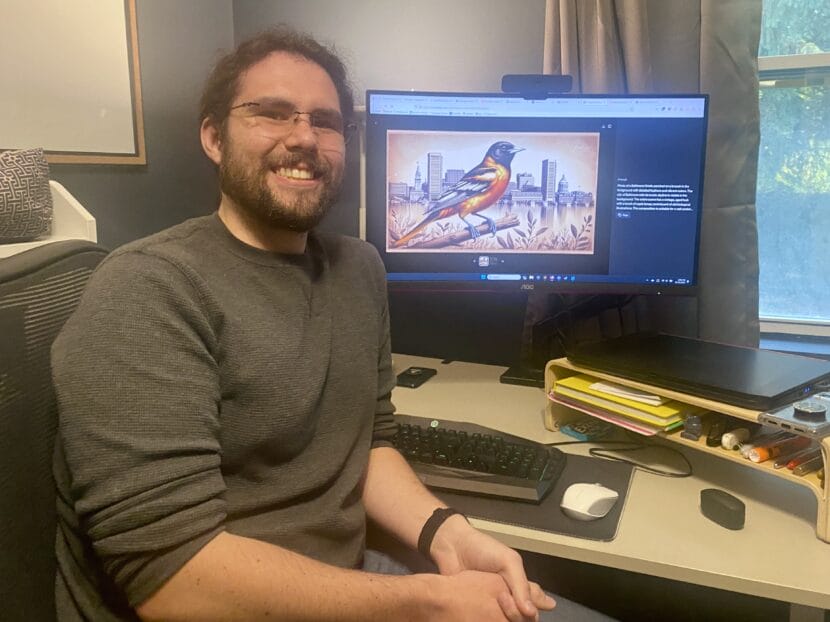
Jeffrey Garcia with an image of a Baltimore oriole he created using DALL-E 3 in October 2023. (Andrea Hsu/NPR)

“It’s getting better, but still not good enough to pass the snuff of someone who knows what’s going on,” he says.

Experiments like this have informed how Garcia uses AI for work. He thinks of ChatGPT as a naïve assistant who can fairly effectively write first drafts, but whose work must be verified and edited.

And there are still some parts of his job that he’s not ready to relinquish. Correspondence is one of them.

“I don’t feel comfortable handing off this thing that I view as essential and deeply human to an automated system,” he says.

Copyright 2023 NPR. To see more, visit https://www.npr.org.

This 3-year cruise around the world is called off, leaving passengers in the lurch

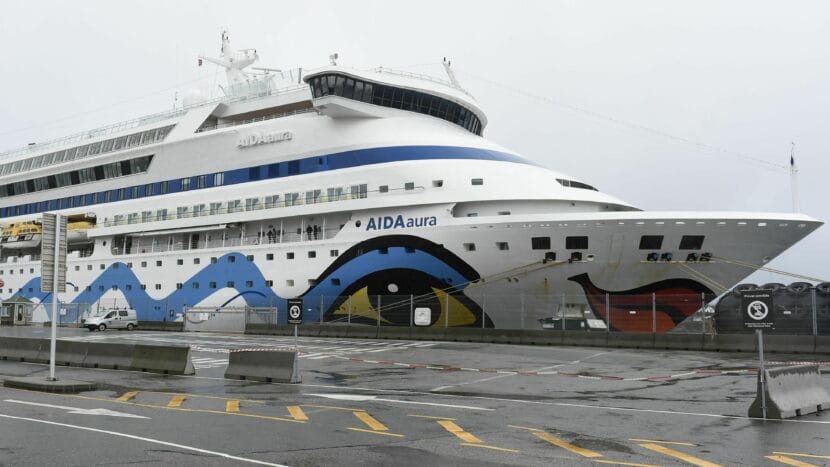
When the Life at Sea cruise line failed to purchase the German cruise ship AIDAaura, seen here in 2020, its plans for a worldwide cruise embarking in November began to unravel. (Marit Hommedal/NTB Scanpix/AFP via Getty Images)

They were promised the world. But cruise company Life at Sea recently told customers who bought passage on a three-year voyage that rather than visiting 140 countries, their trip was called off.

Those customers are now scrambling to make new plans for where they will live for the next three years — and to extract refunds from the cruise line. The intense fallout is drawing comparisons to infamous debacles such as the Fyre Festival — the “luxury” music festival that was more like a “disaster relief area.”

Here’s what to know about the cruise around the world that was called off

What was promised? The world.

The original itinerary mapped 1,095 days of travel, heading from Istanbul to Europe and then to South America and the Caribbean. Passengers would then pass through the Panama Canal before seeing the U.S. West Coast, Hawaii and Alaska — including Juneau — and then head west across the Pacific.

“We are going to be following summer the entire time that we go around the world,” then-Life at Sea CEO Kendra Holmes told prospective passengers in a Zoom webinar in September.

Voyagers were to see seven continents, visiting 140 countries. They would spend roughly 300 days at sea, 795 days at port and have 413 overnight port stays, Chief Operating Officer Ethem Bayramoglu of Miray Cruises, the Turkish parent company of Life at Sea, said in that online session.

Along the way, they would explore wonders of the world, visit UNESCO World Heritage sites and have plentiful chances to go diving and snorkeling, the company said.

The three-year voyage was to begin on Nov. 1, departing from Istanbul. Some passengers reportedly only learned of the cancellation after arriving in Turkey.

What are customers saying?

“Some people read the headlines and think, ‘Oh, that was a scam,’ but I really did my homework before I put a deposit down,” Keri Witman of Cincinnati told NPR. She had attorneys check the company’s background, for instance.

Witman, who owns a marketing agency named Clever Lucy, was planning to work remotely aboard the ship, using its Starlink internet service. And as a single woman, she had been looking forward to exploring the world with a group.

“Having a like-minded community of people that all were interested in travel at the ready was really appealing to me,” she said.

When the cruise missed its planned departure date, the company promised to resolve lingering issues. But after further delays, the trip was canceled.

Witman says the company has begun the refund process, accepting her requests for other expenses to be paid, from airfare to the costs of foreign visas. But some of her fellow customers seem more frustrated.

“Still waiting for my refund. And now you’ve gone belly up?” a woman who identified herself as a Life at Sea customer said recently on the company’s Instagram account. The woman, a retired educator, did not respond to NPR’s message seeking further comment.

Former flight attendant Meredith Shay was looking forward to the trip as a centerpiece of her retirement.

“How did I feel about it?” Shay said in an interview on ABC’s Good Morning America. “Devastated, disappointed, sad. I packed up my belongings, put them in storage, sent four boxes to Miray Cruises.”

Witman says she also shipped boxes to have on the cruise, back in early October.

“I’m following them along on my AirTags today,” she said. “They’re on their way back.”

How much did the Life at Sea cruise cost?

The cheapest packages started at $196,000 for a single traveler, and $231,000 for couples, according to the company’s website. Costs ranged much higher for guests staying in premium rooms.

In exchange, passengers — or residents, as the company called them — were promised a long list of amenities, including an onboard hospital and doctor. Some cabins could host cats; travelers were also promised high-speed internet, free dining, alcohol and laundry service, and “enrichment seminars.”

Terms of the deal help illuminate the would-be passengers’ financial and logistical plight. Life at Sea set initial deposits at 30% of the overall cost. Under its 12-month payment plan, the first draw came due one month ahead of the sail date.

And rather than portioning the cruise for sale in smaller stages, the company required customers to commit to the full three years.

“Our residents are changing their lives for this opportunity, and we are honored to be a part of their personal journeys,” Holmes said in June.

A wide range of passengers had booked cabins.

“The age group is split pretty much between 35 and 85” years old, and the passengers included a large number of Americans, Holmes said.

Did the cruise line actually have a ship?

“In two days’ time, we own this vessel,” Life at Sea itinerary planner Robert Dixon said in late September, speaking in a promotional video from the bridge of a ship he called the “MV Lara.”

But the company wasn’t able to close that deal, and the ship in question — the 20-year-old AIDAaurawas instead sold in November to Celestyal, which specializes in Mediterranean cruises.

Miray’s attempts to purchase the ship dragged on for weeks, and it eventually stalled after investors balked, according to a company message obtained by CNN and other outlets.

“If you’re focused on the ship, this is not the journey for you,” Holmes said in the September webinar. But two months later, she would leave her leadership post at Life at Sea and Miray, as plans for the ambitious cruise unraveled.

Holmes was trying to allay concerns about the quality of the vessel. But it seems that it was the company’s focus, not the public’s, that was the problem.

Warning flags went up earlier this year, when the company changed course from its initial plan to refit one of its ships, the MV Gemini. For the lengthy worldwide voyage, it planned to deploy the larger “MV Lara” — a ship that never materialized.

What does the cruise company say now?

It’s complicated. On Sunday, Miray Cruises issued a statement in Turkish, denying that the cruise is canceled. Instead, the company said the voyage is postponed — and it blamed a lack of enough passenger bookings, rather than problems finding an appropriate ship.

But responding to a social media comment about that same statement, the company sought to clarify that its other operations are unaffected — and in doing so, it stated, “The cancellation in question is related to our 3-year world tour project.”

The company said that anyone requesting a refund will get one, and that it will reimburse travel expenses related to the cruise. Miray also says it plans to mount a similar trip next year.

Witman, for one, says she’s still interested in a worldwide cruise.

“There are two other companies that have been working on a similar concept” that have also run into delays, she said.

“I think one of them will make it happen in 2024,” Witman said. “And I’m hopeful that it will, because I’d like to be on it. I still believe in the concept. I think it’s a really perfect opportunity for me.”

Despite the setback, Witman says she’s been able to form connections with other would-be passengers, who have been keeping in touch via apps and group texts. Some of them are even making plans to travel together this winter.

“I don’t regret at all going down this path,” Witman said. “It moved me forward in a way that I wouldn’t have done without this instigation. And I’m really thankful for it. I’m disappointed, but I’m ready to go for whatever opportunity comes up next.”

Copyright 2023 NPR. To see more, visit https://www.npr.org.

In the battle over books, who gets to decide what’s age-appropriate at libraries?

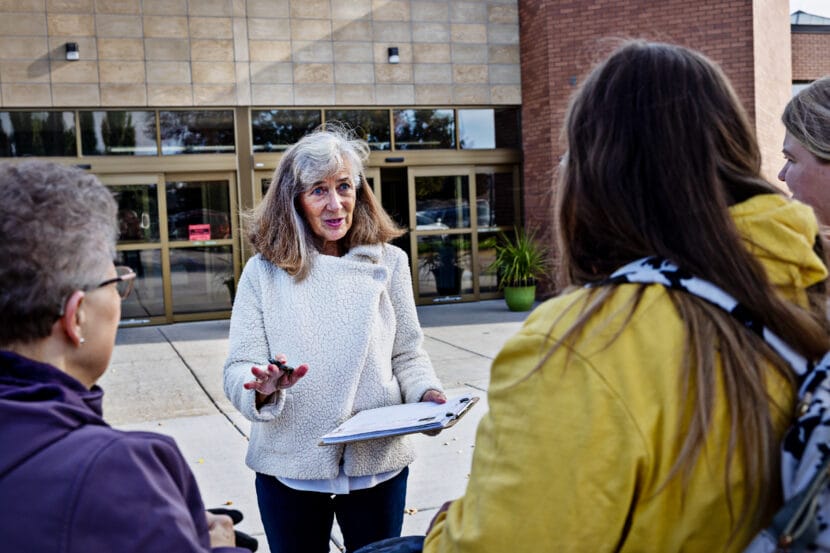
Parents Against Bad Books co-founder Carolyn Harrison (center) talks with people last month outside the public library in Idaho Falls, Idaho, about what she considers obscene books on the shelves. (Kim Raff for NPR)

For months, Carolyn Harrison and a small band of activists have been setting up folding tables with an array of what they call “bad books” outside the public library in Idaho Falls, Idaho. As Harrison, co-founder of the group Parents Against Bad Books sees it, the best way to convince people that the library is stocking inappropriate books is to show them.

“These two books are in the library, if you don’t believe it!” Harrison says to one passerby.

“It’s very graphic, very detailed,” offers Halli Stone, another member of the group.

They point out depictions of what they call obscene sexual encounters, catching many library patrons by surprise.

“Oooh, the graphic pictures!” exclaims one woman. “They’re taking away children’s innocence. They just don’t care.”

“No, they don’t,” Harrison replies.

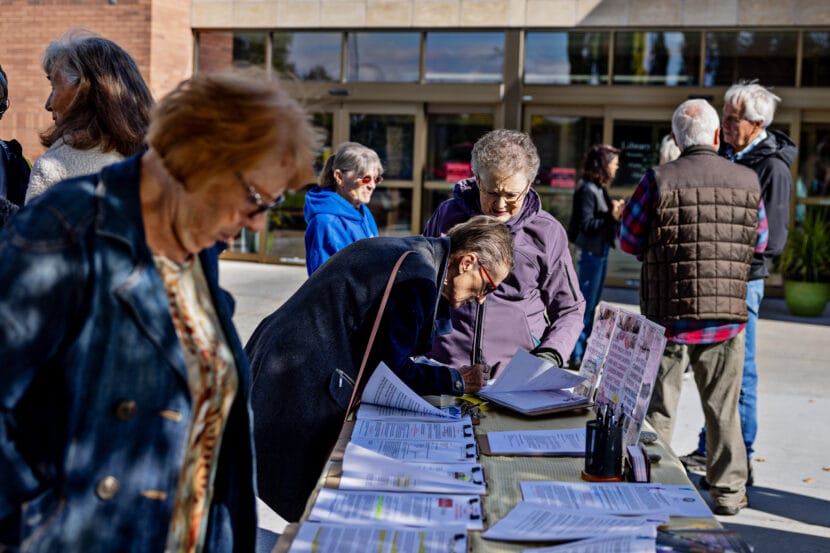
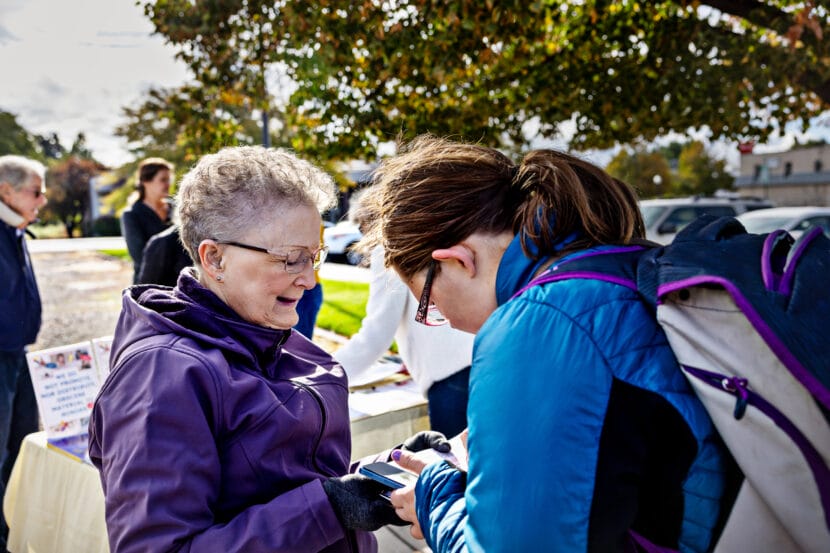
Halli Stone (center right) of Parents Against Bad Books watches as Donna Park signs a petition during a rally last month outside the Idaho Falls Public Library in Idaho. Stone’s group was protesting what they see as obscene literature being available at the library. (Kim Raff for NPR)

Another mom, Natasha Stringam, recalls how her 12-year-old son recently came across a book “about a boy kissing another boy and things that really aren’t appropriate at that stage of development for children,” she says. “These ideas are going to affect our children in ways that maybe aren’t good for them.”

As conversations unfold, Harrison offers a pen and asks people to sign a petition supporting her proposal to let parents weigh in on book selections, alongside the library staff whose job it is.

Pushing for a new way to select and classify books

It’s one of many efforts around the U.S. to change how decisions are made about which books libraries should have on shelves and in which section of the library they belong.

The process of classifying books can be somewhat inconsistent. Books usually get an initial designation from authors and publishers. Then, professional book reviewers usually weigh in with their own age-bracket recommendation, and distributors and booksellers can do the same. But ultimately, local library staff make the final call about the books they buy and where they should go.

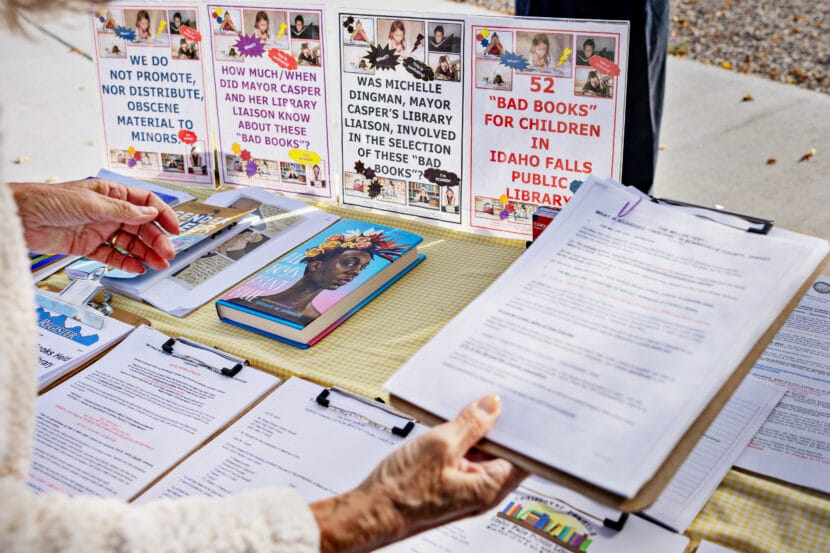
Parents Against Bad Books has been setting up a table outside the public library in Idaho Falls, Idaho, to raise awareness about books they believe are inappropriate for young readers. The group is also collecting signatures for a petition that would allow parents to have a say in which books get selected, alongside the library staff whose job it is. (Kim Raff for NPR)

Harrison wants to change that process by giving parents a voice in that final decision, along with the library staff. But she says libraries are resistant to the idea.

“They’ve told us here that ‘Oh no, you can’t have parents involved. You must have experts choosing books for the children,'” Harrison says. “That makes no sense. Parents are the primary stakeholders for children.”

Local libraries push back

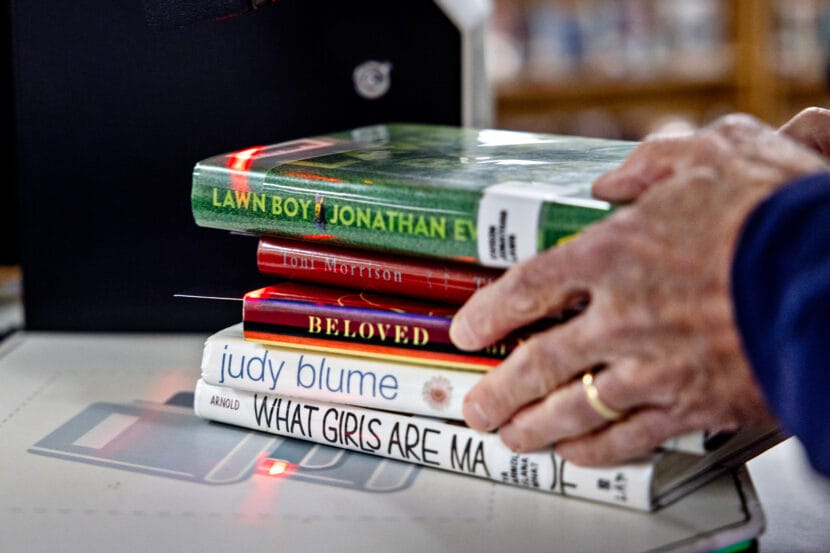
For their part, local libraries say parents are already involved, since much of the library staff are parents themselves. They’re just not quite on the same page as groups like Parents Against Bad Books, which has so far challenged at least 16 titles, including Flamer, Lawn Boy, What Girls Are Made Of and It’s Perfectly Normal. All of those challenges have failed.

PABB also keeps a list of what they call “52 Bad Books.” It includes George M. Johnson’s memoir, “All Boys Aren’t Blue,” which contains some explicit descriptions of sexual scenes. But as is the case with most books in question, one person’s trash is another’s treasure.

Halli Stone (left) of Parents Against Bad Books persuades Samantha Neis to sign a petition protesting what the group considers obscene books at the Idaho Falls Public Library. (Kim Raff for NPR)

“I found it very enlightening,” says Idaho Falls Public Library Director Robert Wright. As he sees it, “All Boys Aren’t Blue” is critical to young people’s development, especially those struggling with issues around sexual identity.

“To me, it was a story of a young boy who felt maybe different, but the story that came through to me was how much his family supported him and loved him regardless,” Wright says.

Anyway, he adds, that book is already in the library’s adult section. And a new tiered library card system allows parents to restrict which books their child can check out, for example, limiting them only to the children’s collection, Wright says.

Harrison says this doesn’t solve the problem, since kids can read any books while they’re inside the library. But Wright counters that if parents want stricter controls on what their children see at the library, that’s on them to enforce.

A call to label books with age classifications, like movies

To that end, others around the nation are trying another tactic.

A proposal in Washington state would require libraries to use a universal book-rating system, like the one voluntarily used by the movie industry to designate films “G,” “PG,” “PG-13” and “R.”

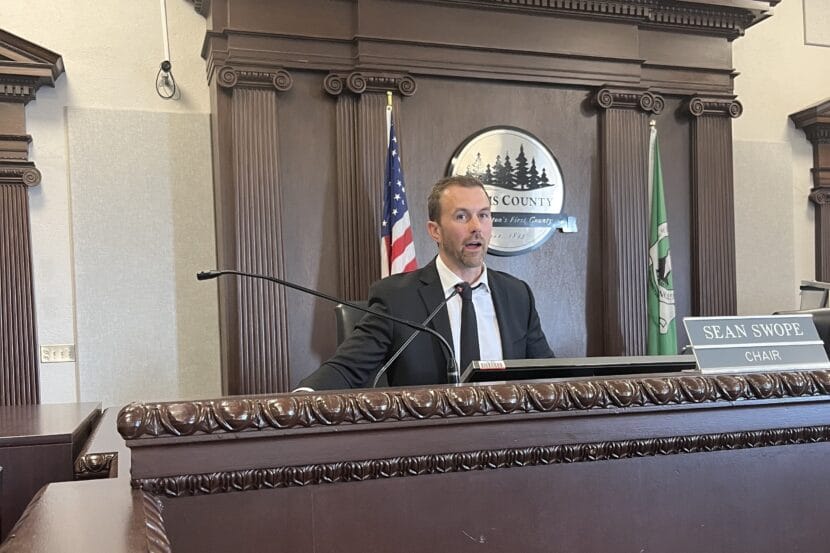
“We’re not asking for anything unreasonable,” says Lewis County Commissioner Sean Swope, who proposed the plan. “This is a tool to provide parents to be able to tell whether this is appropriate book for your child. I mean, that innocence, once it’s gone, it’s gone.”

In Washington state, Lewis County Commissioner Sean Swope has proposed a mandatory book-rating system that would require libraries to put age classifications on books. He says it’s inspired by the voluntary rating system used by the movie industry. (Kyle Norris)

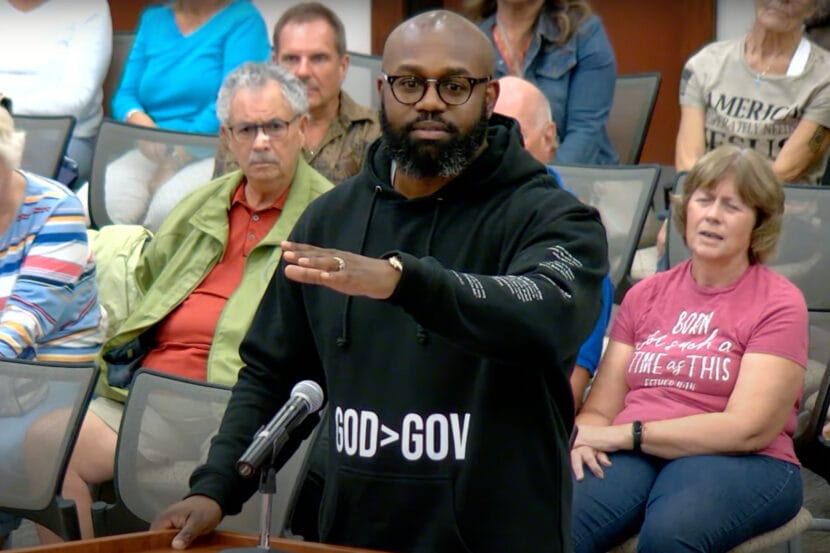
Dozens came to speak both for and against the idea at a recent meeting of the Lewis County Board of Commissioners. Kyle Pratt, a writer and grandparent in Chehalis, Wash., read aloud from the book “Let’s Talk About It: The Teen’s Guide to Sex, Relationships, and Being a Human,” a graphic novel that contains explicit depictions and descriptions of sexual acts, and is kept in the teen section at the Timberland Regional Library.

“‘There is nothing wrong with enjoying some porn, it’s a fun sugary treat,'” Pratt quoted from the book, noting, “That’s just one book and it’s not the worst. There are some parts that I’m not going to be able to read.”

Under Swope’s proposed plan, librarians would be required to rate books according to criteria that he would set.

“G”-rated books, that are “lighthearted and non-controversial” would be available to anyone, for example, while books with “explicit” or sexual content would be “restricted” to adults only.

Parents Against Bad Books co-founder Tom Harrison grabs a stack of what group members call age-inappropriate books that they checked out from the Idaho Falls Public Library on Oct. 4. (Kim Raff for NPR)

Opponents say government-mandated ratings would be unconstitutional

Opponents argue those categories are far too subjective. And they say ratings are already available nationally from multiple websites, ranging from the conservative BookLooks (which was launched by a member of Moms for Liberty though the website is not affiliated with the group) to the more middle-of-the-road approach from Common Sense Media, a nonprofit advocacy group that rates not only books, but also movies, TV shows, games and more.

But those are private groups. And in the case of movie ratings, it’s the film industry that’s rating itself. Opponents say having the government label books crosses into uncomfortable — if not unconstitutional — territory.

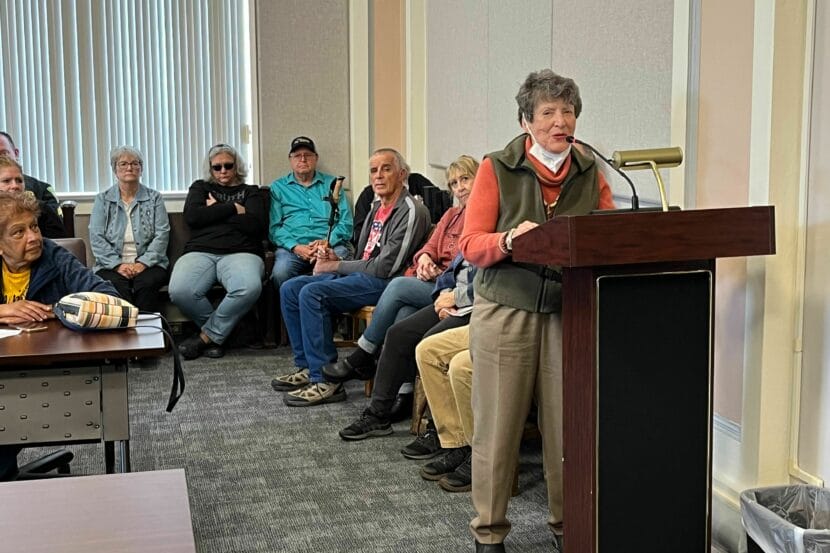
Dozens of people turned out to testify for and against a proposal in Lewis County, Wash., that would require public libraries to classify books according to age categories defined by County Commissioner Sean Swope. He says his plan was inspired by the rating system used voluntarily by the movie industry. (Kyle Norris)

“It is not the place for the government to legislate morality,” Lewis County resident Lori Lawson told the Board of Commissioners at its recent meeting.

As a mother of nine, she says she understands wanting to protect kids, but as a 25-year military veteran, she says she also understands protecting the First Amendment. “I didn’t give up 25 years of my life for certain people to get to decide what other certain people get to do!”

No shortage of other ways to shortcut the book selection process

There are several other ways that people are changing the decision-making process for what books should be in libraries. In Florida, for example, state legislation that critics call the “Don’t Say Gay Law” says when a book is challenged, the decision can be appealed to a special magistrate appointed by the state education commissioner. That means a state political appointee now has the power to overrule a decision made by a local school district.

Even before a book is formally challenged, that same Florida law provides a way for people to get that book effectively banned from a school library. Under the law, if someone reads aloud from a book at a school board meeting and is stopped by the chair because they think the book is too explicit, that book automatically must be removed from schools.

In other words, if it’s too racy for a public meeting, it’s too racy for a school library.

Pastor John K. Amanchukwu speaks at an August school board meeting in Indian River County, Fla. He was just a few words into reading an explicit passage from the book 13 Reasons Why when he was cut off by the board chair — triggering the book’s automatic removal from the school library.
Screenshot by (NPR/School District of Indian River County)

People are already using that law to skirt the formal challenge process, including many in Florida’s Indian River County.

At a recent school board meeting, Pastor John Amanchukwu stood up to read an explicit passage describing a sex act from the book 13 Reasons Why. He had gotten only a few words out before he was cut off.

“Sir, I’ll stop you there,” interjected the school board’s then-Chair Peggy Jones, banging her gavel. “I’ll stop you from reading. It’s going to be removed.”

Dozens of books have been pulled from Florida school libraries that way.

And there’s yet another tactic that some people around nation are using to get around long-standing library book selection policies.

As Carolyn Harrison and Halli Stone from Parents Against Bad books in Idaho Falls have figured out, they can simply check out whatever books they object to, up to a dozen at a time.

“We kept ‘forgetting’ to take them back,” Harrison says. “Somehow, we kept forgetting.”

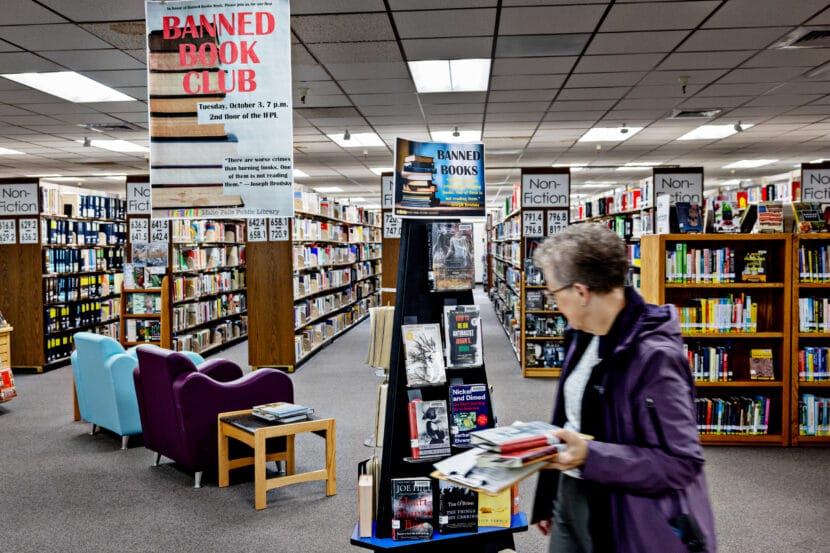
Halli Stone of Parents Against Bad Books looks at a Banned Book Week display at the public library in Idaho Falls, Idaho. She is among those advocating for more parental involvement in the selection of library books for young readers. (Kim Raff for NPR)

“So many of them are simply not on the shelves right now,” Stone deadpans.

And in case it wasn’t clear, Harrison offers, “We’re looking at this as a positive.”

The immense pressure over books has even led some libraries around the nation to self-censor before any controversy starts.

In Florida, state law now prohibits K-8 classroom instruction on sexual orientation or gender identity and in some cases bars it in high schools. The official word to some schools is to “err on the side of caution.” So libraries have simply removed — at least temporarily — dozens of books dealing with LGBTQ+ themes or characters.

Copyright 2023 NPR. To see more, visit https://www.npr.org.

Here’s what will cost you more — and less — for the big Thanksgiving feast

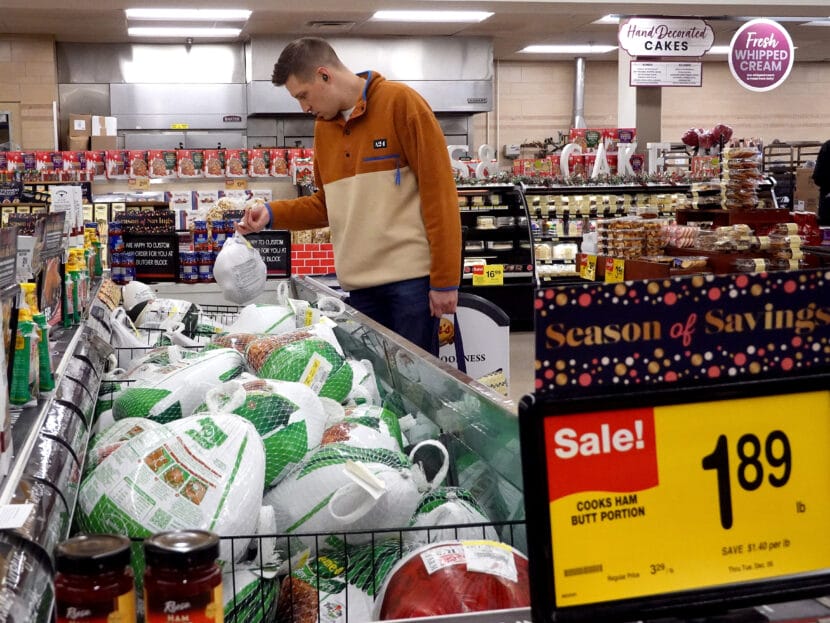
A customer in Chicago looks for turkeys offered for sale on Nov. 20, 2023, ahead of the Thanksgiving holiday. Turkey prices have fallen — but the cost of many groceries are still higher. (Scott Olson/Getty Images)

As friends and families gather around the dinner table later this week, some will be giving thanks for lower inflation.

Grocery prices are still high, but they’re not climbing as fast as they had been. And the cost of a traditional Thanksgiving feast has actually come down a little bit from last year.

The American Farm Bureau Federation estimates the total cost of a Thanksgiving meal for 10 this year is $61.16. That’s 4.5% lower than last year, but still the second highest total since the Farm Bureau began tracking prices in 1986.

Here’s a look at some of the traditional favorites that will cost more — and less — for Thursday’s feast.

Turkey prices have indeed fallen

Turkey, of course, is the at the center of many Thanksgiving traditions — and there’s good news: Prices have fallen.

“There’s a lot of turkey available right now,” says Michael Swanson, an agricultural economist at Wells Fargo. “They just have to price it down to move it.”

The average price of a 16 pound turkey in early November was $27.35, according to the Farm Bureau — a drop of 5.6% from a year ago.

Many stores offer additional discounts on turkey in the days leading up to Thanksgiving.

Cranberries are cheaper — but only if they are fresh

Turkey is not the only relative bargain on the Thanksgiving menu.

Fresh cranberry prices have dropped dramatically this year, thanks to a bumper crop. But people who prefer canned cranberries — the kind where you can still see the ridges of the can even when it’s on the plate — may have to pay more — as a result of higher processing and packaging costs.

“The entire canned market is up, whether you’re talking about beans or cranberries or pumpkins,” Swanson says. “Can prices really shot up.”

The price of canned goods could go even higher next year, if the Biden administration slaps new tariffs on imported steel used in making cans.

“We’ve been pleased that the Department of Commerce has held off on those tariffs for the most part,” says David Chavern, CEO of the Consumer Brands Association. “But there’s going to be a final determination at the beginning of 2024 that we’re watching very closely.”

But groceries are still expensive

Some of the money shoppers save on turkey this year may get gobbled up elsewhere.

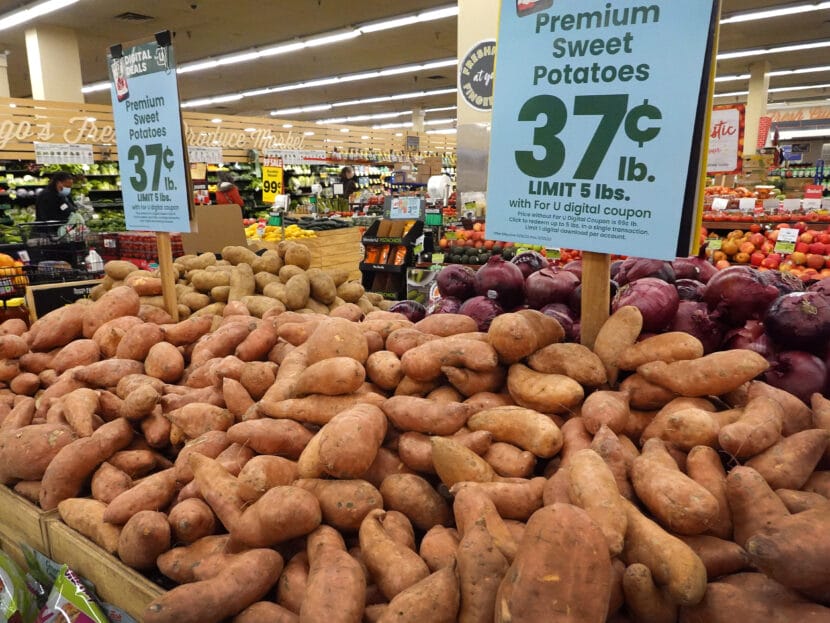
Sweet potato prices are slightly higher than last year. And pumpkin pie filling is also more expensive.

Grocery prices overall have risen 2.1% in the last 12 months, according to the Labor Department, following an increase of 12.4% in the previous year.

“That’s the cost of living,” said Angelina Murray, standing outside a supermarket in Washington, D.C., a few days before Thanksgiving. “Nothing we can do until prices come down. We’re just going to have to deal.”

Grocery prices overall are still higher than last year, including for sweet potatoes and pumpkin pie filling. (Scott Olson/Getty Images)

Then again, some things are still worth paying for

Some shoppers told NPR they are cutting corners in preparing for Thursday’s meal — opting for store-branded products, for example, instead of more expensive national brands.

But most said Thanksgiving is a time for counting blessings, not hunting for bargains.

Carrie Murray was pleasantly surprised to find some discounts in the produce department, even if she had to pay more for staples such as olive oil.

“Things that are expensive —it’s the stuff that has been expensive for a while,” Murray said, loading groceries into the back of her car with Colton Parker.

“Looking at the receipt you say, ‘Oh wow,'” Parker agreed. “But you know, it’s for families. It’s for the holidays.”

Copyright 2023 NPR. To see more, visit https://www.npr.org.

A strained US aviation system braces for a record-setting week of holiday travel

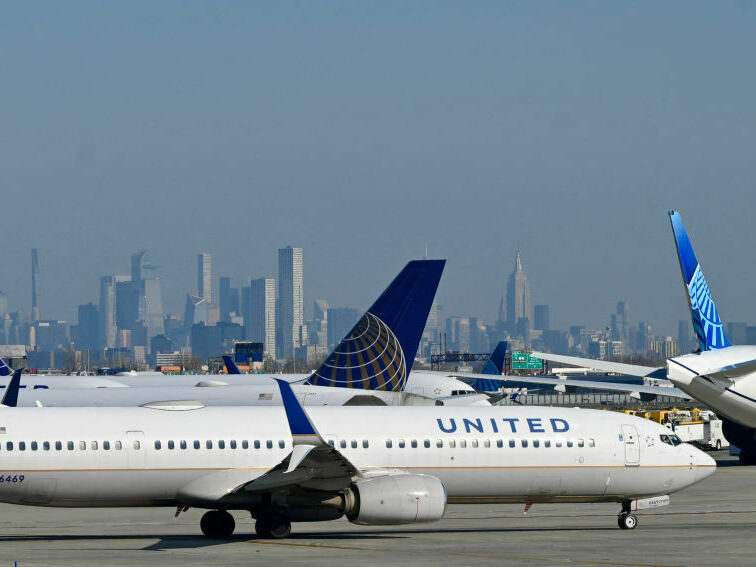
United Air Lines planes line up along the busy Newark Liberty International Airport, New Jersey, on the eve of Thanksgiving on November 23, 2022. (Daniel Slim/AFP via Getty Images)

WASHINGTON — Records are likely to fall this week as millions of Americans take to the skies for Thanksgiving.

The annual rush of holiday travelers will test a U.S. aviation system that is straining to keep up with demand. But federal regulators say the system is resilient and ready.

“This year, we are seeing more people flying than ever with fewer cancellations than we have seen in years,” Transportation Secretary Pete Buttigieg said at a press conference on Monday.

The Transportation Security Administration is predicting it will screen more than 30 million people during a 12-day window that started last Friday.

“We’re ready to go,” TSA deputy administrator Holly Canevari said at a travel industry conference in Washington, D.C. last week. “I think the Sunday after Thanksgiving will be our record-breaker” for a single day, Canevari said.

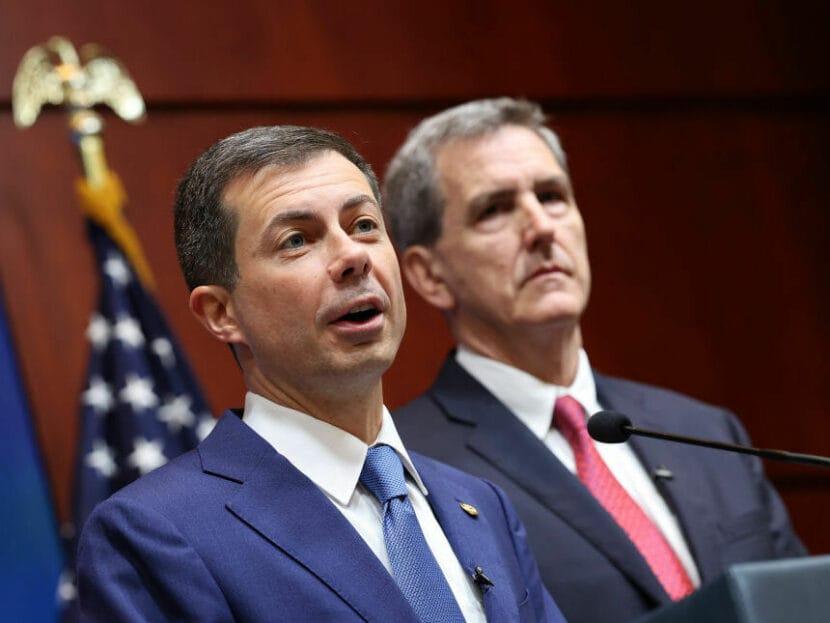
U.S. Secretary of Transportation Pete Buttigieg (left) and FAA Administrator Mike Whitaker at a press conference on Monday in Washington. (Kevin Dietsch/Getty Images)

The Federal Aviation Administration is expecting nearly 50,000 flights on Wednesday alone.

“While we don’t control the weather, we’re doing everything in our power to keep flights safe and keep cancellations and delays low this Thanksgiving,” said Mike Whitaker, the newly-appointed administrator of the FAA, who was unanimously confirmed by the Senate last month.

The FAA responds to a troubling safety warning

Whitaker is confronting deep concerns about safety in his first weeks on the job. An independent safety review board appointed by the FAA is calling for “urgent action” to prevent plane crashes after a series of close calls on runways across the country this year.

The panel’s 52-page report, released last week, raises extensive concerns about the shortage of air traffic controllers, as well as outdated equipment, that are “rendering the current level of safety unsustainable.”

Whitaker says the FAA welcomes the report, and has already announced several new initiatives to speed up the hiring of more air traffic controllers. Those include hiring qualified students directly from aeronautical colleges and universities, and deploying dozens of high-resolution tower simulators across the country to take some pressure off of the agency’s training academy in Oklahoma.

The FAA is also looking at how to lower the attrition rate for aspiring air traffic controllers.

“There’s a fairly high failure rate” at the training academy, Whitaker told reporters on Monday. “My initial focus has been on how to make these numbers go up quickly without lowering standards.”

While troubling, some of the challenges outlined in the independent safety review are not new.

“We have not put the resources we need into funding the air traffic control system — not just this year or last year, but for decades,” said Geoff Freeman, the CEO of the U.S. Travel Association. “We have not prioritized it. We’ve kicked the can down the road on modernization efforts, and we’re paying the price for that today.”

Flight attendants brace for the holiday rush

Full planes and crowded overhead bins could make for a challenging holiday in the flight cabin as well.

“The holidays have always been a time period that flight attendants sort of dread going to work,” said Sara Nelson, the president of the Association of Flight Attendants union.

“The flying is much harder. You have inexperienced people, you’re answering more questions. There’s fewer of us,” she said. “Which then often means that passengers are trying to work things out between each other, and you don’t have a referee there right at the start.”

Nelson says it used to be widespread across the industry for flight attendants to earn more on holiday shifts, but those incentives have been gradually eroding. She urges travelers to keep all of that in mind when flying.

Thankfully, she says, most do.

“The vast majority of people come to the door of our airplane with kindness in their heart and a desire for a safe, uneventful flight.”

Copyright 2023 NPR. To see more, visit https://www.npr.org.

‘It feels like I’m not crazy.’ Gardeners aren’t surprised as USDA updates key map

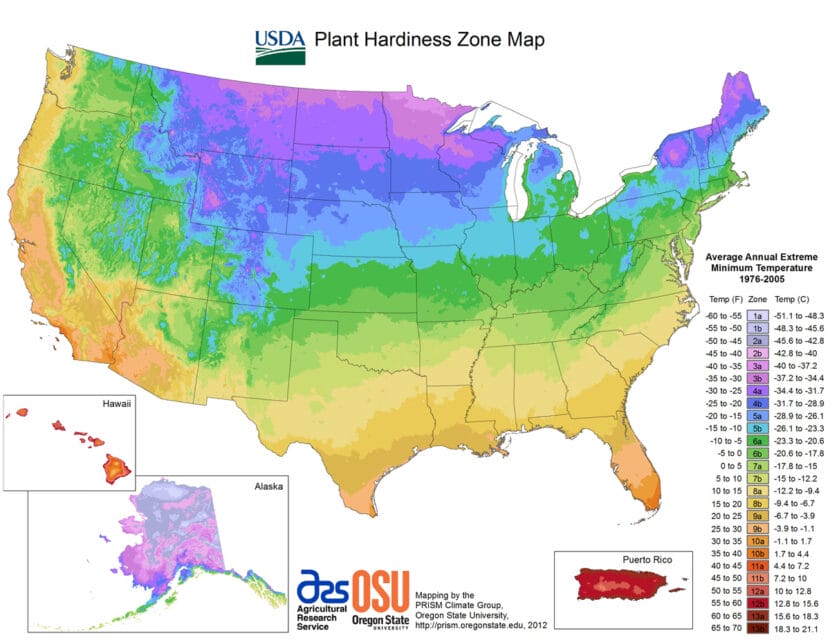
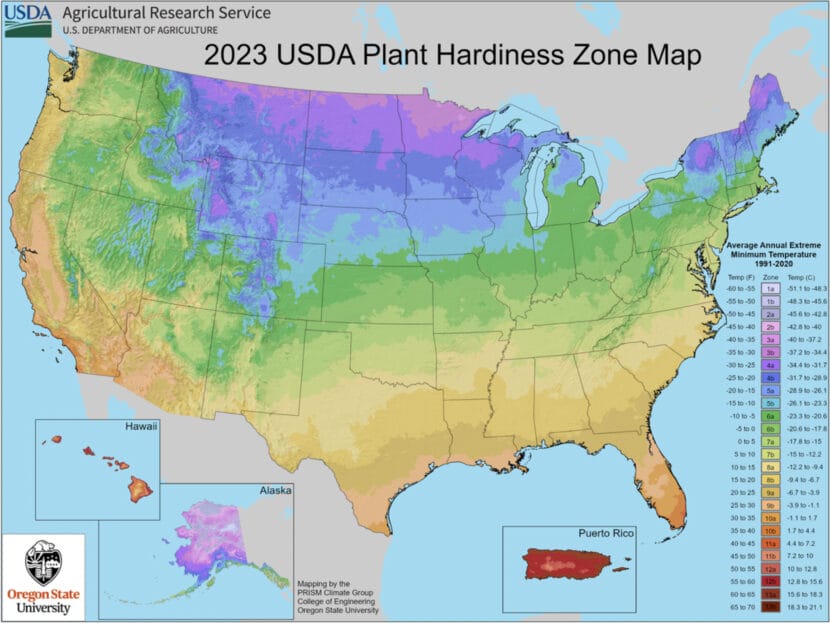
The U.S. Department of Agriculture has updated a map that helps gardeners to figure out which plants are most likely to survive the coldest winter temperatures in their location. About half of the country has shifted into a new half zone. (Robyn Beck/AFP via Getty Images)

A newly updated government map has many of the nation’s gardeners rushing online, Googling what new plants they can grow in their mostly warming regions.

It’s called the U.S. Department of Agriculture’s “plant hardiness zone map,” and it’s the national standard for gardeners and growers to figure out which plants are most likely to survive the coldest winter temperatures in their location.

This week the map got its first update in more than a decade, and the outlook for many gardens looks warmer. The 2023 map is about 2.5 degrees Fahrenheit warmer than the 2012 map across the contiguous U.S., says Chris Daly, director of the PRISM Climate Group at Oregon State University that jointly developed the map with the USDA.

Daly says the new map means about half the country has shifted into a new half zone and half hasn’t. In some locations, people may find they can grow new types of flowers, fruits, vegetables and plants.

The 2012 version of the Plant Hardiness Zone Map. (U.S. Department of Agriculture)
The 2023 version of the Plant Hardiness Zone Map. (U.S. Department of Agriculture)

Many of the nation’s gardeners are not surprised by the change.

“I have been stating all year long, ‘This needs updating!’,” says Megan London, a gardening consultant in Hot Springs, Arkansas, in a video she posted on Facebook. London has been gardening for 26-years, and she’s seen her region warming.

In the new map, London’s region in central Arkansas has moved from zone 7b to zone 8a. What that means for her is that she’s now considering growing kumquats, mandarin oranges, and shampoo ginger, a tropical plant.

But London says that the excitement she and other gardeners have to grow new things is tempered by another feeling: concern about human-caused climate change.

“We’re excited, but in the back of our minds, we’re also a little wary,” London says. “In the back of our mind, we’re like, ah, that means things are warming up. So what does this mean in the long run?”

The scientific community overwhelmingly agrees that humans burning fossil fuels like oil, coal and gas is the primary driver of global warming. The summer of 2023 was the hottest meteorological summer on record for the northern hemisphere, according to the National Oceanic and Atmospheric Administration.

Daly says he is hesitant to explicitly attribute the specific changes from the 2012 map to the 2023 map to climate change because of the volatility of the key statistic they used to create this map. They were mapping “the coldest night of the year, each year, over the past 30 years”, Daly says, and it’s a highly variable figure.

In an email, a press officer for the USDA says, “Changes to plant hardiness zones are not necessarily reflective of global climate change because of the highly variable nature of the extreme minimum temperature of the year.”

But Daly says, in the big picture, climate change is playing a role in changing what grows where in the US: “Over the long run, we will expect to see a slow shifting northward of zones as climate change takes hold.”

Still, for gardeners like Rachel Patterson, in Port St. Joe, Florida, the updated USDA map showing a warming region is validating, if not comforting. “It feels like I’m not crazy,” she says.

Patterson moved to her new community two years ago to help rebuild after a hurricane. She now gardens with her three-year-old and his wheelbarrow, and has seen the impacts of climate change in her Florida gardening community.

“The sweet little grannies here are just heartbroken, they can’t grow their tomatoes,” she says, “It’s so much hotter, the tomatoes burn.”

Patterson has been helping her community adapt to the heat by planting varieties of heirloom tomatoes that are more resilient to fungi that spread more rapidly in warmer climates.

She says the updated map is a reminder of the need for climate action: “It’s just going to keep getting hotter. So the government has to make policy changes to slow climate change down.”

Copyright 2023 NPR. To see more, visit https://www.npr.org.
Site notifications
Update notification options
Subscribe to notifications