
National News

Democrats — and abortion rights — dominated the 2023 elections. Here are 5 takeaways

Supporters for a pro-abortion ballot measure cheer as they watch election results come in on Tuesday in Columbus, Ohio. (Sue Ogrocki/AP)

Tuesday’s elections brought victories to Democrats and supporters of abortion rights across multiple states — including in some that voted for former President Donald Trump in 2020.

Democrats won key legislative and gubernatorial races in Virginia and Kentucky. Democratic candidates in both those states campaigned on abortion access.

“I think it speaks to [abortion rights] as an issue, that this isn’t just a Republican or a Democratic issue,” said Jessica Taylor of the Cook Political Report. “You have Republicans that are clearly voting for it, because Ohio is a state that Trump won by 8 points twice.”

Democrats around the country are already focused on the 2024 presidential race and looking to Tuesday’s elections as a possible litmus test on the national mood.

But Taylor cautions against viewing these results as 2024 tea leaves.

Still, many national Democrats were quick to celebrate Tuesday’s victories.

“Tonight, Americans once again voted to protect their fundamental freedoms — and democracy won,” President Biden wrote on X, the platform formerly known as Twitter.

Here’s what else to know:

Ohio voted to protect abortion rights in its constitution

Ohioans voted to amend their state constitution to guarantee the right to abortion and other reproductive rights.

Ohio was the only state voting directly on abortion access this election cycle. The campaigns both for and against the proposed amendment dominated local airwaves and captured national attention.

More than 56% of voters supported the amendment. Various polls consistently show somewhere between 55% and 58% of Ohioans support at least some abortion rights, the Statehouse News Bureau reports.

The state’s Republican governor and GOP-led Congress opposed the amendment, and had tried unsuccessfully to change the state constitution to require a 60% threshold to pass constitutional amendments, as opposed to a simple majority.

The passage of this amendment effectively ends a state law that prohibits abortion once fetal cardiac activity can be detected — as early as six weeks into pregnancy — with no exceptions for rape or incest. It took effect for several months in 2022 but has been on hold as legal challenges worked their way up to the state Supreme Court.

Virginia Democrats regained control of the state legislature

The Virginia Capitol, pictured in Richmond. Democrats won both the state House and Senate on Tuesday. (Steve Helber/AP)

All 140 legislative seats in Virginia were up for grabs this year. Democrats not only maintained control of the state Senate but also won enough seats to flip the House, giving them more power to push back on Republican Gov. Glenn Youngkin and his agenda.

Don Scott, the minority leader of House Democrats — and favored to become the new House speaker — told NPR Democratic candidates had “the message, the candidates, and the momentum to put a stop to the extreme Republicans’ agenda.”

Abortion access played a big role in many of these campaigns, VPM reports. Virginia has become a sort of southern refuge for abortion rights since the U.S. Supreme Court overturned Roe v. Wade last year.

Youngkin led Virginia Republican candidates in pushing for a ban on abortions starting at 15 weeks, with exceptions for rape, incest, and to save the life of the mother. He refrained from using the word ‘ban’, characterizing it instead as a “limit.”

Taylor, of the Cook Political Report, said this was “really a test of whether Republicans could sort of message this differently.”

While abortion rights were no doubt a motivating factor for many Virginia voters, it’s worth noting that there were many other campaign issues at play as well, including crime and the economy.

Kentucky reelected its Democratic governor

Kentucky incumbent Democratic Gov. Andy Beshear is joined by his wife, Britainy Beshear (R), Kentucky Lt. Governor Jacqueline Coleman (L) and his family as he delivers his victory speech in Louisville on Tuesday. (Stephen Cohen/Getty Images)

Democratic Gov. Andy Beshear won a second term in Kentucky, beating out Trump-endorsed Republican state Attorney General Daniel Cameron.

Beshear’s popularity has remained high in a deeply red state, with voters praising him for his leadership during the COVID pandemic, deadly tornadoes, record flooding, and ice storms, Kentucky Public Radio reports.

Incumbent governors rarely lose, Taylor said — but it wasn’t just Beshear’s popularity that worked in his favor. She said he was able to “go on offense” on abortion because of the state’s stringent law, which doesn’t allow exceptions for rape and incest.

There are signs that legislation is out of touch with Kentucky voters, who last year rejected an amendment that would have added language to the state constitution making it harder to challenge abortion restrictions.

Beshear campaigned in part on increasing abortion access, including by running an emotional campaign ad featuring a young woman who was raped by her stepfather at the age of 12.

Democrats celebrated Beshear’s win as bad news for Republicans in 2024. Kentucky Public Radio notes the winning parties of Kentucky’s last six gubernatorial elections have matched those of the following year’s presidential election winners.

Mississippi reelected its Republican governor

Mississippi Gov. Tate Reeves speaks to members of the press in Flowood, Mississippi after winning reelection on Tuesday. (Brandon Bell/Getty Images)

Meanwhile, Republican Gov. Tate Reeves won reelection in Mississippi — which no Democrat has governed in 20 years.

He defeated Brandon Pressley, a Democrat and one of the state’s three public service commissioners (not to mention a second cousin of the rock and roll legend Elvis). Pressley campaigned in part on expanding Medicaid in the state, which Reeves has refused to do.

Reeves’ popularity and fundraising prowess gave him a significant and expected advantage, but the race became more competitive than many had expected, as Mississippi Public Broadcasting reported.

Pressley campaigned in all 82 counties and focused especially on engaging Black voters (which Reeve’s Democratic opponent in 2019 had been criticized for not doing).

Taylor said the Mississippi race underscores how hard it is to beat incumbent governors.

“I think just the state’s dynamics won out in that regard,” she said.

Historic wins in Rhode Island and Pennsylvania

Tuesday night also saw historic victories for several Black Democratic candidates.

Philadelphia elected Cherelle Parker as its 100th mayor. She is the first woman and first Black woman to hold the title.

The 51-year-old has served as a state representative on the Philadelphia City Council (including as the majority leader) and most recently as the chair of the Delaware River Port Authority.

WHYY reports Parker’s victory was expected after she won her party’s primary in May, with a tough-on-crime agenda and the support of labor and the city’s Democratic establishment.

She has promised to hire 300 new police officers, aggressively target low-level crimes, and bring in the National Guard as part of her response to the opioid crisis. She has also floated “year-round” schooling and gradually reducing city wage taxes, among other proposals.

Parker, who has spoken of being born to a single teenage mother and raised by her grandparents on welfare and food subsidies, told her supporters she would use her personal, academic, and professional experience to “make Philadelphia the safest, the greenest big city in the nation with economic opportunity for all.”

Farther north, Gabe Amo won the special election for Rhode Island’s 1st Congressional District seat, becoming the first Black person to represent the state in Congress.

Amo is serving the rest of the term of former Democratic Rep. David Cicilline, who stepped down over the summer to become the president of the Rhode Island Foundation. Amo will be up for reelection again in 2024.

The 35-year-old son of Ghanaian and Liberian immigrants most recently served as the deputy director of the White House Office of Intergovernmental Affairs, working as Biden’s principal liaison to mayors and local elected officials.

Among other issues, Amo has pledged to work to legalize abortion rights nationwide, fight for federal legislation to combat climate change, and promote stronger gun control legislation, the Associated Press reported.

Amo said he would fight against what he described as extremist Republican attempts to slash funding for Social Security and Medicare.

“Undoubtedly, I’m humbled by the real momentous opportunity to serve as the first person of color,” Amo told the AP. “But I didn’t run to make history.”

Copyright 2023 NPR. To see more, visit https://www.npr.org.

Inside the weird and delightful origins of the jungle gym, which just turned 100

A jungle gym in the 1970s — a staple of playgrounds all across the U.S. (H. Armstrong Roberts/ClassicStock/Getty Images)

This story starts in the fourth dimension.

Or, more specifically, with a British mathematician who, in the late 1800s, was intrigued by the fourth dimension and how to teach disinterested children about it.

Charles Hinton wore a lot of hats. He wrote sci-fi stories before there was sci-fi — he called them “scientific romances.” At Princeton, where he worked for a time as mathematics instructor, he invented a baseball pitching machine powered by gunpowder. He also practiced polygamy, which was against both the mores and laws of his native England. And when he was convicted of bigamy in the 1880s, he was forced to move his young family to Japan where he found work teaching mathematics.

We will save all of that for the biopic, because for the purposes of this story, Hinton was the unintentional inspiration behind the jungle gym — the patent for which has just turned 100.

It turns out that the history of the jungle gym, and its sibling the monkey bars, is full of weird and delightful twists and sub-plots that take us from Japan to suburban Chicago and touch on child development theories and, yes, theoretical math.
Imagining dimensions — in bamboo

Hinton was a mathematician who explored the concept of the fourth dimension and how to represent it. His model of a tesseract as a way to represent the fourth dimension in geometrical space has since inspired a long lineage of science fiction writing and movies — from A Wrinkle in Time to Interstellar.

Yet it was while living in Japan that Hinton struggled to get his students to adequately wrestle with the concept of the fourth dimension.

Charles Howard Hinton
Studio of K. Yoshida in Kanazawa, Japan (Papers of Howard Everest Hinton, University of Bristol Archive)

“He said, you know, the reason these students can’t grasp the fourth dimension is because they were never exposed to the third dimension as children,” says Luke Fannin, a primatologist and Ph.D. candidate at Dartmouth College, who became obsessed with finding out where the term “monkey bars” came from (more on that later) and ended up becoming something of a Hinton family expert.

Hinton theorized that since we spend so much of our lives simply walking in straight lines, and not using all of the three-dimensional space around us, we have an even harder time making the mental leap to fourth dimension.

His solution was to train young children, namely his own kids, to internalize the third dimension. To pull this off, Hinton built his children a series of stacked bamboo cubes. He labeled the bamboo in all three directions, Fannin says: “Where the junctions would be, he would put X, Y, Z coordinates.” Then he attempted to turn these stacked cubes into a game. “He would say, ‘X2, Y4, Z3 — go! And all the kids would race each other towards the correct coordinate,'” says Fannin.

If that does not sound like a fun game to you, you are not alone. And those bamboo cubes never amounted to much. But years later, Hinton’s son Sebastian would recall how much fun it was to climb and swing on them.

“And he goes, ‘That’s what I remember. I don’t remember anything about the math, but I remember that it was so fun,'” says Fannin.

By now it was the early 1920s, and the junior Hinton had moved to Winnetka, Illinois where he worked as a patent lawyer. He dreamed of recreating the bamboo climbing structure of his youth — minus the not very fun math games — and he started describing his plans at a dinner party one night.

Winnetka at this time was a hotbed for progressive education. The village was taken with the educational philosophy of John Dewey, which called for “whole child education.” This meant not just teaching reading, writing and arithmetic, but also how to be healthy and active humans.

So, as Hinton was describing his dream climbing structure, the dinner party was stacked with educators, including the superintendent of the Winnetka City Schools, Carleton Washburne. Fannin says he imagines Washburne’s eyes widening before telling Hinton, “We need to build this in the schools!”

Soon after, Hinton began filing his early patents for the design, which he registered to something he called JungleGym Inc. And the rest, as they say, is history.

If that dinner party had taken place anywhere else in the world, this iconic piece of equipment may never have existed. Or, as Fannin says, “It only stays in Hinton’s backyard. It never becomes sort of the cultural mainstay that is now ubiquitous on most playgrounds.”

The difference between monkeys and apes

From the outside, there’s nothing remarkable about the old Victorian home at 411 Linden Street in Winnetka, Illinois, which these days serves as the headquarters for the town’s historical society.

Inside, the 30,000 artifacts range from typewriters to vacuum cleaners. But for visitors who walk through a small gate into the back yard, surrounded by 20-foot tall conifers, there’s a little bit of a hidden treasure, says Mary Treishman, the executive director of the Winnetka Historical Society.

“We currently don’t have a historical plaque on it,” she says. “We just have this laminated sign that says, ‘Please do not climb on this artifact. It’s not safe.'”

That artifact is a 100-year-old jungle gym — the first real version.

Hinton’s original jungle gym, pictured here in the 1930s at the Horace Mann School before it was moved to the Winnetka Historical Society. (Courtesy of Winnetka Historical Society)

To this day, kids sometimes still stumble across it, and Treishman has to politely tell them to stay off.

“I’ve seen adults come back here and really want to climb it because it reminds them of their childhood,” she says, adding that something about the classic bars really animates people. “The memories of this climbing structure are very deep. This is what everyone played on.”

Few things last 100 years. Children’s toys seem particularly fickle. Pet rocks, pogo sticks and scooters have all had full boom and bust cycles while the jungle gym — unflashy, workman-like, no fuss — keeps children coming back. Why is that?

It may be that the act of swinging and climbing in the jungle gym contains just enough risk, says Ellen Sandseter — a professor at the Department of Physical Education and Health at Norway’s Queen Maud University College, and an expert on risky play.

Sandseter says the jungle gym, and its sibling the monkey bars, offer a lot of challenging and also risky play, which is a good thing. She says it helps kids’ physical development — think motor skills — and their mental health, by building courage and self-confidence while reducing anxiety.

What’s more, unlike a lot of newer equipment that tells kids how it’s supposed to be used, Sandseter says the beauty of the jungle gym is in its simplicity.

“A monkey bar could be used in many different ways. And it, therefore, also affords creativity among children,” she says.

This all may help explain why the jungle gym has endured 100 years. But what about Fannin’s original question: how did the monkey bars get their name? Well, in the original 1923 patent for the jungle gym, Hinton seems to imagine children playing on it in language that has an ethereal quality of dreaming, of imagination:

“I have designed a climbing apparatus, so proportioned and constructed that it provides a kind of forest top through which a troop of children may play in a manner somewhat similar to that of a troop of monkeys through the treetops in a jungle.”

Hinton’s plans for the jungle gym, as outlined in his patent application. (United States Patent and Trademark Office, Sebastian Hinton.)

“There’s an illustration of it in the last patent he had approved. It basically is a jungle gym, and then adhered next to it is the ‘Accessory monkey runway,'” says Fannin. AKA, the monkey bars.

It’s worth remembering, Hinton was a patent lawyer, not a primatologist. And that behavior — swinging by your arms — is ape behavior, not what monkeys do. So should they be called ape bars?

“If you want to be pedantic about it,” says Fannin. “But I love the term monkey bars.”

Sadly, Sebastian Hinton never saw his invention get the U.S. Patent Office’s stamp of approval. He died in April of 1923, just six months before his patent was officially approved.

Much has changed since then: safety concerns have softened materials and rounded edges in playgrounds. But Hinton’s simple design that doesn’t dictate behavior, but facilitates it, has endured.

Perhaps it’s precisely because of this freedom that jungle gyms have afforded children the chance to dream for the last century. And maybe some of them will even dream about new dimensions.

Copyright 2023 NPR. To see more, visit https://www.npr.org.

3 cities face a climate dilemma: to build or not to build homes in risky places

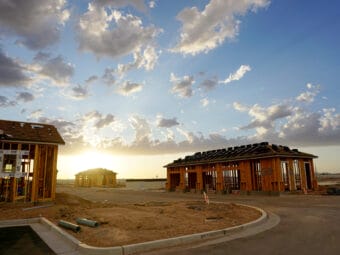
New homes are under construction in June at a housing development near Buckeye, Ariz. A growing number of local governments are considering limits on homebuilding in the face of floods, droughts and wildfires driven by climate change. (Mario Tama/Getty Images)

With climate-fueled disasters killing hundreds of Americans annually and costing communities billions of dollars, a growing number of local governments are asking a basic question: Are there some places where people shouldn’t build homes?

It’s one of the most difficult choices a community can make. Local governments typically want more housing, not less, because budgets are generally funded by the property taxes from those homes. At the same time, a nationwide housing shortage is creating even more pressure to build.

“[If] you’re a local government, of course you want to develop,” says Katharine Mach, who studies climate change and housing at the University of Miami. “You’re building a community. You’re supporting livelihoods. You’re supporting tourism oftentimes. [And] there’s the pragmatic dimension of, you need the property taxes.”

As a result, putting limits on homebuilding can feel like a non-starter for the local officials who generally control land-use decisions.

But with often deadly extreme-weather disasters on the rise, the problem can no longer be ignored. In the last five years, floods, wildfires, severe storms and droughts have caused more than $580 billion in damage and killed hundreds of people. And some states are passing laws that put conditions on future growth.

NPR visited three places that are grappling with the question of how to stop building homes in harm’s way — with varying degrees of success. Whether it’s flooding, wildfires or drought that threatens a community, similar conversations are now playing out across the United States.

California: Building homes in places that could burn

Two things are painfully apparent for many California cities: the massive statewide housing shortage and a growing danger from wildfires.

With some of the most expensive housing in the U.S., California’s cities face requirements to build more housing to boost supply. But where to put it is tricky. About one-quarter of California is at high risk of burning, according to state wildfire authorities. And as the climate gets hotter, tens of thousands of homes have been lost in destructive wildfires in the last five years alone.

With few statewide regulations, navigating housing needs and wildfire risk falls to local governments, like Santee, Calif., a largely suburban town on the outskirts of San Diego.

Santee is nestled next to miles of open space, and at the edge of town, a major new development of almost 3,000 homes, known as Fanita Ranch, is being planned. For years, residents like Van Collinsworth have fought the project, which would be tucked away in the golden, shrubby hills. As a wildfire inspector by day who examines flammable brush, he knows the city is at risk. It barely escaped the 2003 Cedar Fire, which destroyed more than 2,000 homes.

“I don’t think the project should be built — that’s the bottom line,” he says. “I don’t think developers and decision-makers are willing to acknowledge that we are living in a new era of extreme weather and really grapple with what that means for the desire to build and build and build.”

Collinsworth directs Preserve Wild Santee, an environmental group that joined several others to file a lawsuit to stop the development after the city approved it in 2020. A judge agreed, finding that the developer didn’t adequately analyze how long it would take residents to evacuate during a fire or whether they could do so safely.

The developer, HomeFed Corp., proposed the project again in 2022, this time with a phased evacuation plan that works by zones, so neighborhoods could be cleared more efficiently. Houses would be built with fire-resistant materials and have fire sprinklers. Inspectors would check that flammable vegetation was cleared twice per year, something that would be paid for by homeowners association fees. Those funds would also ensure vegetation was cleared around the outskirts of the community, creating a buffer.

“Other parts of the country are in a hurricane zone, and they have codes and standards that say, if you build to these standards, you can go ahead and build a home,” says Kent Aden, senior vice president of HomeFed. “We have all these standards for building in wildfire zones, but there seems to be a resistance to allow projects to move forward that meet or exceed those standards.”

In 2023, the City Council approved the project again, with several members saying they were satisfied with the wildfire safety measures after local fire officials supported the plan.

“We tried to take everything we can learn from the fires plus even more, making it, in my opinion, the best example of what can be done to make a defensible community,” Aden says.

Collinsworth and environmental groups filed a second lawsuit to halt the project, and it will be heard in court next year. It’s one of several lawsuits aimed at stopping developments in California, and some of these suits were supported by state Attorney General Rob Bonta. He recently released guidance for cities about how to analyze wildfire risk.

Still, while California leads the nation in some wildfire policies, like building codes for individual homes, there are few statewide laws about making development decisions in high-risk zones. Those decisions fall to local governments alone. A bill now being considered from state Sen. Ben Allen would require developers to analyze fire behavior and create evacuation plans in cooperation with local fire authorities as part of their projects.

Previous legislative bills requiring local governments to create standards for approving housing in risky areas have failed amid pushback from the building industry.

“If we site houses and infrastructure in places better, safer, that makes it easier to keep people safe as climate change intensifies into the future,” Mach says. “But it’s not as if we have easy choices of just building in the safe places, because there are no places that are devoid of hazards right now.”

Arizona: Limiting growth where water is scarce, with a catch

Located in a desert, cities around Phoenix are constantly facing questions of water supply — not just at water management agencies but also at city councils considering where to develop. That’s because Arizona has one of the most powerful laws in the country linking water with the decision to build.

In Casa Grande, about an hour south of Phoenix, Mayor Craig McFarland knows his city’s future is linked to water. Housing is already in high demand. Industry is moving into the area, with both a battery and an electric car manufacturer offering thousands of jobs near town.

“We have this huge need for workforce housing, and that workforce housing needs a place to go,” McFarland says. “And so that’s why all of a sudden the rush is on.”

But whether that housing can be built is a question. A two-decade drought in the Southwest has triggered cutbacks to Arizona’s water supply, as climate change strains the Colorado River, one of the state’s biggest water sources. Underground aquifers are the state’s other major water source. But in Pinal County, where Casa Grande is located, overpumping of aquifers is a big concern.

So when it comes to development, McFarland consults a map that looks like a patchwork quilt. Some parcels of land are blue, which means a water supply would be ensured for new homes. But many other parcels are white. There, developers would have to find their own water supply in order to build. State law limits growth where water is in short supply, requiring new subdivisions to show they have 100 years of water for their customers.

“Arizona is the only state in the country that requires 100 years’ worth of water,” McFarland says. “It’s a consumer protection.”

This year, regulators announced they would not be guaranteeing water supplies for new subdivisions around Phoenix, limiting future construction. That has been the situation for several years in Casa Grande.

Still, McFarland isn’t discouraged. In the long term, the city is looking at water recycling and conservation. And in the short term, building hasn’t stopped.

That’s because developers have found a profitable workaround. Arizona’s water law applies only when lots are subdivided into smaller lots for six or more homes and those houses are either sold or made available for long-term rentals. Instead, developers have turned to building short-term rentals on a single large piece of land.

Not far from the center of town, construction workers are putting the finishing touches on new single-story homes in a 331-unit development. Water supply hasn’t been a barrier to building because these units will be part of one large rental project.

“We don’t need an assured water supply because it’s one lot,” says Greg Hancock of Hancock Builders, which is constructing the project. “Although it’s 331 units, it’s one lot.”

Casa Grande, like several other Arizona cities, has seen a boom in these “build to rent” projects. Hancock says after decades in the business, his company started building them only recently and has more than 10,000 units built or in development.

“It’s been one of the greatest housing markets forever,” he says. “People will not stop moving here.”

But with the growth, that unaccounted-for water demand is raising red flags. Already, Arizona water regulators say there won’t be enough groundwater to meet existing needs over the next 100 years.

“If you build houses and you rent them, there’s no way to go back and undo the fact that they’re there and people are living in them,” says Kathleen Ferris, senior research fellow at the Kyl Center for Water Policy at Arizona State University.

Ferris helped write Arizona’s 100-year water law four decades ago. She says its strength is that it tethers building decisions to water decisions. Back then, build-to-rent wasn’t common. Now, she says, the state is reaching a pivotal moment when all water use needs to be accounted for.

“Climate change and aridification have come on so much faster than most people thought,” she says. “Yes, there is still opportunity for growth, but there needs to be an understanding of the limits.”

This year, Arizona legislators drafted two state bills to close the loophole, which would require rental projects to have a water supply. Both failed to pass. Some cities pushed back, saying it would limit a key way to address the housing shortage. Now, a working group convened by Gov. Katie Hobbs is examining the issue.

Still, the overriding conversation is about growth. With droughts expected to worsen, Arizona’s water law is pushing cities to look at boosting their water supplies locally, whether that’s through building water-recycling projects or amping up conservation.

“I used to say, ‘Maybe we’re at our limit. Maybe we can’t build any more houses,'” says Pinal County Supervisor Stephen Miller, who works on water issues. “So now I say, ‘If we’re going to maintain any type of growth, we have to bring water in.'”

New Jersey: A little bit of everything adds up to a lot of flood protection

New Jersey may offer a blueprint for how to get people out of harm’s way while continuing to grow and prosper economically, according to climate experts.

The marshy coastal state is a decade into a systematic statewide effort to protect residents from floodwaters. And those efforts appear to be successfully limiting new construction of homes in flood-prone areas and better protecting people who live in flood zones or are considering moving into them.

“This is an area where New Jersey is very proactive,” says A.R. Siders, a climate researcher at the University of Delaware who studies climate risk and housing.

New Jersey has attacked its flooding problem from every angle. Since Superstorm Sandy devastated the region in 2012, New Jersey has passed regulations that make it harder to build new homes in flood zones. If you want to substantially renovate a home that already exists in a flood-prone area, the new rules require major upgrades to protect the house from water, such as putting the whole house on stilts or moving air conditioning units and other crucial utilities off the ground so they can survive a flood.

This year, New Jersey also passed some of the strongest flood disclosure laws in the country, which means that people who are buying homes in the state get information about whether their prospective new house has flooded in the past or is likely to flood in the future.

And the state has purchased more than 1,000 houses in the last decade through a permanent home-buyout program known as Blue Acres, which acquires homes that have flooded and knocks them down to provide more open space for floodwater.

As a result, New Jersey appears to be doing significantly better than the national average when it comes to the number of homes in flood zones, according to preliminary findings by a group of climate scientists including Siders and Mach.

That’s particularly notable since New Jersey is both the most densely populated state in the country and one of the most flood prone.

The town of Woodbridge, N.J., has been on the front lines of New Jersey’s strategy.

After Superstorm Sandy flooded the town, the local government decided to support home buyouts.

“[It’s] not something we wanted to do, but we had to do it,” says longtime Mayor John McCormac. “We didn’t want to lose residents.”

But it was equally unthinkable that homes would be rebuilt in places that had flooded, he says. And there were alternative ways for the town to grow economically.

Because home buyouts are voluntary, the town could move forward only if people agreed to move. McCormac remembers a town meeting he presided over in the high school auditorium.

“It was difficult. People were angry,” he says. “It wasn’t an easy process. You know, somebody’s talking to you about moving out of their home that they’ve been in for 60 years. And it’s their biggest investment in their life.”

Similar conversations have played out across the state in recent years, says New Jersey’s chief resilience officer, Nick Angarone. “These are very complicated and very difficult conversations to have,” he says. “You’re talking about some of the basic principles of the country, you know? Where and what you can do with your property.”

But unlike in other states, New Jersey residents who are considering a home buyout are assigned a case manager who can help navigate both the paperwork and the emotions that come along with such a momentous decision.

“Our case managers are sort of our secret sauce,” says Courtney Wald-Wittkop, who runs the Blue Acres program. “They’re very good about developing that rapport and relationship with the homeowners.”

One reason New Jersey is able to match people up with experienced case managers is that, unlike other state buyout programs, Blue Acres exists all the time, not just after major disasters. Because it’s permanent, it’s more accessible to both homeowners and local officials, without whose support buyouts cannot happen.

Ultimately, more than 180 homeowners in Woodbridge decided to accept buyouts and move away, says McCormac, the mayor.

The homes that remain in flood-prone areas of Woodbridge are subject to New Jersey’s new, tighter regulations that require them to be elevated. Instead of building new homes in marshy areas, Woodbridge is allowing more units to be built in denser parts of town near train stations and highways. The town’s population is stable, and its economy is growing.

The town’s flood plain manager, Tom Flynn, says the strategy is also paying off in the form of less flood damage. When the remnants of Hurricane Ida dropped 8 inches of rain in Woodbridge in 2021, Flynn says, it flooded dozens of homes instead of hundreds.

Copyright 2023 NPR. To see more, visit https://www.npr.org.

Six things to know about the political debate around daylight saving time

Picture taken on March 23, 2018 shows a technician working on the clock of the Lukaskirche Church in Dresden, eastern Germany. – The European Commission will recommend EU member states abolish daylight saving, where clocks are advanced by one hour in summer, its president Jean-Claude Juncker said on German television on August 31, 2018. (Photo credit SEBASTIAN KAHNERT/DPA/AFP via Getty Images)

Twice a year, every year, the ritual returns as literal clockwork: the start or end of daylight saving time.

Millions of Americans, filled with grunts or glee, tap at their devices or wind their watch hands, manually changing the time to reflect a change in seasons.

But in recent years, lawmakers have talked as if this timeworn tradition might be on its last legs. A raft of bills on the federal and state levels are taking aim at the biannual time changes — and yet nothing is changing, at least for now.

Here’s a look at where things stand.

What’s the status of that Senate bill to end time changes?

In March 2022, the Senate passed the Sunshine Protection Act. The intent behind the bill was to make daylight saving time permanent starting in spring of 2023.

And at first, it looked as though it might become a reality. The Senate passed the bill through an expedited process and with unanimous consent — legislative rarities in this day and age.

But the bill failed to be taken up in the House. Members cited higher priorities, like a budget deficit and war in Ukraine, but there was also a growing chorus of criticism about the bill’s approach (more on this below).

Sen. Marco Rubio, R-Fla., reintroduced the bill this March, and it was sent to the Committee on Commerce, Science and Transportation, but there’s been no notable movement on it since. A companion bill, introduced by Rep. Vern Buchanan, R-Fla., is similarly stuck in committee at the House level.

Even if either bill manages to pass both chambers, it’d still need to be signed by President Biden, who hasn’t indicated how he leans on the issue.

So for now, the tradition remains in tact.

When is the end of daylight saving time 2023?

This season’s turnover time is 2 a.m. on Nov. 5, meaning residents of most states will want to move their clocks back an hour when they go to bed this Saturday.

Two states — Hawaii and Arizona — don’t observe daylight saving time. The U.S. territories of Samoa, Guam, Puerto Rico, the Virgin Islands and Northern Mariana Islands also don’t change their clocks.

What’s the argument against the Sunshine Protection Act?

When the Sunshine Protection Act was first debated in a House subcommittee, experts said switching to permanent daylight saving time would do everything: save lives, reduce crime, conserve energy and improve health.

And pretty much everyone agrees that ending the time changes is generally a good idea. Our bodies can be very sensitive to disruptions to our circadian rhythms.

But the medical community has taken issue with how the bill proposes to make the change — specifically, that it mandates all states adopt permanent daylight saving time rather than sticking to standard time.

Doctors and scientists argue that standard time is actually better for our health. Our internal clock is better aligned with getting light in the morning, which, in turn, sets us up for better sleep cycles.

The bill’s sponsors aren’t budging though. Sen. Rubio is still pushing for permanent daylight saving time.

And the biggest argument for this approach may be an economic one. The idea is that having more light in the evenings encourages people to go out and do things — i.e., spend money.

The nation’s convenience stores, for example, told a congressional subcommittee that they see an uptick in spending when clocks are set to daylight saving.

Could the states adopt their own time change rules?

With federal legislation stuck in a holding pattern, states could take up the issue, but they’re still subject to some federal limitations.

The Uniform Time Act, which was passed in 1966, says that states can enact permanent standard time but not permanent daylight saving time.

At least 550 bills and resolutions have surfaced concerning time changes at the state level in recent years, according to a tally from the National Conference of State Legislatures (NCSL). So the same debate that’s happening at the federal level is playing out in statehouses across the country.

Which states are trying to end daylight saving time?

Nineteen states have actually passed measures pledging to switch to permanent daylight time if Congress changes the rules to allow for such an action.

Those states are:

  • Alabama
  • Colorado
  • Delaware
  • Florida
  • Georgia
  • Idaho
  • Kentucky
  • Louisiana
  • Maine
  • Minnesota
  • Mississippi
  • Montana
  • Ohio
  • Oregon
  • South Carolina
  • Tennessee
  • Utah
  • Washington
  • Wyoming

California voters also authorized a resolution in 2018, but lawmakers haven’t taken any action on the legislation so we’re not counting it here.

As of September 2023, nine states were actively considering legislation that would also end daylight saving, but by switching the state to year-round standard time, according to the NCSL.

Those states are:

  • Maine
  • Massachusetts
  • Minnesota
  • New York
  • Oklahoma
  • Pennsylvania
  • South Carolina
  • Tennessee
  • Vermont

But these pieces of legislation are all marked ‘pending’ so residents should still plan to turn back their clocks this year — and check in before the next time daylight saving time starts up again.

When will daylight saving time resume in 2024?

That’ll be Sunday, March 10. Mark your calendars.

Copyright 2023 NPR. To see more, visit npr.org.

As some medical debt disappears from Americans’ credit reports, scores are rising

Kayce Atencio, who had a heart attack when he was 19, was unable to rent an apartment for years because of bad credit attributed in part to thousands of dollars of medical debt. “It always felt like I just couldn’t get a leg up,” says Atencio, one of millions of Americans whose access to housing is threatened by medical debt. (Rachel Woolf for KFF Health News)

The share of American consumers with medical debt on their credit reports has declined dramatically over the past year as major credit rating agencies removed small unpaid bills and debts that were less than a year old, according to an analysis published Thursday from the nonprofit Urban Institute.

At the same time, millions of Americans have seen their credit scores improve, making it easier for many to get a job, rent an apartment, or get a car.

“This is a very significant change,” said Breno Braga, an economist at the Urban Institute and a co-author of the study. “It affects a lot of people.”

For years, medical debt has depressed credit scores, undermining the financial security of tens of millions of patients and their families.

Under mounting pressure from patient advocates and government regulators, the three major credit agencies over the last two years have taken a series of steps to remove some medical debts from credit reports, including unpaid medical bills under $500.

The changes appear to be having an impact. As of August, just 5% of adults with a credit report had a medical debt on their report, down from almost 14% two years earlier, the Urban Institute analysis found.

Researchers also found that Americans with a medical debt on their credit report in August 2022 saw their VantageScore credit score improve over the next year from an average of 585 to an average of 615.

That moved many consumers out of the subprime category. Subprime borrowers typically pay higher interest rates on loans and credit cards, if they can borrow at all.

Consumers’ improved scores don’t mean the medical debts have been eliminated. Hospitals, collectors, and other medical providers still pursue patients for unpaid bills. And many continue to sue patients, place liens on their homes, or sell their debts.

But the credit reporting changes appear to be mitigating some of the more pernicious effects of medical debt.

Credit scores depressed by medical debt, for example, can threaten people’s access to housing and fuel homelessness.

In total, about 27 million people experienced a significant improvement in their score, the Urban Institute researchers estimated. VantageScore, which uses a slightly different methodology than FICO, in January stopped using any medical debt to calculate scores.

The credit reporting changes have drawn criticism from debt collectors and some medical providers, who warn that hospitals and physicians may require upfront payments from patients before delivering care or may push more patients into credit cards and other kinds of loans.

In August, a California dermatologist sued the three major consumer credit rating agencies, claiming that with fewer medical debts appearing on credit reports, patients would have less of an incentive to pay their bills, costing physicians nationwide potentially billions of dollars. The case is pending in federal court.

But most leading consumer and patient advocates applaud the more restrictive credit reporting rules. Other research, by the federal Consumer Financial Protection Bureau, has found that medical debt — unlike other kinds of debt — does not accurately predict a consumer’s creditworthiness, calling into question how useful it is on a credit report.

In September, the Biden administration announced plans to push broader changes that would eliminate all medical debts from consumers’ credit scores. Federal regulations to implement such a ban will be developed next year by the CFPB, federal officials said.

This would expand current state efforts. In June, Colorado enacted a trailblazing bill that prohibits medical debt from being included on residents’ credit reports or factored into their credit scores. A similar measure was passed by the New York state legislature this year and is pending before the governor.

The Urban Institute researchers predicted that these policies would continue to improve consumer credit scores, though they warned that more systemic changes will be necessary to reduce medical debt, which burdens about 100 million people in the U.S.

“Reducing the burden of medical debt and its wide-ranging consequences would likely require health insurance reforms that build on the Affordable Care Act to further protect consumers from out-of-pocket medical expenses they can’t afford,” the report concludes.

The report by the Urban Institute, which has worked with KFF Health News over the past two years to analyze medical debt data, is based on a sample of credit records from one of the three large credit rating agencies.

KFF Health News, formerly known as Kaiser Health News (KHN), is a national newsroom that produces in-depth journalism about health issues and is one of the core operating programs at KFF — the independent source for health policy research, polling, and journalism.

Copyright 2023 NPR. To see more, visit npr.org

These American birds and dozens more will be renamed, to remove human monikers

The Steller’s jay, Cooper’s hawk, and Wilson’s warbler will all get renamed under a new plan to remove human names from U.S. and Canadian birds. (Mick Thompson, Tom Murray, Jerry McFarland/Flickr Creative Commons)

Get ready to say goodbye to a lot of familiar bird names, like Anna’s Hummingbird, Gambel’s Quail, Lewis’s Woodpecker, Bewick’s Wren, Bullock’s Oriole, and more.

That’s because the American Ornithological Society has vowed to change the English names of all bird species currently named after people, along with any other bird names deemed offensive or exclusionary.

“Names have power and power can be for the good or it can be for the bad,” says Colleen Handel, the society’s president and a research wildlife biologist with the U.S. Geological Survey in Alaska. “We want these names to be powerful in a really good way.”

The move comes as part of a broader effort to diversify birding and make it more welcoming to people of all races and backgrounds.

“We’ve come to understand that there are certain names that have offensive or derogatory connotations that cause pain to people, and that it is important to change those, to remove those as barriers to their participation in the world of birds,” she says.

The project will begin next year and initially focus on 70 to 80 bird species that occur primarily in the United States and Canada. That’s about 6 or 7 percent of the total species in this geographic region.

The society has promised to engage the public, and says that birds’ scientific names won’t be changed as part of this initiative.

The effort represents a huge change for the birding community, and those involved expect a certain amount of opposition from long-time birders.

“I’ve been seeing some of these birds and using these names every year for the last 60 years,” says Kenn Kaufman, a prominent author of field guides. He says he initially opposed the idea of changing so many names, but has come around.

“It’s going to feel like a bother to some people, but I think it’s actually an exciting opportunity,” says Kaufman. “It’s an exciting opportunity to give these birds names that celebrate them — rather than some person in the past.”

While the society also has authority over English names of Latin American birds, it is planning a broader set of discussions with ornithologists and organizations in Latin America before proceeding with Latin American name changes.

“There are birds in South America that were named for friends of mine,” adds Kaufman. “I would like to think that they would accept this, for the benefit that it brings.”

The American Ornithological Society and its predecessor organization have maintained a list of the official English-language names for birds in North America since 1886. Occasionally, bird names have been changed, most often for scientific reasons.

a bird
This bird used to be named for Confederate General John McCown, but in 2020, it was renamed the Thick-billed Longspur. (Aaron Maizlish/flickr Creative Commons)

One notable exception came in 2000, however, when the society renamed a bird that’s now called the Long-tailed Duck because of concerns that its previous name was derogatory to Native Americans.

“That was the first that I’d ever really recognized or heard of a name that was offensive,” says Handel, who says at that point in time, concerns about injustice wasn’t a traditionally accepted reason for changing bird names.

That really started to change in 2020, when police officers killed George Floyd in Minneapolis. On that same day, a white woman in Central Park called the police on black birder Christian Cooper, claiming he was threatening her.

Less than a month later, a group called Bird Names for Birds wrote to the leadership of the society, pointing out the potential problems that come with eponymous honors and demanding change.

They noted that a 2019 proposal to rename a small prairie bird that had previously been named for Confederate General John P. McCown had been rejected.

In 2021, the society officially gave that bird the name “Thick-billed Longspur,” after amending its naming guidelines to explicitly consider social justice reasons, says Handel.

“Because of those associations with racism and slavery, it was decided that this name needed to be changed,” she explains.

Renaming a bird here and there was one thing. But the idea of renaming a whole slew of birds to remove names associated with historical figures? That took more mulling over.

“This proposal was so different because it was asking us to change an entire group of names instead of one by one,” says Handel.

A diverse group of ten experts met to consider it, says Erica Nol, a biologist at Trent University in Canada who co-chaired this ad hoc committee.

“The membership was carefully chosen to reflect broad perspectives. And it really did,” she says. “We all came to the decision in our own way and over time and quite slowly, actually, because the final decision is fairly radical.”

Kaufman, who was not involved in making the decision, says that initially, he thought that just a few really offensive bird names should be changed.

“I knew the young people who had started this Bird Names for Birds movement, and I tried to talk some sense into them,” he recalls. “But the longer we discussed this, the more I came around to seeing their viewpoint.”

Trying to do this bird by bird would mean engaging in divisive debates about individual people and the merits of whether or not they should have the honor of having a bird named after them, he realized.

“That just seemed like it would lead to endless arguments,” he says, adding that he didn’t think the birding community should become the morality police for people who lived two centuries ago.

Renaming the birds, in contrast, offered an opportunity to highlight unique features of the birds themselves. Unlike “Wilson’s warbler,” for example, the names “Yellow Warbler” or “Golden Winged Warbler” offer up a useful description, he says.

Take Brewer’s sparrow, says Kaufman. “What would be a good descriptive name for that? We can’t call it Sagebrush Sparrow, even though it is in the sagebrush,” he says, “because there is a sagebrush sparrow already.”

Nol says she recently was visiting some salt marshes this summer and saw a common bird there that’s called Wilson’s Snipe, which has a long bill and engages in dramatic displays such as flying in high circles, which produces a whistling sound as air flows over specialized feathers. “And I thought, what a terrible name,” she says. “I mean, Wilson was the father of modern ornithology in North America, but this bird has so many other evocative characteristics.”

She says people have pointed out to her that the birds don’t care what their names are.

“Names are important for humans. And this is absolutely a human-driven exercise,” she says. “They’re important for the people who watch birds and the communities who may or may not feel very welcome, if all the birds are named after these old European ornithologists.”

Copyright 2023 NPR. To see more, visit npr.org

Site notifications
Update notification options
Subscribe to notifications