National News

A seasonal viral stew is brewing with flu, RSV, COVID and more

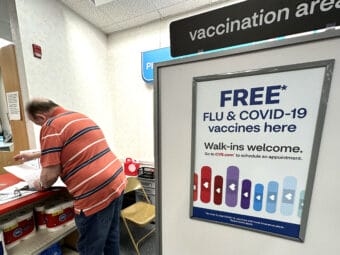
Flu and COVID-19 vaccinations are now available across the U.S., including at this CVS pharmacy in Palatine, Illinois. (Nam Y. Huh/AP)

As the weather cools down, health officials are gearing up for a new season of sickness. It’s the time for gathering indoors and spreading respiratory viruses.

So what is brewing in the viral stew?

There’s the big three to start: the flu, respiratory syncytial virus (RSV) and COVID-19. “These are the three that cause the most utilization of the health care system and the most severe disease,” says Dr. Demetre Daskalakis, acting director of the Centers for Disease Control and Prevention’s National Center for Immunization and Respiratory Diseases.

Last year, 40% of U.S. households were hit with at least one of these viruses, according to a survey from KFF, a nonprofit health policy research group.

And there are other viruses in the mix, says Marlene Wolfe, an epidemiologist and assistant professor at Emory University. There are rhinoviruses and non-COVID coronaviruses — both can cause the common cold.

There are parainfluenzas — in a different family from flu-causing influenzas — which can cause croup and pneumonia in children. And there’s enterovirus D68, which caused a national respiratory illness outbreak in 2014.

There’s also human metapneumovirus, a relatively new virus first identified in 2001. It’s in the same family as RSV and has similar symptoms.

Wastewater data reveals a fuller viral picture

Wolfe says that data from a wastewater study showed that human metapneumovirus circulated a lot last winter. In California, where the samples were collected, it could have been a fourth virus added to the tripledemic mix.

Wolfe co-leads WastewaterScan, a program that provides a granular, real-time look at circulating pathogens, based on testing wastewater samples from around the United States.

A lot of these viruses have the same cold- and flu-like symptoms: coughing, sneezing, aches, fevers, chills. These infections may not lead to doctor’s visits, but they cause sickness and misery. Analyzing wastewater data, collected from community-level sewage plants, means researchers are starting to see the full picture of what’s circulating.

That means data comes in “even from people who are just mildly sick and sipping tea at home,” Wolfe says. The wastewater information helps show how these different viruses intersect, Wolfe says.

Knowing what’s circulating locally could help health care workers and hospital systems plan for surges. “If you have multiple of these viruses [surging] at the same time, that could be worse for individuals and worse for the systems that are trying to take care of them,” she says.

It’s still early in the season. So far, national data shows there are medium levels of COVID-19 going around and low levels of other respiratory viruses in most of the country, though some southeastern states are seeing increases in RSV.

Vaccination can lower disease risk

That means it’s a good time to get protected, says Daskalakis, of the CDC. “We can attenuate the level of disease, make it less severe through vaccination,” he says, describing the effect of the vaccines as “taming” the disease, “turning a lion into a little pussycat.”

This season, updated COVID-19 and flu vaccines are available for those age 6 months and up. For RSV, there are vaccines for older people and pregnant people, and preventive shots for newborns.

There may not be medical interventions for the other winter viruses, but “we have really good commonsense strategies” to help prevent them, Daskalakis says, including good ventilation, washing your hands, covering your sneezes and coughs and staying home when sick to reduce the chances of passing on illnesses.

The CDC expects hospitalizations during the 2023-2024 viral season to be similar to last year — better than the height of the COVID-19 pandemic, but worse than the years before it. Still, hospitals could be in trouble if these viruses all peak at once. The CDC says vaccines — as well as collective common sense — can help keep those levels down.

Copyright 2023 NPR. To see more, visit https://www.npr.org.

4 key takeaways from the FBI’s annual crime report

Police tape is pictured at a crime scene in Monterey Park, Calif., in January 2023. (Frederic J. Brown/AFP via Getty Images)

Homicide rates in the U.S. fell significantly last year, according to newly released FBI data. But reports of hate crimes and property theft increased.

The FBI’s Crime in the Nation analysis compiles annual crime statistics from more than 15,000 law enforcement agencies across the country. These agencies submit data voluntarily and participation is uneven. Still, the report is the most complete view of reported crime trends nationwide.

Here are four major points from the data for 2022.

Homicides are down but still higher than they were pre-pandemic

The homicide rate fell significantly last year, by slightly more than 6% compared with 2021.

Many experts were anticipating a drop, which confirms nationally what they were hearing about fewer reported homicides on the local level. In 2020, the U.S. saw the largest rise in killings in more than a century. Homicide numbers have since dropped, but they still aren’t back to where they were in 2019, before the pandemic. Data from other researchers suggests the decrease will continue for 2023.

Understanding exactly why homicides rose so dramatically in 2020 – or why they’re falling now – is complicated, and there are likely many factors. But there are theories that intuitively make sense, says Ames Grawert, justice program senior counsel at the Brennan Center for Justice.

“The disorder of the pandemic and the stress that caused on all of our social institutions, the way it shut down key parts of communities like violence intervention programs, schools, libraries, things like that, you shouldn’t understate the impact of those things,” Grawert says.

An increase in guns as well as de-policing, or law enforcement disengaging from proactive police work, may have also played a role in the spike, says Justin Nix, an associate professor of criminology and criminal justice at the University of Nebraska Omaha.

“But I would also say that in 2020, that one year spike was historic,” says Nix. “So it shouldn’t be super-surprising a couple of years later that we have a not historic, but a pretty drastic decline in the homicide rates.”

Overall, reports of violent crime – including rape and aggravated assault – also fell last year. In the crimes that were documented, guns were a commonly used weapon, and both victims and offenders were mostly in their 30s or younger.

Property and car thefts are going in the wrong direction

Reports of larceny, which basically means stealing, and motor vehicle theft both increased significantly last year, by about 8% and 11%, respectively.

Experts trace the rise in motor vehicle thefts to a TikTok trend that exposed security vulnerabilities in Hyundai and Kia vehicles and made them easier to steal. But Grawert says the rise in car thefts and shoplifting, a form of larceny, should be taken in context.

“Property crime has been on a more or less downward path for almost 30 years,” Grawert says. “The 2022 data in that context is kind of a rebound. It’s not necessarily an increase over the pre-pandemic baseline.”

Property crime, however, tends to be less reliably reported than homicide or other violent crime data.

Hate crimes are up, but we need better data

Reports of hate crimes have been on the rise for decades.

Last year, there were more than 11,000 reported hate crimes, which are motivated by certain aspects of a victim’s identity, including race, religion, sexual orientation and gender identity. Black people, Jewish people and gay men were the most likely to be targeted.

All crimes tend to be undercounted, and that’s especially true for hate crimes partly because they rely on the discretion of police, says Insha Rahman, vice president for advocacy and partnerships at the Vera Institute of Justice.

“Many jurisdictions don’t accurately capture what is a hate crime or not, and it is a much harder crime to accurately capture because it requires sussing out intent,” Rahman says. “That is just a much more nebulous thing than, say, was property taken, was somebody injured.”

In 2017, James Cullen, then a researcher at the Brennan Center, highlighted this problem.

“According to the FBI, there were zero hate crimes in Mississippi in 2015. None. That is unbelievable, in a literal sense. We should not believe it,” Cullen wrote.

“Shaky is an understatement,” Nix said when describing the hate crime data.

Even if a crime is not coded as a hate crime, that doesn’t necessarily mean it’s going unprosecuted. In many cases, the crime itself – like intimidation, assault or vandalism – is what appears on paper.

But Rahman says marginalized communities don’t need statistics to understand the rise.

“There’s a very real fear that particular communities have in this country that they are more likely to be targeted,” she says. “The stabbing of a 6-year-old Muslim boy or swastikas on a synagogue up on the Upper East Side of Manhattan, those are the things that really drive perception and fear, more so than these numbers.”

Prepare for a spin cycle

Republicans have been quick to blame Democrats for increases in crime – a political refrain that’s not always backed up by data. Both Alabama and Massachusetts, states at different ends of the political spectrum, saw violent crime rise last year, while Florida and Rhode Island saw it fall.

“When we say crime, what are we talking about? Are we talking about the scariest stuff, homicides and robberies? Well, this report gives us reason, at least at the national level, to be optimistic, though that might not be true in your own backyard,” says Nix, of the University of Nebraska Omaha. “If we are worried about having our property stolen, then this report gives us reason to be a little bit concerned that it’s going in the wrong direction. And again, that might not be true in your own backyard.”

What’s more, how people think about crime and the level of crime being reported aren’t always aligned. For instance, a poll from last October indicated most people surveyed thought violent crime was increasing nationwide.

“People’s views of crime sort of get stuck in the past. I’ve heard some policymakers on fairly big stages talk about crime as if it was still 2020,” Grawert says.

“It’s a real problem that our understanding of crime lags reality, and it means we’re always a little behind the times in making policy and in talking about public safety.”

Copyright 2023 NPR. To see more, visit https://www.npr.org.

21 species have been declared extinct, the US Fish and Wildlife Service says

The historical range of the Bachman’s warbler included Alabama, Florida, Georgia, North Carolina, South Carolina, and Tennessee. (U.S. Fish and Wildlife Service)

Twenty-one species, including birds, a bat and several mussels, have been labeled extinct, the U.S. Fish and Wildlife Service said Monday.

The species were previously on the national list of threatened and endangered species.

The extinct species include:

  • Eight Hawaiian honeycreeper birds
  • Bridled white-eye bird of Guam
  • Mariana fruit bat of Guam
  • San Marcos gambusia, a one-inch long fish from Texas
  • Scioto madtom, a small catfish found exclusively in the Big Darby Creek in Ohio
  • Bachman’s warbler, a black and yellow songbird found in several Southern states and Cuba
  • Eight freshwater mussels: the flat pigtoe, green-blossom pearly mussel, southern acornshell, stirrupshell, tubercled-blossom pearly mussel, turgid-blossom pearly mussel, upland combshell and yellow-blossom pearly mussel

“Our determinations of whether the best available information indicates that a species is extinct included an analysis of the following criteria: detectability of the species, adequacy of survey efforts, and time since last detection,” the U.S. Fish and Wildlife Service said.

The U.S. Fish and Wildlife first proposed the species be taken off the endangered and threatened list in 2021, as they had not been seen since as early as 1899 and as late as 2004.

There are now 650 species that have gone extinct in the U.S., according to the Center for Biological Diversity, which says factors such as climate change, pollution and invasive species contribute to species loss.

Between 2004 and 2022, climate change effects contributed to 39% of amphibian species moving closer to extinction. About 3 billion birds have been decimated in North America since 1970, Fish and Wildlife said.

Still, 99% of the animals on the endangered and threatened list have not reached extinction. Fifty-four have been taken off the list due to recovery efforts, while 56 have been downgraded from endangered to threatened, Fish and Wildlife said.

“Federal protection came too late to reverse these species’ decline, and it’s a wake-up call on the importance of conserving imperiled species before it’s too late,” Fish and Wildlife Director Martha Williams said. “As we commemorate 50 years of the Endangered Species Act this year, we are reminded of the Act’s purpose to be a safety net that stops the journey toward extinction. The ultimate goal is to recover these species, so they no longer need the Act’s protection.”

The Hawaiian honeycreepers are now extinct due to their forest habitat being cut down for development and agriculture. Mosquitoes, which are not native to Hawaii, also spread avian pox and avian malaria.

Other Hawaiian birds, such as the ‘akikiki, are also on the brink of extinction, with as little as five known pairs in the wild, the Center for Biological Diversity said.

According to the Center for Biological Diversity, the Bachman’s warbler was also lost to habitat destruction and the bridled white-eye and Mariana fruit bat was lost to an invasive brown tree snake.

The Mariana fruit bat was also compromised by agriculture and overconsumption as food. The San Marcos gambusia suffered from water overuse that impacted groundwater supply and spring flow. The scioto madtom was lost to runoff and silt buildup from dams.

Copyright 2023 NPR. To see more, visit https://www.npr.org.

US book bans are taking a toll on a beloved tradition: Scholastic Book Fairs

A Scholastic Book Fair banner pictured outside a school in Queens, New York. (Lindsey Nicholson/UCG/Universal Images Group via Getty Images)

It’s fall, which means it’s Scholastic Book Fair season. Schools across the country are setting up shelves in their libraries and gymnasiums to let students shop a vast selection of books provided by the educational and publishing company. It’s a highlight for many students, and a nostalgic memory for many adults.

But the events have also waded into controversy, after the company behind them changed its policy to help schools navigate the growing number of book bans in the U.S. — and was quickly accused of caving to censorship.

The accusations started swirling on TikTok and Reddit last month: Scholastic — the billion-dollar educational company that both publishes and distributes books — was allowing schools to opt out of providing diverse books at its nationwide book fairs, according to complaints by several school librarians.

They said Scholastic was putting most of the books focused on race and sexuality into a separate display and letting schools decide whether to order it.

Backlash was swift. Scores of writers and educators on social media accused the company of helping to enable book restrictions, and argued that the company was not taking a strong enough stand against them.

Scholastic acknowledged the change in a statement on Friday, but defended its decision. Enacted or pending legislation in more than 30 states prohibits certain kinds of books — mostly “LGBTQIA+ titles and books that engage with the presence of racism in our country” — from being in schools, the company said.

Because book fairs take place in schools and without parental supervision, it said, such laws create “an almost impossible dilemma: back away from these titles or risk making teachers, librarians, and volunteers vulnerable to being fired, sued, or prosecuted.”

Scholastic says it’s trying to help schools navigate a complicated landscape

The company said in order to continue offering diverse books, it created a new collection for its elementary school fairs called “Share Every Story, Celebrate Every Voice.”

“We don’t pretend this solution is perfect — but the other option would be to not offer these books at all — which is not something we’d consider,” Scholastic said, adding that there are still diverse titles at all of its book fairs and that middle school fairs remain unchanged.

A Scholastic spokesperson told NPR that the company has been in touch with customers about the new policy since August.

They said many school districts had questions and concerns about how to navigate the new legislation, which in some cases took effect over the summer. Those conversations, they added, weren’t about how to eliminate certain books from their fairs, but how to safely hold a fair in the current climate.

According to a list shared with NPR, out of the more than 100 titles in this year’s book fair, most of the books dealing with issues of race, gender and sexuality are in the “Share Every Story, Celebrate Every Voice” collection.

The case includes some 30 books, ranging from The ABCs of Black History to biographies of Rep. John Lewis, Ruby Bridges and Supreme Court Justice Ketanji Brown Jackson. There are picture books and graphic novels by poet Amanda Gorman, civil rights activist and football player Colin Kaepernick, and Jojo Siwa, a dancer and internet personality who came out as gay in 2021. A book based on the PBS animated show Alma’s Way features a Puerto Rican family hunting for a kid’s missing tooth.

The Scholastic spokesperson says moving those titles to a specific group made space to include more diverse books in their other collections and that the change has been largely well-received by school districts.

Book bans pose all sorts of risks

The movement to restrict books is “driven by a vocal minority demanding censorship,” says the free speech group PEN America, which said it found 3,362 cases of book bans in the 2022-’23 school year, up from 2,532 bans in the 2021-’22 school year. The group defines a ban as any move that restricts access to a book. A majority of Americans oppose book restrictions, according to an NPR/Ipsos poll.

It says such bans in schools and libraries are most prevalent in Texas, Florida, Missouri, Utah and South Carolina, but are being “modeled and replicated across the country.”

Many districts are still figuring out what new book bans mean for their classrooms and libraries.

The wording of the laws themselves — and the resulting legal back and forth — have created a lot of confusion, as is the case in Texas where one of those new laws temporarily takes effect this month after an appeals court blocked a judge’s injunction against it.

A fifth-grade teacher in Georgia was fired earlier this year for reading out loud from a book addressing gender stereotypes, which she said was chosen from the Scholastic book fair. (She appealed her termination to the State Board of Education last month.) A middle school teacher in Texas was fired for assigning her class an illustrated adaptation of Anne Frank’s diary.

Other librarians and educators across the country have faced harassment, threats and termination in the face of book bans, anti-critical race theory protests and other culture war issues. Some have started to censor themselves, while others have resigned altogether.

Mychal Threets, a librarian in California with a large social media following, responded to the Scholastic change on TikTok.

Addressing the company, he said: “We are fighting for the freedom to read. We are celebrating the freedom to read. Join us. You are the powerhouse. Use your voice.”

Copyright 2023 NPR. To see more, visit https://www.npr.org.

Vaccine hesitancy affects dog-owners, too, with many questioning the rabies shot

Cindy Marabito runs a pit bull rescue out of her house in Austin, Texas. “We’re the only raw-feeding, holistic, completely no-kill pit bull refuge and rescue in the United States,” she says. She currently has nine dogs that roam her big, mulched backyard by the banks of the Colorado River.

The philosophy of her rescue is to give “low to no vaccines.”

In most states – including Texas – dog owners are required to give their pets a rabies shot every three years. Health officials say the shots keep rabies – a disease with a 99% fatality rate for humans and animals – at bay.

But Marabito considers the current vaccination guidelines “excessive.” She’s one of many pet owners with “canine vaccine hesitancy,” a phrase coined in a recent study led by the Boston University School of Public Health and published in the journal Vaccine. The study found that 53% of U.S. dog owners surveyed question whether the rabies vaccine is safe, whether it works, or whether it’s useful.

The researchers sought to quantify a sentiment they were seeing in their work as veterinarians.

“It’s something I deal with on a day-to-day basis,” says Gabriella Motta, a veterinarian at an animal hospital in Glenolden, Pa., and a co-author on the paper. “We’re [often] dealing with an aggressive animal that’s not vaccinated where the staff is taking extra precautions, really making sure not to get bit.”

Motta’s survey focused on the rabies vaccine, considered by health officials and many veterinarians and health officials to be the most critical dog vaccine for public health – and one that’s required by law in almost every state.

That around half of all dog owners are skeptical about the rabies vaccine is “very disturbing” to Lori Teller, a veterinarian at the Texas A&M School of Veterinary Medicine and Biomedical Sciences and past president of the American Veterinary Medical Association. “The rabies vaccine has been around for decades and it is so incredibly safe, especially when you consider the risk of death,” she says.

Rabies is nearly always fatal if it advances to the point where symptoms appear.

Understanding the risk and benefits of vaccination

Marabito hikes almost every day with the dogs in an area with “all kinds of wildlife – from raccoons to skunks to possums to deer,” she says.

Like most people today, Marabito has never seen a rabid animal, so she says she considers the risk of rabies to be low.

More than 10 years ago, however, she says she saw one of her foster dogs have a bad response to a set of vaccines, including the rabies shot – “reacting violently”, she says. That made her wary of the vaccines.

Serious side effects from the rabies vaccine are very, very rare, say Ryan Wallace, a veterinary epidemiologist and lead for the Rabies Team at CDC.

Of the approximately 24 million dogs that are vaccinated against rabies each year, “the vast majority … have no adverse reactions to the vaccine,” he wrote in an email, “There are only a very small number of severe adverse reactions per year (~2.4 per 1,000,000 vaccinated) and, even with those, it’s difficult to definitively attribute these reactions to vaccination.”

In comparison, Wallace sees great benefit to rabies vaccinations. He analyzed rabies data and estimated that they prevent nearly 300 dogs from getting infected with rabies per year, in turn preventing more than 100 human deaths and saving more than $3 million in treatment costs.

Not vaccinating against rabies could lead to your dog dying if they get infected – or in some cases – if they bite someone, Teller from Texas A&M says: “There is a real likelihood that animal control could euthanize your dog and test it for rabies because human health is going to supersede animal health at that point,” she says.

‘The most dreaded of all diseases’

A hundred years ago, rabies was arguably “one of the most important of health problems” in the U.S., according to public health researchers at the time.

“The suffering and fear caused by it are so great that they make this the most dreaded of all diseases,” wrote the authors of an article from 1928 in the American Journal of Public Health. In the early 1900s, thousands of pets and farm animals caught it each year, and dozens of people died from it.

After decades of concerted public health efforts, the rabies situation in the U.S. was brought under control in the 1960’s, and remains so — meaning most human deaths are prevented. Each year, a few hundred pet cases are reported, and one to three people die from it.

Most people in the U.S. aren’t vaccinated, and if a person is bitten by a rabid animal, they need immediate emergency prophylactic treatment.

In 2007 the specific variant that typically affects dogs was eliminated in the U.S., but other rabies strains continue to spread among wildlife, so pets remain at risk — and still need to be vaccinated.

CDC surveillance detects around 5,000 rabid animals – mostly wildlife – each year. Bats with rabies are found in every state except Hawaii; other mammals including raccoons, skunks, foxes, wolves and mongoose can also spread rabies in parts of the country.

Pets and people can get exposed through interactions with feral animals. “We have instances every year where a dog has tried to eat a bat,” says the CDC’s Wallace. There have also been reports of rabid skunks in doghouses and “rabid raccoons and skunks that, for some reason, really like cow pens,” leading to rabid cattle, horses and farm dogs.

Globally, rabies is still considered “one of the most feared infectious diseases worldwide,” according to health researchers. The disease kills around 59,000 people each year, mostly in countries in Asia and Africa where the disease is endemic in dogs.

From a bite to the brain

The rabies virus is usually transmitted by the bite of an infected animal. Virus in their saliva gets into the muscle. It travels slowly up the nerves, at a rate of about a centimeter a day, to the brain.

There, in the brain, the virus starts replicating rapidly. That’s when an animal or a human starts showing signs. “It’s almost impossible to come back after that,” Wallace says. “The virus’s goal is to make you act abnormal so it can spread to the next animal.”

It messes with the nervous system, throwing off the body’s ability to regulate heart rate and blood pressure, sometimes causing seizures and heart attacks. It can lead to severe swelling in the brain and spinal cord. It migrates to the salivary glands, shedding through saliva and drool. For a patient showing these symptoms, there’s no cure at this stage and most die.

The way to prevent this in humans is to not get bitten by a rabid animal; or to get a series of shots soon after, before symptoms appear, to stop the virus from getting to the brain.

The way to prevent this in pets is to vaccinate them before they get exposed.

Canine vaccine hesitancy ‘spillover’ from humans

“Vaccine skepticism towards pets does not necessarily come from a bad place,” says Matthew Motta, assistant professor of health law, policy and management at the Boston University School of Public Health, and a co-author on the Vaccine paper with his sister Gabriella.

“If you’re a type of person who believes that vaccines are unsafe, then it is because you love your pet that you wouldn’t want to vaccinate them,” even though “this position is at odds with the best available scientific research” and evidence, he says.

Motta sees pet vaccine skepticism as a “spillover effect” from a rise in human vaccine hesitancy – related to the skepticism towards COVID vaccines and the anti-vaccine movement against childhood shots. “We see in our research that people who hold negative views toward human vaccinations are precisely the types of people who hold negative views toward vaccinating their pets.”

While many dog owners have some skepticism towards the rabies vaccine, the shot is required by law in most places and 84% of the Mottas’ survey respondents said they’re still giving it to their pets. That’s about the same as it was a decade ago, the CDC’s Wallace says, according to a separate study conducted then.

Health officials say the margin is slim. The World Health Organization and CDC both recommend maintaining at least a 70% dog vaccination rate, to prevent rabies outbreaks. If the rate dips below that, parts of the U.S. could start seeing more deadly rabies cases in people and pets, Wallace says.

Copyright 2023 NPR. To see more, visit https://www.npr.org.

Transcript :

MARY LOUISE KELLY, HOST:

Many people treat their pet dogs like family and raise them in accordance with their own values. A recent paper finds that human vaccine skepticism – it’s making its way into the pet world. NPR’s Pien Huang reports.

PIEN HUANG, BYLINE: Cindy Marabito runs a pit bull rescue out of her home in Austin, Texas.

CINDY MARABITO: We’re the only raw-feeding, holistic, completely no-kill, 100%, pit bull refuge and rescue in the United States.

HUANG: Right now, she has nine dogs roaming her big backyard near the banks of the Colorado River. Her philosophy is to give low to no vaccines.

MARABITO: Why are we giving all these dogs, horses, kittens, cats, excessive rabies shots?

HUANG: Health officials say those shots help keep a deadly disease away. In most states, dogs are required to get rabies shots every three years. But Marabito is one of many pet owners with canine vaccine hesitancy. According to a recent survey out of Boston University, 53% of U.S. dog owners question if the rabies vaccine is safe, if it works or if it’s useful. Lori Teller is a veterinarian at Texas A&M and former head of the American Veterinary Medical Association.

LORI TELLER: I find it very disturbing. The rabies vaccine has been around for decades, and it is so incredibly safe, especially when you consider the risk of death.

HUANG: Teller says skepticism towards human vaccines has risen with the politics around COVID and the anti-vaccine movement against childhood shots.

TELLER: And I am extremely concerned that we’re getting spillover into the veterinary space, particularly because a lot of these vaccines do prevent diseases that are potentially contagious to humans.

HUANG: The disease most worrying for human health is rabies. Ryan Wallace, head of the rabies team at the Centers for Disease Control and Prevention, explains the infection.

RYAN WALLACE: It’s usually, almost always, transmitted from saliva of an infected animal.

HUANG: The virus gets into the body through a bite wound. It travels slowly up the nerves to the brain, and then it starts replicating rapidly. That’s when an animal or a human start showing signs.

WALLACE: It’s almost impossible to come back after that. The virus – its goal is to make you act abnormal so it can spread to the next animal.

HUANG: Wallace says 99.9% of humans and animals that get rabies for the brain will die. A hundred years ago, rabies was considered one of the most important public health problems in the U.S. Now it’s largely under control.

WALLACE: We have shifted as a country from vaccinating dogs at a high rate to get rid of the virus, to now vaccinating our pets at a high rate, to keep the wildlife versions of this virus from getting into our pets and people.

HUANG: About 5,000 rabid animals get reported each year – mostly bats, raccoons, skunks and other wildlife. Cindy Marabito, from the pit bull rescue, says she’s never seen a rabid animal.

MARABITO: You know, I’m not careless. But I also really don’t overly concern myself with being fearful of things that rarely, rarely, rarely happen.

HUANG: But she says she has seen a dog act strangely after getting a rabies shot. Serious side effects from the rabies vaccine are very, very rare. But seeing that made her wary. Researchers say that while half of dog owners are skeptical of the rabies vaccine, most are still giving it to their pets. The vaccination rate is around 80% – about the same as it was 10 years ago. Still, health officials say the margin is slim. If that 80% rate drops to below 70%, pockets of the country could start seeing more deadly rabies in people in pets.

Pien Huang, NPR News.

(SOUNDBITE OF ERIC TUCKER SONG, “FWM”) Transcript provided by NPR, Copyright NPR.

An empty-nest mama bear just won Fat Bear Week

July 8: 128 Grazer is photographed before putting on hundreds of pounds of weight. (Naomi Boak/NPS)

She didn’t need to win to prove anything. She just needed to eat hundreds of pounds of salmon so she could survive hibernation. But the bear known as 128 Grazer chomped and she romped, and now she is a Fat Bear Week champion.

“She has been putting in the work,” ranger Felicia Jimenez said as the 2023 bracket was unveiled. “She was quite dainty in early summer, but now she is huge.”

A dominant bear, 128 Grazer brooked no nonsense at Brooks River in Katmai National Park and Preserve this summer: “For example, a large adult male, 151 Walker, regularly avoided her approach,” the park noted.

Sept. 14: 128 Grazer is well-known as a tough bear, competing for the best fishing spots. Without cubs to care for, she grew to a huge size this summer. (Naomi Boak/NPS)

Grazer took care of business at the ballot box as well, trouncing rival bears at every stage of the tournament. She dispatched past champions 747 and Holly to reach the final and a faceoff with 32 Chunk, an enigmatic and immense bear. Grazer earned 108,321 votes to Chunk’s 23,134 to win her first championship.

Grazer, identified by her trademark big blonde ears, was a fan favorite coming into the competition, both for the staggering transformation she pulled off this summer and for her personal journey.

Grazer is a skilled and versatile angler, known to keep pulling in fish into the night. She has successfully raised two sets of cubs, and this year — finally — she’s an empty nester.

“She hasn’t had to worry about providing for anybody but herself, so she has really made some massive gains,” Jimenez said.

Like an ursine Sarah Connor, Grazer is one tough mother, known to preemptively attack huge males that might threaten her offspring. She’s also an expert at preparing for the future, thanks to her ability to catch and eat mass quantities of salmon.

Even without cubs, the park said “many other bears remembered her reputation and Grazer maintained a high level of dominance even though she was single.”

This year’s tournament benefited from a new surge of interest, with nearly 1.4 million votes cast. Two years ago, some 800,000 votes were cast in Fat Bear Week.

The annual competition is a celebration of the bears, which must pack on hundreds of pounds in order to survive their lengthy hibernation, as well as highlighting their thriving environment. In recent years, the area has seen record-setting salmon runs, with more than 60 million sockeye salmon, according to the Department of the Interior.

Copyright 2023 NPR. To see more, visit https://www.npr.org.
Site notifications
Update notification options
Subscribe to notifications