National News

They logged on to watch the famous fat brown bears. They saved a hiker’s life instead

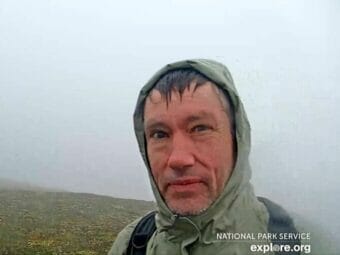
A livestream set up by Explore.org in the Katmai National Park for bear enthusiasts captured a missing hiker pleading for help on Sept. 5. (Screenshot by NPR/Explore.org)

A handful of wildlife enthusiasts were probably hoping to catch a glimpse of Katmai National Park’s famous brown bears when they logged on to a livestream of a remote Alaska mountaintop last Tuesday. But the resident celebrities were nowhere to be seen when a distressed hiker walked into view instead and pleaded for help.

The scene unfolded on the Dumpling Mountain livestream, one of 12 camera views operated by Explore.org inside the Katmai National Park.

Around 3:30 p.m. local time on Sept. 5, a man in a green rain jacket, wet and disheveled, appeared on screen and looked straight into the lens, clearly mouthing the words “help me.” He returned a few minutes later, giving a thumbs-down signal.

“There is someone distressed on the camera,” one viewer posted in the rolling comments beneath the stream. That message was seen by a volunteer chat moderator, who in turn messaged a Katmai park ranger.

After reviewing the footage, the ranger mobilized a search and rescue team, which found the man just about three hours later, not far from the site of the web camera.

The man was ultimately unharmed, Cynthia Hernandez, a spokesperson for the National Park Service, told NPR in an email. She added that the rangers were notified of the distressed hiker directly thanks to the concerned viewers.

When the chat moderator shared this news with the viewers, there was a flood of kind words and a sweet celebration.

“Aaaand I’m crying because I’m so relieved,” posted the user who originally flagged the man’s appearance. “Those rangers made it up there fast!”

Dumpling Mountain isn’t typically a popular livestream

The cameras have been around since 2012, but really started to take off in 2014, with the advent of Fat Bear Week — a delightful man-made tournament in which the public votes on which of the park’s bears has grown the most rotund as preparation for their winter hibernation. (This year’s Fat Bear Week has yet to be announced, but the competition usually lands in early October).

Roughly 10 million people tuned in to the Katmai live streams last year, according to Mike Fitz, a naturalist with Explore.org who previously worked as a ranger at the park.

But most of those views went to the cameras trained on Brooks Falls, where the bears make daily stops during salmon spawning season.

Sitting about 2,200 feet above sea level, the Dumpling Mountain camera is more of a “scenery cam than a wildlife cam,” Fitz said.

Stunning sunsets, like this one highlighted by Explore.org, are a main reason to tune in to the Dumpling Mountain live camera. (Screenshot by NPR/Explore.org)

The camera auto-pans across a sweeping vista: Colorful alpine tundra shrubs dot the landscape while the largest lake in a U.S. national park (Naknek) stretches out in the foreground. Some of Katmai’s 14 active volcanoes are visible in the distance.

But that height comes with tempestuous weather, which can often obscure the view and offers little in the way of shelter and food for the kind of big-ticket animals viewers crave. When NPR checked the stream on Friday morning, only 12 people were watching.

The camera itself is about 2 miles away from the nearest trail, which is described by the National Park Service as a “strenuous hike” featuring “steep portions” and some overgrown areas.

The climb rises 800 feet over 1.5 miles and ends about 2.5 miles from the actual summit of the mountain, but an unmaintained footpath continues on for a while before petering out.

Fitz says that makes it “a great place to find some quick solitude away from the river, away from the bears,” but also shrouds the path in danger.

It’s still unclear how the hiker found the remote camera

Cell service and shelter can be hard to come by on the rounded and short-shrubbed mountain peak.

And, during poor conditions, like the kind that set in on Sept. 5, “You really have no sense of direction,” Fitz said. “The landmarks you saw on the way up disappear when the clouds come down.”

The 4.1-million-acre Katmai National Park is tucked between the Pacific Ocean and the Bering Sea, making it a prime spot for storms in any season.

Rain and wind were detectable on the camera Tuesday. Due to fog, the visibility appeared to be about 50 feet or less.

It’s still unclear how the hiker found the camera installation. Fitz says the collection of solar panels and wind turbines sticks out amid the short vegetation, but it still isn’t huge — maybe about 20 to 30 square feet total.

“This was certainly a first for us,” Fitz said of the hiker asking for help, though wildlife viewers around the world have flagged pressing emergencies before, like an injured elephant at a Kenyan wildlife sanctuary.

“Our webcam viewers, collectively, are very sharp-eyed and they don’t miss much,” he added.

That was evidenced again on Sunday, when Dumpling Mountain’s viewers, still recovering from the stress of seeing the hiker, caught sight of a big thing in a slim six seconds of the stream: A brown bear, rambling across the camera’s view, miles away from his typical hangouts.

Copyright 2023 NPR. To see more, visit https://www.npr.org.

What airport security was like before Sept. 11

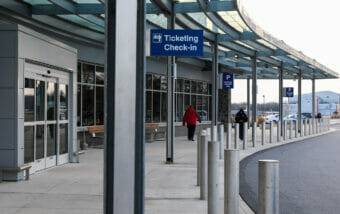
A traveler at Ronald Reagan Washington National Airport walks to a Transportation Security Administration checkpoint on Nov. 26, 2014. (Paul J. Richards/AFP via Getty Images)

It’s hard to fathom now, but we used to be able to arrive at the airport just minutes before a flight. We’d keep our shoes and coats on as we went through a simple metal detector, and virtually anyone could go right to the gate without a boarding pass or even showing an ID.

The 19 al-Qaida-affiliated terrorists who hijacked four commercial jetliners on Sept. 11, 2001, knew that and exploited lax airport security measures, strolling through metal detectors at four airport security checkpoints with ease, with deadly weapons in hand. This allowed the hijackers to commandeer those airplanes and use them as jet fuel-filled missiles as they flew them into the twin towers of the World Trade Center, the Pentagon and a field in Shanksville, Pa., killing nearly 3,000 people.

“It was so easy — a lot of us were surprised it hadn’t happened sooner,” says Jeff Price, who was assistant security director at Denver International Airport on Sept. 11, 2001, and is now an aviation security expert at Metropolitan State University of Denver.

Airport security at that time was carried out by private contractors, usually hired by the airlines, with few federal standards. Those security contracts usually went to the lowest bidder.

“Before 9/11, security was almost invisible, and it was really designed to be that way,” Price says. “It was designed to be something in the background that really wasn’t that noticeable and definitely did not interfere with aircraft or airport operations.”

“You could walk up to the gate at the very last minute. You did not have to have a boarding pass,” Price says. “All you had to do was go through the security checkpoint — no questions asked, no ID needed.”

That forever changed on Tuesday, Sept. 11, 2001.

Now, travelers often stand in long lines at security checkpoints with wait times that can exceed an hour. We take off our shoes, empty our pockets and take laptops and other devices out of carry-on bags before stepping into high-resolution, full-body scanners, while our bags go through 3D-imaging X-ray machines. And don’t forget to take your liquids of 3.4 ounces or less out of your carry-on.

Some of us enroll in known- or trusted-traveler programs such as PreCheck, surrendering some of our privacy in an effort to have a smoother expedited screening process.

Aviation security experts acknowledge that prior to 9/11, no one envisioned suicide terrorists wanting to use commercial airplanes as weapons and being willing to kill themselves in order to kill hundreds of innocent people.

Now, counterterrorism and homeland security officials in the federal government work to imagine the unimaginable and enhance defenses to prevent the ever-changing and growing threats to aviation security.

Here’s a look at how airport security has evolved over the past 20 years.

Sept. 11, 2001: Terrorists hijack and crash four passenger jets

The 19 hijackers checked in for their flights at the airport in Portland, Maine, at Boston’s Logan International Airport, at Liberty International Airport in Newark, N.J., and at Dulles International Airport in the Washington, D.C., area.

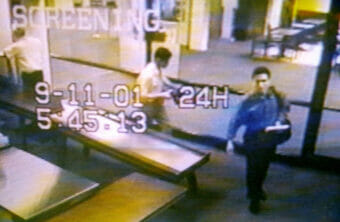
Two men identified by authorities as hijackers Mohamed Atta (right) and Abdulaziz Alomari (center) pass through airport security on Sept. 11, 2001, at Portland International Jetport in Maine in an image from airport surveillance tape released on Sept. 19, 2001. (Reuters/Portland Police Department)

When Mohamed Atta checked in at the Portland airport with a fellow hijacker for their short flight to Boston, he was selected for additional scrutiny under what was then known as CAPPS (Computer Assisted Passenger Prescreening System). But according to The 9/11 Commission Report, “Under security rules in place at the time, the only consequence of Atta’s selection by CAPPS was that his checked bags were held off the plane until it was confirmed that he had boarded the aircraft. This did not hinder Atta’s plans.”

Several of the other hijackers were flagged by CAPPS at the other airports, but none was questioned and they were allowed to board in the same way Atta was — without much additional scrutiny. As they strolled through metal detectors at the airports, a couple of the hijackers set off alarms, but they were quickly cleared and sent on their way after going through a second metal detector or being scanned by a hand-held wand. It’s not clear what exactly set off the alarms, but according to The 9/11 Commission Report, the hijackers used knives and/or razor blades in their attacks, which they likely had on them or in their carry-on bags. Even if those weapons were detected, it wouldn’t have mattered.

“The FAA allowed knives of up to 4 inches in length on board an aircraft,” says Price, the aviation security expert. “So even if the hijackers would have been caught with their knives prior to boarding the plane, the screeners would have handed it right back to them. “By 8:00 A.M. on the morning of Tuesday, September 11, 2001, they had defeated all the security layers that America’s civil aviation security system then had in place to prevent a hijacking,” The 9/11 Commission Report states.

September and October 2001: enhanced airport security, fewer Americans flying, longer wait times in airport security lines

After the planes hit the twin towers and the Pentagon, the Federal Aviation Administration immediately ordered all remaining commercial aircraft still in the air to land at the nearest available airport. All flights remained grounded until Sept. 14. But when air travel did resume, very few Americans were willing to fly. Nonetheless, in the days and weeks after the stunning terrorist attacks, airport security immediately intensified.

Armed National Guard soldiers joined local and state police in some cities to help patrol airports and screen travelers. Knives, box cutters, razors and other types of blades were banned, and the list of other items prohibited on aircraft grew significantly.

Military police from the Massachusetts National Guard on their first day of duty at Boston’s Logan International Airport on Oct. 5, 2001. Several thousand National Guard troops were called up around the U.S. to ensure airport security in the wake of the 9/11 attacks. (John Mottern/AFP via Getty Images)

Airport security officers began searching through carry-on bags and patting down passengers, and that, according to Price, is when wait times in airport security lines started to grow longer, even though few Americans were flying. He says authorities were “slowing down the lines at the checkpoint to do a more thorough search of passengers and baggage.”

November 2001: The Aviation and Transportation Security Act creates the TSA; checked baggage screened by X-rays

Congress passed and President George W. Bush signed the law that would create the Transportation Security Administration, which would become part of the newly created Cabinet-level Department of Homeland Security.

Transportation Secretary Norman Mineta (left) meets with the CEOs of major U.S. airlines, including U.S. Airways CEO Rakesh Gangwal (right), and Federal Aviation Administration Director Jane Garvey on Nov. 15, 2001, at the Department of Transportation in Washington, D.C. Mineta called the meeting to discuss improvements in airport security. (Shawn Thew/AFP via Getty Images)

In addition to creating the TSA, the Aviation and Transportation Security Act required 100% of all checked baggage to be screened by X-rays, the Federal Air Marshal Service was expanded to put more armed air marshals on many more flights, and the law required airlines to reinforce cockpit doors on their aircraft to prevent attackers from entering.

The law also mandated that the TSA oversee security for all modes of transportation, such as passenger rail (including Amtrak) and intercity bus travel. Experts say the TSA was a major step forward in improving security.

December 2001: the shoe bomber and how shoe removal at airport security checkpoints started

On Dec. 22, 2001, on an American Airlines flight from Paris to Miami, British-born terrorist Richard Reid tried to detonate explosives that he had packed in his shoes. Passengers subdued and restrained Reid as the flight was diverted to Boston, the closest airport.

This still frame from television footage obtained by ABC News and released Feb. 7, 2002, shows a shoe worn by shoe bomber Richard Reid. (ABC News/Getty Images)

Investigators later said that Reid had enough explosive material to blow a hole in the fuselage of the plane, but that rainy weather and Reid’s foot perspiration made the fuse too damp to ignite. Reid pleaded guilty to eight terrorism-related charges in October 2002 and was sentenced to three consecutive life sentences and 110 years, with no possibility of parole. The incident led to the TSA and airlines asking passengers to voluntarily remove their shoes when going through screening at airport security checkpoints.

December 2002: deploying explosives detection systems, very detailed 3D images

The TSA meets the mandate to screen 100% of all checked luggage by deploying machines that can scan bags for explosives and other dangerous weapons in every airport in the country.

The technology used in these screening systems has improved greatly over the intervening years, according to Deb Scovel, a TSA baggage and checkpoint supervisor at Chicago O’Hare International Airport, who says today’s X-ray scanners are similar to CT scanners used in hospitals.

Left: On Jan. 24, 2002, at Port Everglades in Florida, customs inspector Lance Howard (left) demonstrates the operation of the American Science and Engineering Micro-Dose 101 X-ray machine to Customs and Border Protection Commissioner Rob Bonner (center) and Immigration and Naturalization Service Commissioner Jim Ziglar. Right: A handgun inside a briefcase is displayed on the machine’s screen. (Joe Raedle/Getty Images)

“The X-rays take images of it from all sides,” says Scovel, “so it does an all-around picture of whatever goes inside so you see it from every point of view.” She says the 3D images are so detailed that “I can tell you the difference between Irish Spring and Dove soap — yes, I can. And officers that have been here a while can do the same thing. You can tell the difference between an Apple and a Dell laptop; they’re very detailed.”

April 2003: Pilots start to carry firearms on board flights, and other cockpit protections

The first pilots certified under a voluntary program allowing them to carry handguns were on board flights. Bush signed the Arming Pilots Against Terrorism Act into law in November 2002, and the TSA began training flight deck personnel on how to use firearms on board, if needed, soon after.

Participants in the first class of commercial airline pilots who volunteered to carry handguns learn defense tactics on April 17, 2003, in Glynco, Ga., as part of the TSA’s federal flight deck officer training program. The inaugural group of federal flight deck officer candidates spent the week learning how to use a handgun and defensive tactics. (Gary Wilcox/Getty Images)

Also in April 2003, the TSA announced that all airlines had met the requirement to reinforce cockpit doors on their entire fleets of planes.

Pilots and their unions continue to push for additional cockpit barriers and fortifications to protect them from possible attacks from outside the cockpit.

August 2006: liquids banned, shoe removal mandated and more air marshals added

British authorities disrupted a terrorist plot to detonate liquid explosives on board 10 commercial aircrafts bound from London to various cities in the U.S. and Canada. U.K. prosecutors alleged the would-be bombers prepared to disguise the explosives as soft drinks in 500-milliliter branded plastic bottles.

As a result, the TSA banned all liquids, gels and aerosols from passenger carry-on luggage.

Containers holding liquids and gels that were taken from passengers lie in a trash can at Dulles International Airport near Washington, D.C., on Aug. 10, 2006. (Mark Wilson/Getty Images)

A month later, in September 2006, the TSA lifted the ban on liquids and amended its rule to allow airline passengers to carry liquids, gels and aerosols in containers of only 3.4 ounces or less in a single, clear, resealable 1-quart plastic bag that had to be removed from carry-on baggage when going through security screening.

August 2006 is also when the TSA began to require that all travelers remove their shoes so footwear could be screened for explosives at airport security checkpoints.

The TSA also began deploying more federal air marshals, including on international flights.

March 2008: Canine units join airport security forces

Although bomb-sniffing dogs were already being used in a limited capacity as part of transportation security, the TSA began deploying canine teams to specifically aid in the screening of cargo loaded onto passenger aircraft at U.S. airports.

The program later expanded to use dogs to detect possible explosive materials on passengers and in checked and carry-on baggage.

Sgt. Cliff Java of the San Francisco Police Department and his dog, Jacky, check luggage at San Francisco International Airport on July 3, 2007. (David Paul Morris/Getty Images)

December 2009: the “underwear bomber” and the installation of full-body scanners

On Christmas Day 2009 on board a Northwest Airlines flight from Amsterdam to Detroit, al-Qaida extremist Umar Farouk Abdulmutallab tried to detonate an improvised explosive device that he had hidden in his underwear.

Abdulmutallab later told FBI agents that he had been following the jetliner’s flight path on his seat back’s screen, as he wanted to blow up the plane over U.S. soil. Inside his briefs, he had explosive chemicals that would ignite when mixed. After going into the plane’s lavatory to make final preparations, he returned to his seat and pushed a plunger to mix the chemicals.

But the volatile mix didn’t explode as he intended, possibly because of excess moisture after the chemicals were inside his pants for so long. The mixture only caught fire, seriously burning Abdulmutallab, who tried to get his burning pants off before fellow passengers and crew members subdued him.

Abdulmutallab later pleaded guilty and was sentenced to life in prison.

A passenger goes through a full-body scanner at Reagan National Airport in Washington, D.C., on Nov. 24, 2010. (Jewel Samad/AFP via Getty Images)

In response to the failed attack in which a terrorist was able to sneak dangerous explosives through security, in March 2010 the TSA began installing hundreds of full-body scanners that used advanced imaging technology.

By the end of 2010, approximately 500 such machines were deployed nationwide.

December 2011: TSA PreCheck begins, vetted travelers pay to go through shorter security lines

With hundreds of millions of travelers passing through the TSA’s airport security checkpoints each year, the agency wanted a better way to discern who was and who wasn’t a serious threat. So it started its known- and trusted-traveler PreCheck program to provide expedited screening for those willing to pay for it and undergo a more detailed background check.

The TSA says it makes risk assessments about passengers prior to their arrival at airport checkpoints via these thorough background checks. Vetted travelers pay $85 for a five-year membership and get to go through a shorter security line where they no longer have to remove shoes and belts.

The TSA, meanwhile, says it is able to focus resources on more high-risk and unknown passengers.

June 2015: TSA flunks undercover tests

The TSA’s inspector general reported that 95% of the time, TSA officers failed to detect weapons, explosives and other prohibited items that undercover agents smuggled through various airport security checkpoints.

The astronomically high failure rate led to the reassignment of Melvin Carraway, who was then the TSA’s acting director. It also prompted significant changes in TSA training and procedures, including enhanced screening and increased random searches.

March and June 2016: attack outside Turkish airport security perimeter, concerns about soft targets

In June 2016, three suicide bombers who had been turned away at an airport security checkpoint opened fire with semiautomatic weapons before detonating explosive belts at Ataturk Airport’s international terminal in Istanbul, killing themselves and 45 other people, while injuring more than 200.

Bullet impacts mar a window at Ataturk Airport in Istanbul on June 29, 2016, the day after a suicide bombing and gun attack targeted the airport, killing 45 people. (Ozan Kose/AFP via Getty Images)

That deadly assault followed a similar coordinated terrorist attack just three months earlier that killed 32 people and injured more than 300 at an airport terminal and subway station in Brussels. The incidents raised concerns about what security experts call soft targets — the areas outside the hard security perimeter where large groups of people wait at baggage claim, line up at check-in counters and kiosks or queue up to go through security checkpoints.

Some critics, including counterterrorism expert Tom Mockaitis at Chicago’s DePaul University, say it exposes a flawed approach to security.

“I’ve seen, in this country, us waste literally millions of dollars on what I call placebo security — highly visual measures like armed guards strutting up and down in our airports, you know, creating a feeling of well-being and a feeling of security without providing any real added benefit,” Mockaitis told NPR in July 2016.

March 2017: the laptop ban

The Trump administration, citing threats gathered from credible intelligence sources, prohibited travelers from certain countries from bringing laptops, tablets and other large electronic devices into the cabin on commercial flights to the United States.

John Kelly, secretary of homeland security at the time, said the intelligence indicated that terrorists were developing bombs powerful enough to bring down an airplane but small enough to be hidden inside those devices. The laptop ban affected travelers from 10 airports in eight countries with majority-Muslim populations.

“We didn’t feel at the time that overseas airports had the kind of security initially that could give me a comfort that they could detect this device, the airports in those countries,” Kelly said a couple of months after the ban was imposed.

The laptop ban was lifted in July 2017.

June 2017: facial recognition, biometric screening and privacy concerns

In 2017, some airlines, in collaboration with the TSA, began trials of facial recognition software that allows passengers’ faces to be their boarding passes.

The system takes a photo and matches it with one on file with the airlines, speeding up the passenger-screening process and providing greater customer convenience. And because users of the system must be enrolled in the federal government’s known-traveler program, it provides an extra layer of security.

But this and other biometric-screening methods, which could allow the government to track your whereabouts at home and abroad, raise significant privacy concerns, as NPR’s Asma Khalid reported.

Aviation security experts say the TSA’s efforts to expand the use of facial recognition and biometric screening was significantly delayed by the COVID-19 pandemic but could begin to ramp up again in the next couple of years.

September 2021: still room for improvement but layers of hard and soft security

TSA officials say aviation security continues to evolve to address ever-changing threats, with a layered approach that involves surveillance, intelligence and technology. The agency has 65,000 employees and spends billions of dollars each year in an effort to stay one step ahead of potential foreign and domestic terrorists.

“People are very creative. The threats are very creative,” says Louis Traverzo, the TSA’s deputy federal security director. He adds: “It’s up to us to anticipate that, and it’s up to us to look at those things and try to come up with ideas to counter methods” that terrorists may come up with.

There hasn’t been a successful attack against commercial aviation in the U.S. in the 20 years since 9/11, and outside experts agree that while there is still room for improvement, the TSA has been effective in preventing another terrorist attack.

Copyright 2023 NPR. To see more, visit https://www.npr.org.

The share of US drug overdose deaths caused by fake prescription pills is growing

This photo provided by the U.S. Attorneys Office for Utah and introduced as evidence in a 2019 trial shows fentanyl-laced fake oxycodone pills collected during an investigation. (AP photo)

U.S. public health officials are continuing to warn of a growing threat fueling the country’s historic opioid crisis: fake prescription pills.

The share of overdose deaths involving counterfeit pills more than doubled between mid-2019 and late 2021, and the percentage more than tripled in western states, according to a new report from the Centers for Disease Control and Prevention.

According to the CDC, overdose deaths that had evidence of fake pill use accounted for just 2% of fatalities between July and September of 2019. That figure jumped to 4.7% between October and December of 2021.

Those who died from overdoses with evidence of fake pill use — compared to overdoses without it — were more often younger, Hispanic or Latino and had misused prescription drugs in the past.

When looking at states in the west — including Arizona, Washington and Alaska — researchers found that the rate surged from 4.7% to 14.7% over that time period. The CDC says that’s a change for this region, which has historically seen less illegal white-powder fentanyl — a powerful opioid commonly found in counterfeit pills — because it’s difficult to mix with black tar heroin, which is more prevalent in the western U.S.

The report comes as drug deaths across the country remain at record highs, with the CDC estimating that more than 105,000 people fatally overdosed in 2022.

“The proliferation of counterfeit pills, which are not manufactured by pharmaceutical companies, but are typically made to look like legitimate pharmaceutical pills (frequently oxycodone or alprazolam), is complicating the illicit drug market and potentially contributing to these deaths,” the report’s authors said.

Illicit fentanyl was the sole drug involved in 41.4% of drug overdose fatalities with indications of counterfeit pill use, the CDC added.

The Drug Enforcement Administration issued a public safety alert in 2021 warning of an uptick in fake prescription pills being sold illegally, many of which contained potentially deadly amounts of fentanyl.

Some commonly faked prescription drugs included OxyContin, Percocet, Vicodin, Xanax and Adderall, and authorities said the counterfeit pills were being sold online and over social media.

“Drug traffickers are using fake pills to exploit the opioid crisis and prescription drug misuse in the United States, bringing overdose deaths and violence to American communities,” the DEA said at the time.

Last year, the DEA said 60% of the fentanyl-laced fake prescription pills it tested contained a potentially lethal dose of the opioid.

Meanwhile, U.S. officials continue to try to combat the country’s raging opioid epidemic.

The Biden administration announced last week that it was setting aside more than $450 million to combat the ongoing opioid crisis, including $18.9 million to expand a law enforcement program targeting drug trafficking and production at a regional level.

Portions of the funding will also go to a national ad campaign about the dangers of fentanyl aimed at young people as well as to services in rural areas across the U.S. for those at risk of overdosing on illicit fentanyl or other opioids.

The Food and Drug Administration also announced in March that it approved the overdose-reversing nasal spray Narcan for over-the-counter sales without a prescription.

Copyright 2023 NPR. To see more, visit https://www.npr.org.

Lab data suggests new COVID booster will protect against worrisome variant

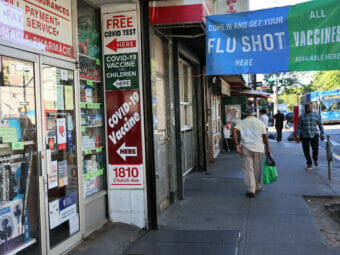
Lab data suggests the new COVID-19 booster shots should protect against a variant that concerns scientists. The boosters should be widely available this fall at pharmacies, like the one seen in the Flatbush neighborhood of Brooklyn borough in New York City. (Michael M. Santiago/Getty Images)

Scientists have produced the first data indicating that a variant that has raised alarm is unlikely to pose a big new COVID-19 threat.

Four preliminary laboratory studies released over the weekend found that antibodies from previous infections and vaccinations appear capable of neutralizing the variant, known as BA.2.86.

“It is reassuring,” says Dr. Dan Barouch, who conducted one of the studies at the Beth Israel Deaconess Medical Center in Boston.

When it was first spotted, BA.2.86 set off alarm bells. It contains more than 30 mutations on the spike protein the virus uses to infect cells. That’s a level of mutation on par with the original Omicron variant, which caused a massive surge.

The concern was BA.2.86, while still rare, could sneak around the immunity people had built up and cause another huge, deadly wave.

“When something heavily mutated comes out of nowhere … there’s this risk that it’s dramatically different and that it changes the nature of the pandemic,” says Benjamin Murrell, who conducted one of the other studies at the Karolinska Institute in Sweden.

But Murrell and Barouch’s experiments, along with similar studies conducted by Yunlong Richard Cao at Peking University in China and by Dr. David Ho at Columbia University in New York, indicate BA.2.86, is unlikely to be another game-changer.

“It’s reassuring that this is not a variant that’s going to pose a huge problem for our soon-to-be-released vaccines,” Ho says. “At least from this perspective, it’s not as threatening as feared.”

Murrell agrees.

“For BA.2.86 the initial antibody neutralization results suggest that history is not repeating itself here,” Murrell says. “Its degree of antibody evasion is quite similar to recently circulating variants. It seems unlikely that this will be a seismic shift for the pandemic.”

The studies indicate that BA.2.86 doesn’t look like it’s any better than any of the other variants at evading the immune system. In fact, it appears to be even be less adept at escaping from antibodies than other variants. And may also be less efficient at infecting cells.

“BA.2.86 actually poses either similar or less of an immune escape risk compared with currently circulating variants, not more,” Barouch says. “So that is good news. It does bode well for the vaccine.”

Moderna released a statement Wednesday saying the company has data indicating its new shot produces a strong immune response to BA.2.86.

The Food and Drug Administration is expected to approve new vaccines soon that target a more recent omicron subvariant than the original shots. And the Centers for Disease Control and Prevention would then recommend who should get them.

While that subvariant, XBB.1.5, has already been replaced by others, it’s a close enough match for the new shots to protect people, scientists say.

“I wish the booster was already out,” says Dr. Peter Hotez of the Baylor College of Medicine and Texas Children’s Hospital, noting that yet another wave of infections has already begun increasing the number of people catching the virus and getting so sick that they’re ending up in the hospital and dying. “We need it now.”

Copyright 2023 NPR. To see more, visit https://www.npr.org.

Transcript :

ARI SHAPIRO, HOST:

Today, we have some good news about the pandemic. New data indicate that a variant that has raised alarm is unlikely to pose a big, new threat. NPR health correspondent Rob Stein has the details.

ROB STEIN, BYLINE: When scientists first spotted the new variant, known as BA.2.86, it set off alarm bells, even though it’s rare. That’s because BA.2.86 had mutated like crazy – on par with the original omicron, which caused a massive surge – raising fears BA.2.86 could sneak around the immunity people had from all their infections and vaccinations and cause yet another huge, deadly wave. Ben Murrell has been studying the variant at the Karolinska Institute in Sweden.

BEN MURRELL: When something heavily mutated comes out of nowhere, and there’s a lot of uncertainty, and there’s this risk that it’s dramatically different, then it changes the nature of the pandemic.

STEIN: But the first studies to analyze how well our immunity can neutralize the variant came out over the weekend and indicate BA.2.86 is unlikely to be another game-changer. At least four preliminary laboratory experiments all found that antibodies people have in their blood from getting vaccinated or infected with one of the more common variants that are already circulating widely can effectively block BA.2.86.

MURRELL: For BA.2.86, the initial antibody neutralization results suggest that history is not repeating itself here. Its degree of antibody evasion is quite similar to recently circulating variants, and it seems unlikely that this will be a seismic shift for the pandemic.

STEIN: Because, it turns out, BA.2.86 doesn’t look like it’s any better than any of the other variants at evading the immune system. In fact, it appears to be even less adept at escaping from antibodies than other variants and may also be less efficient at infecting cells. Dr. Dan Barouch has been studying the variant at the Beth Israel Deaconess Medical Center in Boston.

DAN BAROUCH: BA.2.86 actually poses either similar or less of an immune escape risk compared with current circulating variants, not more. So that is good news. That is reassuring. It does bode well for the vaccine.

STEIN: The Food and Drug Administration is expected to approve new vaccines soon that target a more recent omicron subvariant than the original shots, and the Centers for Disease Control and Prevention will then recommend who should get them. While that subvariant, called XBB.1.5, has already been replaced by others, it looks like a close enough match to protect people. Dr. Peter Hotez at the Baylor College of Medicine hopes as many people as possible will get the new vaccines as quickly as possible.

PETER HOTEZ: I wish the booster was already out. That’s – my only concern is we need it now.

STEIN: Because yet another wave of infections has already begun, increasing the number of people catching the virus and getting so sick that they’re ending up in the hospital and dying.

Rob Stein, NPR News.

(SOUNDBITE OF STATIK SELEKTAH SONG, “TIME”) Transcript provided by NPR, Copyright NPR.

More small airports are being cut off from the air travel network. This is why

The Williamsport Regional Airport in Montoursville, Pa. (Heather Ainsworth for The Washington Post/Getty Images)

Walking into Pennsylvania’s Williamsport Regional Airport is a strange experience.

It has everything you’re used to seeing in a terminal building: check-in desks, a baggage carousel, car rental counters.

But there’s one thing missing — passengers.

There haven’t been any commercial airline flights out of Williamsport since American Airlines left in 2021.

To lose service entirely is rare. But the withdrawal of legacy airlines from regional airports is a growing phenomenon.

American, Delta and United combined have left 74 regional airports since the beginning of the COVID-19 pandemic, according to a study by aviation consulting firm Ailevon Pacific.

Changing economics

A shortage of pilots is partially to blame for major airlines’ departure from smaller airports. But changing airline economics means the challenge facing regional airports could become insurmountable.

“The 50-seat jet today is just not economic as it was 10 years ago. Labor costs going up. Fuel costs going up. Maintenance costs going up. And it’s hard for that airplane at that seat size to be profitable,” longtime industry analyst William Swelbar told Morning Edition.

Those are the planes that typically service regional airports like Williamsport, which is why we’re likely to see more small cities lose their airline service, according to Swelbar.

“In the West, the distances are greater, the terrain is more difficult, people need to fly. Whereas you look in the East, there’s lots of airports that are located in a certain geography. And the highway system is terrific. That’s why there will be more Williamsport,” he said.

As regional airports increasingly run out of options for passengers, it will change how many Americans begin their journeys, Swelbar believes.

“The highway has become and will become the first access point to the air transportation grid going forward,” he added. “Not every community can support the trend toward larger airframes.”

Hard feelings

Despite the economics, the way legacy airlines are leaving smaller cities is frustrating to Richard Howell, the executive director at Williamsport Regional Airport.

“During COVID the airlines took $55 billion worth of money from the government for a variety of loans and PPP and all the rest of it. And as soon as COVID’s gone, they start pulling out of markets like mine. I mean, they’re literally abandoning rural America,” he said.

Richard Howell, the executive director at Williamsport Regional Airport, stands in the terminal building. (Adam Bearne/NPR)

In a statement to NPR, American Airlines said: “It’s always difficult to decide to end service to a market and there are always several factors to consider, including customer demand, alternative airport access for local residents and industry constraints like the regional captain shortage.”

The economic effect of their decision to leave is already being felt.

World Travel International is a travel agency based inside the airport terminal. But in a cruel irony, the company’s clients can’t begin their journeys there.

“It’s very sad. To know that we can’t help people that need immediate service to leave right from here. Or like our older clients, having to pay a driver to get them to other airports because they’re no longer able to make those drives,” said owner Julie Johnston McManus.

“We’ve lost all our walk-by traffic,” she added.

Beyond the terminal

It’s not just inside the airport where businesses are struggling because of the lack of air service.

That’s been identified as a big issue by site consultants looking to potentially bring businesses to Williamsport.

The Williamsport Lycoming Chamber of Commerce invites businesses to visit the city during the Little League World Series, which is held every year.

“We all work to try to get them to land their projects here. Last year was the first year that we did it post-COVID. And it was also the first time that we did it without an air service,” said the Chamber’s president and CEO Jason Fink. “And the number one deficiency that was cited was the inability to easily get here.”

In another ironic twist for a city without airline service, one of the biggest employers is Lycoming Engines, which makes piston engines for aircraft.

“When you’re trying to conduct different business meetings and have the opportunity to bring in prospective customers, you want to have that flight service available in your city,” said Shannon Massey, senior vice president at Lycoming Engines.

It’s also affecting Lycoming’s recruitment process.

“If you’re trying to have candidates come in and they want to be interviewed, they have family members. And they want to know if they can or can’t get to their families in a certain distance,” Massey added.

Hope for the future

Howell believes his airport can still make a comeback, if he can get some help from Congress.

He wants Williamsport to get back into a program called Essential Air Service (EAS).

It gives grants to airlines to fly to locations where it’s tough to make money.

Williamsport dropped out when Congress changed the rules in 2012, saying that airports who didn’t use EAS funds the previous year were no longer eligible.

Back then, the airport didn’t need the money. But it does now.

“There’s carriers out there that all they do is EAS because it’s fully subsidized. They’ve got no risk. Even if I could just get back in the program for five or six years or something like that, so we get past this pilot thing,” said Howell.

“Just get me in the door. Ultimately we get back to where we were, where there’s no subsidy at all. The market sustains itself,” he added.

But Howell understands the reality that cities like Williamsport are facing in an era where smaller planes are grounded.

“The planes keep getting bigger and bigger. So you out there with your 75 seat airplanes and things like that, you’re next,” he said.

“If we don’t have some pieces in place that we get our elected officials to put there for us, then you’re just going to be next on the list,” Howell warned.

An old Challenger jet used to train students of the Pennsylvania College of Technology is seen behind a fence at Williamsport Regional Airport. (Adam Bearne/NPR)

A quiet runway

On the airfield at Williamsport Regional, a lone green tractor mows the grass.

But finally, a plane is spotted heading for the runway, a small blue and white private aircraft.

It’s the type of plane that might be used to learn how to fly. And this pilot practiced a touch-and-go landing before immediately taking off again.

Circling the airport and repeating the process, there was no rush.

There’s plenty of time for training when you have the runway all to yourself.

The audio version of this story was edited by Halimah Abdullah. The digital version was edited by Treye Green.

Copyright 2023 NPR. To see more, visit https://www.npr.org.

Transcript :

LEILA FADEL, HOST:

If you’re flying this Labor Day weekend, you might need to drive further than you’re used to to catch your flight. Airline service to smaller cities around the country is dwindling due to a shortage of pilots and changing airline economics. So what does this mean for the surrounding communities? NPR’s Adam Bearne traveled to Williamsport, Pa., to find out.

(SOUNDBITE OF HELICOPTER FLYING)

ADAM BEARNE, BYLINE: A black helicopter takes off into the clear, blue skies above Williamsport Regional Airport.

(SOUNDBITE OF SLIDING DOORS)

BEARNE: Inside, the airport’s executive director, Richard Howell, points out the beautiful, blue tiled floor.

RICHARD HOWELL: The colored floor is representative of the Susquehanna River going through the community. So it goes through the terminal. So it takes people from the airline ticket counter to TSA.

BEARNE: There’s, like, a flow to it.

HOWELL: Yes. Yes, yes.

BEARNE: But there are no passengers flowing through here. Those airline ticket counters stand empty. And at TSA, there are no blue-shirted officers anywhere to be seen.

HOWELL: You get the behind the scenes here.

BEARNE: Yeah. It’s not often that you get to just walk past TSA like that.

HOWELL: Yeah. It’s kind of fun.

BEARNE: No need for security when there’s no flight to catch. There hasn’t been any commercial service at Williamsport since American Airlines left in 2021. While that’s an extreme example, regional airports around the country are seeing legacy airlines pull out. Since the pandemic, American, Delta and United combined have left 74 of them, according to a study by aviation consulting firm Ailevon Pacific. That’s due to a shortage of pilots to fly smaller jets and because it’s harder to make money with those planes.

WILLIAM SWELBAR: The 50-seat jet today is just not economic as it was 10 years ago.

BEARNE: That’s longtime industry analyst William Swelbar.

SWELBAR: Labor costs going up, fuel costs going up, maintenance costs going up. And it’s hard for that airplane at that seat size to be profitable.

BEARNE: In a statement to NPR, American doesn’t mention that as a factor for leaving regional markets, instead, saying it’s due to the pilot shortage and that they have to factor in customer demand and what other airport’s residents have access to. But the way airlines are taking off from small cities still frustrates Howell.

HOWELL: During COVID, the airlines took $55 billion worth of money from the government for a variety of loans and PPP and all the rest of it. As soon as COVID’s gone, they start pulling out of markets like mine. I mean, they’re literally abandoning rural America.

BEARNE: In one corner of the airport, the economic effect of that decision is already being felt.

JULIE JOHNSTON MCMANUS: We’ve lost all our walk-by traffic.

BEARNE: Julie Johnston McManus owns World Travel International, a travel agency based in the terminal.

MCMANUS: It’s very sad to know that we can’t help people that need immediate service to leave right from here or, like our older clients, having to pay a driver to get them to other airports because they’re no longer able to make those drives.

BEARNE: One of her customers is Christina Ertel, who drops by to pay for a tour of the British Isles, but she can’t get there from here.

CHRISTINA ERTEL: Normally when we traveled, we would probably fly out of Williamsport. At this point, we’re flying out of Newark. So we’ll have to make plans to stow a car or get transportation to Newark.

BEARNE: That’s a three-hour drive. Starting a journey this way is becoming increasingly likely, says industry analyst Swelbar.

SWELBAR: The highway has become – and will become – the first access point to the air transportation grid, going forward. Not every community can support the trend toward larger airplanes.

BEARNE: And he believes other American cities are likely to suffer the same fate, especially east of the Mississippi.

SWELBAR: In the west, the distances are greater, the terrain is more difficult. People kind of need to fly. Whereas you look in the East, there’s lots of airports that are located in that certain geography, and the highway system is terrific. That’s why there will be more Williamsports.

(SOUNDBITE OF HORN HONKING)

BEARNE: Back in Williamsport, the downtown has the feel of a place making a comeback from hard times. But the head of the local chamber of commerce, Jason Fink, says the lack of airline service is holding the city back, despite it being home to the world’s most famous youth baseball tournament.

JASON FINK: During the Little League World Series, we bring in site consultants, and they usually introduce companies to various communities, and we all work to try to get them to land their projects here. Last year was the first year that we did it post-COVID, and it was also the first time that we did it without an air service. And the No. 1 deficiency that was cited was inability to easily get here.

BEARNE: Out at the airport, Richard Howell is still confident that can change if he can get some help from Congress. He wants Williamsport to get back into a program called Essential Air Service, or EAS. It gives grants to airlines that fly to locations where it’s tough to make money. Williamsport dropped out when Congress changed the rules in 2012, saying that airports who didn’t use EAS funds the previous year were no longer eligible. Back then, Williamsport didn’t need the money. It does now.

HOWELL: There’s carriers out there that all they do is EAS because it’s fully subsidized. They’ve got no risk. Even if I could just get back in the program for five or six years or something like that until we get past this pilot thing, just, you know, get me in the door, ultimately, we get back to where we were where there’s no subsidy at all. The market sustains itself.

BEARNE: And Howell’s warning other small cities to make sure they get funded, too.

HOWELL: Today it’s Williamsport. We lost our air service. There’s other communities in the area that have lost their air service. The planes keep getting bigger and bigger. So you out there with your 75-seat airplanes and things like that, you’re next. And if we don’t have some pieces in place that we get our elected officials to put there for us, then you’re just going to be next on the list.

BEARNE: Out on the airfield, a lonely green tractor mows the grass, but then a plane can be spotted heading for the runway. It’s a small, blue-and-white private aircraft, the kind you might use to learn how to fly. That’s what this pilot seems to be doing – practicing landing…

(SOUNDBITE OF LANDING GEAR HITTING RUNWAY)

BEARNE: …And taking off again.

(SOUNDBITE OF AIRPLANE ENGINE)

BEARNE: Plenty of time for training when you have the runway all to yourself.

Adam Bearne, NPR News in Williamsport, Pa.

(SOUNDBITE OF ADIE DERRICK SONG, “COME FLY WITH ME”) Transcript provided by NPR, Copyright NPR.

12 things student loan borrowers should know about the return to repayment

Maria Grejc for NPR

All good things must come to an end.

For three and a half years, tens of millions of federal student loan borrowers have enjoyed an unprecedented respite, not only from their loan payments but from the accumulation of interest on top of those loans. Countless books and doctoral theses will be written about what that money paid for instead; what matters today, though, is that interest resumes its inexorable march come September and, in October, so do loan payments.

Here’s the problem for borrowers: A lot has happened over the past few years. Their lives have likely changed – perhaps dramatically – and, like them, so has the student loan system itself. Some of the biggest loan servicers pre-pandemic are gone, their borrowers shuffled to other servicers, and a new, more generous repayment plan awaits low-income borrowers.

It’s a lot to navigate – but don’t worry, we’re here to help. NPR’s Education Desk has been covering student loans for years. We’ve published investigations into mismanaged loan programs, and then written about the fixes that came out of those stories. And most importantly, we’ve been following every development in the pandemic payment freeze. It’s a lot. So…

Here’s a list of 12 things borrowers should know as they return to repayment.

1. It’s time to log into your student loan portal (no really, stop putting it off!)

First thing’s first. Many borrowers haven’t checked in on their loans in months – in some cases, years. Or ever (I see you, younger borrowers)! That’s fine. This is a guilt-free zone. But it’s time to get online and get reacquainted – or acquainted for the first time.

Go to the U.S. government’s federal student loan portal. You’ll need your FSA ID to access your account. If you don’t have one, or don’t remember it, it could take some time. So don’t delay.

Once you’re logged in, make sure your contact information is up to date. If your email or brick-and-mortar address has changed, the U.S. Education Department and your servicer need to know.

Speaking of servicers, while you’re there, you can find out who your servicer is now. It may be a name you’ve never heard before, like MOHELA (in case you’re curious, it’s moh-HEE-lah). Millions of borrowers got shuffled around during the pandemic. Don’t be alarmed if you’re one of them.

From there, you’ll need to go to your servicer’s website and add or update your contact information there too. Redundant? Perhaps, but you need to do it. If they can’t find you, they can’t bill you – but that won’t keep your loans from ballooning with interest.

If all of this requires you to go down a rabbit hole remembering old passwords or your FSA ID, take a moment now to save them somewhere. Because moving forward, if you didn’t before, you should make a habit of checking in on your loans every month or two.

If you can’t figure out how to log into the government’s portal, you can always call for help: 1-800-4-FED-AID (1-800-433-3243).

2. Figure out the repayment plan that makes sense for you

The kind folks at the Department of Education’s office of Federal Student Aid have built a handy tool to help you do just that. It’s a loan simulator, and it will ask you all sorts of life questions, like whether you’re currently employed, or paying for health insurance, or married (with children). It’ll ask you where you went to school, how much debt you have and how much income you’re earning. And then it will let you choose your plan based on how you answer the most important question of all …

3. What is your repayment goal?

Do you want to pay as little money as possible in the short-run… or the long-run? For the long-run, the traditional, “standard” 10-year plan is almost certainly your best bet. You’ll have larger, fixed payments right out of the gate – but that also means you’ll end up paying the least amount of interest over time compared to other, more stretched-out plans.

The “graduated” plan works similarly, though you’ll start with smaller payments that then get big enough over time that you’ll still repay the loan in 10 years.

If shorter-term affordability is more your priority…

4. You might qualify for a $0 monthly payment!

If you’re a young earner and want/need a low monthly payment, great. The Biden administration’s new income-driven repayment plan, known as the SAVE plan, might be a good fit. If you’re single and earn less than about $33,000, you should qualify for a $0 payment.

Among the many new perks with this plan: As long as you’re paying each month what the government thinks you can afford, then it will waive any leftover interest not covered by your payment. For example, let’s say your loans accrue $60 in interest every month, but your monthly payment is just $40. The government will waive the remaining $20 in interest. But don’t be fooled. There’s still interest, and you may end up paying a ton of it over the life of the loan.

Another example: Let’s say you earn $40,000 and need to pay back $32,000 in federal student loans. According to the department’s loan simulator, the cheapest way to do that, long-term, is to repay on the standard 10-year plan, with a $322 monthly payment. That plan would have you paying back a total of roughly $39,000 with interest.

On the other hand, under the SAVE plan, your initial payment would be just $60 a month. But, with interest, you’d be paying $49,400 over the life of the loan. This is really important. If you’re making a small payment, say $60, it’s possible much or even all of it would go toward interest.

Your loan won’t grow, but it won’t shrink quickly either. That’s where loan forgiveness comes in.

5. Yes, loan forgiveness is still a thing

OKAY, deep breath… yes, the loan forgiveness landscape has been confusing. President Biden’s big loan relief plan, to erase between $10,000 and $20,000 of student loan debt for most borrowers, was struck down by the U.S. Supreme Court. But there are other loan forgiveness options that are very real and plentiful.

Like Public Service Loan Forgiveness. Sure, you’ve seen stories about how poorly managed the program was (many of which came from NPR), but the Biden administration has since overhauled PSLF, making it easier to navigate. The rules are still roughly the same: work for 10 years in public service (in government or for a qualified nonprofit) while making 120 qualifying payments and your remaining balance will be forgiven. If this rings your bell, you should consider the new SAVE plan. There’s no point paying hefty monthly sums upfront, through the standard 10-year plan, if you think you will qualify for forgiveness in 10 years anyway. Also, don’t worry if you logged three years as a teacher, dabbled as a stock broker, then went back to teaching. The years of service don’t have to be consecutive.

Income-driven repayment plans also come with different levels of forgiveness. Typically, it’s 25 years for graduate school debt and 20 years for undergraduate debt. The new SAVE plan will also include a new tier of forgiveness for low-debt borrowers: folks who take out $12,000 or less can qualify for forgiveness after 10 years, though that part of the plan won’t go into effect until July of 2024.

One last thing to consider as you weigh your odds of loan forgiveness…

6. You may get retroactive credit toward forgiveness

If I could write this section in neon, I would.

Right this minute, the Education Department is reviewing the records of millions of borrowers and giving them retroactive credit toward forgiveness for time already spent in repayment – time that didn’t previously qualify: months in forbearance, deferment or other repayment plans.

This means, for older borrowers, enrolling in an income-driven repayment plan now, for the very first time, could come with 10, 15 or even 20 years of back credit toward loan forgiveness. Here’s a quick explainer re: why that’s happening and what it means for borrowers.

Skeptical? Earlier this summer, the first wave of borrowers – more than 800,000 of them – had their debts erased after receiving this retroactive account adjustment.

And next summer could bring a mini-explosion of loan forgiveness. Again, that’s when the SAVE plan’s new, 10-year forgiveness promise kicks in for borrowers with original loan balances below $12,000. Well, lots of these borrowers are in a position to get at least 10 years of back credit. Meaning, the moment the policy begins they’ll qualify to have their debts erased.

7. Borrowers with old federal loans may want to consolidate

Millions of borrowers still have old loans known as FFEL Program loans. These date back to the days when federal loans were backed by the U.S. government but held by private banks, and these borrowers have gotten used to being excluded from previous loan relief efforts.

But it’s not too late for FFELP borrowers to qualify for Public Service Loan Forgiveness or forgiveness under that big, retroactive account adjustment the Education Department is doing right now. They simply need to consolidate their old loans into a new federal, Direct Consolidation Loan by the end of 2023, according to the Education Department.

8. Consider enrolling (or re-enrolling) in auto pay

If you tend to pay your bills at the last minute and have been known to miss a deadline or two, consider enrolling in auto pay. You’ll even get a 0.25% cut on your interest rate.

If you were enrolled in auto pay before the pandemic, the Education Department says you’ll likely need to re-enroll. So don’t sit back and assume that train will roll without a fresh nudge.

9. There’s an on-ramp for all of this

For the next year, the Biden administration is trying to ease borrowers into repayment by not reporting them to the credit agencies if payments are late or missed altogether. But don’t take that as a license to wait. Interest will keep growing, whether or not you’re making payments.

10. Avoid default

If a borrower goes 270 days without making a payment, they’ll go into what’s called default, which is a place so awful only Dante could do it justice. Default destroys a borrower’s credit and allows the government to dip into your wages, tax refund and Social Security. In short, the government’s likely going to get its money the easy way, or the hard way. Try the easy way first.

If you can’t afford a monthly payment right now, that’s fine – check out the SAVE plan. You may qualify for a $0 payment. You can also call your loan servicer and request a temporary forbearance or deferment – not as good as being on a repayment plan but preferable to default.

11. Borrowers already in default are being offered a “Fresh Start”

This is a big deal, but this fresh start requires that you opt in – it’s not entirely automatic. If you’re in default, you need to reach out to whoever holds your loan. That may be a guaranty agency. You can find a list of agency contacts here.

If your loans are still held by the U.S. Department of Education, you can initiate the fresh start process by going to this website or calling 1-800-621-3115. As part of that process, you’ll be able to enroll in the new SAVE income-driven repayment plan, which should help keep your monthly payments reasonable while also keeping you out of default. According to the Education Department, half of Fresh Start borrowers currently have a $0 monthly payment.

12. Don’t wait. Your servicer may be understaffed

NPR reported back in January that the federal office that oversees student loans has been flat-funded for the year, and it’s now passing on its budget crunch to the servicers it pays to deal with borrowers. Several months ago, it gave those servicers permission to cut student loan call center hours. Now do the math:

More than 40 million borrowers returning to repayment + loan servicers cutting service = a whole lotta hold music, depending on your servicer and when you call.

So, if you can, try to get back on track online. You might be surprised by how useful the Education Department’s loan tools can be.

And if you still have a question, don’t wait till Oct. 1 to call your servicer.

Edited by: Nicole Cohen
Visual design and development by: LA Johnson

Copyright 2023 NPR. To see more, visit https://www.npr.org.

Site notifications
Update notification options
Subscribe to notifications