National News

Yellowknife residents wonder if wildfires are the new normal as western Canada burns

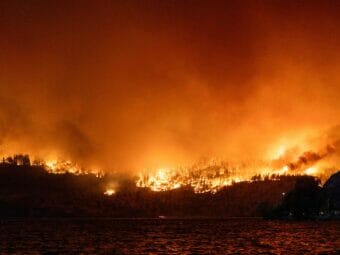
The McDougall Creek wildfire burns in the hills West Kelowna, British Columbia, Canada, on Thursday as seen from Kelowna. (Darren Hull/AFP via Getty Images)

For the past few days, Ollie Williams has been intermittently checking the doorbell camera from his phone to see if his house is still there. Sometimes, he checks the camera that’s normally used to watch the dog when he and his partner aren’t home.

“It’s a rather traumatizing way to check back in,” he admits. “I looked at the camera of our nice living room there — you know, there’s the TV, there’s the sofa, there’s the dog’s bed. And I cried for about five minutes.”

Williams isn’t sure if he’ll ever see it in person again.

He’s currently about 400 miles from his home in Yellowknife, the capital of the Northwest Territories in Canada. He evacuated along with nearly all of the city’s 20,000 residents after a mandatory evacuation order as wildfires rage dangerously nearby.

There are more than 200 fires burning in the Northwest Territories. Nearly 400 are burning in the nearby province of British Columbia. Canada is grappling with its worst wildfire season on record, leaving tens of thousands of people displaced and blanketing parts of that country and the U.S. with thick, choking smoke. All in all, there have been at least 5,790 fires in Canada this year, according to the Canadian Interagency Forest Fire Centre.

In Yellowknife, a mandatory evacuation order went into effect for the entire city Wednesday, creating a chaotic scene as long lines of cars queued for miles to flee along the only road out of town.


View this post on Instagram


A post shared by NPR (@npr)

“It’s one lane in each direction for 600 kilometers. And it’s virtually a dirt road in places,” Williams says.

Williams is the editor of Cabin Radio, an independent internet radio station and online newsroom based in Yellowknife. He and his small team have been tirelessly pushing out text alerts to residents throughout the evacuation — even as they themselves evacuated — trying to get information to people in an area where cell service and resources are spotty. He evacuated with a Starlink satellite dish set up in the back of his truck, propped up between bags of dog food, using the signal to keep updating the community while his partner drove.

“Personally, I’m fully wrecked at this point. I’ve spent most of my week delivering what can only be described as survival updates to 20,000 friends, and I’m mostly doing my job because it spares me from having to think about anything else,” Williams says.

It’s not just people who are being displaced by the flames — wildlife is also being forced to relocate. On Friday, the city of Yellowknife tweeted that a bear was spotted on the streets.

Yellowknife is one of eight communities in the Northwestern Territories evacuated in the past week, mayor Rebecca Alty told NPR’s All Things Considered, calling it “unprecedented.” She said that this was Yellowknife’s first evacuation.

“The last two fires that were kind of big in our region were in ’98 and 2014, but nothing that threatened Yellowknife so much that we even had to consider an evacuation, let alone actually issue an evacuation,” she said. “It’s been a tough, tough couple days and, I’d say, a tough month. That’s when the fire first started.”

South of Yellowknife, closer to the border with the United States, a surreal wall of flames hugs the picturesque Okanagan Lake in West Kelowna, British Columbia. At night, the hillsides are alight with the blaze, a stark backdrop to the city of a more than 30,000, as firefighters from all across the province battle to hold the fire at bay.

“It’s tough to characterize. It sounds like a rushing river. And day turns to night,” West Kelowna Fire Chief Jason Brolund told the CBC, after a particularly long night fighting the flames. “The funny thing was, last night — and I say funny with the utmost respect — but the funny thing was that night turned to day and the orange glow was like nothing that I’ve ever experienced.”

Speaking at a press conference Friday morning, Brolund looked weary, saying that several structures had been lost.

“We knew it was going to be bad. But it was exponentially worse than we had expected,” he said. “Somebody described it to me last night in the heat of the battle as it was like a hundred years of fire fighting all at once in one night. And I really think that it was true. We fought 100 years worth of fires.”

A potential new normal

It’s part of a natural cycle for Canada’s boreal forests to burn, and at a certain level it’s beneficial for the ecosystem.

“Some people are like, ‘Well, this is climate change. This is terrible. We’ve never seen this before.’ That’s wrong. We’ve seen this plenty of times. But it is [also] climate change, and it is much worse than we’ve seen before,” Daniel Perrakis, a fire research scientist with the Canadian Forest Service in British Columbia, told NPR.

Climate change makes large, destructive wildfires more likely because of hotter temperatures and drier vegetation. Higher average temperatures are increasing the length of the fire season, the amount of land burned, and the number of places where fires can occur. In recent years, fires have expanded in the Arctic and even in some rainforests.

For Ollie Williams, waiting to see if his house — and his community in Yellowknife — is OK, he says he’s worried that fire seasons like this might just be the new normal: “I think, the scariest thing is that this year is an outlier, but it might not be an outlier in future. It might just be a regular summer. And then what do we do?”

But he also says it’s hard to think about the future when there is so much to worry about from day to day.

And then he gets a message from someone fighting the fires back in Yellowknife, and he hangs up to update the community, now scattered, waiting to go back home.

Copyright 2023 NPR. To see more, visit https://www.npr.org.

Priceless connections to Hawaii’s ancient past were lost when cultural center burned

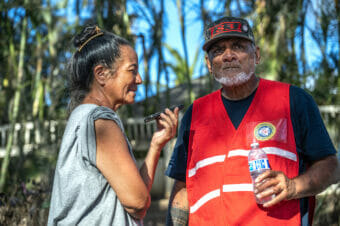
Uilani (left) and Keeamoku Kapu run the Na ‘Aikane o Maui Cultural and Research Center which was burned to the ground in the wildfires so they set up this grassroots community distribution center in Lahaina. They are on the phone here taking a call from Oprah about supplies she will be delivering. (Deanne Fitzmaurice for NPR)

MAUI, Hawaii — It could be a long time before the full extent of human loss is known after the wildfires. The official death is more than 110 and expected to keep growing.

While people are grappling with that news, they’re still trying to understand the loss of priceless artifacts and their connections to the island’s ancient past.

The Na ‘Aikane o Maui Cultural and Research Center was home to vestiges of Ancient Hawaii, before European colonization. “Old documents. Maps. Genealogy. Books that were actually signed by our kings,” said Ke’eamoku Kapu, the center’s steward. “Our cultural center was the hub for a lot of our Native Hawaiian people longing for the past.”

For Kapu, the center meant even more than the rare, tangible treasures of his ancestry. It was where his community gathered. “It was a place of worship. A place of traditional cultural, protocols.”

The center was on the main thoroughfare in Lahaina, which was once the capital of the ancient Hawaiian Kingdom. Kapu returned to the rubble two days after the fire to see what was left of the town. “Oh, man. All my neighbors gone. Our churches are these apartment buildings that flourish with families. With generations of families gone.”

He also went to the site of the cultural center with the hopes of recovering some artifacts. But he found very little. “Carving images made out of stone. That made it, one of them. And a stone that was given to me personally by different chiefs from the South Pacific, New Zealand, Tahiti, Samoa, so a great loss.”

This grassroots community distribution center has been set up by a Hawaiian community in Lahaina. (Deanne Fitzmaurice for NPR)

Some of the rare books and documents preserved at the center weren’t just history — they were instructive materials for Indigenous people fighting for ownership of the land and water that belonged to their ancestors. Kapu himself was involved in litigation that ended up at the state Supreme Court and won him the rights to hold on to the land that his family has owned since the days of the Hawaiian kingdom. He brought that knowledge to other community members at the cultural center.

“That was a great advantage of the center to bring families in and teach them what I’ve done in order to help them get their lands back and has been working all the documents. All those documents are gone.”

As he talked, Kapu points his finger to his right temple.

“All I have is what I have in here. I just cried. Like we got erased.”

Kapu said he still hasn’t had time to process the loss. He’s already been through three other fires on Maui before this one. “I cannot sleep. I wake up with nightmares. Wake up thinking everything is fine, only to wake up and see it’s not. But I guess that’s a reason why I’m doing what I’m doing. Because I got to stay busy.”

What he’s doing is working with Maui’s Emergency Management Agency – helping to run one of the distribution centers in Lahaina with several members of his family. He’s getting food, supplies and water to those affected by the fire. Kapu says Indigenous people bring a unique understanding to this work.

“We know exactly what the general community is feeling now. Because we know about trauma. We know about being displaced.”

Kapu is also serving as a liaison between the local government and Indigenous community. He’s on an advisory council to the mayor as the county navigates the response to this fire. “There’s a lot of distrust right now, and our responsibility as advisors in the community is to alleviate that distrust, because if we don’t, it is going to be chaotic.”

He plans to keep working with the government as the recovery and rebuilding process continues. He’s wary of the potential for payouts for property that was lost and is encouraging community members to try to hold on to their land.

“What is it going to take to rebuild the capital of the kingdom once again? What is it going to take? This is our legacy we’re talking about. What is the payout for losing that?”

Copyright 2023 NPR. To see more, visit https://www.npr.org.

Pioneering Study Links Testicular Cancer Among Military Personnel to ‘Forever Chemicals’

John Sherman, a 60th Engineer Squadron firefighter, is hit by fire-retardant foam after it was “unintentionally released” in an aircraft hangar at Travis Air Force Base in California on Sept. 24, 2013. Firefighters with the 60th Air Mobility Wing helped control the foam’s dispersion using powerful fans and covering drains. (KEN WRIGHT / U.S. AIR FORCE)

Gary Flook served in the Air Force for 37 years, as a firefighter at the now-closed Chanute Air Force Base in Illinois and the former Grissom Air Force Base in Indiana, where he regularly trained with aqueous film forming foam, or AFFF — a frothy white fire retardant that is highly effective but now known to be toxic.

Flook volunteered at his local fire department, where he also used the foam, unaware of the health risks it posed. In 2000, at age 45, he received devastating news: He had testicular cancer, which would require an orchiectomy followed by chemotherapy.

Hundreds of lawsuits, including one by Flook, have been filed against companies that make firefighting products and the chemicals used in them.

And multiple studies show that firefighters, both military and civilian, have been diagnosed with testicular cancer at higher rates than people in most other occupations, often pointing to the presence of perfluoroalkyl and polyfluoroalkyl substances, or PFAS, in the foam.

But the link between PFAS and testicular cancer among service members was never directly proven — until now.

A new federal study for the first time shows a direct association between PFOS, a PFAS chemical, found in the blood of thousands of military personnel and testicular cancer.

Using banked blood drawn from Air Force servicemen, researchers at the National Cancer Institute and Uniformed Services University of the Health Sciences found strong evidence that airmen who were firefighters had elevated levels of PFAS in their bloodstreams and weaker evidence for those who lived on installations with high levels of PFAS in the drinking water. And the airmen with testicular cancer had higher serum levels of PFOS than those who had not been diagnosed with cancer, said study co-author Mark Purdue, a senior investigator at NCI.

“To my knowledge,” Purdue said, “this is the first study to measure PFAS levels in the U.S. military population and to investigate associations with a cancer endpoint in this population, so that brings new evidence to the table.”

In a commentary in the journal Environmental Health Perspectives, Kyle Steenland, a professor at Emory University’s Rollins School of Public Health, said the research “provides a valuable contribution to the literature,” which he described as “rather sparse” in demonstrating a link between PFAS and testicular cancer.

More studies are needed, he said, “as is always the case for environmental chemicals.”

Not ‘Just Soap and Water’

Old stocks of AFFF that contained PFOS were replaced in the past few decades by foam that contains newer-generation PFAS, which now also are known to be toxic. By congressional order, the Department of Defense must stop using all PFAS-containing foams by October 2024, though it can keep buying them until this October. That’s decades after the military first documented the chemicals’ potential health concerns.

A DoD study in 1974 found that PFAS was fatal to fish. By 1983, an Air Force technical report showed its deadly effects on mice.

But given its effectiveness in fighting extremely hot fires, like aircraft crashes and shipboard blazes, the Defense Department still uses it in operations. Rarely, if ever, had the military warned of its dangers, according to Kevin Ferrara, a retired Air Force firefighter, as well as several military firefighters who contacted KFF Health News.

“We were told that it was just soap and water, completely harmless,” Ferrara said. “We were completely slathered in the foam — hands, mouth, eyes. It looked just like if you were going to fill up your sink with dish soap.”

Fire-retardant foam was “unintentionally released” in an aircraft hangar at Travis Air Force Base in California on Sept. 24, 2013. “The non-hazardous foam is similar to dish soap,” says the Defense Visual Information Distribution Service. “No people or aircraft were harmed in the incident.” (KEN WRIGHT / U.S. AIR FORCE)

Photos released by the Defense Visual Information Distribution Service in 2013 show personnel working in the foam without protective gear. The description calls the “small sea of fire retardant foam” at Travis Air Force Base in California “non-hazardous” and “similar to soap.”

“No people or aircraft were harmed in the incident,” it reads.

There are thousands of PFAS chemicals, invented in the 1940s to ward off stains and prevent sticking in industrial and household goods. Along with foam used for decades by firefighters and the military, the chemicals are in makeup, nonstick cookware, water-repellent clothing, rugs, food wrappers, and a myriad of other consumer goods.

Known as “forever chemicals,” they do not break down in the environment and do accumulate in the human body. Researchers estimate that nearly all Americans have PFAS in their blood, exposed primarily by groundwater, drinking water, soil, and foods. A recent U.S. Geological Survey study estimated that at least 45% of U.S. tap water has at least one type of forever chemical from both private wells and public water supplies.

Health and environmental concerns associated with the chemicals have spurred a cascade of lawsuits, plus state and federal legislation that targets the manufacturers and sellers of PFAS-laden products. Gary Flook is suing 3M and associated companies that manufactured PFAS and the firefighting foam, including DuPont and Kidde-Fenwal.

Congress has prodded the Department of Defense to clean up military sites and take related health concerns more seriously, funding site inspections for PFAS and mandating blood testing for military firefighters. Advocates argue those actions are not enough.

“How long has [DoD] spent on this issue without any real results except for putting some filters on drinking water?” said Jared Hayes, a senior policy analyst at the Environmental Working Group. “When it comes to cleaning up the problem, we are in the same place we were years ago.”

On a Mission to Get Screening

The Department of Veterans Affairs does not recommend blood testing for PFAS, stating on its website that “blood tests cannot be linked to current or future health conditions or guide medical treatment decisions.”

But that could change soon. Rep. Dan Kildee (D-Mich.), co-chair of the congressional PFAS Task Force, in June introduced the Veterans Exposed to Toxic PFAS Act, which would require the VA to treat conditions linked to exposure and provide disability benefits for those affected, including for testicular cancer.

“The last thing [veterans] and their families need to go through is to fight with VA to get access to benefits we promised them when they put that uniform on,” Kildee said.

Evidence is strong that exposure to PFAS is associated with health effects such as decreased response to vaccines, kidney cancer, and low birth weight, according to an expansive, federally funded report published last year by the National Academies of Sciences, Engineering, and Medicine. The nonprofit institution recommended blood testing for communities with high exposure to PFAS, followed by health screenings for those above certain levels.

It also said that, based on limited evidence, there is “moderate confidence” of an association between exposure and thyroid dysfunction, preeclampsia in pregnant women, and breast and testicular cancers.

The new study of Air Force servicemen published July 17 goes further, linking PFAS exposure directly to testicular germ cell tumors, which make up roughly 95% of testicular cancer cases.

Testicular cancer is the most commonly diagnosed cancer among young adult men. It is also the type of cancer diagnosed at the highest rate among active military personnel, most of whom are male, ages 18 to 40, and in peak physical condition.

That age distribution and knowing AFFF was a source of PFAS contamination drove Purdue and USUHS researcher Jennifer Rusiecki to investigate a possible connection.

Using samples from the Department of Defense Serum Repository, a biobank of more than 62 million blood serum specimens from service members, the researchers examined samples from 530 troops who later developed testicular cancer and those of 530 members of a control group. The blood had been collected between 1988 and 2017.

A second sampling collected four years after the first samples were taken showed the higher PFOS concentrations positively associated with testicular cancer.

Ferrara does not have testicular cancer, though he does have other health concerns he attributes to PFAS, and he worries for himself and his fellow firefighters. He recalled working at Air Combat Command headquarters at Joint Base Langley-Eustis in Virginia in the early 2010s and seeing emails mentioning two types of PFAS chemicals: PFOS and perfluorooctanoic acid, or PFOA.

But employees on the base remained largely unfamiliar with the jumble of acronyms, Ferrara said.

Even as the evidence grew that the chemicals in AFFF were toxic, “we were still led to believe that it’s perfectly safe,” Ferrara said. “They kept putting out vague and cryptic messages, citing environmental concerns.”

When Ferrara was working a desk job at Air Combat Command and no longer fighting fires, his exposure likely continued: Joint Base Langley-Eustis is among the top five most PFAS-contaminated military sites, according to the EWG, with groundwater at the former Langley Air Force Base registering 2.2 million parts per trillion for PFOS and PFOA.

According to the EPA, just 40 parts per trillion would “warrant further attention,” such as testing and amelioration.

The Defense Department did not provide comment on the new study.

Air Force officials told KFF Health News that the service has swapped products and no longer allows uncontrolled discharges of firefighting foam for maintenance, testing, or training.

“The Department of the Air Force has replaced Aqueous Film Forming Foam, which contained PFAS, with a foam that meets Environmental Protection Agency recommendations at all installations,” the Air Force said in a statement provided to KFF Health News.

Both older-generation forever chemicals are no longer made in the U.S. 3M, the main manufacturer of PFOS, agreed to start phasing it out in 2000. In June, the industrial giant announced it would pay at least $10.3 billion to settle a class-action suit.

Alarmed over what it perceived as the Defense Department’s unwillingness to address PFAS contamination or stop using AFFF, Congress in 2019 ordered DoD to offer annual testing for all active-duty military firefighters and banned the use of PFAS foam by 2024.

According to data provided by DoD, among more than 9,000 firefighters who requested the tests in fiscal year 2021, 96% had at least one of two types of PFAS in their blood serum, with PFOS being the most commonly detected at an average level of 3.1 nanograms per milliliter.

Readings between 2 and 20 ng/mL carry concern for adverse effects, according to the national academies. In that range, it recommends people limit additional exposure and screen for high cholesterol, breast cancer, and, if pregnant, high blood pressure.

According to DoD, 707 active and former defense sites are contaminated with PFAS or have had suspected PFAS discharges. The department is in the early stages of a decades-long testing and cleaning process.

More than 3,300 lawsuits have been filed over AFFF and PFAS contamination; beyond 3M’s massive settlement, DuPont and other manufacturers reached a $1.185 billion agreement with water utility companies in June.

Attorneys general from 22 states have urged the court to reject the 3M settlement, saying in a filing July 26 it would not adequately cover the damage caused.

For now, many firefighters, like Ferrara, live with anxiety that their blood PFAS levels may lead to cancer. Flook declined to speak to KFF Health News because he is part of the 3M class-action lawsuit. The cancer wreaked havoc on his marriage, robbing him and his wife, Linda, of “affection, assistance, and conjugal fellowship,” according to the lawsuit.

Congress is again trying to push the Pentagon. This year, Sen. Jeanne Shaheen (D-N.H.) reintroduced the PFAS Exposure Assessment and Documentation Act, which would require DoD to test all service members — not just firefighters — stationed at installations with known or suspected contamination as part of their annual health checkups as well as family members and veterans.

The tests, which aren’t covered by the military health program or most insurers, typically cost from $400 to $600.

In June, Kildee said veterans have been stymied in getting assistance with exposure-related illnesses that include PFAS.

“For too long, the federal government has been too slow to act to deal with the threat posed by PFAS exposure,” Kildee said. “This situation is completely unacceptable.”

Fire-retardant foam temporarily covered a small portion of the flight line at Travis Air Force Base in California after it was released inside a hangar on Sept. 24, 2013.(KEN WRIGHT / U.S. AIR FORCE)

KFF Health News is a national newsroom that produces in-depth journalism about health issues and is one of the core operating programs at KFF—an independent source of health policy research, polling, and journalism. Learn more about KFF.

Subscribe to KFF Health News' free Morning Briefing.

Just how hot was July? Hotter than anything on record

It was scorching hot across much of the planet this summer. Asia, Africa, and South America had their hottest July’s ever. Temperatures in Beijing and other parts of northern China hovered around 100 degrees Fahrenheit for weeks, with some cities topping 120 F on the worst days. (Kevin Frayer/Getty Images)

Human-driven climate change pushed global temperatures to never-before-seen heights in July, according to new data from the National Oceanic and Atmospheric Administration and NASA. The month is now officially the hottest July on record since record-taking began in the 1800s.

And it wasn’t even close: the month was a whopping 0.4 °F warmer than the previous record set in 2019, and well over 2.1 °F hotter than the 20th century average.

“Most records are set in terms of global temperature by a few hundredths of a degree,” says Russell Vose, a climate expert at NOAA’s National Centers for Environmental Information. But this one, nearly half a degree Fahrenheit, was “bigger than any other jump we’ve seen.”

That was not what Vose expected to see. “I am rarely surprised, that’s what my friends tell me. And I was surprised by this number.”

The intensity of July’s heat is certainly exceptional, says Sarah Kapnick, chief scientist and climate expert at NOAA who worked on the report. It’s also part of a long, clear pattern of planetary warming going back decades, driven primarily by humans burning fossil fuels. It’s only likely to get hotter. “The next few years will be the coolest of my life if the world continues to emit greenhouse gasses,” Kapnick says.

July’s record-breaking temperatures were not subtle. Intense heat waves gripped many regions of the world. In the U.S, Arizona, New Mexico, and Florida posted their hottest months ever since NOAA started taking records in 1880. Northwestern China experienced some of the hottest temperatures ever, topping 122°F. Unseasonably hot weather also settled in across the Southern Hemisphere; even in the depths of winter, temperatures exceeded 100°F in some parts of Chile and Argentina.

The oceans ran an equally high fever. Off the coast of Florida, temperatures at the sea surface topped 100°F. Alarmed scientists rushed to protect or move coral nurseries to deeper, cooler water. Some parts of the North Atlantic Ocean hovered 7 to 10°F above the long-term average. The central Atlantic, the birthing ground for hurricanes, also experienced off-the-charts heat, raising the risk of more intense storms this season.

“Oceans also are key factors for regulation of climate by soaking up heat,” says Rajiv Chowdhury, a global health and climate expert at Florida International University, but “these useful impacts on land temperature become far less impactful when the oceans heat.”

Many scientists were alarmed not only by the intensity of the heat but also how long it lasted. “That’s what kills, the duration of heat,” not just the heat itself, says Pope Moseley, an intensive care physician and heat expert at Arizona State University. When heat persists—especially if nights stay exceptionally warm as they did in many heat-stricken zones last month—people’s bodies don’t get a chance to cool down.

That unrelenting heat stress exacerbates health problems like heart disease and stroke risk. One study from Sweden found that heat deaths increase by two to four percent a day s hot weather extends.

Phoenix strung together 31 days of daytime temperatures that exceeded 110° F. The heat index, which takes both air temperature and the dangerous effects of humidity into account, topped 100° F for 46 days in Miami.

This year is shaping up to be one of the hottest years—and possibly the hottest ever—in recorded history. Next year could be even worse, says Gavin Schmidt, a climate scientist at NASA. An El Nino event, which raises planetary temperatures, is intensifying right now. “Not only is 2023 going to be an exceptionally warm and possibly a record year, but we anticipate that 2024 will be warmer still,” he says.

Any one super-hot month, or even year, solidifies a clear pattern: a steady upward march of global temperatures over decades. The last nine years have been the hottest ever seen. Each of the last five decades has been hotter than the one before.

“A year like this gives us a glimpse at how rising temperatures and heavier rains can impact society and stress critical resources,” says Kapnick. “These years will be cool by comparison by the middle of the century if we continue to warm our planet as greenhouse emissions continue.”

There are glimmers of progress. Global demand for fossil fuels could be nearing its peak, according to a 2022 analysis from the International Energy Agency, while countries from the U.S. to China are adding renewable energy sources, like solar and wind, at an unprecedented clip.

Copyright 2023 NPR. To see more, visit https://www.npr.org.

The plot thickens: The battle over books comes at a cost

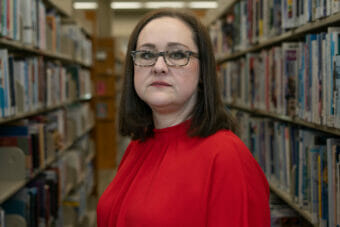
School librarian Amanda Jones endured harassment and threats after speaking out in defense of a diverse selection of books in the public libraries of Livingston Parish, La. (Abdul Aziz for NPR)

Be advised that this story contains references to sex acts involving children, and suicide.

LIVINGSTON PARISH, La. — It’s been a year since the start of what one librarian here calls “The Troubles.” That’s when once-boring meetings of the Livingston Parish Library Board of Control started devolving into bitter brawls over books that some consider to be too sexual and harmful to kids. Meetings have been laced with insults, interruptions and the kind of profanity that would probably get you kicked out of the library.

At the most recent meeting in July, it wasn’t quite as heated as the 100° temperatures outside, but tempers flared over plans to immediately remove challenged books under review from library shelves — even if that takes months, or more.

Board member Larry Davis likened it to removing a teacher accused of sexual harassment until an investigation is complete. Others shot back that it was hardly the same thing, and vehemently objected to a policy they say would effectively empower one person to ban a book from the entire community. “Just leave it on the shelf,” shouted one.

Tensions spilled over after the meeting when one board member confronted a conservative activist and implored him to stop insinuating online that she was a groomer.

A sign on a door at the Denham Springs-Walker Branch library in Livingston Parish announces the elimination of Sunday hours due to staff shortages. (Abdul Aziz for NPR)

“Look, just stop posting about me on Facebook,” she demanded.

The activist snapped back that he never actually used the word “groomer,” but made clear that he sees her as fair game.

“You’re now a public person,” he said. “So I’m going to talk about what I’m going to talk about.”

Once-beloved librarians now vilified

It’s something of a “new normal” here — as it is around the nation. No longer are just books under fire, but also the library administrators, teachers and long-beloved librarians who are defending them. They’re being shouted down by parents, vilified on billboards, reported to the police, and trolled online, leaving many fearing for their safety.

“I had an actual death threat,” says Livingston Parish school librarian Amanda Jones, her voice breaking as she recalls one particular post: “We know where you work + live….u have a LARGE target on ur back. Click… Click… See you soon.”

Jones says it started after she spoke out at a library board meeting against censorship and “book policing.” Without mentioning any specific book, Jones said that challenges “often done with the best intentions,” tend to target the Black and LGBTQ communities. Removing or relocating those books, she said, would be “extremely harmful to our most vulnerable — our children.”

“Just because you don’t want to read it or see it and does not give you the right to deny [it to] others,” she said that night.

Librarian Amanda Jones speaks out at a Livingston Parish Library Board of Control meeting on July 18, 2023, against a policy that would automatically remove challenged books from library shelves until a review is completed, even if that takes months or more. Jones said that would effectively be a book ban. (Abdul Aziz for NPR)

Then, she says, her comments were twisted online. She was accused of “advocating teaching anal sex to 11-year-olds,” and pushing “sexually erotic and pornographic materials,” to children “as young as six.” That prompted a barrage of insults and threats as relentless as they were vicious.

“We’re going to put ur fat evil commie PEDO azz in the dirt very soon b****” read one. Another pictured Jones with a red and while circle around her face.

She was terrified.

“I was hyperventilating,” Jones says through tears. I didn’t leave my room for days, and I cried so much that my eyes swelled shut. It was a mess, a real mess.”

Jones started having panic attacks, she lost 50 pounds and chunks of hair, and ended up on a medical leave for six months. She was so scared, she started carrying a gun.

Amid all the skirmishes over individual book titles and challenge policies, it’s easy to miss the toll it’s taking on librarians, kids, and the country. Jones’s case may be more extreme than most, but countless other librarians around the nation who are also feeling the heat are also quitting in droves, leaving libraries short-staffed. It’s all driving up the human, civic, and financial costs embroiled in the battle over books.

“It’s scary,” sighs one librarian in Livingston Parish. “This is the first time I have not felt entirely safe in my job.” She asked that her name not be used because, she says, she’d be fired “in a heartbeat.”

Librarians are making the hard choice to quit

In her decades of library work, she says, she’s never seen this kind of exodus, from low level workers all the way up to the library system’s director and assistant director, who both abruptly resigned within weeks of each other this spring.

“It was like rats escaping from a sinking ship,” says the librarian. “We have lost some excellent people.”

Livingston Parish library director Michelle Parrish says library staffing is currently down nearly 30 percent, and it’s been as challenging to attract candidates as it is to retain staff. Adding to the pressure, Louisiana’s attorney general has set up a tip-line for complaints about librarians or staff, and libraries are dealing with a strict new state law that restricts all minors’ access to library material that depicts or describes sexual conduct.

“When you’re in this environment, and you have a choice to go a place where [this level of rancor] hasn’t reached there, then why wouldn’t you do that? I would, if it were me,” she says.

To get out of the heat, Milissia Cole, treated her two sons to an hour of video games at the Denham Springs-Walker Branch Library in Denham Springs, La. “The park was not an option,” she says. (Abdul Aziz for NPR)

Many who have fled for friendlier turf — or quit the field altogether — have done so at great personal cost, uprooting their families, for example, or forgoing benefits.

That was the case for one librarian in Texas who asked not to be identified, for fear of provoking exactly the kind of backlash she was trying to escape. She had always hoped to work until she was eligible for her maximum retirement package, but opted instead to leave significant money on the table, because, she says, she just couldn’t take it anymore.

“It was a dark cloud over me all the time,” she sighs. “To feel like an enemy, a groomer, and all these things, it just made me feel sick all the time.”

Giving up her job, and letting go of what she considered her calling, however, caused her a whole other level of pain.

“It’s making me tear up,” she says wiping her eyes, “because I just felt terrible grief. Tremendous grief. I did feel like that was my purpose as in my whole life and I didn’t want to stop.”

Another librarian, Latasha McKinney, also had a hard time leaving her school in Oklahoma that she found hostile to LGBTQ-themed and race-related books.

“I always thought that I would be the type of person who would stay and fight,” she says. “I wouldn’t be the type to run.”

But McKinney says staying just felt like too big of a compromise. She says her grandfather was kicked out of a public library in the fifties because he was Black. That was a big reason why she wanted to become a librarian in the first place. She says she wanted to help bolster “representation, and access. And now we’re going to remove some of that access to books and they’re saying they want [me] to be part of that. So I was like ‘no, I’m definitely not going to be the one to participate in this.'”

“Something has shifted, where you have a lot of people who are [saying] ‘OK, this is it. This is where I get off,'” says Sonia Alcántara-Antoine, President of the Public Library Association, (a division of the American Library Association.) “It’s extremely concerning. It has a ripple effect on communities.”

Library staffing has long been on a decline, and while the pandemic exacerbated the problem, the harsh climate librarians are now facing is another big blow. Hard data is hard to come by, but a 2022 national survey by the Public Library Association shows 73% of public libraries now cite staffing as the top reason for limiting services. That’s nearly double the second most common reason, which is funding.

“Libraries offer much more than books on the shelf,” says Alcántara-Antoine, “and when you attack libraries, you’re ultimately jeopardizing everything libraries do in service to and in support of their communities.”

This spring, Livingston Parish announced the closure of the last branch in the library system that was open Sundays. “We are down quite a few man hours,” Parrish explained at the time, “and we are also down man hours in all of our other branches also, so moving people from branch to branch is not an option.”

Short-staffing means cuts in library hours and services

Meagan Simmons and her family were among those surprised and disappointed this summer. The library is important to them, as one of the few places to take kids that are both free and air-conditioned, she says. Simmons and her 3-and-a-half-year-old daughter set out for a much-hyped trip to the library on a Sunday, so Dad could join too.

They all piled in the car, excited to get a book they’d been waiting for, Simmons recalls. “We made it all the way here, and I was like ‘Oh my gosh, the library is not even open on a Sunday anymore!’ So we had to turn around. I had a very upset child.”

A young girl checks out her selection of books at the Livingston Parish Library Main Branch in Livingston, La. She’s among those disappointed that all libraries in the parish are now closed on Sundays. (Abdul Aziz for NPR)

On one recent weekday, Simmons’s daughter spins around the children’s section, filling a cart with books. As usual, the Dedham-Walker Springs branch is bustling. In the back corner, a social worker is filing reports from home visits he’s just completed. Nearby, a young man who works the night shift at a fast food place is here for the Wi-Fi, he says, since he won’t have his back until his next paycheck.

In the children’s section, a homeschooling mom goes over the ABCs with her younger kids as her teenager takes a course down the hall on Microsoft Word. Another mom seeking an escape from the blistering heat, is treating her two boys to an hour of video games on library computers. At a help desk, a guy is asking a librarian for a book on Sacajawea for his wife. Another — who’s on first-name basis with most the librarians — is here to do genealogical research, and another man who was just laid off is filing for unemployment and looking for a new job at one of dozens of stations in the computer center.

Trying to keep up, the staff work extra hours and in a number of cases do multiple jobs. But patrons looking for help these days in any of the branches are likely to wait longer for it, says the librarian who asked not to be named. “One person cannot help ten people at one time,” she says. “You can’t make copies for this one, you can’t help this one format their Word document, you can’t get this one on Google all at the same time! It just doesn’t happen that way.”

She puts on her hushed librarian voice to reenact what she says has become her constant refrain. “I’ll be with you in a minute. I’ll be with you in a minute. I’ll be with you in a minute.”

The “Kids World” section of the Livingston Parish Library Main Branch, is dedicated to children’s literature and learning. (Abdul Aziz for NPR)

It’s a similar story in Broward County, Florida. It’s a liberal-leaning community that supports a diverse collection of books, but Library director Allison Grubbs says because it’s in Florida — a hot spot for book restrictions — few will even apply. That became abundantly clear at a recruiting table the library set up at a library convention this summer.

“Every single conversation, to a T, was tied around politics, the attacks on us and fear,” says Grubbs. “People are just staying away.”

As a result, Grubbs says she, too, is making cuts.

“We had to close an entire computer center because we just don’t have the staff,” she says. “And in terms of events and programming, computer classes, finance, literacy, health education — there’s so many we’re just not able to produce, and that is a tragic disservice to our communities.”

The financial and emotional toll

The ongoing brawl over books is also costing many libraries in real dollars, as they spend countless staff hours responding to book challenges that often come by the dozens — or hundreds — at a time. Lisa Varga, Executive Director of the Virginia Library Association, puts the price at millions of dollars.

“You’re talking about the admin who receives the request, you’re talking about the FOIA officer who has to answer anything, the school board attorney, the superintendent, the principals, and all the library media specialists who then have to be flagged,” Varga says. “This has a real cost. This is an abuse of the system and a waste of our time and money.”

Those challenging the books see that as the price of protecting children from harmful material.

But to others, the greater harm comes from removing books, which risks making marginalized kids feel more isolated or depressed.

A collection of books, addressing sex and sexuality, sit in the young adult section of the Denham Springs-Walker Branch in Livingston Parish. (Abdul Aziz for NPR)

“It really felt kind of personal, and it really saddens me,” says Thomasina Brown, a high school senior in Nixa, Missouri, where an outspoken librarian who had pushed back against book challenges was abruptly transferred to a different job this spring.

Brown, who identifies as queer, says it was crushing to lose such a staunch advocate for LGBTQ-themed books, including one her favorites about a girl discovering her sexual identity.

“She very well could have been me,” says Brown. “And so when they called it inappropriate for children, it kind of felt like I was inappropriate as well.”

It’s one of the reasons Amanda Jones says she decided to return to her librarian job in Livingston Parish this school year. In the twenty-plus years she’s worked in the school, she says about a dozen former students of hers who identified as LGBTQ have died by suicide.

“I just think I have a responsibility to speak out,” she says, amid tears. “Your silence is compliance. So when they want me to be quiet, I always say ‘I’m going to roar. I’m not going to stop.'”

At the same time, Jones worries the ever-escalating vitriol swirling around books could lead to violence. Especially when she was caught up in the maelstrom, Jones says she was horrified to think what all the hate rhetoric might incite. “I was scared that someone mentally unstable was going to come up to the school to get me, and in the process, harm a child,” she says.

On yet another level, some say what’s ultimately at stake in the battle over books is nothing less than democracy itself.

Despite being harassed and threatened, librarian Amanda Jones — seen here attending a Livingston Parish Council meeting on July 17, 2023 — says she will not cave to the pressure. After a long medical leave, she returns to her school librarian job this month. (Abdul Aziz for NPR)

“You know, Russia bans books. That’s not what America stands for,” says Carolyn Foote, a retired-librarian-turned-activist, who founded the Texas based FReadom Fighters in 2021. Foote says she worries about the slippery slope.

“When we start tinkering around the edges of the First Amendment, first maybe it’s books that have mature content, and then it’s a book about race, and then it’s a book about Billie Jean King because a parent didn’t like that she was gay, and then, it’s ‘Well I don’t like the way that book talks about the police.’ You know, it just completely ignores the fact that we’re a democracy with a first amendment.”

“We can’t have civil debates”

Polls suggest a majority of Americans oppose book restrictions, and want to protect intellectual freedom, as opposed to the smaller, but strident faction of conservatives who say they want protect kids from inappropriate content. They maintain they’re not trying to ban books, they just want to move certain ones out of the children’s and teen’s sections, to ensure parental control over what kids are reading , and to make sure libraries are not “promoting explicit content” to minors.

“That’s what’s wrong with the world right now; it’s indoctrination,” says Livingston Parish resident Benny Reinninger. “Somebody’s trying to push an agenda, and [kids] don’t need things causing confusion in [their] confused little minds.”

Still, Reinninger says he also believes that all the furor over cultural issues like book bans, is starting to pose an existential threat to the country.

“We are a nation divided, so [we] can’t have civil debates,” he says. “And we’re going to destroy ourselves.”

Civil discourse has certainly taken a hit in Livingston Parish, not only on the library board but also on the Parish council, where debate over library books has sunk into the morass of political stunts, personal attacks and even a physical run-in.

Livingston Parish Council member Garry Talbert says library books need to be age appropriate, and aligned with community standards. (Abdul Aziz for NPR)

Council member Garry Talbert has been at the center of some of the antics. In retrospect, he tells NPR, there are some instances he may not have “handled the best way.” He acknowledges all the rancor and demonization of the other side is taking a toll.

“We politicize crap that doesn’t need to be politicized. It’s like all one way or all another and there is no happy medium,” he says. “And so if we all listened, then I think we would realize people don’t eat their kids for supper.”

But in the next breath, Talbert steps right back in it.

“I’m digging myself a hole, but I can’t shut up either,” he says as he explains how he believes certain LGBTQ people are trying to “shock” the community, and are the ones instigating the divisions themselves.

“I really don’t think I’m that judgmental,” he says. “But there are times that I’ve been in New Orleans and the Decadence Parade was coming down the street, and I thought that s**t is just ridiculous. Some of the s**t they were wearing is not acceptable to be outside in any way. Community standards need to rule.”

Livingston Parish residents will have their say on whether they think library books are violating community standards, when library funding comes up for a vote this fall.

“Let’s see what the community really thinks about this,” says conservative activist Michael Lunsford who founded the group, Citizens For A New Louisiana.

“The most effective way to take care of issues is with purse strings,” Lunsford says. “You know, if you’re not seeing the light, it’s time to feel the heat.”

A meeting of the Livingston Parish Library Board of Control opens with the Pledge of Allegiance on July 18, 2023, at the Denham Springs-Walker Branch in Denham Springs, La. (Abdul Aziz for NPR)

Lunsford spent years raising the heat in nearby Lafayette Parish, leading a stealthy but steady campaign that replaced members of the library board who, from his perspective, were not quite on board. He’s now using the same playbook in Livingston Parish — and he’s vowing to expand his campaign to the entire state.

State approval was recently granted to expand the library board from seven to nine members, prompting fears that the Parish Council will pack the board with those who support stricter restrictions. Lunsford says he’s already identifying candidates who are “good conservatives who think the library’s moving in the wrong direction,” and he’s also keeping a close eye on how current library board members are voting. If that makes current members fearful, Lunsford says, that’s the point.

“Livingston Parish needs a reset,” he says.

As for librarians feeling the heat, Lunsford shrugs.

“I’ve gotten my fair share of death threats,” he says “That’s just kind of how it goes.”

Besides, Lunsford says, librarians really shouldn’t complain, because they started it.

“I just would like to remind you, shots were fired by the other side,” he says. “These books are new. They haven’t been there for 30 years. We haven’t had this book on how to perform sex acts on someone else. That’s just nasty stuff. And all of a sudden it’s become a problem, and you know, we say ‘This far, no further!'”

It may be the quintessential cost of polarization, that it begets even more polarization. The point is not lost on librarians who are quitting or relocating because of the current discord: all the self-sorting may leave the nation even more deeply divided into separate camps. And as one librarian put it, “it also leaves the fox guarding the henhouse.”

Copyright 2023 NPR. To see more, visit https://www.npr.org.

A new clue to the reason some people come down with long COVID

Protesters march outside the White House to call attention to those who have long COVID. (Nathan Posner/Anadolu Agency via Getty Images)

Stéphanie Longet is an immunologist and a COVID researcher at the University of Saint-Etienne in France, and just like 10-20% of adults who were infected with the virus, she continues to have symptoms well after her infection has resolved – a condition known colloquially as long COVID.

“I got COVID one year ago and I developed some persistent symptoms,” she says. “I cannot work too long. My legs are quickly exhausted. In the morning it feels like I had run a marathon during the night, and I didn’t do anything, I just slept.”

Longet and other scientists don’t exactly know why some people develop long COVID while others don’t, but preliminary research released in medRxiv in July suggests that genetics plays a role.

The new research, which was an international collaboration between dozens of scientists, describes how some people carry a version of a single gene, FOXP4, that is associated with developing long COVID. Longet calls the new research an “important element” in understanding why some people’s COVID symptoms seemingly never resolve.

A surprising finding about long COVID

Long COVID only affects a small percentage of people who are infected with SARS-CoV-2, but the scope of the pandemic means that many millions of people are suffering. Roughly 25 million people in the U.S. and over 17 million people in Europe have long COVID symptoms, with many more in other parts of the world.

There isn’t a universally agreed upon definition for what is considered long COVID – people experience a range of different symptoms including “fatigue, muscle pain, intestinal disorders and brain fog” and for different periods of time according to Longet, who was not involved in the new research. That’s made the disease difficult for scientists to fully understand.

But the new research adds to the growing body of work showing that genetics can influence COVID outcomes. It was only a few weeks ago when NPR reported that genetics might make some people resistant to developing any COVID symptoms at all.

Jill Hollenbach, an immunologist at the University of California, San Francisco, was one of the scientists who led the research on asymptomatic COVID. She says she was “surprised and excited” about the new long COVID findings.

“The fact that the authors were able to detect this association [between the FOXP4 gene and long COVID], I think, is spectacular,” Hollenbach says.

Hollenbach also thinks that the new research on long COVID is refreshing because “there’s a lot of frustration on the public’s part around progress” of understanding the disease and how to treat it. “There can be a perception out there amongst some people who are involved in advocacy for long COVID that it’s being dismissed [by the scientific community] and I don’t think that’s true.”

The gene that may be connected

The new study looked at DNA from 6,450 people who developed long COVID and compared it to the DNA of those who did not. Not everyone who reported long COVID symptoms in the study had a clinical diagnosis so the research team used a broad definition of long COVID as self-reported symptoms of COVID that affect day-to-day life three months after the initial infection.

When that data was analyzed, only one connection between a person’s genes and whether they developed long COVID stood out – the FOXP4 gene.

The FOXP4 gene is what biologists call a “transcription factor,” meaning that it helps regulate processes throughout the body but isn’t responsible for any one thing in particular. The new research shows that the gene is active in the lungs and mentions that other studies have found an association between FOXP4 and lung cancer.

However, the research does not point to FOXP4 as a smoking gun. “If you have the variant of FOXP4, in theory, you could have a higher probability to develop long COVID,” Longet says. “But it doesn’t mean if you have the variant that you will have long COVID.”

Hollenbach, who published similar work on asymptomatic COVID in the journal Nature, says the new work is “methodologically extremely sound” and that “the result appears to be really clear.”

But Hollenbach is also quick to point out that the genetic effect of the FOXP4 gene is relatively small – though that’s not entirely surprising. “It’s uncommon to see extremely strong genetic effects,” she says. “What we find in studies like this gives us insights into what the underlying pathophysiology is.”

The new research hints at “some underlying immune dysregulation in the lung itself,” Hollenbach says, suggesting an abnormal immune response to COVID might be causing the long-term harm. “We need to just continue to follow these breadcrumbs and see where they lead us.”

That might partially explain why so many people with long COVID are having lung problems, but for other common long COVID symptoms, like brain fog and fatigue, the activity of FOXP4 doesn’t provide much of a clue, meaning there’s more work to be done in order to understand all facets of the disease.

Why your genes may not fully dictate your COVID destiny

The latest research shows that there are clear connections between a person’s genetics and how they respond to COVID. So does this mean that every individual’s COVID fate was set in stone from the day they were born?

Hollenbach doesn’t think so. “I don’t believe that we are unnecessarily subjected to some kind of pre-destiny according to our genes,” she says. “There’s going to be many genetic and non-genetic factors that are going to be in play here.”

One thing that Hollenbach says the scientific community agrees upon, and that this new research reinforces, is that, “you’re more likely to have long COVID If you’ve had a very severe bout of COVID.”

Which is why, according to Hollenbach, “vaccination is still our greatest tool” in the fight against COVID because it can prevent or reduce the severity of a COVID infection, reducing the chance someone develops long COVID.

In the meantime, however, there doesn’t seem to be any imminent relief for those who are already dealing with the effects of long COVID. Longet suggests that people, “find different ways to organize your life. It’s what I’ve done a little bit.”

Working different hours, making diet modifications and trying light breathing exercises are all little things researchers have found to help manage symptoms.

Despite the lack of immediate help, Longet still believes that scientists will soon figure out a way to help resolve her symptoms and the symptoms of others with long COVID. “I’m hopeful because now there are quite a lot of studies and a lot of researchers who are working on this,” she says. “I believe in science, so I’m quite hopeful.”

Copyright 2023 NPR. To see more, visit https://www.npr.org.

Site notifications
Update notification options
Subscribe to notifications