National News

Why can’t we stop homelessness? 4 reasons why there’s no end in sight

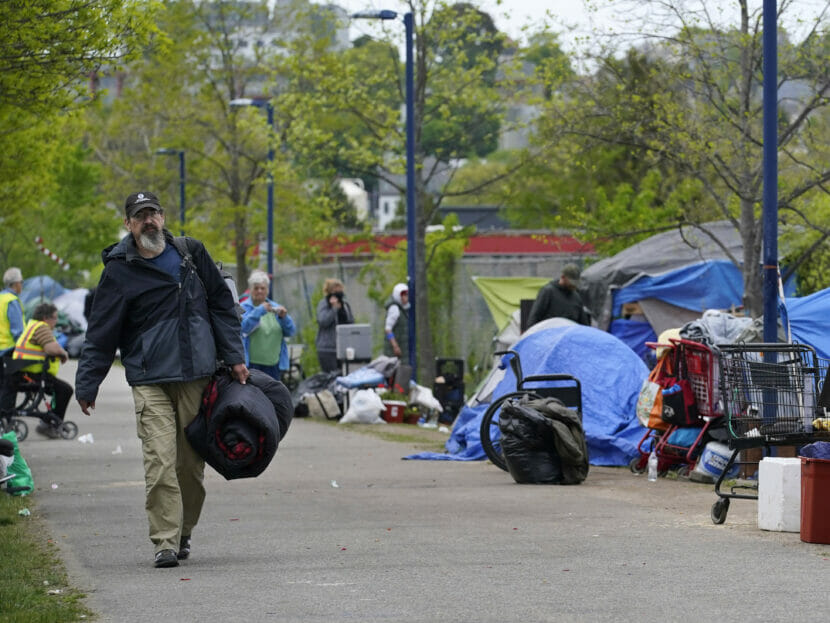
A man carries a sleeping bag at a homeless encampment in Portland, Maine, in May, before city workers arrived to clean the area. State officials say a lack of affordable housing is behind a sharp rise in chronic homelessness. (Robert F. Bukaty/AP)

When Los Angeles Mayor Karen Bass campaigned last year on reining in homelessness, she laid out bold proposals with a budget of hundreds of millions of dollars. In April, she told NPR she hoped for a “very significant reduction” this year, especially of people living on the street. But on Monday, Bass said it’s become clear that there’s simply no end in sight.

“We really need to normalize the fact, unfortunately, that we’re living in a crisis,” she said at a press conference announcing a renewal of her emergency declaration on homelessness.

The shift in tone comes after both LA and New York City recently declared a record level of homelessness, and other cities have also seen their numbers continue to climb despite considerable attention and spending to give people shelter. It’s part of a steady rise around the country since 2016, after years of successfully driving down the number of people without housing.

So what’s going on? Advocacy groups and researchers say a big driving force is the decline of affordable housing, a problem decades in the making but one that has grown significantly worse in the past few years. Here are a few ways it’s playing out.

1. More people than ever are being housed — but an even higher number are falling into homelessness

About a third of the U.S. homeless population is in California, and the state faces mounting questions about why billions of dollars spent in recent years hasn’t reduced the number of people living in cars and encampments. A bipartisan group of lawmakers has asked the state auditor to investigate. A key program in Los Angeles to move people from hotels into permanent housing appears to be struggling.

CalMatters reports that officials across the state are asking how they can do better, even traveling to Texas for guidance.

And yet, those in California and other places around the country can also argue they are helping more people than ever. The Los Angeles Homeless Services Authority says it has placed more than 20,000 into permanent housing for five years in a row — a significant boost from a decade ago — and that it’s doing this faster than it has in the past. Nationally over that time, the inventory of permanent housing available has increased 26% — and it’s more than doubled since 2007.

“We’ve done a lot” to improve how people are placed into housing, says Steve Berg, chief policy officer at the National Alliance to End Homelessness. But he says that’s only half the equation. “The other half is people losing their housing … and we have not had any kind of extensive or organized effort on that,” he says.

The upshot is that, in Los Angeles and elsewhere, even as record numbers of people are being housed, a greater number of them are falling into homelessness.

Berg says one key reason is that only 1 in 4 Americans who qualify for a federal housing subsidy actually get it, and that’s been the case since he was in law school decades ago. The vast majority of low-income renters must rely on market-rate housing, but the U.S. hasn’t built enough housing for more than a decade, since the market crash of 2008. And the shortage is most acute for the lowest income renters — by more than 7 million units, according to the National Low Income Housing Coalition.

That tight market, combined with the worst inflation in a generation last year, has led to double-digit rent spikes in many places around the U.S.

2. Rents are out of reach for many, and millions of affordable places have disappeared

A landmark new report surveyed thousands of people in California about how they came to be without housing, and researchers conducted in-depth interviews with hundreds of them. For most, high rental costs were crucial.

“People just ran out of the ability to pay, whether it happened quickly or slowly,” says lead investigator Margot Kushel of the University of California, San Francisco.

Some said they’d had their work hours cut. Others lost a job because of a health crisis. Many crowded in with relatives or friends, who were also likely to be poor and struggling. “And we found that those relationships, when they fell apart, fell apart quickly,” Kushel says. “People only had one day’s warning” to leave. Even those with their own lease had on average just 10 days to move out.

Their median monthly household income in the six months before they became homeless was $960, she says. The median rent for a one-bedroom apartment in California is $1,700. Around the country, Kushel says, homelessness rates are highest in places where there is both poverty and high housing costs.

That gap has been growing for decades, as rents have risen faster than wages. Nationally last year, the share of renters spending at least 30% or 50% of their income on housing reached a record high. And some markets have seen a major share of their low-cost rentals disappear.

Over the past decade, the number of rentals under $600 fell by nearly 4 million, according to an analysis by Harvard’s Joint Center for Housing Studies. The losses happened in every state, because either rents increased, the units were taken off the rental market or buildings were condemned and demolished. Among slightly higher priced rentals, up to $1,000 a month, some 2.5 million more units were lost.

Even with inflation cooling, rents remain too high for many — and are continuing to increase in some places.

3. Zoning laws and local opposition make it hard to build housing for low-income renters

Voters around the country approved spending for more affordable housing last year, and a record number of apartments are under construction. More places are also loosening zoning laws — some of which date back to segregation — to allow more multifamily buildings in residential neighborhoods. Housing experts say all this is needed to help ease the tight market and bring down prices over time.

With a shortage in the millions of units, though, that could take a very long time. And in most places it’s still a major challenge to build affordable housing. “Neighbors will say, ‘We don’t want low-income people living here,’ and they’ll stop the housing from being built,” says Berg, with the National Alliance to End Homelessness.

Even housing that does get built and is billed as affordable, he says, isn’t always cheap enough for those who need it most. “It’s really about having enough deeply affordable housing so that people with the lowest incomes can move into the housing,” Berg says. “And if they lose that housing, they can find another place to live.”

4. Pandemic aid programs that helped keep many people housed are winding down

An annual count last year did find a pause in the relentless rise of homelessness. Biden administration officials, among others, credit the sweeping array of pandemic aid programs that limited evictions, helped people pay rent and boosted other financial supports. Princeton’s Eviction Lab calculates such policies cut eviction filings in half.

Those programs have largely ended in many places and are winding down in others. Beyond having to pay current rent, it means some people also may be expected to pay down rental debt that accumulated during the COVID-19 emergency. Many link the end of such protections to a recent rise in evictions, well above pre-pandemic levels in some places.

Of course, there are other reasons. Some 19% of those surveyed in the UCSF study became homeless after leaving institutions such as prison, and finding employment and housing with a criminal record is difficult. Advocates say there’s also need for more addiction and mental health treatment, though it’s most effective once someone is safely housed.

But again, the overriding problem, they say, is the dire lack of places low-income people can afford to live.

“There’s really no way to solve homelessness without seriously addressing this,” says Kushel, the UCSF researcher. “Otherwise, we’re going to be compelled to continue to spend huge amounts of money managing an increasingly out of control crisis.”

Copyright 2023 NPR. To see more, visit https://www.npr.org.

Should we invest more in weather forecasting? It may save your life

Richard Bouhet/AFP via Getty Images

On the morning of September 21, 1938, The New York Times published a run-of-the-mill weather forecast that rang no alarm bells for its readers.

“The indications are for rain and cool weather today and for cloudy and continued cool weather, probably with rain, tomorrow, according to the map charted at the United States Weather Bureau at 7:30 o’clock (EST) last night,” the paper wrote.

In the days before, the U.S. Weather Bureau — the predecessor to the National Weather Service — had been tracking a hurricane that was threatening the coast of Florida. The storm ended up changing course and veering away from the Florida coast. And, despite the warnings of one junior forecaster, the agency decided the system would continue spinning away and die in the middle of the Atlantic Ocean. It deemed the cyclone as posing no threat.

The New York Times, in its same edition on September 21, even praised the weather agency for its work in tracking the storm. “If New York and the rest of the world have been so well informed about the cyclone it is because of an admirably organized meteorological service,” the paper wrote.

But that very same morning, off the coast of Long Island, the angry vortex of water and 120-mph winds was already barreling back towards land. At around 2:30 pm, it made landfall. The impact of the tidal surge was so strong that it registered on seismographs as far away as Alaska.

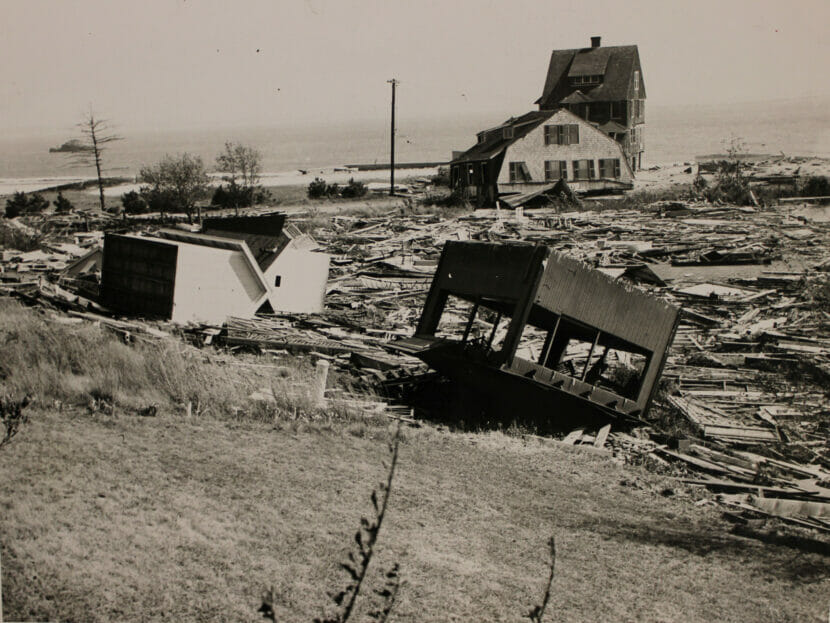
The Great Hurricane of 1938, or “The Long Island Express” as it was also called, would become one of the most destructive hurricanes in American history. It destroyed more than 63,000 homes. It injured thousands. It killed more than 600 people. And — because of bad forecasting — many of these victims were taken completely by surprise.

1938 Hurricane Damage at Crescent Beach in Connecticut. (National Archives)

Weather forecasts have come a long way since the 1930s. Back then, to make forecasts, meteorologists “relied on the 16th-century thermometer, the 17th-century mercurial barometer, and the medieval weather vane,” writes the historian William Manchester. Newfangled airplanes were becoming more important in helping to make forecasts, but forecasters were still heavily reliant on random ships in the sea to inform them about weather patterns, like the track of hurricanes.

Today, forecasters are equipped with a stunning array of technology to make weather predictions. Doppler radar towers detect precipitation and wind patterns. Radiosondes, attached to weather balloons, float through the upper stratosphere, gathering data on temperature, humidity, air pressure, wind speed and direction. Automated surface-observing systems provide real-time data about conditions on land. Satellites circle the earth, beaming in valuable imagery and data. And supercomputers and advanced statistical models aggregate all this data and help forecasters put together a vivid picture of what’s going to happen to our weather in the future.

Equipped with all this technology, meteorologists have been making stunning progress:

Today, a five-day weather forecast is as accurate as a one-day forecast was back in 1980.

The two-day forecast for heavy rainfall is now as good as the same-day forecast was back in the mid-1990s.

Flawed predictions about the path of hurricanes are about half as likely as they were just a few decades ago.

Back in 1990, forecasters could only provide a relatively accurate prediction of weather seven days in advance. Now they can make relatively accurate forecasts ten days in advance.

They may be one of the many things we take for granted in the modern world, but more accurate weather forecasts — and our ability to access them anytime on our smartphones — have tremendous value for our economy. They help farmers make decisions about crops. They help construction crews make decisions about building. They help the tourism industry predict tourist flows. They help countless people take precautions for the future, literally saving lives.

While weather forecasts clearly have value, it’s proved hard for economists to determine just how valuable they can be. But a group of economists recently tried. In a new working paper, “Fatal Errors: The Mortality Value of Accurate Weather Forecasts,” the economists Jeffrey G. Shrader, Laura Bakkensen, and Derek Lemoine focus on the value of one important aspect of predicting the weather: how hot or cold it’s going to be.

How Valuable Is It To Know Future Temperatures?

Recently, Bakkensen and Lemoine joined me on a Zoom call from Tucson, Arizona, on a day when their city was — quite appropriately for our interview — under an excessive heat warning. Both are economists at the University of Arizona.

By their estimates, thousands of Americans die every year due to extreme temperatures. But, before conducting this study, Lemoine says, he wasn’t confident temperature forecasts actually make a huge difference.

“It’s actually not obvious when forecasts have value,” says Lemoine. “If on some days an error in forecasting means that there are fewer deaths, and other days errors mean that there are more deaths, these things could kind of statistically wash out.” Moreover, he says, meteorologists have made such incredible progress in making forecasts more accurate in recent decades that it wasn’t clear whether the errors that remain still have sizable effects.

To see whether inaccuracy in temperature forecasts has an effect on deaths, the economists combine data on the real weather and weather forecasts from the National Weather Service with data on fatalities from the Centers For Disease Control and Prevention (CDC). They focus on one-day-ahead forecasts of temperature over a 12-year period. “We’re trying to compare the same county, essentially the same people, same temperature day, but this day had an accurate forecast, this day had a slightly inaccurate forecast, and see how that impacts mortality,” Bakkensen says.

Sure enough, the economists find that errors in forecasts can have big effects on how many people die. “We see effects of even errors of just a degree or two,” Lemoine says. “We can see in the data that deaths are higher, and we weren’t expecting it to be that sensitive.”

The economists find that making accurate forecasts is particularly important for hot days. While people also die due to the cold, Lemoine says, research suggests that people are more likely to die quickly from heat. So it makes some intuitive sense that a bad forecast in advance of a hot day — in particular a forecast saying it’s going to be colder than it really ends up being — could be particularly deadly.

Bakkensen says their data shows that people clearly use forecasts to take life-saving precautions. For example, they may buy an air conditioner, or cancel a medical appointment, or plan their days to avoid being in the direct sun. Municipalities may also do things like open public pools or increase hospital capacity.

“Well-forecasted days when they’re hot don’t have that much of an effect on mortality,” Lemoine says. “It’s the inaccurately forecasted hot days that have a big effect. So you can trim a lot of those effects just by having better forecasts.”

The economists calculate that “making forecasts 50% more accurate would save 2,200 lives per year.” Furthermore, they estimate, “the public would be willing to pay $112 billion” over the remainder of the century to make that a reality. Mind you, this is just the economic benefit of more accurate temperature forecasts in lowering deaths; it’s not a calculation of the total economic benefit of better weather forecasts in general. “I would expect that this number we’re calculating is a big lower bound on the benefits of overall more accurate forecasts,” Bakkensen says.

The annual budget for the National Weather Service is only a little bit more than $1 billion per year, and Lemoine says their analysis suggests that Americans would see considerable benefits from investing more in the agency in coming years.

Making weather forecasts more accurate is particularly important, both the economists say, because our nation and the world is projected to get hotter and subject to more extreme weather due to climate change. “As climate change shifts us more toward hot days, it’s implicitly shifting us toward days where accurate forecasts matter more,” Lemoine says. An important part of adapting to climate change, he says, will be investing in better forecasting.

Bakkensen says that, between 2005 and 2017, the National Weather Service’s forecasts got around 30% more accurate, so making another 50% improvement is in the realm of possibility. That’s especially the case since meteorologists have begun to turn to Artificial Intelligence to make their forecasts better, and we may already be seeing the beginnings of another quantum leap in greater forecast accuracy.

Copyright 2023 NPR. To see more, visit https://www.npr.org.

Canceled trips and no refunds: Passport delays are derailing travelers

The U.S. is on track to surpass the record-setting 22 million passports issued last year. (Joe Raedle/Getty Images)

Dakotah Hendricks from Virginia Beach, Va., made sure she did everything right in order to visit her husband, who is deployed overseas, this summer.

She filed an application for a new passport months in advance and paid for expedited processing. She spent hours on the phone with the passport hotline and even sought help from her local congressman. But four months later, Hendricks had no choice but to miss her flight.

“I applied for this with enough cushion room for there to be delays,” she told NPR. “But that didn’t matter.”

Across the country, long-awaited reunions and hard-earned vacations are being upended by what the State Department described as an “unprecedented demand for passports.”

In March, the department said standard processing time for a new or renewed passport could take up to 13 weeks. But many passport seekers are finding that the wait is well beyond that — leaving trips abroad compromised and travelers scrambling for refunds on airfare and lodging.

The State Department says it receives about 400,000 applications each week

The stubborn passport delays are, in part, a consequence of the pandemic. As the health crisis has waned, interest in international travel has picked up in turn — causing a surge in applications for new or renewed passports.

As of July, the State Department receives about 400,000 applications each week, which is only slightly lower than the record-setting volume of 500,000 applications received per week between January and May.

Last year, the U.S. issued 22 million passports, a historic high — and is expected to once again surpass the record this year.

A spokesperson for the State Department said they are hiring more staff and authorizing overtime to keep up with the demand. The department also plans to launch a website for online passport renewal applications by the end of the year. The online option is expected to help process about a quarter of applications.

Long wait times and thousands of dollars lost

Keisha Peterson from Maryland spent a year saving up over $3,000 for a vacation in the Bahamas — her 9-year-old daughter’s first trip abroad. They planned to leave on Sunday.

But instead of packing, Peterson said she is finding out whether she can get a voucher or credit for their flights, because her daughter’s passport did not come in time.

“I’m feeling disappointed, devastated, frustrated and just emotionally drained,” she told NPR. “It should not be this hard to get a passport.”

Peterson filed her daughter’s application in March. Two weeks ago, she learned that she was missing some paperwork. After submitting the proper documents, Peterson learned on Friday that the department made a mistake about which documents they needed.

The only silver lining, Peterson said, was that her daughter did not know about the trip or that it was canceled, because it was meant to be a surprise.

“What she doesn’t know can’t hurt her,” she said.

Meanwhile, Hendricks rescheduled her flight to a Mediterranean country, where she and her husband planned to meet, for mid-July. Up until recently, Hendricks, a former member of the U.S. Navy, did not need a passport because service members do not need one when they are sent abroad.

Hendricks said if she does not have her passport by then, she will have lost about $2,500 and will be unable to see her husband until he returns from deployment at the end of the year.

“It’s my only chance,” she said. “The way his schedule works, I don’t get a redo.”

Copyright 2023 NPR. To see more, visit https://www.npr.org.

A year after victory in Dobbs decision, anti-abortion activists still in fight mode

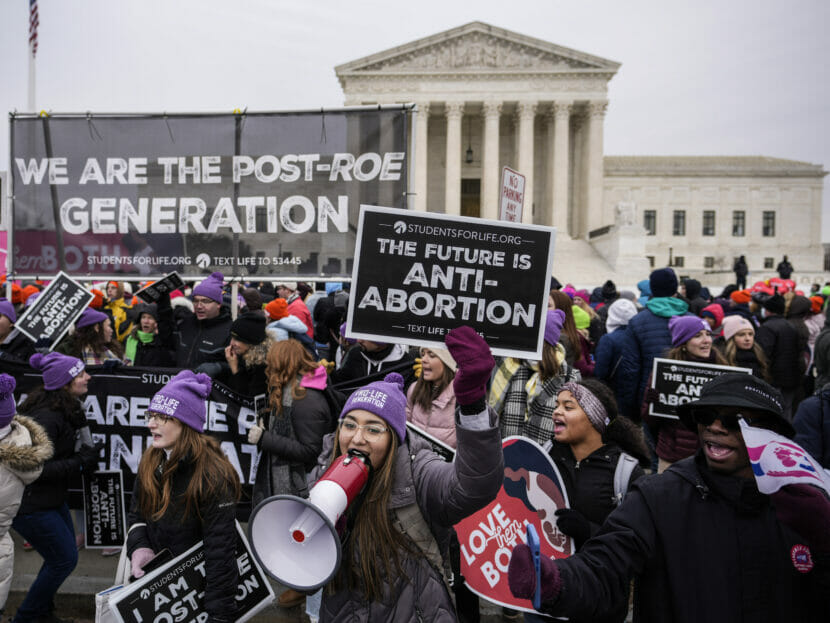
Anti-abortion activists rallied outside the U.S. Supreme Court during the 49th annual March for Life rally on January 21, 2022 in Washington, DC. The rally activists called on the U.S. Supreme Court to overturn the Roe v. Wade decision, which it did a few months later on June 24, 2022. (Drew Angerer / Getty Images)

National Right to Life is one of the nation’s oldest and most prominent anti-abortion organizations, and every summer its annual convention is held in a different U.S. city.

Last year, members were gathered in Atlanta on the very day when the news broke that the Supreme Court had overturned Roe v. Wade with the historic Dobbs ruling.

The room erupted with “a lot of tears of joy, cries of excitement,” recalled Carol Tobias, president of the National Right to Life Committee. “And then it was kind of impressive. Everybody sat back down, kept on going with the general sessions and the workshops because we knew we had work to do.”

That buckle-down and keep-at-it approach also pervaded this summer’s convention, held in Pittsburgh at an airport hotel. There were few overt victory laps. Attendees acknowledged the gains they had made in the year since the Dobbs ruling. But they were more focused on states where abortion remains legal or the societal forces that they believe contribute to women ending pregnancies that they might otherwise keep.

“We know we have a lot of challenges ahead, but our hands are untied,” Tobias told conference attendees. “This is a great day.”

Abortion opponents don’t think they’re winning

The workshops and talks at the gathering June 23-24 reflected the changed political landscape, with titles such as “Political Messaging in Post-Dobbs America” and “Pro-Life Success in the States: Strategies for the Post-Roe Era.”

There was a sense of excitement at this year’s conference due to the new legal reality, said attendee Frank Pavon: “The battle is really engaged. We no longer have that feeling of being, like, constricted, tied up.”

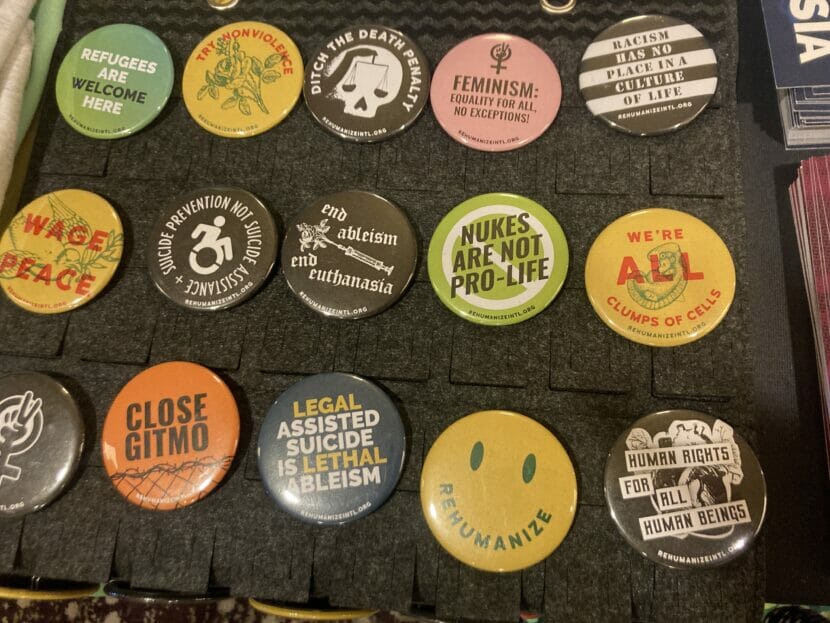
Buttons at Rehumanize International’s table at the National Right to Life conference in June. The group seeks to end “aggressive violence against humans” and espouses a mix of right- and left-leaning positions. (Sarah Boden / WESA)

Dobbs demolished a federal right to abortion, and its legality currently rests with each state. This has created a patchwork of laws that have made legislation designed to stop abortions less effective in some parts of the country.

To put a stop to this, Pavon — a controversial figure who leads the Florida-based Priests for Life — wants Congress to pass a federal ban. But he’s concerned that even the anti-abortion lawmakers in Congress appear reluctant to act. He suspects they are afraid of such a polarizing issue, so they are letting states take the lead in implementing bans. A recent NPR/Marist poll found that six in 10 Americans support abortion rights.

“Let’s look at the makeup of the next Congress,” said Pavon. “We have to see who we have and how far are they willing to go.”

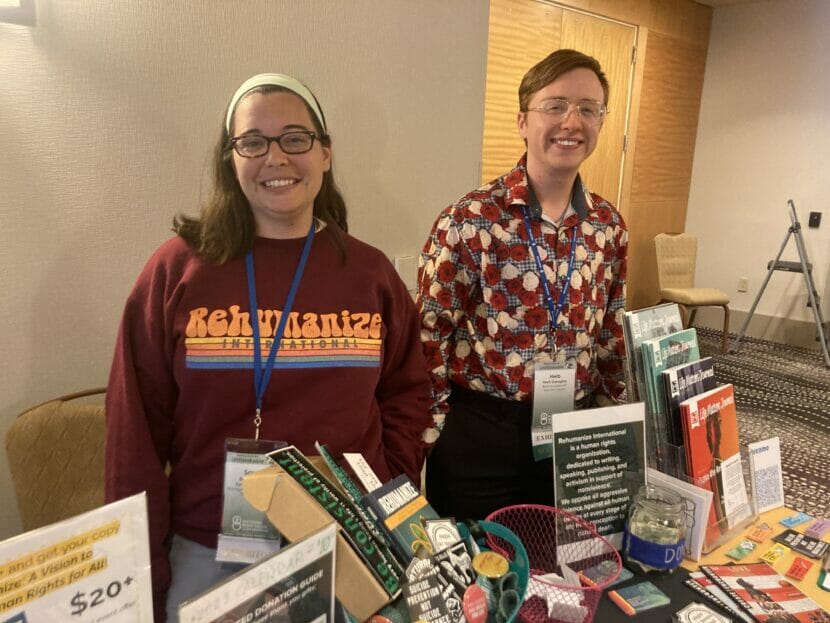
Sarah Slater (left) and Herb Geraghty are members of Rehumanize International. It’s a Pittsburgh-based secular organization that opposes abortion, as well as police brutality, capital punishment and embryonic stem cell research. (Sarah Boden / WESA)

The gathering’s keynote address was delivered by James Bopp Jr., general counsel for the National Right to Life Committee. He expressed frustration by the lack of progress in preventing actual abortions, in the year since Dobbs v. Jackson Women’s Health. Since that decision, abortions — with narrow exceptions — have been banned in 14 states. An estimated 25,000 fewer terminations occurred in the nine months following the ruling. That’s meager progress, according to Bopp, when one considers that before Dobbs, by some estimates the number of abortions was more than 900,000 a year.

“What went wrong? And how can we do something about that?” Bopp asked while speaking to a pensive crowd of anti-abortion activists in the hotel ballroom.

Bopp complained that some Democratic prosecutors refuse to enforce laws designed to curtail abortion access, while health care providers continue to stand up clinics in places like eastern Oregon and southern Illinois, just across the border from states where the procedure is illegal or more restricted.

“We have to face the reality that the world has changed, and it is strange and dramatic,” said Bopp.

Looking for new strategies in a post-Roe landscape

Abortion care has changed in the half-century since Roe first conferred a federal right to abortion up until the point of viability. Now, slightly more than half of abortions are achieved through oral medications that induce a miscarriage — usually through a two-pill regimen, which people can receive through the mail, or travel to neighboring states to pick up before returning home to terminate a pregnancy.

Bopp is infuriated by the websites, volunteers, and travel networks that have sprung up to disperse the medications to states that now ban abortion, or to help patients get to appointments at out-of-state clinics: “[There is] this incredible network of people and organizations, both financial, ideologically, who are supporting illegal abortions in your state, trafficking your women and girls,” he said.

As Bopp describes it, the anti-abortion movement is still embattled. And while Dobbs is a useful tool, it has fragmented the cause across 50 states, creating multiple fronts.

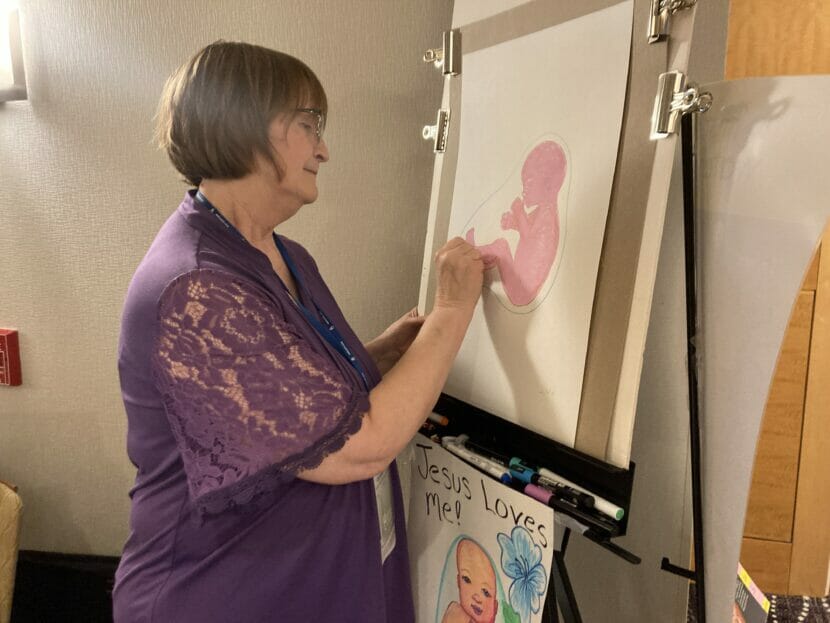
Retired art teacher Catherine Jacobs runs an anti-abortion group called Teachers Saving Children. During the conference, she created drawings of fetuses that then became raffle prizes for people who donated to her organization. (Sarah Boden / WESA)

Many of the attendees in Pittsburgh pointed out that abortion remains legal in 36 states and D.C., though gestational limits on how late in a pregnancy that an abortion can be performed vary drastically from state to state.

And legality does not equate accessibility: A researcher at Middlebury College recently found that the average American must travel 86 miles to the nearest abortion provider.

Abortion opponents also feel they have lost ground in states that strengthened abortion rights and added protections for doctors or nurses who provide abortions.

For example, New York passed legislation in June to prohibit law enforcement from cooperating with any cases that might seek to prosecute New York-based doctors who use telehealth services to deliver abortion care to patients who reside in states where the procedure is less accessible.

Those changes have been especially frustrating for anti-abortion activists living in those states.

“I don’t like to tell people I’m from New York when I’m in a pro-life venue, but I am,” said Catherine Jacobs. She lives in New York’s Chemung County, just north of the Pennsylvania border.

In the hallway outside the conference rooms, Jacobs had set up a table for her group Teachers Saving Children, a network of anti-abortion educators.

In between chatting with other attendees, Jacobs, a retired art teacher, sketched fetuses in an oversized notebook propped on an easel. These drawings then became raffle prizes for people who donate to her organization. The images were large and vivid, colored in pink and blue — Jacobs depicts some of the fetuses smiling or sucking on their thumbs.

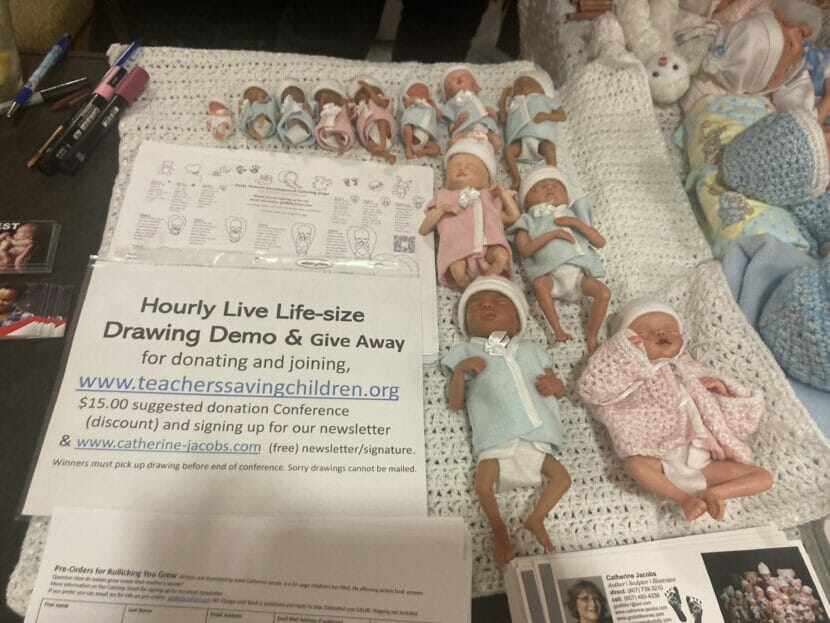
Anti-abortion activist and artist Catherine Jacobs displays some of the fetal models she makes, which are made of resin and based on figures she sculpted with polymer clay. (Sarah Boden / WESA)

Her table also exhibited fetal models at various stages of development; each wore a diaper paired with a blue or pink top. The pieces, poured from resin, are based on figures she sculpted using oven-baked clay.

Jacobs told NPR she started the project after a high-risk twin pregnancy. She also had a miscarriage before that. “I lost a baby that size. I held it in my hand,” said Jacobs, gesturing at the models. “I grieve for that child.”

Jacobs appeared heartbroken that, in her view, babies are still being killed in the U.S., despite Roe’s toppling. Through her art, she tries to show the individuality of each fetus, and maybe even convince others that abortion is a sin. There’s little else she can do in upstate New York, she said, where physicians will continue to provide abortion care for the foreseeable future.

Is a stronger safety net is key to ending abortion in the U.S.?

While a total and national prohibition of abortion is a goal for many at the conference, attendees like Destiny Herndon-De La Rosa, are focused on other strategies.

The founder and CEO of New Wave Feminists, Herndon-De LA Rosa stood out from the conference crowd in her all black outfit and straight black hair. She remembers that when the Dobbs decision was released last year, she didn’t join in with the hugging and high-fiving. Instead, she went to her hotel room and cried; she was overwhelmed by the change, she said, and also felt empathy for her friends who support abortion rights, because they felt hurt and scared by the ruling.

Herndon-De La Rosa is from Houston and describes herself as a “pro-life feminist.” In keeping with the standard anti-abortion view, she believes life starts at conception and that abortion is violence against unborn children. But she is most focused on the fact that people will continue to terminate unwanted pregnancies as long as systemic injustices — such as lack of affordable housing or health care disparities — persist in the U.S.

“Right now, fertility is absolutely a liability for females. Still. Nothing has changed other than the law,” she said.

Herndon-De La Rosa supports condom use and access to hormonal birth control, though she would like to see the development of more male birth control options, so that the burden doesn’t completely fall on women.

Herndon-De La Rosa also believes that new state laws must make room for instances when abortion is medically necessary. She’s upset with what she calls “sloppy” legislation that has been enacted without consulting physicians.

“Women will die from that,” she said.

Many other attendees also brought up the need for a stronger social safety net. One speaker, who operates a chain of state-funded anti-abortion pregnancy centers in Pennsylvania and Indiana, said the goal is to remove the “crisis” from an unplanned or so-called “crisis pregnancy,” by giving a person the support and resources they need to have the child.

In addition to more taxpayer-funding for these pregnancy centers, Maria Gallagher, the legislative director for the Pennsylvania Pro-Life Federation, said people also need to be able to earn a living wage, and have access to educational opportunities and health care.

“We need to have those conversations now because we’re in the post-Roe era,” said Gallagher. “If we don’t have them now, when are we going to have them?”

Copyright 2023 90.5 WESA. To see more, visit 90.5 WESA.

Researchers found a rare octopus nursery off the coast of Costa Rica

Researchers found Muusoctopus nursery grounds on a low-temperature hydrothermal vent off the shore of Costa Rica. (Schmidt Ocean Institute)

Scientists working off the coast of Costa Rica say they’ve discovered the world’s third known octopus nursery.

The international 18-person research team found the site nearly 2 miles below sea level and believe that in the process they may have also discovered a new species of Muusoctopus, a genus of small to medium sized octopus lacking an ink sack.


View this post on Instagram


A post shared by NPR (@npr)

“The discovery of a new active octopus nursery over 2,800 meters beneath the sea surface in Costa Rican waters proves there is still so much to learn about our Ocean,” Dr. Jyotika Virmani, executive director of the Schmidt Ocean Institute, said in a statement.

According to a press release, researchers witnessed Muusoctopus eggs hatch. They said it demonstrated that the area, known as the Dorado Outcrop, was hospitable to young octopuses.

Scientists working off the coast of Costa Rica say they’ve discovered the world’s third known octopus nursery. (Schmidt Ocean Institute)

When the Dorado Outcrop — an area roughly the size of a football field — was first discovered in 2013, researchers believed octopuses couldn’t grow there because they didn’t observe any developing embryos at the site.

Scientists said the discovery also indicated that some deep-sea octopus species brood their eggs in low-temperature hydrothermal vents, such as the one where the nursery was discovered, where fluid heated in the Earth’s crust is released on the seafloor — like hot springs.

Researchers found Muusoctopus nursery grounds on a low-temperature hydrothermal vent off the shore of Costa Rica. (Schmidt Ocean Institute)

The research vessel for the trip was provided by the Schmidt Ocean Institute, a nonprofit research organization founded by former Google CEO Eric Schmidt and his wife, Wendy.

The trip was led by Beth Orcutt of the Maine-based Bigelow Laboratory for Ocean Sciences as well as Jorge Cortes of the University of Costa Rica.

According to the researchers, areas like the Dorado Outcrop are still vulnerable to human activities such as fishing, and some Costa Rican scientists on the trip were trying to discern if the underwater seamounts should be legally protected.

“The information, samples, and images are important to Costa Rica to show its richness and will be used for scientific studies, and outreach to raise awareness of what we have and why we should protect it,” Cortes said.

Copyright 2023 NPR. To see more, visit https://www.npr.org.

Men are hunters, women are gatherers. That was the assumption. A new study upends it.

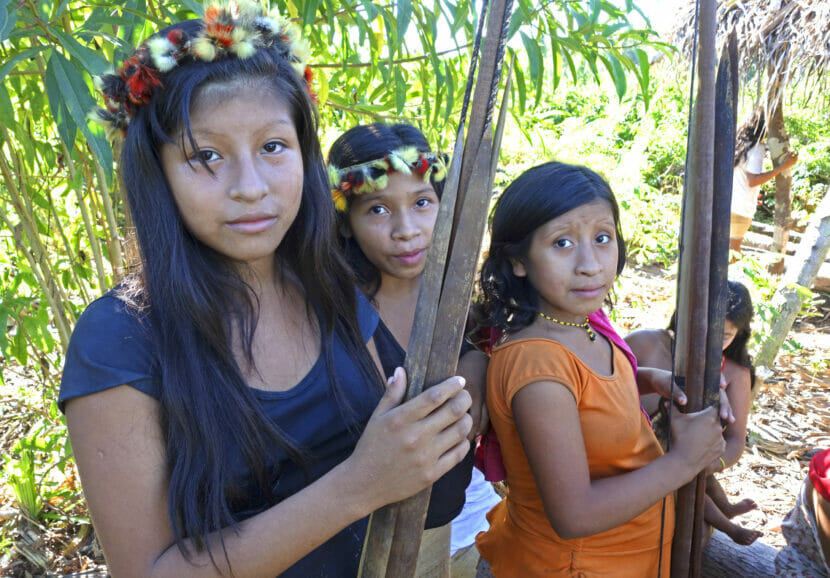
A group of young women from the Awa people in Brazil hold their bows and arrows as they return from a hunt. A new reexamination of ethnographic studies finds female hunters are common in hunter-gatherer societies. (Scott Wallace/Getty Images)

For decades, scientists have believed that early humans had a division of labor: Men generally did the hunting and women did the gathering. And this view hasn’t been limited to academics. It’s often been used to make the case that men and women today should stick to the supposedly “natural” roles that early human society reveals.

Now a new study suggests the vision of early men as the exclusive hunters is simply wrong – and that evidence that early women were also hunting has been there all along.

Specifically, the new research upends one of the key strands of evidence that scientists have relied on to infer what life was probably like during the period that started roughly 200,000 years ago, when homo sapiens first emerged as a species.

Direct evidence is limited because that phase ended about 9,000 years ago, as people slowly began to develop agriculture and settlements. But all over the world, there have been groups, often in remote areas of low- and middle-income countries, who still live a hunting and foraging life. So scholars look to them as a sort of window into humanity’s past. Anthropologists and other specialists have gained these groups’ permission to live alongside them and have produced detailed observational reports.

Until now, the general sense among scientists has been that these accounts overwhelmingly pointed to men mainly hunting and women mainly gathering, with only occasional exceptions, says Robert Kelly, professor of anthropology at the University of Wyoming and the author of influential books and articles on hunter-gatherer societies.

But Kelly says that the views he and others held of the typical gender divisions around hunting were based on anecdotal impressions of the reports they’d been reading, combined with the field work many had engaged in personally. “No one,” says Kelly, had done a systematic “tally” of what the observational reports said about women hunting.

Enter the researchers behind the new study: a team from University of Washington and Seattle Pacific University. “We decided to see what was actually out there” on hunting, says the lead researcher Cara Wall-Scheffler, a biological anthropologist.

A fresh look at old evidence

Wall-Scheffler and her collaborators combed through accounts from as far back as the 1800s through to present day. And rather than relying on summaries of those accounts – as scientists often do when analyzing large numbers of them – Wall-Scheffler notes “our goal was to go back to the original ethnographic reports of those populations and see what had actually been written about the hunting strategies.”

Their findings — published in the journal PLOS One this week — is that in 79% of the societies for which there is data, women were hunting.

Moreover, says Wall-Scheffler, this wasn’t just opportunistic killing of animals that the women happened upon. The vast majority of the time, she says, “the hunting was purposeful. Women had their own toolkit. They had favorite weapons. Grandmas were the best hunters of the village.”

In other words, “the majority of cultures for whom hunting is important train their girls and their women to make their tools and go hunting,” she says. Wall-Scheffler says she was expecting to find evidence of women hunting – but not to this extent. “That piece has just been really underappreciated,” she says, “even though it’s right there in literature.”

The implications of these results are potentially enormous, says Kimberly Hamlin, a professor of history at Miami University in Oxford, Ohio who specializes in ways that evolutionary science has figured in the wider culture.

“I think that next to the myth that God made a woman from man’s rib to be his helper, the myth that man is the hunter and woman is the gatherer is probably the second most enduring myth that naturalizes the inferiority of women,” says Hamlin.

It has fueled the idea, she says, that “men are supposed to be violent, they’re supposed to be aggressive – one of the core elements in the soup of toxic masculinity” used to excuse damaging male behaviors, including rape.

The popular narrative of man as the sole – or at least almost exclusive – hunter has also been used implicitly and even explicitly to argue for policies that prioritize men’s role as the “natural breadwinner” – and that also limit them to that role by, for instance, denying them paternity leave, adds Hamlin.

By the same token, she maintains, “this idea that somehow women are naturally preordained to be caretakers and maternal figures, whether they like it or not,” often underlies policies that effectively “force motherhood on women” – including policies that restrict access to abortion and contraception.

So the new study’s findings are “thrilling,” concludes Hamlin. “It’s really going to encourage us to call into question a lot of these ideas about what men and women are supposedly naturally like.”

For scientists, a shifting narrative about hunters

As to how consequential the study’s findings are for science, scholars say they add to a body of evidence that has been building for years.

Kelly says that notwithstanding the endurance of stereotypes around early human hunting in popular culture, scientists had already moved to a more nuanced picture.

As far back as the mid-1960s, says Kelly, scientists were coalescing around evidence that most of the diet in hunter-gatherer societies has come from plant food gathered by women. “People were saying, ‘We should call them ‘gatherer-hunters’ to emphasize that.’ ”

By the 1980s, adds Kelly, many more women had entered the field of anthropology. Compared to their male predecessors, these women scientists were often able to gain more access to women in foraging societies. The result was a slew of new descriptions of women’s activities – including more accounts of women hunting.

So Kelly’s initial reaction to Wall-Scheffler’s study is that, while its organization and tabulation of the data is “genuinely new and useful,” when it comes to the picture it paints of the hunting practices of women, “there wasn’t anything that struck me as eye-opening. I sort of knew all of this.”

Yet one finding did stick out to Kelly. He says that the current consensus view holds that even when women do some hunting, they engage in a very different form of hunting than the kind done by men.

“The general pattern is that men intentionally go out to hunt large game,” says Kelly. “And women intentionally go out to gather plant food and also intentionally or opportunistically will hunt the smaller, more reliably-gathered game” – meaning animals like lizards and rabbits.

By contrast, the new study found that in a third of societies for which there is data, the women hunt large game. In other words, they do go after the kind of big mammals associated with the stereotype of male hunters.

“I would consider that something new,” Kelly concedes, adding “I’d really like to go look at those ethnographies” that were the source.

Vivek Venkataraman of the University of Calgary is another anthropologist expressing doubts.

He notes that Wall-Scheffler and her colleagues had to limit themselves to societies for which there were explicit accounts of not just hunting practices, but precisely who was doing the hunting. The result is that the study is based on observations of 63 groups.

“But of course there are several hundred foraging societies,” says Venkataraman. “We need to know what’s going on there before we can draw any sweeping conclusions.”

Key clues that were overlooked

Randy Haas disagrees with the critics of the study. An anthropologist at Wayne State University, Haas notes that the societies Wall-Scheffler’s study analyzes are well distributed across the globe. Furthermore, says Haas, “more data is not always better. My sense is that [the evidence used in the study] is a well-structured, high quality sample that is actually more likely to yield a reliable result than a larger sample of lower quality observations.”

What’s more, Haas says, his own experience illustrates how the “near universal” view of men as the sole big-game-hunters may be warping researchers’ ability to recognize data to the contrary. In addition to creating blind spots in the understanding of modern hunter-gatherer societies, Hass says it also appears to have led scientists to overlook key clues from the other main source of evidence on early humans: ancient burial sites and the human remains and artifacts found there.

In 2018 Haas was part of a team in Peru that found a 9,000-year-old person buried with an unusually large number of hunting tools. “We all just assumed this individual was a male,” he recalls. “Everybody is sitting around, saying things like, ‘Wow! This is amazing. He must have been a great hunter, a great warrior. Maybe he was a chief!’ ”

Haas didn’t even think to question the person’s gender until about a week later, when a colleague who specialized in analyzing bone structure arrived and delivered a bombshell assessment: The remains seemed to be female.

The team then used a technology newly available to the field. Scraping the enamel from the teeth found in the grave, they found proteins that confirmed it unequivocally: This apparent master hunter was female.

Stunned, Haas and his collaborators decided to review the records of similar finds across the Americas over the previous 70 years. In 27 gravesites of individuals found with hunting tools, they found 11 cases in which the person was female.

They ran a statistical analysis that finds that this ratio is associated with the probability that between 30-to-50% of individuals buried with hunting tools in ancient American gravesites are female. In other words, says Haas, “Large mammal hunting during this time in the Americas was a gender neutral activity, or at least nearly so.”

Why did this take so long?

Why hadn’t these findings commanded the world’s attention sooner?

Haas says in one of the excavation records he and his collaborators re-analyzed – the 11,000-year-old remains of a female found in the 1970s with a pointy stone tip laid under her head – the scientists who had originally uncovered the grave had effectively ignored their own discovery.

Says Haas, “They had written something to the effect of, ‘Had this [pointy stone] been associated with a male we would have assumed this to be a hunting weapon. But given its association with a female, its use as a kitchen tool would make more sense.” Haas and his co-authors decided it should be reclassified as a hunting tool.

Yet what’s even more notable, says Haas, is that in all but one other case, his team did not need to revise the conclusions of the original excavators: Those scientists had already determined that the individuals they’d found were females buried with hunting weapons. Just as with the findings in Wall-Scheffler’s study, the archaeological evidence had been available the whole time – hiding in plain sight.

“Everybody had just taken this man-the-hunter hypothesis for granted. So no one really decided to evaluate it,” says Haas. “It wasn’t really a question on a lot of people’s minds.”

But Cara Wall-Scheffler had seen Haas’s findings, and they were precisely what prompted her to launch her review of the modern-day accounts.

Wall-Scheffler says the episode offers a reminder of why it’s so important to ensure the scientific community includes people of diverse backgrounds.

“The preconceptions that we all have when we look at a data set really shape the outcome,” she says. “I’m really hoping that people take second looks at some of the data that they already have to see what new questions we can ask.”

Copyright 2023 NPR. To see more, visit https://www.npr.org.

Site notifications
Update notification options
Subscribe to notifications