National News

‘Fueled by lies,’ Trump charged with seeking to overturn 2020 election

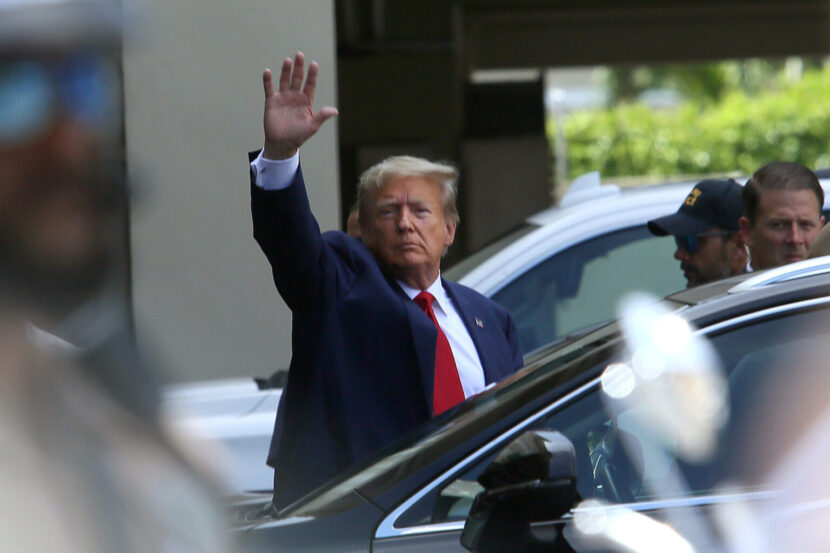
MIAMI, FLORIDA – JUNE 13: Former U.S. President Donald Trump waves as he makes a visit to the Cuban restaurant Versailles after he appeared for his arraignment on June 13, 2023 in Miami, Florida. Trump pleaded not guilty to 37 federal charges including possession of national security documents after leaving office, obstruction, and making false statements. (Photo by Alon Skuy/Getty Images)

WASHINGTON — A federal grand jury in Washington, D.C., indicted Donald Trump on Tuesday, alleging that Trump and co-conspirators attempted to subvert the 2020 election to keep the former president in power through a series of illegal actions that culminated in the Jan. 6, 2021, attack on the U.S. Capitol.

The former president faces four charges in U.S. District Court for the District of Columbia stemming from his actions following the November 2020 election, including conspiracy to defraud the United States; conspiracy to obstruct an official proceeding; obstruction of, and attempt to obstruct, an official proceeding; and conspiracy against rights.

“Each of these conspiracies — which built on the widespread mistrust the Defendant was creating through pervasive and destabilizing lies about election fraud — targeted a bedrock function of the United States federal government: the nation’s process of collecting, counting and certifying the results of a presidential election,” the indictment states.

Special Counsel Jack Smith said during a brief statement on Tuesday evening that Trump’s lies about election fraud caused the “unprecedented assault on the seat of American democracy” on Jan. 6.

“As described in the indictment, it was fueled by lies,” Smith said. “Lies by the defendant aimed at obstructing a bedrock function of the U.S. government.”

Smith said he would seek a speedy trial, so the evidence prosecutors have gathered can be tested in court. He added that investigations into other individuals, possibly including six unnamed co-conspirators listed in the indictment, would continue. He did not take questions.

The indictment lists Trump’s false statements about election results in Arizona, Georgia, Michigan, Nevada, New Mexico, Pennsylvania and Wisconsin.

The 45-page indictment says Trump knew that his statements about the election were false. Despite declarations from state leaders and elections officials that no fraud occurred, Trump continued to say vote totals were in his favor and worked with co-conspirators to influence state legislators to decertify results, according to the indictment.

“Despite having lost, the Defendant was determined to remain in power,” the indictment reads. “So for more than two months following election day on November 3, 2020, the Defendant spread lies that there had been outcome-determinative fraud in the election and that he had actually won.”

“These claims were false, and the Defendant knew that they were false,” it reads.

The indictment later adds: “These prolific lies about election fraud included dozens of specific claims that there had been substantial fraud in certain states, such as that large numbers of dead, non-resident, non-citizen or otherwise ineligible voters had cast ballots, or that voting machines had changed votes for the Defendant to votes for Biden.”

Trump is leading the field of Republicans vying to become the party’s nominee for president in the 2024 election. The first GOP primary debate is scheduled for later this month. Republicans largely rebuked the indictment, with many dismissing it as partisan.

In a statement from his campaign, Trump denied wrongdoing and called his prosecution politically motivated.

“This is nothing more than the latest corrupt chapter in the continued pathetic attempt by the Biden Crime Family and their weaponized Department of Justice to interfere with the 2024 presidential election, in which President Trump is the undisputed front-runner, and leading by substantial margins,” a statement from the Trump campaign read.

The plans for fake electors

The indictment focuses on plans by Trump and co-conspirators — four unnamed attorneys, a U.S. Justice Department official and a political consultant — to replace legitimate electors in seven key states, which Joe Biden in fact won, with fraudulent electors pledged to Trump.

Federal prosecutors listed five steps Trump took, escalating as each effort failed to bring his desired result.

According to the indictment, Trump and his co-conspirators pressured state legislators and election officials in key states to switch the legitimate election results in those states from  Biden to Trump.

Trump and his team organized fraudulent slates of electors, which they sought to have replace the legitimate Biden electors, according to the indictment.

Trump ordered “sham” U.S. Justice Department investigations into election crimes in certain states, and considered having DOJ officials send letters outlining supposed concerns with the elections in those states. Those concerns could then be used as a pretext to advance the fraudulent electors, the indictment reads.

Trump and his co-conspirators then pressured Vice President Mike Pence to use his ceremonial role to certify the election results on Jan. 6 to authenticate the fraudulent electors, the indictment reads.

When Pence, who did not have the legal authority to replace the electors, declined to participate, Trump repeated to supporters who had gathered in Washington that Pence did have the authority to change the election result and “directed them to the Capitol to obstruct the certification proceeding,” the indictment said.

As the crowd turned violent, Trump and his co-conspirators used the chaos to continue launching claims of election fraud and attempting to convince members of Congress to delay the proceeding, prosecutors alleged.

False statements about election fraud

Trump “pushed officials in certain states to ignore the popular vote; disenfranchise millions of voters; dismiss legitimate electors; and ultimately, cause the ascertainment of and voting by illegitimate electors in favor of the Defendant,” the indictment says.

Trump and his co-conspirators worked to establish fraudulent electors in seven states by “attempting to mimic the procedures that the legitimate electors were supposed to follow under the Constitution and other federal and state laws,” according to the indictment.

Those false electors in Arizona, Georgia, Michigan, Nevada, New Mexico, Pennsylvania and Wisconsin met on the same days as legitimate electors, casting fake votes for Trump and then signing certificates where they falsely claimed they were the actual electors.

“Some fraudulent electors were tricked into participating based on the understanding that their votes would be used only if the Defendant succeeded in outcome-determinative lawsuits within their state, which the Defendant never did,” reads the indictment.

Those false election certificates were then sent to the vice president and other government officials, in an attempt for them to be counted instead of the legitimate electors when Congress convened on Jan. 6, 2021 to certify the vote.

That morning an associate of Trump’s, who isn’t named in the indictment, worked to get false election certificates from Michigan and Wisconsin to an unnamed U.S. senator, who was supposed to deliver those to Pence, according to the indictment.

A staffer for Pence later rejected efforts to put those false electors into the vice president’s hands, according to the indictment.

Trump’s pressure on Pence

The indictment details Trump’s efforts to “enlist” Pence to alter the election results, using Trump and his co-conspirators’ fraudulent slate of electors.

The vice president has a ceremonial role in certifying presidential election results.

When Pence remained unconvinced by the scheme, Trump began rallying supporters to amass in Washington, D.C., on the day Pence would preside over the certification, the indictment states.

The indictment recounts Trump’s Dec. 19, 2020, post on Twitter, in which he wrote “Big protest in D.C. on January 6th. Be there, will be wild!”

Days later, on Dec. 23, Trump re-posted a memo titled “Operation ‘PENCE’ CARD,” that falsely stated Pence could disqualify electors from the states where Trump falsely claimed voter fraud. That same day, a person identified in the indictment as “co-conspirator 2,” identified as John Eastman by his attorney, circulated a memo detailing plans for Pence to unlawfully declare Trump the winner.

The indictment details multiple phone calls and conversations in which Trump pressures the vice president, including a call from Pence to wish the president “Merry Christmas” that quickly turned into Trump asking Pence to reject electoral votes on Jan. 6.

“‘You know I don’t think I have the authority to change the outcome,’” Pence told Trump, according to the indictment.

The two spoke by phone again on New Year’s Day when Trump “berated” Pence and told him, “You’re too honest” after the vice president opposed a lawsuit seeking to give him authority to reject or return votes to the states.

Within hours of the phone call, Trump again took to Twitter to promote the rally. “‘The BIG Protest Rally in Washington, D.C., will take place at 11:00 A.M. on January 6th. Locational (sic) details to follow. StopTheSteal!,’” according to the indictment.

The pressure campaign continued into the early days of January, including a meeting on Jan. 4 during which Trump and “co-conspirator 2” tried to convince Pence, his chief of staff and his legal counsel, that Pence should reject or return to the states Biden’s legitimate electoral votes.

Pence’s notes from the meeting detail Trump’s false statements he “won every state by 100,000s of votes,” according to the indictment.

Despite acknowledgement from both “co-conspirator 2” and Trump’s senior advisor that the plan would not stand up in court, Trump ordered a second meeting on Jan. 5 between Pence’s staff and Eastman.

On each meeting occasion, Trump’s senior advisor and Pence’s counsel respectively expressed concern of “riots in the streets,” and of a “disastrous situation” where the election might “have to be decided in the streets.”

Also on Jan. 5, Trump met with Pence alone and warned him that he “would have to publicly criticize him,” the indictment states. Pence’s chief of staff, concerned for the vice president’s safety, alerted his Secret Service detail.

As Trump’s supporters amassed at the Ellipse on Jan. 6, the then-president told them “I hope Mike is going to do the right thing. I hope so. I hope so. Because if Mike Pence does the right thing, we win the election,” the indictment recounts.

Trump continued to fire up the crowd, falsely telling them that the Pennsylvania Legislature wanted “to recertify their votes.”

“But the only way that can happen is if Mike Pence agrees to send it back,” he told them.

They began to chant “send it back.”

Trump continued, telling the crowd “we fight like hell. And if you don’t fight like hell, you’re not going to have a country anymore.”

“During and after the Defendant’s remarks, thousands of people marched toward the Capitol,” the indictment states.

Third indictment for Trump

The allegations mirror conclusions that the U.S. House Select Committee to Investigate the January 6, 2021, Attack on the U.S. Capitol made following the panel’s two-year probe.

The Democratic-led committee placed Trump at the center of the attack, saying his and his close allies’ consistent lies about the election and voicing of conspiracy theories inspired the armed insurrection.

The U.S. House, then under Democratic control, impeached Trump in the waning days of his presidency for inciting the attack. A majority of the U.S. Senate — 57 senators, including seven Republicans — voted to convict him, but fell short of the two-thirds required for conviction.

The indictment is the third for Trump this year.

The former president also faces criminal charges in New York state, where he’s accused of falsifying business records by using campaign funds to cover up an affair, and in federal court in Florida on allegations he kept classified materials after he left office.

He has pleaded not guilty in both other cases.

A sweeping Georgia 2020 election interference probe also could lead to high-profile criminal indictments being handed down for Trump and potentially others in Fulton County Superior Court.

The CDC sees signs of a late summer COVID wave

Hospitalizations for COVID-19 are ticking up. But even if illnesses keep rising, it appears unlikely that they will hit previous summer peaks. (EMS-Forster-Productions/Getty Images)

Yet another summer COVID-19 wave may have started in the U.S., according to the Centers for Disease Control and Prevention.

“After roughly six, seven months of steady declines, things are starting to tick back up again,” Dr. Brendan Jackson, the CDC’s COVID-19 incident manager, tells NPR.

The amount of coronavirus being detected in wastewater, the percentage of people testing positive for the virus and the number of people seeking care for COVID-19 at emergency rooms all started increasing in early July, Jackson says.

“We’ve seen the early indicators go up for the past several weeks, and just this week for the first time in a long time we’ve seen hospitalizations tick up as well,” Jackson says. “This could be the start of a late summer wave.”

Hospitalizations jumped 10% to 7,109 for the week ending July 15, from 6,444 the previous week, according to the latest CDC data.

The increases vary around the country, with the virus appearing to be spreading the most in the southeast and the least in the Midwest, Jackson says.

Rise in cases looks like a jump at the end of ski slope

But overall, the numbers remain very low — far lower than in the last three summers.

“If you sort of imagine the decline in cases looking like a ski slope — going down, down, down for the last six months — we’re just starting to see a little bit of an almost like a little ski jump at the bottom,” Jackson says.

Most of the hospitalizations are among older people. And deaths from COVID-19 are still falling — in fact, deaths have fallen to the lowest they’ve been since the CDC started tracking them, Jackson says. That could change in the coming weeks if hospitalizations keep increasing, but that’s not an inevitability, Jackson says.

So the CDC has no plans to change recommendations for what most people should do, like encourage widescale masking again.

“For most people, these early signs don’t need to mean much,” he says.

Others agree.

“It’s like when meteorologists are watching a storm forming offshore and they’re not sure if it will pick up steam yet or if it will even turn towards the mainland, but they see the conditions are there and are watching closely,” says Caitlin Rivers, an epidemiologist at the Johns Hopkins Bloomberg School of Public Health.

Immunity from vaccinations and previous infections helps

Even if infections, emergency room visits and hospitalizations continue to rise to produce another wave, most experts don’t expect a surge that would be anywhere as severe as those in previous summers, largely because of the immunity people have from previous infections and vaccinations.

“We’re in pretty good shape in terms of immunity. The general population seems to be in a pretty good place,” says Dr. Céline Gounder, an infectious disease specialist at New York University and an editor at large for public health at KFF Health News.

Some are skeptical the country will see a summer wave of any significance.

“Right now I don’t see anything in the United States that supports that we’re going to see a big surge of cases over the summer,” says Michael Osterholm, who runs the Center for Infectious Disease Research and Policy at the University of Minnesota.

Right now the CDC says people should continue to make individual decisions about whether to mask up while doing things like traveling or going to crowded places.

Older people remain at higher risk

People at high risk for COVID-19 complications, such as older people and those with certain health problems, should keep protecting themselves. That means making sure they’re up to date on their vaccines, testing if they think they are sick and getting treated fast if they become infected, doctors say.

“It’s always a changing situation. People are becoming newly susceptible every day. People are aging into riskier age brackets. New people are being born,” says Jennifer Nuzzo, who runs the Pandemic Center at the Brown University School of Public Health. “The work of protecting people from this virus will continue for as long as this virus continues to circulate on this planet, and I don’t foresee it going away for the foreseeable future.”

Scientists and doctors think there will be another COVID-19 wave this fall and winter that could be significant. As a result, the Food and Drug Administration is expected to approve a new vaccine in September to bolster waning immunity and to try to blunt whatever happens this winter.

Some projections suggest COVID-19 could be worse than a really bad flu season this year and next, which would mean tens of thousands of people would die from COVID-19 annually.

“It will still be in the top 10 causes of death, and I suspect that COVID will remain in the top 10 or 15 causes of death in the United States,” says Justin Lessler, an epidemiologist at the University of North Carolina at Chapel Hill, who helps run the COVID-19 Scenario Modeling Hub.

Copyright 2023 NPR. To see more, visit https://www.npr.org.

Why it’s so important to figure out when a vital Atlantic Ocean current might collapse

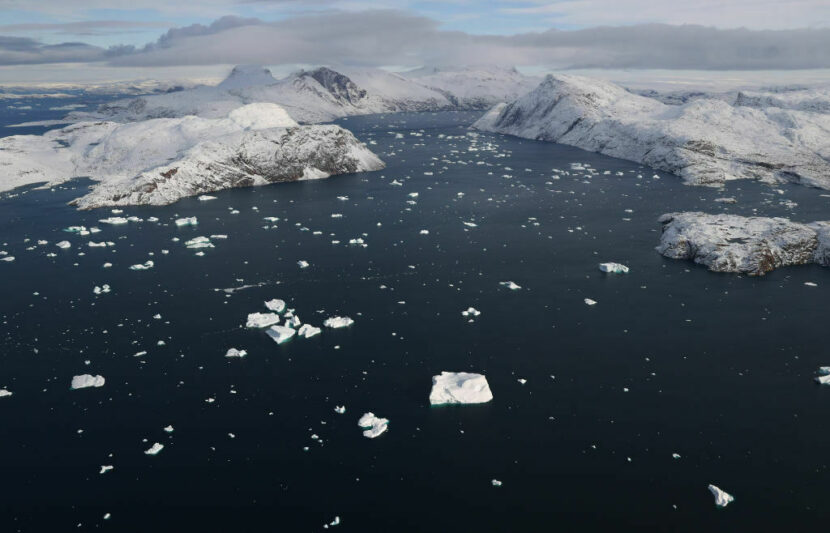
As the planet heats up, Greenland’s ice sheet is pouring more meltwater into the Atlantic. Scientists are tracking whether this could cause a collapse in a crucial ocean current. (Mario Tama/Getty Images)

Deep in the Atlantic Ocean, there’s a massive current the size of 8,000 Mississippi Rivers. Its role in the Earth’s climate is so powerful that it determines weather from the equator to Europe, crop production in Africa and sea level rise on the East Coast.

Scientists say there’s a risk this vital current could shut down as the climate gets hotter, a collapse that could have dire consequences worldwide.

Researchers have been trying to determine when the Atlantic might cross that tipping point. But answering that is no easy task.

Now, a new study finds the collapse of the current, which is known as the Atlantic meridional overturning circulation, or AMOC, could happen far sooner than scientists have previously thought, possibly within a few decades, as a result of human-caused global warming.

“It’s a worrisome result,” says Peter Ditlevsen, professor of climate physics at the University of Copenhagen in Denmark and an author of the study. “It calls for quite immediate actions. We need to reduce emissions. We need more brakes on the train.”

Other researchers caution that the timeline of such a collapse — or even whether the AMOC will collapse at all — remains unclear, given the sheer complexity of understanding an ocean system that stretches thousands of miles. Previous assessments have suggested a collapse is unlikely this century.

The new study adds to a growing body of research suggesting crucial tipping points in the climate system are incredibly hard to predict, and that humans are changing the fundamental processes of the Earth faster than we can understand them. Given the potential for catastrophic impacts, scientists say further research to understand the AMOC is more urgent than ever.

“The AMOC is a bedrock of our climate system,” says Nicholas Foukal, an assistant scientist at the Woods Hole Oceanographic Institution who was not involved in the study. “It redistributes heat globally and it’s something that we just take for granted.”

A conveyor belt for heat

When it comes to weather, Europe has a lot to thank the AMOC for. Cities like London and Paris are warmer than their counterparts at similar latitudes in North America.

“In Scandinavia, we have a sort of pleasant, mild climate,” Ditlevsen says. “And if you compare that with the U.S., we are at the latitude of Alaska, which is much colder than Scandinavia.”

Milder winters in Europe are largely thanks to an influx of heat from the AMOC. The current carries vast amounts of warm water from the equator, which travels north up the East Coast of the U.S. before crossing to Europe. That’s where the water cools off, releasing heat into the atmosphere.

The cold, salty water is denser and heavier, causing it to sink near Greenland. Like a massive ocean conveyor belt, the current then returns in the direction it came from, flowing south along the ocean floor.

Scientists know this conveyor belt has collapsed in the past. Around 12,000 years ago, temperatures around Greenland suddenly dropped by about 18 degrees Fahrenheit. That shift is attributed to a sudden shutdown of the AMOC — and demonstrates the potential impact of such a climate tipping point.

“A tipping point is a strong result to a small change,” Ditlevsen says. “It’s when you’re pushed over the cliff. When you reach the cliff, you drop.”

Looking for the tipping point

To determine how close that tipping point might be, Ditlevsen analyzed ocean temperature records near Greenland over the past 150 years and ran a statistical analysis to track the fluctuations in temperature. He and his co-author found increasing variability in temperatures, which they say is a sign the AMOC is weakening. Based on their analysis, they estimate the AMOC could collapse between 2025 and 2095. That’s decades earlier than other studies have found.

While researchers disagree on the timing of such a collapse, there is broad consensus on the potential consequences. A collapse in the AMOC could have ripple effects around the planet. Temperatures in Europe could fall, while heat in the tropics would rise, exacerbating climate change that’s already occurring.

Rainfall could decrease across the Sahel region of Africa, threatening crop production for millions of people. The summer monsoon could weaken across Asia and sea levels could rise even faster in the Eastern U.S. Scientists have already found that subtle shifts in Atlantic currents can have serious effects on marine life, like threatening endangered North Atlantic right whales.

“It’s going to affect agriculture,” Foukal says. “It’s going to affect disease, especially in the equatorial region. It’s going to affect mass migration.”

When is still a big question

Still, a midcentury collapse is at odds with what other research studies have found. A report from the Intergovernmental Panel on Climate Change found the AMOC is unlikely to collapse this century.

“Whether it will collapse is still a question,” Foukal says. “I think that there is still quite a bit of uncertainty.”

Foukal says this most recent study relies on temperature records from a small part of the system and doesn’t simulate what would happen to the entire current itself. He says it’s also crucial to understand the cause of a collapse to estimate the timing — something Ditlevsen’s study didn’t address.

The last time the AMOC shut down, the Earth was coming out of an ice age. Scientists believe a vast amount of fresh water from melting glaciers poured into the Atlantic, interfering with the conveyor belt. Fresh water is lighter than salt water and can inhibit the sinking motion that powers the entire current.

A similar thing could happen again, as humans continue to heat the atmosphere by burning fossil fuels. Ice in the Arctic and Greenland’s ice sheets are melting at an increasing pace, also adding fresh water to the Atlantic. But Foukal says researchers are still trying to determine whether that would be enough to cause a complete collapse.

What’s more likely, he says, is that the AMOC could weaken this century. That could still cause some of the same serious impacts as a collapse, though to a lesser extent. Some studies have shown a weakening is already happening, but other researchers say that given the normal fluctuations in the current, it will take more time to make that call.

Direct measurements of the Atlantic circulation have only been made since 2004. Given the depths and distances the AMOC covers, it’s challenging to keep tabs on it. But with the potential for such widespread impacts, scientific researchers say further research is more urgent than ever — as well as rapid action to limit how much the planet warms.

Copyright 2023 NPR. To see more, visit https://www.npr.org.

Big carmakers unite to build a charging network and reassure reluctant EV buyers

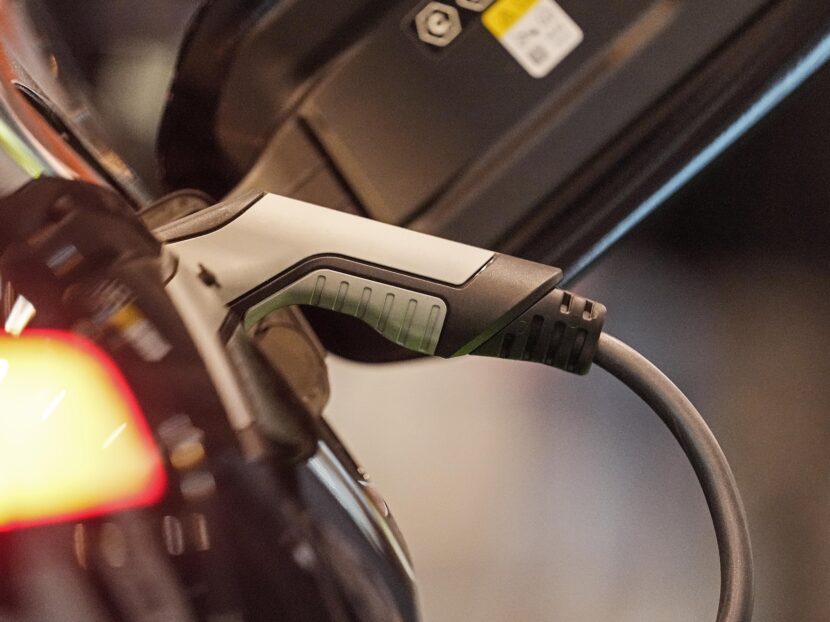
An electric car is charged at the Motor Show in Essen, Germany, Thursday, Dec. 2, 2021. Charging may soon be easier across the U.S. with seven car companies banding together to create a charging network. (Martin Meissner/AP)

Seven of the world’s largest carmakers are launching a new electric vehicle charging network, in an unusual display of cooperation that’s designed to address one of the major deterrents for would-be electric vehicle purchasers.

The goal is to open 30,000 new high-speed fast-chargers in North America, powered by renewable energy. If achieved, that would be significantly larger than Tesla’s current Supercharger network, and would nearly double the number of fast chargers available in the U.S. today. (In this case, a “charger” refers to an individual plug. A charging station at a single location often has multiple chargers.)

But building a charging network of that scale will be a very high mountain to climb.

Ionity, a similar network in Europe launched as a joint venture between many of the same automakers, has built only 2,600 chargers since 2017.

In the U.S., Electrify America — bankrolled by $2 billion that Volkswagen paid as part of the Dieselgate settlement — has installed 3,600 in five years, and those chargers struggle with reliability.

Meanwhile Tesla, the undisputed leader in this space, has spent a full decade building 17,000 chargers.

The newly announced network, which has not yet been named, is a partnership between BMW, GM, Honda, Hyundai, Kia, Mercedes-Benz and Stellantis (formerly known as Fiat Chrysler).

Automakers frequently pair up in joint ventures to to defray costs of research and development or new vehicles. However, a joint venture like this between seven carmakers of this size is — as the automakers’ press release notes — unprecedented in North America.

Carmakers getting involved in building fast chargers, on the other hand, has a very clear precedent: Tesla.

The electric car pioneer calculated that having a network of fast chargers was essential before Americans would be willing to buy EVs, so Tesla built its own. The reliability of that network played a key role in Tesla’s meteoric rise.

For many years Tesla’s network was only open to Tesla owners. But recently, in a deal with the White House, Tesla opened up some chargers to all EV drivers. And in a cataclysmic shift, rival car companies are embracing Tesla technology in exchange for access to its Supercharger network.

Other individual automakers have also explored building chargers directly, some closed to just their customers (like Rivian’s) and others open to all (like one Mercedes-Benz announced this year).

But nothing rivals the scale of the new 7-automaker alliance.

These chargers, the group says, will be open to all EV drivers. The companies would not identify any suppliers they plan to work with to build out chargers, or break down the amount of funding being provided by each automaker. The group plans to access federal and state incentives for fast chargers to help cover the cost of building the network.

“Each site will be equipped with multiple high-powered DC chargers, making long-distance journeys easier for customers,” the automakers wrote in a joint statement. “In line with the sustainability strategies of all seven automakers, the joint venture intends to power the charging network solely by renewable energy.”

Most electric vehicles, most of the time, charge on much slower chargers; that’s cheaper, more convenient and easier on the battery. But the availability of fast chargers remains a significant concern for shoppers. According to surveys by J.D. Power, access to chargers in public is the #1 concern keeping would-be buyers from going electric.

Copyright 2023 NPR. To see more, visit https://www.npr.org.

Affirmative action for rich kids: It’s more than just legacy admissions

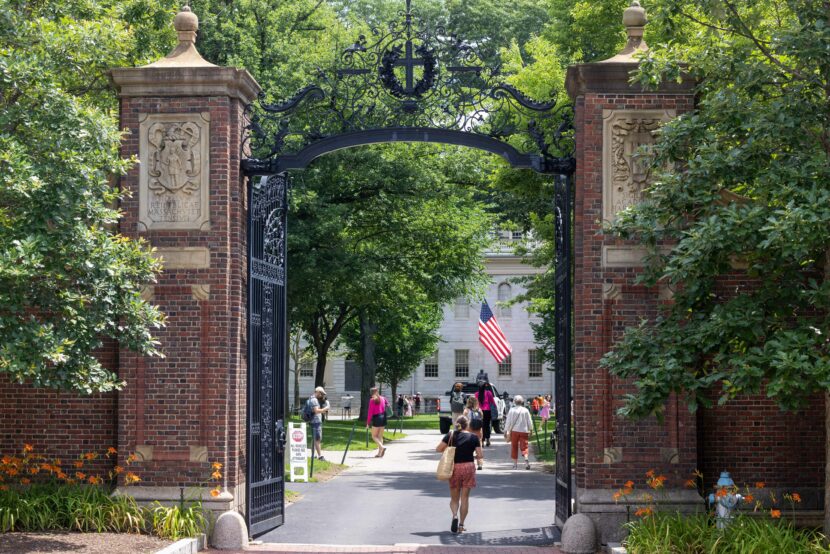
CAMBRIDGE, MASSACHUSETTS – JUNE 29: People walk through the gate on Harvard Yard at the Harvard University campus on June 29, 2023 in Cambridge, Massachusetts. (Scott Eisen/Getty Images)

A few weeks ago, the U.S. Supreme Court ended affirmative action in college admissions. The ruling held that the race-conscious admission programs of Harvard University and the University of North Carolina violated the Equal Protection Clause of the Fourteenth Amendment. It’s now deemed unconstitutional for colleges — both public and private — to weigh race as a factor in who they should admit.

Affirmative action for minority kids may now be dead. But a blockbuster new study, released today, finds that, effectively, affirmative action for rich kids is alive and well. They may or may not always do it on purpose, but a group of the most prestigious private colleges in America are handing a massive admissions advantage to rich kids over less affluent kids — even when they have the same SAT scores and academic qualifications.

The study is by Raj Chetty and David J. Deming, of Harvard University, and John N. Friedman, of Brown University. We at Planet Money have already dubbed Raj Chetty the Beyoncé of Economics because of his long list of popular hits in empirical economics. And, let me tell you, this is another ***Flawless classic in his catalog. I mean, not only is the study eye-opening, but Chetty is also kind of sticking his neck out here, by shining a spotlight on the admission practices of his employer, Harvard. But they can’t fire Beyoncé! (He has tenure).

Among a number of other discoveries, the economists find that kids from the richest 1% of American families are more than twice as likely to attend the nation’s most elite private colleges as kids from middle-class families with similar SAT scores. The silver spoon these wealthy kids are born with can, apparently, be used to catapult them past other equally bright, but less privileged kids into some of America’s best colleges.

Chetty and his colleagues provide compelling evidence that fancy schools are promoting a kind of neo-aristocracy, with admission programs that help to perpetuate a family’s class privilege from one generation to the next. The advantages they grant to rich kids are about more than just legacy admissions, a practice in which elite colleges give preferential treatment to kids of alumni and donors. The economists find that other types of evaluation and recruitment play important roles in giving rich kids a leg up, as well.

Going further, the economists find evidence suggesting that reforms to the admissions policies at these prestigious schools could really make a big difference in the life trajectories of less affluent kids, and make America’s elite less of an exclusive club for people born into privilege.

Silver spoon-fed schools

Chetty, Deming, and Friedman focus their study on what they call the “Ivy-Plus colleges”: the eight Ivy League schools — Harvard, Princeton, Yale, Columbia, Brown, Cornell, Dartmouth, and UPenn — as well as Stanford, MIT, Duke, and the University of Chicago.

Less than half of 1% of Americans go to these prestigious private colleges. “Yet these twelve colleges account for more than 10% of Fortune 500 CEOs, a quarter of U.S. Senators, half of all Rhodes scholars, and three-fourths of Supreme Court justices appointed in the last half-century,” the economists write. These schools, in other words, appear to be an important gateway to the American elite, which makes their admission policies relevant for all of us.

Rich kids obviously have a bunch of advantages that help them bolster their academic credentials — like great private schools, SAT tutors and so on. Indeed, Chetty and his colleagues have already amassed a ton of evidence that the environment — even the zip code — in which kids grow up has a huge impact on their chances of climbing the economic ladder.

But these childhood advantages are not what this study is about. In this study, the economists compare rich kids and their less affluent peers who have achieved roughly equal academic credentials (measured by SAT scores and GPAs). Yet, even then, the rich kids are still way more likely to get into elite colleges. It’s pretty shocking when you consider how much harder it is for a less well-off kid to measure up academically to a rich kid, who, from a young age, has benefited from tremendous resources aimed at bolstering their academic credentials.

[Editor’s note: This is an excerpt of Planet Money’s newsletter. You can sign up here.]

The economists pull together a range of large data sources that enables them to thoroughly analyze the admission decisions of America’s most elite colleges. They got internal admissions data from a bunch of schools, allowing them to see which kids applied and which ones got in. They have SAT and ACT test scores. And, equipped with IRS data, the economists are able to see how rich these kids’ families were when they applied to college, and how much money the kids earned after they graduated. They focus primarily on students admitted between 2010 and 2015, which gives them enough of a postgraduate track record for the researchers to see how they’ve done in their careers.

With this treasure trove of data, the economists then embark on a rigorous analysis. First, they establish the overwhelming reason why rich kids are disproportionately attending these schools: admissions. Yes, they find, their less affluent peers are a bit less likely to apply and enroll, but the main reason for the disparity is colleges are systematically admitting more rich kids than less well-off ones.

As previously mentioned, the economists find that wealthy children, even when they have comparable SAT and ACT scores to less affluent kids, are much more likely to get into these elite schools. A student from the richest 1% of American families (from families earning over $611,000 per year) is twice as likely to attend an elite private college as a middle-class student (from a family earning between $83,000-$116,000 per year) with the same academic credentials. The economists find this disparity can only be found at elite private colleges: they find no such advantage for rich kids at America’s flagship public universities, like UC Berkeley or the University of Michigan.

“I think implicitly what we’re finding in the data is that — whether intentionally or not — we currently have a system that appears to have affirmative action for kids from the richest families, the top 1% in particular, which gives them a substantial leg up in admissions relative to other kids,” Chetty says.

Why rich kids are getting admitted more

The economists find three factors that give rich kids this huge admissions boost. The first is legacy admission programs. They calculate that 46% of their admissions advantage comes from programs that give them preferential admission due to their parents being alumni.

One defense for these legacy kids might be that they’re smart, hard-working, and ambitious, so they’d be able to get into another Ivy-Plus college if they wanted to. But the economists find these same legacy kids see no advantage when they apply to schools their parents did not go to. “So, in other words, that legacy impact is totally non-transferrable across colleges, which strongly suggests that it’s not that these kids are just kind of stronger applicants in general,” Chetty says. “It’s actually about literally being a legacy at this college.”

The second reason that rich kids get an admissions advantage is athletic recruitment. The economists calculate that 24% of the admission boost for students from the richest 1% of families comes from the fact that they excel at some sort of sport. That may be somewhat surprising, because if you watch pro sports, the stars usually don’t come from privileged backgrounds. The economists are unable to do a sport-by-sport analysis, but, Chetty says, it’s likely that kids are finding a recruitment advantage in expensive, elite sports, such as fencing, tennis, rowing or lacrosse. Elite private colleges, after all, are generally not known for their stellar football or basketball teams.

The last reason rich kids are more likely to be admitted is because they tend to have higher non-academic ratings that make their applications pop. Think extracurricular activities, compelling letters of recommendation, and guidance counselors who help them engineer perfect resumes and personal statements. This explains about 30% of their advantage.

Chetty says the rich-kid advantage in non-academic ratings is almost entirely driven by the fact that they are much more likely to attend elite private high schools. “If you’re coming from an elite private school, you tend to have much higher non-academic ratings,” Chetty says. “Now, of course, kids from high-income families are much more likely to attend these schools.”

Why the particular college you go to might matter, after all

So, yeah, rich kids are much more likely to get into fancy colleges than less affluent kids. But does that necessarily mean that it really matters for future outcomes? It’s possible that going to one of these elite schools doesn’t have a large effect on a person’s later career. Indeed, there have been some influential economic studies that suggest that the choice of college by similarly qualified students doesn’t have much of an effect on how much they end up making, on average.

The reason for this, economists have long figured, is that elite colleges are highly selective. The kids they admit are smart, hard-working, highly ambitious — and apparently much more likely to come from rich families — which means they have a solid shot at success, whether they go to a particular school or not. Economists call this “selection bias.” The idea is, basically, schools are just selecting winners — not necessarily making winners. Which is why the causal effect of a particular school on a kid’s outcomes might not actually matter very much.

But that’s not what this new study finds. They find that going to these Ivy-Plus colleges makes kids a lot more likely to become tremendously rich and successful. This is especially the case for less affluent kids. “Attending an Ivy-Plus college instead of the average highly selective public flagship institution increases low-income students’ chances of reaching the top 1% of the earnings distribution by 60%, nearly doubles their chances of attending an elite graduate school, and triples their chances of working at a prestigious firm,” the economists write.

So why are these economists finding that the particular school that kids attend matters a great deal, while previous studies have suggested that it doesn’t? Chetty and his colleagues do a bunch of statistical work backing up and double-checking this finding. For example, they use one technique in which wait-listed kids serve as a kind of quasi-experiment. In some cases these kids are admitted from the waitlist for a somewhat random reason, and other times they are not let in. This enables the researchers to compare outcomes of statistically similar students, some of whom went to Ivy-Plus colleges, some of whom went to flagship public colleges. The economists are now able to see what happened to those students over time.

Chetty says that, consistent with previous findings, the data shows that the particular school these students attend doesn’t matter much when it comes to their average earnings. If a bright kid goes to UC Berkeley instead of Harvard, they’ll still make good money working in tech or law, or whatever. Compared to similar kids who did go to Harvard, their earnings, on average, usually won’t look much different.

However, Chetty says, their data is much richer than previous studies, which relied on small surveys instead of the massive administrative datasets that Chetty, Deming and Friedman use in this study. As a result, the economists are able to zero in and see “upper-tail” outcomes like the likelihood of these kids reaching the top 1% of income earners. Previous studies couldn’t see outcomes in the same detail. And that’s where Chetty and his colleagues are finding significant advantages when kids go to these elite private schools.

“These colleges have a huge causal effect on getting you access to the upper tail — to positions of influence, to becoming a leader,” Chetty says. We’re talking about elite positions like corporate executives, U.S. Senators, top professors, Supreme Court justices. “I think what these colleges do is really open doors for some folks to get to a set of positions that they really would not have had much access to had they not gone.”

As a result, Chetty says, reforming admission practices at these schools could have a meaningful impact on what America’s elite looks like. One potential reform they highlight: just use the same admissions criteria as America’s flagship public universities, where it’s more about raw academic credentials, and wealthy children don’t have the same overt admissions advantage.

Admissions in a world after race-based affirmative action

Mind you, Chetty and his colleagues studied admissions data before the recent Supreme Court decision, when most of these schools had some sort of race-conscious affirmative action program. Even in this world, as Chetty and his colleagues found in a previous study, kids from the richest 1% of American families were 77 times more likely to attend an Ivy League college than those from families in the bottom fifth of the income distribution.

Now, with race-based affirmative action dead, it’s plausible that the underrepresentation of lower and middle-class families at these schools could look even worse in coming years, because race is strongly correlated with income and wealth.

In the wake of the Supreme Court decision, we’ve begun to see a national debate about admissions policies at America’s elite schools. Just days after the ruling, a group of advocacy organizations filed a complaint against Harvard for their legacy admissions policy, arguing that it primarily benefits the kids of wealthy, white families. President Biden criticized legacy admissions and other similar policies that “expand privilege instead of opportunity.” And a wave of universities, including Wesleyan and Carnegie Mellon, have begun ending their legacy admission programs.

But many schools, including the majority of the Ivy-Plus colleges, are still clinging to their legacy admission programs. If their goal is to have their students go on and make a significant impact on society, Chetty and his colleagues find, that doesn’t make a lot of sense. They find that rich kids who are admitted because of their legacy status or their athletic background or their non-academic ratings are actually a bit less likely to see outsized success after graduating, compared to middle- or lower-class kids who don’t have those credentials. The economists find that raw SAT and ACT scores — and, more generally, academic ratings like GPA — are much more predictive of future success than anything else.

Of course, these colleges may still be reluctant to end their programs that give a leg up to the richest kids in America. The colleges assert that legacy programs help build community and school loyalty. Probably more relevant is the importance of legacies to these fancy private colleges’ business models: rich kids are more likely to pay tuition — and their parents are more likely to give donations and pad their endowments.

As for concerns that diversity at these schools is about to plummet because of the end of race-conscious affirmative action, Chetty has some ideas to promote both racial and socioeconomic diversity that may survive judicial scrutiny.

It would be an admission process that would take into account “kids who come from neighborhoods that have particularly low levels of upward mobility and use that as a measure of adversity,” Chetty says. This would not be explicitly focused on race itself, but it would pick up “the adversity in childhood environments that is correlated with race.”

Call it zip code-based affirmative action. After all, if you grow up in a poverty-stricken neighborhood and manage to score a 1500 on the SATs, you’ve jumped over a much higher hurdle than your silver-spoon-fed competition.

Copyright 2023 NPR. To see more, visit https://www.npr.org.

78 pilot whales were slaughtered near a cruise ship carrying marine conservationists in Europe

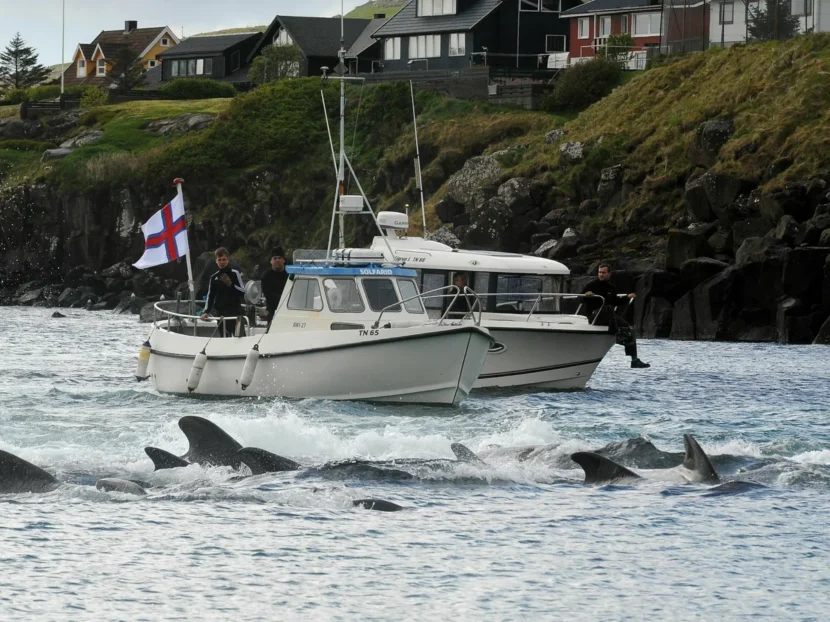
A group of fisherman drive pilot whales towards the shore during a hunt in the Faroe Islands in May 2019.
(Andrija Ilic/AFP via Getty Images)

A cruise line is apologizing to passengers who witnessed the killing of dozens of pilot whales near their docked ship this week in the Faroe Islands.

Passengers aboard the cruise ship Ambition, owned by the U.K.-based Ambassador Cruise Line, had just arrived Sunday in the port of Tórshavn in the Danish territory when they caught the spectacle, part of a long-standing and highly scrutinized local tradition.

Among those passengers were conservationists with ORCA, a marine life advocacy group that seeks to protect whales and dolphins in European waters. Since 2021, Ambassador has paid for ORCA staff to join their cruises in order to educate tourists on marine wildlife and collect data on the animals.

In an account shared by ORCA and confirmed by Ambassador, the conservationists said over 40 small boats and jet skis herded the whales to a beach where 150 people worked to haul the animals ashore with hooks and slaughter them with lances.

In total, the hunt lasted about 20 minutes, ORCA said. Some of the animals, which included nine calves, took over 30 seconds to die.

Ambassador Cruise Line said it was “incredibly disappointed” that the hunt unfolded near the ship and that it continues to “strongly object to this practice.” The company asks their guests not to support the hunters by purchasing local whale and dolphin meat.

“We fully appreciate that witnessing this local event would have been distressing for the majority of guests onboard,” Ambassador said in a statement to NPR. “Accordingly, we would like to sincerely apologise to them for any undue upset.”

A representative for the Faroe Islands government did not immediately respond to NPR’s request for comment on Sunday’s hunt.

Long-finned pilot whales, which are technically a species of dolphin, are a medium-sized marine mammal that dwells in the North Atlantic, known for their bulbous head and sickle-shaped flippers. They’re protected under the Marine Mammal Protection Act, but not currently listed as an endangered species.

The mammals live in social pods of up to 20 individuals, organized into a larger school of hundreds of animals — a social structure that makes them easy targets for whalers, according to the National Oceanic and Atmospheric Administration.

In the Faroe Islands, the hunting of pilot whales is known as the “grindadrap” or “grind.” The Faroese view the tradition as central to their cultural identity and a sustainable way to gather food, according to a local government website.

The government says the killing is not highly commercialized. Each catch is “distributed for free in the local community” but “in some supermarkets and on the dockside, whale meat and blubber is occasionally available for sale.”

Multiple hunts can occur throughout the year, and each is carried out by people with a required license and supervised by elected officials. Local legislation stipulates the killing must be carried out as “quickly and efficiently as possible.”

The government says the average catch is around 800 animals, an insignificant impact on the overall pilot whale population, which it says is around 778,000 animals.

But a record single-day killing of more than 1,400 white-sided dolphins in 2021 brought the practice into intensified scrutiny. The chairman of the Faroese Whalers Association told the BBC that the size of that killing was purely accidental.

That Sunday’s slaughter unfolded near the cruise ship made it seem as if the whalers were “flaunting the hunt and taunting the tourists,” many of whom were hoping to catch a glimpse of marine life in the wild, ORCA CEO Sally Hamilton said.

“It defies belief that the Faroese authorities allowed this activity to take place in clear sight of a cruise ship packed with passengers,” she wrote in a statement shared with NPR. “At some point, the Faroese authorities will have to decide if its marine life is a more attractive tourist proposition when it is alive than when it is being killed.”

The cruise ship was docked for a stop in Tórshavn, the main harbor of the 18-island territory between Iceland and the Shetland Islands. While the local government has invested more into its tourism sector, fishing and marine-related industries still remain the region’s top economic driver.

Site notifications
Update notification options
Subscribe to notifications