Syndicated

Bill would speed Tongass-Mental Health Trust land trade

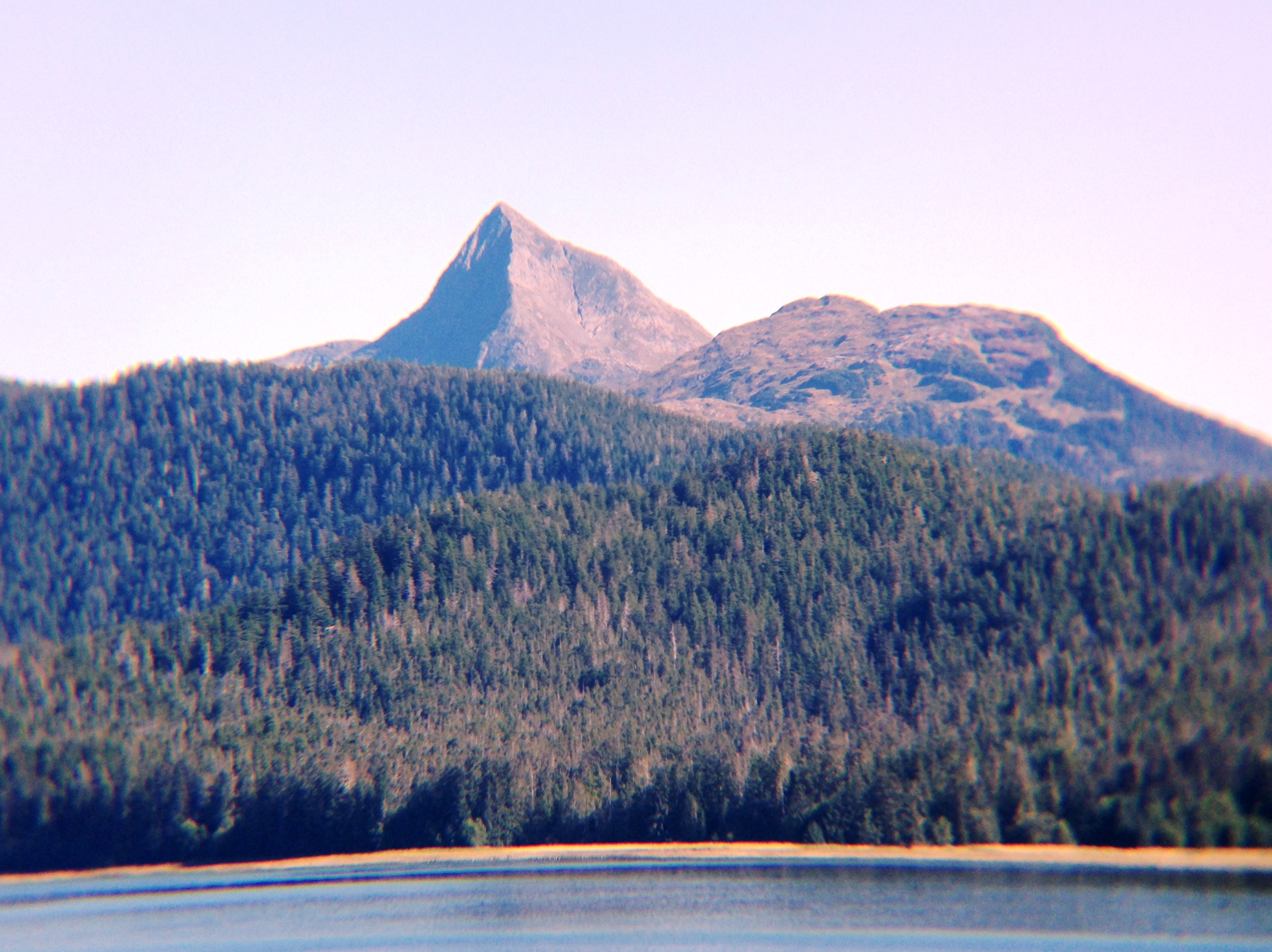
A mountain peak rises above the Tongass National Forest northeast of Sitka Aug. 3, 2016. (Photo by Ed Schoenfeld/CoastAlaska News)

A bill before Congress would speed a timberland trade between the federal government and the Alaska Mental Health Trust. It’s part of a larger legislative effort to increase logging in the Tongass National Forest.

The Alaska Mental Health Trust uses its land to make money to fund programs around the state.

Grants go toward counseling, housing, employment and other assistance to those with mental illnesses, developmental disabilities, chronic substance abuse and dementia.

It owns a million acres, about a quarter of it in Southeast.

Wyn Menefee of the trust lands office said it wants to exchange a little more than 18,000 of those acres that face opposition to development.

“Certain lands that we own next to the communities would be given to the Forest Service. In exchange, the trust [would be] receiving some lands that are more removed from the communities, that would allow development,” he said.

The land is in or near Ketchikan, Juneau, Petersburg, Wrangell, Sitka and Meyers Chuck, on the mainland between Wrangell and Ketchikan.

Southeast Alaska Conservation Council attorney Buck Lindekugel agrees those areas should be closed to logging.

“Some of the parcels that the trust has already received — above Mitkof Highway near Petersburg and Deer Mountain in Ketchikan — are very high-value public-use areas. And there’s been a lot of concern about their development,” he said.

In return, the trust would get about 21,000 acres of timberlands of equal value elsewhere in the Tongass.

Menefee of the trust lands office said the acreage would be near a different part of Ketchikan, and on Prince of Wales Island.
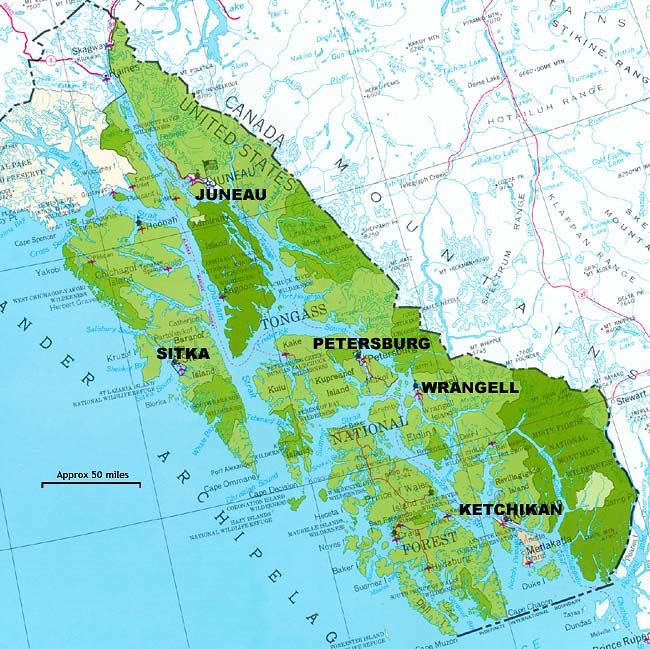
The Tongass National Forest includes most of Southeast Alaska. (Image courtesy U.S. Forest Service).
The Tongass National Forest includes most of Southeast Alaska. (Image courtesy U.S. Forest Service.)

“By making land that we can actually use for timber harvest or for some other purpose available to us where we don’t have conflicts with cutting behind a community or something like that, that does make the asset available or the land available and the resources available for us to use for financial benefit,” he said.

SEACC’s Lindekugel said some listed parcels on or near Prince of Wales should not be part of the trade.

He calls one a wild and scenic river corridor near the El Capitan Lodge, off the northwest part of the island. Another is a cave-rich parcel near the small town of Naukati that includes a cavern that may have cultural value.

But he said he’s optimistic those will be replaced.

“So far the trust has been willing to work with folks to avoid those areas of high conflict and we’re hoping that we’re able to continue and resolve those issues,” he said.

The mental health trust and the Forest Service negotiated the land swap about a year ago. It’s already working its way through the bureaucracy.

The trust’s Menefee said the trade, and subsequent timber sales, would allow more than income for the trust. He said it will provide logs for the region’s mills, which owners say don’t have enough to continue operations much longer.

“In order to make this exchange happen in a reasonable time frame, it needs legislation. Because if you do it through the normal administrative process, it could be seven years or something like that before we get an exchange completed,” he said.

U.S. Sen. Lisa Murkowski filed the Alaska Mental Health Trust Land Exchange Act in late May.

“It was not a question of whether or not the exchange should move forward, but simply to the point of how are we going to assess the value,” she said.

The measure is one of a group of recent Murkowski bills meant to increase Tongass logging.

Another would create five new Alaska Native corporations, each with 23,000 acres of forest land to develop. Other provisions would allow two existing Native corporations to sell or swap property that’s been logged.

Sitka Conservation Society executive director Andrew Thoms said Murkowski’s bills will hurt the Tongass.

“If you look at all these pieces of legislation, there’s a huge potential for a lot of impacts to the remaining forests on Prince of Wales Island. And the potential for a lot of impacts to the high-value, salmon-producing watersheds around the Tongass that are in a state of protection that could be opened up by this legislation,” he said.

He’s particularly concerned about a provision allowing Sitka’s local Native corporation to sell 23,000 acres of land to the Forest Service. It’s in Admiralty Island’s Cube Cove.

“And now, in this situation, the government would buy back the lands that were logged? And Shee Atiká made a profit on them? It’s a strange situation,” he said.

Shee Atiká President, CEO and board chairman Ken Cameron said the Forest Service wants the acreage because it’s an inholding surrounded by a national monument.

“Congress has appropriated $4 million for the first phase of the acquisition, and the appropriation of the rest of the purchase price will be as government funds are available,” said a corporate press release. “The government’s reacquisition of Cube Cove is anticipated to proceed in installments as Congress appropriates funds for the purchase.”

The Forest Service isn’t commenting on the legislation, other than to say it will do Congress’s will.

“The bottom line is our actions will be guided by the legal mandates resulting from legislation,” said Tongass spokesperson Kent Cummins in an email.

SEACC has said proceeds from the sale would allow the corporation to purchase other federal land, possibly on Prince of Wales Island. But Cameron, who would not speak on tape, said its board has not decided what it would do with the proceeds.

The Sealaska regional Native corporation owns subsurface mineral rights at the Cube Cove property. Murkowski’s legislation would swap it for about 14,000 acres of forest on Prince of Wales Island.

“Sealaska identified potential lands to exchange at Lancaster Cove on Prince of Wales Island that are adjacent to other Native-owned lands. Some of these lands were originally considered in the Sealaska land entitlement bill,” said a prepared statement from the corporation.

“It said such a trade remains subject to negotiation with federal agencies.

A bill transferring about 70,000 acres of the Tongass National Forest to Sealaska passed Congress in 2014. It was described as completing the corporation’s land selections, but did not exclude further trades.
Seattle-based company gets permit for senior housing in Juneau

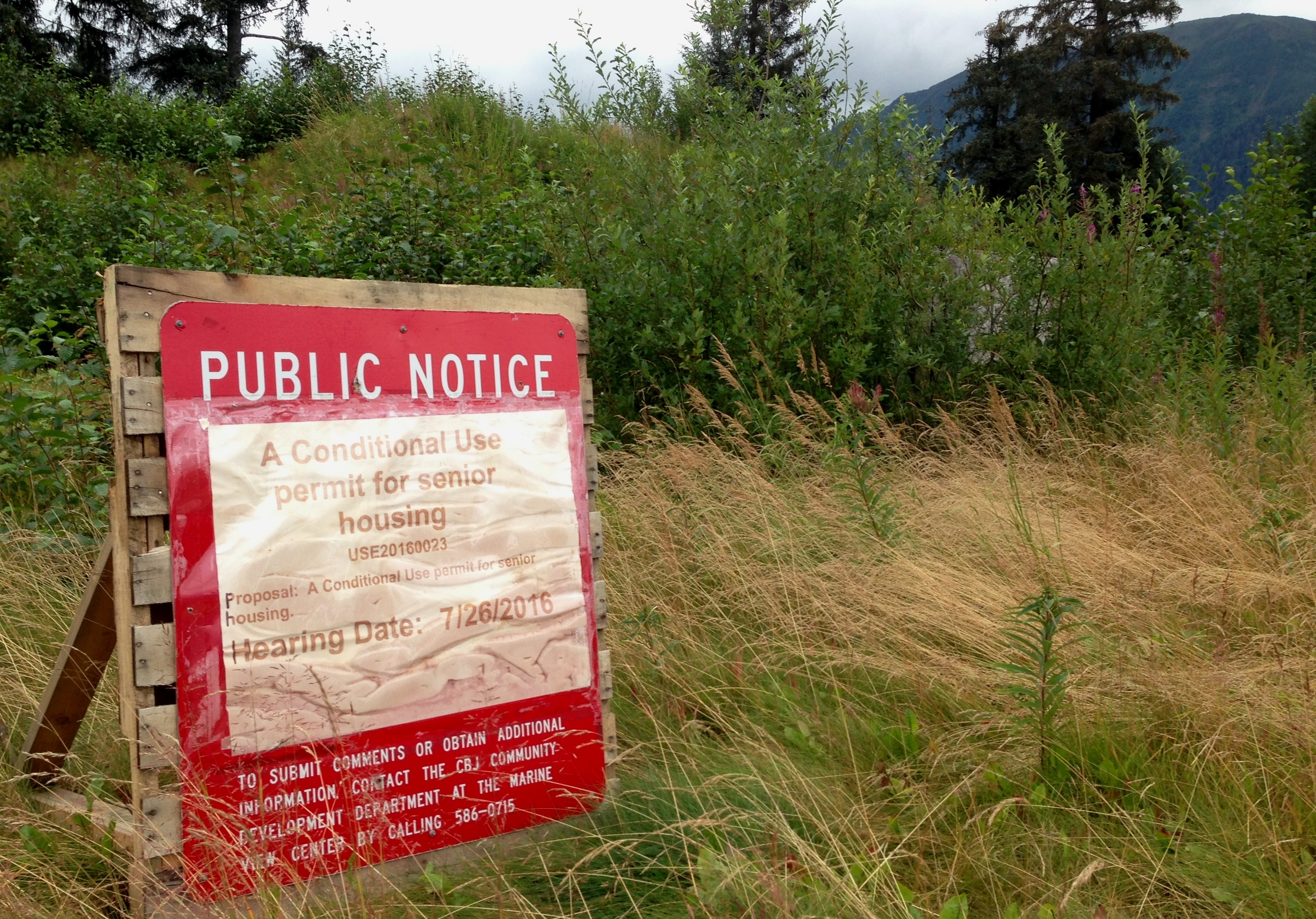
A sign advertising a public meeting marks the location of a planned senior housing building at Vintage Park in the Mendenhall Valley . (Photo by Ed Schoenfeld/CoastAlaska News)

A Seattle-based company is one step closer to building a 49-unit senior housing facility in Juneau. If successful, it would cater to a region’s housing market that’s been historically difficult for everyone, especially Southeast’s aging population.

Earlier this week, the Juneau Planning Commission approved a conditional use permit for GMD Development, LLC. The majority of the beds in the proposed housing unit will be low-income affordable housing.

Assemblyman Loren Jones thinks it’s a positive step for the community.

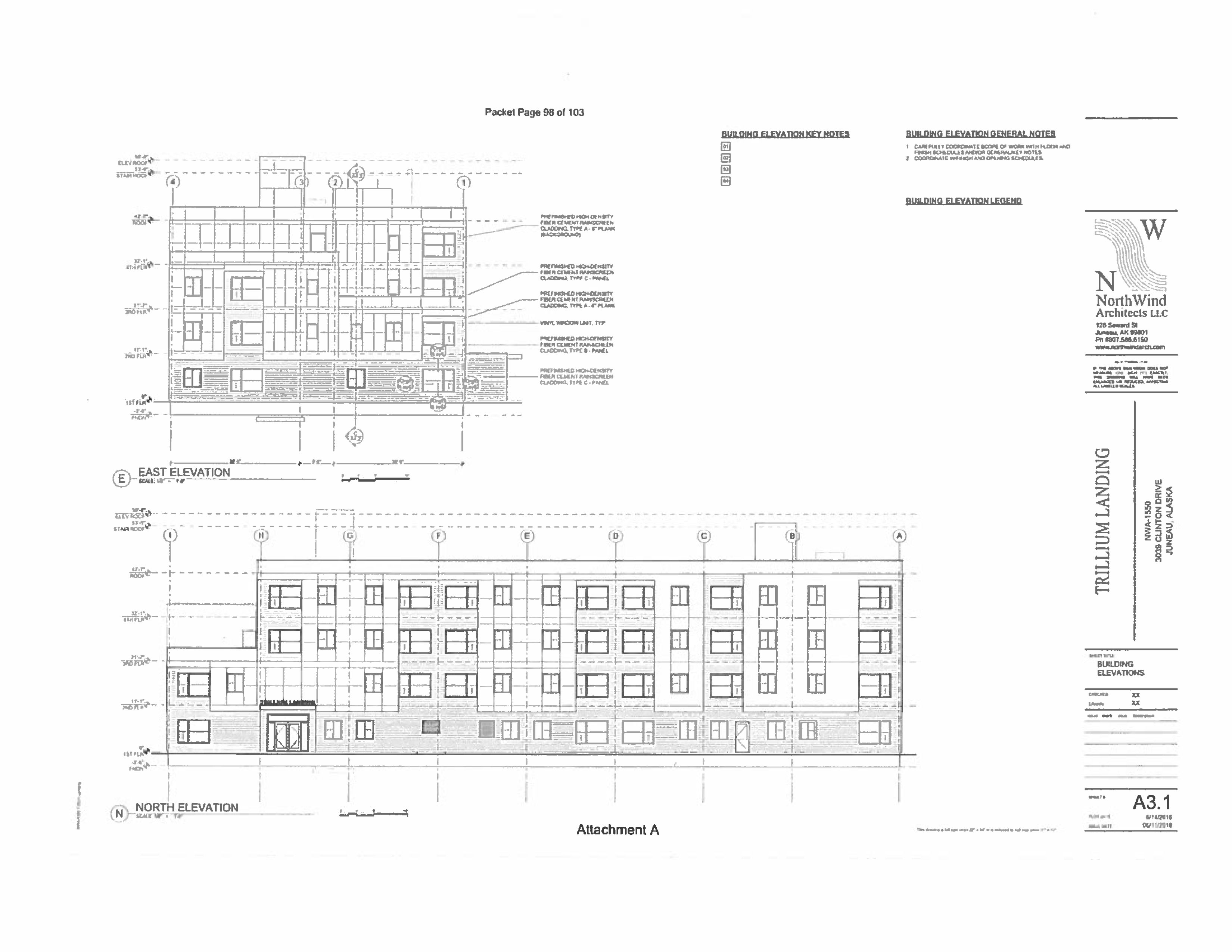
A page from GWD Development's proposal for senior housing, which would include a four-story building with 49 living units. (Image from Regular Commission Meeting Agenda)
A page from GWD Development’s proposal for senior housing, which would include a four-story building with 49 living units. (Image from Regular Commission Meeting Agenda)

“Where it’s at, it’s going to be next to the assisted-living facility,” Jones said, “so there’d be a senior complex there in the valley, and I think it’s very important for Juneau for that to take place.”

The location of the site is off Clinton Drive, near Safeway. The non-profit Senior Citizens Support Services Inc. plans to build a 90-apartment, assisted-living facility in the same area.

Jones said the proposed housing project would help a market that really needs it.

“I have every anticipation there may yet be some construction work this fall, but I would suspect construction would hopefully start next spring,” he said.

Earlier this year, KTOO reported on the shortage of senior housing in for Southeast’s aging community. A 2014 market study estimated that over the next 30 years, Juneau will need more than 300 additional beds to meet demand, given the city’s limited space.

Nearly 400-year-old Shakespeare collection on display in Juneau

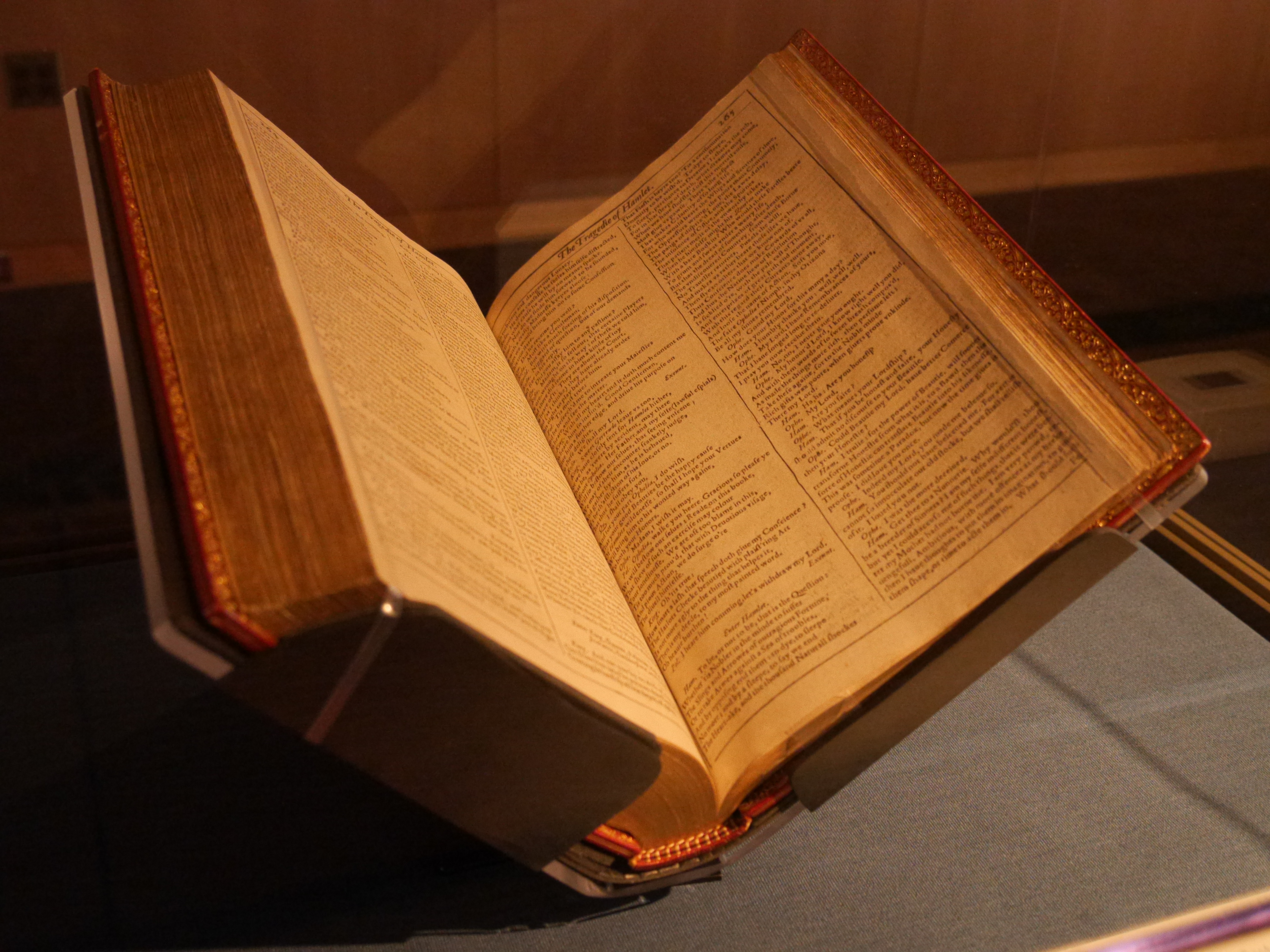
The First Folio sits in a temperature controlled container on display at the Alaska State Library. (Photo by Lakeidra Chavis/KTOO)
The First Folio sits in a temperature-controlled container on display at the Alaska State Library. (Photo by Lakeidra Chavis/KTOO)

A nearly 400-year-old book is on display in the Alaska State Library in Juneau. And it’s not just any old book, it’s the First Folio—the first printed collection of Shakespeare’s plays that brought his work to the world even after his death.

In the backroom of the Rockwell bar downtown, above the music and among glasses of amber ale and wine, a dozen actors are reading “Cymbeline,” one of Shakespeare’s lesser known plays.

There’s an evil queen, forbidden love, epic battles and long-lost relatives. Local Shakespeare company, Theatre in the Rough, is reading all 36 of the bard’s plays within the next month. It’s because the book that brought the world Shakespeare’s work—including this play–is here in Juneau.

The First Folio is a collection of all of Shakespeare’s work. Two of Shakespeare’s buddies created it seven years after he died. The nearly 400-year-old book provides a written record of half of Shakespeare’s plays that would’ve otherwise disappeared–such as “Macbeth” and “The Tempest.”

Freya Anderson is the state librarian who helped get the book here, and a proud Shakespeare geek.

“A lot of what we know today is because of the First Folio,” she said.

Inside Alaska State Library that room that holds the First Folio, a thin veil of light casts on the book, which visitors can view in its glass encasement. For Shakespeare fans, this is their Holy Grail.

“I mentioned before it’s not quite a religious experience,” she said, “but I’d put it in the top three library-related experiences in my life.”

She said the process of getting it to Juneau has been years in the making, and on Tuesday the book went on display.

The library applied for a grant ahead of the First Folio’s visit, before the library even finished construction.

That’s because the First Folio belongs to the Folger Shakespeare Library in Washington, D.C., and the one in Juneau isn’t the only copy. Of the 253 remaining in the world, the library has 82. This year, they’re touring six copies of the First Folio to reach every state and some territories, to celebrate the playwright’s 400th birthday.

Just outside the library, Jim Hale is beginning to prepare for an upcoming lecture on the First Folio. The Shakespeare scholar said seeing the collection is seeing a piece of history.

“Shakespeare’s informed western culture over the last 400 years and this is an artifact of that. It preserves some of our greatest literature, some of our greatest plays,” Hale said. “We wouldn’t have ‘The Tempest’ without this book. I couldn’t imagine a world without ‘The Tempest.’”

The First Folio will be on display until Aug. 24.

For a list of all the Shakespeare events happening in Juneau, visit the state library and museum website.


Stikine sockeye run is the best return in a decade

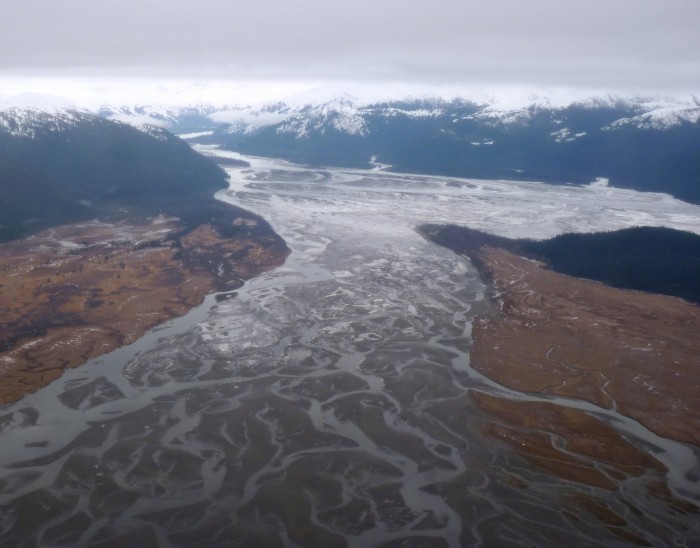
The Stikine River Delta, as seen from the air. The chinook subsistence fishery on the river has been closed. Photo by Ed Schoenfeld, CoastAlaska News.
The Stikine River Delta, as seen from the air. The sockeye fishery on the river is larger than expected this year. (Photo by Ed Schoenfeld/CoastAlaska News)

The sockeye salmon run returning to the Stikine River near Petersburg and Wrangell was predicted to be good, but it’s turning out to be even better than expected.

While the king salmon run for gillnetters turned out to be worse than preseason estimates, the opposite holds true for sockeye. The state-managed sockeye fishery began June 13. Biologists predicted a strong run but were cautious for the first few weeks to let more king salmon into the Stikine River. They limited openings to two days a week and prohibited fishing near the river’s opening.

After most of the Stikine kings passed, managers saw that the sockeye run was coming in strong.

Troy Thynes is the area management biologist with the Alaska Department of Fish and Game, based in Petersburg.

“Sockeyes are looking pretty good this year, at least locally,” Thynes said. “We’re fairly certain that we’re going to exceed preseason expectations. Especially with the Taltan River component of the run that came in really, really strong.”

The state predicted a run size of 223,000 sockeye. That’s well above the 10-year average of 172,000.

“I’m expecting it to be maybe 250,000 or greater,” Thynes said.

That would make it the best sockeye return since the strong runs of 2005-06.

The Tahltan is a tributary of the Stikine River and a major spawning area for sockeye. A weir project at Tahltan Lake counts sockeye coming in and shows numbers now that are way above average.

Managers were expecting at least a good return because of the counting projects at Tahltan Lake. Besides a weir that counts arriving salmon, there is a weir which counts smolt heading out of the lake to become adult fish elsewhere. There is also an enhancement project at the lake where eggs are collected, grown at a nearby hatchery and then released back into the lake as fry.

Thynes said the Tahltan sockeye historically make up close to half of the overall Stikine run.

“And based on our catches this year, both the Canadian catches in river and gillnet catches in District 8, it certainly appears that the Tahltan component of the run is going to be even stronger than what was forecast,” he said.

Because numbers were looking so good this season, managers liberalized commercial openings and allowed for five days of fishing per week. There were as many as 130 boats fishing in Districts 6 and 8, more than in recent years. Their harvests are estimated to be about 120,000.

Stikine sockeye are shared equally between the U.S. and Canada because the river runs through both countries. It’s part of the Pacific Salmon Treaty. Canada has taken about 69,000 sockeye and U.S. fishermen 66,000.

“Very good harvests for both countries,” Thynes said.

“So you’re in constant contact with Canada?” I asked, “so that everybody is kind of getting about the same amount? That’s the goal, 50-50?”

“The goal’s 50-50,” he said. “I mean, the ultimate goal is to ensure that we meet escapement to the river and after that the harvest sharing is 50-50.”

The size of individual sockeye has been about average this year. Gillnetters have been getting about $1.35 a pound from local processors.

Now that it’s the tail end of the sockeye season, local managers will soon be turning their attention to the pink salmon fishery, the largest salmon fishery in Southeast. The Wrangell-Petersburg area will transition towards pink salmon directed management August 1.

Warm ocean water leads to heavy rain in Alaska

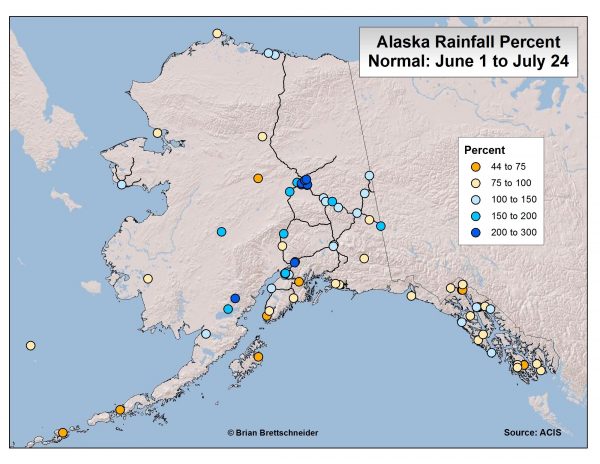
(Graphic courtesy of Brian Brettschneider)

Brian Brettschneider is a climatologist in Anchorage who closely tracks Alaska climate data and trends. Alaska’s Energy Desk is checking in with him regularly as part of a new segment- Ask a Climatologist.

Brettschneider told Energy Desk editor Annie Feidt that some parts of the state, especially near Fairbanks, have had double their normal rainfall since June. That has been good for tamping down wildfires, but it has its own ties to a warmer world.

Interview transcript:

Annie: Why has it been so wet?

Brian: Well, there’s been a couple of reasons. First and foremost, the ocean temperatures around Alaska have been quite warm, near record warm, and those warm waters provide a nearly endless supply of moisture, much more moisture than is typical for the summer. So when we’ve been having rain showers, all that additional moisture is fuel for these storms and it turns a light to moderate storm into a moderate to heavy rain event.

Annie: At least in Southcentral Alaska, in Anchorage, we haven’t thought of this as a rainy summer. What accounts for that?

Brian: Sometimes the perception can be a little bit different than the reality. So here in Anchorage we had a big rain event in June, over an inch in one day. But even if you back that out, it’s been an above normal rainfall summer. So it’s not just the last few days, it’s not just that one storm, there have been a number of events that have contributed rain and those all add up.

Annie: What about Southeast Alaska, are they in the same boat?

Brian: The switch has been flipped a little bit from the first half of the year. The southern Alaska coast and Southeast were quite wet from January though May. But this summer so far, they’re all below normal for precipitation.

Kodiak Island Borough has highest rent in Alaska

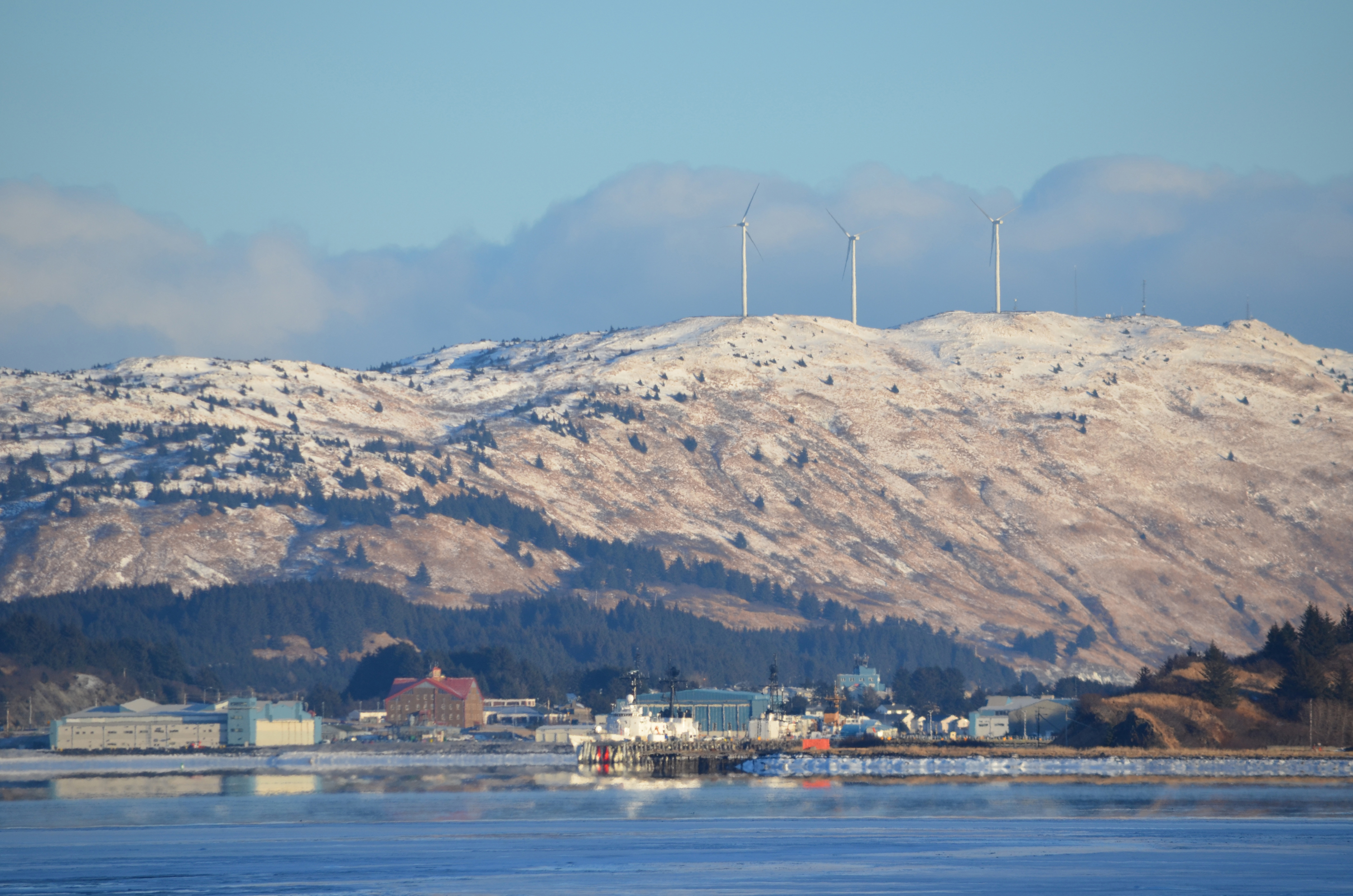
Coast Guard Base Kodiak
Coast Guard Base Kodiak is seen from across Women’s Bay, Dec. 31, 2011. Service members living off base have a housing allowance, which drives up local rental costs.  (Creative Commons photo by James Brooks)

The Kodiak Island Borough has the highest rent in the state. That’s according to a publication from the Alaska Department of Labor & Workforce Development that looks at the cost of living in Alaska and economic trends for July 2016.

Alyssa Rodrigues, an economist with the Alaska Department of Labor and Workforce Development who works in the research and analysis section, said the Coast Guard presence may have an impact on rent in Kodiak.

“If you have a large population of people who are getting a particular allowance, it almost sets a floor. So, if someone, just for example, had a housing allowance of $2,000 a month, then most people wouldn’t want to rent for anything less than that, because they know that they can get that from someone who has that housing allowance,” she said.

She said the availability – or lack of availability – of rooms and apartments can also push up rent.

“So, if you have most of the places that are for rent already occupied, then it’s going to take more for somebody to decide that they want to open up their home or that they want to rent out that particular property, so when you have a low vacancy rate, it kind of boosts up the price as well. It just creates more competition on the demand side,” she said.

And constructing new buildings to provide more housing isn’t always the easiest solution, especially when there’s not a lot of property.

Rodrigues said that’s an area Juneau has struggled with.

“Just because of kind of the land. They have a limited amount of flat land that’s kind of easy to build on, so it’s difficult when you need additional housing to find somewhere to build it without going really far out and then perhaps people don’t really want to live so far away from the main city.”

And it’s not just rent that makes living in Kodiak expensive.

In comparison to Juneau, Fairbanks, and Anchorage, the City of Kodiak tends to be the priciest place to buy groceries. According to the publication, the U.S. average for a half gallon of whole milk is $2.25.

For the same product in Juneau, Fairbanks, and Anchorage, the half-gallon costs anywhere from $2.30 to $2.50, while for Kodiak, it’s roughly $3. Kodiak prices for other common products like bananas, orange juice, beef, and eggs are also higher on average.

Rodrigues said that’s probably in part because importation to rural Alaska is costlier than for bigger cities, like Anchorage, where there are many grocery stores and therefore more competition.

“And we just have big economies of scale, so instead of having small shipments and having to pay maybe a little bit more per pound, say, for things to come, we can load up huge barges and really capitalize on the fact that there’s just so much being shipped to one place and reduce the overall transportation cost of each individual item or per pound. That sort of thing,” she said.

It tends to drive up cost when one business holds a monopoly over a market.

Another standout statistic is that — while doctor and dentist visits are more expensive in Juneau, Fairbanks, and Anchorage than in Kodiak — the cost of veterinary exams are significantly higher.

Anchorage is the second most expensive out of the four at about $62 per visit and it costs an average of $76 per exam for Kodiak. The primary cause may be that Kodiak offers only one veterinary clinic.

In 2015, the Missouri Economic Research and Information Center rated Alaska the fourth most expensive state in the nation.

Site notifications
Update notification options
Subscribe to notifications