Aleutians

Kodiak pedestrian struck by bus, seriously injured

KODIAK — A Kodiak pedestrian was flown to Anchorage in serious condition after he was struck over the weekend by a school bus.

Alaska State Troopers said Jamie Cruz, 21, at about 11 p.m. Saturday was in the middle of Rezanof Drive near Mile 8.

He was struck by a bus driven by Kenneth Cameron, 61, of Kodiak.

Cruz was rushed to Providence Kodiak Island Medical Center and later transported to Anchorage.

The cause of the accident is under investigation.

Kodiak police chief gives statement on discontinuation of body worn cameras

The Kodiak Police Department recently discontinued the use of video cameras attached to officers’ uniforms, and Police Chief Ronda Wallace gave a statement at Thursday’s Kodiak City Council regular meeting regarding the reasons for the change.
She said the KPD began the body camera trial program in 2015.

“Most officers liked wearing the cameras which did two things, gave visual facts as to an incident officers and citizens were involved in and accountability to the officers and citizens alike,” she said. “Officers were genuinely excited to have video recordings that corroborated their written reports in court and strengthened their ability to enforce our laws.”

It also helped her review officers’ interactions with members of the community and identify their strengths and weaknesses, Wallace said.

However, she explained certain challenges arose.

“For example, there were often technical failures or user errors that made it difficult to consistently rely on the equipment,” she said. “The cameras were slow to begin recording from the sleep mode, and although clipped onto an officer, they could easily be knocked off. And when the cameras were on, a button could be inadvertently depressed and turn off the volume and therefore no sound to the video.”

She said officers found the technical issues distracting.

Wallace also noted the potential privacy risks of body cams for the people that officers encounter.

“These individuals could be highly intoxicated, under the influence of controlled substances or otherwise behaving in a manner that’s not normal for them,” Wallace said. “People also contact the police to report extremely private matters that would devastate them if another person could obtain a high definition video of their statement.”

The videos may furthermore record people in the background who are uninvolved in the incident and do not wish to be captured on film, she said.

During citizens’ comments later in the meeting, members of the public had the chance to step up and share their thoughts.

Bonnie McWethy said she’d like the city to consider reinstating the body-cams. She quoted a Huffington Post article about a University of South Florida study which supports the use of body-cams in preventing use-of-force incidents.

“This evidence shows that the accountability of the body cameras keeps civilians and officers safer, and the officers deserve that, the civilians deserve that,” she said. “There are privacy issues, there are a technology issues here, and I think we can find solutions to those. Human safety is the priority here.”

Ginger Duncan also spoke and said she feels that eradicating the cameras would lead to a lack of transparency.

“I believe that, the cameras, we can find different models that work a little better,” she said. “It’s out there. The technology is there. I don’t like people prying into my space, looking at me, but when you’re out in the public, you are presenting yourself to the public and you should behave accordingly, and that goes for the officers too, and I feel like having those cameras in place will keep hold all parties accountable for their behavior.”

The City of Kodiak is currently handling two alleged police misconduct cases, one of which is an ongoing civil lawsuit claiming excessive use of force and involves video footage as evidence.

What killed St. Paul’s woolly mammoths?

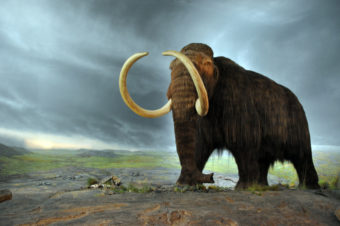
A wooly mammoth on display in the Royal BC Museum. (Photo by FunkMonk/Wikimedia commons)
A woolly mammoth on display in the Royal BC Museum. (Photo by FunkMonk/Wikimedia commons)

What killed the woolly mammoths on St. Paul Island? Thirst. For the first time, scientists have pinpointed the date — 5,600 years ago — and a likely cause of extinction. They believe the environmental changes that killed the animals mirror today’s climate changes.

Six thousand years ago, St. Paul Island looked about the same except for one big difference: There were mammoths. And it’s not like they swam there. Penn State University’s Russell Graham says they walked on the Bering Land Bridge.

“As the glaciers melted, the water in the ocean started to rise,” said Graham. “In this process, a group of mammoths was isolated on the island.”

For a while, it was a good strategy for survival. Without predators, mammoths on St. Paul survived thousands of years longer than many other mammoths around the world. But eventually, they met their end. And Graham and a team of scientists wanted to know exactly when that happened.

“We were able to actually pinpoint when the mammoths actually went extinct,” he said. “It wasn’t like, ‘Well, we think it was this time.’ We actually know!”

Graham’s team analyzed a sediment core from a lake on the island. They examined ancient DNA and three species of fungal spores that grow on the dung of large animals.

Matthew Wooller cores Lake Hill Lake, St. Paul island. (Photo courtesy Jack Williams)
Scientist Matthew Wooller cores Lake Hill Lake on St. Paul Island. (Photo courtesy Jack Williams)

All the evidence pointed to one culprit in the mammoths’ extinction: not enough fresh water. As the sea level rose, St. Paul shrunk. Some lakes were lost to the ocean and a more arid climate caused other freshwater sources to evaporate. As island dwellers, Graham says these mammoths were especially vulnerable.

“A change in the climate of the magnitude that caused this extinction on the mainland probably would have been insignificant,” he said. “But because the animals and plants are restricted to the island — and particularly smaller islands — this little change came together with a whole series of things to create a perfect storm that then caused the extinction.”

In the small world of paleoecology, the findings are a really big deal.

“What is especially powerful about this study is that you have completely independent lines of evidence that back up the same story,” said Jacquelyn Gill of the University of Maine.

As an Ice  Age ecologist, she studies the past to put modern-day environmental problems — like climate change — in context. Since climate change and extinction have happened before, scientists can use what they know about various species responses to help protect today’s biodiversity.

Some might say 6,000 years ago is ancient history. But in geological time, it isn’t. While mammoths roamed St. Paul Island, Gill says ancient Egyptian civilization was well underway.

“When you tell someone, ‘You could have had a mammoth-drawn chariot if things had gone differently,’ I think it makes them think a little bit differently about Ice Age ecology and how relevant this work is to the environmental problems we’re facing right now,” said Gill.

The changing climate that claimed the mammoths of St. Paul has struck again. But this time, it’s human-driven. In June, a small Australian rodent became extinct, driving home Graham’s point that island populations are especially vulnerable.

And Graham says it’s not just the rising sea levels that should concern islands and coastal communities. Take a look at Florida.

“They may be waiting for the water to come up and inundate the peninsula,” Graham said. “But in reality, they maybe should be looking behind themselves because they’re probably going to face other issues — like fresh water availability — before that actually happens.”

The vulnerability of island populations is one lesson from the 72-foot-long sediment core. There could be more. Right now, scientists are hard at work analyzing the rest of it — all 18,000 years.

Driver in fatal Atka crash arrested

ANCHORAGE — A van driver suspected of driving impaired in a crash that killed three on an Aleutian Island is out of a hospital and in state custody.

Alaska State Troopers say Sonny Iloilo, 28, was arrested Wednesday night on a felony warrant.

He is charged with three counts of manslaughter, 12 counts of assault and one count of driving under the influence of alcohol or drugs.

He is jailed in Anchorage.

Iloilo on June 14 drove a van carrying nine passengers in Atka.

Troopers say the van at high speed drifted off a straight stretch of road, overcorrected, rolled and came to rest on its side.

The crash killed 43-year-old McCullough Jr., 51-year-old Mike Tunohun Jr. and 47-year-old Paul Nicholas Nesbit, all of Anchorage.

Kodiak mayor seeks answers to police body-cam policy change

The move by Kodiak Police Department to discontinue the use of video cameras attached to officers’ uniforms was a surprise to Kodiak Mayor Pat Branson and the city council.

The discontinuance of using body cameras was confirmed in an e-mail from Police Chief Ronda Wallace.

“Well, it’s an administrative and police policy,” said Branson, who was out of state last week. “The council doesn’t get into that. And we are being presented with that information.”

When Branson was informed of the change to police procedure, she asked that the chief make a presentation to the city council.

“We will have that information as to why that decision made,” she said, “and then it will be made public, as well.”

The report will be made in open session, and not in a closed, executive session, she said.

Video from an incident with KPD officers nearly one year ago is central to an ongoing civil lawsuit claiming excessive use of force, but the mayor said that denying video evidence in police misconduct cases is definitely not one of the reasons for discontinuing use of the police body cams.

The city of Kodiak is currently defending itself against two alleged police misconduct cases.

Despite Mayor Branson has asked for the report from the police chief, it has not appeared on tonight’s work session agenda or Thursday night’s regular meeting agenda.

Wives of murdered duo files lawsuit against Coast Guard for wrongful death

The widows of the two men murdered by a co-worker at Coast Guard Base Kodiak four years ago have filed a wrongful death lawsuit against the U.S. government.

Nicola Belisle and Debora Hopkins, the wives and executors for their late husbands’ estates, are each seeking more than $1.1 million in damages.

The women are represented by attorney Jill Wittenbrader of Kodiak.

“After reviewing transcripts from the criminal trial, we believe the Unites States Coast Guard should have been aware of the danger that Mr. Wells presented to his coworkers and should have taken steps to protect those working with him,” Wittenbrader said.

Richard Belisle, a retired Coast Guardsman, and James Hopkins, who was active duty Coast Guard, were 51 and 41 years old, respectively, when they were killed by Jim Wells, a co-worker in the rigging shop at the Coast Guard Communications Station on Antone Larson Bay Road, Kodiak, in 2012.

Federal prosecutors claimed Wells, a retired Coast Guardsman, was disgruntled as a civilian employee and killed his co-workers in jealousy and in an attempt to regain his standing in the rigging shop.

In a trio of cases from 1950, the Supreme Court specified that military personnel could not sue for injuries occurring “incident to their service.”

“That’s not true,” Wittenbrader said. “The federal government can be sued under the Federal Tort Claims Act.”

“That act actually outlines an administrative procedure to go through before filing a case in U.S. District Court,” she said. “We’ve proceeded through those administrated claim procedure and this is the next step in pursuing those claims.”

Since Hopkins was killed while on active duty, it could further cloud the wrongful death suit, but Wittenbrader seems confident.

“The government hasn’t brought that up as a defense at this point,” she said. “And I think that if the government’s been negligent and contributed to the cause of someone’s death, certainly they can be held responsible as any other party could be.”

Wells, who was 63 at the time of his sentencing, was found guilty in April 2014 of two counts of first-degree murder and two counts of murder of an officer or employee of the United States, as well as use of a firearm in a crime of violence.

He was sentenced to four consecutive life sentences, which he is serving in a federal prison in the Lower 48.

Site notifications
Update notification options
Subscribe to notifications