The trawler Alaska Juris floats approximately 690 miles west of Dutch Harbor, Alaska, July 26, 2016. See video below. (Photo by U.S. Coast Guard)
Forty-six crewmembers were rescued Tuesday night after their fishing vessel started sinking off the Aleutian Islands. And now, officials are working on a recovery plan for the abandoned trawler.
The Alaska Juris began taking on water Tuesday afternoon near Kiska Island, nearly 700 miles west of Dutch Harbor. Crewmembers donned survival suits, sent a distress signal, and jumped ship for three life rafts.
“These individuals — all 46 people — are actually extremely lucky,” said U.S. Coast Guard Petty Officer Jon-Paul Rios.
He said the agency received the distress call and coordinated the response from Kodiak. Three Good Samaritan vessels joined the rescue effort, along with a Coast Guard cutter, two C-130 airplanes, and two helicopters.
“While they were taking the people off the life rafts and putting them on the Good Samaritan vessels, we also had a total of four aircraft in the air, just making sure nothing went wrong,” he said.
With all crewmembers safe and on their way to Adak, Rios said the Coast Guard is focusing on what to do about the Alaska Juris — still floating in the same area of the Bering Sea.
He said a C-130 search crew will look for the abandoned trawler today and assess the situation.
“They’re going to fly over the vessel’s last known position. They’re going to try to determine if there’s any kind of pollution. And then, also, what the salvage plan would be, if possible,” Rios said.
There’s no word yet on where the ship will be taken, according to officials with the Coast Guard’s Marine Safety Detachment Unit in Dutch Harbor. It’ll depend on whether the vessel can be repaired — and how its owner wants to proceed.
The trawler is owned by The Fishing Company of Alaska. Another FCA ship, the Alaska Ranger, sank in 2008 and killed five people. In a separate incident, the National Transportation Safety Board determined the company failed to maintain a third vessel, the Alaska Spirit, when it caught fire in 1995.
The Coast Guard is now investigating the current incident on the Alaska Juris. Officials say there were calm seas and limited visibility when crewmembers were rescued.
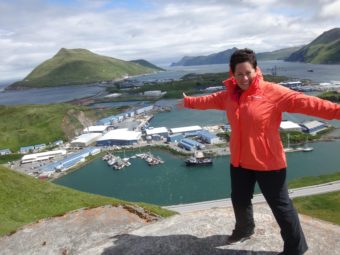
Karen Abel atop Bunker Hill. (Photo courtesy Karen Abel)
For Karen Abel, what started as learning more about her grandfather has grown into sharing the story of World War II’s Aleutian Island campaign. And it’s brought her over 6,000 miles from her home in Florida to see firsthand where he served 74 years ago.
Growing up in Winnipeg, Abel never heard about her grandfather’s service in the Royal Canadian Air Force. She didn’t know about the year — from June of 1942 to June of 1943 — Robert W. Lynch was stationed in the Aleutians as a member of the 111F Squadron.
After the war, his medals were in their living room and his uniform hung in the closet, but it’s just something the family never talked about. When he died, in 1996, she discovered his flight logs and photographs and became inspired to create a blog.
“Once I started to tell his story to other people and talk about the war in Alaska, most people had never heard about what happened here,” Abel said. “And that broke my heart that so many people were up here fighting and so many lives were effected and nobody knew their story.”
The blog grew and she began sharing the stories of other veterans of the Aleutian campaign. As a single mom with her own business, Abel cannot write every day. But, the project has blossomed into a part time job.
“Any spare chance I get I will probably be writing,” Abel said. “I have said that if I could get paid for this I would do this full time. That’s how much I love it.”
For her second trip to Alaska, Karen choose a two-week WWII historical tour through Valor Tours. It brought her from Adak, to Attu and back to Unalaska with stops in Kiska, Umnak and Chernofski.
“It’s like a living museum to go there and to see how things were,” Abel said. “And to see the guns. You get to touch them and feel them and see where they were placed in action. It’s not in a museum. It’s not behind glass. It was exactly as it was then.”
She was the first family member of a veteran to go on the trip.
“A lot of people will know about battles, they knew a lot about guns, strategy maybe,” Abel said. “I’m more interested in the effect war had on people. How people lived. Who was fighting. Who were the ones going in this brutally harsh desolate island and living and fighting.”
And the trip inspires her to keep writing.
“You know that you think this big journey might be the ending. You know, ‘Oh, I reached my goal. Oh, I made it to the Aleutian Islands.’ But for me it doesn’t feel like an ending. It feels like a beginning.”
Abel thinks her grandfather would be proud of her work.
“And he deserves to feel like that,” Abel said. “And they all deserve it. That’s why I write. They all deserve to feel proud and they all deserve to be heard.”
Her next big project is working alongside the Smithsonian Museum — in Washington D.C. — to develop an exhibit that shares the history of the Aleutian campaign. The museum is off to a good start, they already display a plane her grandfather flew.
Scattered across Alaska are 15 radar sites in some of the most remote areas of the state, feeding information to a command center in Anchorage. Keeping them humming 365 days a year are tiny crews of private contractors who live there for months at a time. To a lot of people, the prospect sounds crazy. To others the solitary rhythm makes total sense.
“Ya know, we have celery, and avocados and broccoli, all the normal normals,” said Leta Page. Page is what’s called a “service technician” at the Cape Romonzof Long Range Radar site, an Air Force installation at the edge of the Bering Sea, 15 miles from the nearest village. She’s basically a combination of a cook, quartermaster, and housekeeper.
“I keep my cheeses here,” Page said as she showed me around one of the many freezers. She keeps pounds and pounds of bacon,there, too. “These guys eat a lot of bacon.”
Page and the three other employees that live here work for ARCTEC, a private company that’s held the Air Force contract to maintain these radar sites for the last two decades. Back in the ’50s and ’60s when the installations were manned by hundreds of service members each, it was considered a hardship posting. Depression and pathological boredom were regular. Tours were kept to just one year. Page has been here five.
Leta Page has worked at the Cape Romanzof site for five years. When first hired, contractors rotate from site to site filling in for full-time staff until a permanent position opens up. (Photo by John Norris, Alaska Public Media)
“I’m a piddler,” Page said. “And I find something to do all the time.”
A “piddler,” in Page’s telling, is someone who can just find work that needs to be done. She said it’s common here, that all the technicians are pretty self-directed, and don’t need each other for amusement.
This isn’t her first remote posting. She worked out at Shemya, on the tail of the Aleutian chain, for nine years, but left when her husband got sick. After he passed, she signed on with ARCTEC. Usually she works for two months straight, then takes a month at home in Anchorage, where she’s got a house and can spend uninterrupted time with her grandkids.
“I go pick up my grandbaby at daycare and we go all day long. Now I got two more grandbabies, so I’ll have all three of ’em and we’ll just go, because I don’t have to work.”
On top of the schedule, it’s good money. Generally, technicians make between $120,000 and $150,000 a year, with few expenses while they’re on site. There’s internet, so people can communicate with their families. ARCTEC’s workforce is overseen by Kevin Smiley, who said the company screens job applicants to make sure they’re the type that can handle remote postings.
“We try to work people into it a little bit slower,” Smiley said. “Your first assignment might not be such a long stretch, might be a shorter stretch, kinda send you out, let you experience what’s it’s like before you sign up for that four-month haul in the middle of winter.”
In the winters, contractors spend as many as 14 hours a day keeping roads linking the air strip and radar clear of snow. (Photo by Zachariah Hughes/Alaska Public Media)
The vast majority of site techs are former military, many of whom take advantage of the surrounding wilderness.
“Ya know, one site does a lot of gold mining,” Smiley said. “They find a lot of ways to recreate, whether it’s hunting, fishing, gold mining, trapping. They find a lot of things to keep busy and to do.”
Smiley doesn’t use the word piddler, but this might meet the definition. He shrugged off the suggestion that these jobs are abnormally extreme.
“Would I do it? I – I have – sure I would do it,” Smiley said. “You know, it’s like, eventually someone will come and get you. Ha ha. And there’s food to eat and there’s things to do, so you’ll be OK.”
The Air Force’s remote Romanzof radar site built in the early 1950s used to have a working tram for bringing personnel up and down the steep hills of an inactive volcano. (Photo by Zachariah Hughes/Alaska Public Media)
At Romanzof, Page recalled a period where weather kept out the supply plane for six weeks.
“Yeah, we didn’t have any groceries – anything fresh,” Page said. “So I told the guys if they wanted milk they had to go out to the barn and milk the cow. And if they wanted any eggs they had to go down to the beach and get the seagull eggs down there, that was the closest to eggs they were gettin’ from me.”
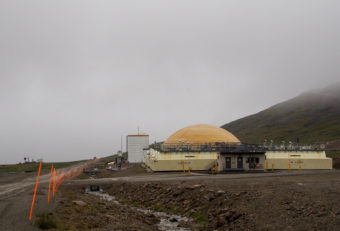
A sign painted on the driveway leading up to the residential dome at the Cape Romanzof site. (Photo by John Norris/Alaska Public Media)
Page kept showing me around the cavernous insulated dome where the contractors live. Past the industrial kitchen is a dining area, and one floor up is a ring of bedrooms.
“Now if you don’t look at the dirt you can look at my room,” Page said.
It looks like a college dorm room that’s been permanently settled, with a TV, comfy chair and an expansive crocheting project tucked neatly in a corner. When Page showed me the supply depot she’s in charge of my jaw dropped. It’s stocked with absolutely every spare provision you could possibly need.
“Well yeah, back in behind here I got blinds for the windows, and there’s some rugs back here – see those black round things? Those are mattresses,” Page said.
I have the sense that Page gets a profound satisfaction from being able to comprehensively care for other people. Years before Romanzof when she lived in Anchorage, she handled the kitchen at a behavioral health clinic for girls.
“Yeah. There was a lot of sad cases,” Page said. “Behavior problems and abuse and everything else. I don’t think a kid should be treated that way, and that was probably the hardest part.”
At the time, her sons were about the same age as the patients. Her house was the gathering spot for a small tribe of teenage boys.
“If I didn’t have one boy I had 10 at my house,” Page said.
When I ask if keeping a home peppered with lost boys is that far off from mothering a bunch of loners at the remote military site, Page said no, not so far off.
“When I first started working remote the station chief told me, ‘Leta, just treat all the guys like they were kids and you’ll be fine, you won’t miss your kids so much then.’ And actually, I still do,” she said.
A sign at radar site. (Photo by Zachariah Hughes/Alaska Public Media)
The Romanzof radar site was built in the early 1950s. (Photo by Zachariah Hughes/Alaska Public Media)
At the height of the Cold War, the military built secretive radar sites all over Alaska. Most of them are still operating, doing essentially the same thing: scanning the sky for anything that’s not supposed to be there, particularly Russian long-range bombers.
But technology and policy have reshaped the sites themselves. Recent equipment upgrades have shrunk the size of electronic packages enabling radar operations, and camps that initially housed hundreds of military personnel now house tiny crews of private contractors. In spite of those changes, the structure of Alaska’s vast air defense system remains essentially the same.
An Air Force airman pilots a C-12 flying from Elmendorf to Cape Romanzof. One of the six passengers was Col. Frank Flores, who oversees the LRR assets in Alaska and the Pacific. (Photo by Zachariah Hughes/Alaska Public Media)
The first barrier getting to one such site was weather. Low gray clouds kept our plane circling in the air, the pilots hoping for an opening after two hours of flying from Anchorage to Cape Romanzof in a small C-12 plane.
The Long Range Radar site looks out over the mouth of the Yukon River, about 15 miles from Hooper Bay.
The site’s radar technician, Max Jones, waited by the airstrip in a pickup truck.
“This is Cape Romanzof weather,” Jones said. “We have a saying here: come because you have to, stay because the weather won’t let you out.”
Jones is one of four contractors who work year round at Romanzof. Technicians like him maintain the equipment and facilities at Alaska’s 15 LRR sites, which means doing everything from electrical engineering to plowing the miles of winding road tying the air-strip to the radar building perched a few thousand feet up.
We drove past the two giant domes that house the crew and their heavy equipment before climbing into fog so dense it hid the truck driving behind us.
Technicians spend as many as 14 hours a day during the winter clearing snow on the roads connecting different installations at the LRR sites. (Photo by Zachariah Hughes/Alaska Public Media)
“This is an old volcano,” Jones said of the steep hill, the sides a few feet away totally obscured. “It’s 3,200 feet straight down right there.”
For the last two years Jones has worked for ARCTEC, the private company that’s held the contract to run the sites since 1994. The Air Force began privatizing site operations in the ’70s.
Jones, who spent 20 years in the Navy, said it’s the best job he’s ever had – largely because of the variety of the work. He stays out around three months, then goes home to Tennessee for a month at a time.
“Being out on a remote site doesn’t bother me,” Jones said, slowing the truck to a halt. “But it’s not for everybody.”
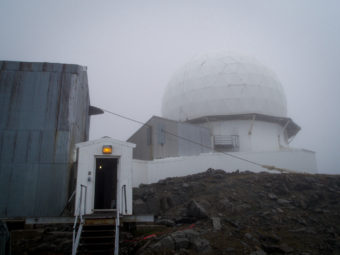
A view of the lower camp from the upper site housing the actual radar facility. Large insulated domes house the small crew and cover the heavy equipment and generators powering the site. (Photo by Zachariah Hughes/Alaska Public Media)
We got out and walked into the most important part of the Romanzof site: a cluster of low-slung structures built into the rocky ridge, a defunct tram system dangling off the edge. Propped atop the metallic rectangles is the giant golf-ball shield that houses the Air Force’s Long Range Radar.
“You’re about to enter a restricted area,” Jones said at the end of a worn wooden hallway, a perfunctory tone flattening what sounded like a familiar speech. “There’s no photography inside the restricted area. And the two civilians: I’ve got to have eye contact with you at all times.”
Inside, it looks like a tidy mechanic’s garage, with blocky metal cabinets, industrial fans, and rectangular monitors. My microphone picks up an eerie hum that makes me wonder about radiation. Jones walked us to a backroom with a glowing map of Alaska showing where the other 14 LRR’s are beaming pulses 250 miles in every direction, probing the sky for abnormalities. Jones hovered near a box called the Radar Signal Data Processor that looks like a dehumidifier.
“Without this the radar can’t do nothing,” he explained. “Everything that the radar creates, transmits, receives, is all fed through this.”
If the processor is like the body of a camera, Jones walked us up a metal staircase to show off the optical lens filtering many rays of light. We craned our necks up to peak at the radar itself from underneath.
“See that white wagon wheel up there?” He asked. “You can actually see the bottom of the radar turning.”
He half-joked that we couldn’t look at it up close while it’s spinning because it would melt our insides.
Jones spent his Naval career working on similar radars, and knows his way around the equipment. But he doesn’t decipher the signals. The whole site – all the machinery, the roads, the dome homes – they’re all in place so that this radar can work like a nerve ending, feeding signals back to a distant brain.
“We detect, identify, track and intercept if necessary, any unidentified traffic within the airspace of Alaska,” said Lt. Col. Carrie Howard of the 176th Air Defense Squadron, part of Alaska’s National Guard.
Howard oversees the large crew at the Regional Air Operations Command, a windowless subterranean facility at Joint-Base Elmendorf-Richardson, 540 miles from Romanzof. It’s filled with glowing computer monitors and looks basically like the war-room in every movie ever made. A piece of equipment gives off a faint green light in the corner, like a Cold War relic. In fact, it was decommissioned in 2006.
An Alaska National Guardsman monitoring radar signals sent to the Regional Air Operations Command in Elmendorf. (Photo by Zachariah Hughes/Alaska Public Media)
“The radars that are around the state, all of those sensors and all of that data feeds into our facility to display on our battle control system,” Howard said. “It shows up as dots on a screen and location, and from there we can determine if they’re actual aircraft or not.”
Most of the time, the colorful clusters of dots speckled across the maps are noise, flocks of birds or reflections off the ice. But the instruments are sensitive enough to tune out signal interference.
When the RAOC finds something that could be a plane, notifications begin working up the chain of command. The Air Force shares information collected from the radars with civilian partners at the Federal Aviation Administration, who can better assess whether it might be a private or commercial aircraft that is off course. If military commanders decide it’s a foreign craft, they may decide to scramble fighter jets.
According to Howard, personnel here detect Russian military aircraft probing international airspace near Alaska around 10 times a year. Though she declined to speculate on what motivates the incursions, Howard pointed out they tend to happen on U.S. national holidays like the Fourth of July. The background on a nearby computer monitor showed an image of an American F-22 escorting a Russian Bear Bomber last July.
“We’re the front lines, I guess you could say, of air defense,” Howard said.
On the wall were hundreds of red stars for each time such an escort has happened since the radar system was built in the early ’50s.
Lt. Col. Carrie Howard stands in front of intercept stars at the Elmendorf Regional Air Operating Command. (Photo by Zachariah Hughes/Alaska Public Media)
The information gathered at the RAOC also feeds into the headquarters of the North American Aerospace Defense Command in Colorado, which aggregates similar data from around the continent.
Back at Romanzof, Max Jones explained that the whole expansive apparatus of the LRR defense system — the personnel, equipment, the constant pulse of signals through the air — depends on the radars quietly spinning atop mountains and old volcanoes.
“That’s the mission. Everybody else out here, the plane that you came in on, it’s mission is to support that radar, the thing that goes around above your head.”
A minor ash emission from Pavlof Volcano viewed from Cold Bay at 7:50 p.m. on May 14, 2016. (Photo courtesy Royce Snapp)
The Alaska Volcano Observatory is again raising the threat level for a remote volcano near the Aleutian Islands.
The observatory said seismicity at Pavlof Volcano increased Thursday.
Web camera images Friday showed minor steam emissions.
That observatory raised the aviation advisory color code from green to yellow, one step above normal volcanic activity.
Pavlof is about 625 miles southwest of Anchorage. On March 27, the volcano sent an ash cloud to 37,000 feet, which led to canceled flights in interior and northern Alaska.
The observatory said pauses in activity lasting for weeks to months have occurred during past eruptive episodes.
Pavlof erupted intermittently for more than two years from April 1986 to August 1988.
The volcano has erupted more than 40 times since record-keeping began in the late 1700s.
From the top of Mt. Newhall in Unalaska. (Creative Commons photo by Tom Doyle)
The City of Unalaska is looking to welcome larger vessels and ensure smoother passage for ships already cruising through. At a meeting Tuesday night, the City Council approved an agreement with the U.S. Army Corps of Engineers (USACE) to dredge the entrance channel of Unalaska Bay.
Mayor Shirley Marquardt said that’ll stop the recurring problem of ships scraping against a sandbar or being blocked entirely. In the past, she said two distressed vessels have been unable to dock because of the bar.
The project will begin with a study to determine the feasibility of dredging. City Manager Dave Martinson said it’ll take USACE about two years to study the potential effects to Front Beach and the surrounding area. The city will pay for half of the study at $1.5 million.
Councilor Frank Kelty said he’s glad the project is moving forward, but he’s concerned about the long timeline — and the ships that may get turned away in the meantime.
“The study takes two years or three years. It could be another five years after that before we get construction started,” said Kelty. “I’d hope it wouldn’t be that long, but I guess we’ll have to see about funding levels.”
If the study supports dredging, the City of Unalaska would only be on the hook for 10 percent of the cost — about $1 million. USACE would cover the remaining $10 to 13 million.
Meanwhile, the vessel that’ll bring high-speed internet to western Alaska is set to pass through Unalaska next month. The telecom company Quintillion is laying fiber optic cable from Barrow to Nome this summer, and Marquardt said the primary ship is using Dutch Harbor as its kickoff point.
The vessel is due to arrive July 19, but Quintillion hasn’t made plans to bring fiber to Unalaska. At least, not yet.
“Phase one is finished. It’s done. But in phase two, there’s a possibility,” said Marquardt. “Mr. Martinson continues to work diligently with the folks there to see how we can become part of phase two.”
Martinson has also negotiated new union contracts for city workers. On Tuesday night, the City Council approved the three-year contract with the International Union of Operating Engineers, Local 302.
The City Council will hold its next meeting July 12.
Close
Update notification options
Subscribe to notifications
Subscribe
Get notifications about news related to the topics you care about. You can unsubscribe anytime.