Aleutians

Predictions of a megaquake rocking the Aleutians

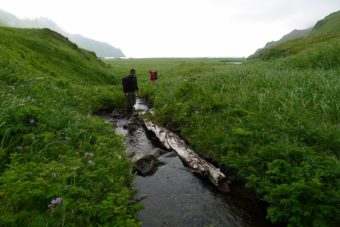
Geologists on Sedanka Island examine drift logs carried more than a half mile from shore by a 1957 tsunami. This information helps researchers estimate the minimum run-up of tsunami waves. (Photo by Robert Witter)

In the next 50 years, there’s a 9 percent chance of an Aleutian Islands earthquake so strong it could send a devastating tsunami to Hawaii. That’s according to researchers from the University of Hawaii at Manoa.
A magnitude 9.0 or greater earthquake is what researchers are referring to. But what does a megaquake look like? Think big – like Tohoku the 2011 Japan earthquake and tsunami.

Geologist Rob Witter works for the United States Geological Survey. His work looks at the frequency of past giant earthquakes in the Aleutians — especially large quakes that might cause tsunamis.

“If there were to be another really, really giant earthquake in the Aleutians it would have the potential to generate a tsunami like what we’ve seen,” Witter said.

This research can be used for national seismic hazard maps as well as to create tsunami evacuation plans.

While Witter studies what happened in the ancient past, University of Hawaii at Manoa geophysicist Rhett Butler looks to the future. He works on estimating the probabilities of future earthquakes.

While watching a video of Tohoku, Butler began wondering if Hawaii had its estimates right.

“We’re surrounded by the ocean here,” Butler said. “So when we’re hit by a very large tsunami wave it affects all sides of the island. If you’re in California you just walk 10 km islands and gee you hardly notice anything other than it’s a general panic. Here in the islands all of our roads are along the seashore. We have lots of hospitals. We have airports. It would be an absolute infrastructure disaster.”

An infrastructure disaster that the state of Hawaii multi-hazard mitigation plan estimates could cost about $40 billion.

Here in Unalaska if you feel the ground move, Witter said to be prepared to move.

“If you feel strong shaking for 30 seconds of more – you should get to high ground quickly,” Witter said. “If you’re in the maritime community or trade you have to get to deep water fast as well because even in the protected waters of the harbors strong currents can occur and those can cause damage to ports and harbor facilities.”

Butler’s research does not guarantee a megaquake. The pressure in the Aleutian subduction zone could be released by a series of smaller earthquakes.

And Butler said he’s not trying to scare anyone.

“You like the place you live it comes with risks,” Butler said. “It’s good to be aware of the risks. It doesn’t mean it’s going to happen in your time. The Japanese didn’t think it would happen in their time, so they were surprised.”

He wants to provide data, so everyone can make informed decisions.

Oregon man fined for driving into eagles

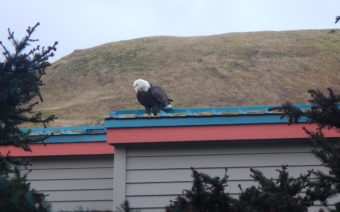
bald eagle in Unalaska
A bald eagle on the roof of Unalaska’s recreation center. (Photo by John Ryan/KUCB)

An Oregon man who killed two eagles after deliberately driving his truck through a convocation of them last summer was sentenced this month by an Unalaska judge.

Alaska wildlife troopers issued 29-year-old Dennis C. Thompson a citation last June after a hit and run investigation. The charge was illegal taking of game.

According to a June 2015 state trooper dispatch, Thompson was accused of “using a motorized vehicle to harass and/or molest game by accelerating a Ford truck through several bald eagles that were feeding on the roadway.” The incident happened on Summer Bay Road near the Unalaska landfill.

Bald eagles are protected under federal law. Unalaska Deputy Police Chief Jennifer Shockley said in Unalaska, it’s common for residents to have run-ins with the birds.

“We do have a number of incidents every year, people report that eagles have struck their vehicle while they are driving down the road, totally unintentionally,” Shockley said. “So it’s not that eagles being hit by cars is particularly unusual, but the intentional part of it is what sets this apart.”

Last week, Thompson pleaded guilty at the Unalaska District Court. He was fined $1,000, half of which was suspended, and he was placed on probation for a year. The judge also ordered him to pay $3,400 in restitution to the Bird Treatment and Learning Center in Anchorage.

13 rural communities awarded federal assistance for energy sustainability

Shishmaref, Alaska is one of the 13 communities chosen to receive assistance implementing sustainable energy projects. (Photo by Maddie Winchester/KNOM)

From the Aleutian island of Akutan to the arctic village of Kiana, 13 communities have been crowned champions of a rural energy competition. The U.S. Department of Energy recently announced that it will help these communities cut their energy use by 15 percent by training local utility providers.
In an effort to spur sustainable energy projects in rural Alaska, the Department of Energy teamed up with the Alaska Energy Authority to organize the RACEE competition.

RACEE stands for the Remote Alaska Communities Energy Efficiency Competition.

Emily Ford works with the Alaska Energy Authority. “It’s an initiative from the Department of Energy to increase energy efficiency in Alaska’s remote communities,” Ford explained.

In total, 64 rural communities applied. Each one pledged to reduce its energy consumption by 15 percent.

Phil Koontz is from the Yukon River village of Galena, one of the 13 winners.

“I’ve been involved in a biomass project to replace diesel-fired boilers with wood chip boilers for the Galena Interior Learning Academy, which is a boarding school in Galena that supports over 200 students,” Koontz explained.

Koontz started working on the biomass project a few years back. Construction will start this summer, and Koontz hopes to fire up the wood chip boilers this fall. While he wasn’t part of Galena’s RACEE application, Koontz said his community is fully committed to becoming more sustainable.

“Fifteen percent energy reduction is just a short-term goal, and I’m hoping for much more than that,” explained Koontz.

Ed Sharten is from Ruby, another Yukon River community and among the 13 RACEE winners. Like Galena, Sharten says Ruby has been working on sustainable energy projects for a while now. There are solar panels on the laundromat and clinic, both of which are connected to the powerhouse by a waste heat transfer system. Sharten said Ruby has even dabbled in underwater turbines.

“Which did work,” Sharten explained, “but we did have some technical difficulties with brush, etc., getting in the turbine.”

Those technical difficulties are exactly what the Department of Energy and the Alaska Energy Authority are hoping to help with. The Department of Energy’s Pam Mendelson said by training local providers to assemble things like solar panels and biomass boilers, communities can tackle some bigger issues.

“What we really want to do is assist remote communities dealing with the impacts of climate change,” explained Mendelson.

Mendelson said the idea for the RACEE competition came from the commander in chief himself.

“When President Obama came up here last fall, he made that commitment on behalf of the administration, and this competition is a direct product of that commitment,” explained Mendelson.

Mendelson says local providers from the 13 communities will receive technical assistance on the projects of their choice. The winners are also eligible to apply for implementation grants, three to five of which Mendelson expects to hand out later this year.

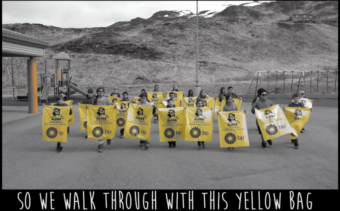
Video: To recruit for cleanup, Unalaska kids rap, dance to ‘Paper Planes’

In a new public service spot out of Unalaska, fourth graders from Eagle’s View Elementary School sing and dance to the tune of rapper M.I.A’s “Paper Planes.” Unlike M.I.A., whose lyrics are about immigrant stereotypes, drugs and violence, the fourth graders are recruiting for a community cleanup.

“We walk through the town and we comb the beach/
We see plastic bags and Comet with bleach/
Trash around town can be such a drag/
So we walk through with this yellow bag.”

The iconic gun shots and ka-chings in the original song’s chorus are replaced with well-punctuated sounds of industrial strength garbage bags being whipped open. The onomatopoeia is rounded out with trash being crushed and dunked into bags.

Chrissy Roes of KUCB’s Channel 8 worked closely with fourth grade teacher Mary Heimes to create the music video PSA.

The Unalaska Community Center organizes two weeks of intensive spring cleanup each year to deal with a winter’s worth of stormy weather that dumps trash on the beaches and along the roads.

This year’s cleanup runs from May 1 through May 15. As part of the cleanup, the center has even stashed 12 prize tickets around town that can be redeemed for a prize.

KUCB’s Lauren Adams contributed to this report.

How do you document changing coasts? Shoot thousands of photos and stitch

The ShoreZone flight crew (Photo courtesy of Pipa Escanlante)
The ShoreZone flight crew. (Photo courtesy Pipa Escanlante)

How many photos do you figure you shoot out the window when you take a trip? Five? Ten? Twenty? How many of you take a picture every three seconds?

I caught up with a helicopter crew of modern mapmakers who shoot 3,000 to 5,000 photos a day.

Imagine looking out a helicopter window taking pictures as you’re traveling 60 mph and you’re only 300 feet over the Eastern Aleutian Islands.

That’s a typical day for the four-person ShoreZone flight crew. But why spend so much time when there are satellites?

“People have said, ‘Well, why don’t you just use satellite imagery so you can get one picture of everything?’ But of course the satellite picture is also limited in resolution,” said oceanographer Carl Schoch. “If we’re trying to resolve objects on shore that are on the scale of centimeters. That’s actually very hard to do unless you get this kind of imagery.”

Schoch added that there actually are no maps like this.

“There are lots of other coastal maps out there — navigation charts, topographic maps — there are even other maps of shoreline habitats but none that matches the imagery up with the map,” Schoch said.

The team can map the shoreline biology because the photographs are shot at an angle, which makes it easier to see cliffs and overhanging vegetation.

Over a week, they are documenting more than 1,300 miles of shoreline through video and still imagery. But there is a short window each year for photographing the shore. It can only be done during extreme low tides in the spring and summer when the intertidal flora is blooming.

To get everything done, the team is on a tight schedule with every five minutes mapped out. Any delay can ruin the entire day.

“All it takes is one flat tire or if anything was to happen here and all of a sudden the whole day is shot. We couldn’t go out,” said Schoch. “That one event would just destroy the whole project. We don’t have an extra day at the end of the tide to make it up. Coming back for 400 kilometers of shoreline isn’t worth it.”

Back in the lab in Victoria, British Columbia, the thousands of still images are stitched together using a technique called structure form motion. Every single pixel gets a latitude, longitude and elevation creating a 3-D model of the shoreline. And that step takes a long time. It will be at least six months before this project is completed.

Online everyone can access ShoreZone’s maps and video. When the program began in the 1980s, it was intended for oil spill responses. But over the years that has changed. Schoch said people can use the data in many ways.

“From beach walkers to people who are planning for making development plans on the coast or very large ecological questions that have to do with the entire gulf of Alaska, this project has relevance to all of them,” Schoch said.

In the winter months, Archaeologist Martin Stanford scrolls through the still photographs and video. The photos help him plan summer trips to explore old village sites where he can document stonefish traps and canoe ramps built nearly 600 years ago.

This trip to the Eastern Aleutians is part of a larger project mapping the entire coast of the Pacific Northwest. Alaska is 90 percent done while the coasts of Washington, Oregon and British Columbia are completed.

Certain areas of Alaska’s coast have been mapped more than once. With the ShoreZone project nearly finished, Schoch thinks people will be interested in seeing how fast their shoreline is changing.

“Now that we are thinking about remapping this becomes relevant because we can compare old 3D models to new 3D models and we can measure the change on a shoreline due to wave erosion or sea level rise,” said Schoch.

Full disclosure: The Nature Conservancy has contracted KTOO’s television production team to produce a documentary on the ShoreZone project. 

Committee to work out differences on bill drawing from rural power fund

The state House and Senate are trying to work out their differences over a bill that would draw money from the Power Cost Equalization Endowment Fund.

The $900 million fund subsidizes the high cost of electricity in rural areas. Because the state government has a $4 billion deficit, some lawmakers have suggested drawing money from the fund to pay for other state costs.

Sen. Lyman Hoffman, D-Bethel, speaks in support of Senate Bill 196 on April 13 in this screenshot from the Gavel archive.

Bethel Democratic Sen. Lyman Hoffman crafted a bill that would limit the draw from the PCE fund to years when the fund earnings are more than what’s needed for the power cost equalization program. This program costs about $40 million per year.

The Senate unanimously passed the measure, Senate Bill 196.

But the House made changes to the bill. These changes made it less likely that excess fund earnings would be redirected back into the fund.

Those changes concern Hoffman. When it was time for the Senate to decide Wednesday whether it would agree with the House’s changes, Hoffman spoke up.

“They changed the formula on how the excessive earnings will be distributed,” Hoffman said. “And I believe that that formula will potentially put the fund in jeopardy and want to go back and revisit the differences between what the Senate has done, which is a more sound approach to the fund.”

As a result, there will be a conference committee to rewrite the bill so that both houses can agree to it.

Hoffman will be the Senate chairman of the committee, which will also have Eagle River Republican Sen. Anna MacKinnon and Fairbanks Republican Sen. Click Bishop. The House members will be chairman Dillingham Democrat Bryce Edgmon, Eagle River Republican Dan Saddler and Fairbanks Democrat Scott Kawasaki.

The Legislature formed the conference committee on what was an otherwise quiet day in the Capitol.

Site notifications
Update notification options
Subscribe to notifications